Slashdot Mirror
Domain: geohive.com
Stories and comments across the archive that link to geohive.com.
Comments · 32
-
Re:Bad arguments
Elsewhere, you've pointed out that it requires the labor of approximately 1% of the population to feed the rest
My argument has been incomplete: Farmers target a 20% profit margin, but often get 10%; at 2% of our working hours as farm labor, a 20% profit margin would mean food costs 2.4% of our income, yet it costs 11%. This is because land and capital are moderators and modulators of human labor; capital, in particular, is machines and knowledge, and that takes human labor time to produce (building, maintaining, fueling the machines; teaching the knowledge--much less labor involved).
Food gets to us by way of fuel, machines, fertilizer, pesticides, irrigation, logistics (planning, warehousing, and shipping), and retail. Technical progress reduces the direct labor (farmers) in favor of (less) indirect labor (oil drillers, machinists, steel miners, chemists), giving a reduction of total labor and, often, of land requirements (intensive farming: Grow more stuff closer together; use less fertile land, use less pesticides, lose less fertilizer to run-off, lose less irrigation to evaporation, cover less land planting and harvesting).
It takes considerably more than 2% of our population to feed us all; it takes considerably less than 50% or 90%.
We are rapidly approaching the point where it requires zero human labor to feed the entire population.
As rapidly as ever. We're approaching the point where a guy on a farm outsources his labor to people who never come within thousands of miles of his farm because the machines are all made in China, the steel is mined in Sweden, and the fuel oil is all refined in Alaska. At that point, I'm sure someone will point and say, "Look! Farms are 100% automated, and the growth of food involves zero human labor!" while it requires the equivalent of 9% of our population to grow food.
Your interlocutor has been trying to point out a new fact. Regardless of ongoing technological development, population is plateauing across the developed world. In Japan, the US, Canada, and most of Western Europe, native population growth is, in fact, a negative number. There is no growth.
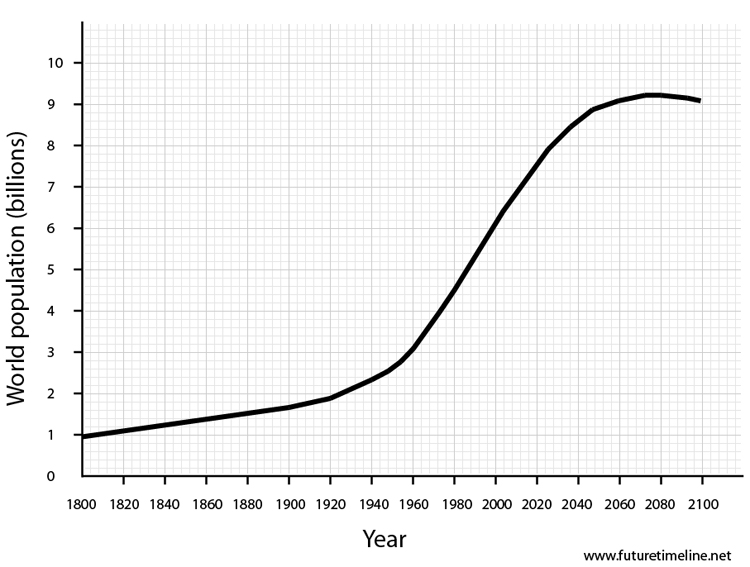
There are a lot of graphs speculating a decline in population in the future. This is patently silly--why would it decline? Only due to failing resources--new scarcity leading to mass-starvation and poverty. As people declare we will soon be free of oil and moving onto renewable energy in abundance, they also declare that we will run out of the capacity to support ourselves--which can only be energy--and lose population.
Nobody is actually proposing we will move onto renewable energy, leave oil behind, find renewable energy just isn't enough, and sacrifice wealth and population to adjust; they *are* proposing we have an environmental responsibility to cull population regardless of our capacity for growth.
Measurements of the world population history are strange. 6.916 billion in 2010; 6.997Bn in 2011; 7.080Bn in 2012; 7.162 in 2013; 7.243 in 2014; 7.324Bn in 2015. This doesn't seem to project well with a plateau, although we are in a considerable dip. A technology paradigm has leveled off; the world population had a considerable drop in growth around 1905, as well, and we have thousands of times the number of people today.
It seems history is no longer an adequate guide to economic and population expectations.
Look at the context we're in. The explosive growth of the mid-1900s tapered off in the 70s. The height of technological growth in the 90s nudged us back up, then back down as the recessions came. The dot-com bust, the hybrid car failure (in 2002-2003 when oil became expensive, everyone made tons of hybrids, oil suddenly got cheap, and people bought SUVs in
-
Re:The nature of any polygamous religion
Except that there's about 1.3 billion Chinese and only about 142 million Russians.
quick google search yields:
China:
total: 1,341,335,152
men: 696,340,752
women: 644,994,400
ratio: 108
difference: 51,346,352 unattached males
Russian Federation:
total: 142,958,164
men: 66,134,540
women: 76,823,624
ratio: 86
difference: 10,689,084 unattached females
It's like US politicians puffing out their chests and bragging about cutting the deficit by a couple billion dollars when we're over seventeen trillion dollars in debt and still growing by almost a trillion dollars per year.
Keep that in mind during this election cycle, please, so that we don't wind up like Greece. -
Re:Something here not right
Also, does the ratio of women employed in IT reflect the ratio of women in the sample population? Why on earth would you expect a 50/50 work force in IT, if the population (for sake of argument) is 35/65?
There's more women in the general population than men:
http://www.geohive.com/earth/pop_gender.aspx
but
http://www.census.gov/prod/2005pubs/censr-20.pdf
shows that there's more men at younger ages, such as the ages of college-bound young adults.However, women are now the majority of people going into college in America. They simply aren't going into IT or engineering fields.
If you could get past all the walls and filters and barriers that inhibit clear communication, how does the percentage of women who want to go into IT compare to the percentage of women who ARE in IT?
What I'd like to see is some surveys of women in IT measuring their satisfaction with the career, surveys to determine how many women have left IT, and surveys to see if women who are/were in IT encourage or discourage other women to go into that field. Perhaps you'll find that they've been warning each other away from it. Even among men, I've heard of lots of older men warning their sons to stay away from engineering as a career.
-
Re:References?
None of this is particularly new information. It's more of an accumulation of knowledge that's been out for a while. For those of you who want evidence, either wait for the book to come out or do an internet search for the original studies.
That said, the claim that polygamy is only part of the problem of male/female in imbalance in Muslim countries:
Bahrain - 134 males/100 females
Kuwait - 150 males/100 females
Oman - 126 males/100 females
Qatar - 203 males/100 females
Saudi Arabia - 122 males/100 females
United Arab Emirates - 210 males/100 females
Honor killings, condoned by Islam or not, is certainly performed in Muslim countries. It is not included in this article, but the killing of females certainly could further skew these numbers. -
Re:India is Unique: India is not a Western nation.
The Indians, like the Chinese, enjoy suppressing human rights -- including the rights to privacy. By contrast, the Poles embrace human rights.
...just a thought, but how do you propose to control a combined 2.4 BILLION people? Considering the sheer amount of HUMAN'S, I find it implausible to expect that EVERY ONE of them can be fully represented. This isn't to say that they don't DESERVE rights, just that with THAT many people, you have to balance security and freedoms VERY carefully, generally tipping towards the former. -
Re:The Days of 100% Efficiency Solar Panels...
A lot. We have 9/11 because of these statistics: http://geohive.com/charts/en_oilres.aspx. Let the numbers speak for themselves. Guess which countries will the axis of evil be dotted through? Anyway, the bear goes to the honey pot and terrorist bees sting him. What else is new?
-
All Your Country Are Belong To U.S.
As far as oil goes Hungary is not in the Top 50 (guess which countries most terrorist hide in), but it does have some coal, nowhere neas are much as the US does though. Back in the days the US used to top the oil reserves chart too, and even as recently as 2003 it held the 2nd spot for largest oil producer even from dwindling reserves, but now it has "fallen" to the 3rd spot. Note how Iraq has a lot of oil, but it's been producing relatively little, holding on to its reserves to the end. Such things are unsustainable, it's like wobbling a piece of sausage before the nose of a hungry dog, or leaving a hungry goat and a head of cabbage together in the same room, how long can you expect the situation to stand? There is actually a proverb/saying in Hungarian, about a desirable solution, where the "kecske is jóllakik, a káposzta is megmarad", meaning a solution where both the goat is sated, but the cabbage has remained too, but can you think of such a solution for the oil case?
-
All Your Country Are Belong To U.S.
As far as oil goes Hungary is not in the Top 50 (guess which countries most terrorist hide in), but it does have some coal, nowhere neas are much as the US does though. Back in the days the US used to top the oil reserves chart too, and even as recently as 2003 it held the 2nd spot for largest oil producer even from dwindling reserves, but now it has "fallen" to the 3rd spot. Note how Iraq has a lot of oil, but it's been producing relatively little, holding on to its reserves to the end. Such things are unsustainable, it's like wobbling a piece of sausage before the nose of a hungry dog, or leaving a hungry goat and a head of cabbage together in the same room, how long can you expect the situation to stand? There is actually a proverb/saying in Hungarian, about a desirable solution, where the "kecske is jóllakik, a káposzta is megmarad", meaning a solution where both the goat is sated, but the cabbage has remained too, but can you think of such a solution for the oil case?
-
All Your Country Are Belong To U.S.
As far as oil goes Hungary is not in the Top 50 (guess which countries most terrorist hide in), but it does have some coal, nowhere neas are much as the US does though. Back in the days the US used to top the oil reserves chart too, and even as recently as 2003 it held the 2nd spot for largest oil producer even from dwindling reserves, but now it has "fallen" to the 3rd spot. Note how Iraq has a lot of oil, but it's been producing relatively little, holding on to its reserves to the end. Such things are unsustainable, it's like wobbling a piece of sausage before the nose of a hungry dog, or leaving a hungry goat and a head of cabbage together in the same room, how long can you expect the situation to stand? There is actually a proverb/saying in Hungarian, about a desirable solution, where the "kecske is jóllakik, a káposzta is megmarad", meaning a solution where both the goat is sated, but the cabbage has remained too, but can you think of such a solution for the oil case?
-
Re:you're bullshiting or completely clueless
I find it hard to believe that Japan's modest lifestyle has led it to be the 4th largest consumer of energy in the world. They used to be the second largest consumer of oil in the world until China came on the scene, which is despite the fact that they import nearly all of their oil - where as the largest oil consumer, America, imports less than half.
http://www.geohive.com/charts/charts.php?xml=en_co ns&xsl=en_const
While you are incorrect, and they are, as you can see, huge energy consumers (which seems to be what you're attempting to disprove) that was not really the type of consumption I was referring to with my comments.
When the US rebuilt Japan, the policy makers saw to it that Japan would be a capitalist utopia of sorts where life was predicated around work and consumption. As you may know, making lots of money and spending it on material goods makes you happy. At least, that's what we're led to believe. In Japan you have this disposable culture, as is in America, taken to illogical extremes. These "media immersion pods" are purportedly a way of getting away from the bustle of the city, of careers, and of societal expectations. That's how people get away? That's how they interact? Go on dates even, by totally isolating themselves from reality and consuming in solitude? Yes, that to me, is frightening. It's an incredibly passive existence (though most people live passively) A respite for me means playing my guitar, or piano. Going out and taking some photos. Writing. Learning something I didn't know yesterday.
To me it seems like they don't want to move away from this exposure, but to become totally immersed in it in order to shed their identities. It's like popping pills. They move away from themselves. It's the same reason people shoot heroin. To each his own, I guess. I'm sorry that I find these trends disturbing.
Oh, and please mind the personal attacks. I'm not damning the nation of Japan. I just think this exemplifies problems I've perceived in their culture. -
Why does this stuff get modded up?
"In a nutshell there are two ways to get hydrogen commercially. The first is striping hydrocarbons. They're called hydrocarbons because it diverts your attention from the very obvious problem with this approach. Hydrocarbons are foriegn oil (more accurately natural gas, but it is the same problem.) Remind me again what the problem is that prompted us to look at alternative fuels."
Or, you could use the Fischer-Tropsch process to make artificial gasoline and hydrogen AT THE SAME TIME.
http://en.wikipedia.org/wiki/Fischer-Tropsch_proce ss
"The mixture of carbon monoxide and hydrogen is called synthesis gas or syngas. The resulting hydrocarbon products are refined to produce the desired synthetic fuel.
The carbon dioxide and carbon monoxide is generated by partial oxidation of coal and wood-based fuels. The utility of the process is primarily in its role in producing fluid hydrocarbons or hydrogen from a solid feedstock, such as coal or solid carbon-containing wastes of various types. Non-oxidative pyrolysis of the solid material produces syngas which can be used directly as a fuel without being taken through Fischer-Tropsch transformations. If liquid petroleum-like fuel, lubricant, or wax is required, the Fischer-Tropsch process can be applied. Finally, if hydrogen production is to be maximized, the water gas shift reaction can be performed, generating only carbon dioxide and hydrogen and leaving no hydrocarbons in the product stream. Fortunately shifts from liquid to gaseous fuels are relatively easy to make."
But we'd still have to use hydrocarbons to make it right? Yes, coal actually, which the US has a larger reserve of than any other country in the world
http://www.geohive.com/charts/charts.php?xml=en_co alres&xsl=en_res
Upsides are continued petroleum production, and a consistent source of hydrogen during the transition away from fossil fuels. No dependence on foreign oil anyore either.
Downside is greatly increased CO2 production.
You haven't looked at all the alternatives. -
Energy consumption comparison
Energy consumption, million tonnes oil equivalent 2004:
USA: 2,331.6
China: 1,386.2
India: 375.8
Population of the World:
USA: 300 million
China: 1300 million
India: 1000 million
Comparative energy consumption per individual:
USA: 7.7
China: 1.1
India: 0.4
Globalization leads to the equalization of energy consumption per individual around the world. Americans had their industrialization, China is well on the way and India is just getting started based on these numbers.
Now, what is so unfair about the Kyoto to Americans? -
Just what kind of bullshit logic is that?
You are riding a car, chainlinked to other cars, and you are all heading down a cliff that you can clearly see. Some cars are breaking. What do you do?
Of course, as an american, you decide that you won't hit the breaks just because some of the other guys aren't, and you don't want to look chicken or use any less gas than they do.
So you all end up together driving over the cliff
and die. After all, it's better to die a hero than to look cowardly and save everyone. It's allright as long as you got to eat most of the cake and as long as you ate more than anybody else did, even if you die, at least you died a winner in the global stupidity contest.
Americans are now 4% of the world's population and are using 27% of it's energy, with 300 million people. China and India are almost 50% of the world's population in their industrial growth periods. China has a population of 1.3 billion people and China consumes energy (2004) 59% of that of USA. ( http://www.geohive.com/charts/charts.php?xml=en_co ns&xsl=en_cons ) That means that an average American uses 7.3 times the amount of energy a Chinese does.
Just because China and India are unable to "hit their breaks" on the global consumption equalization, americans deduce that they won't hit them either, even though they had their own industrial growth period and even though the technology is there, and is being applied all around the world and it could end up saving the world.
So we all end up happily joyriding over the cliff of Global Warming, with Americans hitting on the gas pedal.
Your logic really wins the cake on this one. -
Re:Wrong - the government *is* concerned"Three fourths of the planet is water and of the land area, man occupies only a small portion."
We may be small, but we have big tools. Our technology allows us to extract and consume billions of tons of oiland coal each year. Is it any real surprise that means we've released almost 300 billion tons of carbon into the atmosphere in the industrial era. You don't need to be an atmospheric scientist to see the trouble we are causing. The atmosphere traps some of the sun's heat and we are effectively putting more insulation into a system where the energy input cannot be readily decreased (a broken thermostat)... There are going to be big effects when you add more energy to a (relatively) closed system. The earth will eventually find a new equilibrium, but I doubt it will be very accomodating to us when it does.
I'm a pessimist, but I also take a very long term view. After all, the first anaerobic bacteria created the atmosphere we breathe - and this would have been a pollution crisis in their world if they could have recognized the evidence and understood the ramifications of it.
So maybe we are creating the next environment for something better than us. Or maybe we'll get some giant dragonflies again:
According to recently developed geochemical models, oxygen levels are believed to have climbed to a maximum of 35 percent and then dropped to a low of 15 percent during a 120-million-year period that ended in a mass extinction at the end of the Permian. Such a jump in oxygen would have had dramatic biological consequences by enhancing diffusion-dependent processes such as respiration, allowing insects such as dragonflies, centipedes, scorpions and spiders to grow to very large sizes. Fossil records indicate, for example, that one species of dragonfly had a wing span of 2 1/2 feet.
My money is on a coming panic at the effects of climate change that leads to an attempt to rectify by seeding the oceans with iron filings to feed the plankton and speed the process of breaking down the CO2. This could lead to another elevation in O2 that starts a planetwide fire and forces life back into the oceans again.
I think the fever metaphor is right on - sometimes fever kills the patient. It is the body's own immune response that creates the real problem. Perhaps life is, on some level, programmed to evolve little monkeys who get good at shooting down the occasional catastrophic meteor impacts (the reason we are so inclined to war, with the star wars missile defense type projects being a sort of holy grail for life's long-term success). Perhaps the earth's 'immune response' is normal in the evolution of a life-bearing planet, and unfortunately in some cases, fatal.
N.B. While I consider myself pagan and have no discomfort with being called a tree-hugging dirt worshipping hippy, at this time I don't necessarily believe in an individual sentience per-se in the earth as Goddess, or even as a single organism. But I am willing to believe that this process happens over and over and over again on many different worlds and that creates the basic protein structures that will tend to evolve in certain ways.
The pathologist Lewis Thomas wrote in response to the Gaia hypothesis that he could not see the earth as a living organism, but he could imagine it as a single cell. And then on our immune systems he said:
In real life, however, even in our worst circums
-
Re:Wrong - the government *is* concerned"Three fourths of the planet is water and of the land area, man occupies only a small portion."
We may be small, but we have big tools. Our technology allows us to extract and consume billions of tons of oiland coal each year. Is it any real surprise that means we've released almost 300 billion tons of carbon into the atmosphere in the industrial era. You don't need to be an atmospheric scientist to see the trouble we are causing. The atmosphere traps some of the sun's heat and we are effectively putting more insulation into a system where the energy input cannot be readily decreased (a broken thermostat)... There are going to be big effects when you add more energy to a (relatively) closed system. The earth will eventually find a new equilibrium, but I doubt it will be very accomodating to us when it does.
I'm a pessimist, but I also take a very long term view. After all, the first anaerobic bacteria created the atmosphere we breathe - and this would have been a pollution crisis in their world if they could have recognized the evidence and understood the ramifications of it.
So maybe we are creating the next environment for something better than us. Or maybe we'll get some giant dragonflies again:
According to recently developed geochemical models, oxygen levels are believed to have climbed to a maximum of 35 percent and then dropped to a low of 15 percent during a 120-million-year period that ended in a mass extinction at the end of the Permian. Such a jump in oxygen would have had dramatic biological consequences by enhancing diffusion-dependent processes such as respiration, allowing insects such as dragonflies, centipedes, scorpions and spiders to grow to very large sizes. Fossil records indicate, for example, that one species of dragonfly had a wing span of 2 1/2 feet.
My money is on a coming panic at the effects of climate change that leads to an attempt to rectify by seeding the oceans with iron filings to feed the plankton and speed the process of breaking down the CO2. This could lead to another elevation in O2 that starts a planetwide fire and forces life back into the oceans again.
I think the fever metaphor is right on - sometimes fever kills the patient. It is the body's own immune response that creates the real problem. Perhaps life is, on some level, programmed to evolve little monkeys who get good at shooting down the occasional catastrophic meteor impacts (the reason we are so inclined to war, with the star wars missile defense type projects being a sort of holy grail for life's long-term success). Perhaps the earth's 'immune response' is normal in the evolution of a life-bearing planet, and unfortunately in some cases, fatal.
N.B. While I consider myself pagan and have no discomfort with being called a tree-hugging dirt worshipping hippy, at this time I don't necessarily believe in an individual sentience per-se in the earth as Goddess, or even as a single organism. But I am willing to believe that this process happens over and over and over again on many different worlds and that creates the basic protein structures that will tend to evolve in certain ways.
The pathologist Lewis Thomas wrote in response to the Gaia hypothesis that he could not see the earth as a living organism, but he could imagine it as a single cell. And then on our immune systems he said:
In real life, however, even in our worst circums
-
Re:this is stupid
Actually as of 2000 it was 729,966,641. (http://www.geohive.com/global/geo.php?xml=idb&xs
l =idb&par1=eu) -
Re:conclusion - aussie_a voted for John Howard
"The point I was trying to make was that given the situation, as it currently exists, it's better to have a gun than not to *in many situations commonly experienced in America*."
I understand that's the common perception (and your last post has gone a long way to weakening my support for my previous position), but I still find it hard to believe that it's really necessary to a long and happy life that every citizen has a gun, and is prepared to defend themselves with deadly force at any moment - it seems totally contrary to any concept of a "civilised society" I've ever heard. <:-)
"And I'm surprised you thought those two blurbs towards the end were potentially offensive. Do you think Canadians will be offended by the implication that they're "running around NOT shooting each other"? You didn't think that was at least cute, if not funny? Come ON, I worked hard on that one.
Sorry - I phrased that exceptionally badly. I meant my "heroin addict" analogy of gun ownership might be offensive to you (and god knows why I typed "two scenarios" - brainfart I guess). And yes, it was funny
I did find your assertion that most Americans don't live near potentially dangerous wildlife amusing. What on earth do you base this on? When you vacation here, you're in a major city. You're nowhere NEAR "most Americans". Please don't assume (remember what Benny Hill said).
Granted, I was basing this on a vaguely remembered statistic I read a long time ago. However, the stats for 2001 would seem to back me up - 77.4% of the population live in an urban area.
Now, I'm open to the idea that life-threatening wildlife (bears, wolves, pissed-off deer, whatever) might occasionally invade rural towns (does this count as "urban"?), but surely that's a good time to barricade yourself in your house and call the local authorities, not to get tooled up, emerge from your house and go take it on one-on-one?
Again, I'm not disputing guns are "useful" in many situations, merely whether they're "necessary" or "essential". Or even "worth it, given the down-sides".
Fair play on the number of crimes prevented by return fire - I may well be underestimating the number, but from here it looks like you could be over-estimating it, too. Are there any statistics you can find that would settle it once and for all?
Also fair enough on the serial killer thing. From what I'd read, serial killers tended to shy away from firearms, due to a combination of greater traceability and their psychological type (killing with a gun is a lot more impersonal than other ways). However, I agree you're certainly right in that they don't never use guns.
"And although they might not qualify as "serial killers" there are a lot more murderers around than you would guess... "Culture of violence" and all that... in the U.K. you get into a lot more fights, but you don't actually KILL each other. Here in the U.S. there are lots and lots of murders, but relatively fewer fistfights. Odd as that may seem. And people kill each other here for remarkably stupid reasons. You hear stories about stuff like one redneck wasting another because he wouldn't give him an easement onto his property, things like that. STUPID things. Life is weird here."
TBH, that's kind of my argument in a nutshell. In the UK if you get into a fight the worst someone can do is pull a knife or twat you with a metal bar. Both are nasty, but neither are habitually left lying around the place, either - you have to make a specific and premeditated decision to hurt someone to do it. Most fights are settled as knock-down fistfights, with comparatively little damage to each person, and if someone does go away and come back with a metal bar or three big mates, you've at least got the option of running like hell.
In the US, the ready availability of guns means that when y -
Re:America has a choice..I don't know where you got your numbers (link please?) but here are some numbers I found.
USA GDP is about 20% of global GDP For us to only output 25% of global manufactures goods means we are only a little over average. For an Industrialized nation to only beat the avg. by a little when that avg. includes the third world doesn't sound that good.
80% services in USA. compares well to most tourist traps. And almost nothing else. Not good. And only 18% industry, also low. (granted these are old numbers)
How much of those manufactured goods are military goods? (that are bought by the US military?)
That said, my comment was based on bits and pieces that I have read, including modern news media crap. I would like to see some more hard numbers.
-
Re:America has a choice..I don't know where you got your numbers (link please?) but here are some numbers I found.
USA GDP is about 20% of global GDP For us to only output 25% of global manufactures goods means we are only a little over average. For an Industrialized nation to only beat the avg. by a little when that avg. includes the third world doesn't sound that good.
80% services in USA. compares well to most tourist traps. And almost nothing else. Not good. And only 18% industry, also low. (granted these are old numbers)
How much of those manufactured goods are military goods? (that are bought by the US military?)
That said, my comment was based on bits and pieces that I have read, including modern news media crap. I would like to see some more hard numbers.
-
Re:The excuse still doesn't work
The most spread out and least densely populated Western country is Finland
Hmm...Something doesn't sound right with your statement.
Finland Population 5,219,732 Land Area 338,145 sq km Density 15.4 people/sq km
Canada Population 31,000,000 Land Area 9,984,670 sq km Density 3.1 people/sq km
Source http://www.geohive.com/cd/index.php
Care to elaborate?
I dispute your numbers, but agree with the point. Many countries are doing a MUCH better job than the US, and there is NO excuse for that. -
Re:Some use hydroelectric power for their electric
And there is only so much hydroelectric power to go around. Out of the total US energy consumption, 2.6% is generated by hydroelectric. You can bet most places that are feasible, are already dammed, all around the world. We could dam the Grand Canyon for another 0.0001%. Also, damming does have its environmental drawbacks, even if it doesn't fall into the pollution category. Even nukular energy provides the US 8% of its energy needs, but the rest, well, the remaining 90% is all fossil. Kyoto treaty anyone? Yeah, way to undermine our comfort, our American way of life, and our 8 mpg Hummers. Other nations of Earth, you don't understand, I NEEED that Hummer, otherwise what will my neighbour think of me, how would I compensate for my small penis size??
-
Re:Bill Gates on US Education
Not the "vast tracks [sic] of land"... if you want land, China has a lot more than we do!
Uhh?
http://www.geohive.com/global/geo.php?xml=world&xs l=c_area50
-
Re:Shift in power
Even though Japan uses 3 times as much energy than France, France makes 2 times as much uranium-fission-type energy than Japan, only second to the US. Geohive data.
-
I'll prove that!
Man, if only Bill Gates had a nickel for everytime Windows crashed, he could pay his way out...
Well in 2003 there were 593,085,000 PC's. There were 42.8 million PC's sold in Q2 2004, for simplicity lets assume that these sales remain stable for the period Q1 2004 to the end of Q2 2005 - this would equal 256,800,000 PC's baught in this period. I don't have any figures showing how many of these purchases will be replacements rather than new users, therefore I shall be conservative and say 50% are replacements giving a total number of PC's in the world at a very rough estimate by the end of Q2 2005 to be 721,485,000. About 95% of PC's run Windows, therefore the number of Window's PC's in the world at the end of Q2 2005 would equal approximately 685,410,750.
Let us assume that each Window's PC crashes twice per week, worldwide that's 1,370,821,500 windows crashes per week which equals 71,529,465,870 worldwide windows crashes per year.
A Nickel is worth 5 cents, so the amount of money you would receive per crash per year (pcpy) if you had a Nickel for every time Windows crashed would be $3,576,473,293.5, or $3.58 Billion. Windows was released in 1985 so if we assumed that there were a constant number of PC's from 1985 to 2005 that would be $71.53 billion. Of course there weren't as many PC's in 1985 so that figure would actually be a lot lot less.
As Billy No Gates has a personal wealth of over $61 billion it is safe to say that your argument has been proved! -
Re:Stingy Americans? Here's One...
Here is a rather good article on ODA by country. You'll see USA has the stingiest "1st world" government offering with only 0.14% of GDP.
And, once again, that figure only counts money/aid given. It does not count military humanitarian expenditures, of which the US does a ton of, and most importantly it does not cover private donations, most of which are not in the form of large donations from Gates (which gain the most headlines), but in small, individual donations, which carry no crazy conspiratorial connections.
The fact is, with private donations which total over 200% of what the government gives, the US is extremely charitable. We are the most charitable per capita in private donations. It's a fact. If you want to get hung up over the low public funding, that's fine, and there would be a problem with it if there wasn't the massive amount of private giving that takes place.
The European total absolutely dwarfs the USA total and is a fairer comparison for populations.
European population: 729,966,641
Even if you take out Russia you're still at about 600,000,000, roughly twice that of the US. With that taken into account Europe puts out roughly $42 billion in public funding, the US puts out roughly $16 billion (or 38% of Europe's total, with 48% of the population - and this is with Russia removed). Now, if you compare the European public funding with American private funding, some other numbers appear. American private funding is roughly $28-$30 billion which is about 70% of the European funding with the US again only have about 48% of the population.
American's, on average, donate 2% of their income to charity (both domestic and international), or roughly ~$800 per person. The figures for 2003 are at roughly $236 billion.
Some EU examples:
UK: ~$150 per person
Germany: $50 per person
Netherlands: $251 per person
So, take those numbers, add them to the number for per capita giving by their respective governments, and the US is clearly on top. By a large amount. I would like to be able to split all of the above data into international and domestic giving per capita, but I don't have the data for the UK, Germany, or the Netherlands. For the US it would be ~$150 a person, or a little under 20%.
based on: Private Donations for International Development and Europe Population
If you want to continue harping on low public funding, you can, but then we might as well just be done. -
Re:Potential Social Implications?
...wrest away from the strangle-hold that the oil-producing nations have upon us.
Oil-producing nations.. you probably mean those nations right? Well, looks like we'll get rid of the US in the third round eh? -
Don't forget Fossil Fuels
The end of our oil supply is near!
(Reality: if we're using up our oil, why aren't reserves decreasing?) -
Re:What's gone wrong with the USA?
fostering the widespread hatred of Americans amongst some of the world's most populous countries.
I think you mean "amongst some of the world's loudest countries."
According to this page, the ten largest countries in the world by population are China, India, United States, Indonesia, Brazil, Pakistan, Russia, Bangladesh, Nigeria, and Japan.
My impression is that the people of these countries are either relatively cool with us (US obviously, Russia, Japan) or couldn't really care much less (the others). France and Germany may be good at making noise, but they don't have a lot of people.
Ok, I'm done with this pointless little rant. -
Do I Ever Feel Sheepish...
(Here is the properly formatted comment... what a
Tru they [viruses] wont survive if we don't, but they don't know that. What's to stop the process?
In one word: evolution. The fact that viruses aren't sentient isn't at all important. No one but humans are sentient: is every species but us just lucky that they don't all decide that it might be fun to stop breathing? Viruses that act in unfit ways, that is, contrary to their survival's best interest, become extinct. It's called "survival of the fittest"; I'm sure you've heard that phrase, but you clearly don't understand it.
I don't see AIDS as a bad example considering 80% of the population in Africa is now infected.
Uhh... 80%? According to the United Nations AIDs Program, there are 42 million people in the entire world currently infected with Aids. The population of Africa is around 800 million. Even if every single person infected with AIDs in the world happened to live in Africa, only 5% of the population would be infected. Not exactly 80%. -
Re:Didnt see it but
Tru they [viruses] wont survive if we don't, but they don't know that. What's to stop the process? In one word: evolution. The fact that viruses aren't sentient isn't at all important. No one but humans are sentient: is every species but us just lucky that they don't all decide that it might be fun to stop breathing? Viruses that act in unfit ways, that is, contrary to their survival's best interest, become extinct. It's called "survival of the fittest"; I'm sure you've heard that phrase, but you clearly don't understand it. I don't see AIDS as a bad example considering 80% of the population in Africa is now infected. Uhh... 80%? According to the United Nations AIDs Program, there are 42 million people in the entire world currently infected with Aids. The population of Africa is around 800 million. Even if every single person infected with AIDs in the world happened to live in Africa, only 5% of the population would be infected. Not exactly 80%.
-
Can we skew the results a little more?
According to GeoHive, the population of Europe in 2000 was approximately 729 million while US/Canada's was only 307 million. Do a little simple math and you find that US/Canada have 59% connected while Europe has only 25% connected. Any high school math teacher will tell you to watch out for skewed results.
-
Re:An excellent outcome
Idiots:
The fact that AMERICAN politicians do nothing about SCIENTIFIC DATA from satellites and other sources is a travesty. Global warming DOES exist. I trust the opinions of over 90 Nobel Laureats over at FAS and the over than 150 countries signing the Kyoto protocol (the US being the only country to back out) than your pig-headed "patriotic" asses.
About the population situation:
A bomb is an inadequate metaphor for the population crisis. Basically it boils down to this: recent population expansion is a result of oil, and when the oil runs out (predicted mid-21st century), then the energy wont be there to support the civilization it fostered. Humanity will then regress in what will probably be a messy scramble for resources.
You can see that commercial oil usage and mining began in the mid 19th century, approximately when the population started booming. Oil is the foundation for mechanical and electrical energy necessary for industry, farming, and communication, which creates a positive feedback loop with science and medicine, thus progressing population growth through lower mortality, higher birth rate, and more food.
The special thing about oil is that the payoff in energy is so much higher than the amount you put in to harvest it, unlike most other renewable sources.
A good analogy for our present situation: Imagine humans are extinct through some virus. Somewhere in mid-california there are huge werehouses of packaged food. A small pack of bears, say 50, finds this werehouse and begins to sustain themselves on it. After a few generations, there are 5000 bears. Then the food runs out. What happens to the bears?
We are the bears, and the the food is oil. But we are different. We have brains and can figure out how to lower our energy usage and/or find new sources. But we only have 50 years.
LS