Slashdot Mirror
Domain: geology.com
Stories and comments across the archive that link to geology.com.
Comments · 73
-
Re:They don't care about the problems today.
Nice? Either it's out of sight for the majority of Americans (mountain top removal) or it's out of our country and fucking up some other one. How many companies willingly try to lower their pollution? How many more are brought into compliance kicking and screaming? How many more are in violation but tied punitive measures up in court? Recent example: http://thinkprogress.org/2010/04/06/massey-deadly-mine/
And on that second note, pollution doesn't stop at borders. http://geology.com/nasa/monitoring-pollution-by-satellite.shtml
-
Re:A firewall is the least of the problems
http://geology.com/articles/night-satellite/satellite-photo-of-asia-at-night.jpg actually shows this best.
The bright portion of the peninsula just west of Japan is South Korea, the dark spot between it and the main land is North Korea.
-
Re:Mapping Lunar Caves
Very low frequency radar could do this, such as the SHARAD radar used to map the subsurface water ice on Mars.
This will not be as easy as it might seem - SHARAD uses 15-25 MHz radar, or wavelengths from 1-3 meters. A 10 meter diameter tunnel (a fairly large lava tube) would only be a few wavelengths across, and thus would be hard to see.
Apollo 17 orbited a 60 meter wavelength radar system, but I don't think that this had either the surface coverage or the resolution to realistically see lava tubes.
With this finding, I expect some nation will find the money to orbit a suitable radar around the moon to hunt for more tubes.
-
Re:Oil refining capacity
Known oil fields. The Bakken formation has not been touch yet (I think).
-
Re:Oh this "best fit"
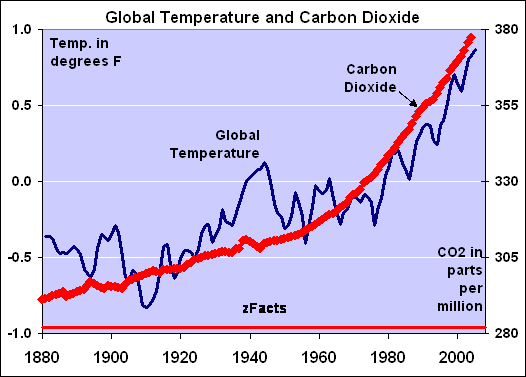
If the global warming advocates couldn't get the next 10 years right when they made their predictions in 1999, why are we still pretending that they can get the next 100 years right? If 10 years is "just weather", then so is 100!
I can't predict the weather over the next ten days, but I have a pretty good idea of what it'll be like over the next ten months. If you're trotting out this argument, you have no idea what a "chaotic system", and have no business commenting on climate science.
Maybe more science will find an AGW signal
-
Re:Just greedy.
The problem with a career in science is that it is like a career in acting. Sure, there's the super stars at the top who are doing extremely well for themselves but then pretty much everyone else is struggling just to feed their families.
You've got chemists coming out of the gate making almost 70k a year, moving up to 120k a year as their career progresses.
You're right that certain applied scientists do OK financially - not as well as medical doctors or lawyers but enough to feed their families. The "geologist" salaries you linked to were for petroleum geologists. The "chemist" salaries you linked to showed large variation. For example, the chemistry post-doc salaries were down at $40,000. It's also worth noting that many of the "chemist" jobs (particularly the high paying ones) were almost certainly primarily management jobs.
I'll agree that a few scientists are doing very well for themselves financially and that certain other classes of scientists are doing OK financially (particularly those working in applied science and in management positions). What you'll find, though, is that the scientists who are trying to make a career out of actual basic science research are far from financially secure.
It may even be that at some level we agree. If you were to claim that PhD scientists (even those doing basic science) should earn a minimum salary of $70K per year then I would say, sure, problem solved. As it is, though, I personally know plenty of talented hard-working PhD scientists making only about half that ($30,000-$40,000 per year).
Maybe $35K is a fair salary for a PhD scientist and maybe it's not - but young people considering a career in science need to be aware of the reality that most hard-working PhD scientists are only earning $30K-$40K per year.
-
Just greedy.
The problem with a career in science is that it is like a career in acting. Sure, there's the super stars at the top who are doing extremely well for themselves but then pretty much everyone else is struggling just to feed their families.
You've got chemists coming out of the gate making almost 70k a year, moving up to 120k a year as their career progresses. Oh, and by the way, physicists and materials people would probably be making more in the USA if there was more domestic manufacturing. Don't need too many physicists if your economy is based on bad banking and real estate. Think about that, when you decide which car to buy. [hint buy made-in-usa]
-
Underwater
Perhaps Florida should plan for hydro power instead, given the projected rise in sea level? http://geology.com/sea-level-rise/florida.shtml
-
Re:negative spin much?
The North west passage was first crossed in 1906 http://www.britannica.com/EBchecked/topic/420084/Northwest-Passage
Al's famous hockey stick is dirty data taken from weather stations that have experienced heat islands being installed in the form of pavement. Go check out surface data.org. Sometimes one needs to "scrub" the data, and throw out obviously tainted data from a compromised station.
Remember all the data pointed to a new ice age in 1970, now the same data points to warming...
Go see Geology.com for the latest in antarctic dust... Turns out that just about all dust in antarctic ice record comes from Patagonia. Previous thought was that dust in the antarctic ice record indicated global warm dry years. Current thought is dust in the antarctic ice record is heaviest in cold dry years when Patagonian glaciers were advancing, released little water, and dust from dry terminal moraine coated antarctic ice. Warm years in Patagonia the glaciers retreat flooding the terminal moraine, and trapping the dust.
http://www.geology.com/news/2009/antarctic-dust-and-climate-record.shtml
The real source is Nature.com, but I don't have an active account. -
Re:The Devil Comes for Republicans
You do know that a stream gaging station requires spending on concrete, lumber, and rebar, right?
Plus construction labor, and transportation expenses, right?
Plus electronics, and solar cells.http://geology.com/articles/gaging-station.shtml
Right, but what good does it do for the economy? Steam monitoring stations require a handful of jobs to produce, set up and monitor. That's nothing compared to a school, federal building, museum, algae-to-ethanol research center or whatever that provides LONG TERM economic growth, which makes in an investment that actually has a return! Throwing $140,000,000 worth of $10 bills out an airplane window would do more to stimulate the American economy than a set of steam monitoring stations in the mountains of Alaska, the Philippines, Japan, and wherever else this money is going!
And before you start telling me about the benefit of knowing when volcanoes will erupt, can you tell me the last time a volcano erupted without our previous knowledge? Right! So why the extra $140,000,000 thrown into a "stimulus" package that could do a whole lot more "stimulating" elsewhere?
-
Re:The Devil Comes for Republicans
You do know that a stream gaging station requires spending on concrete, lumber, and rebar, right?
Plus construction labor, and transportation expenses, right?
Plus electronics, and solar cells. -
Re:Aside from that... that isn't scientific litera
Does that mean you disbelieve in Noah's Flood? Are you sure?
Have you read the Epic of Gilgamesh, and it's description of Noah's flood?
http://en.wikipedia.org/wiki/Fenambosy_Chevron
http://geology.com/news/2006/11/chevron-structures-evidence-of-frequent.htmlDo I believe the Noah's Flood had to do with the flooding of the Black Sea? No.
I believe that this particular meteor strike, though, could have produced such a flood.Those 500 foot high chevrons are impressive.
-
Re:Wrong Premise
As someone who lives on and studies the world's largest freshwater lake (Lake Michigan-Huron)
Lake Michigan-Huron, two lakes really, is not the largest freshwater lake in the world, Lake Baikal in Russia's Siberia is. However Lake Baikal was used as a dump by the Soviets and is polluted too.
Falcon
-
Re:It WILL blow up on...
Informative? Oh well.
I guess that will also be the date on which the Canary Islands Tsunami hits, the Al Qaida dirty bomb takes out Washington, and Paris Hilton wins her first Oscar.
2012 is also predicted to be the year Sarah Palin is elected President. Coincidence? I think not!
-
Re:Read TFA, sounds fundamentally flawed.
Actually, the dust blows itself. It gets charged up by ultraviolet light during the day and the solar wind at night. Because there's no air to help neutralize the dust particles, they jump around like House of Pain. From the fount of all knowledge:
<SNIP>
See the article for more information and drawings of the phenomenon recorded by Apollo astronauts.Interesting.... I wonder how high the dust jumps, I note that the illustration has ~60ft walls round the telescope. If the deposition rate was high, I wonder if the Walls/aperture could be charged so as to act as a anti-dust forcefield.
The back of an envelope indicates meteoric dust is a trivial problem, earth gets ~1000 tons of meteors per day, say the moon geta about 1/6 of that 166 tons spread over 37 million Km2 thats about 5g/Km2, say the mirror 100m2 thats about 0.5 mg/day
-
Re:This needs a "paranoia" tag.
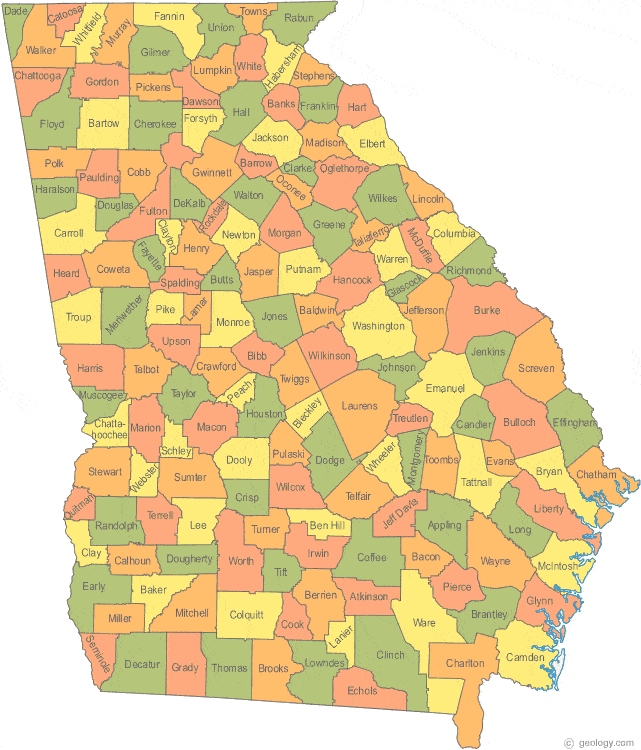
Hear hear! For god's sake people, don't just go off half-cocked when you read an article. Go check the data! I've managed with little effort to pull up the county-by-county results for the 2002 Georgia gubernatorial election.
Look here for election results.
Look here for a map where the counties are labeled.
You'll notice the following: In Fulton county, the Democrat candidate won 62% to 35%. In Dekalb county, he won 74% to 24%.
I'll leave it to some other person to look up the senatorial election results. The results I've found suggest the following explanations:
- the CEO of Diebold is a Democrat
- the evil patch in question had a bug and didn't work as the CEO hoped
- the patch was benign (nah, can't possibly be true)
Either the patches failed to achieve the desired
-
Photos of ice cap melting
Here, see for yourself. No complicated science, just photos:
http://www.everybodysweather.com/Static_Media/Polar_Ice_Cap_Melter/index.htm
http://www.nasa.gov/centers/goddard/news/topstory/2003/1023esuice.html (scroll down)
http://www.cnn.com/2007/TECH/science/09/15/arctic.nwestpssg/index.html
http://news.nationalgeographic.com/news/2006/09/060914-arctic-ice.html
http://www.nasa.gov/vision/earth/lookingatearth/arctic-20070515.html
http://geology.com/nasa/antarctic-ice-sheet-melting.shtml
http://www.esa.int/esaCP/SEMYTC13J6F_index_0.html (scroll down) -
SLAC to become SNLAC one day
Every time I drive by SLAC on 280, I am reminded that the facility sits almost on top of one of the world's most violent and active fault systems. SLAC is only 3000 feet away from the San Andreas fault at its closest point and about 7000 feet at its farthest. If you go to this site, you can zoom in where Sand Hill Road intersects 280 and plainly see both SLAC and the fault line.
To see what happened to another linear structure as a result of an earthquake on the San Andreas, go here.
So, when SLAC becomes SNLAC, will there be collateral damage beyond losing a gazillion dollar investment and shutting down indefinitely numerous research projects and in-progress dissertations? Will there also be an environmental impact as the coolant lines break and containers of who-knows-what exotic materials spill their contents?
I wonder whose bright idea was it to build a huge linear accelerator almost on top of a known fault system in the first place? -
Re:no buildup in front - buildup in one photo
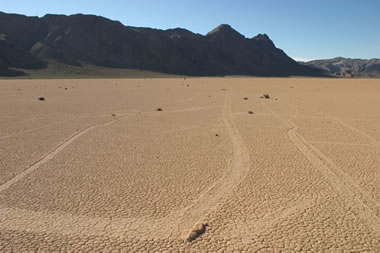
check this photo from the article.
it's clearly consistent with the rock pushing a considerable build-up, then changing course about ninety degrees and leaving the build-up behind. -
Re:Why?Who do you think invented the microchip? Gallium and arsenic are available from domestic sources as well.
And the rare elements now used come from domestic or foreign sources?
I challenge you to find an item we need from abroad, that has NO domestic production and NO potential for domestic production and NO alternative technology.Diamonds. There is no industrial production of diamonds in this country. Of course, I won't say there are NO alternative technologies -- narrowly defining the scope of this issue creates a straw-man argument. Are there domestic sources? Sure. Are they economically feasible to obtain? That's the question that needs to be asked.
-
Re:Language and assumption troubles
"You do realize that continents move around, right? Plate techtonics and all that. Canada, for example, used to be on the equator."
Funny, not according to _these_ maps...
http://geology.com/pangea.htm
Have a nice day. Really.
--
BMO -
Re:Bloomington, IN
As for DEC and DG, the sticks maybe, but Yahoo maps sez that beautiful downtown Maynard is all of 23.2 miles from I'm-sure-equally-beautiful downtown Boston -- a 45 minute drive, close enough that I'm sure many DEC employees lived in Boston.
Boston is a pretty small place, for a large city. Go a couple miles north, west, or east of the heart of the city and you're basically in triple-deckers. A couple miles more, and it's thoroughly suburban, with a few higher-density pockets here and there, in the centers of the outlying towns. There's a Landsat photo of Boston here that shows how even within 128, it isn't always very built up. (n.b. other photos on the site are not to scale)
A 10 mile commute is not unusual, but it would still probably be seen as annoying. A 20 mile commute is a pain in the ass. Especially if you had to go to Maynard, since 2 is a very small road (for some bizarre reason) between 495 and 128.
It's really unlike, say, New York, which is much denser and larger (the dense part of Boston would reach no further than Soho in Manhattan), or larger, sprawlier cities like LA, Seattle, or Chicago.
My understanding is that a lot of DataGen employees lived in the western suburbs, and I'd be surprised if any were inside 128.
But again, my point was that the arrogance of blingToad's post wasn't justifiable -- tech companies have prospered away from high-profile universities.
I suppose so, but I wouldn't want to live away from a large city, regardless of whether my effective income would be higher. The lack of culture and diversity isn't worth it, especially when you have to put up with so much damn nature in the vicinity. -
You never know who you might be talking to.How the hell would a bunch of random people on Slashdot know what you should do in some strange particular circumstances that we couldn't possibly know the details of since we aren't on the staff for your school?
Slashdot readers just happen to include at least one New Orleans native and Tulane graduate, myself. I'd love to know more, so why don't you shut up?
One thing I can contribute is that Tunlane is dead wrong about their admissions. They say,
"We realize that at post-Katrina Tulane, the size of our incoming first-year classes may be smaller. Rather than lower our admission standards in order to admit more students, we will maintain our academic standards by becoming smaller yet stronger."
But they have actually had MORE applications this year than last. The news acted as advertising and actually increased interest in the school!
What they might be having problems with are servicing the huge debt that Dr. Kelly left them with when he built up their business school and people deciding not to return. They might also have trouble housing people who want to stay, though you can see that most places students lived were not flooded, so the live on campus is also misguided.
What ever the problems are, the school is determined to make them worse and I would not want to study anything technical at Tulane now. It was mostly a party school and few people attended for engineering to begin with. I imagine it would be a great place to teach and you can do what you want with what you have. Well, it used to be that way. Now that they are firing everyone, it will surely suck and it will be hard for a student to get a well rounded technical education.
Reading further, it looks like they are a bunch of jerks you don't want to be around. Try this on for size, which looks like more of the same:
a Board of Tulane task force has been charged with redefining how the Newcomb College and Tulane College names and endowments will be used to support the new structure while also acknowledging those colleges' important historic ties to Tulane University.
So, having spent all of their money, they are going after other people's money. They have been trying this for decades and I hope it does not work now. Newcomb has some excellent programs and is far more open minded than Tulane, some programs of which are more like mindless indoctrination camps than education.
What do they want to keep? What do they want to actually pay for in their search for excellence while they trash the school of medicine and the engineering school? Their business school will continue to churn out clueless asses who will follow all the greedy trends, like outsourcing engineering to India. From their own page, we find some real junk surviving majors:
- African and African Diaspora Stud.
- Anthropology - not so junky really.
- Communication
- Consumer Behavior - Marketing
- Legal Studies in Business
- Marketing (see Consumer Behavior)
- Mathematical Economics
- Political Economy
- Social Policy and Practice
- Women's Studies
The Women's studies group actually shared space with the Civil Engineers. The kinds of crap they left on the board beggars description. They thought the new building was built for them at the time and it turns out they were right!
With priorities like that and all the chances to shovel shit "rebuilding" the city being promissed as mandatory exercises, I think it's time to move on or stay gone.