Slashdot Mirror
Domain: gnu.org
Stories and comments across the archive that link to gnu.org.
Comments · 13,360
-
Re: When code is GPL'ed...
It's *OURS*, not mine.
That's the whole idea.
Also, copying bits from one GPL program to another GPL program is not out of the ordinary. This is a constant in open source software.
To minimize confusion, every developer should probably read (and understand) the GPL.
http://www.gnu.org/copyleft/gpl.html
"You may copy and distribute verbatim copies of the Program's source code as you receive it, in any medium, provided that you conspicuously and appropriately publish on each copy an appropriate copyright notice and disclaimer of warranty;"
-Joe -
I got my Linux license...
...for free.
Here, you can have one too! -
GNUNet
What's about GNU's own GPL'd freenet "clone" GNUNet?
I've successfully used it to get some pr0n, at decent speeds. You might also search it for "Billy Joel" to see my additions to the network.
-
Re:sad to say, but GIMP does lack
-
Re:Article Text without silly next buttons
Then what would that make us who write Libre Software exclusively?
Besides, libre software is written to be freely used and shared therefore those who use only libre software are not leeches. -
Re:Irony?
Woof - here goes (this is only applicable in the US):
It is indeed a right, as detailed in the US constitution (one reference.)
It is called copyright because the holder has to right to determine the distribution - in any way they see fit. For a nice example that doesn't fit your definition, see the GPL.
I never suggested the copyright holder loses their status as copyright holder - I stated the copyright holder lost their right in the specific infringing case to determine the distribution.
I never called it theft - I just pointed out that the copyright holder has indeed been deprived of something.
Was your post intended to address mine? If so, I fail to follow how... -
Actually...You might want to read those things sometime. Look at Microsoft's Windows XP Professional EULA for instance:
- Internet-Based Services Components. The Product contains components that enable and facilitate the use of certain Internet-based services. You acknowledge and agree that Microsoft may automatically check the version of the Product and/or its components that you are utilizing and may provide upgrades or fixes to the Product that will be automatically downloaded to your Workstation Computer.
- UPGRADES. To use a Product identified as an upgrade, you must first be licensed for the product identified by Microsoft as eligible for the upgrade. After upgrading, you may no longer use the product that formed the basis for your upgrade eligibility.
- Consent to Use of Data. You agree that Microsoft and its affiliates may collect and use technical information gathered in any manner as part of the product support services provided to you, if any, related to the Product. Microsoft may use this information solely to improve our products or to provide customized services or technologies to you. Microsoft may disclose this information to others, but not in a form that personally identifies you.
(I've intentionally listed terms out of order and added emphasis to make a point.)
In short, Microsoft has the right to change your system in any way they see fit without your knowledge or consent. This includes, but is not limited to, removing your root access. Once they change your system, it is not legal to downgrade to the previous system. Spyware of any sort is perfectly legal if the spyware company is Microsoft or one of its affiliates.
With a license like that, why would anyone use the OS? I did RTFA, and it only shows that the software vendors are being forced to be more upfront with their licenses in stores. Nothing has changed the legally binding status of the EULA. It does not change the fact that Microsoft will ambush you with its licensing changes in security updates and service packs. Perhaps it's time to consider Linux or Mac OS X, eh?
-
Quick listI read about halfway through the thread and saw the same old stuff. I'll throw in a few off the top of my head.
- Overclocked Remix has thousands of video game remixes available for download. Due to the massive amount of bandwidth this takes up, redistribution via P2P is encouraged. In addition, they have bit torrents up of their remixes, with a total amount transferred of roughly five thousand gigabytes.
- Star Trek: New Voyages is a fan made continuation of TOS. With the amount of bandwidth a million episode downloads sucks up, they use and encourage P2P and Bit Torrent redistribution.
- The audio section of the Free Software Foundation's website has many speeches by RMS, Moglen, etc that can be shared via P2P as long as there is no modifications to the recordings. So far I've uploaded about 20 copies of their various speeches.
-
Re:Will this affect software licensing costs? How?
But what exactly IS a CPU from a software-licensing perspective?
Why the hell would a software license care about the number of active CPUs on a board?
-
GNU HurdDoes the expensive development of this provide a significant advantage over GNU Hurd project (including Debian Hurd)?
Will this hardware development bring quantum computing any closer to reality?
-
It's a question of how to treat other people.
Microsoft does something to help shore up a weakness in their OS products, and somehow its still evil.
Microsoft distributes a buggy OS and withholds the freedom for users to inspect how it works, modify it to work better, and distribute the improved version. Users need these freedoms to make their computers work for them, even if they're not programmers themselves (in which case they can benefit from software freedom by running software others inspected, improved, and distributed).
From the perspective of software freedom, Microsoft isn't evil, but they are denying users their freedoms users deserve, and they employ obstructionist policies instead of competing, and that is anti-social behavior.
It's important not to judge them purely on the basis of features because this ignores a far more socially important issue of how people ought to treat each other. Placing people in positions of dependency where nobody can provide their own support or help their community by distributing improved versions of the software is something we should not overlook.
-
Will this work with BSD?
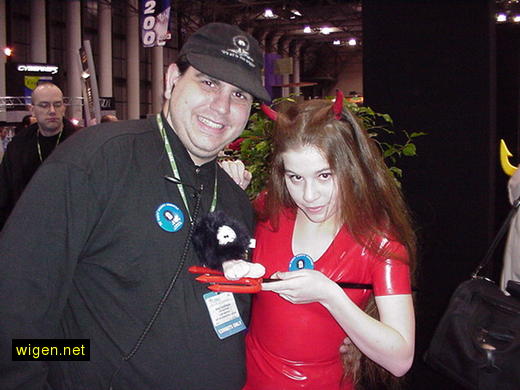
IMPORTANT UPDATE: Please show your support for Ceren in this poll of Geek Babes!
Is it any wonder people think Linux users are a bunch of flaming homosexuals when its fronted by obviously gay losers like these?! BSD has a mascot who leaves us in no doubt that this is the OS for real men! If Linux had more hot chicks and gorgeous babes then maybe it would be able to compete with BSD! Hell this girl should be a model!
Linux is a joke as long as it continues to lack sexy girls like her! I mean just look at this girl! Doesn't she excite you? I know this little hottie puts me in need of a cold shower! This guy looks like he is about to cream his pants standing next to such a fox. As you can see, no man can resist this sexy little minx. Don't you wish the guy in this pic was you? Are you telling me you wouldn't like to get your hands on this ass?! Wouldn't this just make your Christmas?! Yes doctor, this uber babe definitely gets my pulse racing! Oh how I envy the lucky girl in this shot! Linux has nothing that can possibly compete. Come on, you must admit she is better than an overweight penguin or a gay looking goat! Wouldn't this be more liklely to influence your choice of OS?
With sexy chicks like the lovely Ceren you could have people queuing up to buy open source products. Could you really refuse to buy a copy of BSD if she told you to? Personally I know I would give my right arm to get this close to such a divine beauty!
Don't be a fag! Join the campaign for more cute open source babes today!
$Id: ceren.html,v 9.0 2004/08/01 16:01:34 ceren_rocks Exp $ -
Re:VHDL + FPGA - VHDL is greatnah, VHDL isn't not that tough... I love it. (I'm using it for FPGAs with Synplicity Pro, Modelsim and Altera or Xilinx software so I do have an advantage of having great tools available.)
and our company uses it far more than we use verilog...
btw, if you are editing vhdl, check out the Emacs mode for VHDL.
It's far more powerful than vhdl editing aids in any other editors I've used.
(And, yes, you *can* use GNU emacs in Windows too) -
No security holes in Ceren!
IMPORTANT UPDATE: Please show your support for Ceren in this poll of Geek Babes!
Is it any wonder people think Linux users are a bunch of flaming homosexuals when its fronted by obviously gay losers like these?! BSD has a mascot who leaves us in no doubt that this is the OS for real men! If Linux had more hot chicks and gorgeous babes then maybe it would be able to compete with BSD! Hell this girl should be a model!
Linux is a joke as long as it continues to lack sexy girls like her! I mean just look at this girl! Doesn't she excite you? I know this little hottie puts me in need of a cold shower! This guy looks like he is about to cream his pants standing next to such a fox. As you can see, no man can resist this sexy little minx. Don't you wish the guy in this pic was you? Are you telling me you wouldn't like to get your hands on this ass?! Wouldn't this just make your Christmas?! Yes doctor, this uber babe definitely gets my pulse racing! Oh how I envy the lucky girl in this shot! Linux has nothing that can possibly compete. Come on, you must admit she is better than an overweight penguin or a gay looking goat! Wouldn't this be more liklely to influence your choice of OS?
With sexy chicks like the lovely Ceren you could have people queuing up to buy open source products. Could you really refuse to buy a copy of BSD if she told you to? Personally I know I would give my right arm to get this close to such a divine beauty!
Don't be a fag! Join the campaign for more cute open source babes today!
$Id: ceren.html,v 9.0 2004/08/01 16:01:34 ceren_rocks Exp $ -
Re:Cygwin RULES
Konsole is nice, with tab's, I just with there was a tabbed RXVT then life would be truly sweet. (No tabbed putty yet, come on!)
No point in having tabbed terminal emulators when you use GNU Screen. Just a couple of keybindings to learn (^A c to create a new "tab", ^A 0 or ^A 1 and so on to see the Nth tab). Would work in PuTTY too, and all terms I can think of.
I personally hate all these Konsoles, gnome-terminal and others that take forever to load - if I wanted bells and whistles, I wouldn't use the comandline, wouldn't I?
Feel ready to own one or many Tux Stickers? -
Re:Hmm Running a..
GNU folks are a bit "insane in the membrane, insane in the brain":
Have you ever heard of GNU/Hurd?
Here is the name explanation:
HURD: Hird of UNIX Replacing Daemons
HIRD: Hurd of Interfaces Representing Depth
Oh-my-god, mutually recursive acronyms ! Look http://www.gnu.org/software/hurd/hurd.html#TOCname -
That's GNU/Microsoft Windows Services for UNIXMany Microsoft users run a modified version of the GNU system every day, without realizing it. Through a peculiar turn of events, the version of GNU which is widely used today is more often known as 'Microsoft Windows Services for UNIX 3.0' or SFU , and many users are not aware of the extent of its connection with the GNU Project.
There really is a SFU; it is a subsystem, and these people are using it. But you can't use a subsystem by itself; a subsystem is useful only as part of a whole operating system. SFU now inludes Interix which is normally used in a combination with the GNU development toolchain and libraries : the system is basically GNU, with SFU functioning as the compatibility DDL Library layer.
Many users are not fully aware of the distinction between the compiler toolset, which is SFU, and the whole system, which they also call `SFU''. The ambiguous use of the name doesn't promote understanding.
Programmers generally know that is a Subsystem. But since they have generally heard the whole system called `Interix' as well, they often envisage a history which fits that name. For example, many believe that once Softway Systems finished writing the posix compatibility DDL Libraries, they looked around for other free software, and for no particular reason most everything necessary to port a Unix-like system was already available.
What they found was no accident--it was the GNU system. The available free software added up to a complete system because the GNU Project had been working since 1984 to make one. The GNU Manifesto had set forth the goal of developing a free Unix-like system, called GNU. The Initial Announcement of the GNU Project also outlines some of the original plans for the GNU system. By the time Interix was written, the system was almost finished.
Most software projects have the goal of developing a particular program for a particular job. For example, Softway Systems set out to build an environment to allow UNIX apps to be ported directly to NT. Donald Knuth set out to write a text formatter (TeX); Bob Scheifler set out to develop a window system (X Windows). It's natural to measure the contribution of this kind of project by specific programs that came from the project.
If we tried to measure the GNU Project's contribution in this way, what would we conclude? If you had access to the full source code of SFU with Interix, you might find found that, GNU software was the largest single contingent, around 60% of the total source code, and this included some of the essential major components without which there could be no compatable subsystem. SFU by without Interix itself could be about 20%. So if you were going to pick a name for the system based on who wrote the programs in the system, the most appropriate single choice would be `GNU''.
But we don't think that is the right way to consider the question. The GNU Project was not, is not, a project to develop specific software packages. It was not a project to develop a C compiler, although we did. It was not a project to develop a text editor, although we developed one. The GNU Project's aim was to develop a complete free Unix-like system: GNU.
Many people have made major contributions to the free software in the system, and they all deserve credit. But the reason it is a system--and not just a collection of useful programs--is because the GNU Project set out to make it one. We made a list of the programs needed to make a complete free system, and we systematically found, wrote, or found people to write everything on the list. We wrote essential but unexciting major components, such as the assembler and linker, because you can't have a system without them. A complete system needs
-
That's GNU/Microsoft Windows Services for UNIXMany Microsoft users run a modified version of the GNU system every day, without realizing it. Through a peculiar turn of events, the version of GNU which is widely used today is more often known as 'Microsoft Windows Services for UNIX 3.0' or SFU , and many users are not aware of the extent of its connection with the GNU Project.
There really is a SFU; it is a subsystem, and these people are using it. But you can't use a subsystem by itself; a subsystem is useful only as part of a whole operating system. SFU now inludes Interix which is normally used in a combination with the GNU development toolchain and libraries : the system is basically GNU, with SFU functioning as the compatibility DDL Library layer.
Many users are not fully aware of the distinction between the compiler toolset, which is SFU, and the whole system, which they also call `SFU''. The ambiguous use of the name doesn't promote understanding.
Programmers generally know that is a Subsystem. But since they have generally heard the whole system called `Interix' as well, they often envisage a history which fits that name. For example, many believe that once Softway Systems finished writing the posix compatibility DDL Libraries, they looked around for other free software, and for no particular reason most everything necessary to port a Unix-like system was already available.
What they found was no accident--it was the GNU system. The available free software added up to a complete system because the GNU Project had been working since 1984 to make one. The GNU Manifesto had set forth the goal of developing a free Unix-like system, called GNU. The Initial Announcement of the GNU Project also outlines some of the original plans for the GNU system. By the time Interix was written, the system was almost finished.
Most software projects have the goal of developing a particular program for a particular job. For example, Softway Systems set out to build an environment to allow UNIX apps to be ported directly to NT. Donald Knuth set out to write a text formatter (TeX); Bob Scheifler set out to develop a window system (X Windows). It's natural to measure the contribution of this kind of project by specific programs that came from the project.
If we tried to measure the GNU Project's contribution in this way, what would we conclude? If you had access to the full source code of SFU with Interix, you might find found that, GNU software was the largest single contingent, around 60% of the total source code, and this included some of the essential major components without which there could be no compatable subsystem. SFU by without Interix itself could be about 20%. So if you were going to pick a name for the system based on who wrote the programs in the system, the most appropriate single choice would be `GNU''.
But we don't think that is the right way to consider the question. The GNU Project was not, is not, a project to develop specific software packages. It was not a project to develop a C compiler, although we did. It was not a project to develop a text editor, although we developed one. The GNU Project's aim was to develop a complete free Unix-like system: GNU.
Many people have made major contributions to the free software in the system, and they all deserve credit. But the reason it is a system--and not just a collection of useful programs--is because the GNU Project set out to make it one. We made a list of the programs needed to make a complete free system, and we systematically found, wrote, or found people to write everything on the list. We wrote essential but unexciting major components, such as the assembler and linker, because you can't have a system without them. A complete system needs
-
Quantian articleI own the quantian.org domain. The following is from my article on the Quantian Distribution. Here is a brief run down of links, programs, and other goodies in Quantian.
- R, including several add-on packages (such as tseries, RODBC, coda, mcmcpack, gtkdevice, rgtk, rquantlib, qtl, dbi, rmysql), out-of-the box support for the powerful ESS modes for XEmacs as well as the Ggobi visualisation program;
- A complete teTeX, TeX, and LaTeX setup for scientific publishing, along with TeXmacs and LyX for wysiwyg editing;
- Perl and Python with loads of add-ons, plus ruby, tcl, Lua, and Scientific and Numeric Python;
- The Emacs and Vim editors, as well as Gnumeric, kate, Koffice, jed, joe, nedit and zile;
- Octave, with add-on packages octave-forge, octave-sp, octave-epstk, and matwrap;
- Computer-algebra systems Maxima, Pari/GP, GAP, GiNaC and YaCaS;
- the QuantLib quantitative finance library including its Python interface;
- GSL, the Gnu Scientific Library (GSL) including example binaries;
- The GNU compiler suite comprising gcc, g77, g++ compilers;
- the OpenDX, Plotmtv, and Mayavi data visualisation systems;
- it includes apcalc,aribas,autoclass,
-
Quantian articleI own the quantian.org domain. The following is from my article on the Quantian Distribution. Here is a brief run down of links, programs, and other goodies in Quantian.
- R, including several add-on packages (such as tseries, RODBC, coda, mcmcpack, gtkdevice, rgtk, rquantlib, qtl, dbi, rmysql), out-of-the box support for the powerful ESS modes for XEmacs as well as the Ggobi visualisation program;
- A complete teTeX, TeX, and LaTeX setup for scientific publishing, along with TeXmacs and LyX for wysiwyg editing;
- Perl and Python with loads of add-ons, plus ruby, tcl, Lua, and Scientific and Numeric Python;
- The Emacs and Vim editors, as well as Gnumeric, kate, Koffice, jed, joe, nedit and zile;
- Octave, with add-on packages octave-forge, octave-sp, octave-epstk, and matwrap;
- Computer-algebra systems Maxima, Pari/GP, GAP, GiNaC and YaCaS;
- the QuantLib quantitative finance library including its Python interface;
- GSL, the Gnu Scientific Library (GSL) including example binaries;
- The GNU compiler suite comprising gcc, g77, g++ compilers;
- the OpenDX, Plotmtv, and Mayavi data visualisation systems;
- it includes apcalc,aribas,autoclass,
-
Quantian articleI own the quantian.org domain. The following is from my article on the Quantian Distribution. Here is a brief run down of links, programs, and other goodies in Quantian.
- R, including several add-on packages (such as tseries, RODBC, coda, mcmcpack, gtkdevice, rgtk, rquantlib, qtl, dbi, rmysql), out-of-the box support for the powerful ESS modes for XEmacs as well as the Ggobi visualisation program;
- A complete teTeX, TeX, and LaTeX setup for scientific publishing, along with TeXmacs and LyX for wysiwyg editing;
- Perl and Python with loads of add-ons, plus ruby, tcl, Lua, and Scientific and Numeric Python;
- The Emacs and Vim editors, as well as Gnumeric, kate, Koffice, jed, joe, nedit and zile;
- Octave, with add-on packages octave-forge, octave-sp, octave-epstk, and matwrap;
- Computer-algebra systems Maxima, Pari/GP, GAP, GiNaC and YaCaS;
- the QuantLib quantitative finance library including its Python interface;
- GSL, the Gnu Scientific Library (GSL) including example binaries;
- The GNU compiler suite comprising gcc, g77, g++ compilers;
- the OpenDX, Plotmtv, and Mayavi data visualisation systems;
- it includes apcalc,aribas,autoclass,
-
bc
-
Pick a representative
Go here, pick your contry and one of your representatives to write to and just DO IT (Click "country flag -> name", and there you should have the email adress). If you're an American you can probably send an email outlining (from experience) why software patents is a really bad idea - who knows, they might listen to you too, and yes, I'm pretty sure 99.9% of them speak good english.
If anyone has good links containing information about software patent issues please post them so that we can be well-informed before we start writing.
Here's one - Saving Europe from Software Patents (RMS).
And another - Fighting Software Patents - Singly and Together (RMS). -
Pick a representative
Go here, pick your contry and one of your representatives to write to and just DO IT (Click "country flag -> name", and there you should have the email adress). If you're an American you can probably send an email outlining (from experience) why software patents is a really bad idea - who knows, they might listen to you too, and yes, I'm pretty sure 99.9% of them speak good english.
If anyone has good links containing information about software patent issues please post them so that we can be well-informed before we start writing.
Here's one - Saving Europe from Software Patents (RMS).
And another - Fighting Software Patents - Singly and Together (RMS). -
Price is not everything.
I'd wonder if the whole negotiation was over price; the UK Register article seems to focus on price. If the discussions mainly centered on costs, using the philosophy of the open source movement (which focuses on practical goals for programs in their bid to speak to business) is sure to lose because serious proprietors including Microsoft are ready to lower their price to free to keep a competitor away ("lose no sale to Linux[sic]" is what I recall reading in a NYT article which quoted an internal Microsoft memo).
Discussing software freedom may be uncomfortable for some, but this issue reframes the debate on something no proprietor can deliver. This means raising an issue which the open source movement was designed not to raise and it means paying attention to the free software movement's central message of including ethics in one's pitch.
-
Re:Yah, good for Javascript!
-
Every single language you've mentioned there are NOT maintainable. Why? Cause they're all interpreted dynamic languages. It's fun and all to write in these languages and get stuff done with them but as soon as you spot a bug you have a hell of a time to
This is a myth, and has been proven false countless of times, such as by these guys, or these guys, or even these guys, or, God forbid, you may have heard of these guys.
First, the term "interpreted dynamic language" is vague and misleading. Interpretation has nothing to do with code maintainability. (You can interpret C, and you can compile putatively interpreted languages such as Java and Python to native code; indeed Java has been natively compiled for years, and the fact that it is just-in-time compilation is irrelevant).
And what does "dynamic" mean? Do you mean a dynamically, as opposed to statically, typed language? Do you mean runtime introspection? Self-modification and metaprogramming? Runtime name resolution? What? I suspect you mean a combination of these. Python, Perl, Ruby, JavaScript, PHP, Haskell, Lisp and OCaml have these features. C++ can be considered a "dynamic" language, as can Java, C#, etc. So why do you claim that these languages are not maintainable?
These newfangled languages are more rapid to develop in than lower-level languages. Maintenance is simpler because the languages are simpler, higher-level and more easily maintained. For example, the absence of a separate compile/link cycle means I can get from changing a source line to testing the source line quicker.
In many cases, reproducing or debugging a bug is simpler in, say, Python than in C, because the infrastructure itself is simpler. Pure Python, for example, does not have memory access violation errors; there's no way your Python code can read or write an invalid pointer, write beyond the end of a buffer and so on; a whole class of pointer errors, most of which have security repercussions, are annihilated by this feature. Similarly, Python uses exceptions, so nobody can forget to check and propagate a function's error return value.
More often than not, errors that surface in these languages are high-level problems, which is good, because those are simpler than the ones involving someone forgetting to call free() on an allocated buffer or accounting for overflow when shifting a bit mask.
The uncertainty involved in the dynamic typing/late binding model of such languages is compensated for through unit testing.
Oh, and JavaScript, a "dynamic language", is being used by Google in a production system, and Google is known to use Python and Ruby in their systems. I suggest you call them up and tell them their languages aren't suitable.
-
Every single language you've mentioned there are NOT maintainable. Why? Cause they're all interpreted dynamic languages. It's fun and all to write in these languages and get stuff done with them but as soon as you spot a bug you have a hell of a time to
-
Re:Yah, good for Javascript!
-
Every single language you've mentioned there are NOT maintainable. Why? Cause they're all interpreted dynamic languages. It's fun and all to write in these languages and get stuff done with them but as soon as you spot a bug you have a hell of a time to
This is a myth, and has been proven false countless of times, such as by these guys, or these guys, or even these guys, or, God forbid, you may have heard of these guys.
First, the term "interpreted dynamic language" is vague and misleading. Interpretation has nothing to do with code maintainability. (You can interpret C, and you can compile putatively interpreted languages such as Java and Python to native code; indeed Java has been natively compiled for years, and the fact that it is just-in-time compilation is irrelevant).
And what does "dynamic" mean? Do you mean a dynamically, as opposed to statically, typed language? Do you mean runtime introspection? Self-modification and metaprogramming? Runtime name resolution? What? I suspect you mean a combination of these. Python, Perl, Ruby, JavaScript, PHP, Haskell, Lisp and OCaml have these features. C++ can be considered a "dynamic" language, as can Java, C#, etc. So why do you claim that these languages are not maintainable?
These newfangled languages are more rapid to develop in than lower-level languages. Maintenance is simpler because the languages are simpler, higher-level and more easily maintained. For example, the absence of a separate compile/link cycle means I can get from changing a source line to testing the source line quicker.
In many cases, reproducing or debugging a bug is simpler in, say, Python than in C, because the infrastructure itself is simpler. Pure Python, for example, does not have memory access violation errors; there's no way your Python code can read or write an invalid pointer, write beyond the end of a buffer and so on; a whole class of pointer errors, most of which have security repercussions, are annihilated by this feature. Similarly, Python uses exceptions, so nobody can forget to check and propagate a function's error return value.
More often than not, errors that surface in these languages are high-level problems, which is good, because those are simpler than the ones involving someone forgetting to call free() on an allocated buffer or accounting for overflow when shifting a bit mask.
The uncertainty involved in the dynamic typing/late binding model of such languages is compensated for through unit testing.
Oh, and JavaScript, a "dynamic language", is being used by Google in a production system, and Google is known to use Python and Ruby in their systems. I suggest you call them up and tell them their languages aren't suitable.
-
Every single language you've mentioned there are NOT maintainable. Why? Cause they're all interpreted dynamic languages. It's fun and all to write in these languages and get stuff done with them but as soon as you spot a bug you have a hell of a time to
-
Treacherous Computing
When Longhorn comes out, it will introduce support for Next Generation Secure Computing Base (formerly called Palladium), Microsoft's implementation of Treacherous Computing. Many web sites, starting with those that sell DRM copies of copyrighted works, will begin to offer "value added" content available only to users with Microsoft Trusted Internet Explorer (yes, an oxymoron, but the general public still doesn't know that). As more and more Windows users upgrade to Longhorn, either by installing on top of Windows XP or by buying a new computer and paying the Windows tax, the Treacherous Computing userbase will increase, and Alsee has predicted that more and more web sites will migrate to Treacherous Computing access only.
We have to get people to distrust IE now, before the next Microsoft Windows upgrade cycle.
-
Price alone isn't going to win you your point.
The poster asks
[...] I'm wondering what it would take to lobby the city to start switching over to open source software. Has anyone ever tried to lobby your local council to make the jump away from expensive, closed software?
My guess is that it will take more than just an argument over price to win people to software under a license approved by the Open Source Initiative. Serious proprietors looking at a big potential client will reduce their price to free if need be in order to secure the deal.
Microsoft revealed that they were willing to do this (I recall reading a New York Times article which included a quote from an internal a memo which clearly indicated they were to "lose no sale to Linux[sic]"). So if you're only prepared to go into the debate talking only about price and practical advantage, you could very well lose to a proprietor, perhaps even acting as a buttress for the proprietor.
The Free Software Foundation warned against this in their essay about the differences between the free software and open source movements. That difference is quite pertinant here for your question:
Sooner or later these users will be invited to switch back to proprietary software for some practical advantage. Countless companies seek to offer such temptation, and why would users decline? Only if they have learned to value the freedom free software gives them, for its own sake. It is up to us to spread this idea--and in order to do that, we have to talk about freedom. A certain amount of the ``keep quiet'' approach to business can be useful for the community, but we must have plenty of freedom talk too.
For example, making private derivatives could be important to pursuing your town's specific needs. Yet permission to make private derivatives are not included in the definition of "open source" because of that movement's values (this is why the Apple Public Source License which used to require reporting some changes to Apple or publishing changes qualified as an open source license but not a free software license. Changes to the APSL have been made and v2.0 of the APSL qualifies as a free software license. These improvements would not have been made without someone pushing for them). Hence, if you genuinely seek software freedom for the users of this software, I suggest conveying the importance of focusing on user's freedoms to share and modify software.
-
Price alone isn't going to win you your point.
The poster asks
[...] I'm wondering what it would take to lobby the city to start switching over to open source software. Has anyone ever tried to lobby your local council to make the jump away from expensive, closed software?
My guess is that it will take more than just an argument over price to win people to software under a license approved by the Open Source Initiative. Serious proprietors looking at a big potential client will reduce their price to free if need be in order to secure the deal.
Microsoft revealed that they were willing to do this (I recall reading a New York Times article which included a quote from an internal a memo which clearly indicated they were to "lose no sale to Linux[sic]"). So if you're only prepared to go into the debate talking only about price and practical advantage, you could very well lose to a proprietor, perhaps even acting as a buttress for the proprietor.
The Free Software Foundation warned against this in their essay about the differences between the free software and open source movements. That difference is quite pertinant here for your question:
Sooner or later these users will be invited to switch back to proprietary software for some practical advantage. Countless companies seek to offer such temptation, and why would users decline? Only if they have learned to value the freedom free software gives them, for its own sake. It is up to us to spread this idea--and in order to do that, we have to talk about freedom. A certain amount of the ``keep quiet'' approach to business can be useful for the community, but we must have plenty of freedom talk too.
For example, making private derivatives could be important to pursuing your town's specific needs. Yet permission to make private derivatives are not included in the definition of "open source" because of that movement's values (this is why the Apple Public Source License which used to require reporting some changes to Apple or publishing changes qualified as an open source license but not a free software license. Changes to the APSL have been made and v2.0 of the APSL qualifies as a free software license. These improvements would not have been made without someone pushing for them). Hence, if you genuinely seek software freedom for the users of this software, I suggest conveying the importance of focusing on user's freedoms to share and modify software.
-
Don't promote Open Source....Promote Free Software instead.
Open Source is a development model, a way to create a work, usually software. While it does have many pluses compared to other development models, how a program is made generally has little impact on someones decision when they're choosing a program to use. On the other hand, Free Software is based on the Freedoms that a program has, and thus is much more business/government friendly.
Yes, you heard me. The Freedom that Free Software gives you is often the most compelling reason for anyone to switch, you just need to realize that different people value different freedoms. In this case, when talking to a government you need to remind them what freedoms they are giving up by using proprietary software. Here's a brief list of points to get your started.- Any workstation will most likely be using Microsoft Windows XP. If you actually read their license agreement it is very easy to find clauses that would make any government worker with half a brain stem wet themselves. In sections 2.1, 2.4, and 6 you give them permission to snoop on your machine. The text is so broad that you pretty much give them permission to do whatever they want. Section 5 is so ambiguous that technically any file sharing voids the agreement. This is bad news if you allow other people to download/copy documents off your machine in a business setting. When you combine sections 7 and 8 you may be giving them permission to disable your ability to do any networking, including getting on the internet. Note that the final sentence of S8 says "any internet-based service", they didn't say "Any service provided by Microsoft via the internet".
My personal favorite of XP's EULA - Section 9 concerns upgrading and says "After upgrading, you may no longer use the software that formed the basis for your upgrade." This means that if you have a CD of XP SP1 and upgrade to SP2, then according to this agreement you have to buy a totally new copy of Windows to reinstall should your system get hosed.
EULAs are intentionally vague, and chain the user with restrictions so draconian that it's nearly impossible to use the software normally without voiding the EULA. Do some research, it is very easy to come up with a very long list of legal traps that would persuade a user away from proprietary software.
And then you can mention that Free Software does not come with such restrictions. Indeed, one of the basic points of the Free Software definition is that the software should be free to use in any way the user sees fit, without restrictions. A little research into this and you can have one hell of an argument. - Proprietary document formats discriminate against the users, which is a very stupid thing for a government to do. In specific, Microsoft Word files are at best a nuisance. Users of a non-Microsoft OS may have troubles viewing them. Buying the hardware and software necessary to view them can be very costly, and discriminates against the poor. They can be troublesome for people with poor vision. By sending word files to distribute information you strengthen the "everybody uses it" mentality, and thus strengthen Microsoft's monopoly. And so on. Combine this with my first point, and you can have a very convincing argument for Open Office. If you're not making word files, then why buy a $600+ text editor?
- Freedom to modify - Why have a browser on a machine when you don't need it? Why have a bunch of services running that only create vulnerabilities since you don't use them? Why should they settle for an unchangable program designed for everybody, when you can use flexible programs designed for your needs? Using a slimmed down system reduces the risks of bugs, crashes, and security vulnerabilities, making the system less costly in terms of time and money.
- ...And so on, this is but the tip of the iceberg. I'd suggest listening to some
- Any workstation will most likely be using Microsoft Windows XP. If you actually read their license agreement it is very easy to find clauses that would make any government worker with half a brain stem wet themselves. In sections 2.1, 2.4, and 6 you give them permission to snoop on your machine. The text is so broad that you pretty much give them permission to do whatever they want. Section 5 is so ambiguous that technically any file sharing voids the agreement. This is bad news if you allow other people to download/copy documents off your machine in a business setting. When you combine sections 7 and 8 you may be giving them permission to disable your ability to do any networking, including getting on the internet. Note that the final sentence of S8 says "any internet-based service", they didn't say "Any service provided by Microsoft via the internet".
-
Re:Sniff, our little browser's all grown up...
I was going to say "ha ha I bet there hasn't been an exploit for ed in 20 years, but according to Google there was one on Solaris in freaking 2004. Fuck man, I feel so disillusioned. I mean it's ed man, ED! What is there left to trust?!
-
Re:why GPL?
I agree with you. Though GPL can be used for any kind of work, it is best suited for works where is possible to identify a "source" and a "binary" (speaking in terms of software).
A good choice would be the GNU Free Documentation License if you ask me. -
Re:"Finally, after many years of waiting"
In his April lecture he mentions that he is a debian user.
-
Re:ANONYMOUS COWARD CALLS FOR FERRARI TO LOWER PRI
I am sorry did you say java and compile to native.... That is NOT a JVM.
Yeah, and I also said GIJ, which is NOT native-compilation but a JVM.
There are several other VM's out there, Kaffe, JamVM and SableVM, which all use the GNU Classpath library and thus also benefit indirectly from Red Hat's work.
What about Blackdown? It's not open source. Period. It's under Sun's license.
Look at the abomination they did to get Eclipse to run.
Yeah, sure. I've seen it. Have you?
Note particularily the line: No Eclipse changes are needed.
how about IBM's JVM for linux
They have several. What about IBM JVM? It's not open source either. They do have one though which is, JikesVM. And It has GNU Classpath as its library. IBM hasn't contributed any code at all towards the runtime.
(And the class library is the major issue with Java, not the VM. VM's are small by comparison)
Redhat all but hates Java.
Yeah, which is why they hosted an open-source Java summit as recently as two weeks ago.
The only thing they want with Java is the ability for it to be compiled to "their" OS.
Which doesn't quite explain why they're contributing by writing cross-platform Java library code, does it?
I agree that RedHat does do some development, but are you seriously saying that they do anywhere near what Sun or Microsoft do?
No. Nobody said that. You were the one saying Red Hat doesn't contribute to open source software. Now you've suddenly changed this to doing as much development as Sun or Microsoft??!
I do say this: They contribute a hell of a lot more code to the community than either Sun or Microsft does, despite having far smaller resources.
Yes. Red Hat charges a lot of money for support. So does Microsoft for their Enterprise solutions. You are making the stupid mistake of comparing consumer products with enterprise products. These are completely different things. Rest assured that Windows with enterprise support isn't cheap either. Nor is AIX, or Solaris or anything else.
I suggest you stop commenting on stuff which you obviously don't know much about. -
Re:ANONYMOUS COWARD CALLS FOR FERRARI TO LOWER PRI
Bullshit. Which Linux distributor codes a majority of anything?
As for Gnome.. perhaps you should grep through the gnome codebase for @redhat.com adresses?
Then perhaps you'll figure out why they had 4 candidates, (more than any other single entity) for the board of the Gnome-foundation.
Red Hat doesn't code a JVM for Linux?
Obviously you haven't made any contributions yourself in this area, because you really don't have a clue.
The bulk of work in GCJ (which compiles Java to native) and it's VM GIJ has been done by Red Hat.
Do you know how many people they have working on this stuff? Of course you don't. (Hint: Number of contributors to the GNU Classpath Java class library: 10)
Tell me, which other commercial distributions are contributing?
They also do a majority of work GCC. You know that little compiler-thingy?
-
Hurd development
According to the Hurd's "What's New" page, nothing new has happened since August 2003.
Doesn't exactly look as if development is proceeding at a roaring pace. -
More options...
Repeat after me: E-mail clients on Linux are NOT a problem.
* Mutt (console based and unlike PINE its Free and better)
* Evolution (for GNOME)
* KMail (for KDE).
* Sylpheed (for GTK+).
* GNUMail (for GNUstep)
* More at Freshmeat.net > Communications
Perhaps redundant links here and there, but this is a good overal start. I excluded Thunderbird and Mozilla because those are heavily known already. Also, some of the above clients might run on other Unices, other OSes -- including MacOSX and Windows. -
Re:Interesting....
Does that make my system GNU/Windows?
Why, yes it does.
And also:
open source != GNU
I'm a newb my self, but i wouldn't mention GNU (free software) and open source in the same coment.
"Microsoft/Windows" would be redundant.
I'm afraid you don't know the significance of GNU.
www.gnu.org
Not american, not even human. -
spamassassin on rmail in emacs
spamassassin is already installed on this university system providing headers for messages. How do you set up the related dot files or whatever for filtering if you do not have the mastery of computers to even understand dotfiles?...
I use rmail in emacs http://www.gnu.org/software/emacs/manual/html_node
Regrettably the spamassassin web pages are written in jargon for people with greater mastery of computers. -
Re:Why ?
thank you.
people in here tend to be License Nazis -
Answer 50 years. BTW, THIS IS TRUSTED COMPUTING!
I haven't found in the FAQs or anywhere on the site what that EGS period is
From the FAQ: In this program, individuals may purchase a 50-year global personal i-name What isn't in the FAQ is that you are only reserving the name for 50 years and getting 2 years of free "managment services". After that management fees are around $10 a year.
Now that I have answered your question and justified leeching off of the first high rated post (chuckle) I have an important message:
IT IS A FRONT FOR TRUSTED COMPUTING AND DRM!!
IT IS A FRONT FOR TRUSTED COMPUTING AND DRM!!
IT IS A FRONT FOR TRUSTED COMPUTING AND DRM!!
The organisations involved, OASIS (oasis-open.org), XDI.ORG and the others, they are all TRUSTED COMPUTING groups creating "open standards" for ENFORCING DRIGITAL RIGHTS MANAGAMENT systems.
One of OASIS's primary projects is:
Extensible Rights Markup Language (XrML): 'The Digital Rights Language for Trusted Content and Services'.
XDI.org's FAQ
What does XDI.ORG do
This "Identity Commons" wants you to sign up and created a "Trusted Identity" (which is conviently tied to the CREDIT CARD you used to register!), and in the future DRM files will be locked to that identity, and software installations will be locked to that identity, and access to websites will be locked to that identity (single sign-on oh joy) and on and on. And they are offering you an opportunity to sign up and reserve your name before the system is fully deployed, gee thanks.
The system will not be fully operational unless you are running Microsoft's Palladium operating system, or if you are running a Palladiumized version of Linux or other operating system. Palladiumized TrustedLinux is already under construction. And these new operating systems will only work on the new TrustedHardware. IBM and HP and others are already shipping PCs with this new Trust chip. Intel has already embedded a version of the Trust chip inside the Intell Prescott, although it is in an inactive form. The expectation is that the Trust chip will soon be standard on all motherboards, and then move into the CPU itself. Intel, AMD, ARM, Transmeta, and the rest, all of the CPU makers are on board.
The Trust chip spys on your hardware and what software you are running and reports it to other people (remote attestation), the Trust chip makes it impossible to read your own files except with the approval and under the restrictions imposed by the software you were given (sealed storage), it prevents you from modifying the software on your own machine (code identity and sealed storage), the Trust chip even DEFEATS THE GPL! Having the source code and being able to modify and compile it is USELESS when that recompiled code DOES NOT WORK. The Trust chip forbids the recompiled code from access to the required encryption keys. The recompiled code will "run", but it will not WORK because it cannot read it's encrypted files and it cannot interoperate.
I know this sounds like a tinfoil hat conspiracy theory, but IBM is already shipping ThinkCenter, ThinkVantage andNetvista desktops, and Thinkpad laptops with this chip embedded. HP/Compaq are already shipping dc7100 and D530 Desktops and nc6000,nc8000,nw8000, nc4010 notebooks with these chips embedded. Acer Veriton 3600GT/7600GT. Toshiba Tecra M2 Series. Fujitsu Lifebook S7010 and E8000 series and the T4000 Tablet PCs. Samsung all X model laptops. And more every day. As I said, the expectation is that is will soon be standard hardware on ALL motherboards.
EFF on Trusted Computing
GNU.org on Trusted Computing
Wikipedia on Trusted Computing
- -
Re:Why should they?
I can't speak for bersl2, but I think you may have mistaken his point.
When Stallman originated (ie, named) the Free Software movement in '84, he did it for political reasons. Later, ESR and others said that if people want this stuff to be accepted in corporate society, they need to focus on practical and not political ideals. Political statements make suits nervous. (If you were on slashdot, certain Usenet groups, etc in '98 or so, you saw the discussions.)
One big sticking point was the name. "Free software" had two problems. First, ESR &co wanted to get away from the whole "Freedom!" issue, as I described.
Second, it's too easy to think "free" as in "free beer", not "free speech". (I first saw that meme at about the same time, I think.) When people think "free" in that sense, they may think of the plethora of stuff on Tucows etc that cost $0, but have no source. Since source access, modification, and distribution are a big part of what this new movement was about, they didn't want the free-as-in-beer association to be part of the new name either.
Hence, "open source" became the new term. So what bersl2 said has some merit: one big reason for coining the term "open source" is because ESR &co didn't want people to think that things like Spybot S&D were part of this new movement.
From a practical point of view, yes, the two movements generally support the same set of software. The guidelines are similar. But the philosophies are different, and those that care about the philosophy (such as Stallman) distinguish between the two, sometimes more subtly than others.
But the issue of unmodifiable source was one of the reasons that the name "Open Source" was formed: they wanted it, and felt that the term "free software" didn't emphasize that point enough.
-
Re:This stinks!Good, so maybe you can shine your light on this
Sure, but not because I work at Sun. Like I said, I don't have anything to do with this stuff.
So, besides distributing patches to software, we can start distributing patches to licenses as well?
The provision you quoted is nothing new, and I really don't see what the big deal is. From the GPL:
9. The Free Software Foundation may publish revised and/or new versions of the General Public License from time to time. Such new versions will be similar in spirit to the present version, but may differ in detail to address new problems or concerns.
Each version is given a distinguishing version number.
-
They should use Ceren to promote their PCs...
IMPORTANT UPDATE: Please show your support for Ceren in this poll of Geek Babes!
Is it any wonder people think Linux users are a bunch of flaming homosexuals when its fronted by obviously gay losers like these?! BSD has a mascot who leaves us in no doubt that this is the OS for real men! If Linux had more hot chicks and gorgeous babes then maybe it would be able to compete with BSD! Hell this girl should be a model!
Linux is a joke as long as it continues to lack sexy girls like her! I mean just look at this girl! Doesn't she excite you? I know this little hottie puts me in need of a cold shower! This guy looks like he is about to cream his pants standing next to such a fox. As you can see, no man can resist this sexy little minx. Don't you wish the guy in this pic was you? Are you telling me you wouldn't like to get your hands on this ass?! Wouldn't this just make your Christmas?! Yes doctor, this uber babe definitely gets my pulse racing! Oh how I envy the lucky girl in this shot! Linux has nothing that can possibly compete. Come on, you must admit she is better than an overweight penguin or a gay looking goat! Wouldn't this be more liklely to influence your choice of OS?
With sexy chicks like the lovely Ceren you could have people queuing up to buy open source products. Could you really refuse to buy a copy of BSD if she told you to? Personally I know I would give my right arm to get this close to such a divine beauty!
Don't be a fag! Join the campaign for more cute open source babes today!
$Id: ceren.html,v 9.0 2004/08/01 16:01:34 ceren_rocks Exp $ -
gettext
-
Re:Popularity
Not necessarily: http://www.gnu.org/software/mailutils/#mail
-
Reinventing the microkernel?
Aren't the virtualization projects like Xen, User Mode Linux, etc. essentially reinventing the microkernel? Their goals seem awfully close to the idea of abstracting away the hardware so you can safely run multiple OS "personalities" at the same time. I wonder what could be accomplished if the virtualization guys teamed up with the people working on a modern microkernel like L4. Anyone have benchmarks comparing L4-Linux with Linux under Xen? Heck, maybe one day people will realize the advantages of a multi-server OS like the Hurd.
-
Twelve Step TrustABLE IT : VLSBs in VDNZs From TBATwelve Step TrustABLE IT : VLSBs in VDNZs From TBA
Twelve Step TrustABLE IT:
Virtualised Linux Standard Base (VLSB)
in Virtual Demilitarized Network Zones (VDNZ)
from Trusted Build Agents (TBA)Back in August 11, 1998, Microsoft's Vinod Valloppillil and Josh Cohen released a memorandum titled Linux OS Competitive Analysis: The Next Java VM?, in which they predicted that Linux would become ubiquitous as a services platform. However, the title of the paper could be even more prophetic.
Consider the following.
[1] It is well known that Linux is quite portable, in fact only NETBSD comes close to the number of hardware platforms supported.
[2] What is less well known is that the Linux kernel has even been ported to run on itself, as client for a virtual Monitor platform, and even to run virtualised on other operating systems including Win2K and XP.
[3] Other operating systems, such as BSD and Sun's Solaris can also use a compatbility layer to run applications compiled for Linux directly, without the need for virtualisation.
[4]The Linux Standard Base Mission Statement is to
To develop and promote a
set of standards that will increase compatibility among Linux distributions and enable software applications to run on any compliant system. In addition, the LSB will help coordinate efforts to recruit software vendors to port and write products for Linux.
[5] The above standard also defines a generic subset of the standards for each hardware platform as a source level application interface. In fact for an application to be certified for the LSB it must be tested on two of the plaforms supported by the LSB, one chosen at random by the testing body. Following the standard, it's not that difficult a job to write portable C and C++ code : Write once, compile for each platfom.
[6] The GNU Compiler Collection's future GCC 4.0 Release Series now divides the task of compiling into two stages based around Static Single Assignment trees. It should be possible to use the new GCC front ends to compile each language into a SSA tree that represents the common generic subset of the Linux Standard Base: [5].The resulting SSA tree for a build could be dumped into files, analogous to Java's JVM intermediate format, and then complied to native code for the target platform: Write once, run everywhere.
Be it open or closed source, every binary or script you execute represents a risk. It is possible to introduce hostile code at any point along the build chain, before the point where the binary is checksummed and the result digitally signed.
[7] It is possible to use constraints built into any Linux or Unix like operating system to isolate and restrict what a binary executable has access to or can do. Even without employing SELinux's manditory access controls or chroot/jail'ed environments, it is possible to run a process under a different user identity and group identity. Unix servers have used this te
-
Twelve Step TrustABLE IT : VLSBs in VDNZs From TBATwelve Step TrustABLE IT : VLSBs in VDNZs From TBA
Twelve Step TrustABLE IT:
Virtualised Linux Standard Base (VLSB)
in Virtual Demilitarized Network Zones (VDNZ)
from Trusted Build Agents (TBA)Back in August 11, 1998, Microsoft's Vinod Valloppillil and Josh Cohen released a memorandum titled Linux OS Competitive Analysis: The Next Java VM?, in which they predicted that Linux would become ubiquitous as a services platform. However, the title of the paper could be even more prophetic.
Consider the following.
[1] It is well known that Linux is quite portable, in fact only NETBSD comes close to the number of hardware platforms supported.
[2] What is less well known is that the Linux kernel has even been ported to run on itself, as client for a virtual Monitor platform, and even to run virtualised on other operating systems including Win2K and XP.
[3] Other operating systems, such as BSD and Sun's Solaris can also use a compatbility layer to run applications compiled for Linux directly, without the need for virtualisation.
[4]The Linux Standard Base Mission Statement is to
To develop and promote a
set of standards that will increase compatibility among Linux distributions and enable software applications to run on any compliant system. In addition, the LSB will help coordinate efforts to recruit software vendors to port and write products for Linux.
[5] The above standard also defines a generic subset of the standards for each hardware platform as a source level application interface. In fact for an application to be certified for the LSB it must be tested on two of the plaforms supported by the LSB, one chosen at random by the testing body. Following the standard, it's not that difficult a job to write portable C and C++ code : Write once, compile for each platfom.
[6] The GNU Compiler Collection's future GCC 4.0 Release Series now divides the task of compiling into two stages based around Static Single Assignment trees. It should be possible to use the new GCC front ends to compile each language into a SSA tree that represents the common generic subset of the Linux Standard Base: [5].The resulting SSA tree for a build could be dumped into files, analogous to Java's JVM intermediate format, and then complied to native code for the target platform: Write once, run everywhere.
Be it open or closed source, every binary or script you execute represents a risk. It is possible to introduce hostile code at any point along the build chain, before the point where the binary is checksummed and the result digitally signed.
[7] It is possible to use constraints built into any Linux or Unix like operating system to isolate and restrict what a binary executable has access to or can do. Even without employing SELinux's manditory access controls or chroot/jail'ed environments, it is possible to run a process under a different user identity and group identity. Unix servers have used this te