Slashdot Mirror
Domain: gnu.org
Stories and comments across the archive that link to gnu.org.
Comments · 13,360
-
BSD
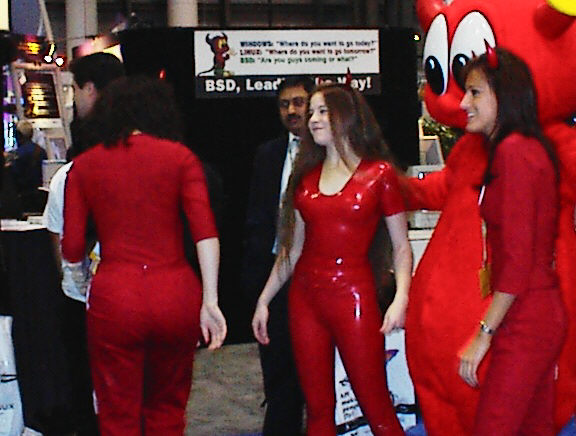
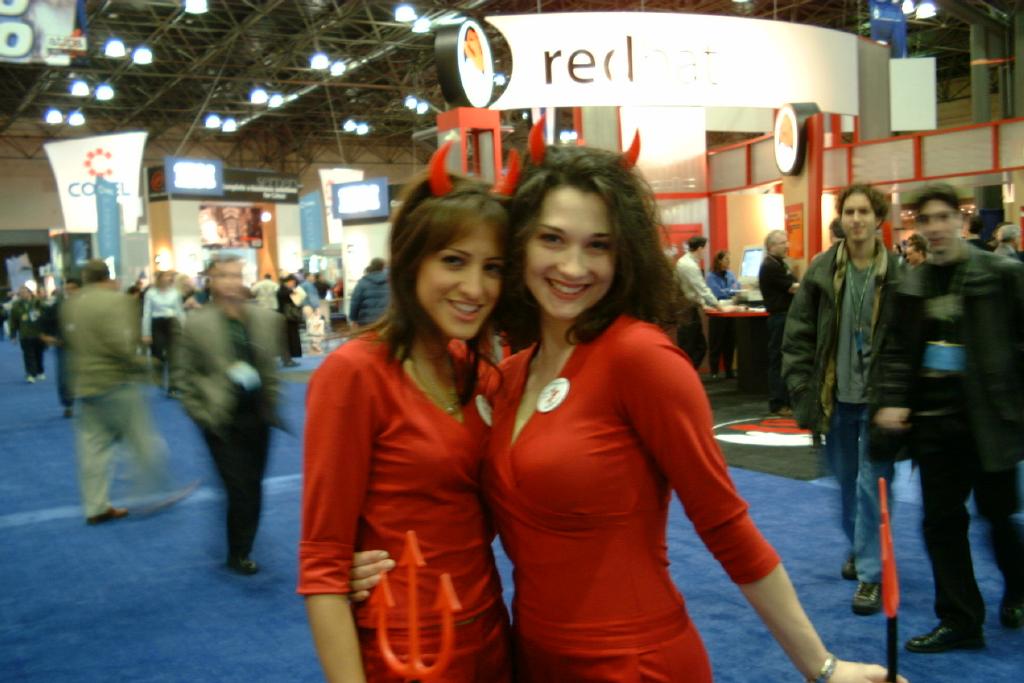
How can people say BSD is dying when it has a mascot like this?! Linux needs to get its act together if it's going to compete with the kind of hot chicks and gorgeous babes that BSD has to offer!
You just can't take Linux seriously when its fronted by losers like these. Would you buy software from them? I don't think so! You Linux groupies need to find some sexy girls like her ! I mean just look at this girl ! Doesn't she excite you? I know this little hottie puts me in need of a cold shower! This guy looks like he is about to cream his pants standing next to such a fox . As you can see, no man can resist this sexy little minx . I mean are you telling me you wouldn't like to get your hands on this ass ?!
With sexy chicks like the lovely Ceren you could have people queuing up to buy open source products. Could you really refuse to buy a copy of BSD if she told you to? Come on, you must admit she is better than an overweight penguin or a gay looking goat ! Don't you wish you could get one of these ? Personally I know I would give my right arm to get this close to such a divine
Join the campaign for more cute open source babes today! -
Darl McBride hires bodyguards - film at 11
This is Darl McBride. He hires bodyguards because people infringing on his "intellectual property", while in fact being very nice and harmless scare him. (There are more of them.) Am I really the only one not surprised?
-
Re:Bill doesn't
Unfortunately this won't work, since the Free Software Foundation use free (as in the GPL) to refer to many licenses of which most are unrelated to GNU. Nice try, though.
-
Re:Bill doesn't
Unfortunately this won't work, since the Free Software Foundation use free (as in the GPL) to refer to many licenses of which most are unrelated to GNU. Nice try, though.
-
Giving GNU a share of credit pains many.
The article mentions Linux all the time, and Linus, but it wouldn't be usable as an entirely free operating system without the free software from GNU.
And the GNU General Public License, which defends the Free Software community from proprietary derivatives. Torvalds gets a lot of credit he doesn't deserve in the BW article and the author shows no sign of understanding what contribution to the community Torvalds made. But judging by the bulk of posts moderated highly in this thread, I'd say a lot of readers and moderators are, unfortunately, comfortable in the myth that "Linux" is an operating system and that very little of value was developed before the Linux kernal appeared on the scene. Reading the GNU/Linux naming FAQ (particularly the parts around "Why not call the system "Linux" anyway, and strengthen Linus Torvalds' role as posterboy for our community?") is apparently going out of style except for when this FAQ is the story. Giving credit where credit is due is becoming a lost art.
-
Giving GNU a share of credit pains many.
The article mentions Linux all the time, and Linus, but it wouldn't be usable as an entirely free operating system without the free software from GNU.
And the GNU General Public License, which defends the Free Software community from proprietary derivatives. Torvalds gets a lot of credit he doesn't deserve in the BW article and the author shows no sign of understanding what contribution to the community Torvalds made. But judging by the bulk of posts moderated highly in this thread, I'd say a lot of readers and moderators are, unfortunately, comfortable in the myth that "Linux" is an operating system and that very little of value was developed before the Linux kernal appeared on the scene. Reading the GNU/Linux naming FAQ (particularly the parts around "Why not call the system "Linux" anyway, and strengthen Linus Torvalds' role as posterboy for our community?") is apparently going out of style except for when this FAQ is the story. Giving credit where credit is due is becoming a lost art.
-
If all you value is saving money...
You will have no reason not to switch to proprietary software when the proprietary software is low-cost. Despite what Open Source movement proponents say about making better code, many so-called Open Source programs are functionally inferior to their proprietary competitors. If all you value is saving money or the practical ends that the Open Source movement champions, you'll never miss the freedom to share and modify software. It's great to get someone interested in Free Software by demonstrating practical use, and it's true some people are uncomfortable talking about ethics and responsibility as well as convenience. But the Free Software community was not built by giving into whatever businesses want. The FSF wrote an interesting essay comparing the Free Software movement with the Open Source movement.
Crediting Linus Torvalds as an altrustic operator is simply incorrect. Torvalds' brand of pragmatism falls squarely into the problem I just described--his use of Bitkeeper is a perfect example. He is also not "Linux' guardian" (as the BusinessWeek article claims). If that title is accurate at all, it properly belongs to the GNU General Public License, the preeminent Free Software license written by the FSF: the organization whose ethical basis Torvalds dismisses.
-
If all you value is saving money...
You will have no reason not to switch to proprietary software when the proprietary software is low-cost. Despite what Open Source movement proponents say about making better code, many so-called Open Source programs are functionally inferior to their proprietary competitors. If all you value is saving money or the practical ends that the Open Source movement champions, you'll never miss the freedom to share and modify software. It's great to get someone interested in Free Software by demonstrating practical use, and it's true some people are uncomfortable talking about ethics and responsibility as well as convenience. But the Free Software community was not built by giving into whatever businesses want. The FSF wrote an interesting essay comparing the Free Software movement with the Open Source movement.
Crediting Linus Torvalds as an altrustic operator is simply incorrect. Torvalds' brand of pragmatism falls squarely into the problem I just described--his use of Bitkeeper is a perfect example. He is also not "Linux' guardian" (as the BusinessWeek article claims). If that title is accurate at all, it properly belongs to the GNU General Public License, the preeminent Free Software license written by the FSF: the organization whose ethical basis Torvalds dismisses.
-
Re:what about GNU
After some comments a week or so ago about Stallman not being a good public speaker, I decided to listen to his speeches and hear for myself. I admit that I too have had a sort of "get over yourself" attitude about him - but I'm realizing as I listen to what he has to say, that I developed this by listening to others who have that attitude, rather than listening to RMS. I won't say I don't have any of that attitude left, but I will say that I think he raises some very provacative issues in his speeches. When he talks about the history of the project, I can also understand why he desires some credit for his and his group's efforts. He did afterall, quit a nice cushy job on principle - I've never done that, I think most people haven't. I respect that "put your money where your mouth is" level of conviction.
Anyway, I don't know that I concurr with all he says, but I do have a lot more respect for him after listening to his talks for a few hours. And incidently, while he may not sparkle like a movie star, his presentations are good. And that is how it should be - they are informative works rather than works of entertainment.
-
Open source would be richer with more babes...
How can people say BSD is dying when it has a mascot like this?! Linux needs to get its act together if it's going to compete with the kind of hot chicks and gorgeous babes that BSD has to offer!
You just can't take Linux seriously when its fronted by losers like these. Would you buy software from them? I don't think so! You Linux groupies need to find some sexy girls like her! I mean just look at this girl! Doesn't she excite you? I know this little hottie puts me in need of a cold shower! This guy looks like he is about to cream his pants standing next to such a fox. As you can see, no man can resist this sexy little minx. I mean are you telling me you wouldn't like to get your hands on this ass?!
With sexy chicks like the lovely Ceren you could have people queuing up to buy open source products. Could you really refuse to buy a copy of BSD if she told you to? Come on, you must admit she is better than an overweight penguin or a gay looking goat! Don't you wish you could get one of these? Personally I know I would give my right arm to get this close to such a divine beauty!
Join the campaign for more cute open source babes today! -
Re:Breaking News...Darl McBride now claims ownership of the new Finder in Panther, and Final Cut Pro.
...but not the Hurd
*ducks*
-
Props to NAH6...
....for doing a PGP extension to Mailman.
The patch file alone is 56 KB... looks like they put in some effort on that one. Pretty cool. -
BSD will beat SCO because we have...
How can people say BSD is dying when it has a mascot like this?! Linux needs to get its act together if it's going to compete with the kind of hot chicks and gorgeous babes that BSD has to offer!
You just can't take Linux seriously when its fronted by losers like these. Would you buy software from them? I don't think so! You Linux groupies need to find some sexy girls like her! I mean just look at this girl! Doesn't she excite you? I know this little hottie puts me in need of a cold shower! This guy looks like he is about to cream his pants standing next to such a fox. As you can see, no man can resist this sexy little minx. I mean are you telling me you wouldn't like to get your hands on this ass?!
With sexy chicks like the lovely Ceren you could have people queuing up to buy open source products. Could you really refuse to buy a copy of BSD if she told you to? Come on, you must admit she is better than an overweight penguin or a gay looking goat! Don't you wish you could get one of these? Personally I know I would give my right arm to get this close to such a divine beauty!
Join the campaign for more cute open source babes today! -
Re:Here's the Meat of the Story...
The real FUD statement was when he talked about a financial house, basing an internal sytem on some GPL stuff, being faced with the issue of having to GPL their internal project.
Um... only if they want to sell it. Yes? Internal projects, by definition, is not software that gets distributed.
I'll admin that the GPL page is not exact on what constitutes distribution. Or does it? -
Re:Code-generation bugsCasting a pointer, as you say:
double d = 1.0; int i = *(int *)
would be the correct way achieve that end (almost). The compiler would observe that the address of d had been taken, and not assume it was "dead" after the assignment. Then, i would get initialized via the pointer. No optimizer would damage such code.
GCC can, will and does damage code that does type punning with pointers. Using a union is the only way guaranteed to work. Read the gcc documentation for -fstrict-aliasing, which is now enabled by default. It explicitly says that code using unions will work, while similar code using pointers will not. The example given for how to convert types correctly isunion a_union {
int i;
double d;
};
int f() {
a_union t;
t.d = 3.0;
return t.i;
} -
what a waste of money!
i got a better use for $299 (or $239)... just run gnump3d and stream on demand to winamp or xmms on any pc in the dump. use your wired or wireless network. done deal.
-
Re:day of the machines
How can people say BSD is dying when it has a mascot like this?! Linux needs to get its act together if it's going to compete with the kind of hot chicks and gorgeous babes that BSD has to offer!
You just can't take Linux seriously when its fronted by losers like these. Would you buy software from them? I don't think so! You Linux groupies need to find some sexy girls like her ! I mean just look at this girl ! Doesn't she excite you? I know this little hottie puts me in need of a cold shower! This guy looks like he is about to cream his pants standing next to such a fox . As you can see, no man can resist this sexy little minx . I mean are you telling me you wouldn't like to get your hands on this ass ?!
With sexy chicks like the lovely Ceren you could have people queuing up to buy open source products. Could you really refuse to buy a copy of BSD if she told you to? Come on, you must admit she is better than an overweight penguin or a gay looking goat ! Don't you wish you could get one of these ? Personally I know I would give my right arm to get this close to such a divine
Join the campaign for more cute open source babes today! -
GNU vs. Unix
An interesting note on the GNU vs. Unix issue is that the GNU coding standards specifically state that GNU code should avoid any similarities to Unix code.
I doubt that the Linux kernel could claim to strictly adhere to all the GNU standards, but it's definetly a good counterargument to SCO:s claims that GNU/Linux programmers don't give a damn about copyright issues. -
GNU vs. Unix
An interesting note on the GNU vs. Unix issue is that the GNU coding standards specifically state that GNU code should avoid any similarities to Unix code.
I doubt that the Linux kernel could claim to strictly adhere to all the GNU standards, but it's definetly a good counterargument to SCO:s claims that GNU/Linux programmers don't give a damn about copyright issues. -
Re:Open Source = freedom??
If we're talking about the GPL The only restriction is that you cannot restrict the freedom of others. Seems fair right? The freedom to swing my arms wildly stops at your face. The bulk of the text is legalese designed to ensure that no one can use legal trickery to remove these freedoms.
And, btw, you can charge for free software" To quote RMS from that link, "Redistributing free software is a good and legitimate activity; if you do it, you might as well make a profit from it." After all, linux vendors have to stay in business somehow. -
Re:Open Source = freedom??
If we're talking about the GPL The only restriction is that you cannot restrict the freedom of others. Seems fair right? The freedom to swing my arms wildly stops at your face. The bulk of the text is legalese designed to ensure that no one can use legal trickery to remove these freedoms.
And, btw, you can charge for free software" To quote RMS from that link, "Redistributing free software is a good and legitimate activity; if you do it, you might as well make a profit from it." After all, linux vendors have to stay in business somehow. -
Re:Who Knowns
Wait until everything gets built natively with gcj..
-
Re:Free as in... BOW BEFORE YOUR MASTER
So write an MSWord document filter module as a plugin for your GPL application, and require a separate download from your main GPL application for that plugin. I think that's how the GIMP got around the
-
now freedom, but will they value it?
I wonder if there was any input from Peruvian Congressman Dr. Edgar David Villanueva Nunez, the guy that wrote the letter to Microsoft, justifying the Free Software in Public Administration bill.
Also, coincidentally, Richard Stallman gave a video-talk in Brazil just 12 days ago.
Free Software and OpenSource are roughly the same thing, but there's no mention of freedom in that article. I just hope they understand the long term benefits of Software Libre.
-
Next move: value freedom
This is of course great news. Maybe they should talk to Peruvian Congressman Dr. Edgar David Villanueva Nunez, the guy that wrote the letter to Microsoft about Peru using Free Software regarding Peru's new "Free Software in Public Administration bill".
Free Software is often better than proprietary software. The OpenSource movement bases it's whole argument on this point. The terms "Free Software" and "OpenSource" usually refer to the same thing, but if people don't value freedom, they won't see a reason not to switch back when a better (low-cost initially) proprietary alternative comes along.
I wonder if this has anything to do with Stallmans recent video talk at a brazillian Free Software conference.
-
run up the spammers' advertising billsHmmm.
# run up the spammers' advertising bills on Overture
You need to remove some spaces slashcode adds to those four search URLs. Adjust --timeout --wait and --tries to taste. Add --quiet to both wget's and place in crontab for enhanced fun. I also use --bind-address but I don't want to publish my IP here.
wget --timeout=3 --wait=2 --random-wait \
--output-document=- --cookies=off --tries=2 \
--user-agent="Mozilla/4.0 (compatible; MSIE 6.0; Windows NT 5.0)" \
"http://www.overture.com/d/search/?Keywords=bul k+email" \
"http://www.overture.com/d/search/?Keywords=ema il+marketing" \
"http://www.overture.com/d/search/?Keywords=mil lion+email" \
"http://www.overture.com/d/search/?Keywords=opt -in" | \
grep -i
wget --timeout=3 --wait=2 --random-wait --cookies=off --tries=2 \
--user-agent="Mozilla/4.0 (compatible; MSIE 6.0; Windows NT 5.0)" \
--force-html --base=http://www.overture.com/ --input-file=- \
--output-document=/dev/nullWonder if Overture needs the cookie for this to actually have effect. I don't wanna risk it.
This (brief) code is hereby released, without copyright, under the GNU General Public License version 2.
-
RedHat still kosher
If you don't want to agree to the terms of Red Hat's contract, don't. I'm sure copies of RHEL are readily available from other sources. Nothing in the contract prevents you from copying and distributing the software once you have it. The contract limits your right to *use* the software, which is not protected by the GPL (to stay within the domain of copyright law). It may be a little sneaky, but it doesn't make free software unfree.
In fact, Red Hat would be within their rights to provide the source only to their customers, though, again, they would be free to redistribute them. But they don't do that. They work in the open, and they share the important stuff: the source. The actual source packages for all of RHEL are available on Red Hat's own ftp servers. Our copy of RHEL WS didn't include postgres, so I had to rebuild the package, but it's the same package, vendor patches and all.
RHEL is a product and a service, and it costs money. And that's okay: there's nothing wrong with selling free software.
-
Illegal modifications
Some people have told me that it is possible to modify the hardware or purchase hardware from outside the US which uses different frequencies to get around this. Yes, it's illegal, but with this much RF pollution, would to be possible for the FCC to triangulate your location (say, inside an apartment building), and would they even care (assuming you weren't interferring with anything local).
OTOH, that happens when everyone starts doing this? God forbid when software radios become popular and people start trashing the entire usable spectrum? -
Re:worried?
Yes, BMH(RMS
gcc Contributors
The credit:
"Richard Stallman, for writing the original gcc and launching the GNU project. "
Roland McGrath was hired by the FSF to write glibc.
And without gcc/glibc and the rest of the FSF code Linus would not have had the hgh quality, free compiler and library he needed to write the kernel, nor the utilities to turn it into an operating system. Without RMS it would be a different world. -
Please don't use "IP" to describe copyright
The "intellectual property" term is confusing enough, since it confuses petents, copyright, trademarks and trade secrets. Using the acronym "IP" only makes things worse. First time I read the headline I skipped the article thinking that it is about the IP addresses of some game users being stored. I am serious. I thought the article was about privacy issues, not the copyright issues which I am always trying to be up to date with. So I ask you, if you absolutely have to use the "intellectual property" oxymoron (just remember it is not a legal term and shows that you don't understand the law, which casts a serious doubt on Slashdot journalistic integrity) please at least don't use the even more confusing "IP" acronym for that.
-
You're in luck!
-
Re:Perhaps you should have read the manual or the
But the bottom line is that nobody should ever have used a Mac iPod on a PC in the first place.
That's idiotic.I have a first-generation 5GB iPod for Mac that was given to me as a gift. I run Red Hat on my desk, so I found gtkpod and gnupod to make it work. I have since formatted back and forth between Win and Mac filesystems (recently got a G4 Powerbook) several times as a test, and it works fine. There should therefore be no reason at all why an iTunes update would corrupt the firmware irreparably, as it appears to have done from the posters' descriptions, aside from buggy or sloppy programing. (Or malice.)
As far as I can tell, the only difference between the two "versions" of the iPod is the filesystem with which the drive is formatted (HFS+ for Mac, VFAT for Win). Other than that, the hardware is exactly the same. (If you think about it, making two different types of hardware would have been prohibitively expensive from a manufacturing standpoint.) Unless someone can provide specific hardware details to the contrary, I'd say Apple is definitely screwing the pooch here.
-
Re:OSS distributions?
Considering that RMS seems to think even Debian isn't really a Free Software(tm) distro, I find it difficult to image that Mandrake qualifies.
What's ironic about that is that Stallman's dispute with the Debian developers revolves around the fact that Debian considers the GNU Free Documentation License "non-free" under the DFSG (Debian Free Software Guidelines). From what I understand, it revolves around the fact that the FDL allows for "non-variant" sections, which cannot be part of the main document (an introduction or dedication) and cannot be changed or removed.
The Debian developers feel that this unfairly restricts people who distribute FDL-licensed documents, as it prevents them from correcting inaccurate or misleading information in a non-variant section, and does not prevent later developers from adding more non-variant sections. You'd end up with a document with many pages of non-variant sections, possibly with contradictory or confusing purposes, much like the obnoxious advertising clause in the original BSD license.
As for Debian not being 100% free, everything in the "main" section of Debian is either GPL, or an open-source license that meets with the Debian Free Software Guidelines. Although Debian does maintain a "non-free" section, with software configured so it can be installed on Debian, it is not included in any official Debian release, and it's likely that Debian may soon remove the "non-free" section from their servers.
The amazing thing is, much of the non-free software that was seen as important when Debian was started has now become acceptable to include in "main" (the QT libraries kept KDE out of "main" for a while; StarOffice gave birth to OpenOffice.org, Netscape gave birth to Mozilla). Hopefully, within a few years a "non-free" section for Debian will be unnecessary.
Jay (= -
Re:IP as in Copyright not Networking
I understand that different things can have the same acronym, but I have to agree with Richard Stallman on this. There is no such thing as Intellectual Property. It refers to Copyright, Patents, or Trademarks without being specific as to which.
See http://www.gnu.org/philosophy/words-to-avoid.html# IntellectualProperty">
this link
for more information.
So while I appreciate the link to acronyms, I am rather relieved that it hasn't made it yet.
Like those people who "google" for things. There are many more ways to search the internet then google.com, and much more to the internet then what can be seen via port 80. Google is a trademark, not a verb. It will be interesting to see how long it takes for that word to disappear when Google goes the way of Altavista. -
Re:RHEL service agreement versus GPL?Specifically,
- your licensing policy, as summarized in the
RHEL FAQ:
Except for a few components provided by third parties (for example, Java) all the code in Red Hat products is open source and licensed under the GPL (or a similar license, such as the LGPL). So you always have free access to the source code. In fact you can download it from our FTP servers at any time. However, Red Hat does not provide free access to the binaries of Red Hat Enterprise Linux, and these, combined with an annual subscription to Red Hat Network, access to upgrades, and a selected support services, are the components that Red Hat bundles into each Red Hat Enterprise Linux solution. Since every Red Hat Enterprise Linux product includes support for the system on which it is installed, Red Hat supplies the products with a per-system usage/support subscription. This simple model ensures that systems which useRed Hat Enterprise Linux are able to access the maintenance, services and product upgrades to which they are entitled. Of course, as mentioned before, this has no impact on your access to the Red Hat Enterprise Linux source code.
- appears to violate the
GNU General Public License:
2. b) You must cause any work that you distribute or publish, that in whole or in part contains or is derived from the Program or any part thereof, to be licensed as a whole at no charge to all third parties under the terms of this License.
- your licensing policy, as summarized in the
RHEL FAQ:
-
A kernel vs an OS vs a trollBullshit. Check the GNU Manifesto itself.
-Jes' feedin' da trolls
-
Re:Torvalds is a far worse advocate than Stallman
First, I would like to thank you for keeping your patent issues separate from your copyright issues. Not enough people realize that copyright law is very different from patent law in many important ways.
In the case of his stance on patents, joking comments aside, I think it's pure pragmatism. The simple, legal fact is that researching patents to make sure Linux implementations were non-infringing would make hime more liable, not less.
I am not asking Torvalds to investigate specific patents that may or may not affect the development of the Linux kernal. What I'm talking about is the depth of understanding of the issues on how patent law hurts us as software developers, computer users, and citizens. Nothing Torvalds has offered on the subject of what are commonly called "software patents" comes close to the depth of understanding Stallman offers every time RMS gives his patent speech. Torvalds' apparent lack of understanding of the ethical and legal issues involved is profoundly impractical. Stallman's talk on the problems with software patents lists the reasons why it's not reasonable to ask anyone to search the patent database looking for possible infringements.
Torvalds has a golden opportunity to use his celebrity power to educate people about a common foe--the existence of software patents and how they hurt everyone except IBM. Or he could speak out on a number of other similar issues, like the ones Stallman talks about.
How about copyright? Again, pragmatism rules. How do you think SCO would have reacted if he'd gone to them a year ago and said "Hey, I'd like to compare Linux against the SysV source tree and see if there's any infringing code?"
It is SCO that is suing, not Torvalds. Torvalds' development strategy has lead to less than careful inclusion of non-free software into his branch of the Linux kernal and because this branch is so popular it is likely others have become dependent on the non-free software. As a result of not paying attention to the freedoms of Free Software and the license under which the Linux kernal is distributed, some have probably redistributed non-redistributable software. In the above link Stallman points out why this is:
"Linux, the kernel, is often thought of as the flagship of free software, yet its current version is partially non-free. How did this happen? This problem, like the decision to use Bitkeeper, reflects the attitude of the original developer of Linux, a person who thinks that "technically better" is more important than freedom.
"Value your freedom, or you will lose it, teaches history. `Don't bother us with politics,` respond those who don't want to learn."
However large book, music, and movie publishers have a lot of say in copyright policy and we're exporting our copyright policy to other countries through trade policies that don't benefit citizens. Stallman brings attention to our freedom to use, share, and modify software. Torvalds doesn't talk about freedom at all and is celebrated for not challenging the 'technically better' view of software.
-
Linux
GNU/Linux isn't free it's open source, there is a big differance. Sure some distros and software are free, but that has nothing to do with the nature of GNU/Linux. From my understanding GNU/Linux was founded up on the idea that we can all help eachother improve, and has found a way to enforce it.
"``Free software'' is a matter of liberty, not price. To understand the concept, you should think of ``free'' as in ``free speech,'' not as in ``free beer.''" -GNU.org -
Here's audios of RMS speeches:
There are ogg recordings of 12 of his speeches from the last 3 years on the GNU philosophy audio page.
Also note that the issue of the name "GNU/Linux" is not about credit (more explanation here)
And an explanation of the fiasco regarding Stallman being asked to talk at a "Linux User Group" is available here.
-
Here's audios of RMS speeches:
There are ogg recordings of 12 of his speeches from the last 3 years on the GNU philosophy audio page.
Also note that the issue of the name "GNU/Linux" is not about credit (more explanation here)
And an explanation of the fiasco regarding Stallman being asked to talk at a "Linux User Group" is available here.
-
Here's audios of RMS speeches:
There are ogg recordings of 12 of his speeches from the last 3 years on the GNU philosophy audio page.
Also note that the issue of the name "GNU/Linux" is not about credit (more explanation here)
And an explanation of the fiasco regarding Stallman being asked to talk at a "Linux User Group" is available here.
-
Re:So long as a single OSS Coder lives...
My apologies, your right. I was confusing This page.
-
Re:I don't THINK so
From what I've heard about Stallman (including that my mother knew him in the late 70s
I think he's an excellent public speaker. He's no Oscar Wilde, but so what? He presents his case consistantly and clearly. What else does anyone want?
I think we all already know that, though - he's caused many an uproar on Slashdot by statements made that have infuriated even people that mostly agree with him.
What does this have to do with public speaking skills? It is possible to be a good public speaker and to have people disagree with you.
It sounds to me as though you have an issue with his philosophy and are using his supposed weak oratary style to attack him. This is a strawman attack and not particularly endearing. -
Free Software is not Open Source.
I appreciate everything RMS has done, but I am not sure he is the best person to represent the open source movement [...]
He would not represent that movement at all. He is the first to speak up when people make the mistake you just did. If you listen to his speeches, you can read or hear him speak on this issue when he corrected Mike Uretsky. I think you would be well served to learn what he has to say instead of judging him by your prejudical view of his appearance.
-
Free Software is not Open Source.
I appreciate everything RMS has done, but I am not sure he is the best person to represent the open source movement [...]
He would not represent that movement at all. He is the first to speak up when people make the mistake you just did. If you listen to his speeches, you can read or hear him speak on this issue when he corrected Mike Uretsky. I think you would be well served to learn what he has to say instead of judging him by your prejudical view of his appearance.
-
Free Software is not Open Source.
I appreciate everything RMS has done, but I am not sure he is the best person to represent the open source movement [...]
He would not represent that movement at all. He is the first to speak up when people make the mistake you just did. If you listen to his speeches, you can read or hear him speak on this issue when he corrected Mike Uretsky. I think you would be well served to learn what he has to say instead of judging him by your prejudical view of his appearance.
-
Free Software is not Open Source.
I appreciate everything RMS has done, but I am not sure he is the best person to represent the open source movement [...]
He would not represent that movement at all. He is the first to speak up when people make the mistake you just did. If you listen to his speeches, you can read or hear him speak on this issue when he corrected Mike Uretsky. I think you would be well served to learn what he has to say instead of judging him by your prejudical view of his appearance.
-
Re:So long as a single OSS Coder lives...
Actually, it does:
The GPL requires all copies to carry an appropriate copyright notice. -
GNU Fileutils
I have really no idea why it was modded as Funny. I had nothing but great experience with dd(1), especially the version from GNU Fileutils. If you are stuck with MS Windows and cannot use Knoppix then check out Cygwin. One of the great advantages of dd(1) is the ability to use good old Unix-style anonymous pipes, so with Netcat or SSH it can really do miracles with filesystems cloning across the network, be it LAN (with nc(1)) or the Internet (with ssh(1) as nc(1) sends data as unencrypted).
-
using dd to clone over the networkdd bs=8192 if=/dev/sda of=/dev/sdb
I'm not sure if this was a serious suggestion or not, but this is exactly how I do it! I use this method to clone linux cluster nodes, but it would work for windows as well.
I use a boot floppy, with the grub bootloader (you could skip the floppy entirely if your hardware supports PXE booting, and you feel like messing with it). The bootloader grabs a kernel and ramdisk image from a tftp server. Then, a shell script creates a fifo, connect it to the tftp server, uses dd to copy to/from the image.
Here's an example of the shell script to make a backup (just do the reverse to restore):tftp_server=192.168.0.253
mknod img0001 p
tftp ${tftp_server} <<-EOT &
binary
put img0001
EOT
dd if=/dev/sda1 > img0001
This method was adapted from the clone HOWTO, which has more in-depth instructions.