Slashdot Mirror
Domain: gnustep.org
Stories and comments across the archive that link to gnustep.org.
Comments · 601
-
Re:Don't want to troll, but... where's the RAD?
C'mon guys, where's the RAD for Linux?
Same place it is for OS X, in the NeXTSTEP API.
see gnustep
I installed gnustep on my FreeBSD box last night and ported one of my Mac GUI apps in just a few minutes. -
Re: sed'ing
qt and gtkmm have different workarounds for an issue that's in the basic C++ design (I'm talking about libsignal and moc). C++ sacrifices usability for speed on too many places to be usable/maintainable for large GUI projects.
In addition, each and every library implements their own autopointers, wtf?
If you want to know how to do it right, take a look at the AppKit (now part of Apple's Cocoa). It's much easier to code, all of the tedious stuff is done without any code whatsoever! That's simply not possible in C++ (b/c you can't call methods by name at runtime).operators are cool as long as you don't have to use other people's code, b/c you don't know the side effects of those operations. (For example, you could try writing (*blah).xyz() as blah->xyz(), but that might actually call a different method!)
-
Re:Copy OS X, not Longhorn
actually another project is getting there close.
that's what's cool about free software: the choice. soon there will be several distros based on GNUStep, and trying to get the best of OSX world into Linux. so the ones who like OSX will choose these ones, and the others will go Novell-SuSE/Mandrake -
Re:can you do one for Objective-C programmers?
The chart in the article has Obj-C listed.. believe it had it listed around 1983 which shocked me. First time I ever heard of it was 2 years ago when I started looking into OS X programming.
Brad Cox came up with Objective-C in 1983. Steve Jobs founded NeXT in 1985, and NeXTSTEP was written in ObjC. NeXTSTEP evolved into OpenStep and then into the Cocoa API at Apple and GNUStep API. The GNUStep folks are now trying to keep theirs up to date with Apple's changes. But the GNUStep project has been around for quite a few years. (i.e. before Jobs went back to Apple, I believe.) -
Re:the future of Linux?
It is here today. GnuStep is a great environment based on OpenStep standard. Too bad that Linux communities got sucked into Genome/KDE to pay enough attention to it. Maybe the popularity of Mac OS X can help GnuStep to gain some attention.
-
GNUstep demo
For thoses who want to see how programming is done in GNUstep, there's this short flash demo here
GNUstep is a free software implementation of the OpenStep API (like Cocoa), and it provides development tools as well. The demo steve do is doable in GNUstep as well..
(Yes, it's flash... a mpeg version will probably be available next week... in the meantime, it's a good idea to check either swift tools or swfdec , if you don't want or can't use the Macromedia Flash player..)
-
Re:Next NeXTSTEP?
-
Next NeXTSTEP?
Wouldn't it make more sense for Apple to contribute to GNUstep?
-
Cool
Screenshot of Tim-Berner Lee's web browser/editor gizmo
Cool, it looks just like my desktop! -
Re:For those who don't know...
SubEthaEdit is a Cocoa application, which means porting it for Windows / Linux would require nearly a total re-write depending on how much of it is written in Objective-C
Because it has to be said, there is always GNUstep when you need to port a Cocoa app to Windows or *nix. I have read mixed reviews, but if you stick to the core Openstep API then you should be okay porting your Cocoa app to GNUstep. As far as Obj-C goes, gcc does compile it, so it isn't the language that's the stumbling block.
All of that said, the codingmonkeys have commented in the past that their use of Apple only frameworks (rendezvous, addressbook, etc), would make a port to gnustep really difficult, and that they make pretty heavy use of the newer Apple Cocoa extensions (CoreFoundation) that aren't in Openstep or GNUstep. So doing a Windows / *nix port is hard, but not because of Obj-C or Cocoa in general, but because SubEtha uses several of the newer OS X APIs that aren't in Openstep. At least that is my understanding of it.
-
Re:Apple should...
The question is: do you really want to go Apple's proprietary route or not? And are you happy with the limited amount of native Macintosh software that is out there?
And my answer is: Mu.
Not all of the Cocoa API is proprietary, you know -- a big chunk of it is the OpenStep API, an open standard. There's even a Free Software implementation called GNUStep. So, I really want to go with the intersection of the feature set of the Cocoa and GNUStep implementations of the OpenStep API. : )
By the way, the "limited amount of native Macintosh software" isn't really all that limited -- Abiword, BitTorrent, Frozen Bubble, LyX, Mplayer, Nethack, Neverball, Nvu, StepMania, VLC, etc. are all Free Software apps with native OS X implementations; Blender, Firefox, and Thunderbird are native to the extent that they don't require X11 (although they don't use the built-in APIs to draw their widgets either); and there are even Mac-only Free Software projects, like Camino, Adium and Fire (IM clients), and many others. -
Re:Why?
Or, to fix the URL, that's GNUstep.
-
Re:What's the downside to using X11?
Maintaining a seperate version of Open Office for another proprietary API
Who said the Mac OS API was proprietary? It's not. In fact, you can even use it both on *nix/X11 and The OS Which Shall Not Be Named. There's only one difference with the version for other platforms:
It's called GNUStep.
Porting OpenOffice to Aqua/GNUStep would actually be useful. GNUStep is similar to Java or -
Re:Not surprising when your co-founder was...
The NeXTStep API is 20 years old too... and Cocoa is the NeXTStep API with tweaks from Apple.
Interestingly enough, if you're careful about it Cocoa programs should work with GNUStep as well. It's too bad so few people realize that, because we could have had bunches of cross-platform [Linux and Mac] native programs LONG before anybody thought of Mono.... -
Re:Write the author and politely help him
I take it back, then. But in case you aren't aware, 80% of OS X is open source. Only the CoreServices are not; however, many of them are similar to their NeXT precursors and are thus compatible with implementations of the OpenStep standard such as GNUStep.
It would be nice if it was economically feasable for us as a society to get rid of closed source for good. However, along with the fat, sneveling VB 6 programmers raping the U.S. real estate industry (one example of many), there are many, many smaller independent developers who produce good closed-source products and don't deserve to be scorned with the likes of Microsoft. One good example: The Omni Group. Another: The Stanford Pande Group's Folding@Home project. Look at the FAQ page and their justification for being closed-source. I think it deserves some thought at the very least. -
Re:Mac version?
Look at the file size difference, I wonder why that is? Could they be using something like the GNUStep Objective-C libraries to make porting from Mac OSX to Windows easier?
EdGCM 2.3.4 Installer
Mac OSX 37.7 MB
Windows 61.4 MB
-
Re:What's wrong with unix?
Give me OS X/ X86 or I'm gonna club this here baby seal!
GNUstep does that (.app bundles for apps or -
More options...
Repeat after me: E-mail clients on Linux are NOT a problem.
* Mutt (console based and unlike PINE its Free and better)
* Evolution (for GNOME)
* KMail (for KDE).
* Sylpheed (for GTK+).
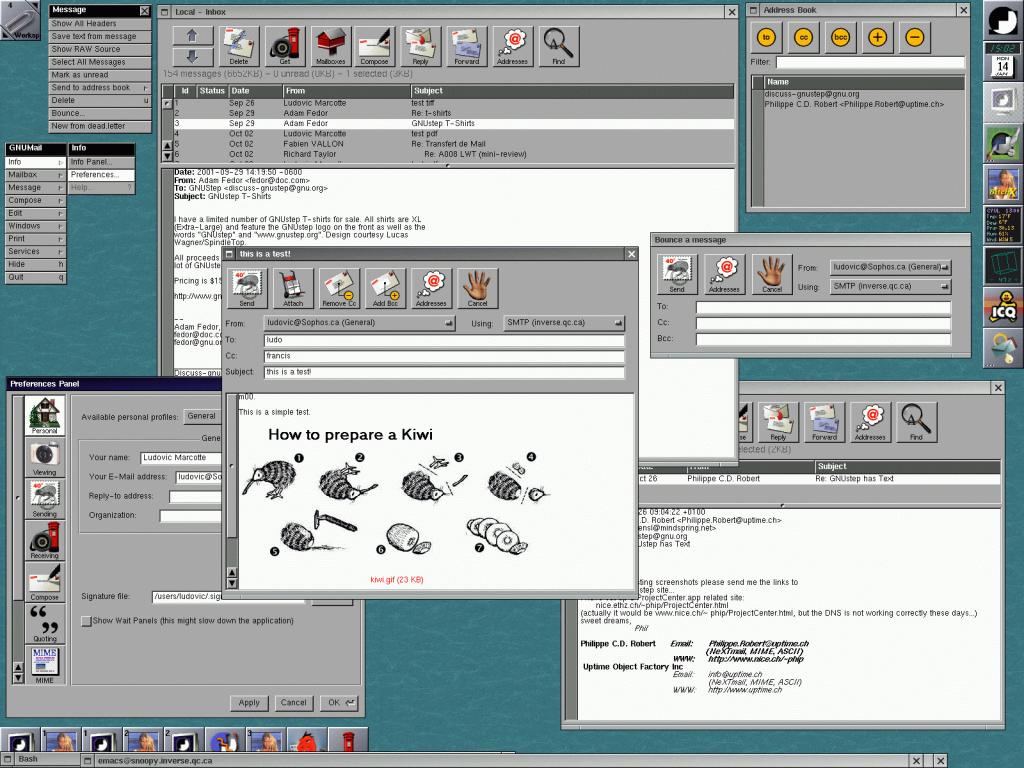
* GNUMail (for GNUstep)
* More at Freshmeat.net > Communications
Perhaps redundant links here and there, but this is a good overal start. I excluded Thunderbird and Mozilla because those are heavily known already. Also, some of the above clients might run on other Unices, other OSes -- including MacOSX and Windows. -
Re:Mac OS X?
One word: GNUStep
Just because nobody has completely implemented the OS X APIs doesn't mean they're not open. Eventually, you may be able to develop an app, GUI and all, on OS X then compile and run it on Linux/BSD/Solaris and *gasp* even Windows.
And if being able to compile all kinds of Unix apps on OS X doesn't make it Unix, I don't now what does.
-
Re:Enterprise/business sales
That's not OpenStep; that's Classic Mac OS. This is OpenStep (or rather, GNUStep, but that's close enough).
-
Re:United linux would succeed if..
GNUStep is the direction *n*x needs to go in order to achieve a more unified look and ease of use.
-
GNUStep
What about using GNUStep?
Adobe could make it advance really fast, if they want to. -
GNUStep
-
Important to note
It's important to note that Window Maker is part of the GNUStep project which is a cross-platform, object-oriented framework for desktop application development, free software implementation of NeXT's OpenStep, which celebrated its 10th birthday on October 19th. For anyone who is interested, there is much more info here.
-
That's great!
Despite being simplistic by today standards, the NeXTStep graphical environment, which WMaker emulates, still is one of the most productive and unintrusive environments ever. And it can look damn good with some proper themes and fine-tuning.
The Xft2 addition is a particularly very welcome one.
This is great news. I hope the integration with GNUStep is a step further too.
-
GNUstep Live CD
It's a pity that, at the peak of the Linux desktop hype in the late 1990s, when evangelists predicted the near death of Microsoft, KDE and Gnome were rushed out of the door, and GNUstep development remained obscure.
Very true...
It is interesting to note that the new GNUstep Live CD was announced on GNUstep Core News in June:
What is it?
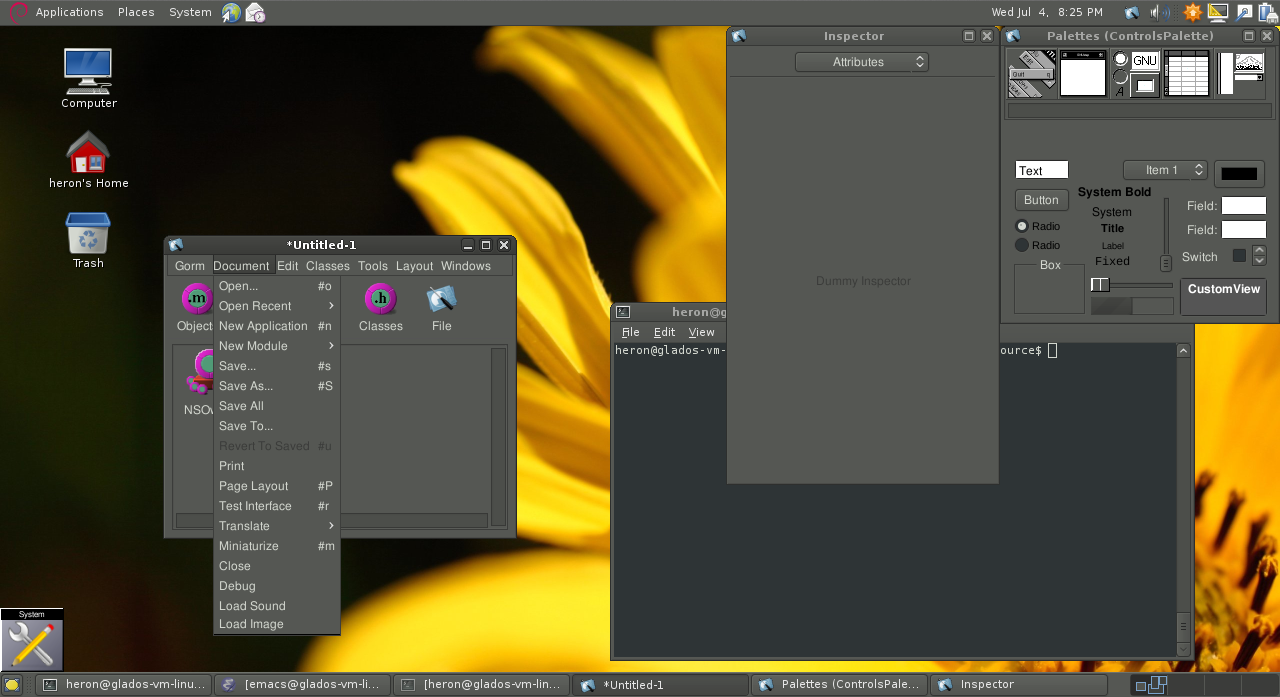
GNUstep Live CD contains a lot of software for GNUstep, a free implementation of the OPENSTEP framework (which was also the base as Cocoa in Mac OS X). Display Postscript is one of its powerful features. It includes an excellent application called Gorm for RAD (Apple Software Design Guidelines). More about the Objective-C Language.Features
Software using GNUstep (Addresses, Agenda, AClock, Affiche, CamelBones, Camera, Charmap, Cenon, Connect, Cynthiune, DisplayCalibrator, EasyDiff, EdenMath, Gridlock, GMines, Gorm, Gomoku, GNUMail, GNUstep-icons, GNUWash, GWorkspace, HelpViewer, ImageViewer, LuserNET, MPDCon, ProjectCenter, PRICE, Poe, Preferences, PlopFolio, Preview, Renaissance, Stepulator, StepTalk, StepBill, Terminal, TalkSoup, TextEdit, ViewPDF, VolumeControl, Waiho, WildMenus, Zipper)In development and not yet on the CD (3DKit, AgentFarms, Burn / CDPlayer, Duncan, Emacs on GNUstep, Encod, Expense, GTAMS, GRASStep GIS, GShisen, GNUstepWeb (WebObjects 4.x), GNUstepWrapper, ILogin, Installer, InnerSpace, LaTeX Service, Localize, MusicKit, MyWiki / MyLibrary, ModPlugPlay, Paje, Pixen, Popup, Position, Rhydot / Skfxdemo, RSS Reader, WebKit / SimpleWWW, Tryst)
The currently used window manager is Window Maker.
Rescue System (lde, gpart, parted, grub, raidtools, portmap, nfs-common, QTParted)
3d Software Blender, Wings3d, Games NetHack, Jump n Bump and SuperTux, LaTeX, TeXmacs, Emacs, GIMP2
Tools (screen, irssi-text, ngrep, tcpdump, openssl, ssh, imagemagick, netpbm, nail, iptraf, mc, gnupg, ibackup, cowsay, hdparm, feh, tetradraw)
The Debian GNU/Hurd K6 mini.iso for easy installation in
C Compiler and development environment
Webbrowsers (dillo, links2), TV Software (xawtv, alevt)
Some music (www.chiptune.com, www.maktone.tk)This is a very interesting project, though of course not as popular as Knoppix.
It was the first time that distributed free software development defected from its proven practice of implementing standardized, proven APIs and technology (like POSIX) and created major APIs of its own. [...] Imagine the massive development efforts on KDE and Gnome, including the massive rewrites of their codebases, would instead had gone into GNUstep, so that the GNU/Linux and *BSD desktop would be OS X/Cocao source compatibile today [and companies developing for OS X port their software to Linux basically with one more compiler run]...
Imagine the efforts on Knoppix would instead had gone into GNUstep Live CD... Imagine the development efforts on Linux would instead had gone into The Hurd... Just imagine... The entire computing world as we know it would be completely different. But what do we expect? People have no idea that GNU even exists, let alone the kernel development! Just few days ago Slashdot posted a story about the Seattle Times interview with Linus Torvalds with this opening paragraph: "Linus Torvalds [pronounced LEE-nus] started a revolution of sorts in the computer industry when he created the Linux operating system and decided to share it with fellow programmer
-
GNUstep Live CD
It's a pity that, at the peak of the Linux desktop hype in the late 1990s, when evangelists predicted the near death of Microsoft, KDE and Gnome were rushed out of the door, and GNUstep development remained obscure.
Very true...
It is interesting to note that the new GNUstep Live CD was announced on GNUstep Core News in June:
What is it?
GNUstep Live CD contains a lot of software for GNUstep, a free implementation of the OPENSTEP framework (which was also the base as Cocoa in Mac OS X). Display Postscript is one of its powerful features. It includes an excellent application called Gorm for RAD (Apple Software Design Guidelines). More about the Objective-C Language.Features
Software using GNUstep (Addresses, Agenda, AClock, Affiche, CamelBones, Camera, Charmap, Cenon, Connect, Cynthiune, DisplayCalibrator, EasyDiff, EdenMath, Gridlock, GMines, Gorm, Gomoku, GNUMail, GNUstep-icons, GNUWash, GWorkspace, HelpViewer, ImageViewer, LuserNET, MPDCon, ProjectCenter, PRICE, Poe, Preferences, PlopFolio, Preview, Renaissance, Stepulator, StepTalk, StepBill, Terminal, TalkSoup, TextEdit, ViewPDF, VolumeControl, Waiho, WildMenus, Zipper)In development and not yet on the CD (3DKit, AgentFarms, Burn / CDPlayer, Duncan, Emacs on GNUstep, Encod, Expense, GTAMS, GRASStep GIS, GShisen, GNUstepWeb (WebObjects 4.x), GNUstepWrapper, ILogin, Installer, InnerSpace, LaTeX Service, Localize, MusicKit, MyWiki / MyLibrary, ModPlugPlay, Paje, Pixen, Popup, Position, Rhydot / Skfxdemo, RSS Reader, WebKit / SimpleWWW, Tryst)
The currently used window manager is Window Maker.
Rescue System (lde, gpart, parted, grub, raidtools, portmap, nfs-common, QTParted)
3d Software Blender, Wings3d, Games NetHack, Jump n Bump and SuperTux, LaTeX, TeXmacs, Emacs, GIMP2
Tools (screen, irssi-text, ngrep, tcpdump, openssl, ssh, imagemagick, netpbm, nail, iptraf, mc, gnupg, ibackup, cowsay, hdparm, feh, tetradraw)
The Debian GNU/Hurd K6 mini.iso for easy installation in
C Compiler and development environment
Webbrowsers (dillo, links2), TV Software (xawtv, alevt)
Some music (www.chiptune.com, www.maktone.tk)This is a very interesting project, though of course not as popular as Knoppix.
It was the first time that distributed free software development defected from its proven practice of implementing standardized, proven APIs and technology (like POSIX) and created major APIs of its own. [...] Imagine the massive development efforts on KDE and Gnome, including the massive rewrites of their codebases, would instead had gone into GNUstep, so that the GNU/Linux and *BSD desktop would be OS X/Cocao source compatibile today [and companies developing for OS X port their software to Linux basically with one more compiler run]...
Imagine the efforts on Knoppix would instead had gone into GNUstep Live CD... Imagine the development efforts on Linux would instead had gone into The Hurd... Just imagine... The entire computing world as we know it would be completely different. But what do we expect? People have no idea that GNU even exists, let alone the kernel development! Just few days ago Slashdot posted a story about the Seattle Times interview with Linus Torvalds with this opening paragraph: "Linus Torvalds [pronounced LEE-nus] started a revolution of sorts in the computer industry when he created the Linux operating system and decided to share it with fellow programmer
-
10 the Magic Number
This is the 10th anniversary of OpenStep announcement on the GNUstep website:
10 the Magic Number
Today, the OpenStep API celebrates its 10th anniversary. What started out as a joint adventure of NeXT and SUN to define an application development standard that would run on all machines, making "write once compile everywhere" a reality, is still unfolding within the vivid and active community of GNUstep, old NeXT and Apple lovers.
The magic 10 appears in GNUstep's current 1.10.x release and in Apple's MacOS X "Cocoa" release. Programmers worldwide can develop their programs on Mac OS, Linux, the BSDs, Solaris, and with a couple of hurdles -- even on Windows. This solid and well-defined standard is reaching out to the world of software development, slowly but surely.
Program your applications in days or weeks, rather than years or never. Use the advanced API of a development framework that hasn't needed significant modification for 10 years, because it rocks, is stable and just works.
Well said...
-
10 the Magic Number
This is the 10th anniversary of OpenStep announcement on the GNUstep website:
10 the Magic Number
Today, the OpenStep API celebrates its 10th anniversary. What started out as a joint adventure of NeXT and SUN to define an application development standard that would run on all machines, making "write once compile everywhere" a reality, is still unfolding within the vivid and active community of GNUstep, old NeXT and Apple lovers.
The magic 10 appears in GNUstep's current 1.10.x release and in Apple's MacOS X "Cocoa" release. Programmers worldwide can develop their programs on Mac OS, Linux, the BSDs, Solaris, and with a couple of hurdles -- even on Windows. This solid and well-defined standard is reaching out to the world of software development, slowly but surely.
Program your applications in days or weeks, rather than years or never. Use the advanced API of a development framework that hasn't needed significant modification for 10 years, because it rocks, is stable and just works.
Well said...
-
Re:PARCPlace's Environment Beat It
StepTalk is Smalltalk for GNUStep.
-
Re:Win32 Ports Please!
Apple tried at least twice to induce development of ObjC apps on Win32. OPENSTEP Enterprise was an NT port of the OPENSTEP API, and as the NeXT/Apple transition was taking place, they had a version of Rhapsody to take its place.
GNUStep has a Windows port: ftp://ftp.gnustep.org/pub/gnustep/binaries/windows
They're about the only ObjC effort underway, afik.. -
Re:No gnuSTEP link in the writeup?
Informative?!
The very first link in the article is to GNUstep. Maybe check the links found in the article before griping that the link to GNUstep is not there. Because in fact, there is a link to GNUstep, cleverly disguised as OpenStep API celebrates its 10th anniversary.
-
Re:No gnuSTEP link in the writeup?
Informative?!
The very first link in the article is to GNUstep. Maybe check the links found in the article before griping that the link to GNUstep is not there. Because in fact, there is a link to GNUstep, cleverly disguised as OpenStep API celebrates its 10th anniversary.
-
Re:No gnuSTEP link in the writeup?
Informative?!
The very first link in the article is to GNUstep. Maybe check the links found in the article before griping that the link to GNUstep is not there. Because in fact, there is a link to GNUstep, cleverly disguised as OpenStep API celebrates its 10th anniversary.
-
Re:No gnuSTEP link in the writeup?
Informative?!
The very first link in the article is to GNUstep. Maybe check the links found in the article before griping that the link to GNUstep is not there. Because in fact, there is a link to GNUstep, cleverly disguised as OpenStep API celebrates its 10th anniversary.
-
Re:No gnuSTEP link in the writeup?
Informative?!
The very first link in the article is to GNUstep. Maybe check the links found in the article before griping that the link to GNUstep is not there. Because in fact, there is a link to GNUstep, cleverly disguised as OpenStep API celebrates its 10th anniversary.
-
A couple more links
Read the OpenStep specification. Try a GNUstep Live CD.
-
Re:to understand this in contextOn a side note, it is really quite sad the linux developers are not using/updating openstep.
They are. It's called GNUStep. They could use more help, though.
-
No gnuSTEP link in the writeup?
Why isn't there a link to the GNUstep website in the writeup? You'd think they could link to the GNUstep website in a story that talks about GNUstep. What's with that?
Seriously, next time there's a story that has GNUstep in the writeup, they should probably link the text "GNUstep" to the GNUstep website, which is (of course) www.GNUstep.org. -
No gnuSTEP link in the writeup?
Why isn't there a link to the GNUstep website in the writeup? You'd think they could link to the GNUstep website in a story that talks about GNUstep. What's with that?
Seriously, next time there's a story that has GNUstep in the writeup, they should probably link the text "GNUstep" to the GNUstep website, which is (of course) www.GNUstep.org. -
No gnuSTEP link in the writeup?
Why isn't there a link to the GNUstep website in the writeup? You'd think they could link to the GNUstep website in a story that talks about GNUstep. What's with that?
Seriously, next time there's a story that has GNUstep in the writeup, they should probably link the text "GNUstep" to the GNUstep website, which is (of course) www.GNUstep.org. -
No gnuSTEP link in the writeup?
Why isn't there a link to the GNUstep website in the writeup? You'd think they could link to the GNUstep website in a story that talks about GNUstep. What's with that?
Seriously, next time there's a story that has GNUstep in the writeup, they should probably link the text "GNUstep" to the GNUstep website, which is (of course) www.GNUstep.org. -
No gnuSTEP link in the writeup?
Why isn't there a link to the GNUstep website in the writeup? You'd think they could link to the GNUstep website in a story that talks about GNUstep. What's with that?
Seriously, next time there's a story that has GNUstep in the writeup, they should probably link the text "GNUstep" to the GNUstep website, which is (of course) www.GNUstep.org. -
No gnuSTEP link in the writeup?
Why isn't there a link to the GNUstep website in the writeup? You'd think they could link to the GNUstep website in a story that talks about GNUstep. What's with that?
Seriously, next time there's a story that has GNUstep in the writeup, they should probably link the text "GNUstep" to the GNUstep website, which is (of course) www.GNUstep.org. -
No gnuSTEP link in the writeup?
Why isn't there a link to the GNUstep website in the writeup? You'd think they could link to the GNUstep website in a story that talks about GNUstep. What's with that?
Seriously, next time there's a story that has GNUstep in the writeup, they should probably link the text "GNUstep" to the GNUstep website, which is (of course) www.GNUstep.org. -
I'll be the 1st one to say *iirrk*, take it awayWell, at least on linux/unix gnuStep/OpenStep looks awful.
as a KDE-biased user, I'd rather switch to GNOME, then one of *Em's*
No one can (or should) deny that 'looks actually' matter(s)
So what I'm saying, Ya' better redo those gnuStep/OpenStep widgets for linux/unix, if you'd want 'it must look *fancy* nice/good - before I will use it'--folks
-
Some links about OpenStep/GNUstep/Cocoa ..Some GNUstep links:
- the main GNUstep website
- the GNUstep wiki
- a presentation brochure
- a booklet about GNUstep
- an article introducing GNUstep
Other links, Objective-C and Apple Cocoa -
Some links about OpenStep/GNUstep/Cocoa ..Some GNUstep links:
- the main GNUstep website
- the GNUstep wiki
- a presentation brochure
- a booklet about GNUstep
- an article introducing GNUstep
Other links, Objective-C and Apple Cocoa -
Some links about OpenStep/GNUstep/Cocoa ..Some GNUstep links:
- the main GNUstep website
- the GNUstep wiki
- a presentation brochure
- a booklet about GNUstep
- an article introducing GNUstep
Other links, Objective-C and Apple Cocoa -
Some links about OpenStep/GNUstep/Cocoa ..Some GNUstep links:
- the main GNUstep website
- the GNUstep wiki
- a presentation brochure
- a booklet about GNUstep
- an article introducing GNUstep
Other links, Objective-C and Apple Cocoa