Slashdot Mirror
Domain: gnustep.org
Stories and comments across the archive that link to gnustep.org.
Comments · 601
-
Re:huh
GNUStep has been working on FOSS clones of a lot of NextStep derived technologies. They're not all the way there yet, but it's worth checking out.
-
Re:Open source isn't enough
-
Re:c++?
-
Re:c++?
-
Re:c++?
-
Re:c++?
First, WindowsMaker doesn't use Objective-C, it's written in C. However, GNUstep, which is the open source implementation of the Cocoa frameworks (originally the OpenStep specification, but they're tracking Apple changes) could use more help! Oh, and we support (on *NIX) a superset of the Objective-C language that Apple supports on their products, so I wouldn't say that Obj-C is more limited on Linux.
That said, and I say this as the maintainer of the GNUstep Objective-C implementation, I'd recommend C++, but with the two caveats:
- C++ is not an OO language. It sort-of supports OOP, but writing OO code in C++ is not the natural way of using the language.
- Don't look at any version of the language before C++11. It's just terrible and will damage your brain.
C++11 and C++14 have cleaned up C++ a lot. With shared_ptr and unique_ptr, you can write code with sane memory management. With perfect forwarding, lambdas, and variadic templates, you can write code that has most of the benefits of a late-bound language. I like a lot of Objective-C, but Apple broke the 'simple, orthogonal syntax' when they added declared properties and a few other things. Any successful programming language eventually becomes a mess of compromises and ugly corners. Some, like Python and C++, start that way, but at least C++ has been slowly improving over the last couple of versions.
The one thing where Objective-C is still a clear winner is in writing libraries that want to maintain a stable ABI. This is insanely difficult in C++ because the language doesn't have a clean separation of interface and implementation and relies a lot on inlining and static binding for performance. The down side, of course, is that once you have a library in Objective-C you're limited to consumers who also want to use Objective-C.
Oh, and Qt GUIs suck beyond belief on OS X - not sure what they're like on Windows, but I wouldn't recommend them for a portable UI. Good MVC design and a native UI is the only way to go if you really want a cross-platform GUI app that doesn't suck.
-
Free Cocoa
So would free Swift rely on free Cocoa?
-
Re:RMS needs to get over the GPL
They may have released the compiler front end, they never released their Objective-C runtime library making the code worthless and hard to maintain - apple would publish their updates as required without any of the effort necessary to stay compatible with anything but their own non-GPL runtime.
Fortunately, they don't have a monopoly on Obj-C runtimes.
http://www.gnustep.org/
http://www.cocotron.org/ -
GNUstep UI pictures
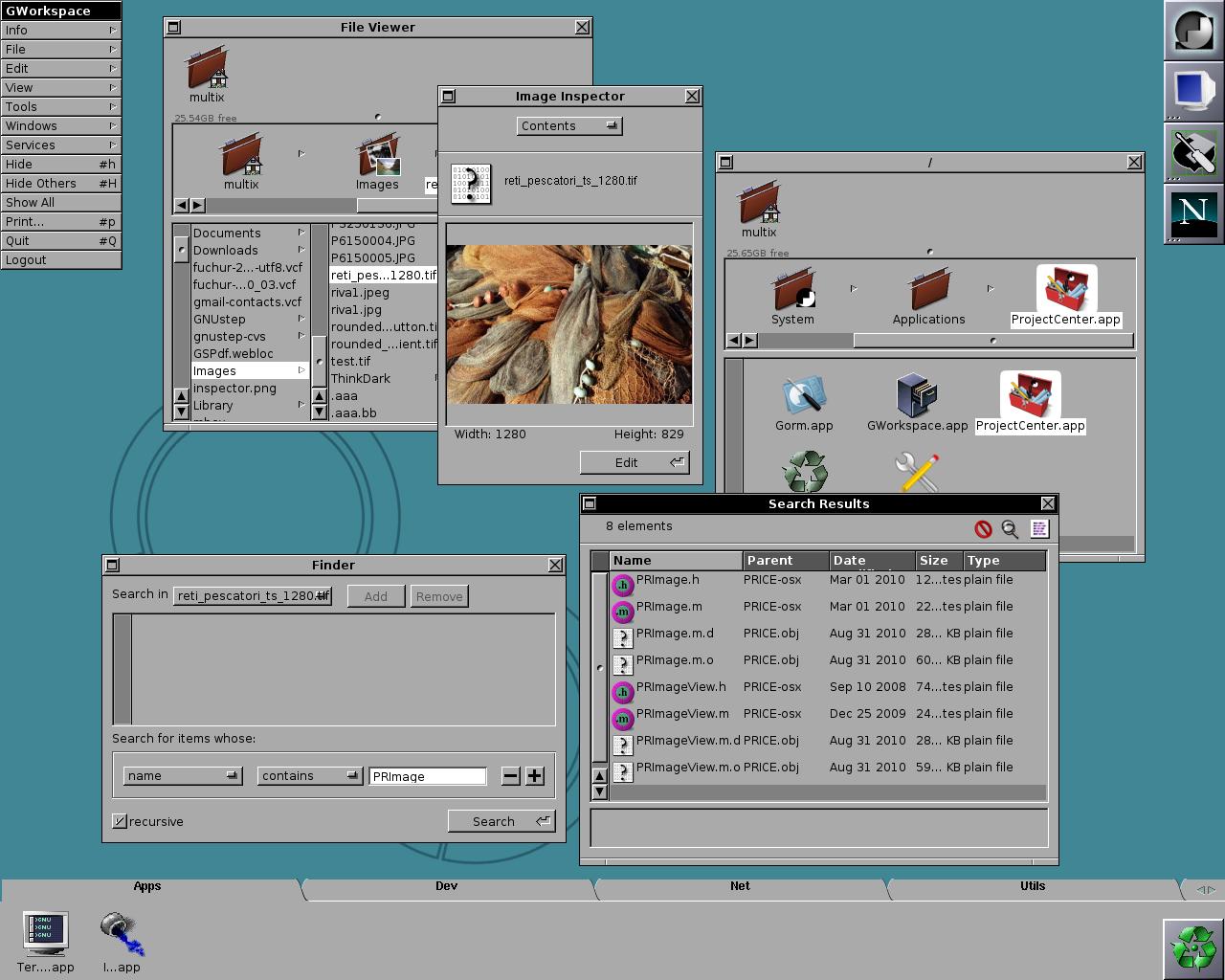
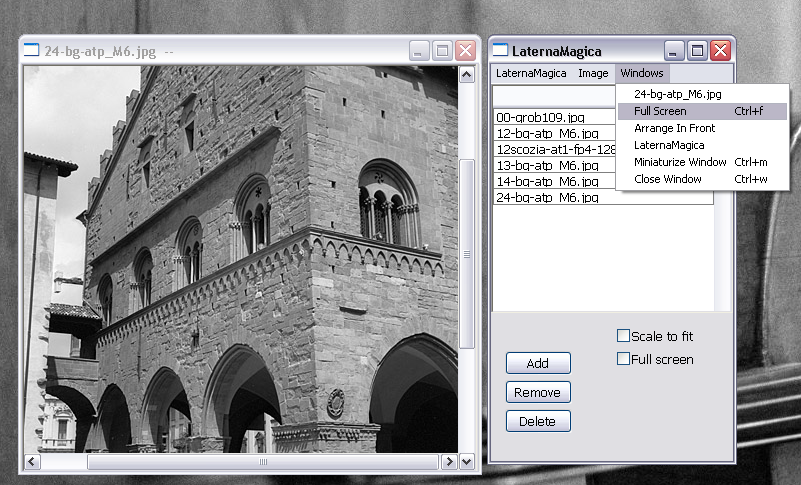
For those who don't know, there are actually multiple ways to run GNUstep's UI There's Macintosh Style: http://www.flickr.com/photos/camaelon/1317405806/lightbox/ There's Next Style: http://www.gnustep.org/images/GWorkspace.jpg And there's Microsoft Windows Style with all menus attached inside of application windows: http://www.gnustep.org/experience/images/lm_xp_themed.png The Classic UI style is only one of many options, you can set which style you prefer in System Preferences.app and it applies across all GNUstep applications automatically. It's better integrated than KDE and Gnome's versions of this. I really want to see webkit get completed,once it's done GNUstep will hae a usable desktop environment for everyday use and it should be a lot more comfortable to boot up on Linux and run it full time as a development/desktop environment. Let's face it, once you've setup X, Sound, and Networking most workstations don't get moved around, and all you really need is browser, text editor, music and video players along with terminal and Remote Desktop. GNUstep already has all of these tools, it's just missing the browser.
-
GNUstep UI pictures
For those who don't know, there are actually multiple ways to run GNUstep's UI There's Macintosh Style: http://www.flickr.com/photos/camaelon/1317405806/lightbox/ There's Next Style: http://www.gnustep.org/images/GWorkspace.jpg And there's Microsoft Windows Style with all menus attached inside of application windows: http://www.gnustep.org/experience/images/lm_xp_themed.png The Classic UI style is only one of many options, you can set which style you prefer in System Preferences.app and it applies across all GNUstep applications automatically. It's better integrated than KDE and Gnome's versions of this. I really want to see webkit get completed,once it's done GNUstep will hae a usable desktop environment for everyday use and it should be a lot more comfortable to boot up on Linux and run it full time as a development/desktop environment. Let's face it, once you've setup X, Sound, and Networking most workstations don't get moved around, and all you really need is browser, text editor, music and video players along with terminal and Remote Desktop. GNUstep already has all of these tools, it's just missing the browser.
-
Re:when software was fast...
I really wish Apple had preserved more of NeXTstep in Mac OS X, or that there were easily accessible options to strip down the features to a parity w/ OPENSTEP 4.2 --- the performance of which on 200MHz+ machines was unbelievable.
William
You can still install OpenStep on a Mac: http://www.gnustep.org/information/openstep.html
I believe most of your old apps should live quite nicely on there. Beyond that, you can also run GNUStep on top of Darwin, if you want to be able to run non-aqua OS X software.
I'd guess that you could probably replace aqua with the GNUStep equivalent too, but that would take a LOT of fiddling, and not really be easily accessible.
Personally, I think that OS X has come a long way since OpenStep 4.2 -- not all changes have been good (stripping NIB files, for example), but the overall architecture is much more solid (which explains the performance hit).
Try GNUStep in VirtualBox and see how it handles your old software; if it does what you want, dual-boot
-
Re:MS undermines Linux by refusing to port Office.
-
Re:It's about damn time
If you look at the source, this is a program designed to compiled by XCode against the Cocoa libraries for use on a Mac (or possibly extended to an iOS device). This is platform specific, though I imagine it could get ported to http://www.gnustep.org/
-
Re:Actual title should be
Well yes. But
PearOS may look a bit like a Mac but doesn't act anything like a Mac.
Gnu Step acts a bit like a Mac but doesn't look like one.
Mix the two, and there might be an alternative. -
Re:C'mon
Actually, a bunch of the APIs aren't even proprietary. A bunch of it is just an evolution of an openly-developed standard, with two companies behind it, that was deployed on multiple operating systems and multiple hardware platforms, and that has an open source implementation today.
http://en.wikipedia.org/wiki/OpenStep
(Not all, sure. But a bunch.)
-
Less is More! Anyone with me?
I'm somewhat of a X desktop transient, switching between KDE, Gnome, and Xfce (variety is the spice of life, and all that rot).
I spend most of my days in Emacs or a term window, and I frankly don't use 90% of the features these desktop managers provide. After a few months with one of the "big three," I always come back to GNUstep. It's totally minimal, and you can do EVERYTHING without touching a mouse. It's as unobtrusive as possible.
Check the wikipedia here, or dig the GNUstep website.
Another option in the "totally minimal" world is xmonad, there's a lot to like here as well. Wikipedia: xmonad,
Or, try the Xmonad website
-
Re:NeXTStep the grand-daddy of all that is now OS
Not entirely limited to Apple:
-
Re:C#
Indeed this is so. You can also compile Objective-C using clang/llvm . See: http://clang.llvm.org/compatibility.html#objective-c . The clang implementation is at feature parity with the Mac OS X 10.7 version of the language, and based on my limited understanding of some comments I've read in various announcements, supports some additional features as well. Use of those features requires the GNUStep Objective-C runtime (libobjc2), rather than the GCC runtime. A high degree of Cocoa compatibility is available using the GNUStep Base (Foundation) and GNUStep GUI (AppKit) libraries, for numerous Unix platforms as well as Windows. A version of CoreFoundation is also available which wraps GNUStep Base, with a rewrite coming very soon that implements CoreFoundation in plain C. Various other Cocoa and iOS-compatible libs are available in disparate states of implementation. As always, GNUStep could use more developers and more users. Companies wishing to port their MacOS software to other platforms are encouraged to investigate GNUStep; previous porting efforts have positively contributed to the project by discovering and reporting bugs and sometimes by providing direct improvements.
GNUStep was recently used to port the Mac-only racing game CoreBreach to Linux: ( http://corebreach.corecode.at/CoreBreach/About.html ). Other visible examples of Cocoa/Objective-C applications ported to Linux from MacOS include the 'eggPlant' automated testing tool from TestPlant ( http://www.testplant.com/ ), and plenty of previously Mac-only Free/Open-Source software such as Bean.app ( http://1.bp.blogspot.com/_2qH5zqXu7wQ/TRi6sNiNZjI/AAAAAAAAADM/i8RwqzQ6OYE/s1600/bean-gnome-theme.png ).
The parent is correct that you do not need Apple kit to develop in Objective-C. To work with most examples you will find, you will need Cocoa-compatible development libraries and tools, though. Interesting starting points include the Windows Installers, which include all of the components you would need to get started ( http://www.gnustep.org/experience/Windows.html ), or the GNUStep Core packages ( http://www.gnustep.org/resources/downloads.php ) for other platforms. The Étoilé Project http://etoileos.com/ is also interesting. Those of you in Europe who are interested and intend on attending FOSDEM should stop by and visit the talks and devroom sponsored by these projects.
-
Re:C#
Indeed this is so. You can also compile Objective-C using clang/llvm . See: http://clang.llvm.org/compatibility.html#objective-c . The clang implementation is at feature parity with the Mac OS X 10.7 version of the language, and based on my limited understanding of some comments I've read in various announcements, supports some additional features as well. Use of those features requires the GNUStep Objective-C runtime (libobjc2), rather than the GCC runtime. A high degree of Cocoa compatibility is available using the GNUStep Base (Foundation) and GNUStep GUI (AppKit) libraries, for numerous Unix platforms as well as Windows. A version of CoreFoundation is also available which wraps GNUStep Base, with a rewrite coming very soon that implements CoreFoundation in plain C. Various other Cocoa and iOS-compatible libs are available in disparate states of implementation. As always, GNUStep could use more developers and more users. Companies wishing to port their MacOS software to other platforms are encouraged to investigate GNUStep; previous porting efforts have positively contributed to the project by discovering and reporting bugs and sometimes by providing direct improvements.
GNUStep was recently used to port the Mac-only racing game CoreBreach to Linux: ( http://corebreach.corecode.at/CoreBreach/About.html ). Other visible examples of Cocoa/Objective-C applications ported to Linux from MacOS include the 'eggPlant' automated testing tool from TestPlant ( http://www.testplant.com/ ), and plenty of previously Mac-only Free/Open-Source software such as Bean.app ( http://1.bp.blogspot.com/_2qH5zqXu7wQ/TRi6sNiNZjI/AAAAAAAAADM/i8RwqzQ6OYE/s1600/bean-gnome-theme.png ).
The parent is correct that you do not need Apple kit to develop in Objective-C. To work with most examples you will find, you will need Cocoa-compatible development libraries and tools, though. Interesting starting points include the Windows Installers, which include all of the components you would need to get started ( http://www.gnustep.org/experience/Windows.html ), or the GNUStep Core packages ( http://www.gnustep.org/resources/downloads.php ) for other platforms. The Étoilé Project http://etoileos.com/ is also interesting. Those of you in Europe who are interested and intend on attending FOSDEM should stop by and visit the talks and devroom sponsored by these projects.
-
Re:GNOME Survey
What is even more ironical, Gnome is still a core GNU project, while even the FSF is recommending GNUstep instead.
I just wish I'd see some distros that offer GNUSTEP as one of the choices of a DE (using the term a bit loosely, since GNUSTEP insists it's not a Desktop on their page) Maybe in addition to KDE, Gnome and XFCE, they should offer the choice of GNUSTEP as a desktop when one logs in. Oh, and if they do that, make it the same experience as was w/ NEXT i.e. one doesn't have to open terminals to do anything
-
Re:iPad's success is simplicity
Big deal. I've seen the same with GUIs bolted onto Linux. Apple has nothing special going on here.
They do have a killer marketing department these days though.
You are so full of shit that I can smell it from here. Listen pal, I used to be a windows both at home and work up until 2002 when Jaguar came out and I bought my first mac (an eMac). I was heavily into the skinning/modding scene before then and I can tell you that a "skin" is only going to give you some of the appearance of OS X but not the functionality. OS X is more than just FreeBSD with with a pretty UI window manager. OS X has a rich set of framework libraries collectively known as Cocoa which even put parts of
I suggest that you at the very least take a look at the the GNUStep project. http://www.gnustep.org/information/aboutGNUstep.html
-
Re:As always...
just look at linux GUI's just a rip of, of Windows.
-1 uninformed, at best
Classic Gnome with customization
Gnome Shell (useful screenshot)
Enlightenment (no screenshots on official site)
GNUstep
Fluxbox
XfceTo continue on-topic: wasn't it just last week when we noted that the Windows Phone marketplace specifically excludes GPL software?
What's with the double line spacing,
-
SUN already messed up NeXT/OPENSTEP Software
Luckily there's GNUstep, however it could be where GNOME/KDE are now. If SUN would have released the Lighthouse Applications: http://www.noodlesoft.com/blog/2007/01/23/the-sun-also-sets/ http://talblog.info/archives/2007/01/sundown.html http://livecd.gnustep.org/ Scott McNealy unfortunately failed to find theses sources... saying he can't find it. I hope Java dies soon. And Sony SNAP gets born... but I doubt, it's SONY.
-
Summary is incorrect
GNUstep's objective is to create a free and open source implementation of the Cocoa libraries, with some additional libraries. It does not target the OpenStep spec, which is antique and obsolete.
Please read the definition -
Re:GPL v2 is compatible with DRM and the appstore
Don't be too quick to defend Apple. The real heroes are the GNUstep people who have given us a Free implementation of a lot of the NeXTSTEP/OPENSTEP/Apple stuff to run on whatever platforms we like.
Give me a break. Do you see that word "OPEN" in OPENSTEP? All the GNUstep people did was re-implement the OPENSTEP platform spec on linux. It was not closed to begin with. There was plenty of documentation on the OPENSTEP platform specification. Where is the spec for windows? Did the Wine project have a spec to implement from or did they have to reverse engineer it through clean room testing?
Let's even take a look at Linux frameworks. While the "CODE" might be "OPEN", there is almost no documentation to allow for a clean room implementation. Code is not a substitute for an open spec.
It is not flamebait. They certainly provided a number of great tools in the past but what have they done lately other than threaten and sue other people? Have you noticed the move away from GCC toward LLVM because of the concerns over GCC going to GPL V3?
Ironically, RMS does not seem to get that companies are NOT the enemy of open source. Some of the most successful projects have been funded by and worked on by corporations. The GPL V3 is a huge step backwards for the open source movement.
Some people have to work for a living because they don't have rich parents to live off of.
-
Re:GPL v2 is compatible with DRM and the appstore
Don't be too quick to defend Apple. The real heroes are the GNUstep people who have given us a Free implementation of a lot of the NeXTSTEP/OPENSTEP/Apple stuff to run on whatever platforms we like.
As for the FSF "spreading FUD and outright lies about their own license" - that's just wrong.
RMS and his cohorts have done more to damage the general OSS movement with their radical FOSS brand than MSFT did through SCO.
And that's complete flamebait. RMS and his cohorts have created a Free software ecosystem and provide the vision and leadership that has kept it thriving despite the cynical corporate and political assaults it has been subjected to over the years.
-
Re:square peg, round hole
Native platform independence was already a solved problem through OpenStep. In fact, the web itself was born out of OpenStep.
What is most interesting is that most of the modern web app frameworks (Cappuccino, SproutCore, etc.) are based on the work of OpenStep. Funny how we continually reinvent the wheel.
-
Re:Write Portable Code
-
Re:Getting screwed in both directions
-
Re:Work backward
What you want isn't really practical. Obj-C is essentially an Apple only language now. But it is possible and in fact supported:
-
Re:Work backward
What language would you suggest? Keep in mind that Objective-C is C. If you can compile C on your target device, you can compile Objective-C to the same device. The only other option on the iPhone for native development is C++.
Objective-C has a long history of portability. OpenStep, an open standard for GUI applications, implementations were implemented atop Objective-C. You'll find numerous open source implementations of the Foundation and AppKit libraries that you may use on non-Apple devices. Granted, the open source UIKit implementations are immature at best. Even Java was heavily inspired by Objective-C.
Yes, using Objective-C and UIKit might make porting your code to another platform difficult. Of course there is nothing stopping you from implementing UIKit yourself. But otherwise, Objective-C is a fantastic choice if portability is a concern.
-
Re:Friendly names for FHS folders
If [...] the community or a man page tells you to edit something in ~/etc/foo/bar, but your seeing
Perhaps putting the subtitle on a different line and in a lighter and/or smaller font would help. Compare how the "Tiles" view in Windows XP uses three lines for the filename, friendly file type name, and byte size or image dimensions.
If someone managed to hash our a decent open OS X-like distro, I would be in love.
Mac OS X is the successor to NeXTstep, and its API is called Cocoa, the successor to OPENSTEP. GNUstep is an implementation of OPENSTEP and parts of Cocoa. So would a Debian-based distribution with Window Maker and GNUstep apps be a good start? See also other thoughts on products that can be built out of GNUstep.
-
Re:It doesn't exhibit natural popularity.
But more than the language I enjoy Apple's APIs. They are very consistent and nicely done. I know it wasn't always like this
You might be surprised. Take a look at the OpenStep specification and see how much is familiar. Apple has filed off a few rough edges, but a lot of Cocoa has not changed in almost two decades.
-
Re:huh?
Cocoa and Openstep seems virtually the same. OpenStep is the spec. But with GNUstep you can also develop applications for Cocoa that run on other operating systems. Pretty awsome. I wish Gnustep would implement Cocoa.
-
GNU Cocoa
Mac is also only using Unix underpinnings, it has plenty of other APIs that a game may be using - e.g. Cocoa and OpenCL.
Which should ease a port to Linux because Linux has parts of Cocoa. Or what am I missing?
-
Re:The first thing to come to my mind...
And what does this mean for us Linux users? OSX and Linux are both Unix variants
Mac OS X native apps use a different toolkit from the vast majority of apps for Linux and the free BSDs. This toolkit is called Cocoa (formerly OpenStep). GNUstep is a Free clone of parts of Cocoa, intended for source compatibility, not binary compatibility like Wine.
-
Re:Visual Studio replacement on Linux
Try an Interface / Project Builder replacement instead:
InterfaceBuilder.app clone:
http://www.gnustep.org/experience/Gorm.html
ProjectBuilder.app clone:
http://www.gnustep.org/experience/ProjectCenter.html
NeXT used to charge $4,995 / developer seat for such tools --- now one can get them for free (even w/ a Mac, one can get a free on-line membership in the Developer's Connection and download the latest version)
William
-
Re:Visual Studio replacement on Linux
Try an Interface / Project Builder replacement instead:
InterfaceBuilder.app clone:
http://www.gnustep.org/experience/Gorm.html
ProjectBuilder.app clone:
http://www.gnustep.org/experience/ProjectCenter.html
NeXT used to charge $4,995 / developer seat for such tools --- now one can get them for free (even w/ a Mac, one can get a free on-line membership in the Developer's Connection and download the latest version)
William
-
Re:Visual Studio replacement on Linux
Try an Interface / Project Builder replacement instead:
InterfaceBuilder.app clone:
http://www.gnustep.org/experience/Gorm.html
ProjectBuilder.app clone:
http://www.gnustep.org/experience/ProjectCenter.html
NeXT used to charge $4,995 / developer seat for such tools --- now one can get them for free (even w/ a Mac, one can get a free on-line membership in the Developer's Connection and download the latest version)
William
-
Re:Linux has more users and software
I assume you are looking for a server. If it's for a desktop, more users and software help a lot. Although BSD and Solaris are more reliable indeed, the intricately, meticulously designed user-oriented design interface of Linux provides details and config files enough to entertain for generations. I have never tried out GnuStep, however an open source nextstep-like interface seems promising.
"Meticulously designed"?!?!?!
What interface are you using, and where did you find it?
-
Linux has more users and software
I assume you are looking for a server. If it's for a desktop, more users and software help a lot. Although BSD and Solaris are more reliable indeed, the intricately, meticulously designed user-oriented design interface of Linux provides details and config files enough to entertain for generations. I have never tried out GnuStep, however an open source nextstep-like interface seems promising.
-
Re:"Systems" language?
Objective-C appears to have it's points, but all the texts on it I've been able to find are very heavy into Apple specific libraries, and so useless.
Huh? This sure doesn't look that Apple specific to me...
-
osx open source -- coming?
all this might get more attention and developers for osx open source alternatives, such as gnustep, Objective C, Darwin, bonjour, etc. More importantly, I think the advance of OSX and Ubuntu provide some important examples for Linux/Open Source. More usability gets more users. When you're programming, it's tempting, and easier, to say "users have to learn more", instead of "the interface is hard to use, true".
-
Pod person?
While you could recompile Unix stuff for MacOS, the Apple faithful would tend to scream at you like pod person for it.
So what do they call you when you recompile Mac OS X stuff for UNIX? An "iPod person"?
MacOS is successful specifically because for 20 years it was NOT unix.
Neither is GNU, which stands for "GNU's not UNIX".
-
Re:Ummm... what?
Apple didn't introduce it, they inherited it. The NSSpellChecker class, which wraps the System Service which provides spell checking was part of the original OpenStep specification back in '94. It may have been included with NeXTSTEP before then, but I don't have a copy of NeXTSTEP 3.3 to check. Of course, that doesn't contradict your point that it's embarrassing for other platforms not to include it (GNUstep does on *NIX, wrapping aspell).
-
Re:open source bits
The most important GPL software in Mac OS X is arguably the GNU compiler, gcc.
Not anymore. GCC on Apple is a Dead Man Walking, because Apple won't work with the GPLv3, which the FSF's GCC project has already upgraded to.
Apple is a major contributor to the LLVM project
Of course, because this is what they intend to replace GCC with, and when this happens GCC-on-Apple and ObjC-in-GCC both go into a slow death spiral. Apple has already ceased providing any significant patches to the FSF GCC project. For example, GCC still doesn't support ObjC v2, two years after its release. There just doesn't appear to be enough developer interest outside of Apple to keep FSF GCC updated.
Apple's implementation of the Cocoa Framework is not an open source framework, but it is based on an open specification, although it has evolved past the specification.
If it has evolved *past* an open specification, and is not open source, then its not open... anything. So your point is?
There is an alternative, open source implementation
there is no hope of GNUstep guaranteeing that we shall maintain compatibility with an Apple API that is constantly changing
Cocoa is full-on, closed-source, proprietary... full-stop. GNUSTEP would have the same problem Mono has (always playing catchup to MS's changes), only worse: they can't even look at the code. So they don't even try. Ergo:
GnuStep != Cocoa
There. Fixed it for you.
Not Exactly.
-
open source bits
Many of the UNIX command line utilities are based on open source projects covered by a BSD (or similarly entirely free license), and some are covered by GPL licenses (which are more restrictive and by simple definition are thus less "free" or "open"). The most important GPL software in Mac OS X is arguably the GNU compiler, gcc. Apple is a major contributor to the LLVM project, which will at some point replace gcc as the primary compiler tool chain on the Mac OS X.
Apple has also sponsored a few other interesting open source projects such as Darwin Calendar Server, WebKit, and of course the Darwin UNIX kernel. Most of these projects are covered by a BSD or similar license.
Apple's implementation of the Cocoa Framework is not an open source framework, but it is based on an open specification, OpenStep specification, although it has evolved past the specification. There is an alternative, open source implementation, GnuStep.
There. Fixed it for you. -
open source bits
Many of the UNIX command line utilities are based on open source projects covered by a BSD (or similarly entirely free license), and some are covered by GPL licenses (which are more restrictive and by simple definition are thus less "free" or "open"). The most important GPL software in Mac OS X is arguably the GNU compiler, gcc. Apple is a major contributor to the LLVM project, which will at some point replace gcc as the primary compiler tool chain on the Mac OS X.
Apple has also sponsored a few other interesting open source projects such as Darwin Calendar Server, WebKit, and of course the Darwin UNIX kernel. Most of these projects are covered by a BSD or similar license.
Apple's implementation of the Cocoa Framework is not an open source framework, but it is based on an open specification, OpenStep specification, although it has evolved past the specification. There is an alternative, open source implementation, GnuStep.
There. Fixed it for you. -
Re:This just in..
Apple makes you program in the painful language of Objective C or some other language that Apple deems as necessary but most programmers cry out in agony.
What's wrong with Objective C? You can mix Objective C and "pure" C / C++ in the same project. Any decent C++ programmer can pick up Objective C / Objective C++ in one day of practice[1]. Obj-C is a superset of C, all of your favorite tricks still work. You can program it on Linux or Cygwin using GnuStep and gcc (though admittedly getting it going is kind of a pain). If you really hate it that much, you can get away with writing a pretty thin wrapper of Obj-C to interface to the OSX specific APIs (most of your calls will probably be standard libc calls in C anyway), and have almost all of your code in C/C++. I don't see how it would be an obstacle to anyone.
[1] No True Scotsman would doubt this comment.
-
Re:Objective-C
There is a Openstep implementation (GnuStep) which is avaliable for al major OS. see: http://de.wikipedia.org/wiki/GNUstep
http://gnustep.org/The screenshots lack a bit, but I've heard the stuff is theme-able.