Slashdot Mirror
Domain: googleusercontent.com
Stories and comments across the archive that link to googleusercontent.com.
Stories · 70
-
Diversity At Google Hasn't Changed Much Over the Last Year (cnet.com)
An anonymous reader quotes a report from CNET: Not much changed at Google over the last year when it came to the diversity of the tech giant's workforce. Google released its annual diversity report on Thursday detailing the composition of its workforce. The percentage of female employees rose by .1 percent to 30.9 percent. The percentage of Asian employees grew by 1.6 percent to 36.3 percent. The number of black and Latino employees grew by .1 percent to 2.5 percent and 3.6 percent, respectively.
"Google's workforce data demonstrates that if we want a better outcome, we need to evolve our approach," said Danielle Brown, chief diversity and inclusion officer at Google, in the report. "That's why from now on ownership for diversity and inclusion will be shared between Google's leadership team, People Operations and Googlers. Our strategy doesn't provide all the answers, but we believe it will help us find them." -
Ethereum Startup Vanishes After Seemingly Making $11, Leaves Message: 'Penis' (vice.com)
CaptainDork shares a report from Motherboard: An Ethereum startup called Prodeum disappeared from the web on Sunday after raising a grand total of $11 USD from investors in a crowdsale. Shortly after the website disappeared, a message appeared on its homepage: "penis." Prodeum's website now redirects visitors to the Twitter account of a cryptocurrency trader (they did not immediately respond to our request for comment), and its Twitter account has been deactivated. Prodeum is at least the second Ethereum startup to pull up stakes after raising money from people in events called Initial Coin Offerings, or ICOs, in which a startup funds their enterprise by taking cryptocurrency from people in exchange for digital tokens. Some ICOs have managed to raise millions of dollars, and the last startup to vanish after conducting an ICO -- Confido, which disappeared from the internet in late 2017 -- made off with roughly $374,000. (A message later appeared on Confido's site stating that it would buy back investors' tokens, but it's unclear if that took place.)
Prodeum, by comparison, only seems to have raised $11 based on the Ethereum address that was advertised on Prodeum's site as being the ICO address. (Update: After this article was published the contents of the ICO wallet were sent to another wallet. That wallet contains roughly $100, with the other funds all coming from a single wallet that predates the Prodeum ICO and contains 46 cents.) Prodeum's pitch, according to a cached version of its webpage, was to track vegetables in a supply chain using digital addresses on a blockchain -- a decentralized ledger at the heart of Ethereum and other cryptocurrencies like Bitcoin. As for why the "penis" message was left on its homepage, it may have something to do with the name of the startup. Prodeum is a medication that treats urinary tract infections and other urinary problems... -
ESET Spreading FUD About Torrent Files, Clients (welivesecurity.com)
An anonymous reader writes: ESET has taken fear mongering, something that some security firms continue to do, to a new level by issuing a blanket warning to users to view torrent files and clients as a threat. The warning came from the company's so-called security evangelist Ondrej Kubovic, (who used extremely patchy data to try and scare the bejesus out of computer users (Google cache). Like all such attempts at FUD, his treatise ended with a claim that ESET was the one true source whereby users could obtain "knowledge" to protect themselves. "If you want to stay informed and protect yourself by building up your knowledge, read the latest pieces by ESET researchers on WeLiveSecurity," he wrote. Kubovic used the case of Transmission -- a BitTorrent client that was breached in March and August 2016 with malware implanted and aimed at macOS users -- to push his barrow. But to use this one instance to dissuade people from downloading BitTorrent clients en masse is nothing short of scaremongering. There are dozens, if not more, BitTorrent clients which enjoy much wider usage, with uTorrent being one good example. Kubovic then used the old furphy which is resorted to by those who lobby on behalf of the copyright industry -- torrents are mostly illegal files and downloading them is Not The Right Thing To Do. But then he failed to mention that hundreds of thousands of perfectly legitimate files are also offered as torrents -- for instance, this writer regularly downloads images of various GNU/Linux distributions using a BitTorrent client because it is the more community-friendly thing to do, rather than using a direct HTTP link and hogging all the bandwidth available. -
Sony Using Copyright Requests To Remove Leaked PS4 SDK From the Web (arstechnica.com)
An anonymous reader quotes a report from Ars Technica: Sony appears to be using copyright law in an attempt to remove all traces of a leaked PlayStation 4 Software Development Kit (PS4 SDK) from the Web. That effort also seems to have extended in recent days to the forced removal of the mere discussion of the leak and the posting of a separate open source, homebrew SDK designed to be used on jailbroken systems. The story began a few weeks ago, when word first hit that version 4.5 of the PS4 SDK had been leaked online by a hacker going by the handle Kromemods. These SDKs are usually provided only to authorized PS4 developers inside development kits. The SDKs contain significant documentation that, once made public, can aid hackers in figuring out how to jailbreak consoles, create and install homebrew software, and enable other activities usually prohibited by the hardware maker (as we've seen in the wake of previous leaks of PlayStation 3 SDKs). While you can still find reference to the version 4.5 SDK leak on places like Reddit and MaxConsole, threads discussing and linking to those leaked files on sites like GBATemp and PSXhax, for example, appear to have been removed after the fact. Cached versions of those pages show links (now defunct) to download those leaked files, along with a message from KromeMods to "Please spread this as much as possible since links will be taken down... We will get nowhere if everything keeps private; money isn't everything." KromeMods notes on Twitter that his original tweet posting a link to the leaked files was also hit with a copyright notice from Sony. -
Sony Using Copyright Requests To Remove Leaked PS4 SDK From the Web (arstechnica.com)
An anonymous reader quotes a report from Ars Technica: Sony appears to be using copyright law in an attempt to remove all traces of a leaked PlayStation 4 Software Development Kit (PS4 SDK) from the Web. That effort also seems to have extended in recent days to the forced removal of the mere discussion of the leak and the posting of a separate open source, homebrew SDK designed to be used on jailbroken systems. The story began a few weeks ago, when word first hit that version 4.5 of the PS4 SDK had been leaked online by a hacker going by the handle Kromemods. These SDKs are usually provided only to authorized PS4 developers inside development kits. The SDKs contain significant documentation that, once made public, can aid hackers in figuring out how to jailbreak consoles, create and install homebrew software, and enable other activities usually prohibited by the hardware maker (as we've seen in the wake of previous leaks of PlayStation 3 SDKs). While you can still find reference to the version 4.5 SDK leak on places like Reddit and MaxConsole, threads discussing and linking to those leaked files on sites like GBATemp and PSXhax, for example, appear to have been removed after the fact. Cached versions of those pages show links (now defunct) to download those leaked files, along with a message from KromeMods to "Please spread this as much as possible since links will be taken down... We will get nowhere if everything keeps private; money isn't everything." KromeMods notes on Twitter that his original tweet posting a link to the leaked files was also hit with a copyright notice from Sony. -
Why Doesn't Harvard Want To Talk About Its Mystery Microsoft Azure Project? (geekwire.com)
theodp writes: GeekWire's Tom Krazit reports, "Microsoft Azure appears to have scored a high-profile customer: Harvard University's prestigious CS50 computer science class, not that anybody wants to talk about it." A deleted-today-but-still-cached Microsoft Technical Case Study on the software giant's GitHub account touts the success of a recent DevOps collaboration effort between Microsoft's Azure team and an unnamed "major U.S. research university." "This U.S. university is world-class," explains the case study, "well known for its research and its alumni. For now, they would prefer to remain anonymous, so this document will refer to them as 'the university' (the case study web page, however, is a not-so-anonymous 'CS50.html')." Like many IT projects, there seems to be a disconnect between the software vendor and the client. "The project we defined and delivered was exactly what they were looking for," boasts the case study's three Microsoft authors, who add that "full deployment and migration will wait until summer." Contacted for comment by GeekWire, however, Harvard CS professor extraordinaire David Malan seemed less committed to the relationship. "We're actually still on AWS," Malan wrote, "though most every summer we do tend to re-evaluate our apps' architecture for the coming year, with AWS, Azure, Google, et al. always among the candidates. So no plans yet, but happy to reach out toward summer's end if we've made any decisions!" -
'The Traditional Lecture Is Dead' (wired.com)
Rhett Allain, an Associate Professor of Physics at Southeastern Louisiana University, writing for Wired: What is the traditional lecture? It is a model of learning in which a teacher possesses the knowledge on a given topic and disseminates it to students. This model dates to the beginning of education, when it was the only way of sharing information. In fact, you occasionally still see the person presenting the lecture called a reader, because way back before the internet and even the printing press, a teacher would literally read from a book so students could copy it all down. Now, don't get me wrong. The traditional lecture model worked wonderfully for eons. But it is an outdated idea (free pass for adblockers). Close your eyes and imagine yourself in a college physics course with a professor giving a traditional lecture. Now open your eyes. Did you envision The Best Physics Lecture EVAR? I doubt it. You probably pictured someone droning on and on in front of a chalkboard or PowerPoint presentation. No way that is more engaging or interesting than an episode of The Mechanical Universe , and if you're a teacher who uses traditional lectures, just stop and play the show instead. Everyone will be better off. You may think by now that I think most physics professors are dolts. I promise that's not the case. But traditional lectures simply aren't effective. Research shows students don't learn by hearing or seeing, they learn by doing, a model often called active learning. Physics faculty should start thinking about how they can go beyond just a traditional lecture. There are some easy things they can do (or students can ask them to do) to make learning more engaging. First, make students read the book outside of class, rather than in class. If your lecture merely covers the material in the textbook, why make students buy the textbook? Now, you may put a different spin on the material, but still. You're merely repeating what students can read on their own. Let them do that on their own time, and use the classroom for experiments and demonstrations and so forth. -
CC'ing the Boss on Email Makes Employees Feel Less Trusted, Study Finds (hbr.org)
Do you ever loop your boss when having a conversation with a colleague when his or her presence in the thread wasn't really necessary? Turns out, many people do this, and your colleague doesn't find it helpful at all. From an article: My collaborators and I conducted a series of six studies (a combination of experiments and surveys) to see how cc'ing influences organizational trust. While our findings are preliminary and our academic paper is still under review, a first important finding was that the more often you include a supervisor on emails to coworkers, the less trusted those coworkers feel (alternative link). In our experimental studies, in which 594 working adults participated, people read a scenario where they had to imagine that their coworker always, sometimes, or almost never copied the supervisor when emailing them. Participants were then required to respond to items assessing how trusted they would feel by their colleague. ("In this work situation, I would feel that my colleague would trust my 'competence,' 'integrity,' and 'benevolence.'") It was consistently shown that the condition in which the supervisor was "always" included by cc made the recipient of the email feel trusted significantly less than recipients who were randomly allocated to the "sometimes" or "almost never" condition. Organizational surveys of 345 employees replicated this effect by demonstrating that the more often employees perceived that a coworker copied their supervisor, the less they felt trusted by that coworker. To make matters worse, my findings indicated that when the supervisor was copied in often, employees felt less trusted, and this feeling automatically led them to infer that the organizational culture must be low in trust overall, fostering a culture of fear and low psychological safety. -
Thousands of Fake Google Maps Listings Redirect Users To Fraudulent Sites (bleepingcomputer.com)
An anonymous reader quotes a report from BleepingComputer: Tens of thousands of fake listings are added to Google Maps each month, redirecting users to fraudulent websites selling phony or overpriced services, or are part of some referral scam. Researchers say that 74% of these abusive listings were for local businesses in the U.S. and India, mainly in pockets around certain local hotspots, especially in large metropolitan areas such as New York, Chicago, Houston, or Los Angeles. In most cases, the scheme was simple. A customer in need of a locksmith or electrician would search Google Maps for a local company. If he navigated to the website of a fake business or called its number, a call center operator posing as the business' representative would send over an unaccredited contractor that would charge much more than regular professionals. If a customer's situation were urgent, the contractor would often charge more than the initial agreed upon price. Researchers said that 40.3% of all the listings for fake companies they found focused on on-call services, such as locksmiths, plumbers, and electricians, and were for customers who were desperate to resolve issues. Further, overall, operators of fake listings managed to hijack 0.5% of Google Maps' outbound traffic for the studied period. -
Server Snafu Exposes Ask.com User Search Queries Via Internal Status Page (bleepingcomputer.com)
"The Ask.com search engine went through some sort of technical issue late Friday night, as its servers were exposing the internal Apache server status page, revealing recently processed search queries," reports BleepingComputer. An anonymous reader writes: The issue is now fixed, but a copy of the server status page with some search queries can still be viewed in Google's search engine cache. "Some of the weirdest search queries were collected by users in a Hacker News thread," reports BleepingComputer, adding "As you'd expect, the server page included plenty of searches for porn."
The issue also affected localized Ask.com servers, such as uk.ask.com/server-status, us.ask.com/server-status, and de.ask.com/server-status, but no user data was exposed, as the search queries passed through load balancers and already hid user IPs. -
T-Mobile Raises Deprioritization Threshold To 30GB (tmonews.com)
An anonymous reader quotes a report from TmoNews: T-Mobile's new deprioritization threshold is 30GB of usage in a single billing cycle. While T-Mo didn't make an official announcement about the change, you can see in this cached page that the network management policy says 28GB: "Based on network statistics for the most recent quarter, customers who use more than 28GB of data during a billing cycle will have their data usage prioritized below other customers' data usage for the remainder of the billing cycle in times and at locations where there are competing customer demands for network resources." Navigating to the webpage today now says 30GB. What this change means is that if you use more than 30GB of data in one billing cycle, your data usage will be prioritized below others for the remainder of that billing cycle. The only time that you're likely to see the effects of that, though, is when you're at a location on the network that is congested, during which time you may see slower speeds. Once you move to a different location or the congestion goes down, your speeds will likely go back up. And once the new billing cycle rolls around, your usage will be reset. -
Google 'Strongly' Recommends Against Third-Party Fast Charging Technology On Android (techcrunch.com)
An anonymous reader quotes a report from TechCrunch: Everyone, it seems, is going the fast charging route these days. Thanks to the nearing ubiquity of USB-C on flagship devices, the feature is quickly becoming a standard -- "standard" in the sense that everyone is doing it, not so much that there's any consistency to the tech. All in all, it's a nice addition to manufacturers' newfound focus on battery life. And while Google has embraced its own version on its new Pixel devices, the company's not so keen on letting everyone implement their own version. In newly released Android Compatibility Definition papers issued for Nougat, the company stops short of an outright ban on technologies like Qualcomm's Quick Charge, though it does take a pretty clear stand, "strongly recommend[ing]" against it. At issue, among other things here, is potential compatibility issues with standard USB chargers. Google said in its latest revision of the Android Compatibility Definition Document, "Type-C devices are STRONGLY RECOMMENDED to not support proprietary charging methods that modify Vbus voltage beyond default levels, or alter sink/source roles as such may result in interoperability issues with the chargers or devices that support the standard USB Power Delivery methods. While this is called out as "STRONGLY RECOMMENDED," in future Android versions we might REQUIRE all type-C devices to support full interoperability with standard type-C chargers." -
Why the Silencing of KrebsOnSecurity Opens a Troubling Chapter For the Internet (arstechnica.com)
An anonymous reader quotes a report from Ars Technica: For the better part of a day, KrebsOnSecurity, arguably the world's most intrepid source of security news, has been silenced, presumably by a handful of individuals who didn't like a recent series of exposes reporter Brian Krebs wrote. The incident, and the record-breaking data assault that brought it on, open a troubling new chapter in the short history of the Internet. The crippling distributed denial-of-service attacks started shortly after Krebs published stories stemming from the hack of a DDoS-for-hire service known as vDOS. The first article analyzed leaked data that identified some of the previously anonymous people closely tied to vDOS. It documented how they took in more than $600,000 in two years by knocking other sites offline. A few days later, Krebs ran a follow-up piece detailing the arrests of two men who allegedly ran the service. A third post in the series is here. On Thursday morning, exactly two weeks after Krebs published his first post, he reported that a sustained attack was bombarding his site with as much as 620 gigabits per second of junk data. That staggering amount of data is among the biggest ever recorded. Krebs was able to stay online thanks to the generosity of Akamai, a network provider that supplied DDoS mitigation services to him for free. The attack showed no signs of waning as the day wore on. Some indications suggest it may have grown stronger. At 4 pm, Akamai gave Krebs two hours' notice that it would no longer assume the considerable cost of defending KrebsOnSecurity. Krebs opted to shut down the site to prevent collateral damage hitting his service provider and its customers. The assault against KrebsOnSecurity represents a much greater threat for at least two reasons. First, it's twice the size. Second and more significant, unlike the Spamhaus attacks, the staggering volume of bandwidth doesn't rely on misconfigured domain name system servers which, in the big picture, can be remedied with relative ease. The attackers used Internet-of-things devices since they're always-connected and easy to "remotely commandeer by people who turn them into digital cannons that spray the internet with shrapnel." "The biggest threats as far as I'm concerned in terms of censorship come from these ginormous weapons these guys are building," Krebs said. "The idea that tools that used to be exclusively in the hands of nation states are now in the hands of individual actors, it's kind of like the specter of a James Bond movie." While Krebs could retain a DDoS mitigation service, it would cost him between $100,000 and $200,000 per year for the type of protection he needs, which is more than he can afford. What's especially troubling is that this attack can happen to many other websites, not just KrebsOnSecurity. -
Why the Silencing of KrebsOnSecurity Opens a Troubling Chapter For the Internet (arstechnica.com)
An anonymous reader quotes a report from Ars Technica: For the better part of a day, KrebsOnSecurity, arguably the world's most intrepid source of security news, has been silenced, presumably by a handful of individuals who didn't like a recent series of exposes reporter Brian Krebs wrote. The incident, and the record-breaking data assault that brought it on, open a troubling new chapter in the short history of the Internet. The crippling distributed denial-of-service attacks started shortly after Krebs published stories stemming from the hack of a DDoS-for-hire service known as vDOS. The first article analyzed leaked data that identified some of the previously anonymous people closely tied to vDOS. It documented how they took in more than $600,000 in two years by knocking other sites offline. A few days later, Krebs ran a follow-up piece detailing the arrests of two men who allegedly ran the service. A third post in the series is here. On Thursday morning, exactly two weeks after Krebs published his first post, he reported that a sustained attack was bombarding his site with as much as 620 gigabits per second of junk data. That staggering amount of data is among the biggest ever recorded. Krebs was able to stay online thanks to the generosity of Akamai, a network provider that supplied DDoS mitigation services to him for free. The attack showed no signs of waning as the day wore on. Some indications suggest it may have grown stronger. At 4 pm, Akamai gave Krebs two hours' notice that it would no longer assume the considerable cost of defending KrebsOnSecurity. Krebs opted to shut down the site to prevent collateral damage hitting his service provider and its customers. The assault against KrebsOnSecurity represents a much greater threat for at least two reasons. First, it's twice the size. Second and more significant, unlike the Spamhaus attacks, the staggering volume of bandwidth doesn't rely on misconfigured domain name system servers which, in the big picture, can be remedied with relative ease. The attackers used Internet-of-things devices since they're always-connected and easy to "remotely commandeer by people who turn them into digital cannons that spray the internet with shrapnel." "The biggest threats as far as I'm concerned in terms of censorship come from these ginormous weapons these guys are building," Krebs said. "The idea that tools that used to be exclusively in the hands of nation states are now in the hands of individual actors, it's kind of like the specter of a James Bond movie." While Krebs could retain a DDoS mitigation service, it would cost him between $100,000 and $200,000 per year for the type of protection he needs, which is more than he can afford. What's especially troubling is that this attack can happen to many other websites, not just KrebsOnSecurity. -
Why the Silencing of KrebsOnSecurity Opens a Troubling Chapter For the Internet (arstechnica.com)
An anonymous reader quotes a report from Ars Technica: For the better part of a day, KrebsOnSecurity, arguably the world's most intrepid source of security news, has been silenced, presumably by a handful of individuals who didn't like a recent series of exposes reporter Brian Krebs wrote. The incident, and the record-breaking data assault that brought it on, open a troubling new chapter in the short history of the Internet. The crippling distributed denial-of-service attacks started shortly after Krebs published stories stemming from the hack of a DDoS-for-hire service known as vDOS. The first article analyzed leaked data that identified some of the previously anonymous people closely tied to vDOS. It documented how they took in more than $600,000 in two years by knocking other sites offline. A few days later, Krebs ran a follow-up piece detailing the arrests of two men who allegedly ran the service. A third post in the series is here. On Thursday morning, exactly two weeks after Krebs published his first post, he reported that a sustained attack was bombarding his site with as much as 620 gigabits per second of junk data. That staggering amount of data is among the biggest ever recorded. Krebs was able to stay online thanks to the generosity of Akamai, a network provider that supplied DDoS mitigation services to him for free. The attack showed no signs of waning as the day wore on. Some indications suggest it may have grown stronger. At 4 pm, Akamai gave Krebs two hours' notice that it would no longer assume the considerable cost of defending KrebsOnSecurity. Krebs opted to shut down the site to prevent collateral damage hitting his service provider and its customers. The assault against KrebsOnSecurity represents a much greater threat for at least two reasons. First, it's twice the size. Second and more significant, unlike the Spamhaus attacks, the staggering volume of bandwidth doesn't rely on misconfigured domain name system servers which, in the big picture, can be remedied with relative ease. The attackers used Internet-of-things devices since they're always-connected and easy to "remotely commandeer by people who turn them into digital cannons that spray the internet with shrapnel." "The biggest threats as far as I'm concerned in terms of censorship come from these ginormous weapons these guys are building," Krebs said. "The idea that tools that used to be exclusively in the hands of nation states are now in the hands of individual actors, it's kind of like the specter of a James Bond movie." While Krebs could retain a DDoS mitigation service, it would cost him between $100,000 and $200,000 per year for the type of protection he needs, which is more than he can afford. What's especially troubling is that this attack can happen to many other websites, not just KrebsOnSecurity. -
Oculus Founder Palmer Luckey Is Secretly Funding Trump's Meme Machine (thedailybeast.com)
The founder of Oculus, Palmer Luckey, has backed a pro-Trump political organization called Nimble America that is dedicated to "shitposting" and spreading inflammatory memes about Hillary Clinton. In 2014, Luckey's virtual-reality company, Oculus, was acquired by Facebook for $2 billion. Forbes estimates his current net worth to be $700 million. The Daily Beast reports: "The 24-year-old told The Daily Beast that he had used the pseudonym "NimbleRichMan" on Reddit with a password given to him by the organization's founders. Nimble America says it's dedicated to providing that "shitposting is powerful and meme magic is real," according to the company's introductory statement, and has taken credit for a billboard its founders say was posted outside of Pittsburgh with a cartoonishly large image of Clinton's face alongside the words "Too Big to Jail." "We conquered Reddit and drive narrative on social media, conquered the [mainstream media], now it's time to get our most delicious memes in front of Americans whether they like it or not," a representative for the group wrote in an introductory post on Reddit. Potential donors from Donald Trump's biggest online community -- Reddit's r/The_Donald, where one of the rules is "no dissenters" -- turned on the organization this weekend, refusing to believe "NimbleRichMan" was the anonymous "near-billionaire" he claimed to be and causing a rift on one of the alt-right's most powerful organizational tools. Luckey insists he's just the group's money man -- a wealthy booster who thought the meddlesome idea was funny. But he is also listed as the vice-president of the group on its website. In another post written under Luckey's Reddit pseudonym, Luckey echoes Peter Thiel, the tech billionaire who used his wealth to secretly bankroll Hulk Hogan's lawsuit against Gawker. The Daily Beast adds: "'The American Revolution was funded by wealthy individuals," NimbleRichMan wrote on Saturday. Luckey confirmed to The Daily Beast he penned the posts under his Reddit pseudonym. 'The same has been true of many movements for freedom in history. You can't fight the American elite without serious firepower. They will outspend you and destroy you by any and all means.'" -
Man Who Teaches People How To Repair Their MacBooks Alludes To Apple Lawsuit (gamerevolution.com)
New submitter alzoron writes: After the failure of New York's Fair Repair Act, independent third-party unauthorized Apple repair shops seem to be under attack. Louis Rossmann, owner of Rossman Repair Group, INC has uploaded a somewhat vague video alluding to his Youtube site, where he posts videos about repairing out of warranty repairs, possibly being shut down. Several sources (Reddit, Mac Kung Fu, 9to5Mac) have been speculating about this and whether or not Apple is behind this. Game Revolution reported on the video (Link is to cache version of the site since the report has since been removed), breaking down each section of the video. 6:52: Louis informs viewers that they can download YouTube videos. 7:41: Louis mentions that YouTube channels have a "finite lifespan," often because a large corporation has the power and money to shut them down. 8:42: Louis shares that he's happy when he's lived a difficult life so that he can be strong for the immense challenge that is ahead. 10:06: Louis shares that he is going to have to fight from his point onward. 11:22: Louis states that all his videos may soon be gone. 11:32: Louis mentions that his business may disappear. Given what Louis has mentioned, it's apparent that Louis has been threatened by Apple likely for condemning its policies to a growing subscriber base, but also for showing users how to repair its hardware without going through Apple support.
UPDATE 7/1/16: The headline has been updated to clarify that the lawsuit is unconfirmed. We'll continue to update the story as it develops. -
Google's Self-Driving Cars Now Know When To Honk (engadget.com)
An anonymous reader quotes a report from Engadget: Google's self-driving cars are not only getting smarter by the day, but they're also getting a little bit more polite. According to the project's latest monthly report, the self-driving car team has recently been teaching the car's AI when and how to honk the horn and give the human drivers on the road a helpful heads up. In order to train its honking algorithm, the team tested a variety of honk-worthy situations, like a car backing out of a blind driveway or a car headed the wrong way down a one-way street. At first, the car would play a little honk sound inside the vehicle so engineers could record whether there was a legitimate need for a honk and provide teaching feedback. Once they felt the AI was ready, they let it blare its horn to the world. The report goes on to say Google has "sound-designed the self-driving car's 'hum' so pedestrians and cyclists around the car can hear it coming." The sound increases when the car speeds up, and decreases when the car slows down. -
Doctor Ready to Perform First Human Head Transplant (newsweek.com)
Ross Kenneth Urken, reporting for Newsweek (edited and condensed): Italian neurosurgeon Sergio Canavero had his Dr. Strange moment when he announced he'd be able to do a human head transplant in a two-part procedure he dubs HEAVEN (paywalled, this alternate link could help) (head anastomosis venture) and Gemini (the subsequent spinal cord fusion). [...] Canavero has a plan: It's a 36-hour, $20 million procedure involving at least 150 people, including doctors, nurses, technicians, psychologists and virtual reality engineers. In a specially equipped hospital suite, two surgical teams will work simultaneously -- one focused on Valery Spiridonov (patient) and the other on the donor's body, selected from a brain-dead patient and matched with the Spiridonov for height, build and immunotype. Both patients -- anesthetized and outfitted with breathing tubes -- will have their heads locked using metal pins and clamps, and electrodes will be attached to their bodies to monitor brain and heart activity. Next, Spiridonov's head will be nearly frozen, ultimately reaching 12 to 15 degrees Celsius, which will make him temporarily brain-dead.Shouldn't it be called a body transplant? Since a person is often defined by the brain. You can read the complete procedure here. -
Google Reveals Own Security Regime Policy Trusts No Network, Ever (theregister.co.uk)
Darren Pauli, reporting for The Register: Google sees little distinction between boardrooms and bars, cubicles and coffee shops; all are untrusted under its perimeter-less security model detailed in a paper published this week. The "BeyondCorp model" under development for more than five years is a zero-trust network model where the user is king and log in location means little. Staff devices including laptops and phones are logged into a device inventory service which contains trust information and snapshots of the devices at a given time. Employees are awarded varying levels of trust provided they meet minimum criteria which authors Barclay Osborn, Justin McWilliams, Betsy Beyer, and Max Saltonst all say reduces maintenance cost and improves device usability (PDF). -
Steam Hacker Says More Vulnerabilities Will Be Found (arstechnica.com)
An anonymous reader shares an article on Ars Technica: The teenager who grabbed headlines earlier this week for hacking a fake game listing on to Valve's Steam store says there are "definitely" more vulnerabilities to be found in the popular game distribution service. But he won't be the one to find them, thanks to what he sees as Valve "giv[ing] so little of a shit about people's [security] findings." Ruby Nealon, a 16-year-old university student from England, says that probing various corporate servers for vulnerabilities has been a hobby of his since the age of 11. His efforts came to the attention of Valve (and the wider world) after an HTML-based hack let him post a game called "Watch paint dry" on Steam without Valve's approval over the weekend."It looks like their website hasn't been updated for years," Nealon told Ars. "Compared to even other smaller Web startups, they're really lacking. This stuff was like the lowest of the lowest hanging fruit." -
Microsoft (Briefly) Reveals New Extensions For Edge, Including Reddit and Pinterest (thestack.com)
An anonymous reader writes: A now-inactive page at a Microsoft Azure development sites shows a page that reveals the first two extensions for the Microsoft Edge browser to be Pinterest and a port of the Reddit Enhancement Suite for Google Chrome. The page was identified by Twitter user H0x0d, and is now only accessible via Google Cache. -
Twitter Stock Jumps Nearly 8 Percent After Fake Report
vivaoporto writes: As noted by Re/code and many other outlets, Twitter stock jumped nearly 8 percent after a bogus report, attributed to Bloomberg News, said Twitter had received a $31 billion buyout offer. The fake story, which cited "people with knowledge of the situation," appeared on a website (Google Cache version) made to look like Bloomberg's business news page and claimed the company had received a takeover offer worth $31 billion.
The website domain, bloomberg.market (now suspended), was registered Friday, according to a search of ICANN's records. The identity of the person or company who registered it is not publicly available. Close scrutiny flagged a number of questionable elements in the report, like the name of Twitter's former chief executive, Richard Costolo, being misspelled. By late afternoon, the web page for bloomberg.market was no longer operable. A message posted on the page said, "account suspended." A spokesman for Bloomberg confirmed the takeover article was fake.
In May, a fake bid for another company, Avon Products, sent its shares as much as 20 percent higher. That offer involved a document filed with the Securities and Exchange Commission. Last month the SEC sued a Bulgarian man, Nedko Nedev, and said he and five others worked together to violate securities laws by creating fake takeover offers. Robert Heim, a former lawyer at the SEC, said these kinds of schemes will probably persist because news spreads so fast over social media and traders have to react so quickly. -
Google Releases Report On Autonomous Vehicle Accidents
An anonymous reader writes: Back in May, a report from the Associated Press pieced together information on car accidents that involved autonomous vehicles. Google, the company testing the most self-driving cars on public roads right now, said the automation technology was not at fault in any of the accidents. However, they took criticism for declining to provide any detail. Now, they've changed that stance, releasing specifics on all of the accidents involving their autonomous cars. They set up a new website for releasing monthly reports. According to their first report (PDF), there have been 12 accidents since 2010. The vast majority of them involved another car rear-ending the Google car while waiting at a stop sign/light. There was one incident where another car rolled a stop sign, one in which another car veered into the AV's lane, and one incident where a Google employee driving the car in manual mode rear-ended another car. None of the accidents resulted in an injury. -
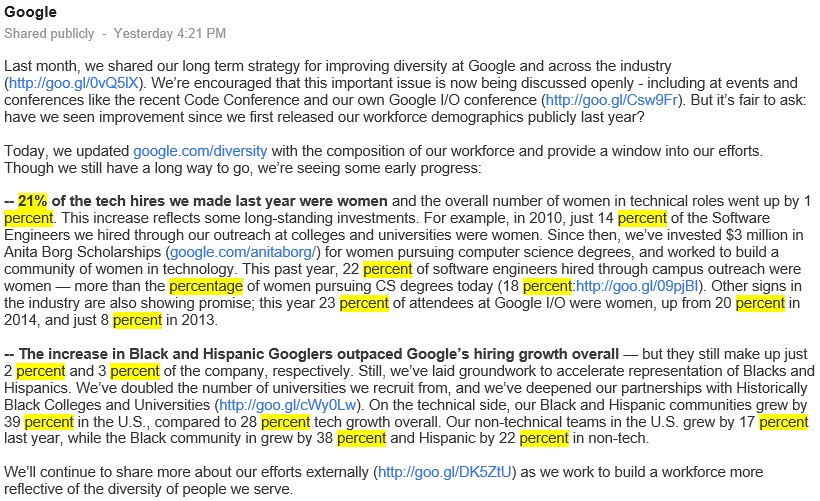
Google Diversity Report Straight Out of 'How To Lie With Statistics' Playbook
theodp writes: Among the books recommended by Bill Gates for beach reading this summer is How to Lie With Statistics, the published-in-1954-but-timely-as-ever introduction to the (mis)use of statistics. So, how can one lie with statistics? "Sometimes it is percentages that are given and raw figures that are missing," explains the book, "and this can be deceptive too." So, does this explain Google's just-released Diversity Report and the accompanying chock-full-o-percentages narrative (find-all-%-image), which boasts "the Black community in grew [sic] by 38 percent", while the less-impressive raw figures — e.g., the number of Google employees increased by 5,928, but the ranks of Black females only increased by 35 (less than 0.6% of the net increase) — are relegated to a PDF of its EEO-1 Report that's linked to in the fine-print footnotes? To be fair to Google, Microsoft, Twitter, Apple and Amazon didn't want people to see their EEO-1 numbers, either. -
The Pioneer Who Invented the Weather Forecast
HughPickens.com writes: Peter Moore has a fascinating article on BBC about how Admiral Robert FitzRoy, the man who invented the weather forecast in the 1860s faced skepticism and even mockery in his time but whose vision of a public forecasting service, funded by government for the benefit of all, is fundamental to our way of life. Chiefly remembered today as Charles Darwin's taciturn captain on HMS Beagle, during the famous circumnavigation in the 1830s, in his lifetime FitzRoy found celebrity from his pioneering daily weather predictions, which he called by a new name of his own invention — "forecasts". There was no such thing as a weather forecast in 1854 when FitzRoy established what would later be called the Met Office. With no forecasts, fishermen, farmers and others who worked in the open had to rely on weather wisdom — the appearance of clouds or the behavior of animals — to tell them what was coming as the belief persisted among many that weather was completely chaotic. But FitzRoy was troubled by the massive loss of life at sea around the coasts of Victorian Britain where from 1855 to 1860, 7,402 ships were wrecked off the coasts with a total of 7,201 lost lives. With the telegraph network expanding quickly, FitzRoy was able to start gathering real-time weather data from the coasts at his London office. If he thought a storm was imminent, he could telegraph a port where a drum was raised in the harbor. It was, he said, "a race to warn the outpost before the gale reaches them".
For FitzRoy the forecasts were a by-product of his storm warnings. As he was analyzing atmospheric data anyway, he reasoned that he might as well forward his conclusions — fine, fair, rainy or stormy — on to the newspapers for publication. "Prophecies and predictions they are not," he wrote, "the term forecast is strictly applicable to such an opinion as is the result of scientific combination and calculation." The forecasts soon became a quirk of this brave new Victorian society. FitzRoy's forecasts had a particular appeal for the horseracing classes who used the predictions to help them pick their outfits or lay their bets.
But FitzRoy soon faced serious difficulties. Some politicians complained about the cost of the telegraphing back and forth. The response to FitzRoy's work was the beginning of an attitude that we reserve for our weather forecasters today. The papers enjoyed nothing more than conflating the role of the forecaster with that of God and the scientific community were skeptical of his methods. While the majority of fishermen were supportive, others begrudged a day's lost catch to a mistaken signal. FitzRoy retired from his west London home to Norwood, south of the capital, for a period of rest but he struggled to recover and on 30 April 1865 FitzRoy cut his throat at his residence, Lyndhurst-house, Norwood, on Sunday morning. "In time, the revolutionary nature of FitzRoy's work would be recognised," says Moore. "FitzRoy's vision of a weather-prediction service funded by government for the benefit of its citizens would not die. In 1871, the United States would start issuing its own weather "probabilities", and by the end of the decade what was now being called the Met Office would resume its own forecasts in Britain." -
Google: Less Than One Percent of Android Devices Are Affected By Harmful Apps
jfruh writes: One of the selling points of iOS is that its more restrictive nature makes it more secure. But even though it's easier for users to accidentally install malicious apps on Android, data collected by Google (PDF) indicates that less than one percent of Android users have actually done so. Quoting: "During October 2014, the lowest level of device hygiene was 99.5% and the highest level was 99.65%, so less than 0.5% of devices had a Potentially Harmful Application (PHA) installed (excluding non-malicious Rooting apps). During that same time period, approximately 0.25% of devices had a non-malicious Rooting application installed. ... Worldwide, excluding non-malicious Rooting applications, PHAs are installed on less than 0.1% of devices that install applications only from Google Play. Non-rooting PHAs are installed on approximately 0.7% of devices that are configured to permit installation from outside of Google Play. Additionally, the second graph shows devices with any PHA (including Rooting applications). Rooting applications are installed on about 0.5% of devices that allow sideloading of applications from outside of Google Play." -
Google Backs Off Default Encryption on New Android Lollilop Devices
An anonymous reader writes: Although Google announced in September 2014 that Android 5.0 Lollipop would require full-disk encryption by default in new cell phones, Ars Technica has found otherwise in recently-released 2nd-gen Moto E and Galaxy S6. It turns out, according to the latest version of the Android Compatibility Definition document (PDF), full-disk encryption is currently only "very strongly recommended" in anticipation of mandatory encryption requirements in the future. The moral of the story is: don't be lazy — check that your full-disk encryption is actually enabled. -
NASA Looking At Nuclear Thermal Rockets To Explore the Solar System
MarkWhittington writes: Officially, NASA has been charged with sending astronauts to Mars sometime in the 2030s. Toward that end, according to a story in Universe Today, space agency engineers at the Marshall Space Flight Center are looking at an old concept for interplanetary travel, nuclear thermal engines. "...according to the report (cached), an NTP rocket could generate 200 kWt of power using a single kilogram of uranium for a period of 13 years – which works out of to a fuel efficiency rating of about 45 grams per 1000 MW-hr. In addition, a nuclear-powered engine could also provide superior thrust relative to the amount of propellant used." However, some doubts have been expressed whether NASA will be granted the budget to develop such engines. -
Philae Lands Successfully On Comet
The European Space Agency has confirmed that the Philae probe has successfully landed on the comet 67P/Churyumov–Gerasimenko and established contact with headquarters. The harpoons have deployed and reeled in the slack, and the landing gear has retracted. (Edit: They're now saying the harpoons didn't fire after all.) There are no photos from the surface yet, but the Rosetta probe snapped this picture of Philae after initial separation, and Philae took this picture of Rosetta. Emily Lakdawalla has a timeline of the operation (cached). She notes that there was a problem with the gas thruster mounted on top of the lander. The purpose of the thruster was to keep the lander on the comet after landing, since there was a very real possibility that it could bounce off. (The comet's local gravity is only about 10^-3 m/s^2.) The pins that were supposed to puncture the wax seal on the jet were unable to do so for reasons unknown. Still, the jet did not seem to be necessary. The official ESA Rosetta site will be continually updating as more data comes back. -
Russia Prepares For Internet War Over Malaysian Jet
An anonymous reader writes The investigation of a Malaysian passenger jet shot down over Ukrainian rebel held territory is heating up. U.S. and U.K. news organizations are studiously trying to spread the blame, Russian ITAR, which, just earlier today was celebrating the downing of a large aircraft by rebel missiles in Torez (Google cache) is reporting that the rebels do not have access to the missiles needed for such attacks. The rebel commander who earlier today reported the downing of the aircraft has also issued a correction to earlier reports that they had captured BUK air defense systems with Russian sources now stating that the rebels do not posses such air defenses. The Ukrainian president has been attempting to frame the incident as a "terrorist attack". President Obama made contact with Vladimir Putin and has been instead treating it as an accident, calling it a "terrible tragedy" and saying that the priority is investigating whether U.S. citizens were involved. With control of the black box and its own internet propaganda army Russia may be in a good position to win the propaganda war. -
Canonical (Nearly) Halts Development of Ubuntu For Android
rjmarvin (3001897) writes "In a since-removed bug report on Launchpad, Ubuntu's issue tracker, Canonical's Matthew Paul Thomas stated that Ubuntu for Android is no longer in active development. In a statement, Canonical stated that while the project is not completely dead, Canonical is currently focusing on pushing Ubuntu for Phones. The company is open to working with partners on Ubuntu for Android, but will not proceed with further U4A development unless they can form a partnership with an OEM partner to launch it. The Ubuntu for Android project was first announced in early 2012." -
Star Wars: Episode VII Cast Officially Announced
eldavojohn writes: "Word was leaking this week of some familiar faces in London hanging out together. Finally today an official cast listing for Star Wars Episode VII was handed down from on high to us mere mortals (Google Cache and Onion AV recap available). From the short release, 'Actors John Boyega, Daisy Ridley, Adam Driver, Oscar Isaac, Andy Serkis, Domhnall Gleeson, and Max von Sydow will join the original stars of the saga, Harrison Ford, Carrie Fisher, Mark Hamill, Anthony Daniels, Peter Mayhew, and Kenny Baker in the new film.' Let's not bicker and argue about who shot first but instead come to an agreement on expected levels of almost certain disappointment. No, this will not feature the Expanded Universe (EU) — you can now refer to those tales as 'Legends' which are not part of Star Wars canon. Instead prepare yourself for what will likely be the mother of all retcon films." -
China Prosecuted Internet Policeman In Paid Deletion Cases
hackingbear writes: "In China, censorship is not just about politics; it's also a vibrant business. Police in Beijing have detained at least ten people, including employees at web giant Baidu and a web censor working at the Beijing Municipal Public Security Bureau (cached version), over allegations that they deleted defamatory online posts about companies and government enterprises in return for money, the Beijing News reports. The case was first surfaced when Baidu noticed and reported several of its workers' illegal activities. From 2010 to 2012, Gu, an ex-Baidu employee, is believed to have deleted over 2,000 posts on Baidu, 500 on news site Sohu and 20 posts on qianlong.com, with over 2 million yuan ($322,000) reportedly changing hands. While Gu can delete negative Internet posts for topics ranging from environmental issues to product quality problems on behalf of companies, he could not delete posts relating to his government clients. So he paid and asked Liu, a Beijing Municipal Public Security Bureau web censor, to issue official orders to the web sites to remove the posts (Google translation of Chinese original). Liu was found to have accepted 770,000 yuan ($124,000) from Gu for deleting posts. He also received 150,000 yuan ($24,000) from other sources." -
High-Frequency Trading For Your Private Data
New submitter fierman writes "In a work to be presented at the Network and Distributed System Security Symposium (ISOC NDSS'14), INRIA researchers show the privacy risks of Real-Time Bidding (PDF) and High-Frequency Trading for selling advertisement spaces. Combining Real-Time Bidding and Cookie Matching, advertisers can significantly improve their tracking and profiling capabilities. Both technologies are already prevalent on the Web. The research discusses the value of users' private data (browsing history) retrieved directly from the advertisers, leveraging an exposed information leak in RTB systems. Advertisers will pay about $0.0005 to display a targeted ad to a single user, while at the same time acquiring information about them. The research also shows evidence of price variation with users' profiles, physical location, time of day and content of visited sites." -
HHS-Run Website Hacked To Hawk Boots, Perfumes, and NFL Jerseys
cold fjord writes with this excerpt from the Weekly Standard: "A portion of the website of the Substance Abuse and Mental Health Services Administration (SAMHSA) was apparently hacked as long as two months ago. SAMHSA is an agency of the Department of Health and Human Services (HHS). HHS also runs the new Obamacare insurance marketplace, Healthcare.gov. Dozens of pages hawking retail merchandise have been uploaded to the SAMHSA site, ranging from NFL jerseys to Ugg shoes to Armani fragrances. ... Shortly after this story was posted, the site nace.samhsa.gov returned an error message saying that the site could not be found. Later, the following message appeared on the site (misspelling included): 'This site is undgoing maintenance. We are sorry for any inconvenience this has caused you.'" (Screenshots in the story; Cached example from Google.)" -
Amazon "Unlaunches" & Postpones $100,000 Civic Apps Contest For AWS
reifman writes "In an unusual move, Amazon abruptly pulled the plug on its $100,000 Civic Apps contest for AWS, redirecting contestants to the AWS government site. All entrants through October 15th were to receive a $50 AWS credit. Amazon AWS PR says they, '...accidentally pushed this out early, but please stay tuned for more information on this program later this year.' The contest site, rules (pdf) and FAQ (pdf) of the apparently still upcoming contest can be read from the google cache. Contest prize winners would have had to 'spend' their AWS credits by December 2014." -
Amazon "Unlaunches" & Postpones $100,000 Civic Apps Contest For AWS
reifman writes "In an unusual move, Amazon abruptly pulled the plug on its $100,000 Civic Apps contest for AWS, redirecting contestants to the AWS government site. All entrants through October 15th were to receive a $50 AWS credit. Amazon AWS PR says they, '...accidentally pushed this out early, but please stay tuned for more information on this program later this year.' The contest site, rules (pdf) and FAQ (pdf) of the apparently still upcoming contest can be read from the google cache. Contest prize winners would have had to 'spend' their AWS credits by December 2014." -
Amazon "Unlaunches" & Postpones $100,000 Civic Apps Contest For AWS
reifman writes "In an unusual move, Amazon abruptly pulled the plug on its $100,000 Civic Apps contest for AWS, redirecting contestants to the AWS government site. All entrants through October 15th were to receive a $50 AWS credit. Amazon AWS PR says they, '...accidentally pushed this out early, but please stay tuned for more information on this program later this year.' The contest site, rules (pdf) and FAQ (pdf) of the apparently still upcoming contest can be read from the google cache. Contest prize winners would have had to 'spend' their AWS credits by December 2014." -
FBI Admits It Controlled Tor Servers Behind Mass Malware Attack
MikeatWired writes "It wasn't ever seriously in doubt, but the FBI yesterday acknowledged that it secretly took control of Freedom Hosting last July, days before the servers of the largest provider of ultra-anonymous hosting were found to be serving custom malware designed to identify visitors. Freedom Hosting's operator, Eric Eoin Marques, had rented the servers from an unnamed commercial hosting provider in France, and paid for them from a bank account in Las Vegas. It's not clear how the FBI took over the servers in late July, but the bureau was temporarily thwarted when Marques somehow regained access and changed the passwords, briefly locking out the FBI until it gained back control. The new details emerged in local press reports from a Thursday bail hearing in Dublin, Ireland, where Marques, 28, is fighting extradition to America on charges that Freedom Hosting facilitated child pornography on a massive scale. He was denied bail today for the second time since his arrest in July. On August 4, all the sites hosted by Freedom Hosting — some with no connection to child porn — began serving an error message with hidden code embedded in the page. Security researchers dissected the code and found it exploited a security hole in Firefox to identify users of the Tor Browser Bundle, reporting back to a mysterious server in Northern Virginia. The FBI was the obvious suspect, but declined to comment on the incident. The FBI also didn't respond to inquiries from WIRED today. But FBI Supervisory Special Agent Brooke Donahue was more forthcoming when he appeared in the Irish court yesterday to bolster the case for keeping Marque behind bars." -
Could Technology Create Modern-Day 'Leper Colonies'?
theodp writes "Back in the day, leprosy patients were stigmatized and shunned, quarantined from society in Leper Colonies. Those days may be long gone, but are our mapping, GPS, and social media technologies in effect helping to create modern-day 'Leper Colonies'? The recently-shuttered GhettoTracker.com (born again as Good Part of Town) generated cries of racism by inviting users to rate neighborhoods based on 'which parts of town are safe and which ones are ghetto, or unsafe'. Calling enough already with the avoid-the-ghetto apps, The Atlantic Cities' Emily Badger writes, "this idea toes a touchy line between a utilitarian application of open data and a sly wink toward people who just want to steer clear of 'those kinds of neighborhoods.'" The USPTO has already awarded avoid-crime-ridden-neighborhoods-like-the-plague patents to tech giants Microsoft, IBM, and Google. So, when it comes to navigational apps, where's the line between utility and racism? 'As mobile devices get smarter and more ubiquitous,' writes Svati Kirsten Narula, 'it is tempting to let technology make more and more decisions for us. But doing so will require us to sacrifice one of our favorite assumptions: that these tools are inherently logical and neutral...the motivations driving the algorithms may not match the motivations of those algorithms' users.' Indeed, the Google patent for Storing and Providing Routes proposes to 'remove streets from recommended directions if uploaded route information indicates that travelers seem to avoid the street.' Even faster routes that 'traverse one or more high crime areas,' Google reasons, 'may be less appealing to most travelers'." -
The Shortest Internet Censorship Debate Ever
rysiek writes "When a politician starts talking about defending the innocence of children, there's bound to be a great policy initiative ahead. That's how British PM David Cameron introduced the British porn block. That's also how the Polish Minister of Justice started his remarks yesterday morning on how good an idea it is and that it should be introduced in Poland. This started the shortest Internet censorship debate ever, as in the evening of the same day the Polish Prime Minister and the Minister of Administration and Digitization denounced any such ideas: 'We shall not block access to legal content regardless of whether or not it appeases us aesthetically or ethically.' There had been several full-blown Internet censorship debates in Poland during the last four years. Apparently the arguments against it were not lost on at least some of Polish politicians." -
Nokia Engineer Shows How To Pirate Windows 8 Metro Apps, Bypass In-app Purchases
MrSeb writes "The principal engineer for Nokia's WP7 and WP8 devices, Justin Angel, has demonstrated, in rather frank detail, how to pirate Windows 8 Metro apps, how to bypass in-app purchases, and how to remove in-game ads. These hacks aren't exactly easy, but more worryingly they're not exactly hard either. Angel shows that turning a trial version of a Metro app into the full version — i.e. pirating an app — is scarily simple. It's just a matter of downloading an open-source app and changing an XML attribute from 'Trial' to 'Full.' Likewise, a quick change to a XAML file can remove an app's ads. Bypassing in-app purchases is a little trickier, involving some reverse engineering of some DLLs and and decryption of database files, but Angel still makes it look fairly easy. Angel gives himself one million credits in Soulcraft, an RPG game — something that would cost you over a thousand dollars, if you performed a legitimate in-app purchase. Angel also demonstrates a way to bypass in-app purchases in WinJS (Metro/JavaScript) apps, by injecting scripts into IE10 (the rendering engine for WinJS apps). It's easy to blame Microsoft for this, but isn't this really an issue that is intrinsic to all installed applications? The fact is, Windows 8 Metro apps are stored on your hard drive — and this means that you have access to the code and data. Hex editors, save game editors, bypassing Adobe's 30-day trials by replacing DLL files, pirating Windows 8 apps — these are all just different incarnations of the same attack vectors." -
Free Registrar co.cc Goes the Way of the Dodo
First time accepted submitter Nexus Unplugged writes "Free domain provider co.cc seems to have quietly and mysteriously disappeared. No official explanation has yet been provided, but a cached copy suggest that they stopped accepting new registrations some time ago. Speculation, however, seems to come to a single conclusion. From the article: 'Due to its free nature (and it's $10 for as many as you want), Co.CC was abused and used for scams and spamming and was even de-listed by Google at one point although they did re-enable it. Getting back to the article on hand a few days ago Co.CC seems to have removed its DNS records which ultimately has stops its own site from working and every sub domain it provided.' It's worth noting that free domains are still easily obtainable from places like DotTK." -
US Election's Only VP Debate Tonight: Weigh In With Your Reactions
Tonight's debate between the two largest American political parties' candidates for vice president of the United States takes place at Danville, Kentucky's Centre College, starting at 9 p.m. Joe Biden and Paul Ryan will face each other on stage, and are expected to talk about issues "including the economy, foreign policy and the role of the Vice President," according to C-SPAN, which will feature a live streaming view of the event. (Criteria from the Commission on Presidential Debates means you won't hear tonight from other presidential candidates' running mates (like Cheri Honkala, Jim Clymer, and James Gray, of the Green, Constitution, and Libertarian party tickets, respectively). If you'll be watching the debate tonight, please add your commentary below. It would be helpful if you start your comment's title with a time-stamp (to the minute), too, for context. (Like this: "9:08: $Candidate just intentionally mis-repeated the Q on taxes.") And Yes, we're posting this here in a vain attempt to keep the political discussion out of other story threads tonight. Update: 10/12 01:18 GMT by U L : If you don't have flash, you can use rtmpdump and mplayer to watch (incantation duplicated below, in case the site is slashdotted).Via Don Armstrong an incantation to watch the debate without flash:
rtmpdump -v -r rtmpt://cp82346.live.edgefcs.net:1935/live?ovpfv=2.1.4 \
--tcUrl rtmp://cp82346.live.edgefcs.net:1935/live?ovpfv=2.1.4 \
--app live?ovpfv=2.1.4 --flashVer LNX.11,2,202,238 \
--playpath CSPAN1@14845 \
--swfVfy http://www.c-span.org/cspanVideoHD.swf \
--pageUrl http://www.c-span.org/ | \
mplayer -xy 3 -;
-
Tennessee Crater Inches Toward Recognition
tetrahedrassface writes "Slashdot carried the story of an-as-yet unverified impact crater in Tennessee a couple of years ago. After a few weeks of fairly hardcore sample taking, digging, obtaining some good images and manipulating them, I'm proud to report the first batch of evidence in favor of it being an impact site. The primary smoking gun is the presentation of an astrobleme, obtained from High Resolution Ornithographic Images taken in 2008. Also of note are the melted/deformed rocks, magnetic crater dust, and the fitment of the crater rim to a circle. A rented plane and a bunch of photographs today and it's pretty obvious that it's a crater, folks. Cheers!" -
Tennessee Crater Inches Toward Recognition
tetrahedrassface writes "Slashdot carried the story of an-as-yet unverified impact crater in Tennessee a couple of years ago. After a few weeks of fairly hardcore sample taking, digging, obtaining some good images and manipulating them, I'm proud to report the first batch of evidence in favor of it being an impact site. The primary smoking gun is the presentation of an astrobleme, obtained from High Resolution Ornithographic Images taken in 2008. Also of note are the melted/deformed rocks, magnetic crater dust, and the fitment of the crater rim to a circle. A rented plane and a bunch of photographs today and it's pretty obvious that it's a crater, folks. Cheers!" -
Tennessee Crater Inches Toward Recognition
tetrahedrassface writes "Slashdot carried the story of an-as-yet unverified impact crater in Tennessee a couple of years ago. After a few weeks of fairly hardcore sample taking, digging, obtaining some good images and manipulating them, I'm proud to report the first batch of evidence in favor of it being an impact site. The primary smoking gun is the presentation of an astrobleme, obtained from High Resolution Ornithographic Images taken in 2008. Also of note are the melted/deformed rocks, magnetic crater dust, and the fitment of the crater rim to a circle. A rented plane and a bunch of photographs today and it's pretty obvious that it's a crater, folks. Cheers!" -
Tennessee Crater Inches Toward Recognition
tetrahedrassface writes "Slashdot carried the story of an-as-yet unverified impact crater in Tennessee a couple of years ago. After a few weeks of fairly hardcore sample taking, digging, obtaining some good images and manipulating them, I'm proud to report the first batch of evidence in favor of it being an impact site. The primary smoking gun is the presentation of an astrobleme, obtained from High Resolution Ornithographic Images taken in 2008. Also of note are the melted/deformed rocks, magnetic crater dust, and the fitment of the crater rim to a circle. A rented plane and a bunch of photographs today and it's pretty obvious that it's a crater, folks. Cheers!" -
Polish MP Returns iPad Citing Lack of Control
rysiek writes "Polish MP and spokesperson for one of Polish political parties Dariusz Joski returned his state-issued iPad, citing lack of control (Google-translated). Polish Free and Open Source Software Foundation (of Anti-ACTA fame) offered (free of charge, of course) to help him choose, install and configure Linux on his laptop, including setting-up disk encryption. We are still waiting for an answer from the MP." Another concern of his appears to have been a lack of security regarding communications with other government officials.