Slashdot Mirror
Domain: grammarbook.com
Stories and comments across the archive that link to grammarbook.com.
Comments · 34
-
Re: Big FSorry. I am wrong. You are correct.
-
Re:Summary of the debate - what Oxford comma is
Yes it does.
From the opening of: https://www.grammarbook.com/pu...
"Commas and periods are the most frequently used punctuation marks. Commas customarily indicate a brief pause; they're not as final as periods."
A comma is typically read as a brief pause in a sentence. Even if it's grammatically correct to only have the one comma, the single pause very much implies that Bill and Al are the strippers as it reads like they are grouped together. A pause between Bill and Al's names very nicely breaks them up making it very clear that we are reading a sequential list.
Or as another way of approaching this, think of how the sentence would be read out loud. The brief pause you would use between "strippers" and "Bill" is the same you would use between "Clinton" and "and Al". Try saying the sentence out loud with out that suttle pause between Bill and Al and the sentence takes on a very different meaning. The Oxford Comma simply reflects this pause both verbally, and in the reader's head.
As for your German interpretation of the Oxford Comma, that's irrelevant. If German were shaped to "make sense" to English speakers I'm sure all sorts of rules would go out the window. Likewise with any language relative to any other.
-
Re:Headline correct; summary wrong
-
Re:for a minute there i thought i had freedom.
Some corrections to your post:
1. Windows 10 isn't an open platform because the OS will uninstall your programs if they are not Microsoft's preference. Cf. https://tech.slashdot.org/stor...
2. The telemetry that was backported to Windows 7 can be uninstalled by denying certain updates. Cf. https://gist.github.com/xvital...
3. According to American style, the question mark only goes inside the quotation marks if a question is the substance of what is being quoted. Cf. http://www.grammarbook.com/pun... -
Re:Sorry, can't help myself.
I just got done typing up a nice, long response with links, quotes, explanations, and details...and then I hit Refresh and lost it.
So, here are some of the links. I've provided a super quick summary of what you can take away from them.
Either is acceptable: http://www.grammarbook.com/pun...
Either is acceptable: https://owl.english.purdue.edu...
The Associated Press and Chicago handle it differently: http://www.apvschicago.com/201...
Strunk says keep the "s" unless dealing with ancient names: http://www.bartleby.com/141/st...
Others care more about sibilance: https://en.wikipedia.org/wiki/...You'll find plenty of adherents to each of those approaches. Which is to say, it's a matter of style, not correctness, with various groups recommending various styles. Your way is a safe way to go, and there's nothing wrong with it. Others prefer to ditch characters that are viewed as unnecessary or that can create awkward phrasings.
-
Re:And for good reason
"Evangelical/Pentecostal-Charismatic Christian" ah, well, there's the real problem right there. They've got to maintain their feelings of persecution, and don't feel like a real person unless someone is trying to "nail them to the cross". I love how they capitalize Black US President, per grammerbook.com "white and black in reference to race are lowercase". The feeling of it all is invoking making all the defendants look like their all a huge group of conspiring racists without actually specifically saying so.
-
Whom you trust ... ?
Who vs. Whom
This rule is compromised by an odd infatuation people have with whom -- and not for good reasons. At its worst, the use of whom becomes a form of one-upmanship some employ to appear sophisticated. The following is an example of the pseudo-sophisticated whom.
http://www.grammarbook.com/gra... -
Re:Star Wars Sucks!
Speaking of shit, you should probably look at this:
-
Re:The Unanswered Question
Apparently you have a very hard time with the present tense, but fear not, you can fix it here:
http://www.grammarbook.com/ -
Re: Me too!
The law mandates that the Federal Government should implement the exchange marketplace for states that opt not to. As you might say, "it is the law of the land".
Try reading this, it will help you: http://www.grammarbook.com/punctuation/capital.asp -
Re:hope it was worth the megan's law list
According to a wiki perhaps, but I and others disagree. IRregardLESS is a double negative.
According to many sites (like this one), regardless is the correct version. -
Re:Bad Slashdot
How is a COMMA not a substitute for AND?
http://www.grammarbook.com/punctuation/commas.asp -- See rule #2.
Did you fail English, or are you simply ignorant as due to being ESL? Either way, now you know -- and knowing is half the battle!
HTH, HAND -- your local grammar nazi.
-
Re:Bad Slashdot
How is a COMMA not a substitute for AND?
http://www.grammarbook.com/punctuation/commas.asp -- See rule #2.
Did you fail English, or are you simply ignorant as due to being ESL? Either way, now you know -- and knowing is half the battle!
HTH, HAND.
-
Re:(A) Clever. (B) Boring.
"I won't call you a punctuation nazi, because Nazis at least made an effort to know their own rules."
I have. You are wrong, and Purdue has its head up its ass. Here are just a few other references:
Grammar Book
Your Dictionary
Davis School District K-12 usage guide
Georgia Southern University Writing Center
In Wikipedia's entry on it, the mentions of using it for plurals lack citations. But the refutations of those usages do have citations.
The vast majority of evidence and authority is on my side. You lose. Try again. -
Re:fucking apostrophes, how do they work?
I don't know, how do fucking apostrophes work? I'm a descriptivist. I don't judge either way. I like your way better but that doesn't make you right any more than me liking communism makes Marx right.
-
Re:Stupid to leave this to the Chinese.
The future lies at the feet of whom have energy in [v]ast amounts.
The future lies at the feet of whoever has energy in vast amounts.
Whom is correct in 'the feet of whom', because it is not acting as the subject of a verb phrase. However, in the example above, it also serves as the subject of 'have' in the second part of the sentence. The phrase could be expanded to:"The future lies at the feet of them who have energy in vast amounts."
Note that there is an objective case pronoun for the 'feet of' prepositional phase, and a subjective case pronoun for the 'have energy in vast amounts' verb phrase. According to this reference, that compiles down to 'whoever'.
I'm not trolling, or trying to be a grammar Nazi. It's a tricky sentence, and an easy mistake to make. I just try to spread the good word of proper grammaticality wherever I go. -
Re:Probability
While you were being snarky, you put a period outside of a quote. Now you just look like a dumb-ass.
-
Re:Only one thing to do
-
Re:No, Seriously...
People who correct other's grammar, usage, or spelling should be more careful than to place a quotation mark after a period, at least in American English.
http://www.grammarbook.com/punctuation/quotes.aspMaybe we all need to take ourselves less seriously.
-
Re:Please Drop the Us V Them Mentality
Oh! Another context-challenged logician splitting hairs, how nice.
Please, read my previous response:
http://slashdot.org/comments.pl?sid=1277369&cid=28427099By the way, here are some rules on capitalization:
http://www.grammarbook.com/punctuation/capital.aspShall we call it a day now?
-dZ.
-
Re:Um, he is phony!
By the way, punctuation goes inside the quote.
Not always. Question marks go inside the quote only if the quote is asking a question (Rule 2). In this case, they were not, so his usage is correct. -
Re:Oh dear
Periods and commas always go inside quotation marks, even inside single quotes.
Man, keep talking like that and your code is never compiling...
-
Re:Oh dear
"Should've" = "Should have".
Periods and commas always go inside quotation marks, even inside single quotes.
That depends which country you're from: http://en.wikipedia.org/wiki/Quotation_mark#Punctuation
-
Re:Oh dear
"Should've" = "Should have".
Periods and commas always go inside quotation marks, even inside single quotes.
-
Re:stick to english
Perhaps even more important than learning a foreign language is learning to write well in English. Few people, especially in technical fields, really learn how to write at a professional level. Research requires a lot of writing, usually in a highly specialized style and format. Take the time to really learn English grammar, punctuation, and usage. Familiarize yourself with a variety of writing styles. A course in technical writing might be worth taking.
Some good online resources include the following:
http://www.grammarnow.com/
http://www.grammarbook.com/english_rules.asp
http://www.towson.edu/ows/ -
Re:Some people think bilingualism is bad
protocol and telling you what the rules are, but take a look at this to see how you're wrong there as well:
http://en.wikipedia.org/wiki/Prescriptive [wikipedia.org]
It's obviously stupid to say that "the TCP/IP RFC's are prescriptivist nonsense!" Why can't you see that the same as true with Standard English, another communication protocol? You're avoiding the issue by claiming that there are different standards since they are separated only by geography. You can use Standard American English in the U.S. and RP in Britain in order to be correct in both places. The differences in the versions of the standards almost never result in ambiguity, though, so following one version of the standard is good enough to allow for natural language processing by any competent reader (native or otherwise). If you don't follow the standard, you make it harder for readers to understand you, especially those who
If your issue is that comprehending this protocol is difficult for you, there are several sources available in print and online you can use to educate yourself. Here's a pretty good one:
http://www.grammarbook.com/ [grammarbook.com]
You've been following the standard well in your posts here, so you must understand what it is. If you understand the standard and use it to communicate effectively -
Re:Some people think bilingualism is bad
Sorry, but ad-hominem attacks won't make your argument correct. I don't particularly care about the latest fads in academic linguistics anyway, since I'm looking at a communication protocol and telling you what the rules are, but take a look at this to see how you're wrong there as well:
http://en.wikipedia.org/wiki/Prescriptive
It's obviously stupid to say that "the TCP/IP RFC's are prescriptivist nonsense!" Why can't you see that the same as true with Standard English, another communication protocol? You're avoiding the issue by claiming that there are different standards since they are separated only by geography. You can use Standard American English in the U.S. and RP in Britain in order to be correct in both places. The differences in the versions of the standards almost never result in ambiguity, though, so following one version of the standard is good enough to allow for natural language processing by any competent reader (native or otherwise). If you don't follow the standard, you make it harder for readers to understand you, especially those who
If your issue is that comprehending this protocol is difficult for you, there are several sources available in print and online you can use to educate yourself. Here's a pretty good one:
http://www.grammarbook.com/
You've been following the standard well in your posts here, so you must understand what it is. If you understand the standard and use it to communicate effectively -
Re:Not quite surprising!
You know, these kids have to learn their crappy skills from somewhere-namely their parents. Most of these kids these days have terrible spelling, grammar and reading comprehension skills. I see that especially on
Of course, proofreading helps too, but only if you know what you're trying to fix.
I'm old enough now to have a child that would be posting on this site and others. If I found him doing these atrocious things (rest assured, I'd be nonplussed at the fact he'd be doing that with the family name!), I'd correct him immediately.
Unfortunately, this generation is all about instant satisfaction-common sense and respect be damned. I truly hate having to read some of these Slashdotter's comments because I don't speak ebonics or AOLspeak, sorry. My parents taught me English.
I'm not that damn lazy. -
Re:Goodness...
Sloppyjoes7, you are right.
Reference 1
Reference 2
Reference 3
Point being. I am a nerd, and therefore I am Intellectually Superior. Therefore I will obey the rules of C++, Grammar, and Mathematics (in that order). -
Re:Europeans, mod this up right now!!
-
Re:"How looks"
(The first of 3 times you ignored an obvious joke.)
I just didn't get your jokes. Obviously, we have different senses of humor.
I'll let you check your dictionary to see that printed means "created by pressing or stamping onto a surface".
Dictionaries are notoriously out of date when it comes to usage related to computers. This is just one example. But I will try to use the phrase "the written word" in the future.
The fact that both "one-way" and "one-time" are dictionary words doesn't remove the unhypenated forms from valid English.
Your use was improper. You should always hyphenate between two adjectives when they come before a noun and act as a single idea. See the grammarbook.com.
But you missed the point: The edits show that one can correct errors without misrepresenting what the writer said.
This is akin to Dan Quayle's infamous potato/potatoe spelling-bee incident.
Don't be so hard on yourself. You just failed to capitalize and puntuate properly.
It was a joke. (Finding the 3rd one is up to you. Don't waste your time on it, though)
But what if the third one was actually humorous and I miss out?
Slashdot already has a reputation for lagging in articles, they can't afford to delay it further by more editing.
I have submitted stories and hours and hours go by before they are reviewed. Taking two minutes to edit three or four sentences isn't going to make a substantive difference in timeliness.
I just wish the bulk of readers didn't have to be burdened with language trivia, educational as it may be.
Then perhaps you should stop contributing to the "language trivia." But I'm willing to have the last word if you're willing to let me. -
Re:Jebus!Please read this book too. Thanks.
--
-
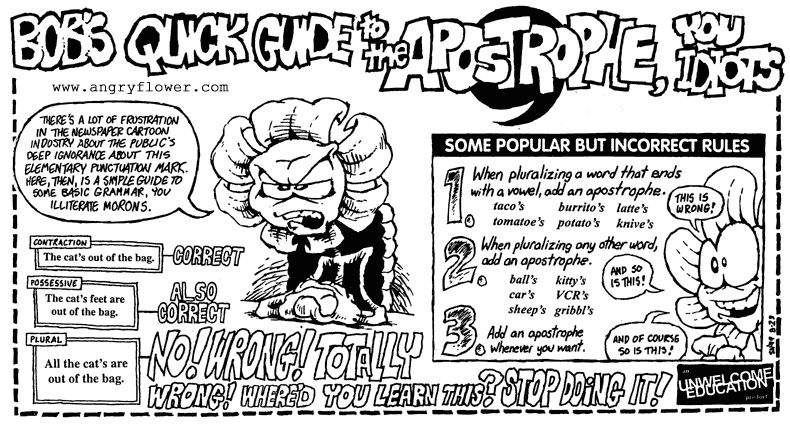
Re:On correct use of apostrophes
No, it is correct.
Following the rules you get Adams's, as you say, but since that is hard to say (Adams-es) the last s is dropped to give Adams'.
The form used in the article (Adam's) is completely wrong regardless because his name is Adams.
See Rule 4 at http://www.grammarbook.com/punctuation/apostro.htm l -
Re:Grammar Nazi, again.
Using an apostrophe to show plurals of numbers, letters, and figures is optional.
That being said, I'm opting not to use it because it looks freaky weird to write VCR's.