Slashdot Mirror
Domain: grida.no
Stories and comments across the archive that link to grida.no.
Comments · 230
-
That's going to make things worse
Contrary to popular belief, the population growth rate in developed countries is nearly zero. Nearly all of the world's population growth is happening in developing countries, and Africa has the highest growth rate by far. So as well-intentioned as these humanitarian measures are (saving babies, food, medicine, clean water, etc), they actually exacerbate the suffering of these people. Medicine, clean water, and saving babies will cause their population to increase faster than it should be growing, forcing them to spread already-limited resources even thinner. Food aid puts local farmers out of business by depressing the market value of their crops, and discouraging others from taking up farming.
The correct way to help them is to help them develop their economies - improve their education systems (that's what the One Laptop per Child project was trying to do), help them build their civil infrastructure, keep criminals and militants in check, and promote private businesses. Then they can train their own doctors, build their own hospitals, grow their own food, pump their own clean water, and save their own babies. As barbaric as it sounds, right now the babies need to die at a high rate to keep their population growth in check. The high infant mortality rate there is symptom of their undeveloped economy. Treating the symptom with addressing the root cause just exacerbates the problem and their suffering. -
Re:climate change deniers (you!)
Rapid changes in global temperatures can absolutely cause mass extinctions.
Rising sea levels are "easy" to adapt to for us - but not cheap. We have a lot of valuable property on low-lying coastal areas, and billion-dollar floods from storm surges will only get more common, until we either build massive levees (where possible) or start relocating vast amounts of city infrastructure. Who gets stuck with that bill, the taxpayers? Owners of private homes who can no longer insure them? And that's assuming it doesn't turn out to be a lot worse than we expected.
Rising sea levels are not so easy to adapt to for the hundreds of millions in less-developed countries, where e.g. tens of millions of people depend on river delta farmland that will get flooded with salt water. (BTW, claiming there's no evidence of that is simple denial).
As for food production, the research shows both positives and negatives up until about 3K warming - and then highly likely to be negative after 3 degrees. It also shows that again, developing countries are least able to adapt and will experience more of the negatives (in part due to lower latitudes).
it is going to happen no matter what policies we adopt
Citation certainly needed for that. Sure we're stuck at 400ppm and probably higher, but we can still avoid far larger increases by phasing out fossil carbon as soon as practical. We're locked in to significant warming and we'll have to deal with that, but it will certainly get far worse (and far more expensive) if we stick our heads in the sand. The business-as-usual case is likely to see 3.7 to 4.5 degrees this century - much higher than the 2.0-2.5 we're hoping we can keep it to.
-
Re:Interesting study
I kind of misspoke when I wrote that. The 0.2% is the difference between maximum solar forcing and minimum solar forcing in a Maunder Minimum scenario given the Sun's variability so the potential change is more like half of that.
I found several sources that seem to disagree with you:
http://www.pnas.org/content/10...
http://www.grida.no/climate/ip...
https://www.ipcc.ch/publicatio... -
Re:Any materialized predictions? (Re:Sudden?)
First of all, the IPCC issues projections, not predictions.
Second of all, you're a partisan hack and you wouldn't accept evidence that goes against your biases if it flooded your own house.
But okay: info gathered from http://www.skepticalscience.co...
The IPCC First Assessment Report (FAR) was published in 1990.
FAR Scorecard
The IPCC FAR 'Best' BAU projected rate of warming from 1990 to 2012 was 0.25ÂC per decade. However, that was based on a scenario with higher emissions than actually occurred. When accounting for actual GHG emissions, the IPCC average 'Best' model projection of 0.2ÂC per decade is within the uncertainty range of the observed rate of warming (0.15 ± 0.08ÂC) per decade since 1990, though a bit higher than the central estimate.
The IPCC Second Assessment Report (SAR) was published in 1995.
SAR Scorecard
The IPCC SAR IS92a projected rate of warming from 1990 to 2012 was 0.14ÂC per decade. This is within the uncertainty range of the observed rate of warming (0.15 ± 0.08ÂC) per decade since 1990, and very close to the central estimate.
The IPCC Third Assessment Report (TAR) was published in 2001.
TAR Scorecard
The IPCC TAR Scenario A2 projected rate of warming from 1990 to 2012 was 0.16ÂC per decade. This is within the uncertainty range of the observed rate of warming (0.15 ± 0.08ÂC) per decade since 1990, and very close to the central estimate.TAR Scorecard
The IPCC TAR Scenario A2 projected rate of warming from 1990 to 2012 was 0.16ÂC per decade. This is within the uncertainty range of the observed rate of warming (0.15 ± 0.08ÂC) per decade since 1990, and very close to the central estimate.
I won't go on copying and pasting as it's 100% certain you'll not be convinced - I'm doing this for those that do have an open mind and are interested in evidence.
Again, the page at http://www.skepticalscience.co... has plenty of links to primary sources.
I'll paste one more thing: the summary:
IPCC Trounces Contrarian Predictions
As shown above, the IPCC has thus far done remarkably well at predicting future global surface warming. The same cannot be said for the climate contrarians who criticize the IPCC and mainstream climate science predictions.
PS, somewhere a village is missing it's idiot; he's on Slashdot and I'm replying to him.
-
Above all else: accuracy!Regarding starting at 1970 - a local minimum as you say: this would make the baseline trend between 1970 and 2000 much steeper. It would be even less likely that the recent trend since 2000 would be in line with the expectations set by the baseline -BUT IT IS!
2 C being a bare minimum
Here is a quote from the TAR in 2001 - a projection that has not changed in recent reports: "anthropogenic warming is likely to lie in the range 0.1 to 0.2C/decade over the next few decades under the IS92a scenario"
So it looks like we are right in line with expectations. If you are concerned about accuracy (as you imply above) then you should quote a source or double check your statements before you post.
-
Arctic Farming
It's definitely possible in the long run, but for the next thousand years or so it's probably going to be what itzly suggested -- a thawed swamp. The first thing that will happen is that the land will subduct, as can be seen already in many places, and is obvious from the density differences in ice and water. Then the depression will likely fill with water; Alaska has millions upon millions of lakes of various sizes due to just this phenomenon. Either way, you will also start to get decomposition in a place where that has been limited to an extremely thin surface layer for millennia. Even without considering possible issues with clathrates, the thawing of the Arctic will produce a shit-ton of CO2. This process of decomposition will probably eventually lead to a deeper layer of topsoil suitable for farming, however, this process takes a Very Long Time (as opposed to desertification which can be extremely rapid).
Your definition of a hothouse is also a bit off; consider that the poles will still have short growing seasons no matter what, although with sufficient daylight you can grow some seasonal plants to be quite large: take a look at some of the vegetables from the Alaska State Fair. Note the asterisks for the world records. It's also pretty stupid to extrapolate the prevailing weather conditions from one pole to another. I sincerely doubt that the Interior regions of either Siberia or North America will have much change. Being able to grow tropical plants does not in any way imply a tropical climate, nor a tropical growing season.
100 million years ago, and 100 million years from today, Siberia might be the garden belt of the world. It's still going to be a cold, dark, frozen hell in the winter, and more importantly we don't get to pick what time we're inhabiting the world in. For this century and many to come, the Arctic will not be at all suitable for farming, especially in the sense of being a replacement for existing farming regions damaged by climate change. For a visual demonstration of this, I present this map of permafrost extent. Everything shaded blue is bad news for humanity.
-
Re:Fusion in some forms can be very dangerous.
I might worry about this shortly before I start to worry about the heat death of the universe. If we look at one of the largest lakes on earth which contains about 3,000,000,000,000,000 gallons of water and extracted water out of it for the purposes of using the hydrogen in it for fusion reactors at the average rate we have been extracting oil out of the ground for the last 100 years it would take about 5000 years to drain the thing assuming no new water entered it. Now add in that this is one lake representing about 10% of the available fresh water and that most of the water on earth by a very substantial margin is sea water and we should be good for at least the next half a million years or so. This also assumes that we would extract the water at the rate we do for oil even though fusion would be providing orders of magnitude more power for the same volume of fuel. So that pushes it off for at least a few 10s of millions of years. If in that time we haven't managed to get off this rock, I say fuck it we all deserve to die.
-
Re:please no
Not sure what you mean by few references...All these were on that page.
http://www.grida.no/publicatio...
http://dx.doi.org/10.1038/ncli...
http://www.weatherzone.com.au/...
http://pubs.giss.nasa.gov/docs...
http://www.sciencemag.org/cgi/...
http://www.copenhagendiagnosis...
http://www.iac.ethz.ch/people/...
http://www.aip.org/history/cli...
http://www.aip.org/history/cli...
http://www.giss.nasa.gov/resea...
http://www.realclimate.org/ind...
http://www.realclimate.org/ind...
http://web.archive.org/web/201...As for Dyson...two imporat words you dont find in his biography are "climate scientist".
In fact, he rather quite well falls into the science trope of the phsycist who insits on talking about things outside his realm of expertise.
(There's even an XKCD for that, though I am missing the link atm) -
Re:CO2 and climate: my take
Your argument is treated in the IPCC report as "Cold Start" - the fallacy of failing to account for the rise of CO2 in previous decades which would have already started to heat up the oceans. In their estimate, this effect has already been accounted for. So, then how come the First Assessment Report of the IPCC gives a best estimate of a rise of 0.3K (0.2K-0.5K) per decade since 1990?
Global temperatures are also below every single projected scenario of the Third Assessment Report 13 years ago, that also took everything into account which you are complaining about. The scenarios included an immediate stop of the rise of CO2 emissions in the year 2000.
Reality consistently contradicts the models. The models are wrong.
-
Re:Context people
Now you are comparing fresh water and salt water in an attempt to save your argument. Unfortunate for humans on planet earth we require fresh water to live. Salt water makes up 97.5% of all water on the planet. That leaves humans and other animals only 2.5% to live on including agricultural and industrial usages.
http://www.grida.no/graphicsli... -
Re:Ah....and please tell me what your definition o
A projection is.
In my definition, it is "if I have x, y, z, and it continues on path q, I can project that it will continue to do so with a given accuracy". But as soon as I open my big fat mouth and say that "q will be such", I've changed from a projection of a model to a prediction. And when ALL of those predictions are wrong and revised.
That's where I think you're mistaken; they don't say, "q will be such", they state something more like, "if q continues to be such, we expect ___ with an X% level of confidence" (ya know, like scientists tend to do).
I found this IPCC glossary:
Climate prediction
A climate prediction or climate forecast is the result of an attempt to produce a most likely description or estimate of the actual evolution of the climate in the future, e.g. at seasonal, interannual or long-term time scales. See also: Climate projection and Climate (change) scenario.vs
Climate projection
A projection of the response of the climate system to emission or concentration scenarios of greenhouse gases and aerosols, or radiative forcing scenarios, often based upon simulations by climate models. Climate projections are distinguished from climate predictions in order to emphasise that climate projections depend upon the emission/concentration/ radiative forcing scenario used, which are based on assumptions, concerning, e.g., future socio-economic and technological developments, that may or may not be realised, and are therefore subject to substantial uncertainty.Finally, the IPCC projections are criticized for being, if anything, too conservative in their projections. Time and time again they've said X in Y years and in Y - Z years X is seen to be having an effect. And when something stupid does come out (Himalayan glaciers melting in 30 years), they correct it. Ya know, like scientists do.
Also, don't confuse media headlines with IPCC projections, just like you can't expect to see realistic scenes of IT in movies.
And please, check out the link a few posts above that points to the Ars Technica story where the comp sci prof has a look at the models - he was impressed - they're pretty good. Or, "all models are wrong, some are useful" and climate models are useful.
-
Re:Monsanto = monopolist
You are wrong here on one point. Monsanto holds about 40% of the market share at the most for a single crop. They are not by any means "monopolizing" the seed market. Oligopoly with the other big corporate players and thereby reducing the number of small seed companies, perhaps, but not a monopoly.
Your other points are valid. Resume popcorn eating and Monsanto bashing.
-
Re:Somewhat welcome news
Wow, the fallacies come fast and strong with that one
Anyway, no need to read an opinion piece by a solidly-in-the-minority individual; there are ample peer-reviewed studies on the accuracy of cliamte forecasts. Now, this comes with the caveat that in the 1970s and 1980s climate science was in its infancy, and even in the 1990s there was a lot that was still being learned. And, as appropriate, the science in these time periods made clear their level of understanding, just as it does now, including discussions of mitigating factors, margins of error based on the unknowns, and so forth. The IPCC reviewed these papers in the TAR. Among the "well-established" conclusions (the highest confidence category): "Coupled models can provide credible simulations of both the annual mean climate and the climatological seasonal cycle over broad continental scales for most variables of interest for climate change. Clouds and humidity remain sources of significant uncertainty but there have been incremental improvements in simulations of these quantities."
The section has 416 peer-reviewed references, pretty much the whole of the modern literature on the topic. The problem with cherry picking and making un-peer-reviewed claims - aka, that entire article you linked - is that it's basically the opposite of the scientific process. Cherry picking a broad field of research and making un-peer-reviewed claims can allow someone to make virtually *any* argument in virtually *any* field, with the errors only obvious to those who work in the field. Aka, another term for it is "propaganda".
And yes, both sides do this to try to sway the public. The difference is that only one side actually has the field consensus on their side as well.
-
Re:Maybe a bit far...
My point was that you're completely overlooking the massive short-term costs of adapting to the change (and the links discuss this too).
You might be able to argue that our total area of arable land will not decrease overall; it might even increase, given a few centuries to allow the biosphere to adapt (species migration, topsoil development etc). Greenland won't be growing tomatoes overnight.
But the costs I (and those links) described are much more short-term than that. Katrina DID happen overnight, and we'll see many more events like that as the sea level rises and extreme weather becomes more common. Droughts are already a problem in many countries, and are predicted to increase. Already some small islands in Indonesia are no longer viable; 22% of Bangladesh will be inundated, along with large chunks of our coastal cities.
There would have to be some astonishingly good overall long-term benefits to make up for these kind of short-term costs.
-
Re:Advanced as They Were
Gore depicted an unrealistic and frightening prediction of the future and has made money out of scamming idiots that buy into his tripe
FTFY
Oh, oops - never mind we won't take responsibility for that failed prediction! Obviously there's a lot of money to be made, considering a tiny nation like the Maldives is worth a $50 million payment just to get them to go along with the scam.
-
apply your gut check numbers to fresh water
it's scarier
http://www.grida.no/publications/vg/water2/page/3209.aspx
"It is estimated that two out of every three people will live in water-stressed areas by the year 2025. In Africa alone, it is estimated that 25 countries will be experiencing water stress (below 1,700 m3 per capita per year) by 2025. Today, 450 million people in 29 countries suffer from water shortages."
that's in 13 years... not 70... and it's freaking WATER! (pop quiz, what do you require, oil or water to live?)
-
IPCC3 says 68m
(Undoing moderation to post this)
IPCC 3 WGI Chap 11 Table 11.3 estimates a 61m sea-level rise if all of Antarctica melts, and 7m from Greenland. This could take 1500 years, though other factors like lubrication might speed this.
It's also worth noting that sea levels have already risen 120m since the last glacial maximum.
-
Re:Isn't that anti-science?
So neither the IPCC, nor NOAA, nor the Royal Meteorological society have made any clearly falsifiable hypothesis statement about Catastrophic Anthropogenic Global Warming. Perhaps you have some other unnamed, unknown climate scientist out there who actually *has* bothered to specify an observation of say, global average temperature and CO2 levels (past, present or future) that would falsify the hypothesis of "humanity is changing CO2 levels in ways that will cause increases in average global temperature that will cause some specified amount of harm by 2100"?
If you cannot even *imagine*, as a "non-scientist", an observation that would shake your faith in your particular, belief, you're doing religion, not science.
I refer you to the "skeptic"'s two most popular, though self-contradictory axioms;
1) climate models can say whatever you want them to say
2) climate models fail in predicting current/past climate.
Of course, given the preceding pair of hysterical claims, the prediction would be that climate models have actually done a decent job of predicting not just global average temperature, but many of the details, and that's true.
The IPCC Report way back in 2001 demonstrated that models without an anthropogenic term are sufficient to describe climate prior to the Industrial Age, but over the past century or so the models predictions deviate more and more from observed data, unless an anthropogenic term describing our actual output of CO2 is included. http://www.grida.no/publications/other/ipcc_tar/?src=/climate/ipcc_tar/wg1/figspm-4.htm
Even Hansen's much-maligned-by-"skeptics" 1988 model actually does a decent job, when you take into account that the slight overprediction of scenario B corresponds to the fact that that scenario relates to somewhat higher CO2 output than actually occurred in the intervening years. But when the model/observed data was given a perturbation, with the Mt. Pinatubo eruption of 1991, it accurately predicted the size and time course of the effect. Radiative, water vapor, and dynamical feedback effects all were accurately predicted. http://pubs.giss.nasa.gov/docs/2007/2007_Hansen_etal_3.pdf The model predicts so many things, from the fact that the degree of warming is higher at the poles than the equator, at night than in the day, and in the winter than in the summer, and that the warming of the atmosphere near the earth's surface is accompanied by a cooling in the upper atmosphere. All these things are predicted by a model of impeded radiation from the earth, and all these things are completely opposite to what you would see when the cause is an increase in incoming energy, as with a warming sun.And those models are the Model Ts of climate study; the current generation of models are more precise, more accurate, and do not change the general picture predicted for the last 20 years, merely refine and validate it.
But since you asked, given that the "skeptics" have no model, no predictions, nothing, why would anyone be convinced by them? They constitute nothing more than "It might be from something different, although I don't know what", which can never be refuted, of course. The null hypothesis for everything is not "No effect". You would not assume that shooting yourself in the head, for instance, would have no effect. Why? Because you have a plausible mechanism. Just as we have a plausible mechanism for every step of AGW, from the digging up of fossil carbon to the cooling of the stratosphere. In fact, the onus is really on the skeptics to demonstrate why AGW would NOT be the predictable result of this causal chain of well established effects. Aside from the cranks flogging the blogs with their tales of how CO2 does not REALLY absorb IR, or how the CO2 in the atmosphere REALLY has not risen, despite both the measurements and our undeniable burning of
-
Re:Where's the beef?
Sorry but that is wrong. From the 2001 AR3 report, specifically WG1 Chapter 9: Projections of Future Climate Change. "The temperature change for the 30-year average 2021 to 2050 compared with 1961 to 1990 is +1.3C with a range of +0.8 to +1.7C...". That is a far cry from 2.5 degrees (C or F?) in 2010-2015.
-
Re:Where's the beef?
Sorry but that is wrong. From the 2001 AR3 report, specifically WG1 Chapter 9: Projections of Future Climate Change. "The temperature change for the 30-year average 2021 to 2050 compared with 1961 to 1990 is +1.3C with a range of +0.8 to +1.7C...". That is a far cry from 2.5 degrees (C or F?) in 2010-2015.
-
bull pucky
This is an article in Science News - once a good publication, now just a political mouthpiece. Anyway, where do they get these "scientists"?
- First, this is all predicated on Europeans moving on a massive scale to the Americas. The author writes "By the end of the 15th century, between 40 million and 80 million people are thought to have been living in the Americas." Given that Columbus sailed in 1492, does anyone seriously believe tens of millions of Europeans moved to the Americas in the next 8 years? Even in the next 100 years? Completely nonsensical numbers.
- Second, there was no significant variation in CO2 at that time. The deviation they point to is ridiculously small on a historical scale - noise.
- Third, they got the direction wrong: if forests were chopped down, they would have been burned and not allowed to regrow - thus increasing CO2, not decreasing it.
-
Re:Global warming has become hopelessly politicize
Trouble is that observations and model output seem to be in close agreement http://www.grida.no/publications/other/ipcc_tar/?src=/climate/ipcc_tar/wg1/figspm-4.htm look at figure c. This includes all forcings including natural and anthropogenic. The curves match quite well. Then there is Jim Hansen model forecast from 1988 ( http://www.skepticalscience.com/images/Hansen_2005_Model.gif ) which matches observations quite well. Hansen's Scenario B (described as the most likely option and most closely matched the level of CO2 emissions) shows close correlation with observed temperatures. Don't give us the bull*it like Pat Michaels did when he LIED under oath before Congress that scenario A is what Hansen was forecasting. Hansen overestimated future CO2 levels by 5 to 10% so if his model were given the correct forcing levels, the match would be even closer. There are deviations from year to year but this is to be expected. The chaotic nature of weather will add noise to the signal but the overall trend is predictable. When Mount Pinatubo erupted in 1991, it provided an opportunity to test how successfully models could predict the climate response to the sulfate aerosols injected into the atmosphere. The models accurately forecasted the subsequent global cooling of about 0.5 C soon after the eruption. Furthermore, the radiative, water vapor and dynamical feedbacks included in the models were also quantitatively verified (Hansen 2007). So SCIENCE SAYS THAT CURRENT GENERATION MODELS MATCH OBSERVATIONS WELL WITHIN THE ERROR BOUNDS OF OBSERVATIONS. Deniers continue to LIE about the mismatch
-
Most of Alaska well below tree line
Since the tree lines runs through the state. Yes, Alaska has lots of trees – but vast areas lie north of the tree line. Since he talks about flying into remote areas I would guess he would be far, far north. I would lay odds that the students have access to wood chips – but it is no guaranty.
I don't think the tree line is where you think. Note that it is the dark green line, not the orange line:
http://maps.grida.no/go/graphic/tree-line-in-the-arctic
There is no shortage of remote settlements below the tree line. And above the tree line you will find mostly oil industry workers. -
Re:The "hide the decline" graph
You don't label three sources of data that show variation on a single graph which then all remarkably converge to the same stunning conclusion. You just don't do that. There's nothing arguable about it.
It is perfectly legitimate, and often done, to show multiple sources of data on the same graph. There's nothing particularly "stunning" about the conclusion that modern average global temperatures are higher than temperatures measured or deduced in the last several hundred years. This has been known for a long time, and is supported by numerous lines of evidence, and is entirely noncontroversial in scientific circles. However, if data from one source has been truncated, the best practice is to note that this has been done, and provide an explanation, or at least a reference, to why this was done.
The key is matching the historical proxy data to the thermometer data, which only goes back to 1850. What's deceptive is making it look like the proxy data from separate studies matches the real temps when they were just blended.
The aren't "blended." They are identified and separately labeled, as you can see from the actual graph in question (p. 3)
And then there's still also the issue of withholding data and erasing email.
While there was some talk about erasing mail, there is no evidence that any mail was actually erased. (Hardly surprising...if they'd actually erased the email, surely they would have also erased the email suggesting that they erase emails) So apparently, cooler heads prevailed.
Which data are you talking about? The data analyzed by CRU? That data was always available from the weather services that acquired it and owned it (although some charge a fee for access). The question was whether a scientist that they shared the data with, but who did not actually the rights to it, was required to provide it to outsiders under a Freedom of Information demands, even though doing so would have been a violation of scientific ethics (you do not share somebody else's data). The only improper thing seems to be that the scientists involved got pissed off and simply ignored what they considered to be unreasonable demands, instead of getting their university's lawyers to issue a formal refusal for cause.
-
Re:United Nations University, Not the UN
This article clearly demonstrates what's wrong with America's science reporting.
America has no science reporting. It has sciency reporting, in the Steven-Colbert "truthiness" sense. Now consider that the media is the main way that "climate change" gets communicated to the people of America. The media... and politicians. Is there any surprise that lots of people are insanely skeptical of it? I'd even say that with those inputs, calling it all a load of nonsense is a very rational response.
Uh, this article is by an Australian author. http://asiancorrespondent.com/author/gavinatkins/
As a side note, here's a direct link to the map: http://maps.grida.no/library/files/storage/11kap9climat.png -
United Nations University, Not the UN
This article clearly demonstrates what's wrong with America's science reporting. If the UN had released a report claiming 50 million global warming refugees by 2010, there would be dozens of news articles on it. The supposed incriminating evidence is a Google Cache page with this map that doesn't itself say anything about refugees, but does highlight areas most susceptible to sea level rise. The "50 million climate refugees by 2010" statement is not referenced anywhere in any UN report, it's a six words on one defunct graphic that was part of a larger report on world agriculture by the UN University. This 50 million by 2010 figure comes from Dr. Bogardi at the UN University in Bonn, NOT the United Nations.
The problem with this prediction being made by any scientist is that keeping track of how many refugees there are is difficult (current estimate by the UN is 1 million a year, a figure that the Red Cross lends support to with the statement that environmental disasters are displacing more people than war now) and the causes are debatable. The epic flooding in Pakistan created 10 million refugees, Hurricane Katrina added a quarter of a million refugees, and desertification in Africa is displacing millions. Can we blame these events on Global Warming? Hurricanes and floods happen without a warming world, but a warming world increases the chances of such disasters happening.
Then there are the refugees that no one realizes. In the small coastal town where I live in North Carolina, houses have been falling into the swamp one by one for decades, but the residents blame it on people building their homes in flood zones, not realizing that sea levels in their state have risen three times the rate of rise on the rest of the Atlantic coast. People didn't build their homes in the water, the water rose 1.5 meters over the 50 years since they were built, but nobody realizes this because of landscape amnesia.
You can read all about the various estimates concerning environmental refugees on Wikipedia. It took the author of this untruth less than an hour to post their nonsense and the deniers flooded the Internet with it quickly. It took me two hours to research and write this response, because I wanted to know what I was talking about, and I will only reach a very small audience in comparison. This is why I despair when considering how science could possibly stand a chance against the overwhelming confidence ignorance brings the unscientific masses.
-
United Nations University, Not the UN
This article clearly demonstrates what's wrong with America's science reporting. If the UN had released a report claiming 50 million global warming refugees by 2010, there would be dozens of news articles on it. The supposed incriminating evidence is a Google Cache page with this map that doesn't itself say anything about refugees, but does highlight areas most susceptible to sea level rise. The "50 million climate refugees by 2010" statement is not referenced anywhere in any UN report, it's a six words on one defunct graphic that was part of a larger report on world agriculture by the UN University. This 50 million by 2010 figure comes from Dr. Bogardi at the UN University in Bonn, NOT the United Nations.
The problem with this prediction being made by any scientist is that keeping track of how many refugees there are is difficult (current estimate by the UN is 1 million a year, a figure that the Red Cross lends support to with the statement that environmental disasters are displacing more people than war now) and the causes are debatable. The epic flooding in Pakistan created 10 million refugees, Hurricane Katrina added a quarter of a million refugees, and desertification in Africa is displacing millions. Can we blame these events on Global Warming? Hurricanes and floods happen without a warming world, but a warming world increases the chances of such disasters happening.
Then there are the refugees that no one realizes. In the small coastal town where I live in North Carolina, houses have been falling into the swamp one by one for decades, but the residents blame it on people building their homes in flood zones, not realizing that sea levels in their state have risen three times the rate of rise on the rest of the Atlantic coast. People didn't build their homes in the water, the water rose 1.5 meters over the 50 years since they were built, but nobody realizes this because of landscape amnesia.
You can read all about the various estimates concerning environmental refugees on Wikipedia. It took the author of this untruth less than an hour to post their nonsense and the deniers flooded the Internet with it quickly. It took me two hours to research and write this response, because I wanted to know what I was talking about, and I will only reach a very small audience in comparison. This is why I despair when considering how science could possibly stand a chance against the overwhelming confidence ignorance brings the unscientific masses.
-
Re:real science
Not one of the models can predict the past
Where did you get this information from? I didn't have to look very hard to find this model from 10 years ago!
Whatever source you have for your information is very suspect. No model would be taken seriously if it couldn't cope with past data.
-
Re:Lies, damned lies and statistics
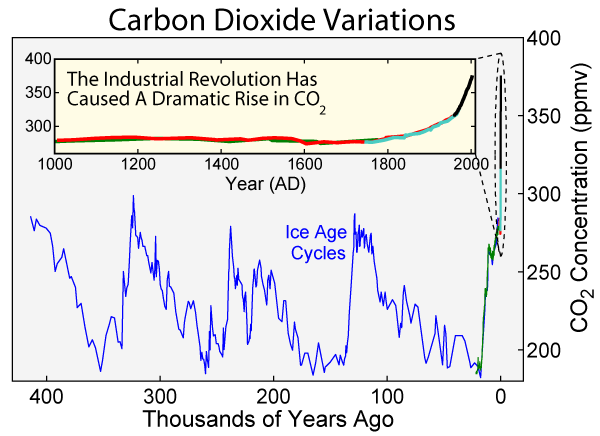
And except that before the industrial revolution, it was also at a plateau for centuries, at almost the highest level for at least 400,000 years, before the industrial revolution, so perhaps something besides Buicks was causing it for the many centuries before 1800. Yes it took off after the IR, but why was it so much higher before then, when human populations were rather sparse? That is the point that people like YOU keep ignoring. There is an issue, but the cause/effect is NOT as cut and dry as you would like to make it.
People like ME are saying, yes, lets cut emissions, lets cut CO2, but in a measured, progressive but sustainable way that might even provide jobs, and there are reasons and justifications for it even if you don't believe the science. People like you TWIST the words of conservationists, who want the same thing you want but in a more reasonable way. We aren't saying to not make changes, we are saying to meet in the middle with serious, ongoing changes with a wider base of benefit, and instead you jump on a soap box and tell everyone that either we agree with your ideas, or we just want to shit on the planet. It is no wonder that people tell environmentalists to fuck off when you are so arrogant. No wonder you post as AC. I'm not ashamed of what I know, or believe.
-
Re:No problem!
It's less severe a variance than the Maunder or Dalton minima. Those were natural variations, no?
Those were, but this time it's not natural as far as most scientists with expertise relevant to the problem are concerned. BTW, the Little Ice Age appears to be more of a Northern Hemisphere thing, so the Maunder minimum was not likely the largest contributor. The current warming, by contrast, is truly global.
-
Re:Quit burning stuff
Not trying to defend China's abysmal environmental record, but on a per capita basis, those in the US send far more CO2 into the air than those in China. (Similarly for other developed vs developing nations.)
On a per country basis, the US is second to China's lead. -
Re:What?????
Fallout, it doesn't stay in their backyard.
-
Re:Didn't even check if evidence existed
Well, maybe I need to "open my eyes", so perhaps you can help me. I still just don't see where the data got fudged. Here's what happened:
1995: First peer-reviewed article discussing the problem with tree ring temperature measurement is published.
1998: Mike Mann publishes in Nature, the most widely-cited journal in the world, an article setting out the "trick".
1998-2004: Multiple peer-reviewed articles supporting the technique are published. No dissenting articles are published. The technique appears to be accepted.
2001: The IPCC publishes its third report on climate change. This report, which is available online in its unedited entirety (as certified by UNEP), contains the following image: Image: variations in the Earth's surface temperature. The image clearly differentiates between different sources of data.
2009: "Climategate". The email is found, removed from its context and used to attack climate change scientists.So please, explain to me exactly "how badly these scientists were behaving in plain sight" when they published peer-reviewed articles explaining exactly what they were going to do, confirmed those with more peer-reviewed articles and then published a graph that clearly shows the different sources of data. What were they fudging when they repeatedly published their methodology and data?
-
Re:Specifically...
He was the primary author of: http://www.grida.no/publications/other/ipcc_tar/?src=/climate/ipcc_tar/wg1/048.htm
Refering to Figure 2.1b: "We do not show standard errors for the CRU land data using the Jones et al. (1997b) method as tests suggest that these may not be reliable for land data on its own." The standard errors are "an inconvenient truth". The method is apparently suitable any time it supports the prejudices of the author. "Thick solid curve - as in (a). Two standard error uncertainties are centred on the CRU curve and are estimated using an optimum averaging method (Folland et al., 2001) and include uncertainties due to urbanisation but not due to uncertainties in thermometer exposures." This violates proper experimental procedures; one does not exclude any uncertainties - EVER. That is serious bad science.
-
Re:I usually just point out
Except that all the data says that CO2 lags temperature. The AGW model requires positive feedback. Historically, the feedbacks have been negative. Why assume a positive feedback loop will occur now?
This is a common misunderstanding. I suggest reading this article on the subject. CO2 is an amplifier (insulator), which is one of the biggest reasons that humans dumping CO2 into the atmosphere is causing acceleration in warming.
In other words, CO2 does not initiate the warmings, but acts as an amplifier once they are underway. From model estimates, CO2 (along with other greenhouse gases CH4 and N2O) causes about half of the full glacial-to-interglacial warming.
For the vast majority of the time CO2 and temperature rise together (as is expected when acting as an insulator), only during initial warming does this trend not follow, which is not sufficient to debunk the rest of the warming period. CO2 may not be the trigger but it is the greatest influencing factor over the rate of temperature change.
CO2 levels and other greenhouse gases very tightly correlates with temperatures when examined over the last 400,000 years. -
Re:Climate change is a security threat
Or you could just point out that the current weather does not -by a long shot- match any of the predictions (made BEFORE it started). For any non-political theory, that would do it.
Specifically that the IPCC predicted a warming of 0.12 degrees +- 0.05 degrees in 2000. From 2000 to 2009, however, there was a cooling of just over 0.1 degrees. That's over 4 times the maximum error they predicted. If you take pure satellite data, it's even more of course.
Before I get accused of heresy (not that having the facts on my side will prevent that, but hey, one hopes against hope):
-> IPCC prediction according to it's 2000 report : http://www.grida.no/climate/ipcc_tar/vol4/english/pdf/wg1spm.pdf figure 5 : uniform rising temperatures for the entirety of the 21st century : every year is warmer than the previous year from now up till 2100, including the lower error bar
-> consistent 10-year dropping temperature http://climateprogress.org/2009/12/08/world-meteorological-organization-wmo-2000s-warmest-hottest-decade-on-record/ (which is a somewhat misleading headline. 2000-2010 may be the warmest decade, but 1995-2000 would be the warmest 5 year period. Wouldn't want to indicate warming has stopped, even temporary, now would we ? That'll just lead to skepticism. There was a time when skepticism WAS science, but hey)Needless to say, if this occured within any exact science, all scientists would be sent back to the "put all your crazy ideas on a napkin" stage, and the theory that produced the errant predictions sent to the bin.
(and while I fully agree this hardly constitutes a cooling trend over the long term, it is far outside of the error margins for the theory, so something is horribly wrong with the models, making their predictions useless at best, dangerous at worst)
-
Re:Why Are We Deferring to an Economic Organizatio
Urban vs. rural trends, w/many refs: link
Windy vs. calm: link link2.
The use of jump-point analysis to detect station incongruities: link
The use of a closely monitored reference network as a control:
A general overview of calculations, detrending, etc: link.
Further studies on that: link link2Now why the hell would you think yourself qualified to be involved in this discussion if you didn't already know this?
Don't you get it? The people raising these concerns are *not scientists*, *have no background in the field*, and *don't know what the hell they're talking about*.
-
Re:People are debating the wrong question
For one, a lot of very wealthy people are going to lose their expensive beach front properties.
A lot of poor people, mostly in third world countries will have to move.
You toss this out as though it's trivial. Where are you going to put 17 million displaced Bangladeshis, when their neighbours are dealing with their own internal refugee crises from the same climate and sea-level changes?
But most people will not starve to death, we will adapt.
Most people in the developed world will not starve to death. The outlook for the rest is not so good, considering that over 30 million people a year already die of starvation. As you say, doing nothing is still an option. But we should at least be up-front about the consequences.
-
Re:Do they know if this is unusual?
Higher average global temperatures imply higher upper ocean temperatures, which imply a higher water vapor pressure. Thus more water vapor will evaporate into the atmosphere. Yes, Roderick 2007 showed that wind speed had a stronger affect on the evaporation rate than changes in temperature, but I doubt that affects the expected theoretical equilibrium vapor pressure from basic thermodynamics. When that more humid air is carried across a tall mountain range, its temperature decreases and the water precipitates.
(I'm the AC you responded to).
While searching for an elevation map of Greenland I came across a map showing rates of surface-elevation change. It's tangental to my specific point, but I found it interesting nonetheless. I don't have access to recent climate data indicating evaporation rates, rainfall, or quantity of particulate matter in the atmosphere, but in the Horizon episode they asserted that there was a decrease in rainfall because extra particulate matter in the atmosphere created more water droplets that -- in aggregate -- were too small to form rain. Even if warmer temperatures were to increase evaporation, there are other factors involved in the amount of rainfall that would result from increased evaporation. The evidence presented thus far is a decrease in rainfall, not an increase. But, as I said, I don't have access to the raw data required to prove that definitively either way.
-
Re:Suicide Rate in Japan
and their economies are creating ecological disasters of enormous proportions.
Couldn't resist . . . I know ecological disasters don't equate to carbon dioxide emissions but according to the World Bank USA Carbon Emissions are at about 20 tons per capita and in India its at just over 1 ton per capita, so even given the population discrepancy the national output is incomparably larger for the US and thus it is arguable contributing to our current most pressing environmental catastrophe.
-
Re:Something doesn't add up.
So, in the 1600s we had a very low number of sun spots and a little ice age.
Except that no, we didn't have a "little ice age". We had a mild cooling period in the Northern Hemisphere, which had intense effects in some areas; but, according to to IPCC, "current evidence does not support globally synchronous periods of anomalous cold or warmth over this timeframe, and the conventional terms of 'Little Ice Age' and 'Medieval Warm Period' appear to have limited utility in describing trends in hemispheric or global mean temperature changes in past centuries."
-
Biodiversity Mass Extinction #6 now ongoing
the earth has had several mass extinctions in the past, the most recent was 65.5 million years ago
We had 5 major mass extinctions in the past, but the most recent one isn't in the past at all but is happening right now. It began slowly with the rise of Man, but ramped up exponentially with the industrial revolution. Compared to previous extinction events, it's by far the worst of them by many orders of magnitude.
This astronomic loss of biodiversity isn't so much about high-profile rhinos and tigers and cute pandas, but about the almost unseen microbiota and microfauna throughout the biosphere, upon which all of our food and even our own bodies depend. It very rarely makes the news (not sexy enough), but we may not pull out of this one.
Apparently we don't need a big rock to hit us at all. We seem to be totally self-sufficient at achieving extinction.
-
Re:Yes we do.
...citation only needed if you have been living under a rock with your fingers in your ears, while hugging a tree and drinking green koolade for the past 30 years. For christ sakes, this is even admitted to in the climatologist manifesto... the IPCC's Third Assessment Report.
The amount of CO2 in the atmosphere today is not unprecedented, and that in fact there is plenty of evidence for much higher levels, while simultaenously the earth being cooler.
Queue up the green folks who want to stress how long ago it was when levels were higher, as if how long ago prevents these facts from seriously questioning their crisis.
Never let a good crisis go to waste. -
Re:Obviously it's a good thing.
Replying to myself:
(wiki) "Present carbon dioxide levels are likely higher now than at any time during the past 20 Myr" (citing: http://www.grida.no/climate/ipcc_tar/wg1/fig3-2.htm )
-
Re:Let's fix the problem that doesn't exist
I'll assume you're not trolling, and answer your questions as best I can.
The global temperature hasn't risen in about 8 years (in fact, it has slightly gone down). So what's to fix?
Yes, you can cherry-pick two points on a noisy signal and pretend it's meaningful, but that doesn't make it so. The meaningful indicator is the overall trend, not the year-by-year variations: http://www.grida.no/publications/other/ipcc_tar/?src=/climate/ipcc_tar/wg1/figspm-1.htm
Supposedly pollutants in the air increased the global temperature but now we want to inject more of them into the air to decrease global temperature? How does that make sense?
You're assuming that all pollutants have the same effect. Is it so far fetched to think that some materials might have different effects than others?
Or by cutting the country's deficit by increasing spending?
Increasing spending can in fact cut the deficit -- if it causes the economy to grow sufficiently that the increased business activity generates more tax revenue than the amount spent took away. (whether or not that will happen is open to speculation, but it has worked in the past)
Or by decreasing unemployment by giving illegal immigrants legal status so they can compete for the already limited number of available jobs?
Oh wait you are trolling, aren't you. You just wanted an excuse to post the standard list of Republican talking points to another forum. Well done.
-
Re:I am not a climate scientist, but...
The evalutation for the models can be sarcastically summed up as "they do a pretty good job with the 20th century":
http://www.grida.no/publications/other/ipcc_tar/?src=/climate/ipcc_tar/wg1/309.htm
http://www.grida.no/publications/other/ipcc_tar/?src=/climate/ipcc_tar/wg1/336.htm(a later edition of the report is available here:
http://www.ipcc.ch/ipccreports/ar4-wg1.htm
but only as pdf, I am talking about Chapter 8; skimming it a little bit indicates that the above statement continues to hold.)
I'm not qualified enough to pretend to have an opinion on the accuracy of the reports or the likelihood of significant anthropogenic climate change, but I get an uneasy feeling when I compare the apparent confidence of the scientists and the apparent confidence of a lot of advocates.
-
Re:I am not a climate scientist, but...
The evalutation for the models can be sarcastically summed up as "they do a pretty good job with the 20th century":
http://www.grida.no/publications/other/ipcc_tar/?src=/climate/ipcc_tar/wg1/309.htm
http://www.grida.no/publications/other/ipcc_tar/?src=/climate/ipcc_tar/wg1/336.htm(a later edition of the report is available here:
http://www.ipcc.ch/ipccreports/ar4-wg1.htm
but only as pdf, I am talking about Chapter 8; skimming it a little bit indicates that the above statement continues to hold.)
I'm not qualified enough to pretend to have an opinion on the accuracy of the reports or the likelihood of significant anthropogenic climate change, but I get an uneasy feeling when I compare the apparent confidence of the scientists and the apparent confidence of a lot of advocates.
-
Re:Well, no, not really...
And I just cited at least two papers that specifically address the issue of solar variability with regard to it's explanatory power with regard to current warming and to what degree it better explains the warming than CO2. Both papers come up with the same result: the numbers just don't add up as required, and CO2 remains the best candidate.
You seem to be under some impression that solar variation as a possible influence in current warming has been ignored by those scientists who view CO2 as the major contributor. This is simply false. There have been many people working on solar variation as a contributor to global warming. Let's go straight to the summaries by those you potentially feel are ignoring it: the IPCC. In the Third Assessment Report from 2001* the IPCC devotes an entire section to considering solar variation and its impact as a forcing causing current warming. There's several pages there, so be sure to click "next", and feel free to follow up any and all of the references given. The forcing chart shows that solar variation is considered signifcant, but not as much of a contributor as greenhouse gas forcings. Admittedly it is listed as "very poorly understood". You may, however, wish to read the section on attribution of climate change to get an idea of how such conclusions are made -- again, please feel free to follow up the referenced papers from that section also.
That brings us to the Fourth Assessment Report from 2008. The forcing chart is now on page 4 of the Summary for Policy Makers and shows that, with further study, then forcing extent of solar variation has been reduced. You can read Chapter 2, from page 188 onwards, for the details of the various studies (with references that you can follow up as you please) into how such conclusions were reached. In other words, solar variability has been considered an important potential contributor, and source of significant study, even to the IPCC for many many years. No one is ignoring it -- rather they are quantifying it, and considering it closely when attributing recent warming.
Since then we also have that Damon and Laut study (reference int he previous post) which covers the issue of solar influence via cosmic rays. So again, no one is ignoring solar variation, it just doesn't add up so far when you actually sit down and run the numbers, while greenhouse gases do.
* (The Second Assessment Report from 1995 also considered solar variation, but I can't link to that online)
-
Re:Well, no, not really...
And I just cited at least two papers that specifically address the issue of solar variability with regard to it's explanatory power with regard to current warming and to what degree it better explains the warming than CO2. Both papers come up with the same result: the numbers just don't add up as required, and CO2 remains the best candidate.
You seem to be under some impression that solar variation as a possible influence in current warming has been ignored by those scientists who view CO2 as the major contributor. This is simply false. There have been many people working on solar variation as a contributor to global warming. Let's go straight to the summaries by those you potentially feel are ignoring it: the IPCC. In the Third Assessment Report from 2001* the IPCC devotes an entire section to considering solar variation and its impact as a forcing causing current warming. There's several pages there, so be sure to click "next", and feel free to follow up any and all of the references given. The forcing chart shows that solar variation is considered signifcant, but not as much of a contributor as greenhouse gas forcings. Admittedly it is listed as "very poorly understood". You may, however, wish to read the section on attribution of climate change to get an idea of how such conclusions are made -- again, please feel free to follow up the referenced papers from that section also.
That brings us to the Fourth Assessment Report from 2008. The forcing chart is now on page 4 of the Summary for Policy Makers and shows that, with further study, then forcing extent of solar variation has been reduced. You can read Chapter 2, from page 188 onwards, for the details of the various studies (with references that you can follow up as you please) into how such conclusions were reached. In other words, solar variability has been considered an important potential contributor, and source of significant study, even to the IPCC for many many years. No one is ignoring it -- rather they are quantifying it, and considering it closely when attributing recent warming.
Since then we also have that Damon and Laut study (reference int he previous post) which covers the issue of solar influence via cosmic rays. So again, no one is ignoring solar variation, it just doesn't add up so far when you actually sit down and run the numbers, while greenhouse gases do.
* (The Second Assessment Report from 1995 also considered solar variation, but I can't link to that online)
-
Re:Well, no, not really...
And I just cited at least two papers that specifically address the issue of solar variability with regard to it's explanatory power with regard to current warming and to what degree it better explains the warming than CO2. Both papers come up with the same result: the numbers just don't add up as required, and CO2 remains the best candidate.
You seem to be under some impression that solar variation as a possible influence in current warming has been ignored by those scientists who view CO2 as the major contributor. This is simply false. There have been many people working on solar variation as a contributor to global warming. Let's go straight to the summaries by those you potentially feel are ignoring it: the IPCC. In the Third Assessment Report from 2001* the IPCC devotes an entire section to considering solar variation and its impact as a forcing causing current warming. There's several pages there, so be sure to click "next", and feel free to follow up any and all of the references given. The forcing chart shows that solar variation is considered signifcant, but not as much of a contributor as greenhouse gas forcings. Admittedly it is listed as "very poorly understood". You may, however, wish to read the section on attribution of climate change to get an idea of how such conclusions are made -- again, please feel free to follow up the referenced papers from that section also.
That brings us to the Fourth Assessment Report from 2008. The forcing chart is now on page 4 of the Summary for Policy Makers and shows that, with further study, then forcing extent of solar variation has been reduced. You can read Chapter 2, from page 188 onwards, for the details of the various studies (with references that you can follow up as you please) into how such conclusions were reached. In other words, solar variability has been considered an important potential contributor, and source of significant study, even to the IPCC for many many years. No one is ignoring it -- rather they are quantifying it, and considering it closely when attributing recent warming.
Since then we also have that Damon and Laut study (reference int he previous post) which covers the issue of solar influence via cosmic rays. So again, no one is ignoring solar variation, it just doesn't add up so far when you actually sit down and run the numbers, while greenhouse gases do.
* (The Second Assessment Report from 1995 also considered solar variation, but I can't link to that online)