Slashdot Mirror
Domain: gsu.edu
Stories and comments across the archive that link to gsu.edu.
Comments · 508
-
Re:Photon position
This is true but not relevant to this particular discussion. A photon from Betelgeuse does not diffuse to both Alpha Centauri and our Sun in any practical sense. It's not a useful exercise to treat the uncertainty in the position of a photon in units of light years. Remember we are talking about photons we've actually observed through our eyes or through out measuring equipment.
It doesn't spread out to distances measured in light years. And we are constraining the photon's position because we have observed it.
It's quite useful because it's possible and in many cases the most likely scenario. The distance of diffraction is dependent on the distance of observation from the constraint of position because it effectively "alters the course" of the photon by an angle as this page outlines. So it's quite possible a single photon can be emitted from from a point, pass through a tiny aperture, and diffract to either earth or alpha Centauri even though neither lines up with the point and aperture opening - you won't know which it hits until it's observed. Note that the observation is not the same as constraining its position, these are seperate things.
-
In a spherical shell net gravity is zero...
Wouldn't a large number of small object in the Kuiper Belt essentially form a spherical shell with roughly uniformly distributed mass?
http://hyperphysics.phy-astr.g...
Given that, the net gravity and gravitational influence within would be zero so it wouldn't explain anything inside it...
I guess the question is, are the strange orbits inside or outside of the "shell".
-
Re:Them Turrists Done Tooken The Nest Steppe
"I've calculated my velocity with such exquisite precision that I have no idea where I am."
Heisenberg Navigation & Propulsion Systems, delivering unrivalled precision & accuracy (see note a), far surpassing anything else on the market!
News Flash: top military commanders are horrified at Trump's tweet saying that Heisenberg equipped ICBM's will be configured to deliver nuclear strike capability in seconds!
Note (a): accuracy subject to the limitations of Heisenberg's Uncertainty Principle: see http://hyperphysics.phy-astr.g...
-
Re:Apparently not
We're in the process of trying to re-create conditions we think exist in the sun
No we aren't. The sun has the benefit of being much larger than any reactor we could build on earth so it can operate at a much lower temperature. Some details here.
There really is not a lot of overlap between the way the Sun goes about things and the way a tokomak does, other than that both are fusion. The reactions are very different. Out sun fuses four hydrogens to make one helium while tokomaks typically use a deuterium-tritium reaction suitable for conditions that can be created on earth.
-
More examples of nuclear power plant problems:
More examples of nuclear power plant problems: Problems with Nuclear Reactors.
-
Re: Riled up and not a kook.
This has been explained countless times.
Vectors aren't additive that way.
http://hyperphysics.phy-astr.g...
http://hyperphysics.phy-astr.g...
https://opentextbc.ca/physicst...
In a nutshell, relative velocity alters space and time. It's the Lorenz Contraction. This throws in the extra term into the equation.
-
Re: Riled up and not a kook.
This has been explained countless times.
Vectors aren't additive that way.
http://hyperphysics.phy-astr.g...
http://hyperphysics.phy-astr.g...
https://opentextbc.ca/physicst...
In a nutshell, relative velocity alters space and time. It's the Lorenz Contraction. This throws in the extra term into the equation.
-
Re:How close do you sit to your big TV?
Taking this one step further, your eye only has roughly 6-7 million color sensitive cones, with a large density of them in the center of your vision. 1920 x 1080 is 2,073,600 total pixels, while 4k has ~ 4 million pixels. At some point your eyes are physically not going to be able to take in all of the information being presented to them.
In other words, 8k is simply too many pixels for the human eye to make sense of - even if you were somehow able to limit your vision to only the 8k screen right in front of you.
-
Re:wow
This seems relevant:
Adams (2000) Tacking on money laundering charges to white collar crimes: What did congress intend, and what are the courts doing?
https://readingroom.law.gsu.ed... -
Re:A little bit more background
Are quarks free inside atomic nuclei?
Inside protons and neutrons you could say yes, they're free
http://hyperphysics.phy-astr.g...
But protons and neutrons wouldn't be described as free inside the nucleus. That's more like electrons in an atom.
-
Re:This is pretty much nonsense
"First, for it to be secure, a theory which we know is flawed (Quantum Theory, does not account for Gravity) needs to hold up to an extremely precise level"
Quantum Field Theory makes extremely precise mathematical predictions, which have been shown correct in many experiments. Measuring the gravitational effect upon a particles momentum is nigh impossible due to how incredibly weak gravity is compared to the other forces (notice this is different from measuring the time dilation effects of different gravitational field strengths).
Precision:
These happen to be too low for crypto. For crypto we would need around 256 bits, i.e. around 1 in 10^76. Even only 128 bit crypto would be around 1 in 10^38.
I do agree that the level of precision is _very_ impressive for Physics, it is just not enough by a very long shot for secure crypto. At the precision level needed for crypto, gravity matters very much. -
Re:This is pretty much nonsense
"First, for it to be secure, a theory which we know is flawed (Quantum Theory, does not account for Gravity) needs to hold up to an extremely precise level"
Quantum Field Theory makes extremely precise mathematical predictions, which have been shown correct in many experiments. Measuring the gravitational effect upon a particles momentum is nigh impossible due to how incredibly weak gravity is compared to the other forces (notice this is different from measuring the time dilation effects of different gravitational field strengths).
Precision:
So, which of the two is The Most Precisely Tested Theory in the History of Science?
It’s a little tough to quantify a title like that, but I think relativity can claim to have tested the smallest effects. Things like the aluminum ion clock experiments showing shifts in the rate of a clock set moving at a few m/s, or raised by a foot, measure relativistic shifts of a few parts in 1016. That is, if one clock ticks 10,000,000,000,000,000 times, the other ticks 9,999,999,999,999,999 times. That’s an impressively tiny effect, but the measured value is in good agreement with the predictions of relativity.
In the end, though, I have to give the nod to QED, because while the absolute effects in relativity may be smaller, the precision of the measurements in QED is more impressive. Experimental tests of relativity measure tiny shifts, but to only a few decimal places. Experimental tests of QED measure small shifts, but to an absurd number of decimal places. The most impressive of these is the “anomalous magnetic moment of the electron,” expressed is terms of a number g whose best measured value is:
g/2 = 1.001 159 652 180 73 (28)
Depending on how you want to count it, that’s either 11 or 14 digits of precision (the value you would expect without QED is exactly 1, so in some sense, the shift really starts with the first non-zero decimal place), which is just incredible. And QED correctly predicts all those decimal places (at least to within the measurement uncertainty, given by the two digits in parentheses at the end of that).
Coupling Constants:
Strong Force = 1
Electromagnetic = 1/137
Weak = 10^-6
Gravity = 10^-39 -
Re:Two Words
Originally, I picked a sphere thinking it'd make the math easier. While that did hold true (somewhat), it also has the interesting effect of reducing that C coefficient.
The drag coefficient C is 0.5 for a spherical object and can reach 2 for irregularly shaped objects according to Serway.
I haven't seen nearly enough information on icebergs to narrow it down more than that, so I figured the estimate would get me within an order of magnitude of correct.
-
Re:Two Words
I did some math. Previously, I've considered similar absurd ideas, and the cost just didn't fall in their favor.
I feel I should start with a disclaimer: It's currently a very late (or early, depending on one's perspective) hour of the evening, and my physics skill isn't what it used to be. I invite and encourage you all to review my work, and if I'm wrong, please tell me how.
Based on the figures provided, we can work out the magnitude of the problem. The first computation is simple: Our speed will be
20 billion gallons of water corresponds to roughly 80 million cubic meters of ice. Cut into a sphere for ease of transport and calculation, it would have a radius of about 300 meters, with a cross-sectional area of about 200,000 square meters. We'll ignore the air resistance of the 10% above water, which falls within the error of my rough calculations. Calculation for the force of drag is ugly*, but works out roughly to C*9*10^6 newtons. That "C" is a coefficient simplifying the effect of the iceberg's shape, ranging from 0.5 for a sphere to 2 for more troublesome shapes.
Considering that range, the water's drag is between 4 and 20 meganewtons. A power source (tugboat, added motors, etc) will need to supply that much force just to maintain speed. If I remember my physics correctly, at 0.3m/s, that's between 2000 and 7000 horsepower.
There are tugboats with that much power. I haven't found much information on the annual cost to operate such a beast, but one tugboat operator gives price estimates per hour. For the purposes of this discussion, we can assume that the quoted price covers the operator's expenses well enough to also cover the overhead of running such a large operation, and the benefits of scale will cover the higher costs of an ocean-going expedition. Those are some very large assumptions, but I don't have information to clarify it further.
With those assumptions, the cost to pull an iceberg for a year is only about $20 to $100 million. That's surprisingly cheap, putting the cost of mostly-fresh water at under $0.001 per liter ($0.005 per gallon). In comparison, a desalination plant supplies water at about $0.0005 to $0.003 per liter ($0.001 to $0.01 per gallon).
In short, it's expensive, but it's in the same ballpark as regular desalination for that much water, and if the losses due to melting and evaporation can be controlled, it might just be feasible. As noted in TFA and elsewhere, it would also be quite the spectacle, promoting yet more tourism to the area.
* The formula I ended up with is F[drag] = C*.5*1g/cm^3*(.9*pi*(80000000 m^3/(4*pi/3))^(2/3))*(0.3m/s)^2.
-
Re:Miles
Some statistics that might help:
horizon radius | 8.86×10^12 meters
event horizon area | 9.86×10^26 m^2 (square meters)
surface gravity | 5070 m/s^2 (meters per second squared)
temperature | 2.057×10^-17 K (kelvins)
entropy | 1.303×10^73 J/K (joules per kelvin)Relative velocity to speed of light = 5000000mph / 671000000mph = 0.00745c
Using Lorentz formula
T = 1.000027
Even at 5 million mph, it's still in first gear relative to the speed of light.
-
Re:3500 degrees
Does the following alternative explanation hold water?
As your target object gets warmer, it radiates more and more of that energy into its surroundings. The energy loss to radiation actually grows much faster than the temperature of the object. According to the Stefan-Boltzmann Law, the net loss of energy is proportional to (T^4 - Tc^4), where T is your target's temperature and Tc is the temperature of its surroundings. So as the target approaches the temperature of the lights it begins to give up energy to radiation just as fast as it absorbs it.
-
Re:instrumentally homogeneous temperature records
greenhouses work because glass (or plastic sheeting) does not well transmit infrared radiative energy. IE, its an insulator that blocks the transmission of radiative heating, or radiative transfer. visible and ultraviolet light passes through the glass and strikes the surface of the objects inside, including the molecules of air. some of this energy is then re-radiated as infrared light energy, ie, heat. Because the glass blocks the infrared from exiting the structure, the system becomes unbalanced.
In thermodynamics terms, the greenhouse is an enclosed system with 1 input and no output.
And therefore because Ei > Eo, the total energy of the system must increase, and this results in increased temperature inside.This is the oversimplified explanation of climate change which I have problems with. Unfortunately, it is the argument parroted by nearly all the armchair climatologists as the reason why global warming is real and we must do something about it Right Now.
From a thermodynamics standpoint, the rate of heat radiated by a black body is proportional to the fourth power of its temperature. The Ei > Eo state is a transitory state - it is only temporary. The temperature increases causes Eo to (quickly) increase, until Eo is large enough to match Ei.. So we end up with Ei = Eo again, but at a new, higher T. In other words, the system stabilizes at a new, higher temperature. This is why glass greenhouses don't continue to increase in temperature until the inside is hot enough to melt the glass. T^4 is a huge number. It only takes a small temperature increase to offset a large Ei increase (actually Pi would be more accurate - the rate of energy coming in, or power coming in).
Unstable "runaway" systems are extremely rare in nature. The reason is simple - anything that's unstable tends to, over billions of years, destroy itself. So the overwhelming majority of things remaining in the universe are stable systems. There is no "delicate balance" of nature. There is no "runaway" greenhouse effect - all we're doing is shifting the equilibrium point. We know this to be true because global CO2 concentrations and temperatures have been higher in the past than they are today, and the Earth did not self-destruct - it is still around with life intact.
Now, from all I've read, that new equilibrium temperature point is high enough to cause massive problems for human civilization if we don't address it. But the alarming layman's explanation of the greenhouse effect that you've given is just as wrong and misleading as the climate change deniers' explanations. -
Re:Great news for a fossil fuel free Sweden...
A wind turbine is just the power turbine in a heat engine.
No it is not. Did you still not read the Wikipedia article? Wow, shame on you.
For starters: Thermodynamics is a set of rules of physics for closed systems. Earth is not a closed System
Then: everything thermodynamics is describing is the tripple between volume, pressure and temperature of "ideal gases" with a heat and mass transfer from the hot "reservoir" to the cold one. Best example is a Stirling engine. Second best is a steam engine (as it is striclty speaking not a closed system, too)
One of the core predicates is e.g. the "carnot efficiency" of a heat process. See: http://hyperphysics.phy-astr.g...I leave it up to you to calculate a reasonable efficiency based on thermodynamics for a wind turbine. Afterwards you might want to look up the real efficiency of a wind turbine.
Usually I charge about $100 for giving classes
-
Re:Some interesting information on that topic
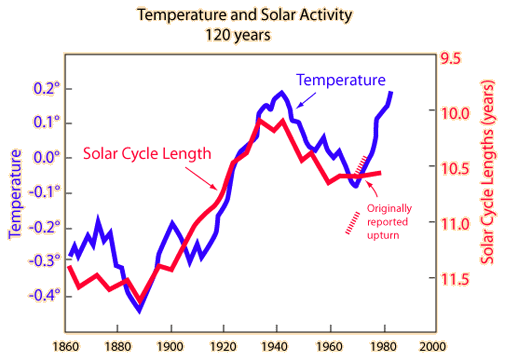
Thanks for that. In your link I see number of sunspots, what I found interesting was the cycle length, shown here:
http://hyperphysics.phy-astr.g...Is there a direct correlation between the two?
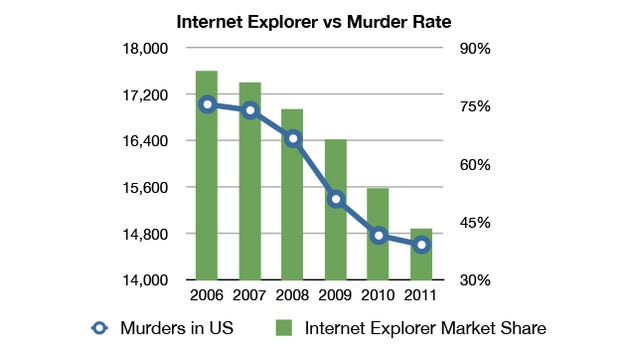
Of course, all of these charts may or may not mean much. After all:
https://i.kinja-img.com/gawker... -
Some interesting information on that topic
Here's somen interesting information on that topic:
http://hyperphysics.phy-astr.g...As you mentioned, there are a lot of different factors. As mentioned on the site you linked to, woodfortress.org, it's very noisy data - reliably identifying trends is difficult. Further, it's so political - 96% of the studies do things like start their time series at a time of record-low temperatures, guaranteeing an increase relative to that time, or conversely start a graph at a warm time, meaning the trend will be cooling compared to the time of record highs. The actual science and analysis itself is difficult, and the obvious political bias in most of the studies doesn't make it any easier.
-
Not quite. Less than 0.2% variance
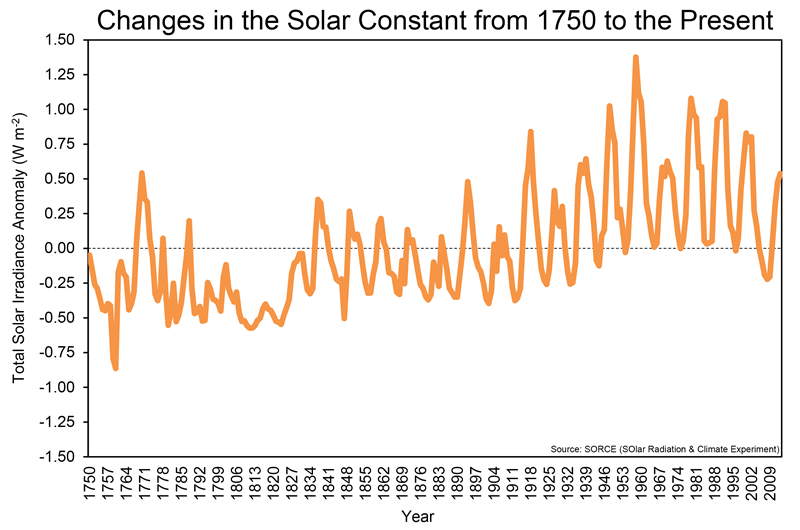
Total solar radiation has varied less than 0.2%, comparing the average across the roughly 11-year cycle. It has neither increased nor decreased. What has changed over time os the length of cycle, and the variance in length correlates very closely with global temperature. See the chart here:
http://hyperphysics.phy-astr.g...
You may have noticed that of you fill a bathtub with hot water in the evening, it's still warm the next morning. Water is very good at holding on to heat. (Compare the air in your house, or the furniture, which will cool in minutes). The huge volume of water in the oceans may hold heat for years, such that the length of the solar cycle matters.
-
Re:No, Not Good
At a humidity rate of 57% there's 10g of watervapor in a cubic meter. We inhale about 11,000 liters of air a day , which is 11 cubic meters. So on a bit humid day, you inhale a little over 100 grams of water a day. At 15 grams of water per tablespoon, I think we should all panic right now!
And how much do we inhale in a single breath, which was the challenge?
-
Re:No, Not Good
At a humidity rate of 57% there's 10g of watervapor in a cubic meter. We inhale about 11,000 liters of air a day , which is 11 cubic meters. So on a bit humid day, you inhale a little over 100 grams of water a day. At 15 grams of water per tablespoon, I think we should all panic right now!
-
Well, in our school...
Just the other day I had a conversation with an 11th grade student and a science teacher about global warming. Turns out, the students were doing a research essay on the subject, one page, and the teacher accepts every paper that's backed up with good sources. And they have a good conversation even evaluating some of the sources. He openly tells students that he firmly believes global warming is real, but it's an open dialog with students.
Not every school discourages open conversation regarding climate change. And I'm equally frustrated that there's just as much closed-minded fervor from both sides of the conversation.
In my study of the topic, I've concluded that climate change is happening, and humans are partially responsible for the change. But the Earth has ways of compensating for the change, though some of these compensations will necessitate either adaptations or extensions from all walks of human life. We humans have had such success in adapting to our environment that we should have no troubles adjusting, but ironically, we resist change. In order to adapt, we need to talk about the changes taking place and how to respond to them accordingly. That's becoming incredibly difficult; climate-change believers are so self-righteous, they feel humans need to take full responsibility for its existence and pretentiously claim we have to "undo" it all; and climate-change deniers don't want to accept any responsibility at all, especially due to the costs.
Climate is changing every moment of every day, and the complete calculus that is climate is so complex, it's nothing short of arrogance to think we alone are at fault. Milankovich cycles. Volcanic vents. Solar output. Water vapor. Not to mention butterflies, methane emissions from cattle (and don't forget buffalo), forest fires, surface volcanic eruptions, and who knows what else. The only explanation I have for taking a ~30 year warming trend within the billions of years of our planet's existence and constituting it as a global crisis is because we humans like to imagine that we're in control of this world. But we're not.
It angers me even further that, just because there's so much in this world that we do not and cannot control, there's no good reason -not- to do what we can to clean up our planet. Until we can find another one to take its place, and find a way to get a subset of the human population there, this is the only one we have. So let's not fuck it up.
-
Re:All Energy Is Conserved
Actually, thermodynamics tells that ALL the energy is not renewable... entropy and stuff...
To the contrary. The first law of thermodynamics tells us that all energy is conserved. You don't have to ever worry about energy conservation: the laws of physics guarantee it will happen.
Usable energy... now, that's a different case.
I've found a fantastic solution to this. No idea why the chumps in the establishment haven't pushed forward on this sooner, I guess they're just that dumb. My first act on assuming office will be to introduce an act repealing the overly restrictive Second Law of Thermodynamics. That thing's been oppressing our economy for years. I think China might have come up with it.
When I'm in, that dumb-ass law's toast.
Donald
-
All Energy Is Conserved
Actually, thermodynamics tells that ALL the energy is not renewable... entropy and stuff...
To the contrary. The first law of thermodynamics tells us that all energy is conserved. You don't have to ever worry about energy conservation: the laws of physics guarantee it will happen.
Usable energy... now, that's a different case.
-
Re:Only if you ignore the data that contradicts th
Your graph only shows Greenland temperatures, not global, so it's not useful for discussing global climate. It also cuts off most of the recent warming.
As for the Little Ice Age, a large factor in that cooling was the Spörer and Maunder Minimums in solar activity, which ended a couple hundred years ago. Solar output then climbed, and temperatures climbed with it - but then solar output peaked in the 1950s, and has been slowly dropping since then. Yet temperatures kept on climbing.
-
Re:The deep insecurity of Islam
I know you're trying to help, but you need to inform yourself about radiometric dating.
Carbon-14 has a half life of 5730 years, so it is not used on 65-million-year-old fossils.
-
Re:here's a question
The EM force is also significantly stronger than gravity -- the effect of those few infrared photons is probably millions of times more powerful than any gravitation you'd feel from dark matter (or real matter, for that matter.. Remember there's still dust and other shit here and there in space that will all be exerting gravitational pull but its so small that its undetectable.)
EM is something like of 10^36 times more powerful than gravity http://hyperphysics.phy-astr.gsu.edu/hbase/forces/couple.html (I'm not 100% sure how the coupling constants relate to measured strength but at that scale difference, being off by a few orders of magnitude won't affect my argument..)
That is to say, you'd need a _hell_ of a lot of unaccounted gravity to match even the tiny effect of a few photons bouncing around. That's why experiments searching for gravitational waves and the such have to be so incredibly precise and eliminate near to 100% noise -- the signal is just so damned weak.
-
Re:Perhaps amend the definition of resonance
You do realize that "resonance" doesn't mean what you think it means, right? There are lots of physics sites which disagree with you - "a resonant frequency is a natural frequency of vibration determined by the physical parameters of the vibrating object..."
Obviously you don't realize that this quotation doesn't mean what you think it means.
"Resonance" is NOT the same as a "resonant frequency." The "resonant frequency" is the natural frequency where a system can experience resonance, but the frequency or the vibration at that frequency is NOT resonance itself.
From the same site you linked, have a look at this graphic, which basically says:
"Resonance involves the existence of natural frequencies which are easy to excite and which a vibrating system picks out from a complex excitation."
Resonance is NOT simply vibrations occurring at a resonant frequency within a system. That's just basic oscillation or vibration or standing waves or whatever. It's not resonance. Resonance is the excitation/driving of vibrations at that frequency by an external force. If the external force isn't selectively driving the oscillation at the resonant frequency in some way, it's not resonance.
If I pluck a guitar string and it sounds at its particular natural frequency ("resonant frequency"), colloquially some people say the string is "resonating." But from a physics standpoint, that's not technically correct -- the string just has standing waves oscillating at a natural mode of vibration. But if I touch a vibrating tuning fork at the same pitch to the guitar string, causing the string to vibrate at the same frequency, THEN I have resonance.
-
Re:Perhaps amend the definition of resonance
You do realize that "resonance" doesn't mean what you think it means, right? There are lots of physics sites which disagree with you - "a resonant frequency is a natural frequency of vibration determined by the physical parameters of the vibrating object..."
-
Re:It has to be
actually, according to this the strong/weak forces do not use inverse square, because they're fundamentally different: they're based on particle exchange and the distance at which the particles can get exchanged is related to quantum uncertainty, which drops off a lot faster with distance than just inverse square.
Electromagnetic is stronger and is also inverse square but it's based on charge differentials, and at macroscopic scales objects tend to be neutral overall which means two planets (for example) have very little charge differential relative to the distance. If you could somehow move all the electrons from Mars to Earth they'd probably be pretty strongly attracted (I haven't done the math... maybe I'll send that one to What If).
-
Re:It has to be
Calculating the range of strong force: http://hyperphysics.phy-astr.g...
-
Re:No such confirmation had been made
(Not a native english-speaker so sorry for any and all mistakes)
Well, if you count 1600 people directly or indirectly as a result of the accident.. But lets go with your line there.. 1600 lives where lost due to the accident..
If you read a few of the latest reports about Chernobyl they estimate it to be somewhere between 4000 to 9000 people that will die due to the accident. (But Chernobyl is a *really* bad example.... The whole mess there is due to bad design (or none) and idiotic people that actually turned off the safety system etc)
But just for the sake of it i'll round the number up to 10000 people on average per failed plant just to make it easy to count...
Lets list the alternatives..
References used:
https://en.wikipedia.org/wiki/...
http://www.forbes.com/sites/ja...
http://www.who.int/mediacentre...
http://hyperphysics.phy-astr.g...Hydroelectric:
Banqiao Dam - "26,000 dead from flooding, 145,000 dead from subsequent famine and epidemics, 11 million homeless. Caused loss of generation, dam failed by overtopping in a 1-in-2,000 year flood[4]"
That's more than 17 times the number in Chernobyl in a single accident...
On average it's 1400 people that dies per year for hydro-electric in the world..Coal:
170000 people per year on average die due to coal-plants.
- That's 17 times the number in Chernobyl.. Per YEAR!Biofuel/Biomass:
24000
- That's 2.4 times the number in Chernobyl.... Per YEAR!If we are talking about saving lives.. start by fighting to shut down the coal-plants and replace them with nuclear/wind/whatever.. Wind will be problematic since the wind does not always blow, but it's great compliment..... Solar will not be possible since we still need power during the night but it's a great compliment..
And the other part.. We do have the knowledge on how to build much safer plants (China is currently building quite a few)..
The main type of reactors available to us.. (simplified, see the references for more information.)
- Boiling Water Reactor
- Pressurized Water Reactor
- Liquid-Metal Fast-Breeder ReactorThe boiler is what it is.. It boils water, not under pressure, to generate steam to power a turbine.. Due to the low temperature it is not very efficient, that's why they moved on to the pressurized water reactor.
The main type of reactor used today, and that is the most dangerous, is the pressurized water reactor.. This is due to that the water is pressurized to allow for higher temperatures, and if the cooling-system fails or there is a breach in the pressure-vessel all that water will flash to steam increasing it's volume many times over. It's also a bit risky due to production of hydrogen, that can cause an explosion.
So to coup with this the whole reactor-design needs to be designed with engineered fail-safes, like a big strong building around it to be able to contail the steam if the pressure-vessel would break. Backup generators to power the cooling-pumps if the external power is lost, and cooling is needed for quite some time after the reactor has been stopped.Liquid-Metal Fast-Breeder Reactor works a bit different than the others.. No pressure, and if the temperature goes up it self-corrects due to thermal expansion of the material reducing the probability of a neutron hitting the next atom. If all hell where to break loose and power is lost to the plant and the cooling would stop it has a passive feature where it would dump the fuel into a passively cooled tank where it can cool down without causing damage to the plant, or releasing anything toxic.. These plants cannot melt down, and if there would be some extreme case o
-
Re:Blimey
You're perfectly correct that MSRs don't actually run on Thorium. That's one of the reasons they'd be an effective nuclear waste burner.
The advantage that MSRs have over pellet/pebble/rod-based reactors is that when you throttle down, an excess of xenon-135 builds up. This is a neutron poison and damps down the reaction, making it hard to throttle up again until it's decayed (that takes a while. The Half-life is 9.2 hours). Attempting to push through the xenon poisoning by setting the power to 11 can be catastrophic - this is what took out Chernobyl. http://hyperphysics.phy-astr.g...
Because the fuel is not sealed into capsules in a MSR, the Xenon can be extracted into the thermal expansion headspace just before the circulation pump by sparging it (https://en.wikipedia.org/wiki/Sparging_(chemistry)). You need to do this to get helium and other gasses out anyway so it's not a big deal. The end result is that throttling is fully linear and because MSRs don't suffer from steam voids if you snap to full power, the reaction rate can track load at least as fast as a hydro plant and probably as fast as a OCGT plant.
I was going to write a lot more but given this is about space applications it's probably irrelevant. You'll need a thorium blankie for your U233 MSR reactor or you'll run out of fuel eventually. Having it soak up stray neutrons is a good thing in what would probably be a relatively confined space.
-
Not remotely news
From http://hyperphysics.phy-astr.gsu.edu/hbase/nuclear/cardat.html:
"Krane points out that future carbon dating will not be so reliable because of changes in the carbon isotopic mix. Fossil fuels have no carbon-14 content, and the burning of those fuels over the past 100 years has diluted the carbon-14 content. On the other hand, atmospheric testing of nuclear weapons in the 1950s and 1960s increased the carbon-14 content of the atmosphere. Krane suggests that this might have doubled the concentration compared to the carbon-14 from cosmic ray production."
-
Re:Sometimes the obvious is the correct answer?
Sorry, I have to post anonymously because I have mod points. You're wrong about the perfect vacuum being a perfect thermal insulator because of radiative transfer. 98.6 F = 310 Kelvin. So an uninsulated human body in space is radiating out at 310K, and the universe is radiating back at 2.7K. Using this calculator and representing the human body as a 60cm ball with sufficient density (.1) to weigh 90Kg or 200 lbs the ball would lose 7 degrees kelvin in the first minute via radiative cooling. Thus 200 lbs X (9/5) X 7 = 2520 BTUs lost the first minute by a spherical 90Kg black body with a surface temp of 310K in outer space. Obviously I made many simplifying assumptions; the worst one being zero temperature differential from the body to the skin, but the conclusion is inescapable: you DO need heating. Furthermore, Peltier effect cooling usually relies on convective transfer, which we both agree doesn't exist in outer space.
-
Re:How do you cool something that cold?
The Doppler effect only comes in to explain how one can get atoms to actually slow down (thus cool down) when absorbing laser light while vibrating back and forth (so the absorption could hinder them or speed them up). The main mechanism is the absorption of photons and respective transfer of momentum. Georgia state university has a very nice explanation except that they are loosing me in the last but one paragraph when it really gets interesting.
-
Re:Using steam.
salt reactors are used almost exclusively for breeding weapons-grade plutonium. I'd like to see citations, please?
-
Re:I don't get the point of this thing...
primary steam out of a nuclear reactor is going to be highly radioactive. The core in a shipboard reactor is generally a pressurised water type, which means it'll have not one but TWO heat exchangers: one inside the core, one next to it. The working steam goes through this secondary heat exchanger where it's heated by superdry steam circulating from the core. The working steam can be vented if needed, the superdry HAS to be kept isolated. In a water reactor, there is only one heat exchanger - the core. Breeder reactors have THREE heat exchangers: the primary and secondary are closed salt loops, the tertiary dry steam. This type is used to breed weapons-grade plutonium.
Citation: http://hyperphysics.phy-astr.g...
-
Re:Terraforming potential?
Not tens of km per second, hundreds. Escaping Venus takes 10.4 km/s. Getting to Mars would take an additional 358km/s, for a total of 368km/s. Assuming that's the most probable speed of the molecules leaving the top of the funnel in a thermal distribution, that translates to a temperature of 358,000,000K*. Could be some minor issues there...
*(according to the calculator near the bottom of this page: http://hyperphysics.phy-astr.g...)
Weird indeed. I flashed to Niven's Smoke Ring series a soon as I thought of it.
-
Re:Affirmative Action is not the same as sexism
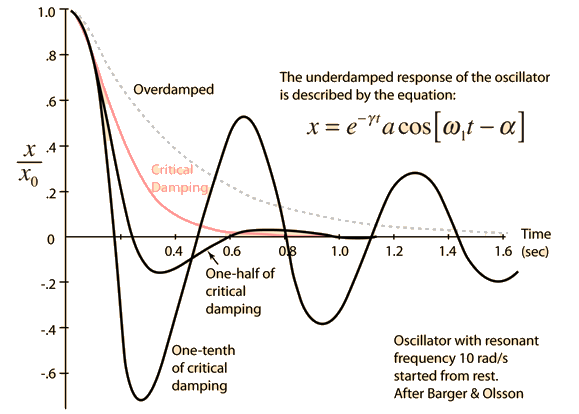
Theoretically, affirmative action can accelerate the speed at which you reach a new equilibrium. In terms of a harmonic oscillator, the regular behavior of the system in response to a change in base state (from 1 to 0 in the picture) is overdamped and it can take a long time for the system to reach the new base state. Affirmative action reduces the dampening to an underdamped state, causing the system to arrive at the new equilibrium state (0) much more quickly. i.e. It is sexism, but applied correctly it can speed up the transition to a new steady state equilibrium.
But an underdamped system will overshoot (drops past 0 in the picture). Since we're talking about law here and not a true harmonic oscillator, this can be avoided by putting in guidelines which trigger the end of affirmative action once the new equilibrium state is achieved. In terms of the picture, we raise the dampening back to normal the moment the system reaches 0. There will be a bit of overshoot, but it should quickly settle down.
Unfortunately, I have never seen any affirmative action laws actual specify at what point the affirmative action should cease. So the system will remain underdamped and will overshoot. If it were implemented fairly, at some point it would overshoot so far that affirmative action would call for more hiring of white males, and we'd end up with the oscillations you see in the picture. But I suspect the powers behind it would never allow that to happen, resulting in a permanent skew in hiring practices. Institutionalized sexism and racism - against white males. -
Re:Wrong Focus
Wait a minute, no, I entered it right into the calculator the first time around. Argh, this interface is confusing. Radiative equilibrium for Tunsten at its melting point 3300C according to the calculator is 92MW/m. A "cool" 1200C radiative temperature according to the calculator 2,6MW/m. According to the calculator, 10kW/m is about 380C.
-
Jane/Lonny Eachus goes Sky Dragon Slayer
Did you see my RT re: NASA budget? NASA environment spending went up 41%, space only 7%. goo.gl/ixcstK [Lonny Eachus, 2015-03-12]
... NASA's climate study budget has gone up 41% while their space budget only went up 7%.
Sure, let's ask Sky Dragon Slayers how many satellites should observe and protect our home planet. As soon as they finish mocking NASA's director because Slayers claim that "global warming" is nonexistent. But even when Slayers insist that "NASA needs to pull its head out of faulty climate science and get back to space," they should remember that not even space is compatible with Sky Dragon Slayerism.
After all, what if NASA just sends more missions to Venus and Mercury? Again, if CO2 isn't the reason, then why is Venus hotter than Mercury? Is Venus hotter than Mercury because of CO2, gray Oreos, or basketball player gloves?
Shouldn't Sky Dragon Slayers be able to answer such simple questions before determining NASA's aims and goals?
Furthermore, Jane should explain why he emphatically rejected the standard physics definition of the term "net". If Jane/Lonny Eachus ever accepts the standard physics definition of the term "net", he'd find that the Sky Dragon Slayer nonsense he's been regurgitating for years is based on a misunderstanding of a basic physics definition.
On that glorious day, Jane/Lonny Eachus would finally have a more credible case for influencing NASA's aims and goals.
-
Jane/Lonny Eachus goes Sky Dragon Slayer
But net radiative power out of a boundary around the source = "radiative power out" minus "radiative power in", so the equation Jane just described also says:
NO!!!!!
After Jane emphatically rejected the standard physics definition of the term "net", it became clear that Jane is hopelessly confused about the term "net". Sadly, this is typical for Jane/Lonny Eachus and other climate contrarians.
After it became clear that Jane is hopelessly confused about the very term "net" which he keeps screaming in ALL CAPS, I explained conservation of energy in a way that didn't require using that troublesome word. At this point, a real skeptic would either try to address this disagreement about a fundamental definition, or agree to disagree about the definition and solve the problem like I did without using the disputed word. But not Jane/Lonny Eachus:
.. No NET incoming radiation from cooler bodies is absorbed, therefore no NET radiation is crossing your boundary FROM those cooler bodies. It comes in and goes right back out.
Instead, Jane kept repeatedly screaming "NET" in ALL CAPS, completely ignoring the fact that his emphatic rejection of its standard physics definition reduces his rant to gibberish. Jane/Lonny Eachus also ignored me after I asked him simple questions about the definition of the word "net", so there doesn't seem to be any way to correct Jane's fundamental misconception.
I try to be tolerant of those who appear to suffer from Dunning-Kruger Syndrome, but one can only be so patient.
Jane/Lonny tries to be tolerant of those he thinks suffer from Dunning-Kruger syndrome, but only if "tolerant" includes endless cussing and screaming garnished with ball washing fantasies. If Jane/Lonny wonders what a Dunning-Kruger victim looks like, he need only look in a mirror:
.. I'm really not sorry to say this after your past behavior, but showing you're wrong is just plain dirt simple. And not JUST wrong, but so ridiculously wrong that I can (and will, believe me!) use it as entertainment for certain of my friends.
.. It feels as though I'm explaining to a high-school student who has never seen a physics problem before.
I keep finding myself in a position where I feel I should explain, but I am at a loss as to why I should have to, becau
-
Re:How did it work without a CPU?
OK, so I don't know much about logic gates and stuff but I still can't understand how can you create a video game console without a CPU.
A CPU is nothing but a ton of logic gates wired mostly to each other inside of a tiny package, and logic gates are made from multiple transistors.
Here is a page showing how each type of logic gate is made from transistors:
http://hyperphysics.phy-astr.g...Within a logic gate chip, all gates have their ground and power lines wired together and out to two pins on the chip, while the inputs/outputs typically also end up at pins on the chip, with everything else being internal to the IC.
Scaling up a level you can wire together multiple gates similarly.
A CPU is generally nothing but thousands to billions of these transistors wired together into gates that are wired together into "logical blocks" (think basic lego parts put together to form shapes, which you make a lot of, and then build your thing with the shapes)
This is why even today CPUs generally have a "transistor count", the number of the most basic elements on the chip making those gates that make up logical blocks that end up actually doing things.The first CPUs in fact were boards (and boards and boards) of nothing but transistors wired together this way, before we could put them on a tiny silicon package in a small enough form to be called a microchip.
The first chips (at least that I am aware of) that packaged standard gates together in an IC is the 7400 line of chips. A 7402 chip for example contains four separate NOR gates for example.
Here is a Z80 CPU built using nothing but these 7400 gate chips:
http://cpuville.com/Z80.htmThe Z80 was used in home computers like the TRS-80, the ZX Spectrum, the Osborne, and I think even some of the old Commodore line. It was also in the original Nintendo Gameboy and Gameboy Color, and a ton more systems.
It's still used today although more for things we would think of as embedded devices. I have a SCSI card powered by one, for example.Instead of a tiny IC measuring roughly an inch squared, when using 7400 chips the CPU is as large as you see in the picture on that page.
Just as it is rare to code in assembly these days, assemblers take higher level commands that consist of many assembly instructions and compiles those high level instructions down to blocks of assembly code (and then proceeds, hopefully, to optimize those blocks... but pretending optimization is disabled may give you a better idea visually)
Hope that explains some of it and didn't make the confusion worse
-
Re:Jane/Lonny Eachus goes Sky Dragon SlayerFor other readers (not for you, because despite your claims you've seen this already several times), from Wikipedia (edited here for clarity given Slashdot's character handling):
A body that does not absorb all incident radiation (sometimes known as a grey body) emits less total energy than a black body and is characterized by an emissivity, epsilon
j* = epsilon * sigma * T^4In the above equation, using the "dot" notation which YOU pointed out to ME, j is energy and j* is power. This isn't just Wikipedia. It is very easy to find this relation in other sources as well:
Here is "A Textbook of Engineering Thermodynamics . The section on radiative power of a gray body:Since all bodies are continuously receiving and radiating thermal energy, energy radiating from unit area (all this energy is absorbed by the black surroundings) = sigma * emissivity * T^4
The example goes on to express heat transfer between long co-axial cylinders using heat transfer equations similar to those we discussed before. But heat transfer is NOT the same as the radiative power of a SINGLE gray body at steady-state. Power out is a function of emissivity and temperature ONLY. Heat transfer from one surface to another requires 2 bodies, or 2 surfaces of the same body. But note that the equation for power out clearly implies it is independent of transfer to cooler bodies.
You can also find it here. In this case, note that it gives the equation for power output as distinct from radiation "loss" (heat transfer). BECAUSE THEY ARE TWO DIFFERENT THINGS. One is the power output of a SINGLE gray body at a given temperature. The other is radiative transfer to another body. One requires ONLY emissivity and temperature to calculate. The other involves 2 bodies.
Is this clear yet? Or are you going to continue to erroneously claim that radiative POWER output is dependent on the presence of cooler bodies? Do you really need more examples, or are you finally willing to admit you have been proved wrong? If you need more examples of this, you can find them with a quick search of the 'net. I just did, since I don't have a good way to link to my textbooks. -
Jane/Lonny Eachus goes Sky Dragon Slayer.
... Since this person is not making any scientific argument anyway, but simply attempting ad-hominem, and saying "so-and-so is wrong" without ANY evidence (which is all he can do, because he doesn't have any), this was a completely pointless exercise on his part. He was simply making another attempt at dragging my persona through the mud. I can only conclude that was his only purpose, since he didn't make any actual, substantive arguments. [Jane Q. Public, 2014-07-25]
A real skeptic would be checking my calculations but Jane can't even acknowledge them. If the Slayers are right, why is Venus hotter than Mercury?
Mercury's daytime surface temperature is 350C while Venus has a nighttime surface temperature of ~470C.
... despite the fact that Venus is 87% farther away from the Sun than Mercury, implying sunlight 3.5x weaker.
... and despite the fact that Mercury's albedo is ~0.1 and Venus's albedo is ~0.65.
... and despite the fact that a "night" on Venus lasts ~58 Earth days, during which the temperature barely changes from that at "high noon".
... Since all atmospheres must get colder with altitude as kinetic energy is transformed into potential energy in a planet’s gravitational field, the lower atmosphere must be warmer than upper atmosphere, even if there is no radiation involved. This follows from the perfect gas law, PV = nRT.
Riiiight. That's why the stratosphere doesn't exist. I've explained that long-term equilibrium surface temperature is determined by conservation of energy, not the ideal gas law. (If scientists were wrong, basketball players would have to dribble with gloves because the pressurized ball would have to be very hot.)
Many Slayers blame equilibrium surface temperature on pressure, which I call the basketball player glove fantasy. None of the Slayers at WUWT would answer this question: would Venus have the same surface temperature if its atmosphere were pure nitrogen, which isn’t a greenhouse gas?
I've even seen a Slayer convince himself that all objects have the same albedo, which I call the gray Oreo fantasy.
Will Jane explain the fact that Venus is hotter than Mercury using basketball player gloves, gray Oreos, or truly original groundbreaking science?
-
Re:Yeah. Right.
It will be used for rider's comfort. Not to take corners faster.
Many will like the comfort but others will like that they can take corners faster. According to the math in this calculator:
* 1/4 mile radius curve, with 7 degree banking results in a max speed of 114 mph
* Same curve with only 1 degree banking results in a max speed of 101 mph.
So, banking does increase max speed in a curve, but Mercedes does not mention that to prevent speeding.
-
Chernobyl was not a meltdown
Chernobyl would not have been prevented by putting the reactor in water. It was the only accident which had a "nuclear power excursion" as the reason. TMI and Fukushima were a failure of the classical cooling.
In Chernobyl the operators ignored the normal precautions. They operated the fuel in a state where xenon (see http://hyperphysics.phy-astr.g...) was present. Due to this the system was far away from the assumed stable oprtion point assumed in the controls.
The power which you would have needed to dissipate at the event to cool the reactor would have been ong the order of 200GW. Normal heat transfer coefficients are on the order of 10s of KW/m^2/K if i assume that you allow 200K difference on the surface, you end up at an active cooling surface of 100000m^2, which just is not there, not even if you drop the reactor into water.