Slashdot Mirror
Domain: hizook.com
Stories and comments across the archive that link to hizook.com.
Comments · 53
-
Also used for inflatable robotics
The same company is also working on inflatable robotics. I wrote an article about 'em a while back; it's definitely worth taking a look: http://www.hizook.com/blog/201...
-
OtherLab's super-impressive inflatable robots
They left off the most compelling example: Otherlab's inflatable arms. http://www.hizook.com/blog/201...
-
Re:Odd
tactile feedback is a big deal.
Tactile feedback could be implemented with electrotactile arrays as discussed here a few years ago. That would combine the flexibility of a touchscreen with the tactile feedback of physical controls.
It would be especially cool if the surface were also pressure sensitive. That way you could feel your way to the right control, then "grasp" it to change the setting.
-
Same press release as last year
The 2012 interview was more informative:
" Indeed. We don't mean "common sense" from a Marvin Minsky-like strong AI perspective. Baxter's "execution" application consists of a series of behavior-based systems. During "training," the robot detects task-relevant features and uses it to build up the behavior based system.
For example, let's say a user is training the robot for a pick and place task. During the "pick" phase, a user places the gripper above an object and closes the gripper. The force on the gripper is detected by the robot. Our "training" application detects this sequence as "the robot is grasping an object"... so during "execution", Baxter won't proceed unless it actually detects an object in the robots gripper. Thus, if the object fell out, it would stop (or do something else). This is different from how existing industrial robots work -- they'd just merrily continue the pick-and-place without the object.
Collectively, these "behavior primitives" are assigned and composed, ie. "learned", during "training" by having non-technical users directly manipulate the robot rather than programming it (which is also possible for those inclined). This gives the robot an air of common sense."This is useful, but not that intelligent. Take a look at these PR videos to see what it can do. Basically, it can pack and unpack things, and move them from one place to another. It's not good enough to assemble much of anything. Plugging in connectors to assemble a phone? Not with this machine and software.
-
Google is confused about itself and post-scarcity
Good point on how we should invest our efforts in productive directions. More by me on that:
http://www.pdfernhout.net/recognizing-irony-is-a-key-to-transcending-militarism.html
"There is a fundamental mismatch between 21st century reality and 20th century security thinking. Those "security" agencies are using those tools of abundance, cooperation, and sharing mainly from a mindset of scarcity, competition, and secrecy. Given the power of 21st century technology as an amplifier (including as weapons of mass destruction), a scarcity-based approach to using such technology ultimately is just making us all insecure. Such powerful technologies of abundance, designed, organized, and used from a mindset of scarcity could well ironically doom us all whether through military robots, nukes, plagues, propaganda, or whatever else... Or alternatively, as Bucky Fuller and others have suggested, we could use such technologies to build a world that is abundant and secure for all. "The question is, how much is Google part of the problem vs. part of the solution? I discuss here in relation to Google's "Virgle" Mars settlement April Fools joke of 2008: http://www.pdfernhout.net/a-rant-on-financial-obesity-and-Project-Virgle.html
----
So what am I really saying?
That we as a society are not going to happily get to Mars or the Asteroids or other star systems, or even just fix up Space Ship Earth, until we come to see the love of money as the problem, not the solution.
Or as made clear by Iain M. Banks:
http://folk.uio.no/thomas/po/the-culture.html
"Money is a sign of poverty, meaning that money only has a function in a scarcity economy, and therefore its existence betrays a pre-abundant (poor) society."
And so financial obesity is part of the problem, not the solution.
That $600 billion a year is spent essentially from fear of the human potential. From fear of "OpenVirgle". From *fear* the kids might actually figure out how to go to Mars instead of being profligate consumers and obedient cannon fodder soldiers.
----Intelligent mobile robots are near to totally transforming our society. And the transition might be quicker than we might expect, as robots can go from worse than human to better than human at some task almost overnight when there is an R&D breakthrough in some area. Here is one such example for manipulation, tossing and catching a cell phone:
http://www.hizook.com/blog/2009/08/03/high-speed-robot-hand-demonstrates-dexterity-and-skillful-manipulationOne thing most people do not yet understand about robotics (especially in the hands of some place like Google) is that if you have millions of networked robots, all learning independently, they can pool that learning over the network. And that network can then learn very quickly. And so "performance" can improve very quickly, with millions of trial-and-error expe
-
Same robot hand doing other crazy stuff
Back in 2009, the same researchers had this hand doing all sorts of crazy dexterous motions... dribbling, pencil flipping, throwing & catching, etc: http://www.hizook.com/blog/2009/08/03/high-speed-robot-hand-demonstrates-dexterity-and-skillful-manipulation
-
Re:2 years for a PhD student...
Actually, the fully-loaded cost for a PhD student is $75k-$80k / year (ie the amount charged to a faculty member's grant). You have to remember, PhD students' tuition is usually incurred as part of the cost since they're working in exchange for (1) a minimally-viable living stipend and (2) fully-paid tuition.
We had two PR2's in our lab (Georgia Tech's Healthcare Robotics Lab). There were ~2 people working on each at any given time.... so the $$ makes sense. And the PR2 was a great platform!
Source: my work on the PR2 http://www.hizook.com/blog/2010/10/16/pr2-robot-autonomously-delivers-medication-using-uhf-rfid-live-cnn
-
High-Speed Robot Hand Demonstrates Dexterity/Speed
I agree the human hand is a marvel, along with hand-eye coordination. But these sorts of technologies are rapid displacing the value of much paid human labor in different areas of the economy. Creating factories generally means re-engineering most tasks so they fit what machines can do. Service industries will also do that more and more (like the US post-office automates, fast-food places automate, hospitals automate, people get household vacuuming robots or buy prepared food, etc..) This means our economic social contract is breaking down where an adult's right to consume was linked to selling his or her labor in the market -- as predicted decades ago:
https://en.wikipedia.org/wiki/The_Triple_RevolutionA basic income is one way to address this, but there are a mix of others.
-
Re:Will sentient robots get the right to bear arms
"AI" has always been that which AI can't do. Here are several activities that once were considered sci-fi-level AI but are no longer considered AI in a broad sense because we know how to do them more-or-less:
* Looking stuff up for us (Google);
http://www.google.com/
* Inferring questions from examples and answering questions posed in natural language (IBM's Watson);
http://en.wikipedia.org/wiki/Watson_(computer)
* Generating hypotheses and doing hands/grippers-on scientific experiments (Adam);
http://en.wikipedia.org/wiki/Robot_Scientist
* Reading text in multiple fonts reliably and quickly and cheaply;
http://en.wikipedia.org/wiki/Optical_character_recognition
* translating one human language to another on the fly;
http://domino.watson.ibm.com/comm/research.nsf/pages/r.uit.innovation.html/
http://www.gizmag.com/go/1833/
* reading and translating signs;
http://questvisual.com/us/
* Making portraits;
http://www.slate.com/articles/technology/future_tense/2012/11/tresset_robot_artist_artist_engineers_robots_to_make_art_and_save_his_own.single.html
* Playing the piano including from sheet music;
http://www.synthgear.com/2009/music-misc/synth-playing-robot/
http://gizmodo.com/5963137/watch-this-adorable-horde-of-intelligent-swarm-robots-play-piano
* Driving a car in busy traffic (Google, Stanford, CMU, others);
http://en.wikipedia.org/wiki/DARPA_Grand_Challenge#2007_Urban_Challenge
* Winning chess games (IBM's Deep Blue and pretty much any PC now against a mid-level player);
http://en.wikipedia.org/wiki/Computer_chess
* Image recognition for quality control in factories;
http://www.general-vision.com/products/mtvs.php
* Recognizing faces;
http://en.wikipedia.org/wiki/Facial_recognition_system
* Figuring out the name of a musical composition from a few notes as well as making new compositions and dynamic accompaniments;
http://www.wikihow.com/Identify-Songs-Using-Melody
http://en.wikipedia.org/wiki/Music_and_artificial_intelligence
* The diagnostic aspect of being a doctor (Watson again);
http://www.wired.co.uk/news/archive/2013-02/11/ibm-watson-medical-doctor
* Investing in volatile financial markets;
http://en.wikipedia.org/wiki/Program_trading
* Serving as a sentry with a machine gun;
http://www.youtube.com/watch?v=v5YftEAbmMQ
* Twirling a cell phone;
http://www.hizook.com/blog/2009/08/03/high-speed-robot-hand-demonstrates-dexterity-and-skillful-manipulation
* Identifying things by smell; -
Biggest Robotics Hardware Announcement This Decade
That's kind of a funny title to see this on the front page of
-
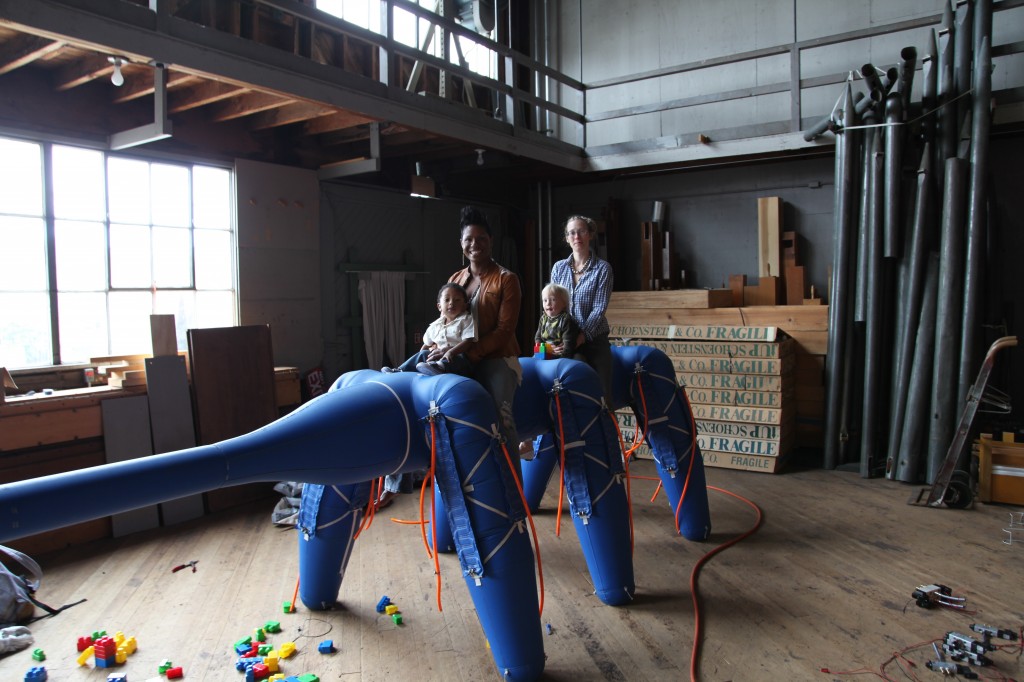
Inflatable Robots by Otherlab
IMO, the "big deal" in inflatable robots comes from OtherLab... They've built giant (ridable!) inflatable robots and inflatable robot arms with insane power to weight ratios. We did a special on them at Hizook a while back: http://www.hizook.com/blog/2011/11/21/inflatable-robots-otherlab-walking-robot-named-ant-roach-and-complete-arm-plus-hand The OtherLab project is also part of the same DARPA program (M3) that spawned the iRobot inflatable arm.
-
Re:what is the issue???
with nearly half($70k) being for the laser lidar system.
Where there is a will, there is a way. LIDAR systems are hideously expensive systems costing at least 5 digits, so designing one that is cheap enough to use in a vacuum cleaner would be impossible, right? Well, no. You can build one for $30. IEEE Conference Paper.
It's amazing what mass production can do to price. Just ask Apple.
-
Re:It's an ironic war, too
"High-Speed Robot Hand " http://www.hizook.com/blog/2009/08/03/high-speed-robot-hand-demonstrates-dexterity-and-skillful-manipulation?page=1
Or: http://econfuture.wordpress.com/2012/05/10/automation-links/
And from there: http://singularityhub.com/2012/05/04/better-faster-and-cheaper-these-robots-are-invading-car-manufacturing-plants/
See especially from the last: http://singularityhub.com/2011/04/23/look-out-humans-this-frida-robot-from-abb-will-take-your-factory-job/
The income-through-jobs link that grants the right to consume (for those 99% without significant capital) is about to be severely stretched... Which was predicted decades ago (like in "The Triple Revolution Memorandum" from 1964).
-
3D already standard on DaVinci surgical system
Uhm... I'm pretty sure that every single one of the Intuitive Surgical DaVinci robot workstations are 3D for the operator -- and we all know that hundreds of surgeries are performed with these every day.. In this video of researchers playing "Operation" (the board game) with a DaVinci robot, you can see the operator console with separate eye pieces to give 3D effects. I personally got to play with a DaVinci at IROS (robotics conference) last year, and the operator console was definitely in 3D -- though the observer consoles are just normal 2D TVs. I was told that this had been standard for a _long_ time.
-
Re:What does "net new jobs" mean?
http://www.kurzweilai.net/the-law-of-accelerating-returns
"I emphasize this point because it is the most important failure that would-be prognosticators make in considering future trends. Most technology forecasts ignore altogether this âoehistorical exponential viewâ of technological progress. That is why people tend to overestimate what can be achieved in the short term (because we tend to leave out necessary details), but underestimate what can be achieved in the long term (because the exponential growth is ignored)."Just look at any recent robotics videos and think again. Self-driving Google cars. The US military flying drones. Flexible manipulators. Wasp-like construction robots. The videos go on and on. Just one:
http://www.hizook.com/blog/2009/08/03/high-speed-robot-hand-demonstrates-dexterity-and-skillful-manipulationThe exponential progress is starting to show. The flashover to some other economic regime may be sooner than you think now. Even China is automating to assure quality and reduce labor costs and management costs.
http://www.appleinsider.com/articles/11/07/31/foxconn_to_substitute_workers_with_1_million_robots_in_3_years.html -
Can build yourself...
There's a long history of home-made steerable vibrobots. You can probably make one of these from parts readily available in your junkbox.
A quick tangent: I've seen these in person. They're pretty cool, but I'm not sure what "technology" Harvard is licensing. Perhaps just the PCB design and code?
-
Hmm, where have I seen that before..
-
Quick clarifications
So a few brief items (that are updated in the Hizook article): The collaborator at Stanford is Manu Prakash; the inflatable actuators actually contract (not expand); they can be powered by either pneumatics or hydraulics; and Ant-Roach can probably support up to 1000 lbs (a bit more than just a few riders).
-
Cost
I work on a volunteer project at my company. The actually bought us the hardware similar to that on the Google car.We are no where close to the Google car but it is fun side project in my free time.
My biggest issue with this coming to the general masses is the cost of the sensors on the vehicle.
The velodyne last I check was 75k. http://www.hizook.com/blog/2009/01/04/velodyne-hdl-64e-laser-rangefinder-lidar-pseudo-disassembled
If they are using the same GPS used in the urban challenges those cost 130k
I would love to see more work on using cheaper hardware and improving the software to work with the cheaper COTs hardware. -
Robot videos
As I posted here (the related p2presearch archive at listcultures.org has died, sadly, though is available elsewhere):
http://webcache.googleusercontent.com/search?q=cache:mf6UxV35GCQJ:listcultures.org/pipermail/p2presearch_listcultures.org/2009-November/005926.html+p2p+implications+robot+videos=======
Michel Bauwens wrote:
> I see a big contradiction between freefall and total robotization, with
> freefall, who's going to invest in total automation?
>
> so I would add 2 centuries to the robotic prediction, though I'm not at all
> certain that this will occur, I think it's a capitalist fantasy essentially,
> to remove all human contact with making and producing its own livelihood
> (I'm aware of course that leftleaning people have the same vision from
> another angle)OK, I responded to this once. I'm going to respond again with a longer list of videos. Most are short (except the Nova one).
"High-Speed Robot Hand Demonstrates Dexterity and Skillful Manipulation"
http://www.hizook.com/blog/2009/08/03/high-speed-robot-hand-demonstrates-dexterity-and-skillful-manipulation"Nova: The Great Robot Race"
http://www.hulu.com/watch/23347/nova-the-great-robot-race"DARPA Urban Challenge 2007"
http://www.youtube.com/watch?v=SQFEmR50HAk"Home Assistance Robot"
http://www.gametrailers.com/user-movie/home-assistance-robot/295707"ASIMO avoids moving obstacles"
http://www.youtube.com/watch?v=YPoANTKo5kA"ASIMOs new artificial intelligence. (ASIMO is learning!)"
http://www.youtube.com/watch?v=P9ByGQGiVMg"Roomba"
http://www.youtube.com/watch?v=HqhIMFQNGCg"IRobot Packbot action!"
http://www.youtube.com/watch?v=eaP0waiz43w"South Korea's Machine Gun Sentry Robot"
http://www.youtube.com/watch?v=v5YftEAbmMQ"Sentry Robot to Patrol Maine School"
http://www.youtube.com/watch?v=mUNikzYgIf4"Predator Drones"
http://www.youtube.com/watch?v=nMh8Cjnzen8"Merseyside Police helicopter remote control drone"
http://www.youtube.com/watch?v=s79QlJGQKks"BigDog Overview"
http://www.youtube.com/watch?v=k-AGWq0k_Mo"The Autonomous Grape-Vine Pruner"
http://www.youtube.com/watch?v=9GaGO9LIDEA"Robots in warehouse"
http://www.youtube.com/watch?v=Fdd6sQ8Cbe0"VMS robotic milking"
http://www.youtube.com/watch?v=aPqWpOxQmIs"Lely Robotic Barn Cleaner"
http://www.youtube.com/watch?v=bphBIwv5Vp8"Da Vinci Surgical Robot"
http://www.youtube.com/watch?v=C17-bGquIjI"CTC UT-1 ROV Ultra Trencher - Animation"
http://www.youtube.com/watch?v=1U72_B7B3Wk"Mars Rover Vid
-
Re:meh
Why not build a better one yourself then?
Someone beat me to it.. in 2009:
-
GE Also Made "Iron Man" Exoskeleton in 1950'sIn 1958 GE made a full-body exoskeleton called (no kidding) Iron Man. It was capable of picking up refrigerators! To quote Hizook:
Ralph Mosher, an engineer working for General Electric in the 1950s, developed a robotic exoskeleton called Hardiman. The mechanical suit, consisting of powered arms and legs, could give him superhuman strength. Mosher subsequently made a simpler version that permitted him to sit in his chair and pick up refrigerators.
-
Re:omg!
you mean like some of the things they show doing here?
-
Re:They have to compete with Willow Garage
Great news.
Maybe it will also help avoid the fate for an unemployed humanity Marshall Brain wrote about in the first part of "Manna" or I talk about in this youtube video:
"The Richest Man in the World: A parable about structural unemployment and a basic income "
http://www.youtube.com/watch?v=p14bAe6AzhATo avoid more economic disaster, we need to transition to a gift economy and other socioeconomic models before robots can replace most people in most tasks as they are more and more doing... Example of the technology just coming out of robotics labs:
http://www.hizook.com/blog/2009/08/03/high-speed-robot-hand-demonstrates-dexterity-and-skillful-manipulation -
High speed robot hand for clicking. :-)
-
Re:Limited demand + rising productivity =unemploym
From an Amazon review of that book: "The one lesson is simply this: economic planning should take into account the effects of economic policies on all groups, not just some groups, and what those effects will be in the long run, not just the short run. That's it. That's the lesson. Fallacious economic policies almost invariably seek to benefit one group at the expense of all others, or to bring about short-term benefits at the expense of long-term benefits. With this as his thesis, Hazlitt examines the numerous manifestations of such fallacies in different situations."
That sounds sensible to me. I'd agree that a lot of problems in the USA are from the way powerful interests have used the government to get preferences in their direction (like the US meat, dairy, and grain industries, which is destroying US health, or like the US war industry, see "War is a Racket" by Major General Smedly Butler).
However, and not having read the book,does Hazlitt talk about how mainstream economist assume demand is infinite as a way to keep up with exponentially rising productivity and still keep most people employed in the mainstream system so they have purchasing power to buy the necessities of life? See also the essay "The Triple Revolution" from 1964 about a breaking "income-through-jobs" link even then, and the last thirty plus years of stagnant real wages in the USA has proved that out to some degree, and now we see declining real wages and those economic trends are really taking hold.
http://educationanddemocracy.org/FSCfiles/C_CC2a_TripleRevolution.htmI feel demand for more physical stuff is not infinite among healthy humans (even given status competition) for at least four reasons. One is a spreading ethics like "Reduce, Reuse, Recycle" that suggests "voluntary simplicity". A second is because of the idea of Abraham Maslow's "Hierarchy of Needs" which suggests that after basic material aspirations are fulfilled, humans tend to focus on higher, generally non-material, ones. A third reason is the simple accumulation of stuff in our environment, where it becomes easier to find what you need as someone else's discarded or underutilized infrastructure at little incremental cost (thus Freecycle and too-cheap-to-matter internet services). A fourth reason is that for more creative and intellectual tasks, it turns out, reward is not much of a motivator and may even reduce performance by interfering with intrinsic motivation:
"RSA Animate - Drive: The surprising truth about what motivates us "
http://www.youtube.com/watch?v=u6XAPnuFjJcWhile the original article makes it seem like cell phones are not being replaced due to limited finances, could it be that we are also reaching some point of saturation in some area of basic communications technology?
While it is true, all things being equal, "more" in some sense might be nicer in some ways (like a faster cell phone or a prettier display), it is also true that the law of diminishing returns sets in at some point, where "more" starts to impose huge costs, including non-monetary ones like confusion and hassles and time costs of constant upgrades and learning new stuff. What would Hazlitt say are the implications of a law of diminishing returns for more goods and services across our entire society? That is not the kind of thing free market economists usually want to think about...
Then there is the fact that people without jobs due to rising productivity and limited demand would have no means to pay for more stuff, which then leads to another set of problems. Think about the implication of IBM's Watson winning at Jeopardy, or, for another case, this dexterous robot hand:
http://www.hizook.com/blog/2009/08/03/high-speed-robot-han -
Re:Not a long term solution for mobile robotics
There is certainly some truth to what you say. However, there are a number of other competing technologies (see overview here and here) such as time-of-flight (like the SR4000), textured stereo (like the PR2's sensor), or even just stereo cameras or structure from motion. The fact remains... the Kinect may have opened the floodgates. It proves that there is a market that it can benefit from economies of scale -- and it's not just for robotics.
It is important to note that almost every robotics lab in the country (that I know) either has a Kinect or plans to buy one. Hopefully the feature set will continue to improve (eg. outdoor operation, multiple sensors in the same scene, etc), either through improvements in structured light depth sensing, or buy adopting alternative technologies. Either way, our lab now uses one on each of our (indoor) robots, and it works better than any other (expensive) sensor we've used to date.
-
Re:Not a long term solution for mobile robotics
There is certainly some truth to what you say. However, there are a number of other competing technologies (see overview here and here) such as time-of-flight (like the SR4000), textured stereo (like the PR2's sensor), or even just stereo cameras or structure from motion. The fact remains... the Kinect may have opened the floodgates. It proves that there is a market that it can benefit from economies of scale -- and it's not just for robotics.
It is important to note that almost every robotics lab in the country (that I know) either has a Kinect or plans to buy one. Hopefully the feature set will continue to improve (eg. outdoor operation, multiple sensors in the same scene, etc), either through improvements in structured light depth sensing, or buy adopting alternative technologies. Either way, our lab now uses one on each of our (indoor) robots, and it works better than any other (expensive) sensor we've used to date.
-
Heard about it buying lunch at CMU Tartan Grill
Then I spent part of the afternoon, along with some others, watching the video replays of it and the unfolding tragedy in a conference room by Hans Moravec's Mobile Robot Lab, all the time hoping it was just a misunderstanding, and the astronauts were all right or something.
One of the hopes of some at the Robotics Institute was that robots could do more of the space exploration more safely, including preparing the way for humans. Was that really a quarter century ago?
http://www.willowgarage.com/pages/pr2/overview
http://www.hizook.com/blog/2009/08/03/high-speed-robot-hand-demonstrates-dexterity-and-skillful-manipulation
http://listcultures.org/pipermail/p2presearch_listcultures.org/2009-November/005926.htmlOr in some cases, even come and gone, sadly:
http://www.ri.cmu.edu/research_center_detail.html?type=publications¢er_id=7&menu_id=262
"Space Robotics Initiative (SRI)
This center is no longer active."Always wanted to work there and make Hewey, Dewey, and Louie from Silent Running, and the space habitat biospheres they maintain.
http://www.pdfernhout.net/princeton-graduate-school-plans.htmlThat Challenger tragedy was doubly sad with a school teacher on board, considering all the school kids who had been encouraged to watch it. I can wonder if that was part of the further collapse of the US space program?
Still, as much as such tragedies are awful, I later wrote that a big problem with the US space program is that not enough people are taking risks and dying from the consequences. If you think of how many people have died in ocean voyages in the early day of sailing, an active space program seriously oriented to extending human life into the cosmos should be willing to accept hundreds or thousands of deaths a year by astronauts taking calculated and reasonable risks (as in, a 80% chance of success).
The obsession with perfection and zero risk by NASA ultimately seems to have grounded the US space program. That, and an acceptance of overly complicated designs. If astronauts are willing to accept a 20% chance of disaster so they can fly more often (or at all), I say let them. If current astronauts don't want those odds, find new astronauts.
I'm not saying take foolish risks, or 99% risks of death, or risks not worth risking death for. I'm just saying, we probably could be launching 100X as many cheaper rockets and having a lot more success, and having thousands of people going into space every year, if we accepted more causalties (on the order of 20% of launches failing like this shuttle did 25 years ago). Obviously, such a program should be voluntary and people should understand the risks as best as they can. Ideally, over time, the risks would be reduced by better engineering to that of the current risks for air travel in commercial aircraft. But it is just too early to have that expectation.
Besides, and maybe I should not say this, but TV ratings would go up for the space program if NASA did not go out of its way to make everything look so boring with astronauts who have been training for years because there are so few launches and they are so expensive. The most interesting thing I ever saw on NASA TV was when that NASA astronaut lost her bag of tools while fiddling with a grease gun.
http://www.space.com/6131-astronaut-laments -
High-Speed Robot Hand Demonstrates Dexterity
It uses high speed visual servoing to dribble a ping-pong ball and to toss and catch a cell phone.
Ironcially, I am listening to President Obama's speech as I write this, and his advisors (and speech) seem clueless about the changing nature of economics given robotics and other automation, AI, better design, and voluntary social networks (even as I think he means well and it is good for the US that he his helping create some jobs by increasing some exports):
http://www.earthtechling.com/2011/01/obama-visits-ge-wind-turbine-plant/
Pres. Obama can talk all he wants about "winning a global competition", but the average human worker anywhere is not going to win a competition with advanced robots... Humans need to learn to "cooperate", not "compete".Economic solutions (my comments):
http://knol.google.com/k/paul-d-fernhout/beyond-a-jobless-recovery/38e2u3s23jer/2From a comment I posted yesterday in relation to an (purported) demo of a cold fusion device:
http://www.journal-of-nuclear-physics.com/?p=360&cpage=6#comment-20270In brief, a combination of robotics (and other automation, all made possible by cheaper computing), better design (whether from cold fusion devices or thin-film solar panels), and voluntary social networks (especially with volunteers cooperating through the internet on free and open source digital public works), are decreasing the value of most paid human labor by the law of supply and demand. Cheaper energy will only accelerate this trend, since often you can substitute energy for labor and thought.
At the same time, demand for goods and services is limited for a variety of reasons. These reasons include some classical ones, like a cyclical credit crunch or a concentration of wealth (with that concentration aided by automation, intellectual monopolies, and the rich getting richer and buying up more and more resources like land for rent seeking). The reasons also including some heterodox alternative economics ones, like people moving up Maslow's Hierarchy of Needs as they get a lot of "stuff" and move on to other pursuits than materialism (including spiritual aspirations, self-actualization, and social connections in communities), and as people embrace a growing environmental consciousness of "Reduce, Reuse, Recycle" to protect the biosphere.
In general, mainstream economists ignore these issues or have very unexamined beliefs about them. Imaginative innovation, like economist Julian Simon talks about in "The Ultimate Resource", makes possible many wonderful potentialities if we think them through. Please don't let your inventiveness or cold fusion get blamed for any issues caused by unimaginative scarcity-based economic models held onto with almost a religious fervor by so many (see "The Market as God" by theologian Harvey Cox in the Atlantic). Mainstream economist have long used such scarcity-based models to apologize for an overly hierarchical social order that we probably did not even need in the past -- search on "The Mythology of Wealth". Still, some degree of centralization can be a good thing; see Manuel De Landa on "meshworks and hierarchies", and how they keep turning into each other and how all real systems are mixtures of both. So, we need to think and experiment regarding ways to allow our 21st century society to function in a healthy way given all the 21st century technology people like yourself are busy creating in all sorts of areas.
A New York Times article called: "They Did Their Homework (800 Years of
-
Re:What does the wasp do with it?
There are numerous examples of electric field sensing fish too. They have electroreceptors along their dorsal line that they use to "see" in murky waters. Now, engineers are starting to replicate the sensors for use on robots -- pretty cool stuff.
-
Re:Hey, congrats
The kinect Z-sensor works by sending IR flashes and measuring the response time at the pixel level. They work well in the 1.8 to 2.7m. That probably makes it worthless in your case. If you need a bigger range, there are rangefinders that can be useful but that are bigger and more expensive. The best one is this one ( http://www.hizook.com/blog/2009/01/04/velodyne-hdl-64e-laser-rangefinder-lidar-pseudo-disassembled ) it does 1m-80m with down to 1cm of precision. But it is in another price range (last year it was $15,000)
-
Originally Demo'ed by iRobot CEO
Colin Angle (iRobot CEO) showed the "jamming gripper" in his 2009 TEDMED talk as an extension of "jamming skin locomotion" (blob robot). In his talk, he showed a video of it grasping medication, keys, a water bottle, and even a dummy-patient's arm; he also demonstrated a hand-held version. It's nice to see a more formal evaluation. For those interested, there is a photo showing how it works over on Hizook.com
-
Originally Demo'ed by iRobot CEO
Colin Angle (iRobot CEO) showed the "jamming gripper" in his 2009 TEDMED talk as an extension of "jamming skin locomotion" (blob robot). In his talk, he showed a video of it grasping medication, keys, a water bottle, and even a dummy-patient's arm; he also demonstrated a hand-held version. It's nice to see a more formal evaluation. For those interested, there is a photo showing how it works over on Hizook.com
-
Already subsumed by 3D cameras (aka Depth Cameras)
This is an interesting idea. However, it is already being subsumed by 3D cameras, more commonly known as depth cameras (a la Microsoft's Kinect), that produce dense 3D pointclouds and color images at framerate. The best example is work by Dieter Fox (et. al.) from University of Washington and Intel Labs Seattle that uses a depth camera to do (near) real-time 3D mapping of indoor scenes -- sort of like a Google Streetview indoors. The benefits of depth camera solutions are multi-fold: much lower cost as sensors like Kinect become available, pointclouds and camera images from a single (registered) source, and better portability.
-
Already subsumed by 3D cameras (aka Depth Cameras)
This is an interesting idea. However, it is already being subsumed by 3D cameras, more commonly known as depth cameras (a la Microsoft's Kinect), that produce dense 3D pointclouds and color images at framerate. The best example is work by Dieter Fox (et. al.) from University of Washington and Intel Labs Seattle that uses a depth camera to do (near) real-time 3D mapping of indoor scenes -- sort of like a Google Streetview indoors. The benefits of depth camera solutions are multi-fold: much lower cost as sensors like Kinect become available, pointclouds and camera images from a single (registered) source, and better portability.
-
Re:The holy grail of camera tech....
This goes a long way toward the "computational camera" where you get flexible depth of field (focus at many depths), trading off pixel resolution for HDR / multispectral imaging, and other cool techniques (like stereo). Exciting stuff!
-
Controlling Home Robots from "Smart Surface"
In case you're interested, there has been some nice work in using tabletop interfaces (ie. Microsoft Surface) to control home robots, like the iRobot Roomba.
-
Re:Depth of Field
Large depths of field, or see http://www.hizook.com/blog/2009/06/26/computational-cameras-exploiting-megapixels-and-computers-redefine-modern-camera and the talk there for how to play games to get low f-stops for non-grainy pictures and large depths of field at the same time. If you notice, most pictures taken with your cell phone camera tend to have a large amount of the picture in focus(excluding the motion blur parts).
-
Re:Help start the revolution!
Might give Robotis Dynamixel servos a try. Pretty simple for beginners to control from a PC or microcontroller: Hizook.com
-
Re:Going beyond vouchers
Automation, better design, voluntary social networks and limited demand mean that the value of most human labor is rapidly decreasing. Implicit in your comments is the assumption we need everyone to be working to produce all the goods and services we need (or want). But, that assumption is less and less true. Depending on who you believe and how you define unemployment, unemployment in the USA right now is somewhere between 10% and about 25%. Further, compared to a century or two ago, when children worked in factories and mines, and practically no one "retired", and practically no one went to college or graduate school, and people worked 70 hour work week (in factories or on farms), unemployment now could be thought of as 50% to 75% or higher compared to a century ago. The fact is, compared to then, essentially nobody in the USA is working, and those who work are not doing very much of it. It's true that if you go back to hunter/gatherer times (see Marshall Sahlins), you'll find a similar pattern (only some worked, and then it was not very hard).
For example, look at this video of a robot arm throwing a cell phone into the air and catching it, and tell me that most human labor will be needed in manufacturing in twenty years:
http://www.hizook.com/blog/2009/08/03/high-speed-robot-hand-demonstrates-dexterity-and-skillful-manipulation
Even China is starting to have issues with manufacturing unemployment. How long before many services go the same way as agriculture and manufacturing? Yet our entire schooling system is still oriented around turning out mostly factory workers and soldiers.
http://www.johntaylorgatto.com/underground/toc1.htmAnyway, so I think current trends show that work has long been going away (even as demand has increased greatly up to a point). Further, in the USA, most people have long gone past the point of diminishing returns for more stuff and bigger homes to the point of negative returns (due to the destruction of community and family) -- even as some 10% to 20% of the US population has been left out of that and is relatively impoverished and would benefit greatly from more stuff.
"The Culture of Affluence: Psychological Costs of Material Wealth"
http://www.ncbi.nlm.nih.gov/pmc/articles/PMC1950124/
"Children of the Affluent: Challenges to Well-Being"
http://www.ncbi.nlm.nih.gov/pmc/articles/PMC1948879/The happiest places in the world usually have both material abundance and strong social programs:
http://abcnews.go.com/Business/Economy/story?id=7585729&page=1
"According to a 2005 editorial, published in the British Medical Journal and authored by Dr. Tony Delamothe, research done in Mexico, Ghana, Sweden, the U.S. and the U.K. shows that individuals typically get richer during their lifetimes, but not happier. It is family, social and community networks that bring joy to one's life, according to Delamothe. "Some related links:
http://www.marshallbrain.com/manna1.htm
http://users.ipfw.edu/ruflethe/american.html
http://www.whywork.org/rethinking/whywork/abolition.html
http://educationanddemocracy.org/FSCfiles/C_CC2a_TripleRevolution.htm
-
Re:War play is a racket...
To turn that around, advanced technology, sir, is walking a line dangerously close to communism!
That's because we are seeing the value of most human labor slowly plummeting to zero (one reason why no one can afford health insurance anymore except the doctors and medical equipment manufacturer owners.
http://marshallbrain.com/robotic-freedom.htm
http://www.marshallbrain.com/manna1.htmSo, as Marshall Brain suggests, the end point of capitalism is the starvation of all people who do not have a lot of capital (because, when their labor is worthless, they will not be able to pay for food, clothes, rent, medical costs, etc.). Everything from milking cows to doing genetic research is being automated:
"VMS robotic milking"
http://www.youtube.com/watch?v=aPqWpOxQmIs
"Robot Scientist Makes Discovery"
http://dsc.discovery.com/news/2009/04/02/robot-scientist.htmlRobots are making the leap from less coordinated than humans to more coordinated than humans:
"High-Speed Robot Hand Demonstrates Dexterity and Skillful Manipulation"
http://www.hizook.com/blog/2009/08/03/high-speed-robot-hand-demonstrates-dexterity-and-skillful-manipulationMore links to robot videos here:
http://listcultures.org/pipermail/p2presearch_listcultures.org/2009-November/005926.htmlThe thing is, "ownership" is ultimately a political construction:
"The Mythology of Wealth"
http://www.conceptualguerilla.com/?q=node/402Propped up by millionaire wannabees and slightly privileged guards:
"The Wrath of the Millionaire Wannabe's"
http://www.conceptualguerilla.com/?q=node/47
"The Coming Revolt of the Guards"
http://www.historyisaweapon.com/defcon1/zinncomrev24.htmlAre you a billionaire? Otherwise, by capitalist standards, if your work can eventually be automated, your life will then be worthless in their eyes, and you should then logically starve once everything you can do of value to billionaires has been automated. And don't say you'll just get another job, because as Marshall Brain suggests, that one will be automated too once we pass some critical thresholds in AI and robotics. That's like saying you will hide under a tree to stay dry in a rainstorm and when that tree gets wet through you will go find another.
The only question is, do we put in place social reforms now, or do we wait until even more people are starving? Well, there's an obvious answer to that in a capitalist society, and as American financier Jay Gould said after hiring strikebreakers, it is "I can hire one-half of the working class to kill the other half."
http://en.wikipedia.org/wiki/Wage_slaverySo, ideally, we need to find alternatives to a society build around a conception of work:
http://www.whywork.org/rethinking/whywork/abolition.htmlThe real reason why violent (and other) games are evil in a way is just that they are a distraction from dealing with that very serious issue of rethinking our society on some better ba
-
Re:Defense?
I actually talked about this some time ago
One of my biggest concerns: government regulation of amateur builders. The FAA already treats commercial UAVs as regular planes, requiring aircraft registration and 60 day pre-flight plans. While the regulations for hobbyists seem to be more lax, I personally believe the FAA should embrace amateur UAV builders in the same way that the FCC embraced ham radio operators of yesteryear. Besides, building UAVs is a great family bonding activity that promotes engineering.
But... the same economies that make UAVs appealing to hobbyists also make them appealing for asymmetric warfare. While I am not familiar with any incident involving UAVs and nefarious organizations / persons, it is pretty evident that asymmetric economies are at play. It is certainly a slippery slope, but let's just hope the FAA remains lax on hobbyist experimentation -- after all, there is no ban on cellphones despite their use in IEDs.
-
I'm working on a related system...
I'm working on a related system to what he describes towards the end of the article -- something that is a partnership between the individual musician and a the computer, to amplify musical creativity, for the Android Smartphone. It's almost ready to release...
People at IBM Research in the past (a decade ago) also did some things also to amplify musical creativity using computers, but unfortunately did not get as much support as they deserved:
http://www.alphaworks.ibm.com/tech/musicsketcher/
http://domino.watson.ibm.com/comm/wwwr_seminar.nsf/pages/sem_abstract_186.htmlAs David Cope says, part of our musical future may well be more about a partnership.
It's been said, "the woods would be pretty quite if no bird sang there but the best". The real reason to do music is because humans are musical creatures, however they want to express it.
The whole issue of "fame" or "income" is linked to dysfunctional social systems and dysfunctional economic systems. The real issue is that we need a "basic income" for everyone to reflect a human right to draw from the industrial material and informational commons, especially because more and more human labor is becoming worth less and less due to increases in automation, better design, and limited demand (as humans get enough stuff and move up Maslow's hierarchy of needs to self actualization which often can be done fairly cheaply). More ideas I helped put together here:
http://en.wikipedia.org/wiki/Jobless_recovery
And here:
"Ideas for a brickfilm and video games to help avoid a Caprican future"
http://groups.google.com/group/openmanufacturing/browse_thread/thread/cf4ee7f45d631838#I think we are seeing that now with health care. Much human labor is no longer valuable enough in the USA to earn the money to pay for health insurance -- even as some very few medical specialists who practice medicine or make medical devices (including medical robots) can command vast sums of money for their expertise. Of course, we don't need that many more medical specialists (even if more might be nice), so there is no easy solution to that since we don't need everyone to be a doctor or medical robot maker; so, ultimately, the government will have to intervene more in a dysfunctional marketplace, once the populace moves past the secular religion of "The Market as God".
http://www.theatlantic.com/issues/99mar/marketgod.htm
Capitalism won't work well unless wealth is widespread, and that means the government has to step in and keep money flowing. Otherwise, the rich just put excess money into a "Casino economy" of derivatives and currency speculation that has little relation to the real world. See:
http://www.moneyasdebt.net/
http://www.capitalismhitsthefan.com/As robots can do more labor, whether creative as in putting together music or physical as in putting together food:
http://www.hizook.com/blog/2009/08/03/high-speed-robot-hand-demonstrates-dexterity-and-skillful-manipulation
http://www.youtube.com/watch?v=nv7VUqPE8AE
we will need a completely new economic ideology if we are to survive the irony of real starvation amidst theoretical robot-produced abundance.People have been talking about this since 1964 and even before:
-
Re:Misses the post-scarcity point; digital abundan
I'm sure a lot of economists would agree with you. And, like you try to do, one may paint some extreme picture (like running out of hydrogen in the universe). But, compared to that happening to a universe-spanning species in some far distant future, the human race has no real resource limits of any significance. Hovewer, there are many *artificial* scarcities that have been created, from a shortage of doctors (carefully controlled med school cartels), to a shortage of copyrights (law), to a shortage of renewable energy (subsidies to nuclear energy and fossil fuels instead), to a shortage of creative people (compulsory schools dumbing people down, like John Taylor Gatto says).
But healthy human beings have limited demands for things, because the best things in life are free or cheap. If you accept that premise, economics begins to fall apart. What you describe, with humans forever chasing unlimited resources, and essentially willing to sacrifice happiness for unlimited material wants, will someday be seen as mental illness, even if it is celebrated in current US culture as "rationality".
Julian Simon shows how prices go down over time for most things, especially in a well functioning market. Aluminum used to cost more than platinum hundreds of years ago; now we throw it away. If you accept that premise, along with the idea that realistic demand grows more slowly than exponential technological capacity, then economics also begins to fall apart.
The FSF site has writings by Alfie Kohn that "reward is no motivator". Even if you assume a need to ration, the economic idea of linking rationing to individual productivity also falls apart.
This shows a robot with high speed hand-eye coordination. This means most human labor will soon be worth very little:
http://www.hizook.com/blog/2009/08/03/high-speed-robot-hand-demonstrates-dexterity-and-skillful-manipulation
If you accept what that video is telling you, economics begins to fall apart.On a practical basis, once we have a lot of abundance, the need to ration any of the basics people now argue over (food, shelter, health care, information, energy) on a personal basis goes away. It would be like charging for sunlight on a sunny day. That does happen in a sense in city apartments. But there are other dynamics that affect that as well. Like, if people had a basic income, they could afford to live in the country and have more say over their lives. Or if laws were different about land ownership, cities might be build differently, perhaps more lowrise like Philadelphia and older cities in Europe.
Now, you raise a good point on selling back to people clean air and clean water after others have polluted it. But, that is an issue of managing anti-social behavior IMHO.
Besides, what do we really know about the nature of the universe and what is possible in a million years? What we do know is that we live in a solar system with enough material to make the surface area of millions of Earths. And that is just one solar system of millions in our galaxy.
So, energy is getting less scarce. Go show me how energy is getting scarce, if you want an example to talk about. The Earth receives thousands of times more solar energy that our civilization uses, to begin with. The Sun itself puts out millions of times more than that. Readily available oil may be getting scarce, but, as a consequence, prices rise and people adapt and create new energy sources.
But, that bet has already been done. The economist taking the side you suggest you want to be on lost:
http://en.wikipedia.org/wiki/Simon-Ehrlich_wagerSure, in theory, in thousands of years, and exponentially expanding civilization might encounter resource limits, but we are nowhere near that. In fact, within all industrialized countries, birthrates of established families are falli
-
Re:That's totally wrong.
A rebuttal to the "socialist agencies" comment I quoted is here by "hiram":
http://www.moonbattery.com/archives/2009/08/a_savage_mob.htmlHiram makes some good points. Still, is not regulation of monopolies something you need a government for? Also, much drug research is fundamentally based on publicly funded (NIH) studies. Also, broadcast media was in general much better for families when there was an equal time law and restrictions against advertising to children. So, some of the problems he points to are the result of deregulation as well as shifting government resources away from "butter" and into "guns". I agree public schooling is a big problem (see John Taylor Gatto and my other post).
We need to separate out various functions of government like regulation and oversight or taxing and redistributing wealth for legitimate public purposes (including avoiding a concentration of wealth that is bad for democracy, like with a progressive tax up to 91% under Roosevelt after WWII) from the issue of who actually provides the services.
But, as I said earlier, take a look at this video of a high speed robot hand from Japan and tell me *anything* about our economy will make sense as-is in ten or twenty years:
http://www.hizook.com/blog/2009/08/03/high-speed-robot-hand-demonstrates-dexterity-and-skillful-manipulationOr even this:
From:
http://www.freerepublic.com/focus/f-chat/2159038/posts http://www.washingtonpost.com/wp-dyn/content/article/2009/01/02/AR2009010202191.html
"Armed robotic aircraft soar in the skies above Pakistan, hurling death down on America's enemies in the war on terrorism. Soon -- years, not decades, from now -- American armed robots will patrol on the ground as well, fundamentally transforming the face of battle. Conventional war, even genocide, may be abolished by a robotic American Peace.
The detachment with which the United States can inflict death upon our enemies is surely one reason why U.S. military involvement around the world has expanded over the past two decades. The excellence of American military technology makes it possible for U.S. forces to inflict vast damage upon the enemy while suffering comparatively modest harm in return.
The rapid emergence of the armed unmanned air vehicles (UAVs) that roam over Pakistan is a sequel to Moore's Law. Onboard computers became far more powerful, so automatic pilots became far more competent. Signal processors became more sophisticated, facilitating collection and processing of more interesting intelligence. Global Positioning System receivers shrank and could be economically employed on small robotic aircraft. Precision-guided munitions could deliver lethal firepower. And so forth.
The U.S. Navy has arguably moved farthest toward substituting treasure for blood. A generation ago the Reagan administration brought World War II-era battleships out of mothballs to provide gunfire support to onshore operations. With a crew of more than 1,500, these ships were designed to be manned by the low-paid draftees of the 1940s, not the more amply rewarded volunteers of the 1980s. The Navy couldn't afford them, and the ships were soon returned to mothballs. In their place, the Navy came up with the new DDG-1000 Zumwalt destroyer, an automated warship with a crew of only 150."I came across that while looking what the freepers say about robots:
http://www.freerepublic.com/tag/robot/index?tab=articlesAnyway, many conservatives don't get it about technology invalidating muc
-
Re:That's what a basic income is for...
Well, we also have robots on Planet Earth:
http://www.hizook.com/blog/2009/08/03/high-speed-robot-hand-demonstrates-dexterity-and-skillful-manipulationWhat does that robot mean about the future of most jobs requiring hand-eye coordination?
See also:
http://educationanddemocracy.org/FSCfiles/C_CC2a_TripleRevolution.htmA basic income almost passed under Nixon.
-
Re:That's what a basic income is for...
And what about Debian GNU/Linux? Or the FOSS movement? And so on. Take a look at this video and tell me anything about mainstream economics is going to make sense soon:
http://www.hizook.com/blog/2009/08/03/high-speed-robot-hand-demonstrates-dexterity-and-skillful-manipulation -
Post-scarcity education for a post-scarcity world
Lots of jobs don't require much literacy, which is one reason schools are getting worse and worse at teaching basic literacy, even as they still stamp out initiative and creativity in many cases.
http://www.johntaylorgatto.com/chapters/16a.htm
"""
I'll bring this down to earth. Try to see that an intricately subordinated industrial/commercial system has only limited use for hundreds of millions of self-reliant, resourceful readers and critical thinkers. In an egalitarian, entrepreneurially based economy of confederated families like the one the Amish have or the Mondragon folk in the Basque region of Spain, any number of self-reliant people can be accommodated usefully, but not in a concentrated command-type economy like our own. Where on earth would they fit? In a great fanfare of moral fervor some years back, the Ford Motor Company opened the world's most productive auto engine plant in Chihuahua, Mexico. It insisted on hiring employees with 50 percent more school training than the Mexican norm of six years, but as time passed Ford removed its requirements and began to hire school dropouts, training them quite well in four to twelve weeks. The hype that education is essential to robot-like work was quietly abandoned. Our economy has no adequate outlet of expression for its artists, dancers, poets, painters, farmers, filmmakers, wildcat business people, handcraft workers, whiskey makers, intellectuals, or a thousand other useful human enterprises--no outlet except corporate work or fringe slots on the periphery of things. Unless you do "creative" work the company way, you run afoul of a host of laws and regulations put on the books to control the dangerous products of imagination which can never be safely tolerated by a centralized command system.
"""This robot is not very literate, but it will probably eventually take many jobs away:
http://www.hizook.com/blog/2009/08/03/high-speed-robot-hand-demonstrates-dexterity-and-skillful-manipulation
"A few blogs are passing around videos of the Ishikawa Komuro Lab's high-speed robot hand performing impressive acts of dexterity and skillful manipulation. However, the video being passed around is slight on details. Meanwhile, their video presentation at ICRA 2009 (which took place in May in Kobe, Japan) has an informative narration and demonstrates additional capabilities. I have included this video below, which shows the manipulator dribbling a ping-pong ball, spinning a pen, throwing a ball, tying knots, grasping a grain of rice with tweezers, and tossing / re-grasping a cellphone!"We need to rethink many things about our society and economy -- and compulsory schooling is interwoven with the notion of a command economy based on rationing and a scarcity-mindset. We need post-scarcity education to go with a post-scarcity economy. A related sci-fi story by Marshall Brain:
http://www.marshallbrain.com/manna1.htm -
Re:Sped Up
You mean like this one?
My guess is either that these robots are designed for lighter gravity and therefor underpowered or the inserted lag in the testing to similate real world conditions of distance.
Of course there is also the possibility that they are slowing the maneuvering in an attempt to not damage them or even rotate different programing training (people at the controls) and so on.