Slashdot Mirror
Domain: huffingtonpost.com
Stories and comments across the archive that link to huffingtonpost.com.
Stories · 276
-
Google's Comical New Social Networking Patent
theodp writes "GeekWire reports on Google's just-granted patent on creating and sharing social network status updates in the form of comic strips, a la Bitstrips. Google also envisions an educational role for its new invention, which the search giant has dubbed the Self-Creation of Comic Strips in Social Networks and Other Communications. Google explains, 'Aside from humor, such comic strips are also usable for education, for instance in summarizing a real-time conversation between two political leaders as it is happening. By posting such a comic strip on a social network facility such as a social network blog or tweet, others may more readily follow the flow of the conversation than if it had been summarized in plain text.'" -
Former CIA/NSA Head: NSA Is "Infinitely" Weaker As a Result of Snowden's Leaks
An anonymous reader writes "The Huffington Post reports, 'Michael Hayden, former director of the National Security Agency, said Sunday that he used to describe leaker Edward Snowden as a "defector," ... "I think there's an English word that describes selling American secrets to another government, and I do think it's treason," Hayden said ... Some members of Congress have also ... accused him of an act of treason. Hayden said his view of Snowden has grown harsher in recent weeks after reports that Snowden is seeking asylum in Germany and Brazil in exchange for assisting their investigations into NSA programs. Hayden said the NSA is "infinitely" weaker as a result of Snowden's leaks. "This is the most serious hemorrhaging of American secrets in the history of American espionage," he said. "What Snowden is revealing ... is the plumbing," he added later. "He's revealing how we acquire this information. It will take years, if not decades, for us to return to the position that we had prior to his disclosures."' — More in the Face the Nation video and transcript, including discussion of the recent legal decisions, and segments with whistleblower Thomas Drake, Snowden legal adviser Jesselyn Radack, and Washington Post reporter Barton Gellman who recently interviewed Snowden." -
Scientists Uncover 3,700-Year-Old Wine Cellar
Taco Cowboy writes in with a link about the remnants of some well-aged wine recently uncovered in Israel. "Scientists have uncovered a 3,700-year-old wine cellar in the ruins of a Canaanite palace in Israel, chemical analysis from the samples from the ceramic jars suggest they held a luxurious beverage that was evidently reserved for banquets. The good stuff contains a blend of ingredients that may have included honey, mint, cedar, tree resins and cinnamon bark. The discovery confirms how sophisticated wines were at that time, something suggested only by ancient texts. The wine cellar was found this summer in palace ruins near the modern town of Nahariya in northern Israel. Researchers found 40 ceramic jars, each big enough to hold about 13 gallons, in a single room. There may be more wine stored elsewhere, but the amount found so far wouldn't be enough to supply the local population, which is why the researchers believe it was reserved for palace use. The unmarked jars are all similar as if made by the same potter. Chemical analysis indicates that the jars held red wine and possibly white wine. There was no liquid left; analyses were done on residues removed from the jars. An expert in ancient winemaking said the discovery 'sheds important new light' on the development of winemaking in ancient Canaan, from which it later spread to Egypt and across the Mediterranean." -
NSA Planned To Discredit Radicals Based On Web-Browsing Habits
wired_parrot writes "New leaked documents show that the NSA was not only monitoring suspected radical sympathizers, but planned to discredit them based on their web-surfing habits. This includes not only evidence of porn browsing and online sexual activity, but also extortion and blackmail based on inappropriate use of funds. At the same time, the leaked document notes that very few of the targeted contacts were associated with terrorism." -
San Quentin Inmates Learn Technology From Silicon Valley Pros
Hugh Pickens DOT Com writes "The Washington Post reports that a rigorous, six-month training program launched by successful tech entrepreneurs for inmates in the decaying San Quentin State Prison is teaching carefully selected inmates the ins and outs of designing and launching technology firms, using local experts as volunteer instructors and the graduates, now trickling out of the penal system, are landing real jobs at real dot-coms. 'We believe that when incarcerated people are released into the world, they need the tools to function in today's high-tech, wired world,' says co-founder Beverly Parenti, who with her husband, Chris Redlitz, has launched thriving companies, including AdAuction, the first online media exchange. During twice-a-week evening lessons, students — many locked up before smartphones or Google— practice tweeting, brainstorm new companies and discuss business books assigned as homework. Banned from the Internet to prevent networking with other criminals, they take notes on keyboard-like word processors or with pencil on paper. The program is still 'bootstrapping,' as its organizers say, with just 12 graduates in its first two years and now a few dozen in classes in San Quentin and Twin Towers. But the five graduates released so far are working in the tech sector. 'This program will go a long way to not only providing these guys with jobs, but it is my hope that they hire people like them who have changed their lives and are now ready to contribute to society, pay taxes, follow the law, support their families,' says former California Department of Corrections and Rehabilitation director Matthew Cate who adds he made the right decision to approve the training course. 'All those things contribute to the economy.'" -
MAVEN Ready To Launch Today
An anonymous reader writes "Mars seems to have gone from being a warm, wet planet with a liquid core (with magnetic fields strong enough to maintain an atmosphere) to a cooled frozen desert-like surface. By gathering information about the Mars upper atmosphere and its magnetic field scientists hope MAVEN can help explain what happened and where the water went." -
How the NSA Is Harming America's Economy
anagama writes "According to an article at Medium, 'Cisco has seen a huge drop-off in demand for its hardware in emerging markets, which the company blames on fears about the NSA using American hardware to spy on the rest of the world. ... Cisco saw orders in Brazil drop 25% and Russia drop 30%. ... Analysts had expected Cisco's business in emerging markets to increase 6%, but instead it dropped 12%, sending shares of Cisco plunging 10% in after-hours trading.' This is in addition to the harm caused to remote services that may cost $35 billion over the next three years. Then, of course, there are the ways the NSA has made ID theft easier. ID theft cost Americans $1.52 billion in 2011, to say nothing of the time wasted in solving ID theft issues — some of that figure is certainly attributable to holes the NSA helped build. The NSA, its policies, and the politicians who support the same are directly responsible for massive losses of money and jobs." -
Twitter's Fake Followers Watching IPO Closely
kraksmoka writes "Is your social media pro 'making it go viral' by pressing a button instead of interacting with a real audience? The purchase and use of fake followers by small to mid-sized social media agencies is rising on Twitter and there is concern that the growth of fake followers can't be stopped. " -
Report Claims a Third of FOIA Requests To the NYPD Go Unanswered
Daniel_Stuckey writes "Reporters Matt Apuzzo and Adam Goldman, who shared a Pulitzer last year as part of the Associated Press team covering the NYPD's surveillance activity, have summed it up perfectly: The NYPD doesn't answer document requests. "For the most part, they don't respond," Apuzzo told the Huffington Post. 'Even the NSA responds.' It's not just reporters who've noticed. New York City Public Advocate and mayoral candidate Bill de Blasio gave the police department a failing grade in an April report based on its dismal response rate to Freedom of Information requests. By de Blasio's analysis, nearly a third of requests submitted to NYPD go unanswered." -
Arizona Commissioner Probes Utility's Secret Funding of Anti-Solar Campaign
mdsolar writes "An Arizona utility commissioner is asking for all the key players in a debate over a solar energy policy in the state to reveal any additional secret funding of nonprofits or public relations campaigns. The probe comes after Arizona Public Service, the state's largest utility, admitted last week that it had been secretly contributing to outside nonprofits running negative ads against solar power. As The Huffington Post reported Friday, APS recently admitted that it had lied for months about paying the 60 Plus Association, a national conservative organization backed by the Koch brothers, to run ads against current solar net-metering policy. APS is currently pushing the Arizona Corporation Commission to roll back the policy, which allows homeowners and businesses with rooftop solar energy systems to make money by selling excess energy back to the grid. Solar proponents say that the policy has facilitated a solar boom in the state, and that changing it could have a huge negative impact on future growth." -
Arizona Commissioner Probes Utility's Secret Funding of Anti-Solar Campaign
mdsolar writes "An Arizona utility commissioner is asking for all the key players in a debate over a solar energy policy in the state to reveal any additional secret funding of nonprofits or public relations campaigns. The probe comes after Arizona Public Service, the state's largest utility, admitted last week that it had been secretly contributing to outside nonprofits running negative ads against solar power. As The Huffington Post reported Friday, APS recently admitted that it had lied for months about paying the 60 Plus Association, a national conservative organization backed by the Koch brothers, to run ads against current solar net-metering policy. APS is currently pushing the Arizona Corporation Commission to roll back the policy, which allows homeowners and businesses with rooftop solar energy systems to make money by selling excess energy back to the grid. Solar proponents say that the policy has facilitated a solar boom in the state, and that changing it could have a huge negative impact on future growth." -
Saudi Justice: 10 Years and 2,000 Lashes For Internet Video of Naked Dancing
An anonymous reader writes with a link to The Huffington Post, which reports "that a Saudi man was sentenced to 2,000 lashes and 10 years in prison for dancing naked on the roof of a car and posting the video online, according to multiple reports. Three other men were also sentenced to three to seven years in jail and hundreds of lashes each for the incident, Agence France-Presse reported, citing Arabic-language paper Al-Sharq. The four men were hit with a number of charges, including "encouraging vice" and violating public morality, according to the report. The prosecutor in the case, which was heard by a judge in Saudi Arabia's conservative Al-Qassem province, reportedly objected to the sentences for being "too lenient," Gulf News notes. The video was reportedly circulated widely on the Internet, but could not be found by The Huffington Post." -
TEPCO Workers Remove Wrong Pipe Get Splashed With Radioactive Water
An anonymous reader writes "A day after TEPCO workers mistakenly turned off cooling pumps serving the spent pool at reactor #4 at the crippled nuclear plant comes a new accident — 6 workers apparently removed the wrong pipe from a primary filtration system and were doused with highly radioactive water. They were wearing protection yet such continuing mishaps and 'small mistakes' are becoming a pattern at the facility." -
Fukushima Nuclear Worker Accidentally Toggles Off Cooling Pumps
An anonymous reader writes "A Tepco employee carelessly pressed a button shutting off cooling pumps that serve the spent fuel pool in reactor #4 — thankfully a backup kicked in before any critical consequences resulted. The question remains just how vulnerable to simple mistakes (such as a single button push) are these spent fuel pools, filled nearly to capacity as they are with over 12,000 spent fuel rods? From the article: 'The latest incident is another reminder of the precarious state of the Fukushima plant, which has suffered a series of mishaps and accidents this year. Earlier this year, Tepco lost power to cool spent uranium fuel rods at the Fukushima Daiichi plant after a rat tripped an electrical wire.'" -
Pentagon Spent $5 Billion For Weapons On Day Before Shutdown
Hugh Pickens DOT Com writes "John Reed at Foreign Policy reports that the Pentagon awarded 94 contracts Monday evening on its annual end-of-the-fiscal-year spending spree, spending more than five billion dollars on everything from robot submarines to Finnish hand grenades and a radar base mounted on an offshore oil platform. To put things in perspective, the Pentagon gave out only 14 contracts on September 3, the first workday of the month. Some of the more interesting purchases from Monday's dollar-dump include the $2.5 billion award the Defense Logistics Agency gave to aircraft engine-maker Pratt & Whitney for 'various weapons system spare parts' used by the Army, Navy, Air Force and Marines, $65 million for military helmets from BAE Systems, $24 million for 'traveling wave tubes' to amplify radio signals from Thales, $17 million for liquid nitrogen, $15 million for helium and $19 million on cots. The Air Force, traditionally DOD's biggest spender, was relatively restrained; it dished out only 17 contracts including $49 million to help France buy 16 MQ-9 Reaper drones, $64 million to Lockheed for help operating spy satellites that are equipped with infrared cameras, and $9 million to URS Corp. for maintenance work on the Air National Guard's fleet of RC-26B spyplanes that help domestic law enforcement agencies catch drug dealers. The air service also spent $9 million on a new gym at the Air Force Academy that includes areas for CrossFit training, space for the academy's Triathlon Club and a 'television studio.' It just goes to show, says Reed, that 'even when the federal government is shutdown and the military has temporarily lost half its civilian workforce, the Pentagon can spend money like almost no one else.'" -
German NSA Critic Denied Entry To the US
An anonymous reader writes "Major newspapers in Germany (FAZ, Die Welt, SZ, ...) and the Huffington Post report that the author Ilja Trojanow has been prevented from boarding a plane from Salvador da Bahia to the U.S. where he was invited to attend a conference. He had ESTA documents showing that his visit was approved as part of the Visa Waiver Program and was last year given a visa to teach at the university of Saint Louis. Trojanow was one of the initiators of an open letter (Google translation to English) urging Chancellor Merkel to take actions against NSA surveillance in Germany." -
Martin Luther King Jr's Children In Court Over MLK IP
cervesaebraciator writes "Slashdot has reported before about the copyright nightmare of Dr. Martin Luther King Jr.'s 'I Have a Dream' Speech. Now, questions of intellectual property and the legacy of Dr. King have caused his children to go to court. The estate, run by King's sons, claims the rights to the intellectual property and memorabilia of Dr. King as assets. Accordingly, it has filed suit against the non-profit Martin Luther King Jr. Center for Nonviolent Change, run by King's daughter, for plans to continue using King memorabilia once a royalty-free licensing agreement expires, (which the estate says will be in September). As is the case with increasing frequency, one is left to wonder about the implications intellectual property claims have for free speech when they can be applied to so public a figure as Dr. King." -
Pastafarian Wins Battle To Wear Colander In License Photo
An anonymous reader writes "Eddie Castillo is the first American to successfully have his government-issued photo identification taken while wearing a colander, though DPS officials are reportedly planning to follow up with Castillo in order to 'rectify' the situation. Others have tried unsuccessfully, and Castillo told KLBK that he was surprised at his victory, which he called a 'political and religious milestone for all atheists everywhere.'" Two years ago Niko Alm won the right to wear a pasta strainer on his head although Austrian authorities required him to obtain a doctor's certificate that he was "psychologically fit" to drive. -
Study Suggests Violent Video Games May Make Teens Less Violent
barlevg writes "A new paper is out in the Journal of Youth and Adolescence which shows no positive correlation between playing violent video games and acts of aggression. The study of 377 children with attention deficit and depressive symptoms in fact showed a slight negative correlation between video game-playing and aggressive behavior such as bullying, which the researchers posit is due to the games awarding some measure of catharsis. The full paper is available online (PDF)." -
XPrize Pulls Plug On $10 Million Genomics Competition
sciencehabit writes "The XPrize Foundation has scrapped its high-profile $10 million genomics challenge set for next month after attracting only two competitors to the sequencing contest. The Archon Genomics XPRIZE began with much fanfare 7 years ago with the aim of boosting medical genomics by offering a $10 million award to the first team to sequence 100 human genomes in 10 days for no more than $10,000 each. After complaints about the tight deadline and unclear judging criteria, the foundation revised the rules in October 2011: The objective was to sequence the genomes of 100 centenarians with high accuracy and 98% completeness within 30 days for $1000 or less. Interest was tepid, however, and only two of the eight contenders in the original contest registered by the 31 May deadline — the company Ion Torrent, and George Church's lab at Harvard University." -
The Big Hangup At Burning Man Is Cell Phones
Hugh Pickens DOT Com writes "L. J. Williamson writes in the LA Times that with no running water, no plumbing, and no electrical outlets Burning Man isn't the kind of place to expect full bars on your smartphone and for many of the participants that's a big part of its charm. 'If you want to partake in the true Burning Man experience, you should leave your phone at home,' says Mark Hansen. In past years, the closest cellular towers, designed to serve the nearby towns of Empire (population 206) and Gerlach (population 217), would quickly get overwhelmed each August when Black Rock City (population 50,000 or so) rose from the featureless playa. Although Burning Man attracts a sizable Silicon Valley contingent including tech giants like Jeff Bezos, Larry Page, and Sergey Brin — the feeling of being 'unplugged' has become an integral part of the Burning Man experience. But another part of the event is an intrepid, DIY ethos, and in that spirit, David Burgess, co-creator of OpenBTS, an open-source cellular network software, brought a homemade in 2008, an 'almost comical' setup that created a working cellular network that routed a few hundred calls over a 48-hour period. In each subsequent year, Burgess has improved the system's reach and expects to have about three-quarters of this year's event covered. Burning Man proved an ideal test bed for development of Burgess' system, which he has since made available for use in other areas without cellular networks. 'People who have a lot of experience in international aid say Burning Man is a very good simulation of a well-organized refugee camp,' says Burgess. 'Because there's no infrastructure, it forces us to contend with a lot of problems that our rural customers have to contend with in very remote places.'" -
Time Reporter "Can't Wait" To Justify Drone Strike On Julian Assange
First time accepted submitter Tuck News writes "A reporter for TIME Magazine sparked a Twitter war when he said that he 'can't wait to write a defense of the drone strike that takes out Julian Assange'. Michael Grunwald deleted his tweet after a follower argued that it would only encourage Assange supporters.Grunwald's employer distanced itself from the tweet, saying 'Michael Grunwald posted an offensive tweet from his personal Twitter account that is in no way representative of TIME's views.'" -
Alcatel-Lucent Cuts Go Deeper — 7,500 Jobs Gone and Counting
Dawn Kawamoto writes "Alcatel-Lucent has cut 7,500 jobs since the start of the year — a couple thousand more than what employees of the embattled telecom equipment maker may have been expecting. Last summer, Alcatel-Lucent said it expected to cut over 5,000 jobs by the end of 2013. Well, cuts have gone deeper than that, and the company's newly minted CEO, Michel Combes, told Wall Street during the second quarter earnings call Tuesday to expect additional cuts and the related cost savings in the coming quarters." -
Google Engineer Wins NSA Award, Then Says NSA Should Be Abolished
First time accepted submitter MetalliQaZ writes "Last week, Dr. Joseph Bonneau learned that he had won the NSA's first annual "Science of Security (SoS) Competition." The competition, which aims to honor the best 'scientific papers about national security' as a way to strengthen NSA collaboration with researchers in academia, honored Bonneau for his paper on the nature of passwords. And how did Bonneau respond to being honored by the NSA? By expressing, in an honest and bittersweet blog post, his revulsion at what the NSA has become: 'Simply put, I don't think a free society is compatible with an organisation like the NSA in its current form.'" -
Rise of the Warrior Cop: How America's Police Forces Became Militarized
FuzzNugget writes "An awakening piece in the Wall Street Journal paints a grim picture of how America's police departments went from community officers walking the beat to full-on, militarized SWAT operations breaking down the doors of non-violent offenders. From the article: 'In the 1970s, there were just a few hundred [raids] a year; by the early 1980s, there were some 3,000 a year. In 2005, there were approximately 50,000 raids.' It goes on to detail examples of aggressive, SWAT-style raids on non-violent offenders and how many have ended in unnecessary deaths. Last year, after a Utah man's home was raided for having 16 small marijuana plants, nearly 300 bullets in total were fired (most of them by the police) in the ensuing gunfight, the homeowner believing he was a victim of a home invasion by criminals. The U.S. military veteran later hanged himself in his jail cell while the prosecution sought the death sentence for the murder of one officer he believed to be an criminal assailant. In 2006, a man in Virginia was shot and killed after an undercover detective overheard the man discussing bets on college football games with buddies in a bar. The 38-year-old optometrist had no criminal record and no history of violence. The reports range from incredulous to outrageous; from the raid on the Gibson guitar factory for violation of conservational law, to the infiltration of a bar where underage youth were believed to be drinking, to the Tibetan monks who were apprehended by police in full SWAT gear for overstaying their visas on a peace mission. Then there's the one about the woman who was subject to a raid for failing to pay her student loan bills. It's a small wonder why few respect police anymore. SWAT-style raids aren't just for defense against similarly-armed criminals anymore; it's now a standard ops intimidation tactic. How much bloodshed will it take for America to realize such a disproportionate response is unwarranted and disastrous?" -
Around 2,000 Fukushima Workers At Risk of Thyroid Cancer
mdsolar writes "Around 2,000 people who have worked at Japan's wrecked Fukushima nuclear plant face a heightened risk of thyroid cancer, its operator said Friday. Tokyo Electric Power (TEPCO) said 1,973 people — around 10 percent of those employed in emergency crews involved in the clean-up since the meltdowns — were believed to have been exposed to enough radiation to cause potential problems. The figure is a 10-fold increase on TEPCO's previous estimate of the number of possible thyroid cancer victims and comes after the utility was told its figures were too conservative. Each worker in this group was exposed to at least 100 millisieverts of radiation, projections show." -
According To YouGov Poll, Snowden Support Declining Among Americans
eldavojohn writes "A recent poll from the YouGov consisting of one thousand responses shows that Snowden's support among Americans has shifted. Now, according to the poll, more Americans think he did the wrong thing rather than the right thing when asked: 'Based on what you've heard, do think Snowden's leak of top-secret information about government surveillance programs to the media was the right thing to do or the wrong thing to do?' The results and breakdown are available online (PDF). Without getting into racial or political breakdowns, the results now show that 38% say he did the wrong thing, 33% say he did the right thing and 29% remain undecided about the results of his actions. Instead of charging the populace into action Snowden may be facing apathy at best and public disapproval at worst." -
According To YouGov Poll, Snowden Support Declining Among Americans
eldavojohn writes "A recent poll from the YouGov consisting of one thousand responses shows that Snowden's support among Americans has shifted. Now, according to the poll, more Americans think he did the wrong thing rather than the right thing when asked: 'Based on what you've heard, do think Snowden's leak of top-secret information about government surveillance programs to the media was the right thing to do or the wrong thing to do?' The results and breakdown are available online (PDF). Without getting into racial or political breakdowns, the results now show that 38% say he did the wrong thing, 33% say he did the right thing and 29% remain undecided about the results of his actions. Instead of charging the populace into action Snowden may be facing apathy at best and public disapproval at worst." -
Can Ride-Sharing Startup Lyft Survive the SoCal Heat?
First time accepted submitter Kyle Jacoby writes "The app-powered on-demand ride-sharing startup, Lyft, has brought its trademark pink mustaches to San Diego. After a successful venture in San Francisco about a year ago, Lyft has since expanded to offer their services to other congested cities, like Boston, Los Angeles, Seattle, and Chicago. Despite the utility of the service, Lyft (and related services Sidecar and Uber) has recently come under fire from the city of Los Angeles, whose department of transportation issued cease-and-desist letters to the startup. It seems that the service has the taxi community in an uproar, who believe that Lyft ride-share drivers should be required to obtain the permits similar to those required of taxi drivers." Nothing like some regulatory capture for Independence Day. Amid the ongoing strike of BART workers in the Bay Area, I bet some people are using on-line organization tools for ride-sharing with a similar upshot. -
Clinkle Wants To Become Your Wallet
vikingpower writes "Clinkle, a new mobile payments start-up, may or may not have succeeded where so many other efforts have fizzled by inventing a practical way to replace credit cards with smartphones. It's hard to say, though, since Clinkle won't say much about how its system works. Its website is, well ... slight. But a prominent group of Silicon Valley investors who do know what Clinkle is cooking up are acting as though it has achieved a breakthrough. On Thursday, Clinkle announced that it had raised $25 million in early financing from Accel Partners; Andreessen Horowitz; Intel; Intuit; Marc Benioff, the chief executive of Salesforce.com; Peter Thiel, the co-founder of PayPal; and a long list of other investors with technology industry pedigrees. The Huffington Post has an article on Clinkle, or rather on Stanford students putting their degree on hold to go work at Clinkle. The Wall Street Journal [paywalled] mentions Clinkle having some 30-odd employees already." -
Tesla Faces Tough Regulatory Hurdle From State Dealership Laws
First time accepted submitter vinnyjames writes "States like Arizona, Texas, Massachusetts and North Carolina either have or have recently added legislation to prevent Tesla from selling its cars directly to consumers. Now there's a petition on whitehouse.gov to allow them to sell cars directly to consumers." Laws that protect auto dealerships aren't newly created for Tesla, though, as explained in this interview with Duke University's Mike Munger. -
Sony's PS4 To Have Less Stringent DRM Than Microsoft's Xbox One
Tackhead writes "E3 is turning into Bizarro World this year. Sony has not only promised that the PS4 will support used games without an online connection, they trolled the Xbox folks hard with this Official PlayStation Used Game Instructional Video. Compounding the silliness, and hot on the heels of the political firestorm surrounding Donglegate, Microsoft went for rape jokes during their Xbox presentation." Similarly, onyxruby writes "The Verge covers how Sony has crafted policies explicitly to make the PS4 consumer friendly to the public. They make the case that the PS4 will be superior in nearly every way [to the Xbox Next] by not requiring an Internet connection, not restricting used games, supporting indie developers and selling for $100 cheaper than the Xbox One." And if you're interested in the guts rather than the policies or the politics, Hot Hardware has a comparison of the internals of both of these new offerings. -
Spain's New S-80 Class Submarines Sink, But Won't Float
New submitter home-electro.com writes "In the era of total CAD and CAM, is it even possible to come up with a fundamentally flawed design ? Turns out, yes. This a fascinating engineering SNAFU. Spain's newly built submarine is 100 tons too heavy, which means it is unable to float. 'Unfortunately for the Spainards, Quartz reports that they have already sunk the equivalent of $680 million into the Isaac Peral, and a total of $3 billion into the entire quartet of S-80 class submarines. If Spain hopes to salvage its submarines, it must either find some weight that can be trimmed from the current design or lengthen the ship to accommodate the excess weight, The Local notes. Though the latter option is more feasible, it is expected to cost Spain an extra $9.7 million per meter.'" -
Supreme Court Rules For Monsanto In Patent Case
Pigskin-Referee writes in with news of the Supreme Court's decision in a dispute between Monsanto and an Indiana farmer over patented seeds. "The Supreme Court has sustained Monsanto Co.'s claim that an Indiana farmer violated the company's patents on soybean seeds that are resistant to its weed-killer. The justices, in a unanimous vote Monday, rejected the farmer's argument that cheap soybeans he bought from a grain elevator are not covered by the Monsanto patents, even though most of them also were genetically modified to resist the company's Roundup herbicide. Justice Elena Kagan says a farmer who buys patented seeds must have the patent holder's permission. More than 90 percent of American soybean farms use Monsanto's 'Roundup Ready' seeds, which first came on the market in 1996." -
Florida Teen Expelled and Arrested For Science Experiment
First time accepted submitter ruhri writes "A 16 year-old girl in Florida not only has been expelled from her high school but also is being charged as an adult with a felony after replicating the classic toilet-bowl cleaner and aluminum foil experiment. This has quite a number of scientists and science educators up in arms. The fact that she's African American and that the same assistant state attorney has decided not to charge a white teenager who accidentally killed his brother with a BB gun has some thinking whether this is a case of doing science while black." -
Coursera To Offer K-12 Teacher Development Courses
An anonymous reader writes "Coursera on Wednesday announced it has partnered with 12 top professional development programs and schools of education to open up training and development courses to teachers worldwide. The massive open online course (MOOC) provider is expanding beyond university courses by offering 28 teaching courses for free, with more to come. It’s worth noting that this is the first time Coursera is partnering with non-degree-bearing institutions. It’s also Coursera’s first foray into early childhood and K-12-level education. The company clearly sees this as a necessary step if it wants to go beyond just students and address the other side of the expensive education equation." -
SOPA Creator Now In Charge of NSF Grants
sl4shd0rk writes "Remember SOPA? If not, perhaps the name Lamar Smith will ring a bell. The U.S. House Committee on Science, Space and Technology chose Smith to Chair as an overseer for the National Science Foundation's funding process. Smith is preparing a bill (PDF) which will require that every grant must benefit 'national defense,' be of 'utmost importance to society,' and not be 'duplicative of other research.' Duplicating research seems reasonable until you consider that this could also mean the NSF will not provide funding for research once someone has already provided results — manufactured or otherwise. A strange target since there is a process in place which makes an effort to limit duplicate funding already. The first and second requirements, even when read in context, still miss the point of basic research. If we were absolutely without-a-doubt-certain of the results, there would be little point in doing the research in the first place." -
Two Changes To Quirky Could Change The World
"Quirky.com has generated a lot of buzz," writes frequent contributor Bennett Haselton, "but it's hard to see how it could ever be more than a novelty unless they change two key features of their process. Fortunately, they already have all the infrastructure in place for bringing inventions to fruition, so that with these two changes, Quirky really could deliver on their early promise to change the way products get invented." Read on for Bennett's thoughts — which seem more sensible than quirky.You've probably read about Quirky in one of many articles that read like valentines to the company and the concept. I do think the vision is brilliant — regular people who have smart ideas, but no experience with patents or marketing, partner with an invention company that manufacturers the product and splits the profits with them. But the hype seems oddly out of proportion to what Quirky actually makes — if you received a catalog in the mail with pictures of these products, would you remember the catalog a week later?
OK, I know, the hype is based not on the products, but on the process — regular people getting a shot at inventor stardom. Certainly the fairy tale has come true for some of the community inventors (who, not surprisingly, are spotlighted by Quirky quite a bit). But if you look at the overall numbers, the "About Quirky" page claims a community of "399,000 inventors" and "325 products developed," a pair of statistics that may reveal more than they intended — and indeed the odds are even worse than that, since only 74 of those products are being sold in their store and making the inventors any money, and only about half of those have made the inventor $10,000 or more. (For reasons explained here, some products selected by Quirky never actually get manufactured.) If you're tempted to think that it's a meritocracy and those 74 products really are the best ones anyone has ever submitted -- do you really think the Glide knife cleaner (12 units sold so far) is more useful than the nearly 400,000 other ideas people have sent in?
So if the products themselves are not changing the world, and from the "community inventor's" point of view it's a lottery that most of them have no chance of winning, then what is the big deal about Quirky?
Not surprisingly, there is an undercurrent of frustration that keeps bubbling to the surface on the Quirky message boards — frustration with the high odds against winning, and the lack of transparency about what products do make it. But I think the frustration can be traced back to two key problems with Quirky's process — both of which could be fixed (one of them quite easily), and which could take the arbitrariness and lack of transparency out of the selection process, and result in more inventions getting selected, all while making Quirky more money.
First, in the existing system, a user submitting a new idea probably doesn't realize that less than 1 in 1000 submissions goes on to be selected by Quirky as one of that week's "winners," and only about 1 in 10,000 ideas has ever gone on to make the inventor more than $10,000. On this page you can see a scrolling list of the most recent submissions; I wrote a script to poll that feed and count up the new submissions as they appeared, and the total averages about 1,500 per week. Of these, only two get selected by Quirky at their weekly staff meeting, and, as noted above, most of the selected winners do not end up in their store anyway.
Quirky also charges $10 for each idea submission, which comes to $15,000 per week, or about $150 per employee — hardly enough for each of them to live on, but not trivial. According to the text I copied from an old version of Quirky's FAQ: "We ask for $10 when submitting an idea for three simple reasons: to make sure you are serious about your submission, to be sure that you're an actual human, and most importantly: to assure that the quality of submissions remains high." Notably missing from that list was "To make Quirky some extra money." But from my experience when running a paid service that offered the first month at a reduced rate, asking for $1 and asking for $10 achieved about the same goal of filtering out the people who weren't serious.
Now, however, Quirky's FAQ answers that question by saying:
Well, you've got to ante up to give your idea the fair shot it deserves. Best case scenario? Your $10 investment takes your idea from a tiny sketch to a professionally manufactured product found on shelves worldwide, earning you a heckuva lot more. Worst case? That 10 bucks gets you extensive community feedback on who liked and didn't like your idea, which serves as focused consumer market research. You then have the option to resubmit your idea, or you can use the feedback you received to make it on your own.
That's not a trivial change, because that statement is actually wrong — the $10 doesn't "get you" any "community feedback". Which brings me to the next problem with Quirky's current system.
When I gave Quirky a test drive by submitting an idea for a standalone smartphone-battery recharger (something I wished for in my article about the usefulness of spare batteries), after I submitted the idea and my payment, I was left on a page without any information about what to do next. How, I wondered, was I supposed to get "votes" for my idea without spamming the message boards or other users? The FAQ didn't — and still doesn't — answer this question, odd for something that would be one of the first things on every submitter's mind. But it referred me to the forums, where I found a post by quirky user Matthew Fleming, whose invention was actually picked up by Quirky, summarizing advice from himself and other Quirky experts on how to get votes (and, presumably, how he himself did it):
"(1) Posting your idea is the designated Pimping Zone. [dead link]
(2) Getting your Facebook friends or Twitter followers to check out your idea.
(3) Promoting to all other people off site (including Google Adwords, Facebook Ads, Reddit, emailing, texting & calling your friends, finding relevant forums elsewhere online).
(4) Putting links to your idea in your profile, then being active in other areas of the site, such as helping other people's. People may check out your profile and look at your ideas.
(5) When adding a link to your submission in # 1 or 4, make sure your link is clickable typing in the html code (OR you can use this handy link generator to generate the HTML code to then paste directly into your post).
(6) Promote in other Quirky hangouts, like:
Quirky Inventors on Facebook
As Seen On Facebook [dead link]
Quirky Products on Facebook"My heart sank like a rock when I read those words. Here I had really believed that — despite the considerable odds against any given submission making it into the production stage — Quirky at least had a system in place for identifying the best ones. But it turned out that those who had played the game successfully were basically admitting that the only way to win was to act as an unpaid Quirky promoter to your friends. And more to the point, it meant that the winners would not be the best inventions, but rather just the inventions that met the minimum requirement of not being embarrasingly stupid, whose inventors were the best at playing the promotion game.
So it is in fact misleading to say that the $10 entry fee "gets you" any community feedback. The only way to get community feedback is to try bringing up your idea in forum threads (which risks pissing people off if you violate some rules that are never clearly explained), to post it in designated areas where idea flooding is encouraged (which are clogged to the point of uselessness from everybody else doing the same thing), or to recruit new people under you in the Quirky pyramid.
I didn't do any of those things, so my idea got a grand total of 8 views and 3 votes, before expiring at the end of the 30-day vote-gathering window. Far from being surprised that I got so few views, on the contrary I don't even have any idea where those 8 views came from, since I didn't rope in any of my friends to sign up and vote for me.
If Quirky wants to essentially limit the winners to people who agree to promote Quirky to their friends, that's their right, but then they shouldn't claim that their system actually identifies the best new ideas, or even what "the community" thinks are the best new ideas.
Meanwhile, the products that do make it into production, seem to bear out the prediction above — they're good, but not great, and many of them look like they made it as a result of a combination of luck and playing the promotion game. The $13 "Pluck" egg yolk separator looks cool, but do you really need it when the grocery store sells an egg separator for $1.59? Well, I don't cook much, so maybe I'm more qualified to evaluate electronics accessories. I actually did just order one of Quirky's "Cordies" for holding cord extensions on your desktop (if it works out, I can let you know in a follow-up to my much-beloved article about low-tech hacks!), but there are gizmos on Amazon that do the same thing. The Pivot Power Strip also looks cool, but it seems simpler to me just to use power strip liberators, which are cheaper per-plug, can be divided across multiple rooms, and light up to show when the power is running.
And the truth is that of all the gadgets I saw in the Quirky store, there's nothing I would choose over having a portable charger for spare cell phone batteries. I may be biased, but what would you rather have — effectively unlimited phone battery life, or an egg yolk separator that happens to look like an egg?
What's frustrating about all of this is that there are two simple changes that Quirky could make to their selection system, which would immediately make the "promotion game" obsolete, and almost by definition would select the inventions that the greatest number of people would actually buy. The first change is the same basic system that I've advocated for reforming the White House "We The People" website, for halting cheating on news aggregator sites, for detecting abusive content on Facebook, and multiple other problems: random-sample voting. In other words, when you submit a new idea to Quirky, the idea would also be presented to, say, 20 other users selected at random. Each user votes on whether they would buy the product if it went into production. (Quirky could simply require that, as a condition of keeping your account active, you have to vote when they ask you to.) The ideas that get the most "yes" votes out of those 20 randomly selected users, are judged to be the most marketable. (Well, 20 is a small enough sample that some would get high ratings just as a statistical fluke, but an invention that cleared the first hurdle could then be sent to a voting panel of 100 users.)
Of course, users who have expertise in particular fields, could weigh in at any time to point out that an invention would be impractical, illegal, in violation of someone else's patent, or redundant given another product already on the market. But to answer the basic question of how many people would buy a product if it cleared all those other hurdles, asking a random sample of users is a rather more valid research method than "texting & calling your friends".
Unusually for one of my "random-sample-voting" lobbying efforts, someone has already made essentially the same point on the Quirky message boards — community inventor Clinton Fleenor wrote a post making essentially the same argument. I would quibble with him in a couple of points (there's no reason to bring in "a million+ impartial, non-submitting voters" per day, since a smaller sample size is good enough), but he got the key point exactly right:
"What happens if the system is distributing the submissions to voters one at a time instead of allowing voters to self-select?
Answer: No submissions are buried."(Clinton's posts since that date have expressed an increasing disgust with the process, most recently calling Quirky "glaze-eyed lazy asses" — and this was from someone who actually won at their game. You can imagine how the people feel who don't win.)
In fact, you could even use the random sampling method to ask people not just whether they would buy a product, but to give them the option to pre-order it, Kickstarter-style, with the money to be returned if the product doesn't get enough pre-orders to justify production. Which leads to the second change that could revolutionize how Quirky works: Rather than picking two "winning" products every week, put every product into production that receives enough votes and/or pre-orders to indicate that it would be profitable.
For example, suppose you have an idea that can be made and sold for $10 per unit, but only if the product sells 10,000 units or more. Assume there are 100,000 Quirky users who can be polled to ask if they are potential buyers. Quirky takes your idea and presents it to 100 randomly selected users, and asks them to pre-order it for $10 if they're interested. If 20 of those 100 users do in fact pre-order, then Quirky presents the idea to all of their 100,000 product-buying user base. Assuming that the original sample of 100 was representative of the population of 100,000, then they would expect that 20,000 users would also pre-order. Now you've exceeded the minimum required order of 10,000 and the product can go into production. On the other hand, suppose only 5 people pre-order out of that sample of 100. Then Quirky could expect that out of their total population of 100,000, only about 5,000 would pre-order the product — not enough to justify production, so they never push the pre-order to the rest of their customers, and the original 5 who placed their pre-order would get their money back.
More realistically, suppose Quirky makes most of their sales through retail and not to their own users, but they also know that sales to their own users are a good predictor of retail sales — for example, that they sell 3 times as many of a product through retailers as they do to their own built-in user base. Then if a product has to sell 10,000 units to be profitable, they put it into production if they determine, via random sampling, that they would sell at least 2,500 units to their own users, and count on roughly 7,500 more orders from retail shoppers.
This system has several desirable features:
- If an idea doesn't appeal to a high enough percentage of the user base (as determined by asking the random sample that are asked to pre-order), then the vast majority of users never get bothered with the pre-order request, since it dies after not making it past the hurdle of the initial 100.
- On the other hand, if there are enough potential buyers among the user population, then barring any statistical flukes, the initial sample of 100 randomly selected users will reveal that. Thus almost all of the time, any idea that does get pushed to the entire user population, will get enough pre-orders at that point to go into production.
- The system can't be "gamed" by promotional shenanigans like "texting & calling your friends".
- It's scalable — any product that receives enough pre-orders to guarantee the desired profit, can go into production, no matter how many such products clear that threshold in any given week.
(If Quirky's patent lawyers are in danger of getting overwhelmed from all the ideas that clear the pre-order hurdle every week, the idea is still scalable for any invention where there's enough profit to pay for the lawyers. Suppose it takes $2,000 worth of lawyer-time to clear all the patents and other paperwork to market an invention. Then any invention that gets enough pre-orders to pay for the production cost, plus $2,000 for the lawyer, can still go to manufacturing. That process can be repeated as many times per week if you want, as long as there are lawyers who want the work.)
Kickstarter doesn't use random-sample-voting to identify the best ideas on their site, but they do use pre-orders to solve the scalability problem -- if enough people make a pre-order pledge on Kickstarter to meet the project's minimum funding requirements, the project goes ahead (and if the fundraising goal is not met, everyone who pledged gets their money back). Kickstarter doesn't pick "winners"; if you meet your funding requirement, you "win," and there's no limit on how many projects can be successfully funded in a given week. So I wasn't surprised to see that Kickstarter has funded over 39,000 projects successfully compared to Quirky's 326. (Yes, that's apples and oranges, since many Kickstarter projects are easier to complete than putting a Quirky invention into production — but still, given the buzz that both companies are receiving these days, would you have guessed that one of them has funded over 100 times more projects successfully than the other one?)
So those are my suggestions to Quirky: Use random-sample voting to get an initial reading for the merits of an idea (very easy), and then use Kickstarter-style pre-orders to secure funding for any marketable invention, not just a limited number of weekly "winners" (a much bigger overhaul, but a good long-term goal). If they appropriate my suggestions, I promise not to organize any protest demonstrations outside their headquarters demanding credit. In fact, given how unfair their current system is to the inventors ponying up $10 each to play their lottery, we should probably stage a protest outside their office if they don't take these ideas.
-
Senate To Vote On Internet Sales Tax (For Real This Time)
New submitter JoeyRox writes "On 3/22 the Senate approved a non-binding proposal to allow states to tax online sales to residents outside their state. That vote was a trial balloon to gauge the support for the Marketplace Fairness Act. This week Senate Majority Leader Harry Reid filed a cloture to allow the law to be voted on for real this time. The vote may occur as soon as tomorrow. eBay is attempting to rally Americans against the bill via a massive email campaign." -
One Boston Marathon Bomb Suspect Dead, Other At Large After Shootout With Police
theodp writes "During the night, The Tech broke news that gunshots were reported at MIT near 32 Vassar Street (the Ray and Maria Stata Center for Computer, Information, and Intelligence Sciences), and one officer was shot and taken to Mass General Hospital. MIT's Emergency Information page also reports that injuries have been reported. Sadly, CNN is now reporting that the university police officer has died. Look for updates on Twitter." The two suspects identified earlier as being behind the Boston Marathon bombings are believed to be responsible for this. They were found by police. One suspect, 26-year-old Tamerlan Tsarnaev, was killed in a shootout. The other suspect, 19-year-old Dzhokhar Tsarnaev, is still being pursued. The Associated Press reports that the two are believed to be from the Russian region near Chechnya. During the firefight, the suspects threw explosive devices at police. Public transit in Boston has been shut down, and hundreds of thousands of people have been asked to not leave their homes. Here are live feed for local TV news and emergency services audio. Police have been warned that the remaining suspect may have a suicide vest.
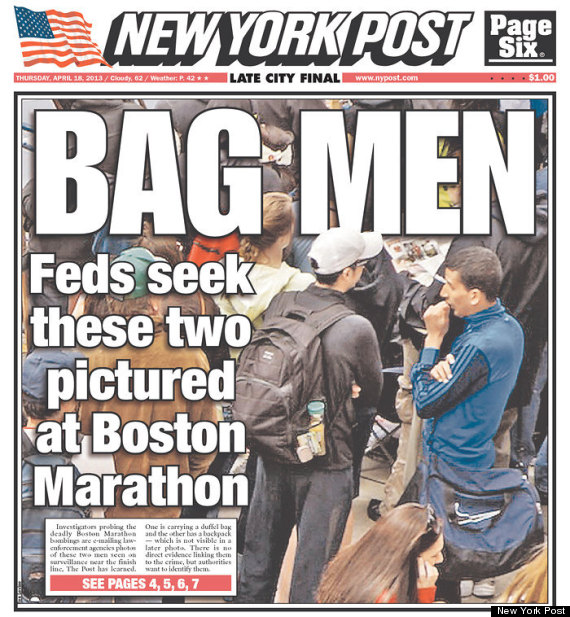
Reader Okian Warrior points out a related story worthy of notice: "The 4chan crowd, poring over images of the Boston marathon, identified two dark-skinned and bag-carrying suspects (among others). This was then picked up by The New York Post, who ran the image on Thursday's front page with the headline 'Feds seek these two pictured at Boston Marathon.' And now, a completely innocent teen now finds himself scared to leave his home." -
Rep. Mike Rogers Dismisses CISPA Opponents "14 Year Old Tweeter On the Internet"
gale the simple writes "Mike Rodgers made a minor splash Tuesday when he decided to liken CISPA opponents to 14-year-old basement dwellers. The EFF, naturally, picked up on this generalization and asked everyone to let the representative know that it is not just the 14-year-olds that care about privacy." -
Senator Feinstein: We Need Video Game Control
ducomputergeek writes "Since the assault weapons ban seems to have died in Congress, it looks like Senator Dianne Feinstein (D-CA) now turning her attention to video games...again. '"If Sandy Hook doesn't [make game publishers change] then maybe we have to proceed, but that is in the future," said Feinstein. She went on to claim that video games play "a very negative role for young people, and the industry ought to take note of that."' Yet, as the article points out, since the introduction of games like DOOM, the crime rate in the U.S. has gone down. Dramatically. Correlation != causation, and all that jazz, but there are a lot of violent video games these days and yet crime has continued to go down." -
Pew Research Finds Opinion Dominates MSNBC More Than Fox News
Hugh Pickens writes writes "Jack Mirkinson reports that Pew Research Center's annual "State of the Media" study found that, since 2007, CNN, Fox News and MSNBC have all cut back sharply on the amount of actual reporting found on their airwaves. Cheaper, more provocative debate or interview segments have largely filled the void. Pew found that Fox News spent 55 percent of the time on opinion and 45 percent of the time on reporting. Critics of that figure would likely contend that the network's straight news reporting tilts conservative, but it is true that Fox News has more shows that feature reporting packages than MSNBC does. According to Pew MSNBC made the key decision to reprogram itself in prime time as a liberal counterweight to the Fox News Channel's conservative nighttime lineup. The new MSNBC strategy and lineup were accompanied by a substantial cut in interview time and sharply increased airtime devoted to edited packages. The Pew Research examination of programming in December 2012 found MSNBC by far the most opinionated of the three networks, with nearly 90% of MSNBC's primetime coverage coming in the form of opinion or commentary." -
Apple Bringing Second Lawsuit To Samsung, Won't Wait For Appeal
sl4shd0rk writes "Hot on the heels of last year's Apple win over Samsung, Apple is geared up for its second attempt at knocking Samsung's alleged copy-cat products off the store shelves. District Judge Lucy Koh asked both parties if they could stay the new case while the first one goes up on Appeal. Apple denied citing a delay would "seriously and irreparably prejudice Apple." The company "will likely suffer a long-term loss of market share and of downstream sales". Samsung replied with a statement saying "Apple will be unable to meet its burden of proving infringement without resorting to the same improper 'representative product' strategy," [that shouldn't have been allowed in the first case.] Although some may think this is a good move for business on Apple's part, some claim the litigation is responsible for Apple's dipping sales and stock prices as well as Increased visibility of Samsung. In the end however, all this litigation is most likely going to be shouldered on the pocketbook of the consumer'" -
DoJ Admits Aaron Swartz's Prosecution Was Political
An anonymous reader sends this excerpt from a blog post by Taren Stinebrickner-Kauffman, founder of corporate watchdog SumOfUs.org and partner of the late Aaron Swartz: "The DOJ has told Congressional investigators that Aaron's prosecution was motivated by his political views on copyright. I was going to start that last paragraph with 'In a stunning turn of events,' but I realized that would be inaccurate — because it's really not that surprising. Many people speculated throughout the whole ordeal that this was a political prosecution, motivated by anything/everything from Aaron's effective campaigning against SOPA to his run-ins with the FBI over the PACER database. But Aaron actually didn't believe it was — he thought it was overreach by some local prosecutors who didn't really understand the internet and just saw him as a high-profile scalp they could claim, facilitated by a criminal justice system and computer crime laws specifically designed to give prosecutors, however incompetent or malicious, all the wrong incentives and all the power they could ever want. But this HuffPo article, and what I’m hearing from sources on the Hill, suggest that that’s not true. That Ortiz and Heymann knew exactly what they were doing: Shutting up, and hopefully locking up, an extremely effective activist whose political views, including those on copyright, threatened the Powers That Be." -
DRM Lawsuit Filed By Independent Bookstores Against Amazon, "Big Six" Publishers
concealment writes "Three independent bookstores are taking Amazon and the so-called Big Six publishers (Random House, Penguin, Hachette, HarperCollins, Simon & Schuster and Macmillan) to court in an attempt to level the playing field for book retailers. If successful, the lawsuit could completely change how ebooks are sold. The class-action complaint, filed in New York on Feb 15., claims that by entering into confidential agreements with the Big Six publishers, who control approximately 60 percent of print book revenue in the U.S., Amazon has created a monopoly in the marketplace that is designed to control prices and destroy independent booksellers." -
Layoffs Hit Washington Post Mobile Team
imac.usr writes "The Huffington Post is reporting that The Washington Post has gone through yet another round of layoffs, but this time instead of cutting editorial positions, they're apparently cutting IT positions, specifically in the mobile applications department. According to Washington, DC media blog FishbowlDC, 54 people, including the General Manager of Mobile and Director of Mobile Products, were given the axe on Valentine's Day. A particularly damning quote from the FishbowlDC article: '"[CIO and VP Shaliesh] Prakash thinks these are 'inefficiencies' – that is the exact word he uses for human beings who are not useful according to him," said a source who spoke only on condition of anonymity. "Get rid of experienced people to save money, under the garb of streamlining is the new trend inside the Post."' Given that mobile products seem somewhat more likely to succeed than printed newspapers, this seems a strange decision at best." -
Monsanto Takes Home $23m From Small Farmers According To Report
An anonymous reader writes "Seed giant Monsanto has won more than $23 million from hundreds of small farmers accused of replanting the company's genetically engineered seeds. Now, another case is looming – and it could set a landmark precedent for the future of seed ownership. From the article: 'According to the report, Monsanto has alleged seed patent infringement in 144 lawsuits against 410 farmers and 56 small farm businesses in at least 27 U.S. states as of January of 2013. Monsanto, DuPont and Syngenta together hold 53 percent of the global commercial seed market, which the report says has led to price increases for seeds -- between 1995 and 2011, the average cost of planting one acre of soybeans rose 325 percent and corn seed prices went up 259 percent.'" -
Economists Argue Patent System Should Be Abolished
nukem996 writes "Two economists at the St. Louis Federal Reserve have published a paper arguing that the American patent system should be abolished. The paper recognizes the harm the current patent system has caused not only to the technology sector but the health sector as well." -
Does US Owe the World an Education At Its Expense?
An anonymous reader writes "'Right now, there are brilliant students from all over the world sitting in classrooms at our top universities,' President Obama explained to the nation Tuesday in his pitch for immigration reform. 'They are earning degrees in the fields of the future, like engineering and computer science...We are giving them the skills to figure that out, but then we are going to turn around and tell them to start the business and create those jobs in China, or India, or Mexico, or someplace else. That is not how you grow new industries in America. That is how you give new industries to our competitors. That is why we need comprehensive immigration reform." If the President truly fears that international students will use skills learned at U.S. colleges and universities to the detriment of the United States if they return home (isn't a rising tide supposed to lift all boats?) — an argument NYC Mayor Bloomberg advanced in 2011 ('we are investing millions of dollars [actually billions] to educate these students at our leading universities, and then giving the economic dividends back to our competitors – for free') — then wouldn't another option be not providing them with the skills in the first place?"