Slashdot Mirror
Domain: icrc.org
Stories and comments across the archive that link to icrc.org.
Comments · 118
-
Re:Trump says, "Wait, their all black & spanis
https://www.icrc.org/en Eat shit dummy The IRC came along much sooner
-
Re:Activist? You misspelled traitor
A man that never admits mistakes is a dishonest man. How willing are you to deny any wrongdoings on USA's behalf regardless of evidence to the contrary? Do you want to be honest? Or are you willing to look away, ignoring anything that contradicts what you have decided to believe?
War crimes include
- killing or wounding a combatant who has surrendered or is otherwise hors de combat;
Watch from 9 minutes into the Collateral Murder video; there is no way the killing of unarmed men picking up a wounded man lying on the street and carrying him into a van to drive him away does not match the above listed war crime. But don't just take my words for it. Listen to one of the soldiers actually being there on the ground:
Their overall mission that day was to protect us, to provide support for us, so I can see where the initial attack on the group of men was warranted. However, personally I don't feel that the attack on the van was warranted. I think that the people could have been deterred from doing what they were doing in the van by simply firing a few warning shots versus completely obliterating the van and its occupants.
-
Re:Questionable comments by the Naval Lt.
Why are you targeting retreating forces? Isn't there something in the Geneva convention about that?
Until the beam diverges to a larger area than the target, the only thing attenuating the power delivered to the target is the atmosphere.
They've tested this on moving boats and UAV's, so I'd assume the answer to "can they target moving objects?" is "yes"
The laser is continuous, it's made from modified 6 welding lasers that all focus on the target.
It's designed to compliment traditional weapons, not replace them. If the conditions are too bad for it to work, they're going use a gun or missile. Which is going to be much worse for the bad guys.
https://ihl-databases.icrc.org...
The Geneva protocol does not prohibit attacking retreating forces, quite the opposite.
Retreat shows an intention to continue combat from another location.The Geneva protocol prohibits attacking persons that are hors de combat (wounded, unconscious, shipwreck)
It prohibits attacking forces that clearly are attempting to surrender and are not attempting to escape. -
Re:Don't shoot until you see the whites of their eIf the blinding is "incidental" - lots of wiggle room there, it doesn't violate the protocol See page 57 of the protocol
Article 3
Blinding as an incidental or collateral effect of the legitimate military employment of laser systems, including laser systems used against optical equipment, is not covered by the prohibition of this Protocol.
But since when does the US obey protocols? They signed the Protocol on Child Soldiers, and then violated it with Omar Khadr.
Article 6
3. States Parties shall take all feasible measures to ensure that persons within their jurisdiction recruited or used in hostilities contrary to the present Protocol are demobilized or otherwise released from service. States Parties shall, when necessary, accord to such persons all appropriate assistance for their physical and psychological recovery and their social reintegration.
Putting a 15-year-old into Gitmo and torturing him is a clear violation of the protocol. Considering he was dragged from his home in Canada to Afghanistan at the age of 10, what outcome did anyone expect when he was captured at 15?
-
Re: Nothing wrong with waterboarding
gravely harm an innocent person
The whole point was, waterboarding does not cause "grave harm". Even the scientists opposing the procedure, god bless their mighty hearts, can fault it only for the potential of dirty water seeping into nostrils and the high levels of stress-hormones. Nothing, in other words, that can't happen to a prisoner of an ordinary detention facility, military or civilian alike...
Inconvenience, maybe
You seem to use the term "innocent" as in "not convicted of wrong-doing by any court". Fine — Khalid Shaikh Mohammed was certainly innocent in that sense, when he was waterboarded. Ok, now, are you going to condemn President Obama for his extensive killing of similarly innocent people? Why not? Mind you, Obama has already done it — on numerous occasions — whereas Trump merely says, he will.
If Obama got reelected comfortably despite such outrageous killings — with enthusiastic support of most Slashdotters — why should mere waterboarding be a problem for Trump?
But, if those killed by "Hellfire" on President Obama's orders were not quite innocent — and thus acceptable in your opinion — what makes you suspect, President Trump will order waterboarding of suspects with less evidence against them?
-
Re:Bring leaders to Hiroshima to see the damage
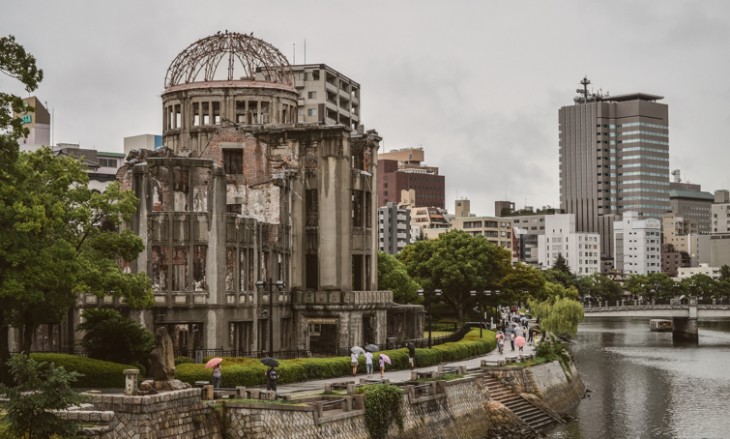
This building, actually close to the hypocenter, has been left standing. This remaining piece of a church is still standing in Nagasaki, similarly close the the hypocenter.
-
Re:Code is Speech. Code is Math.
Read article 5 of Geneva convention 4: https://www.icrc.org/applic/ihl/ihl.nsf/1595a804df7efd6bc125641400640d89/6756482d86146898c125641e004aa3c5?OpenDocument
-
Red Cross
Red cross has a family links database. I wish Google and Facebook just linked to Red Cross, instead of launching each their own redundant person finder features.
-
Its about the Laws of War
Posting as AC because previously a FAC in Iraq and have experience employing armed drones in combat. If enough "respected" countries were to adopt armed UAVs (not Iran, Israel, Russia), then the U.S. would be in a better position to influence the debate on whether unmanned air strikes are a violation of the laws of war or not. The International Red Cross has a good article on the legality of UAVs here. Basically armed-UAVs are not specifically mentioned in any treaties, but under humanitarian laws, "....parties to a conflict must always distinguish between combatants and civilians and between military objectives and civilian objects." In Iraq, Afghanistan, Yemen, etc., the enemy doesn't wear uniforms or roll around in identifiable military equipment. Its arguable that if all you've got is a UAV with a video feed, you are not able to distinguish between military objectives and civilian objects. But let's argue that the U.S. has some super-secret sensors that take all the guess work out of identifying enemies off of a FLIR video feed. Would the U.S. also be exporting those sensors with the UAVs? Or would the U.S. basically be saying that we have fewer civilian casualties than country Y- that bought our drones, so we're taking precautions to prevent civilian deaths... therefore our UAV program is legal and moral? That's likely the real reason that the U.S. has been very slow to even acknowledge that there have ever been any civilian casualties as a result of drone strikes in the first place. Even though everyone knows the civilian body count is much higher than officially acknowledged. You can classify a UAV strike, but you cannot classify a civilian life taken.
-
Re:To your 2nd question
Provide the exact links to what you are referring to and I'll give them a read, I'm not searching through the links to 'everything' that you provided and taking you at your word. Having served in the Military we were trained to say "I was shooting at gear" if anyone was killed by a
Whoever told you about the
I cannot give you a link to something that does not exist.
Some people confuse the USA's rules of engagement with the Geneva protocols on the conduct of warfare. They're not the same and people get the R.O.E. wrong as well. However, the "noHere's cluster munitions.
General Convention on cluster munitions
https://www.icrc.org/applic/ih...copy/paste from above link:
General obligations and scope of application1. Each State Party undertakes never under any circumstances to:
(a) Use cluster munitions;
(b) Develop, produce, otherwise acquire, stockpile, retain or transfer to anyone, directly or indirectly, cluster munitions;
(c) Assist, encourage or induce anyone to engage in any activity prohibited to a State Party under this Convention.2. Paragraph 1 of this Article applies, mutatis mutandis, to explosive bomblets that are specifically designed to be dispersed or released from dispensers affixed to aircraft.
3. This Convention does not apply to mines.
Regarding 30MM chain guns.
Using explosive rounds in rounds of less than 400 grams was banned by the St Petersburg Declaration of 1868. The St Petersburg declaration is widely considered obsolete. Due to the need for explosive rounds in anti-aircraft autocannons and heavy machine guns, and exception was made in the Hague convention of 1923 for aerial warfare.
This link contains modern practice among the countries and explanation which may cover the cases you're interested in.
https://www.icrc.org/customary...Although anti-personnel bullets designed specifically to explode within the human body clearly are illegal, and although weapons, including exploding bullets, may not be used to inflict unnecessary suffering, rule 78, as written, indicates a broader and less well-defined prohibition. The rule itself suffers from at least two problems. First, it fails to define which weapons are covered by the phrase “bullets which explode within the human body.” To the extent that the Study intends the rule to cover bullets that could, under some circumstances, explode in the human body (but were not designed to do so), State practice and the ICRC’s Commentary on the 1977 Additional Protocol reflect that States have not accepted that broad prohibition. Second, there are two types of exploding bullets. The first is a projectile designed to explode in the human body, which the United States agrees would be prohibited. The second is a high-explosive projectile designed primarily for anti-materiel purposes (not designed to explode in the human body), which may be employed for anti-materiel and anti-personnel purposes. Rule 78 fails to distinguish between the two. If, as the language suggests, the Study is asserting that there is a customary international law prohibition on the anti-personnel use of anti-material exploding bullets, the Study has disregarded key State practice in this area. Third, the Study extrapolates the rule to non-international conflicts without a basis for doing so.
-
Re:To your 2nd question
Provide the exact links to what you are referring to and I'll give them a read, I'm not searching through the links to 'everything' that you provided and taking you at your word. Having served in the Military we were trained to say "I was shooting at gear" if anyone was killed by a
Whoever told you about the
I cannot give you a link to something that does not exist.
Some people confuse the USA's rules of engagement with the Geneva protocols on the conduct of warfare. They're not the same and people get the R.O.E. wrong as well. However, the "noHere's cluster munitions.
General Convention on cluster munitions
https://www.icrc.org/applic/ih...copy/paste from above link:
General obligations and scope of application1. Each State Party undertakes never under any circumstances to:
(a) Use cluster munitions;
(b) Develop, produce, otherwise acquire, stockpile, retain or transfer to anyone, directly or indirectly, cluster munitions;
(c) Assist, encourage or induce anyone to engage in any activity prohibited to a State Party under this Convention.2. Paragraph 1 of this Article applies, mutatis mutandis, to explosive bomblets that are specifically designed to be dispersed or released from dispensers affixed to aircraft.
3. This Convention does not apply to mines.
Regarding 30MM chain guns.
Using explosive rounds in rounds of less than 400 grams was banned by the St Petersburg Declaration of 1868. The St Petersburg declaration is widely considered obsolete. Due to the need for explosive rounds in anti-aircraft autocannons and heavy machine guns, and exception was made in the Hague convention of 1923 for aerial warfare.
This link contains modern practice among the countries and explanation which may cover the cases you're interested in.
https://www.icrc.org/customary...Although anti-personnel bullets designed specifically to explode within the human body clearly are illegal, and although weapons, including exploding bullets, may not be used to inflict unnecessary suffering, rule 78, as written, indicates a broader and less well-defined prohibition. The rule itself suffers from at least two problems. First, it fails to define which weapons are covered by the phrase “bullets which explode within the human body.” To the extent that the Study intends the rule to cover bullets that could, under some circumstances, explode in the human body (but were not designed to do so), State practice and the ICRC’s Commentary on the 1977 Additional Protocol reflect that States have not accepted that broad prohibition. Second, there are two types of exploding bullets. The first is a projectile designed to explode in the human body, which the United States agrees would be prohibited. The second is a high-explosive projectile designed primarily for anti-materiel purposes (not designed to explode in the human body), which may be employed for anti-materiel and anti-personnel purposes. Rule 78 fails to distinguish between the two. If, as the language suggests, the Study is asserting that there is a customary international law prohibition on the anti-personnel use of anti-material exploding bullets, the Study has disregarded key State practice in this area. Third, the Study extrapolates the rule to non-international conflicts without a basis for doing so.
-
Re:To your 2nd question
You are quoting myths regarding allowable weapons.
There is a ban upon using small-caliber exploding rounds against personnel, but the
Here are the various Conventions (Geneva):
https://www.icrc.org/applic/ih... [icrc.org]Also, I forgot to mention, the cluster bomb ban only applies to devices deployed from aircraft, so the MLRS isn't covered.
-
Re:To your 2nd question
The last I heard, weapons that blind are banned by the current "laws of war" as recognized by the western powers - and that's been the major impeidment so far to deploying laser (and other directed energy) weapons. Has something changed? Or did the current administration just decide to play with the new toy despite past promises to the other kids?
The US does not honor International Law on banned weapons, nor does any other country in reality. Weapons that are "banned" are normally relabeled to make them look good, but does not change what they are. As long as you are on the winning side who is going to prosecute you? As a prime example, cluster bombs are against the law yet the main artillery round of the MLRS fires a warhead packed with 1001 "grenadelets". See that? By renaming "cluster bomb" to be "grenadelets" you have not broken the law. Firing a weapon at a "person" with a round of
Countries today use what they think they can get away with, and in the case of Western countries that is quite a lot. Look at all the depleted uranium dumped in the middle east causing serious health problems for over a decade.
You are quoting myths regarding allowable weapons.
There is a ban upon using small-caliber exploding rounds against personnel, but the
Here are the various Conventions (Geneva):
https://www.icrc.org/applic/ih... -
Re:This might alienate anti-ISI* Muslims.
One of the religious prohibitions in Islam is making war with fire.
If this is used it will be interesting to see the effects on recruiting by the Islamic State and other anti-US organizations among those Muslims who are currently either opposed to them or unaligned.
Also: How do you keep a 30 kW laser, at any frequency, from blinding everybody in the general direction of the target? The last I heard, weapons that blind are banned by the current "laws of war" as recognized by the western powers - and that's been the major impeidment so far to deploying laser (and other directed energy) weapons. Has something changed? Or did the current administration just decide to play with the new toy despite past promises to the other kids?
Re ban on blinding weapons. Here's the Geneva Conventional protocol on Blinding Weapons:
https://www.icrc.org/ihl/INTRO...
Article 3:
Blinding as an incidental or collateral effect of the legitimate military employment of laser systems, including laser systems used against optical equipment, is not covered by the prohibition of this Protocol. -
Re:One of those strange rules of war.
Yes. That is exactly the rule. Weapons that are intended to injure but not kill are illegal, weapons intended to kill are ok. Injuring someone because you tried to kill them and missed is considered acceptable, because not everyone has perfect aim.
No, that is not correct.
The Hague and Geneva conventions forbid "To employ arms, projectiles, or material calculated to cause unnecessary suffering"
There are endless misconceptions regarding the Hague and Geneva conventions. Please read the actual text of the Conventions and updates. There are many surprises such as the circumstances that allow the execution of random civilians as punishment for the behavior of others.Here is a link to the Hague Convention.
"Annex to the Convention: Regulations respecting the laws and customs of war on land - Section II : Hostilities - Chapter I : Means of injuring the enemy, sieges, and bombardments - Regulations: Art. 23."
https://www.icrc.org/applic/ih...The same web site includes the Geneva 1949 convention and subsequent updates (including the blinding laser weapons article)
Regarding other posts, nowhere are any type of bayonets mentioned. Almost no type of specific weapon is mentioned.
Many people confuse the US Army's rules of Engagement with the Geneva convention.
The ROE is much more specific and is the source of many of the things that people mistakenly believe are forbidden by the Geneva Convention.
FYI, the use ofIf I am incorrect, please show exactly where it can be found in the Conventions.
-
Re: Tag, you're it!
Last I hear, Israel is using people in their all territory (and Palestinian territory forcibly settled by Israelis) as a human shield.
In fact, I hear every time Hamas fires a rocket into Israeli (and Palestinian territory forcibly settled by Israelis), they are trying to hit a high ranking official of the Israeli government or army, but they miss 99.999% of the time.
You are of course aware that use of weapons that miss that often is a de facto war crime by failing to make an "effective contribution to military action".
Nice to know you admit Hamas is fighting in a criminal manner.
-
Re:How are nuclear weapons going to help though?
Contrary to your propaganda I think there is actually significant doubt as to whether he has violated international laws.
Well, soldiers operating without proper identification is a war crime under the 1949 Geneva Conventions and its subsequent modifications(the "Protocol Additional to the Geneva Conventions of 12 August 1949, and relating to the Protection of Victims of International Armed Conflicts (Protocol I), 8 June 1977."). For example, from Article 37:
1. It is prohibited to kill, injure or capture an adversary by resort to perfidy. Acts inviting the confidence of an adversary to lead him to believe that he is entitled to, or is obliged to accord, protection under the rules of international law applicable in armed conflict, with intent to betray that confidence, shall constitute perfidy. The following acts are examples of perfidy:
[...]
(c) the feigning of civilian, non-combatant status;
Also the use of the Night Wolves violates article 43:
3. Whenever a Party to a conflict incorporates a paramilitary or armed law enforcement agency into its armed forces it shall so notify the other Parties to the conflict.
-
Re:How are nuclear weapons going to help though?
Contrary to your propaganda I think there is actually significant doubt as to whether he has violated international laws.
Well, soldiers operating without proper identification is a war crime under the 1949 Geneva Conventions and its subsequent modifications(the "Protocol Additional to the Geneva Conventions of 12 August 1949, and relating to the Protection of Victims of International Armed Conflicts (Protocol I), 8 June 1977."). For example, from Article 37:
1. It is prohibited to kill, injure or capture an adversary by resort to perfidy. Acts inviting the confidence of an adversary to lead him to believe that he is entitled to, or is obliged to accord, protection under the rules of international law applicable in armed conflict, with intent to betray that confidence, shall constitute perfidy. The following acts are examples of perfidy:
[...]
(c) the feigning of civilian, non-combatant status;
Also the use of the Night Wolves violates article 43:
3. Whenever a Party to a conflict incorporates a paramilitary or armed law enforcement agency into its armed forces it shall so notify the other Parties to the conflict.
-
Aaand, dead to me.
Ten percent of all purchases will go to vital causes like American Red Cross,
The Red Cross knew about the concentration camps in Germany during WWII, but did nothing to help them. Yes, there's proof. But besides throwing the Jews under the bus, they also won't accept blood donations from gay men. Wait, I know what you're going to say: it's the government and they're just going along with it. But small problem -- They went far above and beyond. They added an arbitrary list of African countries to their no-fly list (cough) without explanation beyond compliance with the aforementioned federal law. Except there's no federal guidelines on that -- they did that on their own initiative. And double discrimination bonus: Most of the people from those countries? Black. Related -- the current justification by the FDA is that removing this barrier and allowing those groups to donate blood would result in an increase in HIV-positive transfusions in
Here's the thing guys... there are some organizations I don't want to donate money to. I know you're thinking being charitable with the game purchase is a noble thing (and it is!), but why not let us choose which ones do, and do not, get our money? I will never donate to the Red Cross, and because of your policy, I will now never buy your games. Which is unfortunate, because I'm sure you have a few worth playing.
-
Re:Good: he's guilty and so is Assange
Espionage: from L legal-dictionary.thefreedictionary.com:
Espionage, commonly known as spying, is the practice of secretly gathering information about a foreign government or a competing industry, with the purpose of placing one's own government or corporation at some strategic or financial advantage.
From uslegal.com:
Espionage is the crime of spying on the federal government and/or transferring state secrets on behalf of a foreign country.
From the Fourth Geneva Convention:
A person can only be considered a spy when, acting clandestinely or on false pretences, he obtains or endeavours to obtain information in the zone of operations of a belligerent with the intention of communicating it to the hostile party.
Thus, soldiers not wearing a disguise who have penetrated into the zone of operations of the hostile army, for the purpose of obtaining information, are not considered spies. Similarly, the following are not considered spies: soldiers and civilians carrying out their mission openly, entrusted with the delivery of despatches intended either for their own army or for the enemy's army..."Would you like to share some "internationally recognized" definition of espionage by which you might conceivably make a case against Assange?
-
Switzerland??
International Committee of the Red Cross was created in Geneva, Switzerland, http://www.icrc.org/ by Henry Dunant http://en.wikipedia.org/wiki/Henry_Dunant and other nice people.
Geneva Conventions http://en.wikipedia.org/wiki/Geneva_Conventions were accepted, well, in Geneva.
It is sort of a good serious place. -
Re:Headline != articleOk, the Fourth Geneva Convention seems to govern assassinations, murder etc. Here's article 3:
Art. 3. In the case of armed conflict not of an international character occurring in the territory of one of the High Contracting Parties, each Party to the conflict shall be bound to apply, as a minimum, the following provisions: (1) Persons taking no active part in the hostilities, including members of armed forces who have laid down their arms and those placed hors de combat by sickness, wounds, detention, or any other cause, shall in all circumstances be treated humanely, without any adverse distinction founded on race, colour, religion or faith, sex, birth or wealth, or any other similar criteria.
To this end the following acts are and shall remain prohibited at any time and in any place whatsoever with respect to the above-mentioned persons:
(a) violence to life and person, in particular murder of all kinds, mutilation, cruel treatment and torture;
(b) taking of hostages;
(c) outrages upon personal dignity, in particular humiliating and degrading treatment;
(d) the passing of sentences and the carrying out of executions without previous judgment pronounced by a regularly constituted court, affording all the judicial guarantees which are recognized as indispensable by civilized peoples.A leader wouldn't qualify as "persons taking no active part in the hostilities" if they were as the original post stated "waging war".
Nor does he qualify as a "protected person" (unless he's captured or the like, which effectively takes him out of the war) for which virtually the rest of the treaty outlines allowed and disallowed treatment.Art. 4. Persons protected by the Convention are those who, at a given moment and in any manner whatsoever, find themselves, in case of a conflict or occupation, in the hands of a Party to the conflict or Occupying Power of which they are not nationals.
Nationals of a State which is not bound by the Convention are not protected by it. Nationals of a neutral State who find themselves in the territory of a belligerent State, and nationals of a co-belligerent State, shall not be regarded as protected persons while the State of which they are nationals has normal diplomatic representation in the State in whose hands they are.In addition, the latter paragraph brings up an important nuance which holds throughout the Conventions. Groups or countries which don't observe the Geneva Conventions and any civilian populations associated with them aren't (aside from a very limited extent) protected by the Geneva Conventions. For example, even if it were illegal to assassinate leaders of observant groups to the Conventions, Al Qaeda isn't one such group and hence, wouldn't enjoy that particular protection of the Conventions.
Keep in mind that the US had just fought the Second World War. My take is that they wouldn't have agreed to a treaty that would have hamstrung it against similar brutal, ruthless foes as say Nazi Germany, Imperial Japan, or the USSR.
From the US point of view, if you respect the Geneva Conventions, then the US fights relatively fair. If you don't, then the US has the option to total war your ass, bomb your civilian populations with conventional or nuclear devices, and do most of the fun and games that marked the two world wars. -
Re:Not like the USA
You are possibly assuming there a degree of targeting accuracy which they didn't have. Also, many historical building had military import (such as historic railway stations used for moving supplies). Keep in mind in World War II, the accuracy of bombing was so poor that they sometimes bombed the wrong city. If you had a factory or the like in the middle of an area, that wasn't going to help. The more serious problem with Dresden was that arguably they really were targeting civilians. There is some complexity involved though- it isn't clear that the laws of war had yet reached a consensus at that point. See http://www.icrc.org/eng/resources/documents/misc/57jpcl.htm for some relevant points. There's a decent argument also that the presence of factories and the presence of military units stationed in and around Dresden made it a legitimate target. George Marshall made an inquiry that came to that conclusion, but the fact that the US military thought an inquiry was necessary does reflect strongly on the questionable nature of the decision. The argument that the bombing was not justified has been most strongly argued by Alexander McKee who is a historian who has written a fair bit on this subject. Overall, I'd say that McKee's analysis is a strong but not convincing case (although this is also going off my memory of the last time I looked into this subject in detail which was around 5 or 6 years ago).
-
Re:Could have been worse...
Doesn't work that way, if your armed, not a part of a state military, and not in full uniform, you are automatically a unlawful combatant the moment you start shooting or blowing things up. You have no right to a legally competent tribunal.
Unlawful combatants do not qualify for prisoner of war status. Their situatio n upon capture by the enemy is covered by the Fourth (Civilian) Geneva Convention if they fulfil the nationality criteria and by the relevant provisions of the Additional Protocol I, if ratified by the detaining power.
[...]
Persons not covered by either the Third or the Fourth Geneva Convention in international armed conflict are entitled to the fundamental guarantees provided for by customary international law (as reflected in Article 75 of Additional Protocol I), as well as by applicable domestic and human rights law. All these legal sources provide for rights of detainees in relation to treatment, conditions and due process of law.
-
international treaties
Signing a treaty is not enough.
The International Committee of Red Cross http://www.icrc.org/ conducts large scale games in Switzerland where ICRC's voluntaries work together with school students in the field. One part of students are military, another part is POW (prisoners of war), yet another civilians.
The voluntaries explain students and train them in realistic circumstances (tents, bridges, mountains, etc.) how to keep and question POWs, how to treat civilians during military operations, how to handle wounded, etc. in accordance with the Geneva Convention http://en.wikipedia.org/wiki/Geneva_Conventions
It is a very good approach, because kids and teenagers not only learn the right rules, but also how to stick to them in realistic conditions.
We saw recently many cases how military personnel did not follow the Geneva Convention (to put it mildly), even though a country did sign it. Perhaps, it would be a good idea to teach students at school during such field exercises how to follow it. -
Re:Retarded.
I don't know about the Daily Mail other than its repute here, but in this case they really did nothing but regurgitate a paragraph from the conference report, and add a few words of fairly relevant if snide commentary:
http://www.icrc.org/eng/resources/documents/red-cross-crescent-movement/31st-international-conference/31-international-conference-daily-bulletin-2011-12-01.htm
====
Video games and IHL: how should the Movement take action?While the Movement works vigorously to promote international humanitarian law (IHL) worldwide, there is also an audience of approximately 600 million gamers who may be virtually violating IHL. Exactly how video games influence individuals is a hotly debated topic, but for the first time, Movement partners discussed our role and responsibility to take action against violations of IHL in video games. In a side event, participants were asked: âoewhat should we do, and what is the most effective method?â While National Societies shared their experiences and opinions, there is clearly no simple answer. There is, however, an overall consensus and motivation to take action.
==== -
Re:Retarded.
This is the best I could find on the ICRC site. The Daily Mail is being a bit obnoxious, but the reality on the ICRC site is pretty stupid.
-
This is a better ICRC link on the subject
-
Re:Retarded.
It looks like it was a "side event" at a conference. See here.
I can't find any extra information on the ICRC website, can anyone else? Otherwise, it's most likely that the Daily Mail fabricated the rest of the story. Most of the article is speculation, except for a copy+paste from the website I linked to.
-
Re:Followed by weaponization?
There's nothing in the Geneva Convention about Thai hookers..
Actually, There is:
[...] Women shall be especially protected against any attack on their honour, in particular against rape, enforced prostitution, or any form of indecent assault.
So, ENFORCED prostitution is banned, but if they do prostitution out of their own will, then it is not banned.
-
Re:Followed by weaponization?
There's nothing in the Geneva Convention about Thai hookers..
Actually, There is:
Protected persons are entitled, in all circumstances, to respect for their persons, their honour, their family rights, their religious convictions and practices, and their manners and customs. They shall at all times be humanely treated, and shall be protected especially against all acts of violence or threats thereof and against insults and public curiosity.
Women shall be especially protected against any attack on their honour, in particular against rape, enforced prostitution, or any form of indecent assault.
Without prejudice to the provisions relating to their state of health, age and sex, all protected persons shall be treated with the same consideration by the Party to the conflict in whose power they are, without any adverse distinction based, in particular, on race, religion or political opinion.
However, the Parties to the conflict may take such measures of control and security in regard to protected persons as may be necessary as a result of the war.
-
Re:Anonymous isn't an activist group
There is a big difference in striking an area that may contain civilians, because a military target is present as well, and sending someone in to blow up a pizza shop full of innocent civilians just trying to get lunch.
Read the Geneva Conventions. Specifically, the parts covering the terrorist's favorite tactic, human shields:
The presence of a protected person may not be used to render certain points or areas immune from military operations. - Geneva Convention IV, Article 28
So, for example: the fact that Moammar Gadhafi sticks his secret bunker under a "public housing" apartment building does NOT render that building immune to military strikes designated to take the motherfucker out.
-
Re:Always do your research before donating
Is there any guarantee that money donated to the American Red Cross will actually be spent on tsunami relief?
Why are you asking that in response to a suggestion to donate to the International Red Cross? (The ICRC donations page does not yet list Japan.)
Anyway, american.redcross.org says:
Your gift to the American Red Cross will support our disaster relief efforts to help those affected by the earthquake in Japan and tsunami throughout the Pacific. On those rare occasions when donations exceed American Red Cross expenses for a specific disaster, contributions are used to prepare for and serve victims of other disasters.
-
Re:What does this say...
If it was truly a war, the international laws on war, like the Geneva convention, would apply. Some US politicians are fond of calling it "the war on terrorism", but they conveniently forget that it's a "war" as soon as they are asked to follow the rules of war.
Really dude? If you are going to speak with authority on legal conventions you could at least bother to read TWO sentences into the thing
2nd Sentence of Geneva Convention:
In addition to the provisions which shall be implemented in peacetime, the present Convention shall apply to all cases of declared war or of any other armed conflict which may arise between two or more of the High Contracting Parties, even if the state of war is not recognized by one of them. source
-
Re:Is this legal?
Well, as mentioned below the US does not recognize the Hague. But, I was interested in what the Geneva Conventions have to say about it and really, it seems to not be addressed. It is a complicated subject as different nations/states have their utilities controlled by governments and/or private organizations.
If it was really an issue, I think it would have come up relating to invasion forces using local water systems and sewer systems as these functionally are no different that an electric utility. I can't recall any invading force using the local toilets coming up as a war crime.
Pillaging relates to personal gain/profiteering, theft of captured soldiers personal effects, looting bodies or theft of opposing forces equipment for personal gain (i.e. Kelly's Heroes)
http://www.icrc.org/ihl.nsf/CONVPRES?OpenView
http://www.icrc.org/ihl.nsf/FULL/375?OpenDocument
"Part III. Captivity; Section 1. Beginning of Captivity, Art 18. All effects and articles of personal use, except arms, horses, military equipment and military documents, shall remain in the possession of prisoners of war, likewise their metal helmets and gas masks and like articles issued for personal protection. Effects and articles used for their clothing or feeding shall likewise remain in their possession, even if such effects and articles belong to their regulation military equipment."
I cannot find anything that restricts the capturing force's ability to apply the captured equipment (w/ the exception of certain medical equipment and medical circumstances) for their own purposes.
-
Re:Is this legal?
Well, as mentioned below the US does not recognize the Hague. But, I was interested in what the Geneva Conventions have to say about it and really, it seems to not be addressed. It is a complicated subject as different nations/states have their utilities controlled by governments and/or private organizations.
If it was really an issue, I think it would have come up relating to invasion forces using local water systems and sewer systems as these functionally are no different that an electric utility. I can't recall any invading force using the local toilets coming up as a war crime.
Pillaging relates to personal gain/profiteering, theft of captured soldiers personal effects, looting bodies or theft of opposing forces equipment for personal gain (i.e. Kelly's Heroes)
http://www.icrc.org/ihl.nsf/CONVPRES?OpenView
http://www.icrc.org/ihl.nsf/FULL/375?OpenDocument
"Part III. Captivity; Section 1. Beginning of Captivity, Art 18. All effects and articles of personal use, except arms, horses, military equipment and military documents, shall remain in the possession of prisoners of war, likewise their metal helmets and gas masks and like articles issued for personal protection. Effects and articles used for their clothing or feeding shall likewise remain in their possession, even if such effects and articles belong to their regulation military equipment."
I cannot find anything that restricts the capturing force's ability to apply the captured equipment (w/ the exception of certain medical equipment and medical circumstances) for their own purposes.
-
Re:Yeah...Cross Border incidents happen to the best of people. Australia during East Timor conflict...
The first incident was apparently due to the local Indonesian authorities persisting in the use of 1933 Dutch maps and the Australians using more recent Indonesian maps. The Dutch map indicated that the Mota Bicu river formed the border. However, the 1992 Indonesian map used by the Australians showed the border as being 500 metres to the west of that position. Apparently, the Indonesian map reflects a post-1975 decision to make the border a fixed provincial border not dependent on the river as a landmark, with the result that as the river changed course over time and as the villagers moved with it, the village of Motaain would shift its location from East to West Timor and vice versa....
-
Re:Immature and Gun Happy
No guerilla force will survive for a week under those conditions.
Nazis played by those rules, and yet the resistance were active for years. Slaughtering a village full of innocent people in retaliation for the killing of a soldier does not stop the resistance. Instead, it encourages others to covertly work against you.
Any civilian is only protected as long as he can keep both fighting forces away from himself and his house.
Bullshit. The Geneva Convention Additional Protocols (signed by the U.S. in 1977, endorsed by Ronald Reagan, and accepted as binding on non-signatories by the U.N. Security Council, of which the U.S. is a part), Protocol 1, Articles 50 and 51 make it clear that a commander has a duty to protect civilian life, even if it comes at the cost of exposing his troops to greater danger. The commander/soldier must be able to justify any military action that results in the loss of civilian life as being "reasonable" and "unavoidable" in the context of the military target. Article 50 ("Definition of Civilians and Civilian Population") makes it clear that civilians are to be protected, even if there are "unlawful combatants" within the population ("The presence within the civilian population of individuals who do not come within the definition of civilians does not deprive the population of its civilian character.)
Article 50: Definition of Civilians and Civilian Population
- A civilian is any person who does not belong to one of the categories of persons referred to in Article 4 A 111, lIl, (31 and 161 of the Third Convention and in Article 43 of this Protocol. In case of doubt whether a person is a civilian, that person shall be considered to be a civilian.
- The civilian population comprises all persons who are civilians.
- The presence within the civilian population of individuals who do not come within the definition of civilians does not deprive the population of its civilian character.
Article 51: Protection of the Civilian Population
- The civilian population and individual civilians shall enjoy general protection against dangers arising from military operations. To give effect to this protection, the following rules, which are additional to other applicable rules of international law, shall be observed in all circumstances.
- The civilian population as such, as well as individual civilians, shall not be the object of attack. Acts or threats of violence the primary purpose of which is to spread terror among the civilian population are prohibited.
- Civilians shall enjoy the protection afforded by this Section, unless and for such time as they take a direct part in hostilities.
- Indiscriminate attacks are prohibited. Indiscriminate attacks are:
- those which are not directed at a specific military objective;
- those which employ a method or means of combat which cannot be directed at a specific military objective; or
- those which employ a method or means of combat the effects of which cannot be limited as required by this Protocol; and consequently, in each such case, are of a nature to strike military objectives and civilians or civilian objects without distinction.
- Among others, the following types of attacks are to be considered as indiscriminate:
- an attack by bombardment by any methods or means which treats as a single military objective a number of clearly separated and distinct military objectives located in a city, town, village or other area containing a similar concentration of civilians or civilian objects; and
- an attack which may be expected to cause incid
-
Re:Immature and Gun Happy
No guerilla force will survive for a week under those conditions.
Nazis played by those rules, and yet the resistance were active for years. Slaughtering a village full of innocent people in retaliation for the killing of a soldier does not stop the resistance. Instead, it encourages others to covertly work against you.
Any civilian is only protected as long as he can keep both fighting forces away from himself and his house.
Bullshit. The Geneva Convention Additional Protocols (signed by the U.S. in 1977, endorsed by Ronald Reagan, and accepted as binding on non-signatories by the U.N. Security Council, of which the U.S. is a part), Protocol 1, Articles 50 and 51 make it clear that a commander has a duty to protect civilian life, even if it comes at the cost of exposing his troops to greater danger. The commander/soldier must be able to justify any military action that results in the loss of civilian life as being "reasonable" and "unavoidable" in the context of the military target. Article 50 ("Definition of Civilians and Civilian Population") makes it clear that civilians are to be protected, even if there are "unlawful combatants" within the population ("The presence within the civilian population of individuals who do not come within the definition of civilians does not deprive the population of its civilian character.)
Article 50: Definition of Civilians and Civilian Population
- A civilian is any person who does not belong to one of the categories of persons referred to in Article 4 A 111, lIl, (31 and 161 of the Third Convention and in Article 43 of this Protocol. In case of doubt whether a person is a civilian, that person shall be considered to be a civilian.
- The civilian population comprises all persons who are civilians.
- The presence within the civilian population of individuals who do not come within the definition of civilians does not deprive the population of its civilian character.
Article 51: Protection of the Civilian Population
- The civilian population and individual civilians shall enjoy general protection against dangers arising from military operations. To give effect to this protection, the following rules, which are additional to other applicable rules of international law, shall be observed in all circumstances.
- The civilian population as such, as well as individual civilians, shall not be the object of attack. Acts or threats of violence the primary purpose of which is to spread terror among the civilian population are prohibited.
- Civilians shall enjoy the protection afforded by this Section, unless and for such time as they take a direct part in hostilities.
- Indiscriminate attacks are prohibited. Indiscriminate attacks are:
- those which are not directed at a specific military objective;
- those which employ a method or means of combat which cannot be directed at a specific military objective; or
- those which employ a method or means of combat the effects of which cannot be limited as required by this Protocol; and consequently, in each such case, are of a nature to strike military objectives and civilians or civilian objects without distinction.
- Among others, the following types of attacks are to be considered as indiscriminate:
- an attack by bombardment by any methods or means which treats as a single military objective a number of clearly separated and distinct military objectives located in a city, town, village or other area containing a similar concentration of civilians or civilian objects; and
- an attack which may be expected to cause incid
-
FYI
ICRC
-
Re:AMERICAN CITIZEN KILLED BY TURK ON ISRAELI GROU
A Zionist will lie to God's face.
Israel IS a signatory to the 4th Geneva Convention, on Aug 12, 1949.
http://www.icrc.org/ihl.nsf/NORM/35D52356F487FC85C1256402003F9563?OpenDocument
The U.N. Security Council has already weighed in on the blockade (of which the flotilla attack is one part), attacking it in Resolution 1860 for collectively punishing the people of Gaza. The resolution calls for "the unimpeded provision and distribution throughout Gaza of humanitarian assistance, including food, fuel, and medical treatment." The criticism of the embargo as illegal is heavily rooted in the logic of the Fourth Geneva Convention, Article 3 of which mandates that states take all possible steps (even when formal wars have not been declared between two states) to protect noncombatants. Behavior that is expressly prohibited includes any actions that are a threat to individual life (9 civilian activists were killed in the flotilla attack). The taking of hostages (including the more than 660 seized by Israel) for political or military purposes is also prohibited. The blockade is illegal in that it violates the legal principles behind the Geneva Conventions, which were created for the general purpose of prohibiting states from engaging in collective punishment against civilians during times of conflict. Israel's collective attack on the civilians of Gaza (and its refusal to even acknowledge that they are under assault) represents a clear violation of the spirit and letter of the Geneva Conventions.
http://www.counterpunch.org/dimaggio06042010.html
Israel's blockade of Gaza violates the mandate of UNSC resolution 1860. Period.
-
Re:VideoYeah, the medical staff protection was more or less what I was thinking of. Thank you for the links. I was not aware of the following in particular:
any violation of these prohibitions shall not release the Parties to the conflict from their legal obligations with respect to the civilian population and civilians, including the obligation to take the precautionary measures provided for in Article 57
I would note that the US has never ratified protocol 1 though, which is likely why I hadn't stumbled on article 51 section 8 of it before. I think Regan's reasons for not ratifying Protocol 1 are valid, although there are sections of that I would approve of. The ones we have ratified do not require us to observe the protocols if our enemies do not, which is why I was under the impression that human shields were no longer protected as civilians. A number of provisions in other treaties are explicitly conditional on rules being followed. The "Legal Status of Human Shields" paper you linked to is dependent on protocol 1. If it's not binding then from a legal standpoint human shields do not have to be protected. Arguably, not protecting human shield would make the use of human shields less effective, and might be safer for civilians in the long run.
Article 57 is actually somewhat vague. Define feasible, and reasonable in that context. Is it reasonable to assume that a small group, moving as a unit through a warzone with active hostiles nearby, carrying what appear to be weapons (yes, further revue of the video indicates that they weren't weapons) is not civilian in nature? Even if it was binding on us, I'm not sure how it would apply in this situation. -
Re:Video
http://www.icrc.org/ihl.nsf/COM/365-570061?OpenDocument
The ' persons protected ' by the Convention are the wounded and sick, as defined in Article 13 , and medical personnel and chaplains, as defined in Articles 24 to 26...
' Wilful killing ' covers all cases in which the wounded or sick are put to death without any resistance on their part. It also covers any attempts on the life of medical personnel or chaplains, whether serving with their country's forces or when captured or retained by the enemy to care for prisoners...
' Wilfully causing great suffering or serious injury to body or health. ' This phrase is intented to cover acts which, without amounting to "torture or inhuman treatment", are liable to affect the physique or health of wounded or sick persons, medical personnel or chaplains. We might take as an example the mutilation of the wounded or their exposure to useless and unnecessary suffering...
' Extensive destruction and appropriation of property, not justified by military necessity and carried out unlawfully and wantonly. ' This definition covers, in particular, cases of destruction of buildings or material belonging to enemy medical units, in violation, for example, of Article 33, paragraph 3
You're way out in left field, and no one is playing baseball.
If you still don't get it, I have to request that you don't breed.
I'll sleep soundly knowing that requesting the same from you would carry assumptions that are very unlikely.
-
Re:Video
Art. 50. Grave breaches to which the preceding Article relates shall be those involving any of the following acts, if committed against persons or property protected by the Convention: wilful killing, torture or inhuman treatment, including biological experiments, wilfully causing great suffering or serious injury to body or health, and extensive destruction and appropriation of property, not justified by military necessity and carried out unlawfully and wantonly.
-
Re:Video
They were clearly evacuating a wounded man, something I thought was pretty much a universal no-no for engagement.
I believe you are mistaken on this point. International law and the current US ROE most certainly allow one to fire on a retreating enemy target until they law down their arms and equipment and surrender. A duty to allow enemy troops to retreat with their weapons and equipment intact in order to regroup and attack again at some future time makes absolutely no sense. Customary international law (according to the Red Cross) states it this way:
http://www.icrc.org/IHL.nsf/WebART/612-047?OpenDocument
Rule 47. Attacking persons who are recognised as hors de combat is prohibited. A person hors de combat is:
(a) anyone who is in the power of an adverse party;
(b) anyone who is defenceless because of unconsciousness, shipwreck, wounds or sickness; or
(c) anyone who clearly expresses an intention to surrender; provided he or she abstains from any hostile act and does not attempt to escapeAll of this is moot, of course, if the man is not properly an enemy target to begin with, a question I take no position on here because it is a factual dispute and I just wanted to post on the law as I understand it. I'm not at all claiming that it was proper to attack these folks, only that armed retreat is not and has never been grounds for protection under the laws of war. To claim protection, a combatant must lay down his arms and cease trying to escape.
See also:
http://news.google.com/newspapers?nid=1314&dat=19910227&id=rnQfAAAAIBAJ&sjid=OPEDAAAAIBAJ&pg=5146,4465272
http://news.google.com/newspapers?nid=1842&dat=19910227&id=7k8eAAAAIBAJ&sjid=XscEAAAAIBAJ&pg=1239,3716450 -
Re:I Think I Know Why They Left Him OutAnd here is the text of the forth Geneva convention.
It is article 33 which forbids collective punishments:
Art. 33. No protected person may be punished for an offence he or she has not personally committed. Collective penalties and likewise all measures of intimidation or of terrorism are prohibited.
Pillage is prohibited.
Reprisals against protected persons and their property are prohibited.
So, who are "protected persons"? Article 4 gives the answer:
Art. 4. Persons protected by the Convention are those who, at a given moment and in any manner whatsoever, find themselves, in case of a conflict or occupation, in the hands of a Party to the conflict or Occupying Power of which they are not nationals.
Nationals of a State which is not bound by the Convention are not protected by it. Nationals of a neutral State who find themselves in the territory of a belligerent State, and nationals of a co-belligerent State, shall not be regarded as protected persons while the State of which they are nationals has normal diplomatic representation in the State in whose hands they are.
So, unless the US invades a country in order to impose ACTA there by force, victims of "three strikes" cannot consider themselves to be protected by the Geneva convention, and so article 33 would not apply.
-
Re:Result
Before you start calling someone a liar, check your facts.
"A civilian under International Humanitarian Law is a person who is not a member of his or
her country's armed forces."I guess you could say "Some people" use it that way.
Ratification of IHL by nation and treaty
Oh, 194 nations have signed GC I-IV 1949. ya..
You can get more IHL info here.
The news reports cited the two officers as "civilian police officer"
"Civilian police officer Sergeant Kimberly Munley"
"Civilian police officer Sergeant Mark Todd"http://www.stripes.com/article.asp?section=104&article=65937
"The buildings that comprised the Soldier Family Readiness Center sit on top of a hill. Civilian police officer Sgt. Kimberly Munley, who was nearby doing routine daily maintenance on her patrol car when the gunshots rang out, was able to approach the scene using one of the buildings as cover. "
"Mark Todd, another civilian officer, rushed up the hill and began firing at Hasan."
http://militarytimes.com/news/2009/11/ap_army_hood_carnage_110609/
"Around this time, Fort Hood Police Sgt. Kimberly Munley got the call of "shots fired." The SRP isn't on Munley's beat; she was in the area because her vehicle was in the shop."
So, yes, an armed civilian, who was in the area. Munley wasn't on duty, providing security services to that location. She was with her patrol car at the shop.
I looked around a little. I didn't find what Todd was doing. If I remember right though, he was doing traffic control nearby.
-
Re:Result
Before you start calling someone a liar, check your facts.
"A civilian under International Humanitarian Law is a person who is not a member of his or
her country's armed forces."I guess you could say "Some people" use it that way.
Ratification of IHL by nation and treaty
Oh, 194 nations have signed GC I-IV 1949. ya..
You can get more IHL info here.
The news reports cited the two officers as "civilian police officer"
"Civilian police officer Sergeant Kimberly Munley"
"Civilian police officer Sergeant Mark Todd"http://www.stripes.com/article.asp?section=104&article=65937
"The buildings that comprised the Soldier Family Readiness Center sit on top of a hill. Civilian police officer Sgt. Kimberly Munley, who was nearby doing routine daily maintenance on her patrol car when the gunshots rang out, was able to approach the scene using one of the buildings as cover. "
"Mark Todd, another civilian officer, rushed up the hill and began firing at Hasan."
http://militarytimes.com/news/2009/11/ap_army_hood_carnage_110609/
"Around this time, Fort Hood Police Sgt. Kimberly Munley got the call of "shots fired." The SRP isn't on Munley's beat; she was in the area because her vehicle was in the shop."
So, yes, an armed civilian, who was in the area. Munley wasn't on duty, providing security services to that location. She was with her patrol car at the shop.
I looked around a little. I didn't find what Todd was doing. If I remember right though, he was doing traffic control nearby.
-
Re:I am shocked!
Like it or not there's multiple precedents for doing exactly that. Enemy combatants are only accorded POW status if they obey the laws of war.
The first link is about the execution of the conspirators in the Abraham Lincoln assassination.
The second link is about German saboteurs from WWII who were executed as spies.1. What the fuck does that have to do with enemy combatants?
2. Those were the first two times military tribunals had ever been convened and they were controversial then.
Yes, 144 years ago, it was controversial to try non-POWs by the military.The lengths people go to justify the Bush definition of "enemy combatants" never fails to surprise me.
When Al Quada starts fighting in uniforms under a flag and taking steps to prevent civilian casualties (rather then setting out to cause them) then we can start treating them as POWs.
This was written in 1949
Read the last paragraph.If they aren't POWs (3rd Geneva Convention), then they are civilians (4th Convention).
International law is crystal clear that there is no intermediate status.
How hard is it to comprehend that you cannot throw people down a legal black hole and torture them? -
Re:(Un)Surprising
Do you mean this 1906 Geneva Convention?
http://www.icrc.org/ihl.nsf/FULL/180?OpenDocument
It refers to enemy prisoners of war, left on the field of battle and in possession of their foe. It makes no provision about valid targets or methods of destroying one's enemies.
You suggested to the original poster "Go read the Geneva Convention." I return your advice, with this addendum, "s".
The point I am making is this:
Holy Shit, what enlightened societies are you talking about?
"Hey guys, it's not really ok to kill people, but you know, if you have to, just don't kill the one's who can't kill you back, ok guys?" Fucking rubbish. It. Doesn't. Work. Like. That.
If you want a real "Geneva Convention", I'll set it up for you right now: Don't be a douche bag, don't hurt people, and
DON"T FUCKING KILL PEOPLE YOU MORONS.
Sign Here.
According to your assertions, "enlightened societies" will agree, sign, and be on their merry way. But guess what the only problem with the Slashdot Conventions(Simplified 2009) will be?
THE SECOND SOMEONE IS GETTING DOUCHED, HURT, OR KILLED, THEY ARE GOING TO VIOLATE IT.