Slashdot Mirror
Domain: ieee.org
Stories and comments across the archive that link to ieee.org.
Comments · 1,868
-
not to sound picky
im not sure how best to phrase this, but its not a quantum computer in the absolute sense. Its more of a computer in a quantum state that acts as an annealer. all it does is find the global minimum of a given objective function over a given set of candidate solutions. companies that buy it should at least be given full disclosure that its basically a ten million dollar math co-processor...one where depending upon the solver and the equation, mileage may seriously vary. traditional computing has been conjectured to be, at the cost of the D-Wave, not only faster but cheaper.
-
Re:The 51% attack is fatal
Bitcoin does not employ 'secure multiparty computation' in any part of its design
Bitcoin is a multiparty computation system. The fact that it does not build on previous work does not change what Bitcoin is, nor how it can be analyzed.
the concept of digital cash in cryptography this is also well defined
Yeah, and guess what? The security definitions of those systems assume a central bank that issues the money. You do not have to believe me; here, you can read the actual work on it:
http://rd.springer.com/chapter/10.1007%2F11889663_20
http://citeseerx.ist.psu.edu/viewdoc/summary?doi=10.1.1.44.8279
https://ieeexplore.ieee.org/xpls/abs_all.jsp?arnumber=5443458&tag=1 -
Re:Russia/USA is NOT the problem
you claim China has been 'cracking the west', and yet you conveniently ignore stuxnet and flame. you're more pissed off at a whistleblower's "BS" than plain evidence the US government has been engaging in rampant data mining and surveillance on a global scale.
China is the new 'enemy' that the US has been waiting for since the end of the Cold War. No doubt this escalating rivalry will drive the development and purchase of a new generation of military equipment, and justify the US government exerting unilateral control over ever more aspects of online activity and identity. Rest easy: we'll all continue to enjoy unending war in our lifetimes. -
Re:Trending?
-
Re:Race to the bottom
This reminds me of how things played out in the desktop PC market a decade ago: really cheap components caused a lot of problems for a lot of name-brand manufacturers. Bad electrolytic caps on the motherboard were particularly pernicious.
The bad capacitor incident in the early 2000 is pretty well known and the way it played out I don't see how it has anything to do with a race to the bottom.
Rather it was the result of a failed attempt to improve the quality of electrolytes by copying a competitors formula.
You can read about the whole incident here. -
IEEE code of conduct answers this clearly
You know, all engineering fields have faced this question, and there is a correct answer.
IEEE Code of Ethics, Â1 and Â9.
Do not endanger your client. If a feature is that dangerous, either it should have every safety measure required to make sure only a deliberate, informed decision to use it can happen, or it should not be possible to do it in the first place.
Ref. http://www.ieee.org/about/corporate/governance/p7-8.html
-
IEEE Spectrum apologised
IEEE Spectrum apologised for that article:
http://spectrum.ieee.org/podcast/computing/hardware/big-win-for-the-losers-at-dwave
It's a quantum computer all right, just not a universal quantum computer. But it should still show quantum speedups for discrete optimization problems.
http://blogs.nature.com/news/2013/04/further-proof-for-controversial-quantum-computer.html
So far, tests have been very promising:
If it continues to speed up like this, there are some very exciting times ahead of us!
http://www.flickr.com/photos/jurvetson/8054771535/ (Rose's Law, the quantum computer equivalent of Moore's Law)
-
Not a true quantum computer
http://spectrum.ieee.org/computing/hardware/loser-dwave-does-not-quantum-compute
-
Re:Can't offer much
And what do you mean by "at your own expense"? Can't these kinds of skills be learned for free from any computer with an Internet connection?
That depends largely on what it is you need to learn. Most (all?) programming languages are free to learn, but many technical standards (e.g., ANSI, IEEE) are not.
-
Re:ah the anti-NSF crowd again
A certain set of Republican politicians are very opposed to the National Science Foundation, as far as I can tell for two reasons:
1. For some politicians (and grassroots conservatives), they oppose some of the actual research being done. For example, they do not want to fund global-warming research, do not want to fund studies of gun violence, and do not particularly want there to be social-science research into issues such as racism or economic inequality.
2. For other politicians, it's just a convenient source of material for people who want to pose as cutting government spending without having to propose serious cuts any of the programs that take up more significant parts of the budget, because those are either too popular and/or politically too well-connected. Instead they just try to make political hay out of finding a few programs in the single-digit millions which they can attack as "frivolous". So, for example, Tom Coburn compiles an annual list of NSF-funded research projects he considers frivolous. You know, frivolous stuff like robotics research.
It might be worth pointing out that Lama Smith is opposed to abortion, and thus most likely anything to do with stem cell research.
http://en.wikipedia.org/wiki/Lamar_S._Smith#Tenure -
ah the anti-NSF crowd again
A certain set of Republican politicians are very opposed to the National Science Foundation, as far as I can tell for two reasons:
1. For some politicians (and grassroots conservatives), they oppose some of the actual research being done. For example, they do not want to fund global-warming research, do not want to fund studies of gun violence, and do not particularly want there to be social-science research into issues such as racism or economic inequality.
2. For other politicians, it's just a convenient source of material for people who want to pose as cutting government spending without having to propose serious cuts any of the programs that take up more significant parts of the budget, because those are either too popular and/or politically too well-connected. Instead they just try to make political hay out of finding a few programs in the single-digit millions which they can attack as "frivolous". So, for example, Tom Coburn compiles an annual list of NSF-funded research projects he considers frivolous. You know, frivolous stuff like robotics research.
-
No, the design software isn't the problem
The design software isn't the problem. The problem is that the low-end 3D printers suck.
The ultraviolet stereolithography machines work fine, but so far, they cost too much. The Form 1 machine ($2300) is supposed to ship Real Soon Now. That's probably the first low-end machine that will really work.
The low-end plastic extruder approach (MakerBot, RepRap, Up, etc.) is fundamentally flawed. You're trying to weld a hot thing to a cold thing. That never works reliably. Cold solder joints and bad welds are the usual results of trying to do that in other materials. It sort of works for small objects where the previous layer doesn't have time to cool completely. But the time between one layer and the next being laid down has way too much effect on the weld quality. You need some way to heat the layer below the weld just before the weld, like a laser or a hot air jet. It probably would only take a few watts of laser power aimed at the join. You'd have to enclose and interlock the build area, as with a laser cutter, but that's not hard.
The plastic extruder machines will probably go away once stereolithography gets cheaper. It's a sort-of-works technology. Printers went through this. There was wet electrostatic printing (Versatec), magnetic printing, ink jet printing by electrostatic deflection of a stream of ink drops, electrolytic printing (dates from the 19th century), and spark printing. Commercial products using all those technologies were manufactured and sold, but xerographic and ink jet technologies were just better.
-
Re:Push vs. Pull
Humph. Don't insult people you don't know. I am a Fellow of the IEEE, and have been an IEEE member for more than thirty years. (In fact, I was a member of the ACM for more than ten years.) I probably have downloaded a thousand articles from IEEExplore since it was created (my books are very well referenced, I like to think), and there's nothing I like better than using the web to research obscure technical topics on a rainy Sunday afternoon.
Of course the technology to collate information into an easy-to-read list already exists. That's not the point. The issue is determining which information is collated. By telling the software tool what information you want to see, you are inherently determining what information you will not see. This limits what you can learn. How can you be exposed to new areas of interest if your RSS feeds only present you with news from fields in which you already have an interest?
Searching for something on IEEExplore is qualitatively different from getting an issue of JSSC in the mail. The purpose of the search engine is to exclude everything except what I have requested. The paper copy of JSSC, on the other hand, has its Table of Contents on the cover, and it's harder to find a wider distribution of circuit technologies listed in one spot anywhere else. Suddenly, I find myself reading an article on ferroelectric RAM, or distributed amplification, or biasing of Indium Phosphide mixers -- things I never would have realized that I would find interesting. The effect is even stronger when reading the journals Science and Nature.
When I am on the Web, I prefer to peruse sites with a wide variety of subject matter -- arXiv is fun to browse, as is Eurekalert!, although the latter has a pretty high PR content. The "Random article" link on Wikipedia is also a good source of things one doesn't know. But to stay up-to-date, it's far easier to pick up the latest paper copy of Science News on the coffee table.
-
My list
Print:
1) The Economist. Very informative. Their politics are not hidden, and socially, they're definitely left of center. Financially, they're the "Voice of the Plutonomy." But, it works. The articles are typically quite informative.Online magazines:
1) IEEE Spectrum
2) Communications of the ACM
3) Dr. Dobbs
4) Infoworld
5) Linux Journal
6) Machine DesignAnd a variety of online information sources for current events. Typically, Google and Google News are good starting points.
-
SPICE [Re:Lacked the barest of computer aids...]
They had CAD applications, just not what you think as CAD. Anyways, this is interesting, because when do you think CAD applications started? Did the whole thing just pop into existence fully formed, or were there intermediary steps? Just on the electronics side, look at something like SPICE. It didn't pop into existence with a GUI on a personal computer, it started as a punch-card reading batch application on a mainframe.
SPICE dates to 1972. The Saturn V had been designed, built, flown, and out of production for years by the time SPICE was released to the public.
To be fair, SPICE derived from CANCER ("Computer Analysis of Nonlinear Circuits, Excluding Radiation"). But that was also not released to the public ready until the early 70s (the paper describing it was dated 1971: http://ieeexplore.ieee.org/xpls/abs_all.jsp?arnumber=1050166 )
Boom, computer aided design.
"Boom," just in time to be ten years too late to be used in the Apollo program.
-
Re:uh-huh
CSIRO talks out of two sides of its mouth. It wants to take credit for Wi-Fi.
Is it that they want to take credit, or do other people keep giving them credit. By the same token you could say that they want to be called a patent troll just because some people call them that!
And no, CSIRO did not discuss with IEEE the use of the patent prior to its inclusion in the standard. The standard was published in 1997 and CSIRO didn't pipe up until later. They were not even on the 802.11 committee. This is standard submarine trolling.
The CSIRO patent was first used with 802.11a, which was published in 1999. The '97 standard could only do a rather slow 2Mbit/s, a flaw that the patent helped fix. And they did discuss it with CSIRO prior to its release. From the Wikipedia entry that I cited:
In 1998 it became apparent that the CSIRO patent would be pertinent to the standard. In response to a request from Victor Hayes of Lucent Technologies, who was Chair of the 802.11 Working Group, CSIRO confirmed its commitment to make non-exclusive licenses available to implementers of the standard on reasonable and non-discriminatory terms.
Cooper, Dennis (4 December 1998). "Letter to Mr V Hayes, Chair, IEEE P802.11" (PDF). Retrieved 13 May 2012.That letter is located on the IEEE website, and it confirms the date that appears on the scanned letter. And further to that, they had also built their own chip that implemented their technology (and went around trying to sell it to various companies), so that makes them even less like a patent troll, who usually don't have any way of implementing their own patents.
And their FRAND terms? They wanted $4 per device.
Which, as they said, was an opening offer and not one that they ever expected. Every time companies negotiate a figure they start high; that is pretty much a standard tactic.
-
Re:Elite hackers from NK? Pull the other one.
Elite hackers from North Korea? Pull the other one. Most people in NK don't even have access to computers. Those who do are stuck with Red Star OS and a BBS. No, something like this malware would have to come from an very advanced country. USA or South Korea maybe? It's all part of the propaganda war.
NK has a very strong IT sector - http://spectrum.ieee.org/podcast/at-work/tech-careers/for-outsourcing-it-have-you-considered-north-korea
-
Re:You're not kidding
I have some experience with both cryptography and decentralized systems of this kind. Which doesn't make me an expert. But I know enough to ask questions. I have had grave concerns about the validity of their design since I first read about it on slashdot some years back. It seemed to me the case had not been made that bitcoin was not vulnerable to rapid destruction of value, due to attacks on fundamental flaws in its design.
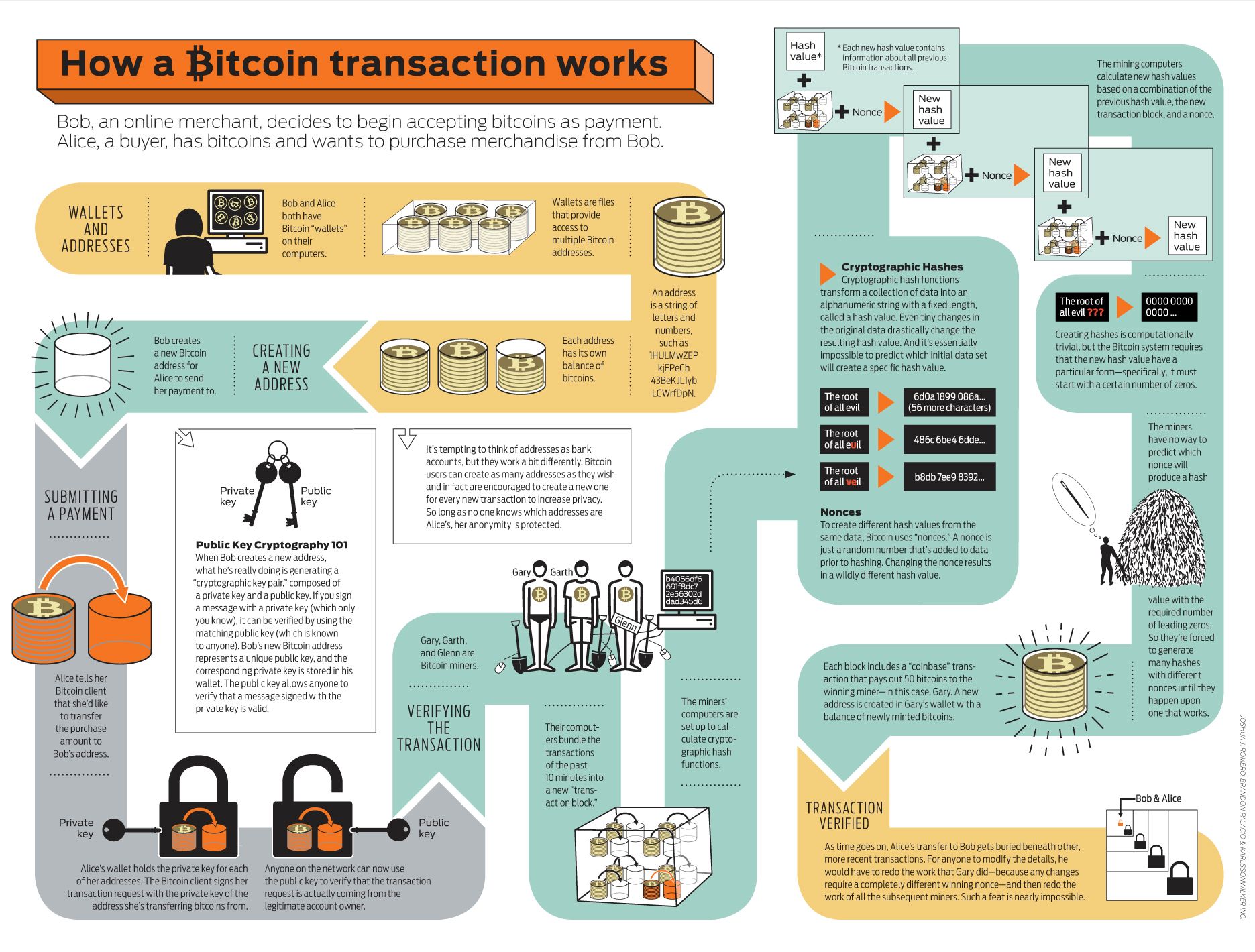
Here is the initial design spec: http://bitcoin.org/bitcoin.pdf. It very close to what is actually being used today. It seems very clear and solid in concept for such a short paper. Here is a graphical representation of the main processes involving cryptography: http://spectrum.ieee.org/img/06Bitcoin-1338412974774.jpg
I do not doubt your experience. I would like you to point out any flaws you see in the process that are not already mentioned in the original paper. I do not want to remain blind to potential threats to bitcoin. I would love to hear from anyone who can point them out.
-
Re:Totally unworkable
Removing uranium from sea water is commercially feasible, and the earth's rivers bring uranium to the sea faster than we could ever use it, even if it accounted for 100% of humanity's energy. So yes, as long as the rivers of Earth keep running, there will be enough accessible uranium.
-
Re:Forensically secure?
This podcast from IEEE (transcript is included in the link) describes a project that addresses that exact concern. It describes work from the Guardian Project that is developing a handful of (Android) apps for capturing and authenticating photos and video. Their aim is largely journalism and humanitarian work, but would be available to everyone. The apps can, for instance, add a cryptographic signature to photos or video, so that subsequent tampering is easily identified. In other instances, the apps can do everything to thoroughly anonymize data: blur faces, remove metadata, post to the internet using Tor, etc.
-
Re:Goodbye USPS
No, the only thing the USPS needs to fix is its budget: They need to pare-down their offerings and focus on what they're still needed for: envelopes, small packages, and letter delivery services. Their problem is that they bloated up while companies like FedEx and UPS took over the lucrative markets of large package delivery and organized to provide rapid package services worldwide. Now they need a strategic refocusing... but to say they're dead because of Walmart?
No, it's because George W. Bush signed a law that stated that USPS must prepay the pension 75 years in advance. Yes, USPS is paying into the coffers of wall street the pensions of people who are not even of working age yet (who of course, aren't employed by USPS yet).
Until then, USPS was pulling in some pretty hefty profits ($1B or so). Of course, all that and more has to go to Wall Street to manage the pension.
http://spectrum.ieee.org/telecom/internet/email-isnt-killing-the-post-office
-
Backdoors Will be Used
I am surprised that no one has commented on the fact that this is another case of a backdoor that was intended for the use of whitehats being commandeered by blackhats. When you build backdoors into systems you weaken security.
Another, really amazing story along those lines is the cell-phone wire-tapping of greece during the months before the last olympics games in athens. The system was designed with a wire-tapping backdoor, greece didn't even purchase that feature when they bought the switches, but the blackhats were able to turn it on and listen in to the phone calls of the mayor of athens and the prime minister of greece.
-
Re:In other news
Some possible solutions: Stop the wind turbines from spinning (or just slow them down) when the bats are most likely to be flying by it (usually at sunset/sunrise). Or not building turbines in locations that are heavily traveled by bats. There are other solutions being researched, such as emitting sounds that mimic the bats' own echo-location signals.
The problem is both bats running into the fins and that the bats' lungs cannot handle the pressure gradient produced by the moving blades. see http://spectrum.ieee.org/energy/renewables/fixing-wind-powers-bat-problem
But this problem seems solvable, and in my opinion doesn't diminish the need for building more wind turbines.
-
Re:More accurate to say "More resilient chips"?
Thank you, that was what I was about to say, massively redundant, cool but it does not actually repair itself back to the way it was before, as it 'heals' it uses up that ability.
Not even new.
They have been building self-testing, redundant chips for years.
Here's a paper from 1982:
http://www.computer.org/csdl/trans/tc/1982/07/01676058.pdf
1988:
http://ieeexplore.ieee.org/xpl/articleDetails.jsp?reload=true&arnumber=3187etc...
-
Re:What's his view on ..
So, what's his view on POV porn on these devices?
I'd say... augmented? You now, with an overlay of arrows and directions and labels and what not, how else?
-
Re:Jesus God
That's nothing. Consider this:
Harry Harlow would be proud.
-
Re:Hope no one hacks our entire Air Force one day
No, you are totally incorrect. Humphreys spoofed a commercial, civilian drone, using the unencrypted civilian GPS channel. The military uses a private GPS channel that is secure and encrypted and has not been hacked or spoofed. In addition, the newest GPS satellites modulate the signal in such a way (called M-code) as to further prevent spoofing (the edges of the square waveforms are peaks with troughs in the middle of the waveform, making it harder to overlay one signal onto another, so the receiver is actually looking at the shape of the waveform and not just the raw digital data it encodes by each peak and trough- or something like that).
Humphreys: Sure. Well GPS spoofing takes advantage of the fact that the civilian GPS signals, as you mentioned, are unencrypted and unauthenticated; so, whereas the military GPS signals have an encryption code overlaid on them, the civilian ones do not and never have.
We did so by purchasing our own drone. No one would lend us a drone because they knew it was going to be a risky endeavor and we generated fictitious GPS signals, captured the drone and brought it down.
http://spectrum.ieee.org/riskfactor/aerospace/aviation/-drones-and-gps-spoofing-redux
And from your own link:
"Hacking a UAV by GPS spoofing is but one expression of a larger problem: insecure civil GPS technology has over the last two decades been absorbed deeply into critical systems within our national infrastructure," Humphries told the subcommittee in his testimony. "Besides UAVs, civil GPS spoofing also presents a danger to manned aircraft, maritime craft, communications systems, banking and finance institutions, and the national power grid."
What he demonstrated has absolutely nothing to do with military at all. He's raising awareness to the risks of controlling important, life-or-death type hardware with unsecured civilian GPS.
-
Re:Counterexample: UNIX/POSIX/Linux
Windows used to provide a POSIX facade over its very much non-POSIX world, which is not the same thing as what I mentioned (where the POSIX interfaces are the default/actual system interfaces.)
And with respect to POSIX, there are specific means to determine "conformance" (the term used in the standard.) The word "Compliance" does not appear in the POSIX standards (ISO/IEC 9945.1) The Open Group now runs POSIX certifications, see http://get.posixcertified.ieee.org/docs/POSIX_Certification_Guide.html
-
Re:Bow down
Details on how to build the mosquito laser: From the IEEE Spectrum magazine
-
Re:I'll get right on that
It is much more likely to be a roundabout way to clear the field for carriers to roll out and profit from small-cell technology.
http://spectrum.ieee.org/telecom/wireless/a-surge-in-small-cell-sites (from January's IEEE Spectrum)
I could see that some of these older cell repeaters might interfere with the newer micro/femto-cell technology that is rapidly becoming the darling answer to cell carriers' problems with expanding data demand. Their existence would certainly interfere with the intention many carriers have of selling private small-cell devices which do their cellular backhaul over the customer's own broadband connection. Most of the carriers are in a position to profit from greater broadband adoption as well - either through owning core network switches, or selling broadband as well as cell service to the same consumers. I pay AT&T for five cell phones, with data on most of them, as well as my U-verse broadband connection at home. I'm sure they would love it if I had to pay for a private microcell as well as move to a higher-speed broadband account to deal with the backhaul capacity requirements.
-
Re:Non removable battery, no memory card slot.
Over the past 8 years or so, every single rechargeable device I or anybody I know has owned for more than a year has lost a significant amount of battery capacity. Maybe it is only 30% capacity lost with high-end batteries after two years (~700 charge cycles), but when this is the difference between lasting 14 hours without a charge and not, the user sort of notices.
Incidentally, Li battery deterioration is a popular topic of study, characterization, and consumer education.
What do you do with your batteries to maintain their capacity? Maybe you are wealthy and don't notice because you replace the whole device instead?
-
Re:"they" can fuck off, the binary units are the o
I assume you would like to look less like an idiot in the future, so I will provide information with references for your education.
"There is no such thing as a half bit"
In communications, a half bit is a signal that is on the wire for half of the time of a full bit. Here is a datasheet from a UART manufacturer. On page 4 they describe the 'line control register' which sets how many stop bits there are: 1, 1.5, or 2. A simple search will return many references to start/stop bits in async communications.
"Ethernet does not have packets"
The IEEE, Cisco, Wikipedia, and Wireshark would all disagree with that, as would anyone who knows anything at all about networking.Your little quote you posted provides no support for your position at all. Nobody ever said maximum numbers (such as data lengths) were not going to be in powers of two, or that calculations such as CRC would not be in powers of two. What I said was that data is not naturally (or even usually) transmitted in power of two increments, and you have shown absolutely nothing to disprove that.
-
Re:Links?
What's even more interesting is that IEEE doesn't list it as a WiFi related patent: http://standards.ieee.org/about/sasb/patcom/pat802_11.html
And considering IEEE doesn't tend to mess around about these sort of things. Actually you might want to contact them on this one. If it works once it could work on bigger players as well, so there is a chance they'd actually take a look at the patent and see if it's worth anything. While I doubt it'll help, it probably wouldn't hurt to try. -
Re:Dumb place to mount the camera
Probably for the same reason they don't simply hold the camera and chopper in place and rotate the world. It takes more effort to rotate the chopper, or even the camera. And even if you went to the effort, it would be incredibly difficult to rotate the chopper around the camera while moving in any direction, and harder still (because you are, after all, subject to air movement) to keep the image steady. And finally, even if you did all of the above, there are limits to how fast you can rotate a chopper.
Instead, a common solution is to have a lens that provides a 360 degree view, with various degrees of distortion. (Panomorphic lenses) Note that in many cases it is 360 degrees around a single axis, with only a limited field of view along the other axes. Some variations use mirrors, others appear to be extreme versions of the fish-eye lens. (Example.)
Another solution appears to be having either a reflector or the camera itself rotate, stitching the continuous stream of images into a series of 360 degree images. ( Android phone example, mirror rotation example)
And yet a third solution is to simply have cameras pointed in every direction at once. (Example)
-
Re:The Secret History of Silicon Valley...
some PDFs (presentation slides) on Silicon Valley history:
http://ewh.ieee.org/soc/cpmt/presentations/cpmt1209a.pdf "The Origins of Silicon Valley: Why and How It Happened Here" Paul Wesling, IEEE SFBA Council (3.5 MB PDF). One particular slide has , "Tube Shops’ Challenges Design around ~250 RCA triode patents – Enormously difficult task (Samsung vs Apple case)"
http://www.incose.org/sfbac/2011events/111108Presentation-50YearsInSpace_v5.pdf "The Global Triggers in the Birth, Growth, and Challenges of System Engineering in Space and Internet" by Sam Araki. This also shows influence of government spending on recon satellites and how it drove chip manufacturers. -
Most research in computer science is available
Citeseer and google scholar contain a large amount of scientific papers freely accessible. Many journals have open access policies. Many researchers publish their result on arxiv before sending it anywhere else. IEEE and ACM let their members access papers (IEEE policy at http://www.ieee.org/publications_standards/publications/subscriptions/prod/mdl/mdl_overview.html . ACM's policy at https://campus.acm.org/public/qj/profqj/qjprof_control.cfm?form_type=Professional . SIAM's policy http://www.siam.org/membership/individual/benefits.php ). So ok, it is not free, but that's not really expensive either if you are actually interested. Most researchers publish preprint on their website. If they don't, drop them an email they'll send you a preprint (if I had not put it on my website, I would send a preprint.)
Assuming you could not find it. And the author is a jerk. And you don't want to pay for it. You can still stop by a university libray where you will be able to download it using university subscription or photocopy it if the library has a paper edition.
Finally, we are not looking to send our papers to the most expensive journal. To the most prestigious certainly, but the price has nothing to do with it. Arguably, one of the most prestigious journal in CS is ACM Computing Surveys. It is an ACM journal, so all ACM members can read it online for the price of their subscription. Hardly the most expensive journal.
That being said, I'd rather we only publish in openaccess journal et we ditch the publishers out. But that's not realistically going to happen anytime soon.
-
Our article on the subject:
We (David Moore, Vern Paxson, Stefan Savage, Colleen Shannon, Stuart Staniford, and myself) did the analysis of how it spread, including showing how it infected all the vulnerable systems in 10 minutes, and detailing flaws in the random number generator.
Our article eventually appeared in IEEE Security & Privacy.
-
Is it cost effective?
By the sound of the article summary, this 'gas' will also make you thin and get you a job promotion. The article itself is much less rosy. It says its compatible and efficient, but how efficient. It suggests that it is for niche markets like the military ect., aka big spenders. And no you can't produce fuel from plants to offset oil because of land area, for more info see http://spectrum.ieee.org/energy/renewables/a-skeptic-looks-at-alternative-energy
-
This happened at Chernobyl too.
From the IEEE spectrum's article Chernobyl's Stressful After-Effects
Perhaps most widespread are psychosomatic illnesses--even in not-too-contaminated areas, there has been a large upswing in stress-related physical ailments, notably stomach and autoimmune disorders. In fact, morbidity and mortality due to such disorders may well in the end exceed sicknesses and deaths caused by radiation.
Also see the book Toxic Turmoil (one review here)for more discussion of the role of stress in disasters.
We should note the Chernobyl's radiation release was an order of magnitude greater than Fukashima's .
-
Re:Scrabble...?
When Christmas shopping, I saw a "Words with Friends" board game. I turned to my girlfriend and said, "It's like the board game Scrabble, but online, and then taken offline and made into a board game."
WWF has different letter scores and different positions for the double/triple letter/word score blocks.
To novice players, it's not a huge deal. To expert players, it is because a lot of strategy involves the correct placment, and knowing where every bonus is and point value of letters is critical to getting high scores.
http://spectrum.ieee.org/geek-life/tools-toys/words-with-friends-not-your-parents-scrabble
This one contains a comparison of Scrabble vs. WWF tile values:
http://spectrum.ieee.org/geek-life/tools-toys/data-mining-scrabbleWWF apparently is tweaked in such a way that the balance of the game can shift since some tiles have higher point values so the underdog can catch up.
-
Re:Scrabble...?
When Christmas shopping, I saw a "Words with Friends" board game. I turned to my girlfriend and said, "It's like the board game Scrabble, but online, and then taken offline and made into a board game."
WWF has different letter scores and different positions for the double/triple letter/word score blocks.
To novice players, it's not a huge deal. To expert players, it is because a lot of strategy involves the correct placment, and knowing where every bonus is and point value of letters is critical to getting high scores.
http://spectrum.ieee.org/geek-life/tools-toys/words-with-friends-not-your-parents-scrabble
This one contains a comparison of Scrabble vs. WWF tile values:
http://spectrum.ieee.org/geek-life/tools-toys/data-mining-scrabbleWWF apparently is tweaked in such a way that the balance of the game can shift since some tiles have higher point values so the underdog can catch up.
-
Re:new requirement for patents
I recall at least two applications of this same sort of thing being done already. It's not even locked inside the realm of Microsoft's imagination; it's already in use by others!
http://mixedrealitylab.org/virtual-hugs-and-intelligent-pillows-invented-in-asia/
http://www.mytware.com/
http://spectrum.ieee.org/at-work/tech-careers/adrian-cheok-making-a-huggable-internetI wish I could bring myself to stop reading patent stories. I don't have enough mental facepalms for them anymore.
-
Re:This should not be patentable.
Prototypes even in 2005: http://spectrum.ieee.org/at-work/tech-careers/adrian-cheok-making-a-huggable-internet .
-
Re:Why perl?
Look at that, you found a chart. Good for you.
Statistically, what you say is just nonsense.
You don't seem to understand that chart, the methodology, or statistics in general.
Fun fact: Our little discussion here actually improves Ruby's TIOBE rank. Interesting, isn't it?
Other similar sites show similar results.
No, they don't.
https://sites.google.com/site/pydatalog/pypl/PyPL-PopularitY-of-Programming-Language
http://www.google.com/trends/explore#q=ruby%20on%20rails
http://lang-index.sourceforge.net/
http://spectrum.ieee.org/at-work/tech-careers/the-top-10-programming-languages
http://techcrunch.com/2012/09/12/javascript-tops-latest-programming-language-popularity-ranking-from-redmonk/
( http://redmonk.com/sogrady/2012/09/12/language-rankings-9-12/ )No one cared about Ruby before RoR -- and now that RoR has fallen out of favor (the fad is over) so will Ruby. Trends appear to show Ruby as flat or in decline.
I know that you really like Ruby. That's fine. But let's not pretend that it's growing in popularity. It doesn't matter if the rumors about Ruby and RoR are true or not -- or that such-and-such criticism is just a myth or whatever else you want to bring up in defense of the language. The fact is that it's in decline and unlikely to ever again enjoy the hype it did years ago. Sometimes, being just the best thing ever in the whole of all history just isn't enough to make something popular.
You seem to have a lot emotionally invested in the language (or other people's perception of the language). Just let it go, kid. In the grand scheme of things, it's not at all important.
-
Re:What is bigger risk: Meltdowns or Climate Chang
2) The only technology that can meet power demands soon enough without causing climate change is nuclear. Wind/solar/etc simply don't have the technology, infrastructure, etc. to come online soon enough.
I agree with what you say, that developing solar and wind and hydro power can't keep up with the rate of growing demand. However, this article from last year's IEEE magazine points out there is enough renewable energy to meet the world's needs.
So, with enough discipline and forethought, one could use nuclear power as a transitional step away from fossil fuels, and later replace nuclear plants with wind and solar as they age and need to be decommissioned.
-
Re:IEEE July 2011
This is a better description of Topological Insulators from IEEE in July 2011. Not real sure what can be done with these things in practice. They have interesting properties, though.
That's exactly what they said about LASERs, when I was in high school! (about 1967.) You know what happened to that...
-
IEEE July 2011
This is a better description of Topological Insulators from IEEE in July 2011. Not real sure what can be done with these things in practice. They have interesting properties, though.
-
Summary of Ada's work and film
For those able to get into the IEEE paywall, there is a great summary of Ada's work in the IEEE Annals of the History of Computing. See "Lovelace & Babbage and the Creation of the 1843 ‘Notes'" by John Fuegi and Jo Francisin the Annals journal of October–December 2003.
-
Re:This is in line with other FAA requirements
I have personally observed a digital camera (Nikon D200 I think), interfering with the navigation receiver on a small plane. Every time we took a picture the VOR needles would jump slightly. We were at cruise altitude and VFR so it wasn't a problem, but it would have been disturbing if it happened low on an ILS approach.
My flight instructor's cellphone rang once we landed and I was taxiing, and I ended up hearing both sides of the conversation in my headset (not a problem - ATC was quiet). Just a regular dumbphone, which rang. Plus, I can hear the GSM pings through the intercom during flight.
(Cellphone regulations on flights are actually from the FCC to prevent massive multistate DDoS - cellphones aren't supposed to see every cell tower across 4+ states, nevermind try to figure out what control channel to use).
Anyhow, the FCC envelope (emitted EM radiation vs. frequency) for avionics is much stricter than for consumer equipment (class B) and class A devices (office use only) are even looser. The FAA can really tell the FCC to sharpen up their transmission envelopes to permit this, but then it would result in howls because meeting those new envelopes is HARD. (and there's a huge swath of frequencies from 108MHz-138MHz where the allowed EM interference is so low lots of tricks are applied...). So if the FAA told the FCC that it would allow "class C" devices aboard for continuous use, practically no one would make it, and you'd have to deal with "not for use on aircraft" labelling.
The official regulations state that absent of regulations, the pilot in command has final judgement over the use of electronics. If he/she decides that no one will be allowed to use electronics at all, he's entitled to enforce that position. And his decision overrides the FAA while the plane is in flight.
Ten years ago the IEEE did a test and found some surprising things - like a certain cellphone, when left on, would cause the GPS to lose lock (not too big a deal then as GPS wasn't as essential as it today), or others would cause the compass to drift a few degress.
http://spectrum.ieee.org/aerospace/aviation/unsafe-at-any-airspeed
-
Re:What exactly were the "technical problems"?
http://spectrum.ieee.org/green-tech/advanced-cars/lithium-batteries-take-to-the-road was written in 2007. I think they got bitten by manufacturing like the early silicon fabs.