Slashdot Mirror
Domain: imsai.net
Stories and comments across the archive that link to imsai.net.
Comments · 29
-
IMSAI 8080
From 1975, another of the early S-100 bus microcomputers. https://www.imsai.net/
-
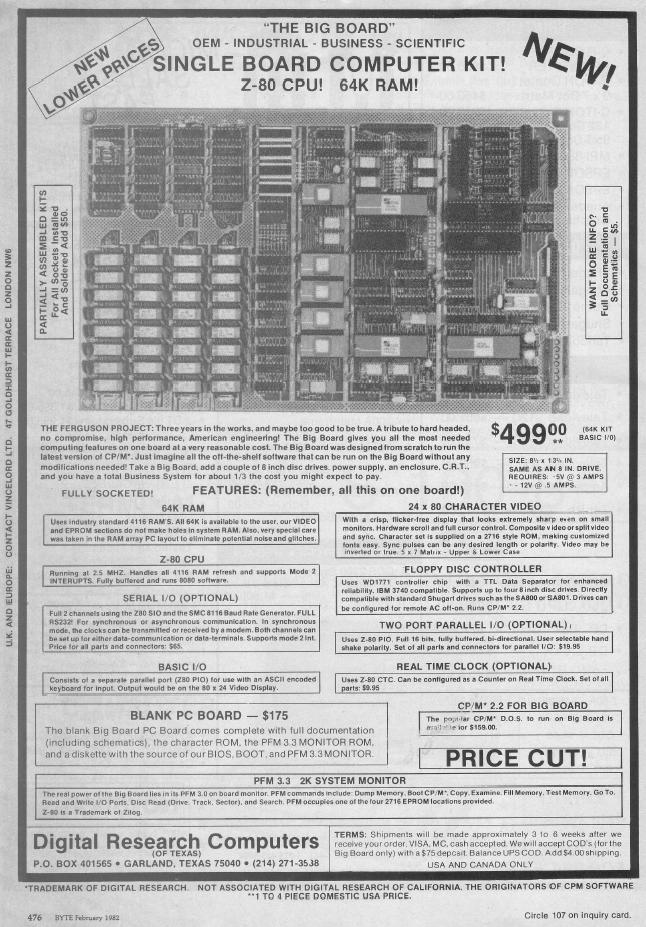
Re:Potetntial HackI love the fact that the last four digits of the above (3741) post happen to match an IBM system from 1974 that used the same diskettes described in TFA. The floppy was formatted to the standard described in the 3740 format. This format was later used on the first CP/M computer systems. My first real computer (a Ferguson Big Board II) used Shugart 850 8" floppy drives that used this same disk format. My second computer (an IMSAI 8080) used 851 drives that supported double sided floppy diskettes.
The standard 3740 diskette held 241kiB of data and was very slow. We've come a long way since then.
-
Re:Are there any old drives around that read these
The IMSAI 8080 had 8" drives
http://www.computerhistory.org...
"Secure system" - yeah, right....
http://www.imsai.net/images/wa...
. -
Re:Macs, not just for product placement
I wonder if IMSAI 8080 paid for placement in WarGames?
From:
http://www.imsai.net/movies/wargames.htm
We decided to go ahead and provide the requested equipment for nothing more than the promotional value and screen credits. -
Re:Anything to PROVE it's the one?
Besides, it would seem he does have plenty of paperwork. Linked from TFA:
http://www.imsai.net/movies/provenance.htm -
Re:But it's not the WOPR!
Apparently, it was scrapped. Keep in mind, that was back in the days when movie props weren't considered particularly valuable assets. Today, they would probably do some sort of auction or at least warehouse it.
-
Re:Anything to PROVE it's the one?
I don't think that will stop anyone. I'm not familiar with movie prop collecting, but it seems it would be hard to probably prove most the stuff was actually a prop that was used.
Plus it's not like this guy just suddenly appeared and is claiming it's the computer. This guy was there from the beginning. Try reading this link:
http://www.imsai.net/movies/wargames.htmDepends on the prop. Special props made just for the show have distinguishing features that often show it's made for TV (usually poor quality, looks like crap up close, etc).
But without official paperwork showing it was used in the movie, or some way to tie it to the movie (if the prop has distinguishing marks that positively identify that one unit to the movie), it is effectively worthless.
At best, an undocumented prop should be sold as a "prop replica" if there's nothing to trace it directly back. Of course, unscrupulous sellers will sell it as a official prop.
The way to document it would be to have its serial number recorded by a third party which can be cross-correlated with this unit. Or an official purchase invoice that shows the buyer as the studio and the serial number. Alternatively, since he's kept it all this time, he could include shots and other stuff and a notarized letter saying it's from the movie and what his credentials are in relation to the movie.
All this only really matters if you want to resell it or send it to a museum and want to get more than what retail would get. It's all about provenance.
-
Re:But it's not the WOPR!
My recollection was correct. There is quite a bit about the prop WOPR design and construction down a bit on this web page.
-
Re:Disk drives
On the IMSAI web site they have a "garage sale" listing at the bottom of the page. They list both 8" and 5 1/4" drives. You might even be able to get 3.5" drives working with it. I seem to recall reading about some CP/M system mods for other systems that would allow that.
-
Re:Anything to PROVE it's the one?
Honestly if it does not have the full paperwork and possibly all the actors signing the lid back then, it could be ANY Altair8080
I don't think that will stop anyone. I'm not familiar with movie prop collecting, but it seems it would be hard to probably prove most the stuff was actually a prop that was used.
Plus it's not like this guy just suddenly appeared and is claiming it's the computer. This guy was there from the beginning. Try reading this link:
http://www.imsai.net/movies/wargames.htm -
Re:He started something big
Hah, that's the first thing I thought of also! You're correct, he did indeed. And, if you're interested, you may be able to purchase the one used in the movie: http://www.imsai.net/Movies/WarGames.htm
-
Long Live the Surplus Store.
Between the racks I got from Weird Stuff, the tube radio I got at Electronics Flea Market, the wiring and connectors, and components I get from Halted and Al Lasher's Electronics, (I still miss Quinn's Electronics, though...), I almost don't need to go to Fry's or order from Digi-Key.
Not that I don't go to Fry's, Digi-Key, or even eBay, but it's nice to still be able to get parts 'n' stuff on a Saturday for $5 in gas and a pleasant drive, rather than a $5 shipping charge and a three-day wait. (I don't mind paying $5 for a $1 connector, but if I gotta go that route, I'll be damned if I'm gonna wait for it
Alas, the surplus store memorial list gets longer with every passing year.
But that covers a few places I know of in the Bay Area. Where are your surplus stores?
-
Re:OverloadLooks like this is a good place for kits these days. www.electronickits.com
Going back 40 years, HeathKit and to a lesser degree Radio Shack were the big names in home electronics kits. Projects ranged from simple amplifiers and AM radios to electronic organs and TV's.
Going back about 35 years with the dawn of the microcomputers, IMASI and ALTAIR were branded kits. I was very surprised to see that IMSAI is still around: www.imsai.net For that matter, you can still build an Altair 8800 using NOS (new old stock) www.altairkit.com
Moving into the early 80's, the Timex Sinclair made a 4 chip z80 set. Believe it or not, you can still buy that one too. www.zebrasystems.com
About that time we also tried out an OKI Semiconductor evaluation kit for a digital PCM encoder (think digital answering machines, voice recorders). You can check the various semiconductors manufacturers who publish evaluation kits, sometimes with sample projects for a slightly more advanced challenge.
-
Re: 640Kbytes
``And Bill Gates once declared that the average person would never have a need for more than 640 kilobytes of memory in a personal computer''
Maybe he was talking about putting that much memory in an IMSAI.
Nah... I don't think that would have even been physically possible -- what was the largest capacity RAM chip available back then? -- much less affordable and anyone who tried would have to have come up with some kind of bank switching to even make it work.
Thankfully, my first PC came from a vendor who must not have heard of Bill's proclamation and who included enough sockets on the m'board to hold a megabyte. (Oh, I had those babies full of chips in no time.)
BTW, for some IMSAI nostalgia, you can still buy the darned things. (Less than a grand for a basic model.) Let the hand assembly and the toggling in begin!
-
Re:Not the same world anymore
The last thing this comment should be moderated is Offtopic. This is one of the more insightful comments you'll find.
My first computer was an IMSAI 8080. I built it from the kit, as well as the Lear Siegler ADM-3A terminal I connected to it. This was in 1976, and I, too, miss those days. While we can do some cool stuff today with 3-D graphics, multithreaded and multiprocessing operating systems, networks, etc., there was still something about building everything from scratch.
I'm with Woz on this one. -
Re:80 Columns? LUXURY!>As for input, I used to write it down on a piece of paper, then toggle it in with binary switches.
You think that's funny? I was looking into the value of an IMSAI8080 that was down in the garage a few months ago. The IMSAI8080 was one of the first personal computers and only has toggle switches and lights on the front panel.
http://www.imsai.net/
A good one goes on ebay for as much as $900.
I also had to toggle in the program for a pic16F84 microcontroller bit by bit because I couldn't get the programmers I made from web plans to work. I finally determined that it wasn't the programmers that were messed up it was that the pic wouldn't accept a program if the supply voltage was over 4.5 volts, even though it was supposed to work at 5v. -
Das blinken lights are cool
Okay okay, SOME lights are cool. The Connection Machine for example http://archive.ncsa.uiuc.edu/Cyberia/MetaComp/Ima
g es/CM5_lg.jpg is very cool. And the IMSAI 8080 was damn cool because it has lights AND switches. http://www.imsai.net/ Now that's a computer. On the other hand, all those damn goofy PC mods with lights on the stupid fans and all is bogus. -
Re:Obsolyte!
Of course, should you have an original Altair in your basement, that's another story entirely.
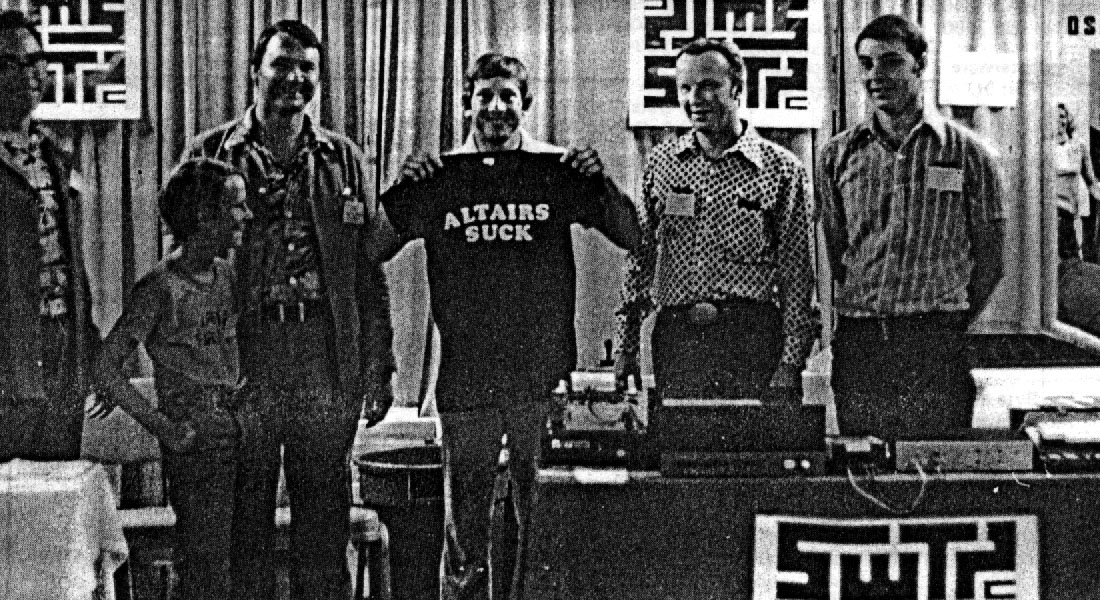
Altairs suck. I have an IMSAI. -
Re:Numero Uno
I can one up you. My dad came home with a circuit board, two paddle controllers,
and an RF converter thingy from the famous bay area surplus house Mike Quinn's Electronics.
It had 40 different games, all variations of pong. It RULED my 7 year old world, because it was color
and the one at the Pizza place was black and white. It was probably a scrapped product that Mike bought in some liquidation.
My dad was always making cases for his projects, but for some reason this pong circuit board remained caseless
for its entire useful lifetime, it just sat on a shelf behind the TV.
Remind me to tell you about the time Dad came home with bags of thousands of 555 timer chips that we had to straighten
out the pins on and plug in to a breadboard tester he had rigged up. The good ones went back
to Quinn's and the bad ones... well.. I think the CIA sent them to the USSR for satellites or something. -
Re:Really old Geek ?A good exhibit mentions Multics.
Multics running on an Apple ][, now that would be something to brag about!
I learned to program in BASIC on a North Star Horizon. It was a Z-80 box. The hi-lite was North Star Basic, which the machine booted into directly. Possibly the first built-in support for 5 1/4" floppy disks, at a time when Apple was limited to audio cassette tape.
IMSAI had some nice looking equipment, with lots of toggle switches. Always wanted one of those, because it LOOKED like a computer. But that beautiful hardwood case on the Horizon, nothing like it today unless you build it yourself.
-
First I owned, or first I used?
The first computer I used was some GE timesharing system back in 1972.
The first computer I owned was an IMSAI 8080 that I built from the kit in 1976. And I bought an 8K RAM board (that I also had to build) for only $200! -
Those who do not know history
...are destined to repeat it:
i'd not heard of this before.
You must be a bit young, or a bit new to personal computing. The first generation of personal computers were all implemented using a passive backplane architecture.
Nowadays chips are cheap so the whole system is disposable--if that multi-hundred-pin superscalar chip fries you just drop in a whole new board, which today becomes a full blown PC with the addition of CPU, RAM and HD. Back in the day even the primitive 6502 was several hours wage for most people and reliability wasn't as good, so integration was a bad thing--at least with cards if one blows there is a good chance the $1000s of other circuitry were still intact. Thus, you had a nice chunky cabinet full of cards---CPU, RAM, terminal I/O or maybe a video card, floppy controller, etc etc.
Industrial controllers are still almost always backplane-and-card setups to this day. Modern controllers have taken this to a new level and are typically hot-pluggable as well. In industrial settings, servicability and maximum availability are more important than lowest cost, so in any critical operation you won't see a PLC processor with integrated network, digital I/O, etc etc etc...'cause you'll never be able to hot-swap chips that are surface-mount soldered to a processor board. -
Speaking of Retro...
If you love this stuff like I do, and want a very nice replica of an "Altair Style" retrobox, the Imsai has been made available again(albeit at a slightly exorbitant price)....
I for one will definitely pony up the $2bux this guy is asking for his Apple replica long before I can afford one of those old Imsais. Much as I want one, I ain't exactly rolling in dough sadly. Just pricked my finger, noticed my blood ain't blue enough. -
IMSAI
Despite the free availability of emulators, people consistently pay thousands of dollars for an Altair 8800 or Imsai 8080. I would if I could afford it.
Fortunately for you, you can get a brand-new IMSAI Series Two, designed by the original IMSAI people, with an, um, ultrafast 20 MHz ZS180 processor, 1M of RAM and an original state-of-the-art S-100 backplane bus. (Actually, I shouldn't make too much fun of the S-100; I remember back in the days when the 80386 was the fastest x86 processor, S-100 backplane DOS cards were faster than conventional PCs.)
Meanwhile, though, I think I'll stick with running xtrs, the TRS-80 emulator, when I need to be reminded how far we've come. I missed the days of front panel switches, but, I don't think I really missed them, ya know?
-
Re:TRS80
DOn't laugh - IMSAI, which predates the TRS80, is soon to sell, for under $1000, a series two with 20Mhz Z8S180, 1 meg static memory, AND toggle switches and flashing lights! CP/M never ran so fast.
-
IDE?
IDE disks? IDE disks? What the bloody hell are IDE disks?
When I were a lad, we 'ad to use 8 inch floppies.
8 inch floppies? You were lucky.
Cut to the Four Yorkshiremen sketch. Is there anyone else here who remembers Phoenix? -
Re:But WHY???...Zilog 20 MHZ. Z8S180 Processor- 1 Meg direct addressing (organized as sixteen 64K "pages"), code compliant with Z80 extended instruction set
Well, Z80's aren't so puny, but this isn't a Z80. It's a
Zilog 20 MHZ. Z8S180 Processor- 1 Meg direct addressing (organized as sixteen 64K "pages"), code compliant with Z80 extended instruction set (from this page)
This is more like an Intel 8088 on steroids. The old Z80 computers ran (mostly) CPM, and occasionaly mpm, and were FAST. They had no GUI, after all. This should be able to run something like GEM on opendos. fast. They do let you put a modern computer inside if you want to, but being able to run the old cpm programs without emulation would be really nice; maybe even worth $995 to me, if I were out of debt. -
Re:But WHY???...Zilog 20 MHZ. Z8S180 Processor- 1 Meg direct addressing (organized as sixteen 64K "pages"), code compliant with Z80 extended instruction set
Well, Z80's aren't so puny, but this isn't a Z80. It's a
Zilog 20 MHZ. Z8S180 Processor- 1 Meg direct addressing (organized as sixteen 64K "pages"), code compliant with Z80 extended instruction set (from this page)
This is more like an Intel 8088 on steroids. The old Z80 computers ran (mostly) CPM, and occasionaly mpm, and were FAST. They had no GUI, after all. This should be able to run something like GEM on opendos. fast. They do let you put a modern computer inside if you want to, but being able to run the old cpm programs without emulation would be really nice; maybe even worth $995 to me, if I were out of debt. -
Re:Why?
If you had read the specs you would know it does support Linux.... The PC software support includes a small software "server" that uses the native DOS/Windows/Linux file system to store files.