Slashdot Mirror
Domain: inflationdata.com
Stories and comments across the archive that link to inflationdata.com.
Comments · 100
-
Re:Software to limit functionality?
In the US from March 2016 to March 2019, consumer prices have risen by approximately 6.7%. $35k then would therefore be about $37,400 now.
However, when the car was announced, Musk said deliveries would begin in late 2017, so we should really be measuring the price rise between (say) October 2017 and now. That's about 3.25%.
-
Click-bait
This 60% thing is an interesting statistic, but it would be more relevant if we could see the proportion of Americans who didn't get pay raises for the last 5 years or so. It's effectively citing a number without a baseline for comparison.
Additionally, it could also be phrased as "40% of Americans got a pay raise this year", and in the context of our recent depression (starting at around 2008) might be a piece of good news. We'll never know.
The economy only really started to take off about October of last year, so we've only had a little more than a year of good economy. Will this trend continue? It might be nice to see a sparkline for this pay raise information month-by-month to see if represents an increasing trend.
Additional to that, the article as posted in a negative light (60%, without baseline) and immediately dives into how management all got raises. It then goes on to talk about minimum wage and how inflation hit a 6-year high in July of 2018.
The article is all about class envy, trying to gin up outrage in order to get clicks. Isn't it simply *awful* how those evil managers reward themselves while keeping most worker wages the same!!!
(Inflation in July 2018 was 0.01%, yet another number cited without baseline to provoke outrage.)
Really. It's well known that wages have been flat for much of the 2000's, and others report that US wage growth is at a nine-year high.
Take a skeptics view of click-bait articles.
-
Re: wTF only $200,000
According to https://inflationdata.com/, the CPI was in 207.342 in 2007 and 245.120 in 2017; that's an 18.22% increase over those 10 years, not the 100% you are claiming.
Late 1971 is 40.900 and late 2018 is 252.885, a multiplier of 6.175, making $200,000 then worth $1,235,000 today.
-
Re:Great.
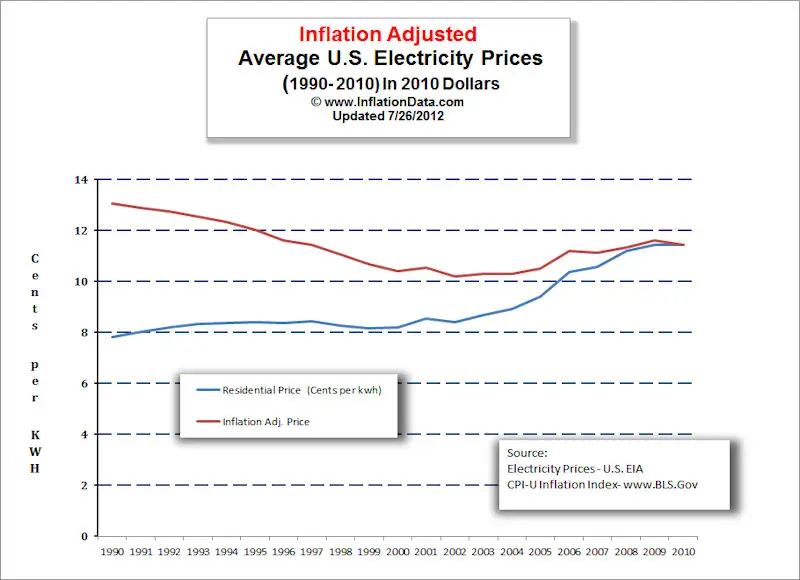
Past performance is no guarantee of future results, but it looks like the price of electricity had gone up about 40% between 1998 and 2010 (which is when the first site I found stopped counting). So from 8 cents to 12 cents in 20 years (I'll say the last 8 years of inflation added half-a-cent). This means your $50 a month would be $75 a month in 20 years—assuming none of the suede/denim skulduggery you fear. https://inflationdata.com/arti...
-
Re:Take that Karl Marx
First off, we don't have laissez-faire capitalism
But you can't deny it's a lot more laissez-faire than the Nordic model.
Second off, these problems have little to do with economics, in fact we've already tried throwing lots of money at these kinds of people, and it didn't work.
What's that? Just throwing money at a problem without actually changing the underlying socioeconomic model that caused the issue in the first place doesn't fix the problem? Who could have predicted??
It's interesting that you say this, because things have only been improving. Pick any metric you want:
I can pick 5 things straight off the bat that haven't been improving:
1. Cost of housing.
2. Healthcare costs.
3. Income inequality. The majority of wages have stagnated while only those at the top have seen their wages increase. Stagnant wages combined with increasing the living costs above is leaving far more lower and middle income families in a precarious position.
So if we follow your assertion, then a more unrestricted economic model is improving life for Americans. The reality is much more nuanced than that, but you're the idiot who made this statement.
Your assertion that things have been improving across the board is demonstrably wrong and there is clearly plenty of room for improvement.
-
DO NOT invest in gold.
Dear God, don't invest in gold! If you look at the price of gold adjusted for inflation it's remained flat, flat, flat. Sure there have been spikes, but the two spikes we've seen so far have been based on speculative trading by people basically betting on the end of the world. And right now we're probably going to see a multi-decade long slide from gold's peak of nearly $1900/ounce down to perhaps a few hundred dollars an ounce.
Now if you really think we are coming to the end of the world and we're about to see economic armageddon, with Mad-Max style gas wars just around the corner, may I suggest investing in cigarettes and alcohol instead, stored in vast storage containers? Seriously, that'd be a better bet than gold...
-
Re:OR
What inflation? Inflation rates have never been so low. We've even had some deflation, which is scary.
-
Re:Regardless of the reasons...
Probably has more to do with cheap oil than the Chinese at least the current situation.
Solyndra's collapse predates the cheap oil boom. Prices are currently around $40/barrel, but they were at around $91/barrel inflation adjusted in 2011, the year Solyndra filed for bankruptcy. Oil was extremely cheap in the 90s, then rose in the mid-2000s to near-historic high levels, where they stayed until 2015 when the price fell back down to c. 2003 levels.
-
Re:In other words
If they were dumping their petro stocks for financial reasons, the time to drop them would've been back when oil began falling from $100/bbl.
Selling off stocks after they've seemingly hit their nadir is a common mistake rookie investors make. When a stock bottoms out, that's actually the best time to buy them. So the fact that they're selling it now actually lends credence to the backstory that they're doing it for environmental reasons. Only way your theory would fit is if they thought oil was going to go even lower than the current $40/bbl. The inflation-adjusted 70-year average price of oil is $42/bbl. -
Re: Trump just says stuff
And the biggest cost to labor is capital, mostly land.
If people didn't have to borrow half a career's income just to have a place to even sit and starve to death in peace, they could work for much cheaper. I live quite luxuriously off a budget that a full-time minimum-wage job could fund if it weren't for rent, and savings to eventually escape from rent, and taxes on the money I have to earn to pay for those things, adding up to almost 300% of what I actually need to consume for that comfortable lifestyle.
Fix the problem of rent (and interest) and get us to a world where people actually own the places they live outright and don't have to pay to borrow them (or money to buy them), and then labor costs can plummet, and the cost of business can plummet with it.
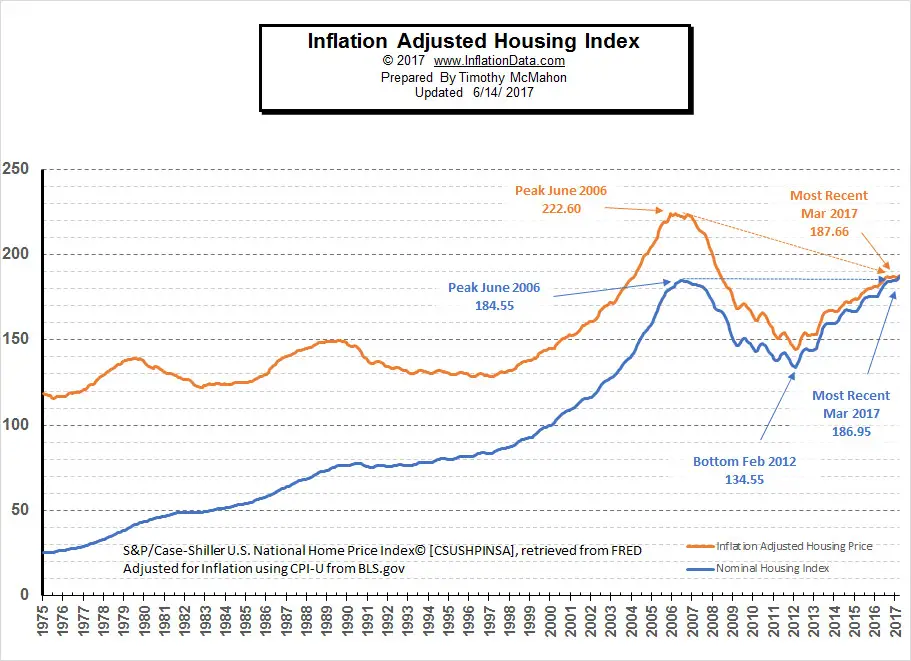
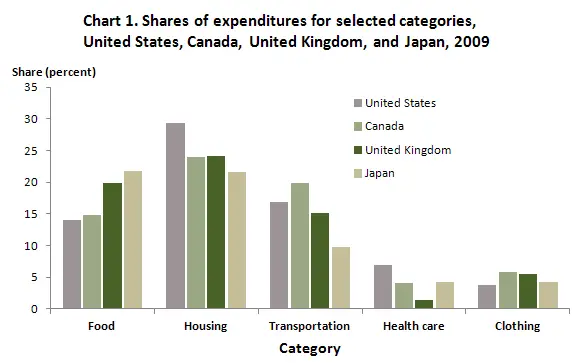
and the cost of housing, whether rental or ownership, is a much larger fraction of people's overall expenses than in other countries. http://inflationdata.com/artic... . this has gotten worse over time. http://static1.squarespace.com...
-
Re:pricing
Well there's your problem!
-
Re:Hmm...
But there's this thing called inflation. A dollar is only worth what it will buy. If wages are artificially jacked up then you can expect prices to react as labor costs are passed along. You do realize that someone has to pay those wages and those funds are limited? Only the Federal government gets to legally print money.
But there's this thing called inflation.
Inflation? Really? Such a thing exists, but it has been historically low for some time now. At least since 2008.
http://inflationdata.com/Infla...
"Annual inflation for the 12 months ending in March 2015 was a deflationary -0.07%. Due to rounding the BLS counts this month as -0.1%. This is down slightly (more deflationary) from the 12 months ending in February at -0.03% when the BLS rounded to 0.0%.but slightly less deflationary than January when the BLS also rounded to -0.1%. Note that Annual Inflation has been negative (i.e. deflationary) for three months now primarily due to lower gasoline prices.
http://aneconomicsense.com/201...
The Federal Reserve sets a nominal inflation rate of 2%. Despite the quantitative easing, we haven't seen anything like that. Monetary policy is one of those areas where you can most perceive just how much Economics is a pseudo-science and how many of the so-called "laws" (such as "supply & demand" and it's resultant fiction, "supply-side economics") are just fables you tell working people to make them behave as the value of their labor is artificially degraded.
-
Re:Someone teach me something here...
Current inflation rates are around 1.6%. And that's with the steep decline in the price of oil. Of course food is really up quite a bit...
-
Re:Free?
You mean a scam like this: http://www.inflationdata.com/i... or http://www.motherjones.com/pol...
-
Re:I think the thing being missed here
Would you pay ten times more? That's the kind of factor you'd be looking at for that kind of speedup.
I paid $100 for a 512MB compact flash card in late 2004, or $200 per GB. I just ordered a 32GB USB 3.0 flash drive for $13, or $0.41 per GB. A 500-fold decrease in cost in just 10 years.
The affordability also hinges on income (productivity per person), which has more than doubled since the 1940s. Energy prices are much more stable than RAM prices. But my point is, just because 10x more expensive is prohibitively expensive today doesn't mean it will continue to be so into the future.
Just as one shouldn't prognosticate by extrapolating current rates of progress into the future, neither should one assume that progress will come to a screeching halt and extrapolate into the future by using a horizontal line. Is hypersonic transport impractical today? Yes. Will it become practical in the future? I'm inclined to disagree with TFA and think it will become affordable. To believe otherwise is to concede we're going to be stuck on this rock forever. Excuse me for being the type who doesn't like to just give up. -
Re:Parent of University Frosh Twins: "Thank You"
Or we could, you know, just restore the massive State and Federal funding
Where's this money coming from? Tax increases have a cost too.
Further, I don't think people get that the massive funding in question just wasn't that massive or that different from today. Recall that college costs have increased for decades at a far greater rate than the US economy has. What was ample funding forty years ago just doesn't come close today.
From the above link, education costs increased by a factor of six in a 26 year period from 1985 to 2011. In that time, nominal GDP (not adjusted for inflation to compare apples to apples) didn't even increase by a factor of 4 (4.35 trillion dollars to 16.16 trillion dollars).
So it's not just a matter of just maintaining historical levels of spending, which probably has been done for most states, but to increase spending as a fraction of the overall economy by 60%. -
Re:Falling energy prices and weak demand?
Energy prices in Europe have been declining for a while now: http://www.platts.com/pressrel...
Electricity rates have been rising in America. Perversely, this is because of falling demand. Electricity consumption peaked in 2007, and has been falling since then. Falling demand should mean lower prices, but most generators are protected monopolies that are guaranteed a profit. So falling demand means that fixed costs must be spread over fewer kwHrs.
-
Re:B-b-b-ut what about American exceptionalism???
Energy is effectively infinite, but not at a rate that's going to effectively substitute for the 160 exajoules per year currently provided by hydrocarbon energy. While I'm a big fan or renewables, even with a full-on effort at conversion, you're just not going to be able to sustain an interdependent, international supply chain based on *cheap* energy, nor will you feed 7 billion+ humans.
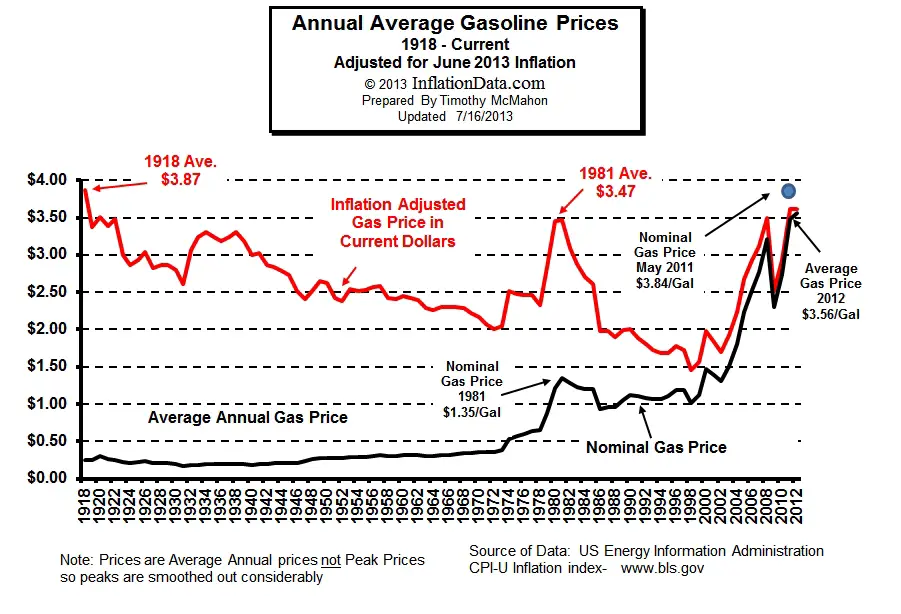
Fortunately we don't have to. When was the last time you bought gasoline for 17 cents a gallon? Probably never in your lifetime. Ok, so the nominal price that was prevalent for nearly 60 years is misleading. When was the last time you bought gasoline for $1.50 a gallon, inflation-adjusted? Some time in 2000. The inflation-adjusted price is double that now, and never in history has it been cheaper, before or since.
People talk a lot about Peak Oil. That was probably it. The price is going up again, so we're already past operating our interdependent, international supply chain on cheapest energy. You could reasonably argue that we're still operating it on cheap energy, but even after doubling the price, we're still running civilization. To judge by most of the rest of the world, we can double it again and we'll still have something that looks very much like our current civilization. Are you going to argue that energy that costs four times as much as it used to cost is still "cheap"? How about 8 times? 16 times? We're going to find out, probably in our lifetimes.
A big fan of renewables you may be, but you haven't really grasped the numbers yet. 160 exajoules annually sounds like a lot, until you see exactly how much power the Sun delivers annually. 3,850,000 exajoules. Year in and year out, that's how much energy we get from the Sun. Or in other words, enough energy to run our civilization for a year is delivered every hour. Hour after hour after hour. The delivery rate is vastly in excess of what we need. We only have to figure out how to capture a tiny fraction of the total available energy every hour to not only sustain our current interdependent, international supply chain, but continue to expand it as well.
The coming population bottleneck can't be avoided. We will, as a species, one day exist on sustainable energy - all of the remaining 300 to 500 million of us, if we're lucky, and we don't throw too many nukes around to celebrate the transition.
Sure it can, and I just showed you how. No one knows what the peak human population will be, but I'm betting it's considerably higher than 500 million. Given the sheer availability of solar energy, I'm betting peak human population on Earth will be considerably higher than 7 billion, and there will be no major population bottleneck induced by economic disruption. The price of hydrocarbon energy will trend upwards, while the price of solar energy trends downward, and the two curves will intersect, then reverse positions. Solar, in its various forms, will pick up where the hydrocarbons left off. There have never been more engineers on Earth than here are right now. Do you really think we're sitting around doing nothing?
Nothing short of a major comet impact is going to induce that population bottleneck, and with just a little more time the engineers of the world will be able to prevent that too.
So relax and learn to love the bomb.
-
Re:Bitcoin
Lol 5-13% inflation? Um, try the vast majority of the last 20 years inflation as been somewhere between 1-4%. Source ( http://inflationdata.com/Infla... ) 1-4% is a healthy range for an economy, if it is below or above bad things will happen (Deflation on the low side, runaway inflation on the other end). Deflation causes people to sit on their money, not invest in new tech, not invest in the future and not expand their businesses (who wants to expand when the money used to do so would be worth more then the investment made?).
A zero percent inflation rate is unattainable (population growth, a million other factors) so keeping it around and low in the 1-4 range is good for everybody.
-
Re:Bullshit!
From 1978-2012, "12 fold" i.e. 1200%:
http://www.bloomberg.com/news/2012-08-15/cost-of-college-degree-in-u-s-soars-12-fold-chart-of-the-day.html
This one only goes back to 1985 and shows "only" a 485% increase to 2011:
http://inflationdata.com/inflation/inflation_articles/Education_Inflation.asp -
Re:It is true
You are not correct. Please check the numbers for yourself. It is true that some refineries were closed down (outdated equipment, higher maintainance cost, etc). However, there were are are new refineries being built and existing refineries are having their capacity increased. The refinery capacity of the US has increased in the past 5 years, not decreased. http://inflationdata.com/artic... http://www.eia.gov/petroleum/r...
-
Re:Let's look at inflation adjusted costs.
Well 1970 seemed pretty near a local minimum. It's not quite that bleak if you look at the historical average.
http://inflationdata.com/inflation/images/charts/Oil/Gasoline_inflation_chart.htm
I don't think it'll ever be going down again, and not due to inflation/weakened buying power of the dollar. We haven't hit peak oil yet, but the rise of demand in the east is far outstripping the rise in supply.
-
Re:There is no overpopulation
Which begs the obvious question: Why do we need GMO to feed the world?
My post was about overpopulation, not GMO.
Which commodities would those be?
In my economics class, the professor showed a graph with the inflation-adjusted price of copper. It was stable for a century.
For electricity, a quick Google search shows the price has _fallen_ in the last 20 years.
http://inflationdata.com/articles/wp-content/uploads/2012/07/Inflation-Adjusted-Electricity.jpg
For food, see figure 4 in
http://www.fas.org/sgp/crs/misc/R40545.pdf> And how do you define "stable"?
I meant "stable" as "not oscillating too wildly and not showing a clear positive correlation with time". If it rises significantly in the long term, it is not stable.but inflation itself is an instability in the system.
Inflation is not caused by "overpopulation", it is caused by the government printing too much money.
Fourth, there is no clear correlation between population density and income per capita.
How is income relevant?
if "overpopulation" caused poverty, we would expect to see a negative correlation between population density and income per capita.
World income per capita has grown even with the financial crisis:
https://www.cia.gov/library/publications/the-world-factbook/geos/xx.html
Unfortunately, in a quick Google, I did not find a historical graph.We already invent pointless jobs for people, mostly in the public sector, because there isn't enough real honest work for everyone to do. That's in the first world, where we can afford more cruft. What happens in India and China, though, as mechanization replaces smallhold farming? What are a half-billion extra people, in each of them, going to do?
Human wants are insatiable. As simple things like food are mechanized, people will want more services such as (just one tiny example) live music.
-
Re:Bottom of the barrel
Then get ready for price shocks and the crash to end all crashes as we run out of what little is left in mere decades, and not that many.
Why will that happen? We're already seeing one effect of "peak oil" that precludes that: higher oil prices when adjusted for inflation. For example, current oil prices are roughly 4 times more expensive when adjusted for inflation than they were in the 90s.
-
Re:We Wish
In 'real', inflation adjusted dollars, gas prices are where they were around 1918, in the 1930s, and again in the early 1980s.
http://inflationdata.com/Inflation/Inflation_Rate/Gasoline_Inflation.asp
I'm not using this as an argument against renewable energy; I think you make some valid points. Notwithstanding the environmental concerns of any technology, it's a simple proposition to develop renewable energy sources when they are *less* expensive than conventional fossil fuels.
-
Re:Fiat Currency
I don't follow how an increased population with the same amount of gold equals deflation. Or, to put it more accurately, I'll just point to reality; while the dollar was on the gold standard, inflation occurred...not deflation. This isn't theory; it's what happened. I find it remarkable that I got modded down for pointing out something that is not only wrong in theory, but in historical fact as well.
-
Re:The problem with most environmentalist ideas
gas is 4 bucks a gallon, 10 years ago it was 98 cents
This couldn't have anything to do with the fact that the oil price went from $23 to $93 by any chance?
-
Re:As intended.
Looks like that was about the same as now ~2%
http://inflationdata.com/Inflation/Inflation_Rate/HistoricalInflation.aspx
-
False.
-
It's costing Joe Public a lot.
If you track inflation, and compare it to incomes, you will see that technology, and the obsolescence of human labor has actually been a loss for the individual. The generally accepted inflation gauge is the CPI:
http://inflationdata.com/inflation/Consumer_Price_Index/HistoricalCPI.aspx?reloaded=true
I think it's pretty safe to say the income chart is close enough to illustrate my point:
http://visualizingeconomics.com/blog/2006/08/15/average-income-in-the-united-statesThe cost of basic necessities has risen by over 2000%, but average income has risen by only about 400%. Mind you, that's just the average income, and I only personally know about a dozen people who earn more than $40k.
It doesn't matter how cheaply things can be made if the consumer cost keeps rising while incomes don't. There are many things at work, so I won't single anything out as the root cause, but the intermingling of government and private businesses is an important factor.
Certainly, this conversation can get very complicated, but I don't think it would behoove us to delve further into it at this time, so take this post with a grain of salt.
-
Re:Gas in Texas hasn't been 79 cents since 1979.
did you miss this comment: "The following plots show how much I paid for each gallon of gas I bought over the past 33 years or so"...
Another problem is that it is only since 1979.
Here is a better article to read....BTW... Gas is expensive historically.
http://www.inflationdata.com/inflation/inflation_rate/Gasoline_Inflation.asp
-
Re:Good luck with that!
It's not too far off though
http://www.multpl.com/s-p-500-price/
Most dramatic drop is black friday era, about 350 -> 75
with gold
http://inflationdata.com/Inflation/images/charts/Gold/Gold_inflation_chart.htm
Highest to lowest is about 1800 -> 400.
Also, looking at the two together, in recent past gold has been more volatile than S and P.
Overall, S&P goes up, and gold stays steady, but both are fairly volatile in the last 30 years ( S&P going 500 - 1400 gold going 250 - 1400, but gold looking ready to crash hard based on recent history, or slowly devalue on older data (1930s)).
-
Re:Good luck with that!
Gold is way overvalued right now.
Compare it to things like durable good, other metals of dubious actual worth, and currencies the world over.
Though it pertains to silver, Adam Smith has a long diversion about how using precious metal as a consistent measurement of value is nearly as silly as using wheat or currency.
People can speculate in gold just as much as anything else (betting against the economy and on inflation).
http://inflationdata.com/Inflation/images/charts/Gold/Gold_inflation_chart.htm
In 2002 gold had lost half of it's dollar value from 1982. In the process it could buy about 1/4 as much per an once. Hardly a safe investment. Having very little real world use, gold has barely more inherent value than bitcoin, I can buy dollars with it, and buy it for dollars. Bitcoin at least can be used to purchase drugs directly.
-
Re:Good luck with that!
The way to preserve your savings over the long term is to dump the Federal Reserve Note, which they are steadily eroding in value, and switch to something else that the Fed can't run off a printing press.
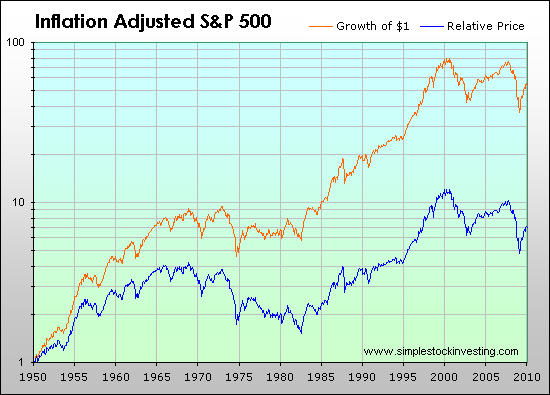
Yes, like shares invested in the S&P 500, whose real value in 2010 was 50x (5000%) that of its 1950 value. (graph) Certainly an improvement over gold, whose real price compared to its 1950 value has ranged in various years from 55% to 450%. (graph)
-
Re:Bittersweet
More citations for the inflation from the top hits on Google.
http://www.westegg.com/inflation/infl.cgi
http://www.usinflationcalculator.com/
http://www.dollartimes.com/calculators/inflation.htm/
http://www.coinnews.net/tools/cpi-inflation-calculator/
http://inflationdata.com/Inflation/Inflation_Calculators/Inflation_Rate_Calculator.aspSo, please cite your source.
-
The "experts" were wrong about $5 and they are
still wrong.
Some Saudi oil costs under $10 to produce a barrel of oil.
The lower the price, the less oil it is feasible to produce.
The higher the price, the more oil it becomes feasible to produce.It is quite likely for the price of oil to return to $20 to $25 a barrel.
http://inflationdata.com/inflation/inflation_rate/historical_oil_prices_chart.asp -
Re:well, duh
There is devaluation of our money in real terms as well. My college costs were $1500/year 30 years ago versus about $20K per year for CA schools. It's called inflation!
Well, one naive comment deserves another I guess. Tuition costs have risen more than four times faster than the rate of inflation since 1985:
http://inflationdata.com/inflation/inflation_articles/Education_Inflation.asp -
Re:Wrong again
Saying that "all currencies are debased" is ridiculous.
- ha ha ha.
20 year trends:
Orange Juice - here you have to switch from year to year to see that prices are growing, it shows one year at a time, so in 2012 the prices are about 180, in 2005 the prices are around 100, in 2001 they are about 85, it's an interactive chart.
coffee - 2012, prices are about 250, in 2010 it's about 160, in 2006 it's about 110, in 2004 it's about 80, in 2001 it's about 55
etc.
The governments of all countries are destroying their currencies in response to the USA printing theirs as fast as USA can, that's what all of the fake interest rates set up by the Fed are about, that's what the stimulus and 'QE' are and were all about, bail outs, etc.etc.
Everybody is destroying their currency, you are not paying any attention.
-
Re:Seems inferior to the current solution.
Gas was so cheap then it didn't matter. Good times.
http://inflationdata.com/inflation/images/charts/Oil/Gasoline_inflation_chart.htm
Inflation adjusted gas prices in the 1950s seems to be pretty average, and higher than they were in the 1990s.
-
Re:Welcome to our world
Did you realize that during his first term, gas prices were still low by historical standards?
-
Re:AMERICA FUCK YEA!!
Not quite. 200% represents a tripling ($100 becomes $300; the difference is $200, or 200%). The present value of $300 over 20 years at about 5.65% is $100. But, oh wait. Inflation has averaged only about 3% over the last 20 years.
Guess what? The future value of $100, in 20 years at a rate of 3%, is about $180.60. So $80.60 of the increase is due to inflation, and $119.40 of it was due to something else. I'd call that a pretty severe dysfunction.
-
Re:Subsidies inflate pricing.
Without student loans, only children of the wealthy will be able to go to college.
By that logic, the day that student loans end, all of the colleges will go bankrupt. No, obviously they will lower their prices until low enough that enough people can afford it that the college is solvent.
But the Federally subsidized student loan is a subsidy: the interest rate is artificially low, it can go unpaid for decades, the lender charges the government fees based on the amount of the loan, and the government guarantees at least part of the principal. Since the university and lender have incentive to increase the tuition cost, and the students have little incentive to find a lower price, the inflation occurs. It seemed to start in the 80s, but it would be difficult to determine the exact date it began based on this graph.
Also note that ending federally subsidized loans does not mean that there will be no student loans available. They may be more difficult to get, and they will have higher interest rates. But these will keep the tuition cost nailed roughly to the rest of the market.
-
What?
-
Re:Interest Rates
Banks have to charge a spread on interest at least equal to the rate of inflation, which is 6-8% right now. Otherwise, the principal deflates with time and the bank loses money.
In the U.S., "official" inflation has been considerably lower than that for the past decade and more, around 1-4%.
http://inflationdata.com/inflation/inflation_rate/currentinflation.aspThat being said, I'm one of those folks that believes changes in measurement methodology over time have led to a systematic under-estimation of inflation:
http://www.shadowstats.com/ -
Education Inflation Unsustainable
"Good," I say. Bringing education online will reduce the costs and increase the availability. Of course there will still be costs associated, Stanford shouldn't expect to offer these for free, but the current rate of cost increase is unsustainable. So, perhaps this will align interests better.
I realize that chart compares the rise to CPI-U, which is rigged for political convenience, but even still the cost rises are too much to continue unabated for decades to come. There will be downstream consequences for the economy to having millions of college graduates starting life under a heavy debt burden. When the 18-35 year old demographic no longer has much disposable income, many changes will have to occur. Instead of buying new washers and dryers for that new house, they'll be paying interest to bankers. Some people don't even know that the student load industry was recently nationalized to hasten this transition.
My daughter has 10 more years until College and I really doubt a traditional live-away 4-year program will be the prevailing model by then. People tell me that's too soon until I point out that we just celebrated the 20th anniversary of the first web browser. 10 years ago, lots of people thought AOL on dialup was pretty neat, then we throw in Moore's Law for the next ten years, along with those slopes, and I think it's more likely we'll see online education with live-away intervals for labs and such.
-
Re:Here's an idea
No. We are near the highest price, adjusted for inflation, that the US has ever seen for gasoline prices.
http://www.inflationdata.com/inflation/Inflation_Rate/Gasoline_Inflation.asp
-
Re:dollar coins can be traced to inflation
food prices are way way up if that's what you're wondering.
But as for my data, the cumulative inflation from 1975 to 2010 is about 310%. the following sites all come up with roughly the same number:
http://www.inflationdata.com/
http://www.usinflationcalculator.com/
http://www.bls.gov/data/inflation_calculator.htm(if you do it for 2011 it works out to about $4.20)
-
Re:IOW, the Chinese
That's just nonsense. "Devaluing the currency" = inflation. US inflation doesn't look at all bad by historical standards.
http://inflationdata.com/inflation/Inflation_Rate/HistoricalInflation.aspx
Flick to the 1976-1987 tab if you want to see what high inflation looks like.
-
Re:Why not just raise taxes on the rich?
The $10M in assets is a valuation based upon the profit margin at $1M/year.
Um, no it's not. It's based on the actual assets a company has - Property/Plant/Equipment, Accounts Receivable, Cash, etc.
This idea that reducing the profitability 50% will not effect that $10M valuation is interesting.. in a fantasy world where things dont effect each other.
I think you are confusing the value of a company (i.e. what you could sell it for) with it's assets. You'd pay more than $10M for a company that has $10M in assets and Net Income of $1M. Look at Skype - I'm sure they don't anywhere near $8B in assets.
This idea that changing taxes will not effect sales in interesting
I guess I could have been a little more clear in my original post. First of all, as I stated, I am talking about the short term. Second of all, I neglected to specify that I'm talking about relatively small changes in tax rates. Obviously increasing tax rates to 100% leads to zero output.
Any increase in cost, whether or not it comes from taxes or from an increase in labor or material costs will not affect how many units the firm can sell at a given price. If a widget costs $1 to make, and the firm prices it at $2, they will sell X units. If the widget costs $1.50 to make, and they still sell it at $2, they will still sell X units. The primary (as in first) effect of rising costs (whether it be from taxes or elsewhere) is a decrease in profit.
If the firm then decides that it can't sustain it's business at this new profit level (i.e. $0.50 vs. $1.00 per unit) then it can either close it's doors, raise prices, or find other costs to cut. It may turn out that they will decide to cut labor costs, but to do so while maintaining the X unit sales volume, they will have to increase productivity (which is output/labor). This is what a lot of firms have done over the past 3 years; the amount of labor used has gone down, but output is back up to pre-recession levels.
Now here is the really interesting part. The ability to increase productivity is there regardless of what the government's income tax policy is (leaving aside tax incentives for investing in technology - we're not talking about those taxes, just income tax). So if a company can increase productivity (and hence, save labor costs while maintaining the same level of output) they will do that whether or not the government raises or lowers taxes.
Now, it is possible that an increase in income tax could lead to a company raising it's sales price, and the probability of this happening is of course proportional to the size of the increase. But there are a couple of things to keep in mind. Any such increase will apply equally (we'd hope) to all firms, meaning that no firm will be disadvantaged versus their competitors. There may be some upward pressure on prices across the board, but there doesn't appear to be any correlation between corporate income tax rates and inflation. In fact, from 1952 to 1963 the top corporate tax rate (in the US) was 52%, the highest rate ever. Inflation in the 50s and 60s was among the lowest is was in the last 100 years. Subsequently, corporate taxes slowly declined to the current 35% rate, but inflation has gone up and down.
-
Re:Inflation adjusted value
Inflation has NOT been going crazy. We've just come out of the first year in the past 50 where we had deflation! And from 2000 to present our inflation numbers have not been high by any means (averaging about 3%).
Opinions are fine, but try to ground them in reality.
http://inflationdata.com/inflation/Inflation_Rate/HistoricalInflation.aspx?dsInflation_currentPage=0
d