Slashdot Mirror
Domain: inflationdata.com
Stories and comments across the archive that link to inflationdata.com.
Comments · 100
-
Re:Yeah, right.
-
Insane Regulation Amnesia
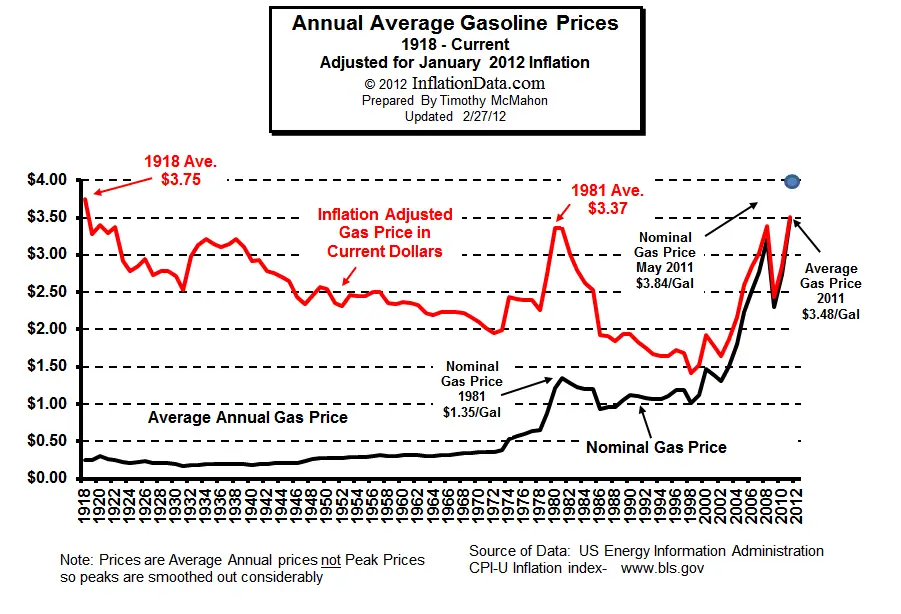
Ever seen an inflation adjusted graph of gas prices? Please do remember that the Department of Energy was created in 1977 and that's when Carter officially set us onto the path of "energy independence" from our insane importation of 1/3 of our oil to our current of almost 2/3.
http://www.inflationdata.com/inflation/images/charts/Oil/Gasoline_inflation_chart.htm
The price of crude is set outside the US. We could only even attempt to force the price down by lowering our consumption. We could do that by choice or through regulation which would lead to shortages and fuel lines. We actually tried that already in 1979-80 because we got pissy with Iran. The only outcome was inconveniencing our own citizenry while Russia happily bought oil from Iran and sold them fighter jets since we stopped selling them ours.
You ever waited 4 hours in line just to buy gas? Gas and electricity are dirt cheap in the US, and we forget how good we have it.
Enron took advantage of stupid regulations to screw over consumers. Had prices been allowed to fluctuate, citizens would have gotten pissed and cried for their heads much sooner.
-
Re:Deregulation? Let's ask Enron!
Just look at all the "innovation" that companies like Enron brought to a deregulated energy market! Let's ask California how well that worked out for the average consumer. While we're at it we can look at deregulatory laws like the Commodity Futures Modernization Act and the repeal of Glass-Steagal that enabled such "innovation". The "free market" for oil is now run by speculators who can buy and sell contracts for millions of barrels of oil but never have to take delivery, creating false demand and squeezing millions of dollars a day from average americans as they have to pay over $3.00/gal to fuel their vehicles. What else has deregulation done? How about all those nasty little unregulated derivatives such as MBS(mortgage backed securities) that imploded the world economy? That's financial "innovation" like the world had never seen before. All thanks to deregulation, yay!
The California electricity market wasn't completely deregulated. And the residual government power is what caused brownouts and bankrupt electricity providers to Enron's benefit.
Second, claiming that speculators are responsible for the slightly elevated price of oil (adjust for inflation) is just a demonstration of your ignorance of the oil markets. Where in the world do you think that oil goes? If I speculate and buy a million barrels of oil, then that oil has to go somewhere. Either I have to pay someone to store it physically or I sell it. Being a speculator, I sell it as expected. And the oil ends up in the hands of the consumers of oil, as expected. Supply and demand explains the oil prices far better than blaming things on the scapegoat of the month.
Finally, you apparently don't understand what went wrong with the financial crisis in 2007-2009. Here's the phrase that explains it all: "50 to 1 leverage". No security, no matter how regulated or safe, makes financial sense when you have. by hook or crook, that kind of leverage. Fortunately, government was around to bail all these greedy bankers and clueless investors. Of course, that means the market wasn't truly deregulated. -
Re:So, the system works?
Investors want a return on their money. Built into growth expectations are things like capital depreciation and inflation. A dollar loses about 2% of its buying power every year so $1,000 sitting in a mayonnaise jar under your bed is only worth $980 next year and $960 the next year. If you give that mayonnaise jar to a business (investing) with no profit planned they would hand you back $1,000 in five years that only had about $900 worth of buying power. To simply pay you back what you invested them the business needs to grow at least 2% per year. In order to give more money back to investors as a reward for them investing the business needs to grow somewhere north of 2% every year. Even an entirely private company needs to grow somewhere above the inflation rate just to be able to give their employees cost of living pay increases, ignoring entirely giving them actual raises to keep them from leaving the company. If someone's paycheck stays stagnant for five years they have about 10% less buying power than when they started working.
-
Re:Price vs gasoline.
If people have not changed their driving habits given where the prices are now I do not see any more increases changing those habits.
Gas is hovering around $3/gallon... that's pretty cheap - or at least not high by historical standards. But anyway, people DID change their habits. Back in 2007-08, gas was near $4/gallon and SUV sales went through the floor.
-
Re:Should be good for the economy
We're actually going through one of the lower inflation periods in history. We've been quite shy of the government's target sweet spot of %2 inflation since the crash. The risk of deflation, and the associated major problems, is very real. The deflation last year definitely didn't help.
Still, you're talking about a change of %1 or so. The unemployment rate is just dipping below one in ten families, and the underemployment and "given up" rate remains far higher than that. People had retirement accounts wiped out. Schools that bought on margin and lost all of their investments, have had to cut back massively on opportunities offered for personal and entrepreneurial growth. While we're on the subject, the availability of small business and startup funding has basically died. The lucky people who have jobs have seen career setbacks that will stay with them for the rest of their lives. Comparatively, a 1% increase in the cost of consumables is spitting in the ocean. This is especially true when that change is, by most expert opinions, desirable.
I'm not saying that there is or is not going to be a recovery. But the change you're talking about there seems somewhat irrelevant.
-
Re:Why prices don't decrease
I was going to tell you that there hasn't been much inflation in the last 10 years. While I'm correct historically speaking, you're right in real terms. According to this calculator, from Jan 2000 to Jan 2010, the inflation rate in the US has been 28%! http://inflationdata.com/Inflation/Inflation_Calculators/Inflation_Rate_Calculator.asp#calcresults
-
Re:Oh BS
No. Inflation has risen 29% since January 2000, that's nowhere close to 200%. ( My mistake in the first post, 1 dollar to 3 dollars is 200% increase, not 300). Nice for you that you're income has quadrupled, but don't assume that's been across the board for everybody.
-
Re:sleight of hand
Bush, Blair, Aznar and Aussie's little Johnny Howard Liberal party were the four that sold the trillion dollar war's onto the world. Voting out the current Aussie Gov unfortunately means your actually voting in the Liberals, whether you want to or not. This small group of politicians are a few of the thousand or so people worldwide that you can assign direct responsibility for this world economic mess. By voting them in, we'd really be rewarding them for screwing us over with the economic cost of war.
The story seems to be repeating worldwide: One group of politicians royally screw us over and cause the economic crisis, the next government becomes unpopular for having to deal with the resulting economic mess, then we all happily re-elect the same bastards that caused it all in the first place.
-
Re:Do we want a society of rich and poor?I'll post to summarize my points in a coherent manner.
- I grant that college education has value. I don't grant that universal college education is better than the current partial college education. For example, in the US we're seeing a drop out rate (compare the percent who get some college education to those who get a degree) of almost 50%. While I'm sure some of those are doing so for financial reasons, I doubt that is a majority.
- I think there are a number of pervasive myths about the value of a college education. This thread illustrates a few of them (such as the number of Nobel laureates indicates the quality of a college program for average people or that getting an education will be better for anyone, a sort of one-size-fits-all approach to life).
- The same parties advocating a college education have been overseeing the decline of the K-12 public education system in the US.
- Employers have been complaining about the quality of college graduates. Some of it's pragmatic (they want college graduates with more vocational knowledge) or self-serving (want to show the "need" for more relatively cheap H1-B imports), but there appears to be a real problem of declining quality in college graduates.
- I believe the current student loan programs have had a harmful effect on colleges and their integrity, for example, leading to an increase in student cheating combined with lack of college enforcement (as I see it, colleges get their money no matter what the quality of the student they produce). This is another indication to me that a free tuition approach wouldn't improve the system.
- We haven't demonstrated that free tuition is better than paid tuition from the point of view of the student. I find people value something more, if they have to pay for it.
- We haven't demonstrated that the US can pay for this system.
On this last point, I have this to note. According to the College Board, in 2006-2007 public school students paid $5800 for that year just in tuition while private students (after financial aid) pay $22,000. At a glance, total college cost is over $100k for a degree (that is, money spent by the student not everyone else), public or private (including room and board, "fees"). A free education would cover all these expenses.
Given that there are currently, almost 20 million college students who are US residents, that's an effective cost of near $2 trillion just to educate the current group of students to a degree. This appears to be somewhat less than 60% of total people of this age, so the actual number who could get a degree are about 50% higher, I'd guess. That means our free, universal education now costs somewhere around $3 trillion to educate this estimated group to a degree. Suppose it takes six years to do so (average stay apparently for public college students BTW), then that's $500 billion per year of spending that has to come out of the federal budget. While that may be better than one Iraq war (which this is roughly equivalent to in cost), it's a huge amount of money to burn.
We also have to consider that this isn't the only source of cost, since there probably would be other subsidies that would get paid to colleges (eg, the public universities are already subsidized by state and federal governments, traditionally) to cover the additional students under a universal college education policy. There's also the matter that education costs are increasing far faster than the rate of inflation or GDP. Since 1986, inflation doubled, GDP tripled, and education c -
Re:Um, what about inflation?
Inflation would need to be nearly 10% for Hollywood to not have higher inflation adjusted revenues this year than last year.
And we've had deflation since March. The highest inflation rate since 2008 has been 5.6%.
Current Inflation -
Re:Where do I begin
I'm not working my butt off for 1-2% raises.
FYI, 1-2% is a pay cut, not a raise.
Two reasons:1. National Inflation has been over 2% for 84% of the months between 1987* & 2007*.
2. Your local Consumer Price Index's fluctuations are not necessarily going to track with the national average. Since CPI is used to calculate inflation, your inflation is +/- the national avg.
What you need to do is look up the CoLA for your area and use that as a starting point for your annual raise. Anything else is a pay cut.
*Pick your own range and do the math, it won't get much less than 80% and the further back you go (until 1965), the higher it is.
-
Re:Don't need electronics to hack someones brain
$4 was a lot, but current prices are arguably 'normal':
http://inflationdata.com/inflation/images/charts/Oil/Gasoline_inflation_chart.htm
-
Re:Solar panel longevity
So maybe it'll pay for itself in 12 years, but how long before those panels need to be replaced? That's what we really need to know in order to decide if he's actually saving money.
Well if you want to be a financial stickler, you might want to factor in the standard rate of inflation if it's going to be 12 years. The funny thing is that inflation has been going down in the past three months according to this site. But you need to remember the pert formula and assume that most of the time you're looking at an average of what about 3% inflation per year? On your original investment of $3800, right? So that's like a 42% increase in the value of that 2008 money assuming inflation continues at an expected yearly rate and a bank will give you that return.
-
Re:Prop 13 limits increases
The average CA budget increase since 1978 is 7.7 percent: http://www.sen.ca.gov/budget/budgethistory.pdf
The average rate of inflation since 1978 is 4.22 percent:
http://inflationdata.com/inflation/Inflation_Rate/HistoricalInflation.aspx?dsInflation_currentPage=0I calculated the numbers from their tables. Please feel free to check and correct.
The budget increases do come in fits and starts some years barely any, others, giant increases. I leave it to the reader to figure out why.
Also this:
California's state spending has ballooned in the last decade at a rate much higher than the rate of inflation and rate of population growth in the state. According to Tom Campbell, California's finance director in 2004-2005, if the 1999-2000 budget of former California governor Gray Davis had been increased over the next decade by a factor representing the inflation rate and California's population growth in that time, California would now be experiencing a budget surplus, rather than a deficit even with the recent revenue decline due to the state's economic recession.[6] Instead, California has had a 50% spending increase over the past five years.[7]
http://sunshinereview.org/index.php/California_state_budget
Footnotes are specific to the above link.
So...
*CA budget levels have not remained at 1978 levels.
*CA budgets have exceeded the rate of inflation and population growth.
*CA Spends too much -
Inflation rate is zero or negative
No, the inflation rate is currently around 0% or slightly negative. See http://www.inflationdata.com/inflation/Inflation_Rate/CurrentInflation.asp.
-
Re:HUH??
According to this website.
CPI in 2008 is 211.08, in 1982 was 94.3.My parents currently make $42k. I currently make $78k. Assuming their jobs were adjusted for inflation they only made quite a bit less when I was born.
I'm socking away money left and right while kids that I went to college with go out and buy big TVs and new cars. My house is set at 45 degrees. I've shut off my hot water heater and shower at the gym (Which costs me less than what running the heater would cost, plus I work out there too). My car is 12 years old and has 220k on it (but still runs fine). Growing up my dad would get 1-2 years out of a $500 car and get another one. I buy almost everything second hand, including clothes.
I do have some 'nice' things like the internet and my MacBook Pro and a house a bit nicer than my parents. But it's frustrating to no end to drive past the subsidized housing on the way to work and see nicer cars than me. People crossing the street on iPhones and wearing brand new clothes. People that bitch they have no money but have plenty of money for 2 packs a day. Some people need to be taught the difference between Want and Need.
And my company has never had an engineering layoff in the entire 85+ year history of the company. I think I'm doing pretty good.
-
Re:One more nobel winner anti-reaganmics
How many more politicians and faux-news talking heads will continue to push the pseudo-scientific religion that is reaganomics?
Humans are capable of believing untrue things for a very long time, even after reality begins to seriously challenge those beliefs. The Left has long-cherished beliefs (Example: Unions are good for workers, My Counter-Example: The number of Unions up until the 60s that prohibited blacks from working at a union shop). The Right has its long-cherished beliefs.
There are a lot of possible explanations why people are like that, but the more important thing is to engage those people by asking questions about the basis of their belief and learning yourself. If someone says something, and you don't know if it's true or not, take some effort to find out if it is. Most of the time, you can Google the issue and find a lot of people have done the hard work for you. You just have to verify if their logic is sound and inferences are valid.
Krugman, via his blog and columns, does try his best to do this. In fact, he often posts links to early versions of his papers and mathematics on his NY Times blog and lets his readers pick it apart. He and Tyler Cowan (a libertarian leaning economist) have very civil debates via their blogs.
Most *-wing sites simply tune out contrary voices with more chanting and weak arguments that bolster that community's feelings on right and wrong. In short: people judge arguments by its truthiness, not its validity.
And for the record, we cannot judge if Reagnomics worked because Reagonomics is:
- reduce the growth of government spending,
- reduce marginal tax rates on income from labor and capital,
- reduce government regulation of the economy,
- control the money supply to reduce inflation.
To be honest, I don't believe he achieved those four goals during his presidency, so I'm not sure one can say Reagonomics worked or not:
- Government spending as a percentage of GDP
- Tax receipts as percentage of GDP
- Quantifying regulation: Notice the Clinton years come out looking pretty good too (i.e., congress is as much to blame/credit as the President)
- Inflation from 1913 to present
-
Re:Americans don't want them to answer honest
See the problem with answering questions honestly is that americans don't want to hear the truth. Carter proved that out when he asked the americans to tighten their belts and live within their means. They called his speech a "malaise" because Americans didn't want to hear it or accept it. So Reagan was voted in when he said "Carter is wrong, you can have anything you want!"
Oh BULL CRAP! Is that what they're tying to tell you in high school or college these days? There was not many people living outside of their means, unless you include buying groceries! Carter was dumped becase:
Inflation was in double digits. Ditto with loans and mortgage rates. Then there was the debacle of the 1979 Iran hostage crisis, the oil embargo where gas prices doubled and there were lines waiting for gas. He was seen as weak on foreign policy and the economy was in the tank.
There was a joke back then you took a pull tab from a beer (this was back in the day when the pop top came off!) You'd wrap the tab around a penny and that was called a "Jimmy Carter dollar in a Billy Carter money clip." (Billy Carter, the president brother, came out with his own brand of beer during his brother's presidency. He was bascially considered a joke and later admitted to being an alcoholic.)
-
Re:Wait ....
In any case, the value of oil is only going to go up.
What gives you that impression? Oil prices have been falling. If China stops subsidizing the stuff (in China, gasoline costs about $2.49 per gallon, cheaper than the US pre-tax price), oil consumption could actually fall.
Historically, while nominal prices of oil have increased over time, they haven't kept pace with inflation. See http://inflationdata.com/inflation/images/charts/Oil/Gasoline_inflation_chart.htm for an inflation adjusted graph of gasoline prices. Note that we are currently above the long term trend. It's quite possible that this is the highest that oil will ever be again. If we have viable alternatives before the next oil shock, then oil won't have its current monopoly on transport.
-
Re:Reality is boring anyway...
What virtual reality are you living in?
According to this chart it hasn't been over $3.50 in 2008 dollars since 1918.
-
Re:Free Competition in Currency Act of 2007
Continue my thought experiment, then, into the future so far that each atom of gold is worth, say, a galaxy class starship. But what if I want to exchange my pocket change for gold? I guess I just get a quark or two shaved off of a gold bar?
LOL... indeed, this is a problem I have considered, but that's a looooong way off.
There's another reason not to worry about it: even taking into account population growth and a vast increase in the amount of gold and silver mined over the past 700 years, the "value" of gold and silver in terms of what a particular amount buys has remained relatively stable over that period.
For example, see the following graph, paying particular attention to the nominal price/gallon of gasoline:
http://www.inflationdata.com/inflation/images/charts/Oil/Inflation_adjusted_gasoline_price.jpg
Until the 70's, gasoline was stable between $0.25 and $0.35/gallon. When Nixon withdrew from the Bretton Woods accord in 1971, closing the gold exchange window, oil suddenly became more expensive and never looked back.
Here's a graph of some measure of consumer prices. I have no idea how accurate this is, but I'm most interested in its demonstration of how stable prices were for a long time, until the final gold backing for the dollar was removed:
http://www.financialsense.com/editorials/hodges/2006/images/0106_1.gif
Anyway, there's a lifetime of reading out there about money. The best way to start IMO is to read Murray Rothbard's "What Has Government Done to our Money?", available for free.
-
Re:It's not the heat, it's the stupidity.
A marriage in Canada is recognised in the US, why would that change for marriages between states?
No matter what your definition of the word "minimalist", I think the US government obviously doesn't apply anymore. Every problem in the world these days they try to solve with another department.
You prove me right by showing what the investment in 1945 dollars is worth today. Putting that money into the high interest savings account would result in a loss of 600 million dollars to inflation, and most of that inflation comes after the 1970s with the end of the breton woods system. If you can't put your money into a high interest savings account without losing a large portion of that money to inflation which exists becuase of attempts to finance wars by the federal government, I'd call that a hidden tax.
You say I'm naive, but I say you're ignorant of history. Inflation effectively didn't exist for 200 years under the gold standard. in the '20s, in an attempt to break the depression, they deviated from the gold standard and inflation began to creep up after the war ended and the effect of that deviation could be seen, and in the '70s when Nixon completely broke the final ties to the gold standard to help finance the war, it began to increase at an incredible rate.
We have no moral obligation to Iraq, for one simple reason: There's no reason to believe we'll be able to solve anything. We've been over there 20 years, and through our meddling, they've gone from being the most progressive, liberal, advanced nation in the middle east to being one of the most violent, dangerous, backwards nations. It's time we just pull out and let the Iraqis handle themselves, becuase we've had our shot, and a lot of people are dead for it. Our moral obligation is to stop playing God, stop spending our children and grandchildren's money on undeclared wars of aggression, to stop policing the world, and to have our military defend OUR borders instead of fighting useless wars out on the other side of the world. We've got the largest military in the world, the most advanced military in the world, there's no reason why we should even be having the illegal immigration debate. We spend more on the federal army, navy, and air force than the next 20 countries combined, we should be able to defend our own borders.
I'd love to agree with you that the press isn't under attack, but the whitehouse just won't let me. A family member of a dissident was put in mortal danger by the whitehouse for purely political reasons. If you don't see anything wrong with that, maybe I should point the jihadists at YOUR wife next.
Besides, they're secret prisons, and it's been established that we DO torture. How the hell do YOU know that people aren't getting locked up? It's not like they have right to common-law writ of Habeus Corpus. We could be holding a bunch of press there right now, and call them terrorists so the people don't get all upset.
I mention entitlements, and elsewhere I mention birthright citizenship. In my post, they're completely disconnected. Could it be that like you've done here, you're imagining a connection where none exists? Illegal immigration is a sovereignty issue. Our armed forces should be able to keep invaders at bay, and if they're not, we shouldn't be in other countries.
-
Re:extinction of zinc?
And I don't think you understand the role of inflation...
http://www.inflationdata.com/inflation/Inflation_Rate/Historical_Oil_Prices_Chart.asp
The price of gasoline was $0.30 USD/gallon in 1961. The value of the metal content of three 1961 dimes will buy you a gallon of gas in May 2008 dollars.
I still think the current situation is ridiculous, but let's put things in perspective. Not only do you not seem to understand inflation, you seem to not understand that United States peak oil does not equal WORLD peak oil.
And I love that the definition of "peak oil" has changed definitions so many times...it used to just be "peak production" but now it's "cheap oil," with "cheap oil" being whatever definition seems to work to shoehorn current economic conditions into the Peak Oil prophesy.
-
Re:People don't learn from history
That's because of this pesky thing called inflation.
Not really...at least right not....inflation is hardly running rampant. Inflation has averaged between 1.59% (2002) - 3.39% (2005) for the years 2000-2007. Not great, but not really a lot--especially if you're old enough to remember the double-digit inflation we went into during Carter's budget years (such as an average of 13.58% for 1980).
And inflation doesn't factor into everything. Take computers. You can buy a decent laptop for $600-$800 and a desktop for even less that that. The price of making the computer has gone down even while the computer's processor, hard drive size, etc. have all gone up and improved.
No, the reason Washington calls increasing the budget a cut is when they want to get the entitlement population up in arms that they won't be able to get their "fair share" and the mean old republican party is trying to take X away from them. (Unfortunately as we have seen, the republicans, who have been complaining for years about trying to be fiscally conservative fighting those 'spendthrift dems' started spending like drunken sailors once they had the majority. So neither party has been responsible with the people's money. And even more unfortunate, I don't think the people had demanded enough of that from the politicians. We're fat and happy when OUR representative brings home the pork products.) -
Re:Geezer alert!Tell me again how we should be glad gas prices are low "after inflation?" Offtopicish, but care for a graph?
(They're actually nearing inflation-adjusted highs not seen since a brief stint in 1981, and before that, the 1910s. But there is always something a little funny when you inflation-adjust the price of something which is, itself, a component of most inflation indicies. (And they say that the CPI overstates inflation, too...)
-
Re:home brewersWhere are you getting this "eek" assumption from? Farm subsidies are very generous in the US. I don't think it's an "eek", it's no 7-figures, but it's certainly sustainable.
From personal experience. I've watched my Father quit farming and go to work at the USPS because he couldn't make a living. I've watched my sisters and I all enter different career fields because the lack of opportunity in agriculture. I've seen many of the local farms that I grew up with be sold off either because the operation wasn't profitable or because the children of the farmers didn't think it would be in the future.
Take a look at historic corn prices. When adjusted for inflation the price of corn has dropped SIGNIFICANTLY in the last 35 years. Just as we've seen lately, the price of corn directly impacts the price of other crops and livestock. If the price of corn stays down, the farmer doesn't make much money.
My great grandfather, in the years before and after the great depression, was a profitable enough farmer that he was able to purchase 3 separate farms and pay them all off. Most farming operations today are either living off government subsidies or going broke. I can't really comment on the subsidies, we never took any significant money from the government, but I know it's tough to make a living in agriculture without that government money. -
Keeping up with Inflation?
We had about 5 percent growth in both the domestic and worldwide box office, all-time highs on both fronts reminding us once again that good stories well told always find a place in our hearts, our lives and our local theaters.' What ever happened to the ravages of online piracy?"
Not sure about the ravages of online piracy, but inflation in the US was about 3% last year, and the projections for current US inflation put it at about 4.6%. I'm not sure if their growth estimate takes the increase in CPI into account. Mayhaps someone with a more global view on inflation rates could chime in and give us an adjusted Hollywood growth rate?
Reid -
Re:That's the bit that gets me, the console makersThat inflation chart would be fine, except the government decided to stop tracking M3 inflation for some reason... hmm.
http://www.inflationdata.com/inflation/Inflation_Articles/M3_Money_supply.aspBut that is all small potatoes, M3 includes all of M2 (which includes M1) plus large-denomination ($100,000 or more) time deposits, balances in institutional money funds, repurchase liabilities issued by depository institutions, and Eurodollars held by U.S. residents at foreign branches of U.S. banks and at all banks in the United Kingdom and Canada."
In other words, M3 tracks what the big boys are doing with the money. This includes US dollars held in banks in Canada and the UK (called Eurodollars) not to be confused with the Euro which is the standard currency of Europe.
So in other words, they don't track the largest chunk of inflationary data. The banks, and the rich. All these sub-prime housing loans are getting funded somehow. You don't think that the M3 rate could be through the roof (to get people to buy into housing) and they decided to hide it from the general public? Sure, M1 and M2 looks fine, but with M3 the American Dollar is slipping on the global market to pay for it. I don't know if that chart lists the M3 rates, but my guess is that it doesn't. -
Re:That's the bit that gets me, the console makers
1) We always have a war going on... this is not new.
2) torture? civil rights? This has always been going on. I argue that It's gotten BETTER because now with the internet, you actually hear about it.
3) Dollar's value is dropping, but not by all that much. The housing market will bounce back in about 2 years, and the small recession will be over. chart
Yes, some people believe the games corrupt children, so it's an important topic for them. Just because you don't agree doesn't mean it can't be discussed. Get over it. -
Re:Too bad that doesn't keep up with inflation.
Just to address a few specific claims.
Housing: Housing prices are not increasing? Did you see the losses all of the banks took this quarter? It's because of all of the people who defaulted on mortgages they could not afford to pay. Those people cannot afford to pay because they have no equity in their homes to refinance. They have no equity in their homes because property values have declined by as much as 15% in the last year in some parts of the country. Those houses they walked away from; they are now being repossessed and sold further depressing the housing market. This isn't inflationary at all. It's text book deflationary pressure, and based on the losses some these banks are taking I predict its going to result in a net decrease of at least $40-70 billion in the money supply of this country. This is only going to show in the form of these people decreasing their spending since they won't have that home equity line of credit to draw from.
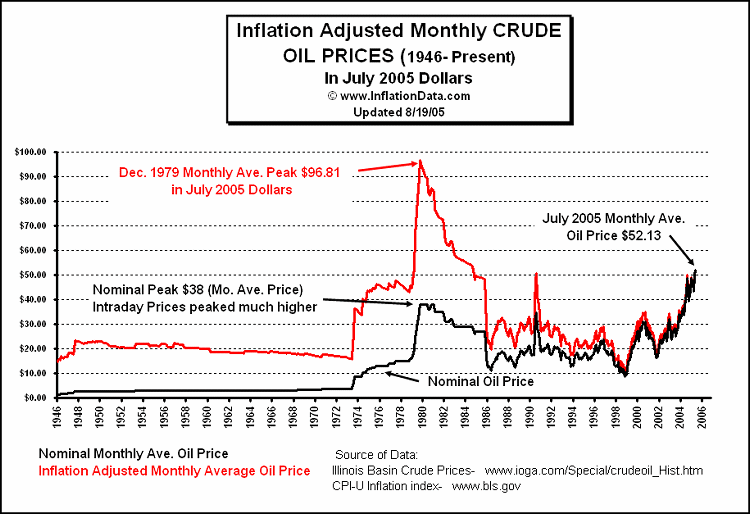
Fuel: Sure oil is hitting $90 a barrel, but that's still below the inflation-adjusted all-time high of $100 that we saw in late 1970s. Source. And most of this recent spike is due to overblown concerns over Iran and speculators (i.e., people who are just buying oil because they think it is going up in price, not people who actually use it) who are going to start dumping oil in the next few months. I bet you oil is closer to $70 in January than it is to $100. (And as an aside, as someone who wants to encourage renewable energy, I want $100 oil because at this point solar, biodiesel, ethanol, geothermal, and a whole bunch of other alternative energy sources become economically profitable. That'll never happen until oil is legitimately scare though because OPEC will act to keep longterm prices below this point to avoid letting the genie out of the bottle. Source.
Health Care and Education: There are legitimate concerns with respect to inflation in these two areas as their cost increases are far and a way outstripping regular inflation. -
Re:Freefall....
The CPI excludes stocks, bonds, and real estate
http://www.bls.gov/opub/hom/pdf/homch17.pdf
Here is a graph of the CPI:
http://www.inflationdata.com/Inflation/images/charts/Annual_Inflation/annual_inflation_chart.htm
US inflation has remained around 3% since the 1990s. Information on how the BLS computes the CPI is here:
http://www.bls.gov/bls/inflation.htm
While things like gas are up, other things (like the Department Store Inventory Price Index) is down over 10 years. Clothing is cheap, computers are cheap, etc. -
Re:Currency should factored
Say WHAT? You're telling me that in 3 years, this dollar I'm holding will only buy half as much? And that 3 years ago, it would buy twice as much?
Electronics sure don't follow that.
Food doesn't follow that. (Especially fast food.)
Gas does... But that's a special case.
In fact, let's give up on the specific examples. http://inflationdata.com/inflation/Consumer_Price_ Index/CurrentCPI.asp That shows us that inflation is nowhere NEAR the 15% you claim it is. (3 years, etc etc.)
So yes, measured per dollar per year, unless they account for inflation, clock speed increase is misleading, but not nearly so much as you'd have people believe. -
Re:flamewar comin'For example, when is the last time you were able to hear the opinions of a labor leader, explaining the benefits of joining a union?
A few times a year on my local conservative talk radio show. The host has brings on someone from the labor side when he has the topic of government waste and related matters.The labor person tries to make the case that it's a good thing that employees, who aren't part of the union, be forced to pay money to the union because of "all the benefits" those employees receive.
Benefits? You mean like getting a 2.5% pay increase maybe every year? What's the rate of inflation? According to this site, throughout almost all of 2006 it was well above 3%. In other words, those wonderful benefits were costing me money.
How about the benefit of not getting any pay increase or COLA for 2 years yet still having to pay union dues (sorry, fair share dues). Great benefits the union got me.
Yes, I took this job. Yes, I am responsible for my own earnings. I plan on moving up one pay level this year which will put me out of reach of unions but that is irrelevant to my comments. Every time you hear someone talk about the benefits of a union, ask them how much their pay increases are and compare it to the rate of inflation. Not such a good thing to be in a union, is it?
-
Re:Good ol' Supply and demand
Zero-risk interest rates in the U.S. are around 5% and inflation is about 4%. European rates are somewhat lower and inflation is about 2%. Canadian rates are more in line with European than American, although out unemployment rate is more in line with the U.S. (i.e., low) and our public finances are unique (that is, in surplus federally and near balanced provincially.)
So most of us aren't quite in the cheap-money days of the late '90's, although the U.S. is coming close. -
No money? Print your own!1. I predict this version of Monopoly will TANK big time.
2. come on people! Get with the program - when you run out of money - do what I do:
PRINT YOUR OWN.
It's not hard. coloured paper is cheap - for a few dollars you can print up MILLIONS of Monopoly dollars - and use a groovier design, no less.
I remember when I was a kid we would play Monopoly for DAYS - one game. Eventually the bank would run out of money, and we'd start printing more using paper and rubber stamps. We'd print up $1000 bills $5000 bills. since there isn't any real compounding interest taking money out of the game, the game tends to run out of money, creating inflation.
So, crank up your injet and print your own monopoly money.
Since they stopped publishing the M3 pretty soon your monopoly money might be as valuable as a real dollar - maybe even more...
RS
-
Re:Patent BashingYes, I used to be naive like you. It's time you grew up and learned the way things really work. You're comment assumes that we live in a capitalistic democracy, and risk and reward go hand in hand. Not true. We live in a corrupt oligarcy and reward is guaranteed for the corporate elite.
Sorry, but you sound like a nutcase. There is no kabal in the US thats somehow controling prices or marketplace, outside of the Fed interest rate things are more or less controlled by supply and demand.
Have you had to buy gas recently? Looked at your cable bill? If you read Slashdot, yout know about the current attempt to distroy the egalitarian structure of the internet by the big Telcos to fatten their wallets.
Yep, gas prices are rising, guess what, demand for gas is rising, China is growing at 10%, so is India, Brazil, Russia etc... In any case, gas prices in the US have not risen as much compared to the rest of the consumer index. http://inflationdata.com/Inflation/Inflation_Rate
/ Gasoline_Inflation.aspAs far as the internet is conserned, I don't really see a problem with it, where I live, a medium size US city, I have a choise of 5 service providers for broadband, thats prolly pretty high for most places in the US, but things will only get better.
Think about this, if i am an ISP i can charge you a certain rate for 100 gb/sec maintained 95% of the time, i can charge some other guy a higher rate for 50 gb/sec 99% of the time. Now i only have so much pipe, and to insure that both of you get what you paid for someone is going to get their packets out faster then someone else. There is absolutely nothing wrong with this as far as the market is concerned. Essentially you get what you paid for. I fullfill my obligation as an isp, you get a bandwith that fits your buisness needs.
-
Re:in comparison to....
See if I care: I *already* pay $5/gallon *now*...
Offtopic, but its sunday and not much action is going on here.
Yes, Americans do pay less for gas than probably anywhere else in the world, but like everything else, things are relative. Here are the differences between your gas price and ours:
1) We use more, we get volume discount.
2) We essentially own much of the oil in either owning companies like Exxon, and we do produce 40% of our own oil.
3) We drive more. Its a cultural thing. Public transportation is almost taboo here.
4) Another cultural thing, senior citizens "need" a 4x4 to drive to the grocery store, Wal-Mart, and church. No, I'm not making that up.
I'm sure there are other things as well, but that should be a good start.
Back to the relativity part, gas prices are going up here, but we don't get paid more at our job because of it. Here is a graph of historical gas prices: http://inflationdata.com/inflation/Inflation_Rate/ gas_vs_oil_price_comparison.htm
The real question, "How does this effect the price of tea in China?" -
Re:32% less enrollment, but salaries STILL decreas
Linked article states that CS jobs went up 2.3% for the period Jan 2004-Dec 2004. Keep in mind that the inflation rate for the same period was 2.75% (http://inflationdata.com/Inflation/Inflation_Rat
e /InflationCalculator.asp), resulting in a net decrease in effective wages.
Simple application of the notions of supply and demand suggest that the demand for CS jobs is slightly outpaced by the supply, as of 2004. No amount of spin from the various megacorps can deny this.
True "shortages" should result in humoungous real gains in compensation, similar to what we saw in the late 1990's. Now, it *may* be the case that the corps forsee future shortages based upon the traditional growth of the industry versus the current reduction in people entering the field; that much could be true. But as of right now, it appears as if supply is slightly outpacing demand. -
Re:Not really
Well you go on believing that FUD: We've already made it back to the 90's, I don't think the 90's rate is sustainable at all so I'm expecting a downturn over the next couple of years because we are doing so good it can't be sustained. As for your statement about unemployment figures the change only was for federal employee's benefits affecting only an extremely small fraction of the number. The random sampling method continues today, let me let snopes.com school you on your FUD: http://www.snopes.com/science/stats/unemploy.htm On the economy, let me just copy and paste what I did on another forum back in November (which is why some of the numbers are a little older than a couple of months but still less than a year, and we've gotten even better since then)
ftp://ftp.iza.org/charts/PDF56_e.pdf
For the past 3-4 years the US has had the highest GDP growth of: germany, france, italy, japan, canada, UK & EU in general
http://www.oecd.org/dataoecd/35/47/35326565.pdf
From OECD standardized unemployment rates, July of 05 we have a level of 5.0, less than Germany (9.3), less than France (9.7), less than Italy (7.8), less than Canada (6.8), only UK (4.7) and Japan (4.4) have a lower one.
http://inflationdata.com/inflation/inflation_rate/ CurrentInflation.asp
For about a year we've been hovering at around 3% or so (up and down) inflation, which is the same it was before 9/11. You'll note around 9/11 Greenspan dumped a whole lot of cash into the economy & China picked up it's output significantly decreasing inflation to some of the lowest rates it's ever been (~1 percent). Greenspan only lately has been saying that our economy has been doing so *good* that our growth rate is starting to encourage those inflationary items, so he's started gradually raising the interest rate to start removing dollars out of the economy to slow it's growth rate down. Classic example of a Phillips curve. I think greenspan should probably start getting more aggressive on it as our economy has been going so *good* that we need to stop it from turning into a beast like it did in the 2000 where we get another big bubble. Right now it ain't sky high, it's nowhere near sky high, under 1-2% means our employment level isn't doing well and pressuring it down, over 5% is high, over 10% is sky high (look to the 70's).
So we have a higher GDP growth rate (rate our economy is expanding/contracting) and we have one of the lowest unemployment rates. Our unemployment rate is at a level that is lower than almost every other country in the world. Our inflation rate is increasing but it's still very reasonable, but the government does need to start pulling money out of the economy because we are doing so good we are starting overheat it. The govenment needs to start becoming more miserly with our money: spend when the goings bad and save when the things go good to reduce the major peaks and valleys. Unlike you, from all the things I see as economic indicators that I think our economy's been doing *so* good that we should be expecting a dip here in the next few years as part of the general up/down cycle, and we should start pulling money out of the economy. -
Re:Damned if you do, damned if you don't
Actual US citizens are reproducing too slowly to replace the working US population.
My mistake, I knew that we're currently reproducing above the replacement rate, but wasn't aware that the baby boomers themselves didn't make the replacement rate, and we didn't catch up. Needed more research
Aside from that, the issue is that the floor of the bottom if the barrel is dropping out from under the lower class thanks to inflation. Minimum wage was last bumped (on the nation-wide level) in 1997. Since then, inflation has driven prices up roughly 20% (from http://inflationdata.com/Inflation/Inflation_Rate/ InflationCalculator.asp which seems to be selling investment tips, bias possibly overstating inflation to scare people... or understating it to make their investments look better?). When I went to school, I worked a part time job full time to pay for college during the 30 weeks a year when I was in college and still have some cash for clothing and computer parts for the summer. Looking at the same public college now, the cheapest dorm room ($1200/15 week semester, still competitve with apartments unless you cram three to an economy, yet twice what i paid before they were air-conditioned), full time tuition (about $3000/semester, resident, almost twice what I paid) and a modest meal plan (10 meals a week: $1000/semester... I've forgotten what I paid) for a total of $10400 a year, working about 50 solid 40 hour weeks breaks even, assuming you manage to deduct enough of it to avoid taxes and you don't have any emergencies or unpaid leave. At the current rate of inflation, how long will it be before "burger flipper" isn't a job capable of getting a kid an education? -
Re:Lies, damn lies, and math
Ah you do have a valid point, but that's when you start to go from 2D math to 3D math or beyond with the more variables. However I'll entertain the added notion of time value of money but if I put forth any more effort in the calculations to attain more accuracy I might as well publish my counter article
$5,012 is the the initial borrowed principal in the the time value of money "account"
$24.35 - $35 hybrid gas vs reg gas per a week = $10.65 payed back every week into the time value of money "account"
Assuming a 3% average yearly inflation rate we're going to see the "account's" left over value after 8 years and 417.419656 payments of $10.65 have been made using a Loan balance equation.
3% interest a year is
Balance = A(1+i)^n (P/i)[(1+i)^n 1]
Balance = 5012*1.000574961^417.419656 - (10.65/0.000574961)*(1.000574961^417.419656-1)
Balance = 5012*1.271161506 - 18522.995472736*0.271161506
Balance = 6371.061468072 - 5022.723348018
Balance = 1348.338120054
Using this new equation after 8 years you paid $1348.34 more over time for your hybrid car.
Balance = A(1+i)^n (P/i)[(1+i)^n 1]
Balance = 5012*1.000574961^521.77457 - (10.65/0.000574961)*(1.000574961^521.77457-1)
Balance = 5012*1.349742478 - 18522.995472736*0.349742478
Balance = 6764.909299736 - 6478.278336617
Balance = 286.630963119
Using this equation after 10 years you paid $286.63 more over time for your hybrid car.
P.S. Also as an interesting aside for my example calculations above. The car traveled 187,004 miles in 8 years and 233,755 in 10 years. Actually though I think the Civic has a little less than a 14 gal tank, but yeah there are a lot of variables.
References:
http://inflationdata.com/Inflation/Inflation_Rate/ CurrentInflation.asp
http://oakroadsystems.com/math/loan.htm -
Re:A Simon vs Ehrlich type wager
The bet went from 1980 to 1990. In 1980, the price of a barrel of oil was at around $37 in 1980 dollars, and in 1990, by amazing luck due to the Iraq / Kuwait / USA crisis, it briefly spiked from ~$20 to ~$35 in 1990 dollars. However, if you normalize those numbers to 2005 dollars, then oil went from around $85 to $50/barrel.
I was unable to find similar data for lumber, and water isn't something that's typically traded on the commodities market.
Had the basket of goods consisted entirely of oil, Ehrlich would still have written a check to Simon in the amount of around $412, compared to the actual check amount of $576. Had they entered into their agreement two months earlier, or a few months later, then the inflation-adjusted difference would have been about 30/85 -- meaning that Ehrlich would have written Simon a check for about $647.
Also, (IIRC) Ehrlich was the one who chose the basket of commodities, and Simon's only rule was that it couldn't be more than 30% oil. -
Re:sigh
I call bullshit. Inflation rate is at an average of 3% for quite a few years. That's hardly just over 0% and inflation needs to be taken into account with budgets in the millions and billions of dollars!
See this link for just one source of inflation numbers:
http://inflationdata.com/Inflation/Inflation_Rate/ AnnualInflation.asp
There are hundreds more. -
Re:Almost useless
Actually, core inflation is closer to 3% or so.
Of course, inflation varies by market -- home price inflation has been higher than the overall inflation rate, for example, as was inflation on some grocery goods last year (e.g. milk).
Also, although you're right about most banks' savings accounts, if you shop around, it is possible to beat that current inflation rate using a mere savings account (although, this was not the case about 2 years ago). EmigrantDirect, for example, currently has a 3.25% APY (though note that only a few weeks ago, they were offering only a 3.00% APY, while inflation was at 3.26%).
But overall, you're right... Month-to-month variations show that savings accounts and MMAs, even the highest-returning ones, are not a smart way to beat inflation, assuming it's possible at all without major micromanagement. Using one's savings as investments (bonds, stocks, index funds, etc.) is a much better idea... -
Should read: "from the LESS-in-the-pocket dept."
IT salaries to rise 0.5%? That's great...
Consumer price inflation (CPI) is around 3.26%.
Basic microeconomics (the Fisher Equation) says you take the wage increase rate and subtract the inflation rate, in order to get the real wage growth.
0.5% - 3.26% = -2.76%
So, assuming your wage increases with this 0.5% rise, you're still not increasing your pay enough to outpace inflation. This means your real purchasing power will be decreasing this year, by 2.76% if the figure above remains anywhere near accurate.
Salary rising by 0.5% this year? Quite a shitter, if you ask me. But, of course, it could be worse (we could be seeing negative growth).
(The data security guys still come out ahead though: 5.1% - 3.26% = 1.84% real pay increase. At $90k/year, that's another $1656 in purchasing power they can afford, in real terms.) -
Re:one omission
Inflation is at 2.65% right now.
http://inflationdata.com/inflation/inflation_rate/ CurrentInflation.asp -
Re:Some actual costs from NASA ...Blockquoth the poster:
OOOOOHHHHH... A whole 8 years of inflation... That could be 1/100th of 1% more in todays dollars...
OK, I'm a child of the late 1970s, so I hear you when you scoff at recent rates of inflation. But according to the inflation calculator, something that cost $1 in 1996 would cost about $1.21 right now. That's not really negligible. -
very low inflation rates
You must remember that despite the wonderfully low interest rates, inflation is next to nothing and not likely to increase much over the next 20 years. It's been 2-3% for the last decade. Inflation is what makes your house worth more money, and what makes the big payments you start with seem small in 10 years. If inflation is low, your mortgage will continue to be the same large portion of your income... and the value of your house does not increase as much... compare that to people who bought houses in the early 70s for 25-30K, and can now sell them for 150-200K, and who would just now be paying off their mortgage if they went for a 30 year.
Tax benefits are negligible now, for new mortgages anyway... interest rates are too low for new mortgages to get a real advantage on the taxes, since the tax writeoff is only on the interest, not the overall cost. -
Not quite as good as it sounds...
I'm all for space exploration, but this just strikes me as nothing more than a political game.
That $1 billion increase sounds good at first, but spread it out over 5 years, and you've got $200 million/year. On the other hand, increasing NASA's budget at a rate consistent even with November's unusually low inflation rate of 1.77% would give a yearly increase of $230 million. So, in the best case, they're treading water. (For comparison, NASA's 2004 budget received a roughly 3% increase over 2003.)
What about that other $12 billion in exploration money? It "will come from reallocation of $11 billion that is currently within the five-year total NASA budget of $86 billion". So, NASA just got 13% of their budget reallocated.
Aside from the apparent fiscal impotency of the plan, the thing is just dripping with political rhetoric. From the white house release: "From 1992 to 2000, NASA's budget decreased by a total of 5 percent. Since the year 2000, NASA's budget has increased by approximately 3 percent per year." What an interesting point to suddenly bring up! Why yes, it is an election year!