Slashdot Mirror
Domain: infoplease.com
Stories and comments across the archive that link to infoplease.com.
Comments · 653
-
Re:The Best-Selling Video Game of All Time...
-
Re:not really a good comparison
[...]Even you said it, that even the craziest "Christians", the WBC, is considered less nuts than radical islam and muslims.[...]
WBC are hardly the craziest "Christians".
Let's start our tour with an inquisitor, then move on to The Troubles, then back way up to the Crusades. This Crusade is a particularly fine example. Jumping ahead, we have Jim Jones et al, and of course, as others have pointed out, a whole list of violent crazies on Wikipedia. (Darn it, I tried to avoid Wikipedia links.)
WBC are just a relatively mild set of nutjobs in the long view. Christianity can offer hundreds of years of worse.
With that said, pick any other large group, and I'll be able to find similar levels of crazy within it. It's a human thing, not particular to any one religious or ethnic grouping. One of the fallacies humanity will hopefully eventually overcome is the crazy idea that one group of people is inherently "better" or "worse" than any other group of people. As far as I can tell, you can only really judge on an individual level, and that can be pretty messy and ambiguous in most cases.
Also:
I'm not saying Islam is going to disappear tomorrow due to terrorists, but recruitment is probably down since the 90s.
I haven't found a good comparison of Muslim growth in the ten years before and the ten years after 2000, but it seems like they have a pretty solid growth rate currently.
-
Re:Incredible
-
Re:Because the Article Breaks Down the Claim Fully
Life expectancy continues to go up only because infant mortality goes down. Among those who reach adulthood, life expectancy has barely moved in the past 50 years. Among those who reach elderly age (70+) life expectancy has been nearly constant for all of human history.
According to this site, for white males, it's gone up from 10 years life expectancy at age 70 in 1949-1951 to 13 years life expectancy in 2004. In absolute terms, that's not a big difference, but it's a 30% increase in life expectancy. The improvement in life expectancy at age 10 for the same demographic group has gone up from 59 more years to 66 years, an improvement of 7 years. Either figure indicates your assertion is incorrect since the overall life expectancy from birth has gone up from 66 to almost 76 years in that time. So we're seeing a 10 year increase in total life expectancy along with a three year increase in life expectancy for a 70 year old.
-
Causes of health disparities & personal choice
On your second citation, even by your own statistics, if 30% of health outcomes was from "genes" and "access to health care", 70% of health outcomes would come from something other than genes and access to sick care.
But, when you think about it, "genes" don't act alone in most cases (excepting a very few rare conditions). Genes interact with the environment and your history of behavior. That also includes nutrition.
For example, here is an African-American health care researcher suggesting vitamin D deficiency has had a big impact on the health of people in the USA with darker skins:
http://curtisduncan.blogspot.com/2009/10/why-michelle-obama-is-more-likely-to.html
Some other related research:
http://www.vitamindcouncil.org/health/autism/the-black-community.shtml
This is not to argue against social and economic reforms (we need lots IMHO), just to demonstrate how nutrition or outdoor exercise or choice of clothing and so on can have a big effect on your health from even just this one factor, as health emerges from an interaction of genes and environment in the context of our personal choices (and what we know about how their consequences) -- in this case, the CDC has been doing a terrible job for decades at informing people about the connection between vitamin D deficiency and ill-health, or even studying the issue.Lifestyle choices for anybody that include whether you smoke, how promiscuous you are, how much you exercise, what drugs you use, your connection to nature, how much you drink alcohol, how much you sleep, what sort of job you decide to take or train for, what sort of friends you cultivate, what community you choose to live in, your spiritual practices (including meditation), whether you laugh a lot, what sort of media you watch and how often, as well as what you eat (including whether it is organic), remain dominant factors in how long you live. Still, sure, how polluted your environment is makes a big difference too, but in almost all cases, not as big, and people often still make choices that relate to that as well (like where to live). And, how well your body handles a more toxic environment is also effected to a big degree by nutrition (how well your body can deal with heavy metals or how good it is as preventing cancer).
If the CDC really cared about your health, they would have raised the US RDA for vitamin D by a factor of ten a long time ago.
http://www.vitamindcouncil.org/treatment.shtmlI don't see how that CDC page backs up your point. Glancing at that page, how do they quantify "small"? The world "small" isn't even on that page. The major killers in our society are heart disease, stroke, diabetes, cancer, and some consequences of obesity, and almost all of those preventable (or for cancer, greatly delayable) by excellent nutrition (which links to behavior, since you control what you put in your mouth). Even Alzheimer's and other dementia is probably greatly reduced by good nutrition. Statistics:
"10 Leading Causes of Death in the U.S., 2004"
http://www.infoplease.com/ipa/A0005110.htmlDr. Fuhrman, for example, has built an eating plan that works to reduce lots of disease, based on thousands of scientific studies that say nutrition is a very significant aspect of health:
http://www.youtube.com/watch?v=wPiR9VcuVWwBlueZones, as another example, is one approach to building healthier communities that had an immediate significant (one year) reduction of heart disease and mental illness (including by creating parks and promoting healthy nutrition at local restaurants):
-
Re:Wiretapping....
Yes, most famously for the Linda Tripp recordings of her own conversations with Monica Lewinsky (which occurred in Maryland).
-
Re:Suckaz
Proof or GTFO.
It's quite simple. The question isn't where to begin, but rather where to end. Let's start at the present and work backwards shall we?
We've got over racist elements in the Tea Party. ("Obama-nomics: Monkey See Monkey Spend", "Zoo Has an African, and the White House has a Lyin' African!".
Obama as witchdoctor, isn't intrinsically racist, but is racially charged given the context. On the other hand, telling Obama to return to Kenya, isn't racist, it's a mistaken, but not a fringe belief with right wing activists.
Are these fringe elements of the Tea Party? I hope, and believe so. But it's hard to dismiss when the leaders of the "movement," exhibit racist signs themselves. As seen with Daje Robertson, self-refered founder of the Texas Tea Party, and operator of teaparty.org, holds a sign that reads "Congress = Slave Owner; Taxpayer = Niggar [sic]." Most people would have used,"slave," also they would have spelled the word correctly.
Also, we've got the pre-Tea Party the president is a pimp, and the first lady is his (presumably) number one ho, and Michelle Obama is a monkey, and who could forget, "Obama Bucks"?
Now how does the leadership of the GOP respond to statements like this? That's the real question. You might not be able to help it if idiots show up to your public rally, but nothing stops you from calling them out. Well silence.
Why? Well the Republic party has long used racism as a main tactic for stirring up votes.
Jesse Helms' infamous "Hands" ad for instance. So was the ad racist? It certainly was immediately perceived that way, but let's use the words of the Helms' campaign manager, and later CHAIRMAN of the Republican Party, Lee Atwater:“You start out in 1954 by saying, ‘Nigger, nigger, nigger.’ By 1968, you can't say ‘nigger,’ that hurts you. Backfires. So you say stuff like forced busing, states' rights and all that stuff. You're getting so abstract now [that] you're talking about cutting taxes, and all these things you're talking about are totally economic things and a byproduct of them is [that] Blacks get hurt worse than Whites ”
This is called "The Southern Strategy", and hinges almost exclusively on promoting racism, and racist policies. One legacy of this is the fetishization of the Confederacy and Civil War. It is not a coincidence that Confederate flags regained prominence at the start of the Civil Rights movement, long after the symbol had become associated with explicitly racist groups such as the Klan. (See South Carolina,1962; Georgia, 1956) ("It's pride, not prejudice," the apologists say. Yet, many of these people aren't from the Confederacy, regularly make racist statements, and invoke "freedom" and "patriotism" while lionizing, traitors who began an armed rebellion for the "freedom" to keep slaves. The mind reels at the irony.)
-
Re:uh....
what world are you living in?
1983
1993
October, 2000
for a more complete list of American citizens being killed by Muslims, try here. -
Re:At the risk of being labelled flamebait.
Yeah well in China people walk into elementary schools and smash kids dead with hammers.
Haven't heard of THAT happening in the US.
http://www.infoplease.com/ipa/A0777958.html
That should refresh your memory.
-
Re:This is not only good common sense
The protectionist law Smoot-Hawley Tariff Act [wikipedia.org], which became law in 1930, led to the Great Depression
Sorry, that's yet another right wing free trader myth with absolutely no basis in reality. The stock market collapse took place in October, 1929.
I phrased it wrong. The Smoot-Hawley Tariff Act made the depression last longer and get worse than it would have without the act being law. Read what the Department of State says. Before President Hoover signed it 1000 economists urged him to veto the act. Then as Info Please says, "U.S. foreign trade suffered a sharp decline, and the depression intensified."
So then people, perhaps you, will say FDR's policies brought the Great Depression to an end. HAHA! FDR came to office on 4 March 1933 yet the Great Depression bottomed in 1932. The "U.S. economy was growing again by 1933, and technically the United States was not in recession from 1933 to 1937." The Great Depression may of seemed to last longer, but that's partially because of the Recession of 1937-38.
Falcon
-
Re:No degree, bad citizen
Do you have any data to back up your claim that non-college educated folk are dim-witted drains on society? Or are you just being a douche?
Here's one - the percentage of people who vote:
Those with at least some college
- 74% of the voters in the 2004 election http://www.cnn.com/ELECTION/2004/pages/results/states/US/P/00/epolls.0.html
- 53% of the population http://www.infoplease.com/ipa/A0908670.htmlSo having at least some college exposure makes one significantly more likely to participate in the governance of our country.
-
Re:Yay...
Gee, you looked in Wkikpedia and didn't see that Egypt is part of the middle East? Egypt's in Africa.
Gee, you didn't notice that Egypt is both Middle East and Africa!
http://wordnetweb.princeton.edu/perl/webwn?s=middle%20east
http://middleeast.about.com/od/middleeast101/f/me080208.htm
http://www.infoplease.com/atlas/middleeast.html -
Re:Speaking of the oil spill...
Where to start...
Ok, when you say "we've been doing this for the better part of a cenury", define "doing this". Not all oil operations are equally risky, and I'd like to see a citation to back the claim that we've done deepwater drilling for the better part of a century.
Maybe more importantly, what do you mean "this has never happened before"? There have been many oil spills. Including from blown oil wells. Including in the Gulf of Mexico (1979). Here's a list of a few of them. If that's not enough, if you read the links from the submission you'll see that being neck deep in oil is pretty much the norm for Nigeria.
Oh, and when a company makes a decision to remove a safety mechanism and then suffers exactly the kind of failure that mechanism is meant to prevent, you can't file that under "things go wrong, period". BP took a risk (for reasons unclear - but if you'd like to bet against me, my belief is it had to do with someone's bonus) that they had no right to take; this is, in fact, the "evil corporation's" fault. (And no, the fact that the well might, maybe, eventually have blown out even with the safety fluid in place does not change the fact that it's BP's fault. BP could make that argument if they hadn't removed the drilling fluid.)
-
Re:Scope
The US prison system is fucked up anyway. Most prisoners are mentally ill in some manner, and there are very few programs in the prison systems to deal with that, and so when they get out, they're still dangerous.
In fact, recidivism rates (re-offense after being release) are about 60% within three years in the US (here and here).
The way I see it is that we should do away with the time based punishment for the most part, and have incarceration be based on mental health. Criminals should only get out if they're considered mentally healthy, especially if they're convicted of violent and/or sex crimes.
-
Re:Well, OK, there is nuclear.
We absolutely MUST replace coal fired electricity generation with low CO2 methods. Coal is the worst CO2 emitter.
I didn't say anything about replacing coal in the post you replied to. All I said was that nuclear power appeals to state planners not businesses.
I very much doubt that current renewable technologies are sufficient. The only stuff that is immediately deployable is wind and solar.
They are sufficient now. Those who build off the grid do so every day. And yea, solar and wind is employable today unlike nuclear power. According to Infoplease the Palo Verde 2, Ariz. is the largest reactor in the US, at 1,335 MWs. According to Wiki construction started in 1976 with it's first year of commercial operation in 1988, 12 years later. Now take wind turbines, erect and connect 10 5 megawatt turbines a month, and there are larger turbines, and in 1 year you've added 600 MWs or in 2 years 1,200 MWs. That's almost as much as Palo Verde 2 provides, in 1/6 the tyme. SciAm's A Solar Grand Plan says solar power "could supply 69 percent of the U.S.'s electricity and 35 percent of its total energy by 2050." The Wind Energy Resource Atlas of the Unites States, created by the National Renewable Energy Lab of the Department of Energy, details the wind potential of various regions of the US. The Rocky Mountains along contain enough potential energy to electrify the US, but that's not the only region with large wind potential. On the East Coast from Massachusetts to North Carolina offshore wind farms could "supply all the energy needs of much of the East Coast and then some". From British Columbia to Southern California on the Pacific Coast could provide a lot as well. Actually hook a hard left in S Ca through AZ and NM to western Texas and the wind potential grows.
For baseloads geothermal is good though not for all of the baseload. Until large scale storage is available currently used power plants could provide the baseload.
Enhanced geothermal is very promising but there is still no commercial size power station.
Ah but there is commercial scale geothermal right now. In CA geothermal provided 13,000 gigawatt-hours of electricity in 2007. It provides 20 percent of Hawaii's Big Island electricity. Geothermal provides 27% of Philippine's energy. Geothermal is even available and used in New York City.
If it comes to raising the planet's temperature by 5C or nuclear power, I'd have to say nuclear is the clear choice.
Fine, let businesses pay for it not taxpayers. No loan guaranties, limited liability, or other subsidies. However left to their own devices corporations will not build nuclear power plants.
When all is said and done, I think that the carbon pollution problem will only be solved by inexpensive clean electricity. Some hard choices will have to be made.
Unfortunately there is no inexpensive clean electricity. Well, except for the Negawatt, the energy not produced due to energy efficiency or simply cutting the energy used. Therein lies the hard choice, people don't want to give up what they have even if they will s
-
Re:Here's a radical idea
The problem with your data is that it counts 'gun deaths', not crime levels. Your data includes suicides and accidental shootings with the violent crime. That's a very convenient set of data to present if your agenda is to outlaw gun ownership, but it's a bit disingenuous.
So I'm going to counter with a few graphs of my own.
First, http://img339.imageshack.us/i/89312727.png/
This is the one you already made: gun laws on the x axis, gun deaths on the y. I guess most people can be convinced there's a negative correlation there. Let's move on.
I assert that suicides contribute a significant amount to that correlation. In support, I present http://img691.imageshack.us/i/96131586.png/ (source: http://www.afsp.org/index.cfm?fuseaction=home.viewpage&page_id=05114FBE-E445-7831-F0C1494E2FADB8EA) as support. The shape of the two graphs is pretty similar. This kind of makes sense, because guns are a pretty effective way to kill yourself, but I digress. Instead...
http://img249.imageshack.us/i/21700353.png/
That's gun laws versus murder rates (source: http://www.infoplease.com/us/statistics/crime-rate-state.html). Suddenly the correlation is much less obvious. On the low end of strictness, data is all over the place, and on the high end, as availability of guns goes down, murders actually go up.
The same trend repeats with violent crime ( http://img220.imageshack.us/i/72421515.png/), property crime ( http://img260.imageshack.us/i/21861589.png/), and robbery ( http://img176.imageshack.us/i/84688439.png/). Interestingly, though, not with rape ( http://img519.imageshack.us/i/45149589.png/); can't really explain that one.
So, yeah. I don't think anyone would argue that more guns leads to more gun-related deaths (which the data you provided does show, however weakly), but we were never arguing about gun deaths. We were arguing about crime, where the correlations are much less clear-cut.
-
Re:Maybe Americans just fly too much?
We have single states (equivalent to what Europeans refer to as countries) that are nearly half the size of the entire continent you live on. I could drive from one end of your content and back, and still have driven a shorter distance than to my brothers house.
Yes, you have big states. Congratulations. However, that doesn't mean it makes sense to take a job 1000 miles from your home and drive there every day, or move 3000 miles away and expect your family to visit every week.
You have bullet train rides between countries that are shorter than my wifes daily drive to work.
Perhaps that's another difference in ideology, but if someone I knew took a job and commuted hundreds of miles to another country on a daily basis, I'd call them insane.
You are a urban population. [...] We are not, we are a rural population. The majority of our people are scattered across the nation in little villages and towns.
I added up the numbers found in this Wikipedia article and found that 254,734,040 people in the United States live in what is defined as:
"one or more adjacent counties or county equivalents that have at least one urban core area of at least 50,000 population, plus adjacent territory that has a high degree of social and economic integration with the core as measured by commuting ties."
This is 84% of the estimated 301,621,157 people living in the U.S. in 2008. (source) The United States are very much an urban population - although these numbers include suburbs, too. Perhaps I should say suburban population.
You are a urban population. 90% of your people live in a handful of cities
I'm not going to do the math, but I'll reckon you're not that far off - given the 84% the U.S. scored. However, if 90% of the people work in large cities, it makes sense for 90% of the people to live in the actual city as well. The American model of surrounding cities with suburbs where everyone gets up in the morning to drive separate SUVs into the city makes little sense to me.
we have designed ourselves to be a nation that drives
You have designed yourselves to be a nation that doesn't care about the consequences of driving such distances, and in many cases flat out denies them.
Anything Europeans do thats 'good' for the environment still doesn't make up for the damage done over the past few thousand years
First of all, that's unfair. The United States have only existed for a couple hundred years, and most current Americans have European roots anyway, so anything before the 18th century is on all of us.
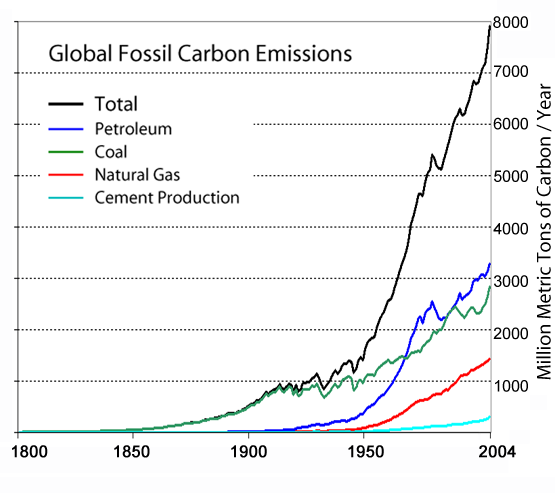
Second, as this chart clearly shows, burning of fossil fuels practically didn't start until well into the 19th century, and it didn't really take off until the 1950s. And I don't think we need to discuss the United States' part in this.
In short, you have no concept of living anywhere except your little neck of the woods. You are what Europeans typically like to refer to a 'ignorant American', except replace American with European and pull that big stick of smug out of your ass cause you're just showing everyone how clueless you are.
And I should just ignore how clueless you are? All of my statements are based on rationality. Yours are based on laziness and comfort.
And while I'll admit the U.S. are an amazing country with many great achievements, and I can't imagine the world without it, it does have significant shortcomings, and failing to see that would be a sign of ignorance us Europeans can only dream of. As the most powerful country in the world, it's your task to better that world.
-
Re:Business Schools
Essentially that is the draw back of the American way, nobody is directly represented. A few speak for the many and we all hope that they speak for what we feel.
Effectively the majority has relinquished their opinion in Congress by not voting. Take a look at levels of turnout for federal elections over the last several non-presidential elections and you will see that nobody is elected by a majority of the population (approx 30% turnout != majority). Presidents are another matter all together, now if we take the results of the most recent election since there was a clear winner, I'd say it's pretty obvious that the majority is represented fairly. In the previous two elections it was a little closer and I would say nobody was fairly represented.
If you don't like the way you are represented then you have every right as a citizen to run for office or elect somebody who will represent you the way you want. I'd like to imagine a future where we are all represented fairly where we have multiple political parties involved, money and donations play absolutely no roll in the process, and extremist attitudes (conservative or liberal) are not rewarded.
I think that there are very few areas of controversy in the US where there is a clear consensus of a majority and minority opinion. Typically speaking the groups that are out spoken claiming to be speaking for the majority really only speak for a few members of a select minority and these people are who get the most publicity. Sometimes it's not about what one person wants (you, senator, rep., pres.) it's about what will benefit the whole. -
Re:Great. We have a right-wing lunatic behind /.
actually i'd prefer pre-FDA, pre drug prohibition (which was sold using race baiting tactics: http://en.wikipedia.org/wiki/Harrison_Narcotics_Tax_Act, which are certainly not claimed ideals of the political left...)
1950's tax rates were only necessary to pay off the war debt, something we've no concern for these days... simply have the Fed put a few more trillion in the federal account from the bit bucket.
1950's unionization levels were higher than today in part because there was a legitimate need for the unions with respect to protecting workers' human rights. today the largest union sector is state and local employees, hardly an underprivileged class.
1950's life expectancies were fine. the major improvement in life expectancies came about with the introduction of antibiotics and sanitation. growth in life expectancy in the last decade or three has been anemic at best despite the ever-growing share of GDP expended on it.
http://www.infoplease.com/ipa/A0005140.htmlso yes, lets put the civil rights act into the constitution where it belongs, clean up a few other things to make our laws and constitution internally consistent, and return to the fiscal responsibility of the past. thank you very much.
-
Re:An easier plan
And just as there are some things that the government should NOT be allowed to keep secret, for example the Tuskegee Syphilis Experiment.
-
Re:Good and bad.
Guilt is never absolute.
As for you, bitZtream: you come into every Slashdot discussion carrying the most ignorant, vitriolic, hateful chip on your shoulder that man has ever conceived. In every conceivable circumstance, you come down in favor of money, power, influence, and the elite instead of social justice and basic fairness. You would rather live in the world of medieval crusades than in the one of Locke and Rousseau.
You're either an excellent troll or a miserable human being. I'll give you the benefit of the doubt and assume the former.
-
Re:Am I alone or
You might want to look at mortality rate, rather than just birthrate. There is a reason why poor people have lots of children !
eg consider following rates per 1000.
USA 14 births - 8 deaths. ( http://www.infoplease.com/ipa/A0004395.html )
Zimbabwe 27 births , 22 deaths ( http://en.wikipedia.org/wiki/Demographics_of_Zimbabwe#Death_rate )Africa - Population Density ( Pop. density 30.51/km2 )
N. America Population - ( Pop. density 22.9/km2 (59.3/sq mi) ) -
Re:I'm pretty sure
How am I a racist? By pointing out that how education is funded in the US is unfair to the poor? Or the fact that statistically speaking, white people are less likely to be poor? It's a fact. You don't solve problems by pretending they don't exist.
US Census, median incomes for 2006:
White: $50,000 / year
Black: $32,000 / year
Hispanic: $38,000 / year
The percentages are also interesting. -
Re:Why?
> "The most common snow crystals by far are the irregular crystals. These are small, usually clumped together, and show little of the symmetry seen in stellar or columnar crystals."
If two symmetrical crystals get clumped together and hence become irregular, that nonetheless doesn't invalidate the perfect symmetry extant before the clumping. Thus the mistery persists...
> "As the crystal becomes larger, however, branches begin to sprout from the six corners of the hexagon (this is the third stage in the diagram at right). Since the atmospheric conditions (e. g. temperature and humidity) are nearly constant across the small crystal, the six budding arms all grow out at roughly the same rate."
Of course, branches growing from all corners don't have to form the same way -- under any atmospheric condition. Were this to be a sufficient explanation, a number of equal flakes would be formed -- all under the same conditions.
I'm sorry but this explanation looks illogical to me.
From the cited page:
> What synchronizes the growth of the six arms?
Nothing. The six arms of a snow crystal all grow independently, as described in the previous section. But since they grow under the same randomly changing conditions, all six end up with similar shapes.And why don't they all turn left? Since they are under the same conditions, they would all turn left. Or right. See how pointless?
> If you think this is hard to swallow, let me assure you that the vast majority of snow crystals are not very symmetrical. Don't be fooled by the pictures -- irregular crystals (see the Guide to Snowflakes) are by far the most common type.
Even so, the photos do a superb job of showing striking symmetry. Should it exist in the first place? Does it have something to do with Saturn's hexagon? (ok, the last part admittedly just for show)
> If you don't believe me, just take a look for yourself next time it snows.
It may take a while where I live. Maybe centuries.
> Near-perfect, symmetrical snow crystals are fun to look at, but they are not common.
Looking at the the Guide to Snowflakes I have the exact opposite impression. One (maybe 2) is not symmetrical.
From http://physics.suite101.com/article.cfm/the_symmetry_of_snowflakes
> Molecular Structure
> The growth of snowflakes and other ice crystals is determined by the molecular structure of water itself. Water is made of one oxygen atom and two hydrogen atoms. The two hydrogen atoms attach chemically to the oxygen atom at angles making a V-shaped molecule. Three V's can connect together to make a molecule with six arms. Actually, the crystal growth is messier and more complex than this, but crystals have self-similarity. This means that the atomic geometry of any crystal is reflected in it's macroscopic structure.
Ok, now we have material for an hypothesis. The V-like water molecules can be influenced both by the instant weather varying conditions _and_ by other nearby molecules (they have an electrical property because of the V-shape.
See: http://www.infoplease.com/ce6/sci/A0861883.html
> Many of the physical and chemical properties of water are due to its structure. The atoms in the water molecule are arranged with the two H-O bonds at an angle of about 105 rather than on directly opposite sides of the oxygen atom. The asymmetrical shape of the molecule arises from a tendency of the four electron pairs in the valence shell of oxygen to arrange themselves symmetrically at the vertices of a tetrahedron around the oxygen nucleus. The two pairs associated with covalent bonds (see chemical bond) holding the hydrogen atoms are drawn together slightly, resulting in the angle of 105 between these bonds. This arrangement results in a polar molecule, since there is a net negative charge toward the oxygen end (the apex) of the V-sh
-
Re:The important part of the article
IMO there should be no health insurance companies. Get rid of them and have the government pay for your health care, and our costs (the highest in the world) will drop to where more civilized countries' costs are
IMO you are a free individual and are capable of moving to a "more civilezed country." So plesae, start packing your bags instead of trying to steal from me.
Your higher taxes will more than be made up by not having to pay insurance premiums.
Tell that to the healthy people who currently CHOOSE NOT TO HAVE INSURANCE.
We have the most expensive health care in the world, but by no metric do we have the best care.
And we have people traveling from Canada, Russia, and Europe to receive care here why again? My wife works in medical billing, there's a significant amount of people CHOOSING TO COME HERE for care.
I blame private insurance.
When the top diseases in the country ARE PREVENTABLE if life styles are changed, why do you blame insurance?
http://www.infoplease.com/ipa/A0005110.html
http://www.vandenberg.af.mil/news/story.asp?id=123103015I had hopes for Obama, but his version of health care "reform" seems to me nothing but a gift to the insurance companies.
Seems more like lost freedoms to me.
-
Re:Rules 1 through 7 of using a Cell Phone
If this is true, then why have traffic fatalities trended downward for the last several years while cell phones have shot up dramatically during the same time period?
-
Re:Ridiculous law
2) Your argument also assumes that terrorists will never gain the means or the opportunity to carry out attacks that harm very large numbers of citizens
Terrorists had the means and the opportunity in 2001:
Four smaller buildings and a hotel, all built nearby around a central landscaped plaza, completed the complex. The mall at the World Trade Center, which was located immediately below the plaza, was the largest shopping mall in lower Manhattan. The six basements housed two subway stations and a stop on the PATH trains to New Jersey.
Some 50,000 people worked in the buildings, while another 200,000 visited or passed through each day. The complex had its own zip code, 10048. World Trade Center History -
Re:Seriously?
Sure - we see more attacks.
Really? I honestly don't think I see more terrorist attacks today than prior to 9/11. Don't forget Oklahoma City, the first WTC bombing, the Unabomber, etc. etc. Terrorist attacks are a fact of life, and are most certainly not limited to attacks on aircraft.
Yeah, if you dig around a bit, you'll find that the frequency of attacks have increased. However, the deeper you dig, the more you find a rather lengthy history of terrorism. I agree that terrorism has existed for quite a long time. But there has been an increased frequency of attacks on US and/or US interests in the last 8 years. Of course, at the same time, those attacks still represent a insignificant risk compared to other risks most of us are exposed to daily.
What I *do* see is a lot of mis-characterized "terrorist" attacks around the globe. An IED blows up a humvee in Iraq? Terrorist! (No, it's a military strike.)
I'm not even considering these sorts of attacks. But it's very interesting that you make note of it. This points to the twisty rabbit hole that is the definitions of criminal acts, armies, nations, and other associated "rules" of war. I don't really want to follow the rabbit hole in this post. But I'll agree that it's there but not part of my scope.
-
Re:Death is not an inconvenience?
It may be costly - but put it this way - how much is your mothers life worth? Your wife? Child? yourself?
Obviously they are not worth very much if any of them step outdoors, or drive a car, or are present in a metro city, or do any of the hundreds of daily activities that have a much much MUCH higher chance of killing you.
In 2008, the number of American who died from a terrorist attack was about 260.
All of those except 4 were NOT in the USA. [1]4 deaths from terrorist attacks in an entire year on US soil.
Also in the whole year of 2008, there were 37,261 deaths from auto accidents. [2]
You are 9315 times more likely to die from an auto accident, be it one you caused, one someone caused into you, or you are walking down the street and two other motorists bring the accident to you on the sidewalk.
That is almost 4 orders of magnitude higher!
For every person killed by a terrorist in this country, nearly 10,000 people are killed by a car in the exact same amount of time.
If you willingly put yourself and mother and wife and child in the situation of 'being out doors' then clearly you value them and yourself 1000 times less than if a terrorist attack was your only concern.
My question to you is, why are you so willing to spend a million dollars to stop a terrorist attack, without spending the equally valid and necessary ten billion dollars to have all cars banned and removed from the roadways?
References:
1 - http://www.infoplease.com/ipa/A0001454.html
2 - http://www-fars.nhtsa.dot.gov/Main/index.aspx -
Re:Um, this is real easy to go to far with
They are a little thin, but the numbers listed here suggest that a ten-year old living today can expect to live about 15 years longer than a ten-year living in 1850:
http://www.infoplease.com/ipa/A0005140.html
The 60 years that the 1850 era ten-year old could expect to obtain isn't that bad, but the 75 years that today's ten year old can expect is still better.
I wish this question had offered a bigger bounty:
http://answers.google.com/answers/threadview?id=439616
It would make the lack of meaningful answers more interesting. Infant mortality may well be the most significant factor, but it certainly doesn't appear to be the only significant factor.
-
Re:Another easy solution!
Any citations? I agree with your argument, but I've only heard it from second hand accounts. Data would be helpful.
You can find some data for the US broken down by age, sex, and (partially) race here.
-
Re:Why is there even a debate?
Not only is the CO2 data available, it's easy enough to compute with only high school algebra. Burning one gallon of gasoline generates 19.4lb of CO2. In the US, we went from almost zero gasoline burned in 1920 to around 160,000,000,000 gallons in 2000 and the usage graph is conveniently linear. Thus we can compute the area inside the triangle to find that we have pumped 1.24 x 10^14 lb of CO2 into the air in the last eighty years. 62 billion tons from the US alone.
Unfortunately the global consumption of fossil fuels has grown to the point that the world is now emitting around 30 billion tons per year. There's absolutely no question that we humans are changing the atmospheric makeup of the earth.
-
Re:Is Kirk hinting to us?
>>The irony of your last comments is that the income tax started out as only a tax on the exteremly wealthy
Irony indeed:
-
Re:From the original Nature article...
'qualified them as "very large", only to note later that "One of the newly discovered RNAs, called GOLLD, is the third largest and most complex RNA discovered to date"'
I'm not seeing what's wrong with that.
The third tallest building in the world is 101 stories / 1614 feet tall. That's a very large building.
I guess you were assuming that "very large" meant "larger than any similar thing we'd seen before"; but to me "significantly larger than typical thigns of the same type" is very large.
-
Re:Panspermia
Something about this has me wondering, isn't devolution easier for life than evolution? Usually life builds off of itself, becoming more complex as it goes, but retaining most of what was already there. From previous studies it seems as though lots of bacteria are able to adapt to space much more readily than was expected. http://www.infoplease.com/spot/spacefungus1.html (infoplease.com) Watch out for aggressive ads on that site. Doesn't this suggest that bacterial life was previously adapted for space?
-
Re:icing on the cake:
You should really dig up that citation, because none of what you said is true.
Most of that map that was red were large rural areas without many voters.
here's a breakdown of federal aid by state - the top 8 are all red states, the bottom 15 are blue (16 counting DC).
here is the median income by state. The 17 lowest are red states, the 9 highest are blue states (with the exception of alaska at #6)
here are crime rates. It's generally a mixed bag, the 5 lowest are: Maine, Vermont, New Hampshire, N. Dakota, and S. Dakota, the 5 highest are: South Carolina, Tennessee, Nevada, Louisiana, and Florida. (DC is the highest).
Detroit, and Michigan in general are certainly in a bad way, but Georgia and the Carolinas aren't far behind. Crime has dropped dramatically in major cities over the past 15 years, especially in New York. Today we're worried about meth in the boonies.
-
Re:parse error at "generous amounts of aid"
The same could be said of dropping someone naked in the Artic tundra. They're self-sufficient till they freeze to death (and hence no longer survive).
LOLWUT? Self-contradict much? The very definition he posted, and that you'll find in most dictionaries, includes that nagging little conditional "survival," or in other words, NOT death. Argument fail.
I don't think it's a good idea to take this plan only from the point of view of the island. The thing that bothers me here is that there's absolutely no mention of cost in most of these stories. The best I've found is an estimate of 11,000 euro [milkproduction.com] per person which allegedly includes some amount of local investment.
Of course there is cost. No one said this stuff could get done for free or dirt-cheap. That's what pilot programs are all about, seeing if the initial investment is worth it. I really hate having to repeat arguments already made, but allow me to explain yet again: as net-positive energy infrastructure becomes common to meet increasing demand, the setup costs go down as the techniques are refined and companies find less costly materials and manufacturing techniques to achieve the same results. Just look at what's happening in the newly emerging consumer space-flight market. Also, you fail to acknowledge the fact that if they are now able to produce more energy than they consume, they can sell back the excess they don't use to the grid.
The link mentions a farmer, Jørgen Tranberg who happens to own 2.5 million euros in two windmills (one on his property, one offshore), has another 4 windmills (probably another 5 million euros value and generating rent) sitting on his 150 acre farm, and who speaks glowingly of the whole plan. My view is that if I picked up a few million euros on this sort of thing, I might speak well of it too, purely for selfish reasons.
Yeah, because the only thing that motivates people is pure selfish greed, and couldn't possibly be that, although he is benefiting, it's good for everyone... Nice to know you think so highly of people. Benefit to him: makes money from selling back excess power. Benefit to government: proof that self-sustainability can be achieved, at least on a small scale, reason to invest similarly in other regions. Benefit to Samsø/region: less power draw from grid to power that island. Benefit to nation: long-term reduction of coal burned for power. Also, quick question of little importance: where'd that link to milkproduction.com come from? I see no such link in the
That massive investment in windmills (much of the power being exported to the mainland) indicates to me that we probably have a large wind power subsidy distorting this economic picture further.
Alan Shore says, "Objection, your honor: Speculation." Proof plz? And just for the record, you do know that a subsidy is, right? Denmark is not exactly known for corruption problems, so I doubt they'd claim something like self-sustainability (including monetary) which could be disproved by checking the local government financial records.
All I can say, given that there's at least two large subsidies going on here (and I suspect they are massive enough to turn dairy farmers into multimillionaires)
I didn't know you had one of these.
..., is that we can, when we throw enough money at the problem, turn a small region into a carbon negative region. I suppose you could run numbers, but the experiment has at least two big subsidies throwing it.
Incredible You should call the Catholic Church. Nice to see how, somehow, what sta
-
Re:Captain TwatObvious
This simply means that you willfully misunderstand statistics. A vaccine that saves millions of lives at the risk of a few hundred is a justifiable risk. The same logic applies to warfare: we sacrifice the lives of the few to save the many. It is painful and regrettable, but it must be done.
That is a FAR cry from saying that vaccines "cause disease" or that this is a manufactured pandemic to make money.
At least 62% of the U.S. population is under the age of 45. How does conferred immunity from the 1957 asian flu help them? What about the world?
You may have only gotten the flu once. The plural of anecdote is not data. Epidemiology is data, and it argues against you.
If your car never fails in the 10 years that you drive it, does it mean that mechanics are perpetrating fraud? Think about it. -
Re:What about the "CSI Effect"?
Considering the average American's lack of basic understanding of science and mathematics compared to nearly every other developed country
I hate to go [citation needed] on you but I'd really like to see your data.
So far my googling managed to find:
http://nces.ed.gov/timss/table07_1.asp
http://www.infoplease.com/ipa/A0930085.html
http://imo.math.ca/results/CRBY.html -
Re:historical revisionism
And yet, the actual facts say something different.
Rebuilding Germany and Japan was probably very much a realpolitik decision - the seeds of WWII were present in the terms imposed on Germany after WWI. Spending to rebuild those countries and avoid economic collapse was probably a very farsighted thing to do.
In terms of direct foreign aid on a per-capita basis, the USA ranks quite low: http://www.infoplease.com/ipa/A0930884.html
-
Re:Understanding
They don't have that many guns, and they all have stringent gun control.
Compared to what? Compared to the rest of Europe they have lots of guns. Compared to the US they don't have as many.
Switzerland isn't an anomaly really, more of an example of working gun control.
What evidence do you offer besides your own personal bias to suggest that gun control is the main reason that Switzerland or the other countries have a lower rate of crime?
Spoiler: all of those things exist in Europe too.
Did I say they didn't? You don't get to dismiss my point that quickly unless you've got some evidence to suggest that those factors occur in Europe at nearly the same rate as they occur in the US. You asked what else could be driving the difference in crime rates and I offered several suggestions. Are you going to give them serious consideration or are you going to dismiss them out of hand so you can continue to advance your argument that guns are the driving factor?
Are you required to get a license and register them with the feds, like in all of the European countries you listed?
As a matter of fact in some American states (New York, Massachusetts, New Jersey and Illinois among others) you have to do exactly that. There's still no evidence that it makes any meaningful difference on way or another on the crime rate though.
Here's a list of US States with crime statistics. The highest murder rate occurs in the "state" with the strictest gun control laws. Washington DC has 29.1 murders per 100,000 people. In DC it was illegal to own a handgun or even to keep a long run assembled in working condition until just a few months ago. Yet it has the highest murder rate in the US.
Want to look at whole US states rather than one poor urban area? Coming in at #1 for most murders per capita is Louisiana. Louisiana is generally regarded as having permissive gun laws so I guess that's a "win" for your side. Coming in at #2 is Maryland. Maryland has fairly tough gun laws. All purchasers need to pass a safety program, all handguns and so-called assault weapons must be registered and concealed carry permits are rarely issued. I guess that's a "win" for my side.
The most permissive US States are generally regarded as being Alaska and Vermont. In either state you can purchase a gun without any waiting period, training or registration. The only requirement is that you pass a criminal and mental health background check. In both states you can carry a loaded gun openly or concealed without need of a permit. So where do they rank? Alaska is #22 for murders per capita and Vermont is #42. FYI, Vermont actually has a per capita murder rate comparable (1.9 per 100k) to the UK (2.0) and Canada (1.8).
The US States with the strictest gun laws would probably be New York, New Jersey, California, Illinois and Massachusetts. Where do they rank? CA comes in at #11, IL at #17, NJ at #26, NY at #27 and MA at #36.
If there's a linkage between gun control and crime I can't find it. As with Europe the data is all over the map. There are permissive regions with low crime rates (Vermont, New Hampshire, North and South Dakota) and restrictive regions with high crime rates (California, Illinois, Maryland). There are also restrictive regions with low crime rates (Hawaii, Massachusetts) and permissive regions with high crime rates (Louisiana, Nevada, South Carolina).
The only thing this data suggests is that you can't prove causation between gun availability/gun control and the crime rate. It should be obvious that the other factors that drive crime have much more influence than guns do. Is still a fact that you are interested in disputing and if so what evidence do you offer to support your argument?
-
Re:A Waste?
Iran is -barely- the size of a single state in terms of people.
Huh? The poster above used CIA figures to show Iran has over 65 million people. What state do you live in that has more than 65 million people? California has just over 35 million and it's the largest.
For reference. Using that chart, Iran has a population larger than the last 21 states combined.
Not a single woman was executed,
Again, huh? Since the reinstatement of the death penalty in 1976, 11 women have been executed in this country. In fact, the last woman to be executed was in 2005 in Texas. If you're counting only federal executions, two women have been executed: Ethel Rosenberg and Bonnie Brown Heady.
For reference (state data).
Other than your calculations for the percentage of executions, the rest of your comments are bupkis. -
Polish Race(ist)s
Races in Poland: Polish 96.7%, German 0.4%, Belorussian 0.1% Ukrainian 0.1%, other 2.7% (2002)
According to: this
They list races with 0.1%, but no black people. Seems more realistic to take the black man out. The Asian is pretty out of place too, and should be replaced with a sausage. -
Re:Wowza
I hate it when simpson's paradox is ignored...
Just for instance, check the relative demographics of the US and UK and then examine the life expectency broken down by race and sex in the US (about page 141 in the file). Combining the 2 and looking only at males, we get a life expectency of 74.8 in the US. Compare the english and scotch combined in the UK (the population percentages add up to more than a 100, but this is just an illustrative example rather than definitively good statistics), of roughly 92%. Using the same life expectancy by racial group, the UK would have a male life expectancy of 75.6. I would love to find a source to compare the life expectancy in the UK broken down by ethnicity and sex for a more direct comparison. It's possible for the life expectancy of each racial group to be better in the US but nonetheless worse overall.
On a related note, if someone wants to look at infant mortality, I reccomend perinatal mortality instead. It partially avoids the issues about defining a live birth, which not all countries do the same way. As an example, the US has a better perinatal mortality rate than the UK, although our infant mortality is worse. -
Re:how dare you
http://www.infoplease.com/ce6/world/A0837004.html
Ossetia
Ossetia (os'shu, Rus. usye'tu) [key]or Alania (älän'yä) [key], region of the central Caucasus, divided between the Republic of Georgia and the Russian Federation. On the northern slope is North Ossetia-Alania. (1990 est. pop. 641,000), 3,100 sq mi (8,029 sq km), a constituent republic of Russia; Vladikavkaz (formerly Ordzhonikidze) is the capital. This region extends north beyond the Terek River. On the southern slope is South Ossetia. (1990 est. pop. 100,000), 1,500 sq mi (3,885 sq km), an autonomous region in Georgia; Tskhinvali is its capital. The region extends southward almost to the Kura River.
Both sections of Ossetia have valleys that produce fruit, wine, grain, and cotton. Lumbering and livestock raising are important in the mountains. North Ossetia-Alania has lead, silver, zinc, and boron deposits and nonferrous metallurgical, oil-extracting, and food-processing industries. Ossetian artwork includes wood, stone, and silver carving.
The Ossetians, an Iranian-speaking people, are mainly Sunni Muslims in the north and Eastern Orthodox Christians in the south, where Georgian culture prevails. They are descended from the medieval Alans (see Sarmatia). During the 17th cent. the Northern Ossetians were subject to Karbada princelings. From the 18th cent. they came under strong Russian influence, and between 1801 and 1806 all of Ossetian territory was annexed to Russia.
In Mar., 1918, the entire area was declared an autonomous soviet republic, and in Jan., 1920, was renamed the Mountain Autonomous Republic. In 1922, South Ossetia was made part of Georgia; in 1924 North Ossetia-Alania (then called North Ossetia) became an autonomous region in the RSFSR. In 1936, North Ossetia was made an autonomous republic. North Ossetia-Alania was a signatory to the Mar. 31, 1992, treaty that created the Russian Federation (see Russia).
The republic has not been immune to the turmoil in neighboring regions. In 1992, after several days of fighting, tens of thousands of Ingush inhabitants of North Ossetia-Alania's Prigorodny region, once part of the Checheno-Ingush ASSR and to be reincorporated into it under a 1991 Soviet law, fled or were expelled to the newly established republic of Ingushetia. The city of Beslan was the scene in 2004 of a Chechen-Ingush terrorist seizure of a middle school; the siege ended violently, with the death of more than 300 hostages. North Ossetians have been strong supporters of the nationalists in South Ossetia, and the leaders of both regions have called for their unification as a republic in the Russian Federation.
South Ossetia lost its autonomous region status by an act of the Georgian Supreme Soviet in 1990. Following Georgia's independence from the Soviet Union, Ossetian nationalists in the South demanded either independence from Georgia or incorporation into North Ossetia-Alania. In Apr., 1992, the South Ossetian Autonomous Region was reestablished in Georgia. Fighting in the region between Georgian and Ossetian forces was ended by a truce in July, which left South Ossetia under the control of the Ossetians. Further accords were signed in 1996, but the political situation remains unresolved, with South Ossetia dependent on Russia for support. Tensions increased in 2004 as Georgian President Mikhail Saakashvili sought to reassert Georgian supremacy over the nation's independence-minded autonomous republics and regions, and two years later South Ossetians voted overwhelmingly for independence in a referendum that was not generally recognized internationally.
-
Re:World improves
Yeah, about that correlation vs causation thing. The older your body gets the more likely you are to get cancer. Until we discover the secret to immortality, cancer is going to increase. Look at this chart. Less people died from cancer in 2005 than from Tuberculosis in 1900, but in 2005 only only 2 people per million died from Tuberculosis in the US. People are living much longer than and aren't dying from the same causes as our ancestors. Nobody is living forever, so they're gonna die somehow.
-
Re:The stupid and the lazy
Not that I believe this particular conspiracy theory, but if this was an elected judge rather than an appointed one, it may be possible.
A note on impeachment in the federal system:
Since 1797 the House of Representatives has impeached sixteen federal officials. These include two presidents, a cabinet member, a senator, a justice of the Supreme Court, and eleven federal judges. Of those, the Senate has convicted and removed seven, all of them judges. Not included in this list are the office holders who have resigned rather than face impeachment, most notably, President Richard M. Nixon. Of thirty-five attempts at impeachment, only nine have come to trial. Because it cripples Congress with a lengthy trial, impeachment is infrequent. Many officials, seeing the writing on the wall, resign rather than face the ignominy of a public trial. A Short History of Impeachment
Impeachments of Federal Judges
The first - and I think the only - federal judge to be convicted of bribery was District Judge Robert F. Collins in 1991. Federal judge is first ever convicted of taking bribe
-
Re:Down to 95% of the world's arsenals!
Depends on which cities you hit I suspect:
Washington DC (mostly because that'd take out the politicians)
New York
Los Angeles
Chicago
Houston
Philadelphia
Phoenix
San Antonio
San Diego
Dallas
San Jose
DetroitThese are the 11 largest cities in the US plus DC. If that killed everyone in those cities (unlikely) it'd cost 26.4 million lives in the US.
The economic outcome would be horrible, but taking out New York takes out all the Wall Street brokers and most of the bankers, so it'll probably come out as a wash
-
Re:Nothing is wrong with our copyright law...
Presidents rarely veto things.
While the proportion of vetoes to presented bills is low, I think part of your notion of Presidents rarely vetoing bills may in part be because Bush almost didn't veto at all for his first six years, just once. Then that upticked to eight during the last two years of his presidency:
http://www.infoplease.com/ipa/A0801767.html
If you'll note in that chart, previous presidents generally far more prolific in their vetoes.
-
Re:Yay
How is my point of reference way off? Minimum wage figures are fact, which I gave you.
http://www.infoplease.com/ipa/A0774473.htmlThe numbers I provided are accurate. You're simply taking another approach, which is a completely different method than mine.
So, Corvettes have risen in price compared to other general goods. So what?
Other general goods were once quality made in the US or Canada. Now they're mostly crap made in China with near-slave labour, so it's not surprising that the inflation-adjusted price has dropped.
Then there's also the fact that the Corvette has moved somewhat upmarket since its introduction.
It used to be the poor man's sports car. Now it's sport luxury.I'm sure if you did the same calculations with any car manufacturer and model that had been available for 54 consecutive years, you'll find the new ones are more expensive than their older counterparts.
But that's not relevant to my argument.