Slashdot Mirror
Domain: ipcc.ch
Stories and comments across the archive that link to ipcc.ch.
Comments · 821
-
Re:Scientific Method
Oh really? http://www.ipcc.ch/pdf/IAC_report/IAC%20Report.pdf
"Independent Judgment. When requested to provide advice on a particular issue, the IAC assembles an
international panel of experts. Serving on a voluntary basis, panel members meet and review current,
cutting-edge knowledge on the topic; and prepare a draft report on its findings, conclusions, and
recommendations. All IAC draft reports undergo an intensive process of peer-review by other
international experts. Only when the IAC Board is satisfied that feedback from the peer review has been
thoughtfully considered and incorporated is a final report released to the requesting organization and the
public. Every effort is made to ensure that IAC reports are free from any national or regional bias",But then again, THAT report was only signed by 2500 scientists...
Right, nothing ever gets past the IPCC...
http://www.timesonline.co.uk/tol/news/environment/article6991177.ece
-
Re:Scientific Method
Oh really? http://www.ipcc.ch/pdf/IAC_report/IAC%20Report.pdf "Independent Judgment. When requested to provide advice on a particular issue, the IAC assembles an international panel of experts. Serving on a voluntary basis, panel members meet and review current, cutting-edge knowledge on the topic; and prepare a draft report on its findings, conclusions, and recommendations. All IAC draft reports undergo an intensive process of peer-review by other international experts. Only when the IAC Board is satisfied that feedback from the peer review has been thoughtfully considered and incorporated is a final report released to the requesting organization and the public. Every effort is made to ensure that IAC reports are free from any national or regional bias", But then again, THAT report was only signed by 2500 scientists...
-
Re:Why is this here?
"So, where's that extraordinary proof?
Ok, I'll feed the troll, here's the evidence. BTW, it's "extrodinary claims require extrodinary evidence", science is not, and has never been, in the business of proof.
-
Re:The meaning of random
Did you look at the graphs? Do you see any acceleration in the rate of change? Is there a greater rate of change between 1900 and 1940 as that between 1950 and 1990? No, there isn't.
You're just plain wrong. From wikipedia (citing the IPCC's 4th assessment):
The most common measure of global warming is the trend in globally averaged temperature near the Earth's surface. Expressed as a linear trend, this temperature rose by 0.74 ± 0.18 C over the period 1906-2005. The rate of warming over the last half of that period was almost double that for the period as a whole (0.13 ± 0.03 C per decade, versus 0.07 C ± 0.02 C per decade).
-
Re:NASA Gets Busted All The Time
Second, you mentioned the “0.3C per decade” prediction from emission Scenario A, but you’ve repeatedly ignored Scenario B which Hansen himself called “more plausible” in 1988. [Dumb Scientist]
That’s great, but I’m not talking about Hansen88, but AR1, which focuses on Scenario A. It’s possible this was done to scare politicians into action, but when one reads it, the +0.3C increase appears to be the best guess. [ShakaUVM]
No, what you and Michaels are doing isn't "great" in any sense of the word. Again, by "summarizing" the IPCC AR1 WG1 report as though it only gave one scenario, you pulled a "Pat Michaels".
As I've explained ad nauseum, the dynamical nature of climate models means that evaluating a GCM ensemble requires comparing projected forcings to the actual forcings. In other words, each scenario is an "if-then" statement: "If greenhouse gas concentrations rise at rate X, then temperatures will rise at rate Y." You and Michaels not only chopped off the first part of that sentence, you both presented it as the only scenario... which "coincidentally" makes it seem like scientists are discrediting themselves by making bad predictions.
The correct approach is to open the AR1 to the Annex on page 333, and examine the rates of CO2 rise given in the top-left of figure A.3. Scenario "A" (BaU in that plot) only applies if CO2 levels exceed 400ppm by 2010, which hasn't happened. The top right graph also shows that methane rises to over 2000ppm in that scenario by 2010, and once again that hasn't happened either.
Just like in Hansen88, AR1's scenario B is the closest match to the actual forcings. That's not really surprising, considering that Hansen was a contributing author for sections 6 and 8, table 2.2 on p52 repeatedly references Hansen88's radiative forcings and corrects a typo on p9360 of Hansen88, and chapter 3 repeatedly references Hansen88. Unsurprisingly, the emissions scenarios used in both studies seem very similar.
I thought you'd be able to learn something from the eerie parallels between your mistake and Michaels's, but apparently I was wrong. Again.
Unlike many other scientists, I don't think Michaels is lying because his "rebuttal" seems to indicate that he's trying to draw conclusions based entirely on each scenario's legend, and that he doesn't understand the difference between dynamical and empirical models. If he thinks that climate models are empirical, it makes sense that he wouldn't understand the reason for making three different projections. In that case
-
Re:NASA Gets Busted All The Time
Second, you mentioned the “0.3C per decade” prediction from emission Scenario A, but you’ve repeatedly ignored Scenario B which Hansen himself called “more plausible” in 1988. [Dumb Scientist]
That’s great, but I’m not talking about Hansen88, but AR1, which focuses on Scenario A. It’s possible this was done to scare politicians into action, but when one reads it, the +0.3C increase appears to be the best guess. [ShakaUVM]
No, what you and Michaels are doing isn't "great" in any sense of the word. Again, by "summarizing" the IPCC AR1 WG1 report as though it only gave one scenario, you pulled a "Pat Michaels".
As I've explained ad nauseum, the dynamical nature of climate models means that evaluating a GCM ensemble requires comparing projected forcings to the actual forcings. In other words, each scenario is an "if-then" statement: "If greenhouse gas concentrations rise at rate X, then temperatures will rise at rate Y." You and Michaels not only chopped off the first part of that sentence, you both presented it as the only scenario... which "coincidentally" makes it seem like scientists are discrediting themselves by making bad predictions.
The correct approach is to open the AR1 to the Annex on page 333, and examine the rates of CO2 rise given in the top-left of figure A.3. Scenario "A" (BaU in that plot) only applies if CO2 levels exceed 400ppm by 2010, which hasn't happened. The top right graph also shows that methane rises to over 2000ppm in that scenario by 2010, and once again that hasn't happened either.
Just like in Hansen88, AR1's scenario B is the closest match to the actual forcings. That's not really surprising, considering that Hansen was a contributing author for sections 6 and 8, table 2.2 on p52 repeatedly references Hansen88's radiative forcings and corrects a typo on p9360 of Hansen88, and chapter 3 repeatedly references Hansen88. Unsurprisingly, the emissions scenarios used in both studies seem very similar.
I thought you'd be able to learn something from the eerie parallels between your mistake and Michaels's, but apparently I was wrong. Again.
Unlike many other scientists, I don't think Michaels is lying because his "rebuttal" seems to indicate that he's trying to draw conclusions based entirely on each scenario's legend, and that he doesn't understand the difference between dynamical and empirical models. If he thinks that climate models are empirical, it makes sense that he wouldn't understand the reason for making three different projections. In that case
-
Re:Keep drinking the coolaid
"can you link to the data that shows AGW?"
Attribution does not come from statistics. The attribution section of the IPCC WG1 report is the most thourough treatment of that question I know about but it's heavy reading. For something less formal you could try this article on attribution.
A good accounting of the major climate forcings (both +ve and -ve) can be seen in this graph that summarises the IPCC's findings.
Some salient points on attribution are...
1. We know the proportion of CO2 mankind has put into the atmosphere from analysing it's isotopes, the result is a ~30% increase since the start of the industrial revolution. That equates to half a trillion tons, projections of current emmisions show that it will take another 40yrs to emit another half a trillion tons.
2. The radiative forcing effect of CO2 has been known since Fourier discovered it in 1824, the modern formula is RF=5.35*ln(C1/C0) where C1 and C0 are the end and start concentrations of CO2 respectively. Thus the temprature change due to changes in CO2 concentrations can be easily calculated (for the troposphere), what cannot be easily calculated are the feedbacks that such a temprature change will induce. To estimate the effects of feedbacks they use paleoclimatology and computer modelling.
3. Remove the +ve forcing effect of our emmission from climate models and the 20th centry shows a slight but insignificant cooling.
"The only part I don't comprehend about this debate is jumping to the conclusion that SUVs are responsible"
Well that makes two of us, by far the largest source is the coal industry (~40%), oil and gas is secondary (~25%), followed by concrete (which emits CO2 while setting), and then a whole bunch of other minor sources. Arguments about SUV's just demonstrate the ignorance of people who participate in them. -
No, it couldn't
http://www.ipcc.ch/pdf/assessment-report/ar4/wg1/ar4-wg1-chapter3.pdf
Page 244
(warning: the pdf is 24 MB, so it takes a significant amount of time to download)
Studies that have looked at hemispheric and global scales conclude that any urban-related trend is an order of magnitude smaller than decadal and longer time-scale trends evident in the series (e.g., Jones et al., 1990; Peterson et al., 1999). This result could partly be attributed to the omission from the gridded data set of a small number of sites (1%) with clear urban-related warming trends. In a worldwide set of about 270 stations, Parker (2004, 2006) noted that warming trends in night minimum temperatures over the period 1950 to 2000 were not enhanced on calm nights, which would be the time most likely to be affected by urban warming. Thus, the global land warming trend discussed is very unlikely to be influenced significantly by increasing urbanisation (Parker, 2006).
-
Re:Global climate != Local weather
our current temperature is almost back up to what it was 1000 years ago, but not yet back to what it was 5000 years ago.
You fail to cite a source for this (as I mentioned, the post you linked conveniently ignores the last century). In fact it's now warmer than at any time in the past 12,000 years.
More significantly, the rate of temperature increase is large, and is not decreasing; on the 12,000-year graph, the past fifty years are almost a vertical line. So even if you were correct in asserting that we're just returning to the Medieval Warm Period, we're clearly going to overshoot it pretty swiftly.
The Earth has been cooling since about the time of Christ.
No, there have been various fluctuations which are all dwarfed by both the current temperature and current rate of warming.
Considering how well humanity did in warmer times than this, a finer grained assessment of the risk vs. rewards should be made
Fortunately this has been done; it's called the Working Group II Report of the IPCC Fourth Assessment. Their conclusions don't support the assertion that the temperature increases will be a net benefit for humanity.
what's with the crap about polar bears becoming extinct?
Concerns about polar bear populations are due to an observed decline in the number of polar bears in most of the monitored populations. This is based on people going out and counting polar bears, not arguing about whether the populations should be declining based on what they believe about global temperature trends.
-
Re:Asking the right question
Yes I am suggesting that you are not able or not willing to try to understand the effects of flooded coastal regions. You can see the effects of a rising of several centimeters in Bangladesh.
but your point is, that you disprove of my statements. So for starters read this: http://www.ipcc.ch/pdf/assessment-report/ar4/syr/ar4_syr.pdf
To help you. Look a figure 1.1 and read the text around it. You will see that we had a rise in sea level since 7cm since the 1980s which effects is the flooding of the coastal areas in Bangladesh.
You also might reed this: http://en.wikipedia.org/wiki/Current_sea_level_rise
Amsterdam's history is BTW not a good point of comparison, as the Netherlands are rather small and they just needed to build more and higher dikes. Even doing that, they the Netherlands still lost land in that period. And by that time we did not have 6-7 billion people living on earth.
Nowadays we have for example Shanghai with 19 mio people, where the highest point is 4 m above sea level. Their tidal range is approx 2 m. An increase of 770 mm (as states in the wiki article) will most likely increase the risk of flooding significantly. Yes they can build higher dikes. But you have to do this for all coasts around the world.
And you can see in th US that even so proud countries are not really able to manage their dikes properly (e.g. New Orleans). Guess what happens when more countries which even less capacity and stability have to battle floods.
Another problem of the rising sea level is its affect on ground water flows and salt concentrations. This can also have an effect of various thing from plant life to ground structure.
I strongly recommend reading the IPCC report and assume for a moment that they are right.
-
Re:Asking the right question
1) Is the climate warming or cooling?
2) Are humans responsible?Addressed by the IPCC Fourth Assessment Report Working Group I.
3) What's going to happen that's so bad we have to "do something about" now?
4) When is that going to happen?Addressed by the IPCC Fourth Assessment Report Working Group II.
WGI establishes the physical basis of anthropogenic climate change. AFAIK this is has not been convincingly challenged. WGII attempts to quantify the results, which is of course harder to pin down (and included a notorious inaccuracy or two). This new study will doubtless help refine the WGII predictions further.
-
Re:Asking the right question
1) Is the climate warming or cooling?
2) Are humans responsible?Addressed by the IPCC Fourth Assessment Report Working Group I.
3) What's going to happen that's so bad we have to "do something about" now?
4) When is that going to happen?Addressed by the IPCC Fourth Assessment Report Working Group II.
WGI establishes the physical basis of anthropogenic climate change. AFAIK this is has not been convincingly challenged. WGII attempts to quantify the results, which is of course harder to pin down (and included a notorious inaccuracy or two). This new study will doubtless help refine the WGII predictions further.
-
Re:Deniers...
What would motivate a majority of the world's scientists to 'fabricate' climate change, or 'manipulate' the reasons behind climate change?
Most scientists? Would that be the IPCC's "831 highly qualified experts" that make up the authors of AR5? (I noticed that they don't use the term scientists anymore)
Compared to the 700 Scientists that currently reject AWG?
Even if you added both groups together, you still wouldn't get into the numbers of "Majority of scientists". Most of the worlds scientists have not studied AWG and have no professional opinion on the subject.
-
Re:Subjective perspective exaggerated
Actually, halving our CO2 output is the consensus view of what we need to do to stabilize temperatures at a reasonable level. [ShakaUVM]
Huh? The IPCC AR4 WG1 says: "For comparison with this constant composition case, it is useful to note that constant emissions would lead to much larger radiative forcing. For example, constant CO2 emissions at year 2000 values would lead to concentrations reaching about 520 ppm by 2100."
Furthermore, "A 50% reduction would stabilise atmospheric CO2, but only for less than a decade. After that, atmospheric CO2 would be expected to rise again as the land and ocean sinks decline owing to well-known chemical and biological adjustments. Complete elimination of CO2 emissions is estimated to lead to a slow decrease in atmospheric CO2 of about 40 ppm over the 21st century."
Notice that reducing emissions by 50% would only stabilize CO2 for less than a decade. It wouldn't stabilize temperatures at all (see "constant emission commitment") because the huge thermal inertia of the oceans causes surface temperatures to lag behind changes in the effective radiating temperature of the Earth brought about by increasing levels of greenhouse gases.
The scientific consensus is actually that the total amount of CO2 emitted is what's important, not the emission rate. Every gigaton of CO2 we emit in 2010 is one less gigaton that our descendents will be able to emit in 2100. Therefore, the person you were lecturing was actually correct about this one point. Scientists wouldn't ever say that we just need to emit 50% less CO2 in order to stabilize temperatures, because that's simply not true.
As usual, I'll have to guess that you're referring to the title of a pop-science article. Next time, read past the title:
"It is wrong to believe that the temperature will remain constant with constant emissions," says Knutti.
Or, look at the picture next to the title. Notice that Knutti's graph of CO2 emissions doesn't just drop in half, because that wouldn't stabilize temperatures. As Knutti stresses, the total amount of CO2 emitted is what's important, which is in this graph is the area under the curve. Knutti's curve has finite area because in hi
-
Re:Subjective perspective exaggerated
Actually, halving our CO2 output is the consensus view of what we need to do to stabilize temperatures at a reasonable level. [ShakaUVM]
Huh? The IPCC AR4 WG1 says: "For comparison with this constant composition case, it is useful to note that constant emissions would lead to much larger radiative forcing. For example, constant CO2 emissions at year 2000 values would lead to concentrations reaching about 520 ppm by 2100."
Furthermore, "A 50% reduction would stabilise atmospheric CO2, but only for less than a decade. After that, atmospheric CO2 would be expected to rise again as the land and ocean sinks decline owing to well-known chemical and biological adjustments. Complete elimination of CO2 emissions is estimated to lead to a slow decrease in atmospheric CO2 of about 40 ppm over the 21st century."
Notice that reducing emissions by 50% would only stabilize CO2 for less than a decade. It wouldn't stabilize temperatures at all (see "constant emission commitment") because the huge thermal inertia of the oceans causes surface temperatures to lag behind changes in the effective radiating temperature of the Earth brought about by increasing levels of greenhouse gases.
The scientific consensus is actually that the total amount of CO2 emitted is what's important, not the emission rate. Every gigaton of CO2 we emit in 2010 is one less gigaton that our descendents will be able to emit in 2100. Therefore, the person you were lecturing was actually correct about this one point. Scientists wouldn't ever say that we just need to emit 50% less CO2 in order to stabilize temperatures, because that's simply not true.
As usual, I'll have to guess that you're referring to the title of a pop-science article. Next time, read past the title:
"It is wrong to believe that the temperature will remain constant with constant emissions," says Knutti.
Or, look at the picture next to the title. Notice that Knutti's graph of CO2 emissions doesn't just drop in half, because that wouldn't stabilize temperatures. As Knutti stresses, the total amount of CO2 emitted is what's important, which is in this graph is the area under the curve. Knutti's curve has finite area because in hi
-
Re:Subjective perspective exaggerated
Actually, halving our CO2 output is the consensus view of what we need to do to stabilize temperatures at a reasonable level. [ShakaUVM]
Huh? The IPCC AR4 WG1 says: "For comparison with this constant composition case, it is useful to note that constant emissions would lead to much larger radiative forcing. For example, constant CO2 emissions at year 2000 values would lead to concentrations reaching about 520 ppm by 2100."
Furthermore, "A 50% reduction would stabilise atmospheric CO2, but only for less than a decade. After that, atmospheric CO2 would be expected to rise again as the land and ocean sinks decline owing to well-known chemical and biological adjustments. Complete elimination of CO2 emissions is estimated to lead to a slow decrease in atmospheric CO2 of about 40 ppm over the 21st century."
Notice that reducing emissions by 50% would only stabilize CO2 for less than a decade. It wouldn't stabilize temperatures at all (see "constant emission commitment") because the huge thermal inertia of the oceans causes surface temperatures to lag behind changes in the effective radiating temperature of the Earth brought about by increasing levels of greenhouse gases.
The scientific consensus is actually that the total amount of CO2 emitted is what's important, not the emission rate. Every gigaton of CO2 we emit in 2010 is one less gigaton that our descendents will be able to emit in 2100. Therefore, the person you were lecturing was actually correct about this one point. Scientists wouldn't ever say that we just need to emit 50% less CO2 in order to stabilize temperatures, because that's simply not true.
As usual, I'll have to guess that you're referring to the title of a pop-science article. Next time, read past the title:
"It is wrong to believe that the temperature will remain constant with constant emissions," says Knutti.
Or, look at the picture next to the title. Notice that Knutti's graph of CO2 emissions doesn't just drop in half, because that wouldn't stabilize temperatures. As Knutti stresses, the total amount of CO2 emitted is what's important, which is in this graph is the area under the curve. Knutti's curve has finite area because in hi
-
Re:Must do the work yourselfMy agenda is to find the truth. I respect people who also have that agenda.
how much of the data have you really looked at? Do you actually
I've looked at a good chunk of it. If you are just getting into the field, you should consider reading the IPCC report, it does a decent job outlining the major issues. WG1 only, the other parts don't live up to the same standard, unfortunately.
-
Re:Causation and Correlation
I wouldn't say so. I personally am not big on AGW simply because too many of the scientists we have seen for it have a serious "we don't have to show data to riff raff" attitude, and to me that is the opposite of science. Scientists, those that I consider "real" scientists anyway, like Einstein, were happy to show you their work.
Breaking: some crafty hackers have uncovered all the secret data thats been hidden from us "riff raff", and released it here: http://www.ipcc.ch/publications_and_data/publications_and_data_reports.htm
happy reading!
-
Who's attacking who?
so many people that are on the side that says human centric global warming is a fact; tend to use the argument that anyone who does not agree with them is a right-wing gun toting SUV driving mentally crippled slack jawed idiot?
What I've seen is usually that the "anti-warmists" claim that this insult comes up, but every refutation I've seen comes with consistent scientific arguments.
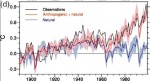
When you have sources with plenty of reliable scientific data, when you have graphs like this you don't need to call names.
-
Re:Clearly a sign of AGW
It's not true. The Earth warmed this much, and this fast, from 1900 to 1945
No, today's warming is faster.
The early 20th century warming is a combination of several factors -- first, a strong shift in the PDO, and then followed by not only a decline in PDO, but a rapid increase in global industrialization. The latter might seem like it would have just the opposite effect, but you have to remember that until the 1960s/1970s, there was very little regulations on power plant emissions. While CO2 causes warming, it has to accumulate for this to happen. Far more rapid is the cooling effects of chemicals like sulfur dioxide, which were emitted en masse until the first world started mandating scrubbers on its power plants. While SOx has a relatively short (compared to CO2) residency, so it's really just a masking of the real climate, its affects are quite powerful.
-
Re:But is it caused by humans?
A review, with numerous citations to primary publications, may be found here.
-
Climate models
If the climate models that indicate anthropogenic causes were correct and rigorous, we could run them retrograde and accurately model the climate of the planet for the past few millennia. Then events like the Medieval Warm Period and the Maunder Minimum would show up. To my knowledge, no one has bothered to create such a model
Or at least, you haven't bothered to look it up
-
Re:More Info & Dashboard
Oh, so you thought Al Gore was a scientist? Nobody told you that he was a politician?
As it happens, his account of the science seems to be pretty reasonable by journalistic standards (according to the real scientists). But nobody is asking you to take Gore's word for it, based on his personal example. If you want the science, you can find it in the primary literature, or for a more technical summary than Gore presents, in the IPCC reports.
-
Re:!Science
Anyone who links to realclimate.org is a tool. You sir, are a tool. Congratulations, and go learn to do some real research instead. Here's a good start if you're lazy.
-
Re:The greater problem
If you can't peer review, it's not science. If you're theory cannot actually predict anything but the past, that's not a good theory and you need to go back to the drawing board.
The subject of this discussion is the Synthesis Report of the fourth IPCC Assessment Report.
The Assessment Report (AR4) consists of four volumes: the Synthesis Report (SR4) and reports from Working Groups (WGs) I, II, and III. Think of the WG reports as literature reviews and The Synthesis Report as an overview for policy makers. Quoting from the forward to SR4:
[SR4] illustrates the impacts of global warming already under way and to be expected in future, and describes the potential for adaptation of society to reduce its vulnerability; finally it presents an analysis of costs, policies and technologies intended to limit the extent of future changes in the climate system.
So, we should expect the WG reports to present the science and any conclusions derived therefrom, and the SR to discuss those conclusions. What has happened is that some small number of "factoids" the SR used to illustrate the conclusions of the WG reports were not peer reviewed and turned out to be wrong.
You can debate the idea of using examples not in the WG for purposes of illustration, but the justification for doing so is that it makes it more relevant to the lay reader (according to me). And let me repeat, the purpose of the non-peer reviewed data is to illustrate conclusions that have already been made based on peer reviewed science.
So my question to you would be, what is it about all this that you find objectionable? Something about peer review I think but I don't understand specifically what you are objecting to in the IPCC process.
-
Re:Before People Scream Conspiracy...
Insightfull but misleading.
There are four volumes in the report, the report of which you speak uses "grey material" from goverment, industry and private sources that cannot be found anywhere else. In this case they used a government source for the percentage of land below sea level, unfortunately the Dutch govt got it wrong but that is about impacts and has nothing to do with the science. The scientific volume (WG1) only uses peer-reviewed sources and nobody has yet pointed out any errors in WG1, in fact the people who pointed out the 2035 error were contributors to WG1.
Note the prominent link directly above the reports to their statement about the 2035 mistake. The IPCC is widely recognised by scientific institutions as one of the most robust peer-review exercises ever conducted and it has been forthright about recognsing it's mistake but if your expecting perfection from a large bunch of humans over a 20yr period you will be dissapointed. -
Re:All policy makers
Have you ever actually read the IPCC Glossary? It states, Climate Change is...
"A change of climate which is attributed directly or indirectly to human activity that alters the composition of the global atmosphere and which is in addition to natural climate variability observed over comparable time periods."
In other words, it specifically excludes all non-human contributors, such as wholly natural and solar processes.
-
Re:We All Wish
Neither of you are providing links to peer-reviewed articles, so I won't bother trying to guess what specific event either of you are talking about. But most climate variability pre-1970 can't be "significantly" blamed on anthropogenic CO2 (i.e. "soot") because our population was small and the power generated was miniscule by today's standards. The inefficiency of 1800s era technology merely multiplied the total fossil fuel use by a larger coefficient than today's more efficient tech, but that total fossil fuel use was tiny compared to the demands of the modern world. Various proxies (middle graph) show variability over the last 1000 years, but most of this is explained by natural changes like the solar Maunder Minimum and occasional sustained "statistically significant" changes in volcanic activity (which normally adds aerosols to the atmosphere thus causing a brief "volcanic winter" but the CO2 emitted stays in the atmosphere longer so volcanic activity warms the long term climate). Also, notice that the top graph (the shorter instrumental record) shows no real change from 1800 to 1850, and both absolute temperatures are below the current temperature-- but this is from a period where they don't even bother to provide error bars because there are only a handful of recording stations. If you examine the middle graph (proxy reconstructions) again, you'll note that there's some disagreement about variability on ~30 year timescales, but even the increase around ~1000 CE is consistent among proxy reconstructions, and explained in terms of natural causes.
Remember that climate scientists aren't saying that natural variability doesn't exist. We're just saying that previous and current climate changes have natural causes which are relatively well understood, but the current increase in global average temperature as averaged over ~20 years is at least largely due to anthropogenic causes. Personally, I say this is a good reason to go nuclear. Yesterday.
-
The calculation [Re:Correct... but irrelevant]
There is a lot of science... this is not made up. (And it dates to way before Al Gore, who's not a scientist.) Have you actually read, for a start, the IPCC Fourth Assessment Working Group I Report on Physical Science Basis of Climate Science?
Yeah, I read it,
Excellent, I'm glad you've actually read it, that puts you in the
here's what it says: the increase in temperature based on anthropogenic CO2 radiative forcing is minimal. Without feedback systems, global warming would not be a problem.
That question can be very easily answered. The calculation was done in 1967 by Manabe and Wetherald-- it's summarized in any reasonable book about atmospheric science (such as the one on my desk at the moment, An Introduction to Atmospheric Radiation, by Liou (1980), p. 188). Calculating the greenhouse effect alone (that is, assuming no change in cloudiness, and constant relative humidity), Manabe and Wetherald (1967) showed "a ten percent increase in CO2 concentration (from 300 to 330 ppm) would lead to a warming of 0.3 K." It's a logarithmic response function (Arrhenius calculated that much back in 1895, although he didn't have the data to do the complete numerical integration), so it's easy to extrapolate this to the current carbon dioxide of about 385 ppm. It comes to about 0.78 K increase by their model.
So, actually, no. The 0.3 to 0.9 K increase shown by the current supercomputer models with all the feedbacks incorporated is within spitting range of the 0.78 K you get just from the CO2 greenhouse effect with no feedback.
...One thing we do know, if we want to stop it, it's going to be hard. Agreements like Kyoto or what was discussed in Copenhagen won't accomplish anything really. To make any kind of difference, we are going to need to reduce emissions by something like 80%. Think of that: are you willing to drive 80% less? It's not an easy thing to do: even if we got rid of all coal power plants, it wouldn't be enough. To really do it, we need new technology.
Ah, there's the heart of it. This has nothing to do with the scientific reality of global warming. Global warming is no less real whether it is easy to deal with, or hard to deal with.
The political question does not affect the science question... except that there are a large number of people who want to make the political argument, and they find it convenient to make that political argument by denying the science.
-
Re:More science still
GL: Have you actually read, for a start, the IPCC Fourth Assessment Working Group I Report on Physical Science Basis of Climate Science?
SuperKendall: Yes. Have YOU looked into the problems with said report?
Gadget Guy: [...] And none of the problems have been with the actual science that underlies climate change (which is what the Working Group 1 Report is all about). The original poster is correct: the science still stands.
Wow, somebody who gets it. That's exactly right; I was citing the Working Group I Report-- The Physical Science Basis-- because that is the one summarizing the basic science, which is what the deniers are denying. (And, as someone pointed out, it's a summary of the science, not the actual science. It references review articles that summarize real science, so it's a place to start learning about the science, not the place to end.)
Moving on from this, there are very real questions such as, what are the effects? Is this bad? If so, how bad? What should we do about it, if anything? What are the effects of these possible actions we might take?
Those are good questions; some of them are very hard questions, and they are worth a serious debate. But that serious debate has been short circuited, because there is a very loud contingent of deniers who basically shout down the very existence of the effect.
The result is that, by denying the physics in the first place, the deniers have pretty much abandoned the actual debate to other extreme.
-
Correct... but irrelevant [Re:We All Wish]
The earth has been both hotter and cooler than it is now.
That is correct... but irrelevant to the question.
Anthropogenic global warming is not instead of natural variations-- it is in addition to natural variations. Natural variations don't suddenly vanish now that we add carbon dioxide to the air.
...I'm all for taking better care of the planet, but the global warming nuts haven't really provided much evidence and they're the ones making the allegations.
The way I see things, if you make a bunch of claims, the burden of proof is ON YOU... not the people you're speaking to.
By "global warming nuts," you apparently mean "the scientists who actually study the problem."
By "the burden of proof is on you" you apparently mean "...to prove the correctness of scientific results to people who aren't willing to take any effort to look at the actual science, but will believe any criticism with no skepticism whatsoever."
There is a lot of science... this is not made up. (And it dates to way before Al Gore, who's not a scientist.) Have you actually read, for a start, the IPCC Fourth Assessment Working Group I Report on Physical Science Basis of Climate Science? What? No? Because you already read in a blog somewhere that it's a hoax, so you don't need to read it?
So, uh, if you won't actually read the evidence, how can any possible amount of evidence convince you?
-
Re:Forcing
While honest climatologists will admit that some areas in AGW are very well understood, and others are much less understood, dishonest climatologists will pretend that they know everything and how dare you for questioning the global warming groupthink. In fact, how they respond to reasoned criticism is often a clear giveaway as to which camp they fall into.
Posted anonymously by khayman80 (Dumb Scientist) from an internet cafe in Koh Phi Phi Don.
I'd like to thank Abcd1234 for once again reducing my workload- especially during my vacation. But this statement is doubly redundant because (1) All climatologists I've met or researched have been honest (defined as PhD physicist specializing in a range of subfields related to climate prediction or paleoclimatology.) and (2) all scientific fields have areas that aren't well understood.
(Of course, if you'd said "members of the general public who identify with the Green party, I've already repeatedly agreed with you. But you didn't.)
In fact, climatologists express how "well understood" an effect is by the error bars on the radiative forcings chart. The larger the error bars, the "less understood" the effect is. That's just the way all natural science is done. Strangely, some pseudoscientists criticize climatologists when their error bars are too small (i.e. pseudoscientists accuse climatologists of pretending to know everything) AND when their error bars are too large (apparently that means they're deliberately avoiding falsification.)
Do you have any reputable citations showing professional climatologists engaging in groupthink or responding badly to reasoned criticism? I ask because, once again, your description of the climatology community sounds like a description of a cult...
-
Re:Imprecise language, should be GHG Tax
Not sure why your reply was modded informative(possibly due to the methane formula otherwise it was anything but) anyways, that whole powerful vs stays in the atmosphere has been worked out thus you have the GWP(global warming potential here )Which states that methane is 25 times worse than CO2.
Yes, per kilogram, methane is ~25x more effective at trapping heat than CO2 on a time horizon of 100 years. But industrial processes release so much more CO2 that the total radiative forcing of CO2 is more than double that of methane.
-
Re:Hard predictions?
Wow, have your cake and eat it too -> they're not statistical models, but they're somehow "consistent with this body of data"?
What do you find difficult to understand about comparison of causal physical models to data? Newton's theory of gravitation is a causal model, but one reason why it was accepted was that it was consistent with the observational data on the motion of planets across the sky.
Some of it radiates down, some of it radiates up. At the boundaries of the atmosphere, the radiation out escapes, and you have the whole "hot air rises" convection routine that transports heat from the high pressure surface to the lower pressure outer atmosphere. None of it gets magically stuck in the lower atmosphere to cause a "runaway" greenhouse effect.
That's not what the models--the real ones that take into account actual conditions of a planet rather than assuming a sealed, insulated box--say. What they do say is that the atmosphere becomes less efficient as a radiator of the heat energy absorbed from the sun, such that the temperature has to be greater--much greater--in order to radiate away the energy absorbed by the clouds.
So what's your definition of "substantial", and what's your prediction of maximum temperature increase (saturation point)?
Once again, you illustrate the point that you haven't taken the time to learn anything about the model that you are attacking so energetically. Read the IPCC report yourself. You might learn something. One thing that you might learn is that the maximum temperature increase is not limited by saturation, but by the fact that that CO2 is not projected to increase indefinitely, due to replacement of CO2 generating technologies with carbon-neutral technologies.
For volume, we take a representative sample at a given altitude (say 1m^3), so that remains a constant.
Sorry, you've already violated the assumptions upon which the ideal gas law is founded--a fixed volume container with perfectly rigid, perfectly insulated walls. No excuses. Once you've violated the assumptions, you can't use the theory--you need a new theory, derived for the conditions that you really have (which is, of course, what climate scientists have done).
It's what I was talking about. If you're interested in the troposphere, I'm assuming you mean this:
The tropospheric temperature readings are the satellite temperatures for which we have long-term records. They are the ones that are commonly cited as showing global warming. And they are the ones that crackpots like Monckton have falsely claimed to be calibrated against ground readings. I take it that you now concede that they are not?
Sigh. So tell me tgibbs, exactly what does the IPCC *predict*? Apparently I can't just read it plainly and assume that their citations actually mean what they say they mean -> do you have the IPCC-guide-to-what-they-really-predict-and-what-they're-just-"mentioning"-for-entertainment-purposes?
Oh yes, it is terribly hard to find. They hid their projections in the Technical Summary in a section entitled "Projections of Future Changes in Climate"
-
Re:magical negative feedback
This is what the creationists do--no matter how many fossils you show them, they always insist that the fossil evidence is not strong enough, because there are "missing links."
Let me continue the analogy for you for warmists - no matter how many natural drivers you show them, they always insist that the evidence is not strong enough, because there is "unaccounted for warming."
So Mann made some techincal errors, but they were largely irrelevant to his basic conclusions, which have since been validated by other studies that do not share those technical flaws. This remains the scientific consensus.
Of course science != consensus. But here's a refutation of the whitewash:
http://www.uoguelph.ca/~rmckitri/research/WegmanReport.pdfI challenged you to cite the text of the IPCC report that predicts runaway warming as a consequence of anticipated levels of CO2.
So you didn't look at any of their graphs? Here, try page 792-793. http://www.ipcc.ch/pdf/assessment-report/ar4/wg2/ar4-wg2-chapter19.pdf
In the model, CO2 has exactly the same effect no matter where it comes from. But if something other than CO2, such as an increase in solar radiation, increases the temperature, then CO2 rises afterwards (and amplifies the increase in temperature).
If CO2 has the same effect no matter where it comes from, you can't have lags -> CO2 emitted, whether from oceans in response to solar changes, or from supervolcanoes or model T fords, always acts as a positive feedback effect and raises temperatures. Lags wouldn't exist if CO2 amplified the increase in temperature, since whatever triggered the initial CO2 release, you'd end up with a positive feedback effect.
Dropping a rock in a pond will create ripples. Ripples in a pond do not create dropping rocks.
-
Re:magical negative feedback
A subsequent review by the NRC concluded that McIntyre & Kitrick's techincal objection was correct, but that it did in fact produce an incorrect result in the case of Mann's data.
You meant "correct result", right?
You seem to be trying to argue that "if one measurment is not enough, then however many you have can't be enough either." That makes no sense.
No, I'm really trying to argue that a model cannot be its own justification. A model which takes measurements from 1000 stations cannot be its own justification, just as a model which takes measurements from 1 station cannot be its own justification. This is why Popper's falsifiability criteria is so crucial to determining causality.
This is an independent peer-review panel of the US National Academies of Science, the most respected independent organization of scientists in the nation, if not the world.
I'm sorry, but the appeal to authority argument falls flat here.
http://www.uoguelph.ca/~rmckitri/research/trc.html
"They accepted our argument that Mann's method is biased towards producing hockey stick-shaped PCs, that uncertainties have been underestimated and that the bristlecone data, on which the famous hockey stick shape depends, should not have been used. They also express very little confidence in the IPCC's claim about the 1990s being the warmest decade in the millennium. But you have to read the report closely to pick all these things up--they bury it in a lot of genteel and deferential prose."
Yes, I know what it is called. I asked you to "Kindly quote the section of the IPCC report that predicts runaway warming as a consequence of anticipated levels of CO2."
http://www.ipcc.ch/publications_and_data/ar4/wg2/en/ch4s4-references.html
Check out the page, and text search for "runaway". You'll find it somewhere towards the middle of the page.
Aren't you getting a bit ahead of yourself? You haven't even established that IPCC actually made a prediction of a "runaway greenhouse."
RTFL: http://www.ipcc.ch/publications_and_data/ar4/wg2/en/ch4s4-references.html
And global climate models assume that every molecule of CO2, wherever it came from, has the same physical chemistry and the same impact on climate. No such memory is assumed.
You're contradicting yourself. You asserted that CO2 lags temp changes if the CO2 is not "added", and leads temp changes if it is "added". This is an assertion of different behavior depending upon whether or not the CO2 came from the outgassing of the oceans, volcanoes, or other natural sources, or if they came from the burning of petroleum products by humans. This is an invalid assertion of memory.
If CO2 causes a feedback effect, any addition of CO2 from any source should cause an increase in temperatures. Magical CO2 just does not exist.
-
Re:magical negative feedback
A subsequent review by the NRC concluded that McIntyre & Kitrick's techincal objection was correct, but that it did in fact produce an incorrect result in the case of Mann's data.
You meant "correct result", right?
You seem to be trying to argue that "if one measurment is not enough, then however many you have can't be enough either." That makes no sense.
No, I'm really trying to argue that a model cannot be its own justification. A model which takes measurements from 1000 stations cannot be its own justification, just as a model which takes measurements from 1 station cannot be its own justification. This is why Popper's falsifiability criteria is so crucial to determining causality.
This is an independent peer-review panel of the US National Academies of Science, the most respected independent organization of scientists in the nation, if not the world.
I'm sorry, but the appeal to authority argument falls flat here.
http://www.uoguelph.ca/~rmckitri/research/trc.html
"They accepted our argument that Mann's method is biased towards producing hockey stick-shaped PCs, that uncertainties have been underestimated and that the bristlecone data, on which the famous hockey stick shape depends, should not have been used. They also express very little confidence in the IPCC's claim about the 1990s being the warmest decade in the millennium. But you have to read the report closely to pick all these things up--they bury it in a lot of genteel and deferential prose."
Yes, I know what it is called. I asked you to "Kindly quote the section of the IPCC report that predicts runaway warming as a consequence of anticipated levels of CO2."
http://www.ipcc.ch/publications_and_data/ar4/wg2/en/ch4s4-references.html
Check out the page, and text search for "runaway". You'll find it somewhere towards the middle of the page.
Aren't you getting a bit ahead of yourself? You haven't even established that IPCC actually made a prediction of a "runaway greenhouse."
RTFL: http://www.ipcc.ch/publications_and_data/ar4/wg2/en/ch4s4-references.html
And global climate models assume that every molecule of CO2, wherever it came from, has the same physical chemistry and the same impact on climate. No such memory is assumed.
You're contradicting yourself. You asserted that CO2 lags temp changes if the CO2 is not "added", and leads temp changes if it is "added". This is an assertion of different behavior depending upon whether or not the CO2 came from the outgassing of the oceans, volcanoes, or other natural sources, or if they came from the burning of petroleum products by humans. This is an invalid assertion of memory.
If CO2 causes a feedback effect, any addition of CO2 from any source should cause an increase in temperatures. Magical CO2 just does not exist.
-
Re:magical negative feedback
insisting that the distribution is not good enough is empty handwaving--unless of course you can support it with a model that demonstrates that a more uniform distribution gives different conclusions.
Isn't that Mcyntre and McKitrick's complaint?
I see no value in such a contrafactual assumption. Perhaps if you have a mathematical model of climate for which you can show that only one station would be sufficient then that would be worthy of discussion.
But that's exactly the problem -> the model is the proof of the model. Any arbitrary model can claim to be its own justification.
If you want to argue that millions of years ago a volcano made a significant contribution to CO2 and climate, I'm willing to look at the evidence, but I don't see the relevance to our discussion of global warming in the modern era.
The relevance is the assertion that the difference between lags and leads of CO2 is due to "added" CO2 (the consequence being that we ignore things like outgassing from the ocean, because it isn't "added"). My supposition would be that millions of years ago a volcano made a signifiant contribution to CO2, which did not have a signifiant impact on climate because of the negative feedback effects not properly modeled yet. This would serve as a contradiction to your assertion that leads in CO2 are due to "added" CO2 - unless you further ad hoc assert that volcanic CO2 is of a different quality than man emitted CO2.
You need to postulate some fairly contrived circumstance to generate an artifactual trend--as evidenced by the fact that you have not yet managed to come up with a scenario that would do it.
So, you are insisting that you cannot possibly find a trend that does not exist. Interesting.
I've read the article. It is a toy model that omits so many of the factors that influence climate in the real world as to be of no relevance.
The whole point of the toy model is to take it to its extreme and show that CO2 models of runaway warming are flawed even in the simplest form. It is, as you say, the "sanity check".
...concluded that Mann's conclusions are essentially correct.
Shame on you. That whitewash should be patently obvious to someone with such a iron grip on statistics.
No, I haven't read anything of the sort in the IPCC report. Kindly quote the section of the IPCC report that predicts runaway warming as a consequence of anticipated levels of CO2.
They call it the "runaway greenhouse effect" -
http://www.ipcc.ch/publications_and_data/ar4/wg2/en/ch4s4-references.htmlAnd here's the refutation:
this behavior is not at hoc, but a necessary consequence of the well established physical chemistry of CO2.
This behavior is of course ad hoc. CO2 has no memory, and the climate system cannot distinguish between "added" CO2 and "non-added" CO2 -> physically, no such animal exists.
You have insisted that there are examples of massive releases of CO2 due to volcanoes. If you can find evidence of this, without a temperature increase following, then this would be a problem for the model.
As devil's advocate, I'll assert that the AGW defense of that would be the assertion that aerosols like SO2 balance it out. But I'll keep in mind that you'll accept that evidence as a falsification of AGW.
-
Re:interestingly, themselves sometimes touted
http://www.ipcc.ch/pdf/assessment-report/ar4/wg1/ar4-wg1-chapter2.pdf
Table 2.14.
(CH4 is "about 80"(72) in a 20 year "Time Horizon")
-
Re:It won't workSays wikipedia (not a certain source, I know):
Despite substantial uncertainties, especially for the period prior to 1600 when data are scarce, the warmest period prior to the 20th century very likely occurred between 950 and 1100, but temperatures were probably between 0.1C and 0.2C below the 1961 to 1990 mean and significantly below the level shown by instrumental data after 1980. The heterogeneous nature of climate during the 'Medieval Warm Period' is illustrated by the wide spread of values exhibited by the individual records.[12]
Here's some reasonable data somewhat supporting your solar intensity hypothesis. The problems are that (1) now that we can observe intensity directly, we haven't observed large enough changes (2) your assertion about the relative warmth of the MWP seems to be not quite correctn and (3) where's the huge pile of sunspots?
I found no problems in anything that you referenced, because you referenced nothing. If you want to make a case, please support it. The "standard sources" (Wikipedia, top hits in Google) don't. -
Re:It won't work
"Call me old fashioned"
No, I'm old fashioned, I don't own a mobile phone. You are simply repeating propoganda without bothering to understand the context. The data still shows the MWP and the RWP however it has been demonstrated time and again that they were regional anomolies thus they have less influence on the global data than previously thought. That kind of self-correction is how science progresses, if you think that it goes against the scientific method then you must be looking at a different method to the rest of us.
"Weren't past IPCC reports peer reviewed (back when peer review maybe meant something)?"
The more you speak the more you reveal your ignorance. The IPCC is a 4 yearly review of all peer-revived papers on the subject of climate, it has an annual budget of $5-6M sourced from over 200 politically diverse nations. Each review involves roughly 2500 unpaid scientists tirelessly pawing over the mind numbing details of tens of thousands of papers during those four years. Collectively those scientists represent virtually every reputable scientific body on the planet. Who do you suggest should peer-review what amounts to the most rigorous peer-review of peer-reviewed science ever conducted on any scientific question?
Of course for any genuine skeptic the answer to that question is to review the reports and data yourself but I doubt the political muck raking displayed in your post will allow that to happen. -
Straight from both ends of the horseRead the reports that are put out by the "experts".
The IPCC Expert Meeting on Detection and Attribution Related to Anthropogenic Climate Change Report - September 2009: http://www.ipcc.ch/pdf/supporting-material/expert-meeting-detection-anthropogenic-2009-09.pdf
p21 - "Sea ice around Antarctica shows little change – a fact, which is still not fully understood." Yet the changes in sea ice in the Arctic apparently are since they match the authors' preconceptions.
p22 - "Especially mountain glaciers are considered to be 'unique demonstration objects' concerning ongoing climate change." Unique as in something different and non-representative of the truth. A Ginsu knife cutting through a soft drink can is quite impressive but has little to do with how well it will cut meat compared to another knife that may not cut the can.
p22 - "Glacier extent (length, area) may have reached 'warm' limits of pre-industrial (Holocene) variability ranges and is far out of equilibrium conditions at many mid- and low-latitude sites." Restated - glaciers are no smaller than they were in pre-industrial times; somehow it doesn't sound particularly ominous when stated in this equally
p22 - "Complex air/ocean/ice interactions make attribution to exact causes difficult but 'warming' as a general cause appears to be evident." Why the quotation marks around "warming"? Evident means that it looks that way to a casual observer, but not necessarily to an educated one. Note the lack of "anthropogenic", and that exact causes are not known.
p25 - "Global scale surface temperature is recorded by an instrumental record of 150 years and reconstructed from palaeo data over several centuries. Both compare well with climate model simulations if driven with estimates of external forcing
p26 - "Thus, concise, exact, and intuitively understandable language needs to be crafted that helps express this range of attribution results." Translation: "We need to use the same words that a marketing person would choose", too bad "new" and "improved" aren't suitable. The appropriate conclusion, one that a scientist would make, is that the models need to be improved before they are the basis for making policy decisions. I am not saying we should do nothing - just do things for other, more tangible and rational reasons. Reduce fossil fuel consumption because we should save our reserves since it is easier to make plastic out of oil than anything else, or because you hate sending money to Arab terrorists and Venezuelan revolutionaries.
p26 - On precipitation models: "... the magnitude of the observed change is larger (significantly so) than that of the multi-model mean fingerprint, raising questions about instrumental data and climate model realism." The models don't predict th
-
Straight from both ends of the horseRead the reports that are put out by the "experts".
The IPCC Expert Meeting on Detection and Attribution Related to Anthropogenic Climate Change Report - September 2009: http://www.ipcc.ch/pdf/supporting-material/expert-meeting-detection-anthropogenic-2009-09.pdf
p21 - "Sea ice around Antarctica shows little change – a fact, which is still not fully understood." Yet the changes in sea ice in the Arctic apparently are since they match the authors' preconceptions.
p22 - "Especially mountain glaciers are considered to be 'unique demonstration objects' concerning ongoing climate change." Unique as in something different and non-representative of the truth. A Ginsu knife cutting through a soft drink can is quite impressive but has little to do with how well it will cut meat compared to another knife that may not cut the can.
p22 - "Glacier extent (length, area) may have reached 'warm' limits of pre-industrial (Holocene) variability ranges and is far out of equilibrium conditions at many mid- and low-latitude sites." Restated - glaciers are no smaller than they were in pre-industrial times; somehow it doesn't sound particularly ominous when stated in this equally
p22 - "Complex air/ocean/ice interactions make attribution to exact causes difficult but 'warming' as a general cause appears to be evident." Why the quotation marks around "warming"? Evident means that it looks that way to a casual observer, but not necessarily to an educated one. Note the lack of "anthropogenic", and that exact causes are not known.
p25 - "Global scale surface temperature is recorded by an instrumental record of 150 years and reconstructed from palaeo data over several centuries. Both compare well with climate model simulations if driven with estimates of external forcing
p26 - "Thus, concise, exact, and intuitively understandable language needs to be crafted that helps express this range of attribution results." Translation: "We need to use the same words that a marketing person would choose", too bad "new" and "improved" aren't suitable. The appropriate conclusion, one that a scientist would make, is that the models need to be improved before they are the basis for making policy decisions. I am not saying we should do nothing - just do things for other, more tangible and rational reasons. Reduce fossil fuel consumption because we should save our reserves since it is easier to make plastic out of oil than anything else, or because you hate sending money to Arab terrorists and Venezuelan revolutionaries.
p26 - On precipitation models: "... the magnitude of the observed change is larger (significantly so) than that of the multi-model mean fingerprint, raising questions about instrumental data and climate model realism." The models don't predict th
-
Re:Main points
I still want to hear staticians weigh in on the time period of data compared to the history of the earth. And some better assessment of the margins of error for the various sampling methods.
Start reading. This is a good start. Once you get through the few thousand pages of actual research, you'll have an idea of where to find the discussions by statisticians and the margins of errors of the various sampling methods.
Oh, wait. That's right. You don't want to hear a statistician talk about this stuff, you want to have someone answer you any and all questions you could have. Sorry, that's not how it works. People who deal with complex topics aren't too keen on spending hours explaining something only to be told "But you doctor your research just like Exxon, why should I believe you?"
-
Re:Main points
Scientists sure like to doctor their research to get more funding, they are like exxon.
Except that if there are $X available for grants, scientist A is competing against scientist B to get those funds, while Exxon and British Petroleum are united in their quest to deny reality for their own economic interests.
I still want to hear statisticians weigh in on the time period of data compared to the history of the earth. And some better assessment of the margins of error for the various sampling methods.
I suggest you start here
-
Re:NOT Good enough
Absolutely, or even better, how about an inter-governmental panel that brings the foremost scientists and mathematicians from around the world into one giant committee of the world's best and brightest. And then how about we repeat it three or four times to make sure they come up with the same answers each time?
Oh wait, that sounds somewhat familiar....
And how about we put on that panel those who are open minded and tolerant of dissenting opinions? Or a panel that doesn't claim "consensus" or "unanimity" when all they really have is a majority?
-
Re:NOT Good enough
Absolutely, or even better, how about an inter-governmental panel that brings the foremost scientists and mathematicians from around the world into one giant committee of the world's best and brightest. And then how about we repeat it three or four times to make sure they come up with the same answers each time?
Oh wait, that sounds somewhat familiar....
-
Re:Non-peer Review
There's more to paleoclimate reconstruction than tree rings. In fact it's essential to explore unrelated proxies for correlations. Mann did this and so have several others.
http://www.ipcc.ch/publications_and_data/ar4/wg1/en/ch6s6-6.html
-
Re:A little known fact
It is a little know fact that, given the uncertainties of what is happening in our climate system, the warming seen over the last few decades is entirely attributable to the reduction in aerosols in recent years. This is mentioned in WGI chapter 2 of the IPCC report. Of course, that fact didn't make it into the "Summary for Policy Makers." In fairness I should mention that the chances of the temperature change being entirely attributable to the change in aerosols is actually quite low, but it's still something worth considering.
Yeah, it's odd that an ~18 page summary for nonscientists doesn't include all the nuances in a ~1000 page report filled with scientific jargon.
The summary's forcing chart clearly shows a huge, lopsided error bar on the cloud albedo effect, and lists the Level Of Scientific Understanding as "low". This is a copy of figure 2.20 on page 203 of chapter 2. In both charts, notice that the CO2 forcing is very large and known far more precisely.
The particular statement you found, that "the warming seen over the last few decades is entirely attributable to the reduction in aerosols in recent years" isn't something I've seen in chapter 2. The bottom panel of figure 2.22 on page 206 seems like the closest match to your statement, but it's a projection based on emissions over 20 years in the future. Could you specify the page number where you found your statement?
I'll note that your claim isn't necessarily contradicted by figure 2.20 because that's the radiative forcing integrated from 1750-2005, whereas you're referring to something like 1985-2005... right?
-
Re:A little known fact
It is a little know fact that, given the uncertainties of what is happening in our climate system, the warming seen over the last few decades is entirely attributable to the reduction in aerosols in recent years. This is mentioned in WGI chapter 2 of the IPCC report
Oh really? Since you conveniently neglected to link to anything even vaguely supporting your claim, here's one and it does NOT say what you said.
http://www.ipcc.ch/publications_and_data/ar4/wg1/en/faq-2-1.html