Slashdot Mirror
Domain: kde.org
Stories and comments across the archive that link to kde.org.
Stories · 648
-
KDE 2.0 Final Released
Well, as the title says - KDE 2.0 final is out! You can download it here or here or you can look at the mirrors (mirrors please!) Note: RH 6.2, FreeBSD and Solaris packages will be available soon. While you're downloading it, you may want to look at Kivio (a nice diagramming and flowcharting tool for Linux/KDE), or look for some applications for your KDE2 here. I've been using lately KDE 2.0 for a while and I must say - great work KDE team. -
KDE 2.0 Final Release Candidate Is Out
As the title says - The final Release Candidate (RC2) of KDE 2.0 is out. Announcement is here, Red Hat RPM's available here (for Red Hat 6.2 and 7.0). SuSE and other distributions RPM's available through the mirrors. Solaris 8 packages will be out soon. Please test this release and if you'll find any showstopper bug, then please report it. -
KDE 2.0 Final Release Candidate Is Out
As the title says - The final Release Candidate (RC2) of KDE 2.0 is out. Announcement is here, Red Hat RPM's available here (for Red Hat 6.2 and 7.0). SuSE and other distributions RPM's available through the mirrors. Solaris 8 packages will be out soon. Please test this release and if you'll find any showstopper bug, then please report it. -
KDE 2.0 Final Release Candidate Is Out
As the title says - The final Release Candidate (RC2) of KDE 2.0 is out. Announcement is here, Red Hat RPM's available here (for Red Hat 6.2 and 7.0). SuSE and other distributions RPM's available through the mirrors. Solaris 8 packages will be out soon. Please test this release and if you'll find any showstopper bug, then please report it. -
KBasic
-
Mozilla-KDE Integration
zniper writes: "According to this mail on the KDE-KFM-DEVEL mailing-list, Corel revived the Mozilla QT-port and claim to have a port even more stable than the official GTK version. Additionally, they are planning to port Gecko to the KDE2 kparts architecture, allowing it to be embedded into Konqueror and other KDE2 programs. " -
KDE 1.94 "Kandidat" released
The folks at KDE e-mailed with the news KDE 1.94 "Kandidat" has been released. It's the fifth and final beta preview of Kopernicus - which is supposed to ship in the last part of 2000. They also asked folks to use HTTP instead of FTP when downloading it. You can grab it here or read the release for different package formats. -
KDE 1.94 "Kandidat" released
The folks at KDE e-mailed with the news KDE 1.94 "Kandidat" has been released. It's the fifth and final beta preview of Kopernicus - which is supposed to ship in the last part of 2000. They also asked folks to use HTTP instead of FTP when downloading it. You can grab it here or read the release for different package formats. -
KDE 1.94 "Kandidat" released
The folks at KDE e-mailed with the news KDE 1.94 "Kandidat" has been released. It's the fifth and final beta preview of Kopernicus - which is supposed to ship in the last part of 2000. They also asked folks to use HTTP instead of FTP when downloading it. You can grab it here or read the release for different package formats. -
KDE to RMS: That's Absurd.
A retierd War Corespondant writes "KDE has issued a formal response to RMS' latest editorial on KDE and GPLed QT. Favorite Quote: "This entire thing is just too absurd and we refuse to play this game." They also point to the listing of licenses and Authors within KDE." Update: 09/06 11:38 AM by H :Some of the authors have written as well. -
KDE to RMS: That's Absurd.
A retierd War Corespondant writes "KDE has issued a formal response to RMS' latest editorial on KDE and GPLed QT. Favorite Quote: "This entire thing is just too absurd and we refuse to play this game." They also point to the listing of licenses and Authors within KDE." Update: 09/06 11:38 AM by H :Some of the authors have written as well. -
KDE to RMS: That's Absurd.
A retierd War Corespondant writes "KDE has issued a formal response to RMS' latest editorial on KDE and GPLed QT. Favorite Quote: "This entire thing is just too absurd and we refuse to play this game." They also point to the listing of licenses and Authors within KDE." Update: 09/06 11:38 AM by H :Some of the authors have written as well. -
KDE to RMS: That's Absurd.
A retierd War Corespondant writes "KDE has issued a formal response to RMS' latest editorial on KDE and GPLed QT. Favorite Quote: "This entire thing is just too absurd and we refuse to play this game." They also point to the listing of licenses and Authors within KDE." Update: 09/06 11:38 AM by H :Some of the authors have written as well. -
KDE to RMS: That's Absurd.
A retierd War Corespondant writes "KDE has issued a formal response to RMS' latest editorial on KDE and GPLed QT. Favorite Quote: "This entire thing is just too absurd and we refuse to play this game." They also point to the listing of licenses and Authors within KDE." Update: 09/06 11:38 AM by H :Some of the authors have written as well. -
Mandrake 7.2 Beta (Ulysses) Released
dclatfel writes "Just wanted to let everyone know that the latest beta of Mandrake for Intel is up - 7.2 Beta - and it's called Ulysses. (Now where is that Golden Fleece?)" They've got notes regarding it as well - KDE 2 Beta 4, and Gnome 1.2, as well as XFree86 4.01 as the default X server. -
KDE's Official Position on the GNOME Foundation
infodragon was among the many folks to submit the fact that KDE has an Official Position with regards to the recently announced Gnome Foundation and all the ruckus that followed. As usual, the opinions of the folks most directly involved are much more rational and realistic then the crazed fan hordes (and the following reactionary pieces in the mainstream media) that think there is some sort of war going on instead of healthy competition. Quote: "Q: "How much does creation of GNOME Foundation affect KDE development?" A: "As much as the birth of the last baby polar bear at the Quebec City Zoo" (i.e., not at all) " -
KDE Strikes Back
Nerds writes: "The fourth beta release of KDE has been announced. Also, you might want to check out this editorial at LinuxPlanet. It is a bit biased, but the author makes good points." Its an enjoyable piece that everyone ought to read: it takes some pot shots, and points out some very real truths (and does both with a reasonable sense of humor). -
Tidings From Swagland: An LWCE Wrap-Up
With a planned move to San Francisco next summer, last week saw San Jose's last Linux World Expo, at least for now. The future as always is stubbornly uncertain, but it's impressive that the serendipitous combination of Free tools (from GNU) and a Free kernel (from Linus) has inspired enough interest and prosperity to excite a larger group of people each year. If you've not had the chance to attend one of these expositions, we hope this article will give you a flavor of what it's like. Note: Here are a few pictures from the floor (Day 1 & Day 2) contributed by Sensei^); do you have any cool shots to link to in comments?First, the prelude: If you've worked on the pre-show aspects of anything from a high-school play to a LAN party, you know all those booths, displays, people and computers don't materialize by themselves. For several days before the show floor opened on Tuesday, forklift crews zipped cargos of wooden, fiberglass, plastic, aluminum and steel cases from moving trucks to exhibit spaces. These contained banners, snap-together modules, computers, lighted signs -- and Yes, more gratis logo-imprinted toys than you can wave a TuxTops LED light at.
Spiderwebs of CAT-5 and electric cord (run beneath the show floor) sprouted from the centerpoints of many booths, with strands for each computer to be connected to the Net during the show. Rolls of padding and carpet came next, then the slow assembly of display booths. These ranged from no-nonsense fabric partitions that housed companies like TuxTops and Sendmail (and legions of volunteers from PerlMonks, the Simple End User Linux project, Flightgear, and many others), to elaborate constructions with motorized signs, projected lasers and huge illuminated logos. Note: Slashdot (the site) was put together last week mostly from the comfy chairs of the PerlMonks booth.
The "C" (as in conference) part of LWCE got started on Monday, and for the days that followed, attendees got instruction -- on everything from Linux security to evangelizing Free software to their bosses-- in half-day doses. Meanwhile, the setup work continued into the wee hours, as exhibitors raced the clock to make sure that at least their signs, if not their networks, were up for the next day. And at the OSDN booth (home of the red-carpeted Slashdot stage and beanbags), prep work included stacking thousands of boxed distributions of Debian, and attempted to pawn a few copies off on every passer by.
Tuesday morning, at a shade before 10:00, visitors willing to miss Michael Dell's keynote began to stream into the halls, on a quest to find new distros, old friends, and swag. It's amazing what companies will give away in order to snag a little nook in your brain. Besides the usual trinkets (keychains, T-shirts, stickers) and the distributions that a Linux show would be empty without, booth visitors were handed everything from knives (Sendmail) to cute monkeys (Helixcode) to embarrassing pictures of themselves (BSDi), as well as too many toys with embedded LEDs to bother counting. Rather than a full swag accounting (which would only annoy those unable to attend), let me just say that you won't hurt for toys when the chance presents itself. (CT:I just wanted to note that VA gave away 2300 pounds of shrink-wrapped boxed Debian. Like 5000 copies. It was beautiful)
The things on display around the LWCE floor were more interesting than the toys, though. (And unlike a museum, most were available for hands-on demonstration, not hidden behind glass.) Indrema showed a prototype player (not in the sleek black box you see on their Web site, but still sporting that cool blue LED) hooked up to a HDTV display, playing a very fast game of Quake. (CT:Actually it was an HDTV demo, they promised the real deal will be less vaporous before I have children) In the Intel booth were server clusters populated with quad Itanium processors, demonstrating failover when one system was rudely but intentionally shut down. The amazing-like-emacs-is-amazing Flightgear project showed a really nice looking demo which is enough incentive by itself to invest in a better video card for my system so I can play with it.
Both Helixcode and Eazel made their first LWCE appearance this time around, exciting for those filling their anti-FUD cannon for the perpetual "Linux is tough to use" argument. The Eazel folks showing off Nautilus seemed to be all but cackling as they showed off the smoothness of the zooming information available for documents and the cool music-integration abilities it contains. It would have been cool if they'd had some sample CDs, but they promise a developers' release soon. (CT:They also promised .deb's, but I'll believe it when I see it. The UI was awesome, I just hope that someone hacks in something like the GUI command line in EFM)
Considering that Sun was showing off the GNOME desktop on Solaris (hinting at its inclusion in stock Solaris systems sometime very soon, too) and that the GNOME project itself was not only in one of the small booths against the wall but the subject of a big announcement -- about the advent of the GNOME Foundation -- it looks it's showing up everywhere. Happily, there seems to be no shortage of room for window managers right now: the KDE folks were also there not only in their own booth, but showing up in software demonstrations all over the floor, as SuSE, Caldera and others demonstrated the very slick KDE 2.0. (Can't we all just get along, anyhow?)
SuSE, by the way, was the only distributor I noticed showing off Linux on Apple hardware, and their current distro was sweet and fast on a G4. Beyond the curious lack of Apples, and the obvious ubiquity of x86 machines, there were machines based on everything from microcontrollers to StrongArm, MIPS, Alpha, Itanium ... even the IBM S/390s which have gotten attention for the ridiculous number of concurrent Linux systems they can support.
For all the cool hardware and cusp-of-reality, bleeding-edge distros, it's interesting that the announcement which seemed to generate the most buzz of the entire show was the long-awaited release of Debian's Potato. Considering the reputation that Debian has for intelligent upgrading, stability, and diligence in guarding the license of the software which makes it up, it's not as surprising as it might otherwise be that Debian's new release made people sit up a bit more than the newest offerings from the large commercial distros.
(CT: Also extremely impressive was the Pocket Linux booth, where they actually had iPaq's running Linux. The first dude that demoed the box to me was very nice, but what I really wanted to see was X11 running on it ... oddly enough, I encountered one of his cohorts in the bar later that night who showed it to me: X, xeyes, xterm, and twm running on an iPaq. When they get the wireless action going on these things I'm totally there ... I'll just need to hack minimalist interfaces onto pronto and my MP3 player software and use the thing as a portable X terminal on the local 802.11 wireless lan. Yum.)
Oh, and there were people on the floor as well -- close to 20,000, all told. I met some folks I've known previously only through IRC, and quite a few I might never have otherwise encountered.
It's interesting to see in the space of a few hours many of the smart people who you may experience vicariously through writings, speeches, code, art or IRC chatter -- and it also belies the idea that software celebrities of the Free software world are becoming celebrities of the traditional variety, since everyone from ESR to Jon "maddog" Hall (and Linus himself) are willing to talk to anyone who catches up with them long enough to say hello. The atmosphere (especially outside the mondo corporate-castle booths) is mellow and accomodating, and suprisingly so even within most of those castles. There were undoubtably personality conflicts at work, but it seems like most people have the good grace to deal nicely with each other for these few days at least.
At the close of each day, people shuffle out to drop laptops, T-shirts and bags of stuff at their hotels, then thousands of them show up to parties sponsored by companies from AMD to Red hat to VA, which are full-blown events in themselves. Mandrake's party, for instance, had go-go dancers in cages, which may be the most bacchanal thing I have ever witnessed. Ironically, though, many coders couldn't attend even events sponsored by their own companies, or thrown in the honor of their projects, because of strict carding policies. Wouldn't a chem-free party or two be a thoughtful way to include people?
(CT: This has been a consistent problem for several years. Although I know at "Someones" party (no names *grin*) they weren't carding, and I recieved many a happy note from fellow attendees proclaiming that they were able to get in. The parties themselves weren't bad: the OSDN/Potato release party was fun, with San & Zak spinning the tunes (next time we'll force CowboyNeal to scratch for us under threat of death). They had 2 buildings: one was a pool hall, where we tormented The Pope for nearly an hour, carefully distracting him, and then returning his balls to the table. He never noticed. We also met up with Nitrozac from After Y2k, and I snuck accross the street to the Eazel party for a bit, and got to meet Dave "You might remember me from cheat codes in some first person shooter" Taylor.) Attendeees mostly filed out for flights or drives home Thursday and Friday, but some are still in San Jose for the Intel Developers Conference, or otherwise enjoying the Northern California weather. It's a strange familiarity that many of them will feel when the next big conference rolls around, to see many of the same fellow attendees or workers -- of course, by the time the next big conference happens, perhaps we'll all be too excited by the release of 2.4 to notice.
-
KDE Developer on the GNOME Foundation
The ongoing debate between KDE and GNOME has calmed down a lot in the last year as each system became stable and usable. Recent announcements regarding the Gnome Foundation has caused some tension (ranging from words to DNS hijaacking). Kurt Granroth, a KDE Core Team Member, and the KDE US Press Rep has submitted his opinions on the subject, are in some cases very good points, and in other cases extremely inflammatory, but in both cases, worth reading.The following was written by Slashdot Reader and KDE Core Team Member, Kurt Granroth
One developers Opinion of Sun + GNOMERecently, Sun and HP (but mostly Sun) announced that they will be using Gnome as their default desktop. As a member of the KDE Core Team and as a US press-rep, announcement, I have been asked more then a few times what KDE thinks of this. I have also been asked if KDE user should be worried about the future of KDE now. I've given a rough idea of what "KDE thinks" to those journalists.. but the answer must be pretty generic since KDE is too distributed and diverse to permit me to speak for everybody.
But the wishy-washy answer that I am forced to give doesn't mean that I don't have strong *personal* opinions on the matter -- I do. So I'd like to take this time to offer a few of them for your enjoyment.
I look at the Sun announcement and I try to imagine how it can effect the KDE project. Let's look at the absolute *worst* case situation (from our point of view). Say Sun and HP contribute a significant amount of top-notch programmers towards the Gnome project and as a result, they overtake us. Perhaps for the first time, Gnome is better designed, easier to program for, easier to use, and more stable then KDE. Meanwhile, with the momentum gained by it being the "commercial Unix standard", more and more vendors use Gnome in porting their apps without giving KDE a second thought. Maybe as a result, even "Joe Hacker" in his dorm room might not want to work with KDE.
That's the "worst" case. But say, even if that *did* become true (doubtful, see below), it still wouldn't take away from the fact that KDE is very well designed, incredibly easy to program for, intuitively easy to use and rock solid stable. We have managed to attract hundreds of developers and millions of users to KDE and we will continue to attract the numbers after words. Remember, even if Gnome does become a great desktop, that doesn't mean that KDE will stop being a great desktop. Put another way, KDE will always be around and it will always be a worthwhile desktop to use and platform to develop on.
But let's back-pedal just a bit. I personally find the above scenario *incredibly* unlikely. It has never been shown that throwing more developers on the project will guarantee that the project will succeed, and you can show that it often makes no difference at all. Sun may have a lot of developers, but it remains to be seen if it will matter.
I have reason to be skeptical. Let's not forget just how the backers of the Open Group/Motif and CDE were. That's right -- Sun and HP. Two large companies with all their resources thrown at this that couldn't compete with *either* Gnome or KDE. The Sun website talks glowingly of all the really cool things they will do with Gnome... but those with a memory (and a web browser pointed towards the Open Group's website) will remember that Sun said pretty much the same thing for Motif/CDE.. and look where that went.
No, Sun's developer resources don't worry me in the slightest. We have already shown that we can take them on and win convincingly. I don't see that they will magically change anytime soon.
I do worry a *little* bit more about the PR aspects of this, though. There will be a temptation among the less-dedicated journalists to say that now that Sun and HP and RedHat all favor Gnome, then it must be a standard for Unices. After all, everybody knows that Linux *is* RedHat, right? I am already seeing mentions of this and as people jump on the bandwagon, we'll likely see it even more.
This may have nothing to do with any kind of reality, though. Already, for every new Solaris or HP workstation, there are likely several computers running Linux. Looking at the demographics of all the Linux distributions worldwide, we see that KDE focused distributions are still the norm. All in all, there are likely a LOT more workstations running KDE then there are running something else.
This somehow brings me to the another question that has been frequently asked: Will KDE ever have a corporate-backed "foundation" deciding it's future? While I'm not arrogant enough to think I can guarantee what the future will hold, I am still reasonably secure in saying that pigs will probably fly first. A board like that flies square in the face of everything that the KDE project stands for.
KDE is, has been, and always be governed and managed by those *developers* that actually do the work on it. Working code is what matter, not your market capitalization. Commercial entities may sponsor development on various aspects of KDE, but they will never be allowed to decide what KDE will become. KDE is a desktop "by the people and for the people" and if we were to prostitute ourselves to big-money for the chance of being a media-recognized standard, we would be stomping on all the people that have supported, developed, and used KDE throughout the years. We can honestly say to all developers that if you contribute good code to KDE, we will welcome it and assure you that it will never be subject to the whims and fancies of a company under the gun from shareholders. Your code will be judged purely on it's merits. More to the point, your contribution will make a difference -- it will *matter*.
I do find it ironic, though, that it is *Gnome* taking this step. Could anybody have possibly imagined this when Gnome started? Weren't they the "hacker desktop"? Didn't they have all the "desktop for the people" principles? Hmm... times change, I guess.
But back to KDE and the possibility of a great Gnome. I get the feeling that most of the people that are comparing Gnome and KDE are doing so with current Gnome and KDE 1.1.2 (or less). Even though a version of KDE that *old* still compares favorably, it's a pale shadow to the upcoming KDE 2.0. A comparison between current Gnome and current KDE (in my opinion, of course), shows KDE really shining. I *strongly* urge everybody to check out 2.0 before jumping to any kind of conclusion -- it is a truly kick-ass desktop with by far the best development architecture out there.
So I'll end this longish, partially incoherent ramble with this disclaimer: These are all my personal (largely un-filtered) opinions on these matters. They *may* reflect the views of other KDE developers, but there is no possible way I'm going to be presumptuous enough to claim that they *do*. I may be a little bit pro-KDE in thinking it is superior to Gnome, but I still have the utmost respect for the Gnome developers themselves. I've met a number of hackers -- both "free-agent" ones and HelixCode/Eazel/RedHat paid ones -- and all have demonstrated immense talent and a genuine hacker mentality. Please don't take any of what I said as a attack on *any* person or persons.
-
KDE Developer on the GNOME Foundation
The ongoing debate between KDE and GNOME has calmed down a lot in the last year as each system became stable and usable. Recent announcements regarding the Gnome Foundation has caused some tension (ranging from words to DNS hijaacking). Kurt Granroth, a KDE Core Team Member, and the KDE US Press Rep has submitted his opinions on the subject, are in some cases very good points, and in other cases extremely inflammatory, but in both cases, worth reading.The following was written by Slashdot Reader and KDE Core Team Member, Kurt Granroth
One developers Opinion of Sun + GNOMERecently, Sun and HP (but mostly Sun) announced that they will be using Gnome as their default desktop. As a member of the KDE Core Team and as a US press-rep, announcement, I have been asked more then a few times what KDE thinks of this. I have also been asked if KDE user should be worried about the future of KDE now. I've given a rough idea of what "KDE thinks" to those journalists.. but the answer must be pretty generic since KDE is too distributed and diverse to permit me to speak for everybody.
But the wishy-washy answer that I am forced to give doesn't mean that I don't have strong *personal* opinions on the matter -- I do. So I'd like to take this time to offer a few of them for your enjoyment.
I look at the Sun announcement and I try to imagine how it can effect the KDE project. Let's look at the absolute *worst* case situation (from our point of view). Say Sun and HP contribute a significant amount of top-notch programmers towards the Gnome project and as a result, they overtake us. Perhaps for the first time, Gnome is better designed, easier to program for, easier to use, and more stable then KDE. Meanwhile, with the momentum gained by it being the "commercial Unix standard", more and more vendors use Gnome in porting their apps without giving KDE a second thought. Maybe as a result, even "Joe Hacker" in his dorm room might not want to work with KDE.
That's the "worst" case. But say, even if that *did* become true (doubtful, see below), it still wouldn't take away from the fact that KDE is very well designed, incredibly easy to program for, intuitively easy to use and rock solid stable. We have managed to attract hundreds of developers and millions of users to KDE and we will continue to attract the numbers after words. Remember, even if Gnome does become a great desktop, that doesn't mean that KDE will stop being a great desktop. Put another way, KDE will always be around and it will always be a worthwhile desktop to use and platform to develop on.
But let's back-pedal just a bit. I personally find the above scenario *incredibly* unlikely. It has never been shown that throwing more developers on the project will guarantee that the project will succeed, and you can show that it often makes no difference at all. Sun may have a lot of developers, but it remains to be seen if it will matter.
I have reason to be skeptical. Let's not forget just how the backers of the Open Group/Motif and CDE were. That's right -- Sun and HP. Two large companies with all their resources thrown at this that couldn't compete with *either* Gnome or KDE. The Sun website talks glowingly of all the really cool things they will do with Gnome... but those with a memory (and a web browser pointed towards the Open Group's website) will remember that Sun said pretty much the same thing for Motif/CDE.. and look where that went.
No, Sun's developer resources don't worry me in the slightest. We have already shown that we can take them on and win convincingly. I don't see that they will magically change anytime soon.
I do worry a *little* bit more about the PR aspects of this, though. There will be a temptation among the less-dedicated journalists to say that now that Sun and HP and RedHat all favor Gnome, then it must be a standard for Unices. After all, everybody knows that Linux *is* RedHat, right? I am already seeing mentions of this and as people jump on the bandwagon, we'll likely see it even more.
This may have nothing to do with any kind of reality, though. Already, for every new Solaris or HP workstation, there are likely several computers running Linux. Looking at the demographics of all the Linux distributions worldwide, we see that KDE focused distributions are still the norm. All in all, there are likely a LOT more workstations running KDE then there are running something else.
This somehow brings me to the another question that has been frequently asked: Will KDE ever have a corporate-backed "foundation" deciding it's future? While I'm not arrogant enough to think I can guarantee what the future will hold, I am still reasonably secure in saying that pigs will probably fly first. A board like that flies square in the face of everything that the KDE project stands for.
KDE is, has been, and always be governed and managed by those *developers* that actually do the work on it. Working code is what matter, not your market capitalization. Commercial entities may sponsor development on various aspects of KDE, but they will never be allowed to decide what KDE will become. KDE is a desktop "by the people and for the people" and if we were to prostitute ourselves to big-money for the chance of being a media-recognized standard, we would be stomping on all the people that have supported, developed, and used KDE throughout the years. We can honestly say to all developers that if you contribute good code to KDE, we will welcome it and assure you that it will never be subject to the whims and fancies of a company under the gun from shareholders. Your code will be judged purely on it's merits. More to the point, your contribution will make a difference -- it will *matter*.
I do find it ironic, though, that it is *Gnome* taking this step. Could anybody have possibly imagined this when Gnome started? Weren't they the "hacker desktop"? Didn't they have all the "desktop for the people" principles? Hmm... times change, I guess.
But back to KDE and the possibility of a great Gnome. I get the feeling that most of the people that are comparing Gnome and KDE are doing so with current Gnome and KDE 1.1.2 (or less). Even though a version of KDE that *old* still compares favorably, it's a pale shadow to the upcoming KDE 2.0. A comparison between current Gnome and current KDE (in my opinion, of course), shows KDE really shining. I *strongly* urge everybody to check out 2.0 before jumping to any kind of conclusion -- it is a truly kick-ass desktop with by far the best development architecture out there.
So I'll end this longish, partially incoherent ramble with this disclaimer: These are all my personal (largely un-filtered) opinions on these matters. They *may* reflect the views of other KDE developers, but there is no possible way I'm going to be presumptuous enough to claim that they *do*. I may be a little bit pro-KDE in thinking it is superior to Gnome, but I still have the utmost respect for the Gnome developers themselves. I've met a number of hackers -- both "free-agent" ones and HelixCode/Eazel/RedHat paid ones -- and all have demonstrated immense talent and a genuine hacker mentality. Please don't take any of what I said as a attack on *any* person or persons.
-
Gnome "To Attack Windows"
A couple people wrote in regarding the ZD article talking about Gnome taking the battle to Windows. Having talked with Nat Friedman [?] and Miguel de Icaza [?] , I can definitely say that is their intent - and with how good both Gnome and KDE look, Windows should be getting some serious desktop competition. -
Free GUI E-mail Clients For X11?
TheLocustNMI asks: "My question is this: Are there any stable, easy to use GUI e-mail clients out there? I'm in the process of making the switch from Win9x to Linux, and I'm finding it hard to get hold of a decent GUI mail program. Most of the ones I do find are PINE or MUTT, etc. But, coming from Win9x, and as much as it pains me to say so, I liked Outlook. It was easy to use and configure, and wasn't too terribly huge. I've looked into Balsa and Adora, and I've used KMail, but they are either not stable enough (Balsa), not in development anymore (Adora), or just plain clunky (KMail). I would have expected more GUI clients out there, but so far, I've come up with a very short list. Ideas?" Lately, I've been using Pronto, a GTKPerl based email client that supports multiple accounts, filters, MBOX, Maildir and POP3 support. Pronto was originally CSCMail but CSCMail has since moved to C. -
Commercial Apps Can Link With GPL'd Libraries?
tommyd writes: "In the discussion following this editorial at Freshmeat, Matthias Ettrich of KDE fame claims that it's OK for a commercial application to use GPL'd libraries. I've never heard such a claim before. It would certainly make this plea from RMS redundant (not to mention the LGPL), but could spell bad things for GPL'd software generally. What's the Slashdot community's opinion?" -
Commercial Apps Can Link With GPL'd Libraries?
tommyd writes: "In the discussion following this editorial at Freshmeat, Matthias Ettrich of KDE fame claims that it's OK for a commercial application to use GPL'd libraries. I've never heard such a claim before. It would certainly make this plea from RMS redundant (not to mention the LGPL), but could spell bad things for GPL'd software generally. What's the Slashdot community's opinion?" -
Slashback: Speed, Reprieves, Geometry
Would you imprison beautiful new computers in a rack? Does every mention of a Gnome application leave you twitching to see what related KDE programs are doing with themselves? Have you been gathering quarters to put into the Buy Iridium pot? Read on, pilgrim. But first, some good news about recent legislation!Legislators cut down crack intake, film at 11. In this article about strange privacy-invading provisions of H.R. 2987, the Bankruptcy Reform Act of 2000; you'll be pleased to note that many of its more odious portions have been erased. From the article: "[P]roponents of the bill -- known as the Methamphetamine Anti-Proliferation Act, (HR 2987) -- have steadily dropped some of its most controversial pieces, including a provision that would have made it illegal for news Web sites to link to Webpages about topics like medical marijuana. ... Another provision that was removed would have forced Internet Service Providers to remove users' Web pages without due process on the basis of mere allegations by the government." Hmmm -- laws and sausages.
Letting sleeping white elephants lie, or something. cetan writes "The Chicago Sun Times is reporting that "Motorola's request [to pull the plug on Iridium] follows a determination by Castle Harlan Inc., the New York investment bank that planned to buy Iridium's assets for just $50 million, that the business is too weak to save." Who knows though, maybe the system will get a last-minute breath of life yet..." The pool of possible saviors is pretty small now, eh?
A serious-stuff-only-station. gfxnrrd writes: "I just heard a talk by a researcher from Sony KARC about the GS cube. recently exhibited at SIGGRAPH. The cube contains 16 upgraded PS/2 chipsets; that is, 16 Emotion Engines (with 128 MB of main memory, instead of the measly 64 that the PS/2 has) and 16 Graphics Synthesizers with 32 MB of DRAM each, up from 4 from the PS/2). It can sustain 2024x1028 frames (in 32 bit color, natch) at 60 frames per second. It's connected to the world via a Linux box, which is responsible for both network and controller I/O. On the down side, the processors (at least in this prototype) are connected only via the bus, so no hypercube MP architecture or anything.
I should also mention that the earlier Slashdot article about the GS cube was misleading, in that Sony has no plans to sell this box (for any purpose) any time in the near future. It's not a "graphics workstation" nor can it be unless some radical changes are made (like adding a disk drive, to name only one thing). It's purely a research prototype at this point."
Speaking of cubes, MattTC writes: "These guys have some neat ideas on using the Mac Cube as a rackmountable server." It's also cool to see the G4 Cube without its clothes on.
First-class mail? navindra writes: "The legions of KMail fans may be interested in this progress review by Don Sanders. The last stable release of KMail was way back in September 1999 but development has far from halted." It may not look as slick as Evolution 0.3 does, but it sure looks like a nice clean mail experience!
-
KDE 2.0 Beta 3 Is Out
As the title says - KDE 2.0 beta 3 is out. Announcement is here. The KDE development team worked really hard to make KDE 2.0 beta 3 stable - and people who have tested the snapshots can testify about it. Grab it, test it, torch it, and please - submit bug reports. Great work, KDE team! -
GTK-Themes To Be Supported By KDE2
Tackat wrote to us regarding the recent announcement from the KDE folks concering KDE2. While KDE has had widget themes and such, the people behind KDE have announced support for GTK Themes. For some screenshots, check out the announcement body. -
GTK-Themes To Be Supported By KDE2
Tackat wrote to us regarding the recent announcement from the KDE folks concering KDE2. While KDE has had widget themes and such, the people behind KDE have announced support for GTK Themes. For some screenshots, check out the announcement body. -
Pre-KDE 2.0 Progress Report
Matthias Kalle Dalheimer writes: "Hi, just wanted to let you know that there is a progress report about the achievements made at the last KDE developer meeting in Trysil, Norway, at KDE.org " -
Pre-KDE 2.0 Progress Report
Matthias Kalle Dalheimer writes: "Hi, just wanted to let you know that there is a progress report about the achievements made at the last KDE developer meeting in Trysil, Norway, at KDE.org " -
Visual Python 0.1 Loosed
realberen writes: "Visual Python 0.1 is released. Quoting the Web site: Visual Python, at its current stage of development, is a set of components aimed at GNOME and KDE application developers to enable them to easily add scripting capabilities to their applications. Ah, how I love Python! :)" Does this neatly counteract the argument that MS Office applications are necessary for complex, scripted integration (via Visual Basic)? -
When Does A Window Manager Become An Environment?
psycona asks: "This may seem kind of a nonsensical question, but it has been bugging me for some time now. When does a window manager become a desktop environment? Where's the point of transition? I've been a big fan of Window Maker for some time now, and here's the thing; it has wmfinder, FSViewer and a few other file managers, it has postilion and Aileron and probably other email clients, it has a ton of dockapps to do most desktop, filesystem, LAN, ppp etc. monitoring and even admin work and gawdknowswhatelse. It even has scripts to change screen resolution and colour on the fly. So can it start calling itself a desktop environment like kde,gnome,cde and xfce? And if not, what else is needed?" A simple answer might be: 'when it does more than manage windows', but that would describe most of our current crop WMs, wouldn't it? -
KDE 2.0 Beta 2 "Kleopatra" Now Available
-
Slashback: Moolah, Visuals, Geosynchrony
Thanks to all of the fine folks who contributed these updates, you are in for another illuminating, invigorating, inspiring round of fruity nuggets picked from the tree of wisdom, irradiated, waxed, polished, chilled, packaged and shipped (metaphorically) to your browser. Swallow two of these a week, call if symptoms recur.Who needs an atmosphere? Xibalba writes "As a follow up story to the orbiting Web server, NASA already has an ftp server installed on UoSat-12 and has been sucessfully transferring images for the past week." Soon there should be no shortage of IP-addressable tin cans floating around space.
World domination, increment 00000003707391: xaniamud writes "NVidia have released version 0.93 of their OpenGL XFree86 drivers, check it out." Hopefully, nVidia is interested enough in selling video cards to the faithful to wipe it's nose clean of GPL violations, too.
This time, let's help DivX succeed ... Mike Hicks writes "An update to a previous story. FlashingYellow has combined with OpenCodex, and they now have a $10,000 prize along with an iMac DV for the first individual or group to produce an open source DivX ;-) plugin for Quicktime." Added to which, I will supply the second individual or group with a letterboxed DVD of Carlito's Way, Heat or The Godfather.
You may already be a winner! You may recall that Dr. Günter Bechly recently offered a $3000 incentive to the developers of KDE if the license under which KDE is released were amended such that it could be distributed with Debian's main (free) distribution.
Dr. Bechly has now withdrawn the offer, for the reasons he outlines below. He writes:
"Hello, I just wanted to let everybody know that KDE did not bother to send an official answer to my offer of a donation of $3000 in case that they fix their licence problems that currently prohibits an inclusion of KDE in Debian GNU/Linux. Just two people of the KDE camp answered at all, and both basically said that the licence change is impossible to do since there is too much code of third parties (including those who sent patches) involved who can hardly be traced. This is quite interesting, since in the past most KDE representatives claimed that the licence issue is moot since the requested exception clause in the licence is implicitly given due to the fact that the KDE programmers coded KDE-software for the QT-toolkit. Now they admit that they use a lot of GPL'ed code of non-KDE programmers which have never given such an implicit permission to link their GPL'ed code to QPL'ed libraries.
Just as a reminder: The issue is not how to use KDE with Debian (e.g. by adding the link site to apt-sources), but how to legally include KDE as free software in Debian main. The issue is also neither that KDE is indeed free software nor that QT is indeed free software, but the issue is that the two involved free licences (GPL versus QPL) are mutually incompatible, which makes any distribution of binaries of GPL'ed software that is linked to QT simply illegal! The KDE project obviously does not care at all that it violates the GPL licence of other peoples code. This is not only rude behaviour but simply unacceptable. I hoped that my offer would help to solve the problem, but the reaction or rather the non-reaction of KDE shows that this attempt failed, just like any other attempts to solve this issue before. Apparently KDE and the distributions that include KDE are relying on the mean consideration that private authors of free software will not take the finacial risk to sue them for their licence violation. Maybe the only hope for the final solution of the problem could be that one of these authors proves this consideration to be ill-founded!
Allegations that Debian is just using the licence issue as camouflage for their general dislike of KDE are absolutely unwarranted, since I got only very positive responses from the Debian camp including the Debian leadership. There is no doubt that Debian would happily include KDE as soon as the licence problems are solved. Anyway, it does not look like that is ever going to happen. KDE unfortunately has a long tradition in violating the free software spirit:
1.) It was founded by Matthias Ettrich who developed the very fine program Lyx, but then used the non-free toolkit xforms for its GUI, instead of e.g. using a free alternative like TCL/TK.
2.) When the KDE project was started, it was built on a non-free toolkit, too, since QT1.x was not under QPL or any other free (open source) licence. KDE attempted from the very beginning to become the standard desktop of Linux by using a non-free toolkit. They could not know that QT would later be forced by the outcry in free software community and the attempt to develop a free replacement (Harmony) to release QT2.x under an open source licence (which unfortunately is still not compatabile with GPL).
3.) When the free QT replacement Harmony was still in development (it achieved a rather advanced state!) the KDE project refused to agree to switch to this toolkit in the future and they even announced that they will incorporate any useful new features of future versions of QT, which made it impossible for Harmony to ever reach compatability.
4.) KDE had no problems in the change of the licence of kisdn, which was developed under GPL, and as soon as it was accomplished was transformed into shareware. I am quite certain that they did not ask all people who sent patches for their permission for this licence change!
5.) Finally, KDE is blatantly ignoring their constant violation of the GPL of other peoples software that is used in KDE (e.g. in kflopppy). To sum up: There is no other volunteer project in the Linux world that has shown so much disrespect and ignorance of the free software movement than KDE (just for the record: this is said by someone who used KDE since beta4 and once in a flamewar with Bruce Perens even strongly defended the KDE-project; sorry Bruce, I did you wrong!). Therefore, even though KDE is very nice and usable software, I will say goodbye to all KDE stuff and will now only use Gnome which is rapidly evolving into a comparably mature desktop environment (current Helix-Gnome is certainly as good as KDE 1.1, and forthcoming Gnome 2.0 with Nautilus will be on a level with KDE2 and konqueror). Even koffice will soon be made superflous by The Gimp, Sketch, Sodipodi, Gnumeric, Abiword, gcalender, etc. I hope that many will follow this migration from KDE to Gnome.
My offer of 3000,- $ will not be lost for free software and will now be given to Debian for an improvement of the Debian installer. Further details will be discussed with the Debian project.
With kind regards,
Dr. Günter BechlyDontcha love it when life imitates pundits? styopa writes "It seems that TurboLinux and Compaq Computing have announced an Alliance. Compaq will support TurboLinux on all of their platforms. Could this be the beginning of the end of TRU64?" Of course, this was carefully arranged to follow the recent story on Linux mergers, which now seems a bit more relevant. Of course, ZDNet had Compaq pegged for a date with Mandrake, but close enough.
-
David Faure Interview
-
Solutions for Linux Desktops using NT Proxy?
prac_regex asks: "I'm both lucky and unlucky. Unlucky that im in an NT proxy environment, but lucky that I am able to use Linux at work for all of my work requirements. I can talk to the file servers via Samba and get email from our exchange server via kmail, but for things that require talking to servers outside the proxy, I fail for nearly everything but web-browsers. My question is what solutions exist to communicate to the NT servers for applications that may or may not have proxy settings? Even things like xchat --with-socks I cant get to work. the NT server simply seems to ignore me. I know microsoft does make things difficult for everyone that doesnt use windows, but Im sure people have solved this. My goal in the longrun is to get the proxy off NT but in the meantime..." -
KDE 1.90 (2.0 Beta)
Jon347 writes: "KDE 2.0 beta has been released, and looking very slick, regular files are on kde.org's servers and rpms on people.redhat.com. This one has been delayed for a while but looks worth it. This is the first of three beta releases. " -
Workspot Offers Free Web-based Linux Accounts
medicthree writes, "Workspot is offering free Linux accounts to anyone who wants one. These accounts are accessible through a normal Web browser, and let anyone install and run whatever (free) software they want to on the accounts. KDE is the window-manager (as I'm still on the waiting list I'm not sure if this can be changed). The system lets one keep up to two different desktops alive 'infinitely,' and they plan on charging later for additional features (more desktops, renting 'high-end' software to use on your account, more disk space, more CPU usage, etc.) One of [Workspot's] angles is that the system lets people 'try' Linux without installing anything on their actual computers. " -
KDE 2.0 Release Schedule
jhittner wrote to us with more news about the release of the KDE 2.0 beta. We're currently looking at a release towards the end of this month. As well, there is a new timetable on the KDE development mailing list. Update: 03/14 01:26 by E : To be more clear - it is kdelibs 2.0 that are being frozen - KDEBase is frozen around the end of April. -
Kdevelop 1.1 is out & other KDE news
-
Linux Word Processor Showdown
Matthew Mastracci has sent in the first in a series of features comparing the various productivity type apps under Linux. This week is an application I haven't used since college: Word Processors. Specifically he looks KOffice's KWord and Applixware's ApplixWords. Other word processors (including StarOffice Writer, Corel's WordPerfect 8, AbiWord and KLyX will follow).The following was written by Slashdot Reader Matthew Mastracci
Linux Office Showdown (Part 1: Applixware 5.0 M1 vs. KOffice pre-beta)One of the biggest barriers to the acceptance of Linux on the desktop is the perception of those outside the Linux community that Linux has no support for Office suites and applications. As we all know, this is far from the truth. We've seen StarOffice, Corel, Applixware and the up-and-coming KOffice, but how many of these have you used? The choices are so diverse that people just end up trying or buying one of them and sticking with it.
In this series of reviews, I'm going to try to cut through all the hype and mystery surrounding these applications so that you can see exactly what each of these tools offers, without having to go through all the trouble yourself. I've come from the pure Microsoft Office background myself so I know (at least to some extent) what newcomers to the Linux-as-a-desktop environment will be looking for.
This review includes some beta and pre-beta software, meaning that it crashes often. I'm keeping the state of each program in mind as I write this review so you can be sure it won't take anything away from my review. Also note that I've put a quick overview of my installation experiences in this first piece to ensure you'll know what to expect.
These are the office suite word processing components that will be reviewed in this series of articles:
- KOffice: KWord
- Applixware: ApplixWords
- StarOffice: StarOffice Writer
- Corel Wordperfect 8.0
And for completeness, a few stand-alone applications:
- AbiWord
- KLyX
On that note... let the games begin!
KOffice: KWord (CVS Snapshot, Feb. 5)KOffice is one of the new things that's going to be coming along with KDE2. It's not a clone of one of the office giants like StarOffice or Microsoft Office, but instead a full suite of tools for office productivity with a different set of features than others.
KOffice is such a huge suite that I couldn't review every part of it in a single article. If I missed or skimmed over something you're interested in, please send me some mail and I'll try to add it to the piece as a footnote for future reference.
Installation To fit my role as a possible end-user of the software, I decided to install this software in pre-built binary form. There are source packages available, but I wasn't looking forward to spend hours compiling all of the required libraries and applications.
I grabbed the latest RPM build pointed to from the KOffice binaries homepage: http://koffice.kde.org/install-binaries.html. The one I took was the massive 29 MB RPM with everything in it. Once wget had finished, I just logged in as root and installed it using RPM. That was all it took to install. Wow.
Since I had downloaded the monolithic installation RPM, there were no library conflicts, no package installation order issues or anything else that might even consider giving me grief. Unless you have a good reason for it, I suggest you take this path as well.
From tinkering around with a few of the programs, I discovered that I had to start dcopserver and kded - two programs used extensively by all KDE2-based programs. Once those two are going, everything seems to work like magic.
First Impressions with KDE2 (a short digression) Okay, this review is for KOffice, but I'll take a few moments and say some things about KDE2. This is a very slick-looking package. There are way more applications and utilities included in this bundle than with KDE1. A few of the new ones I noticed include:
- KDevelop: a development studio for KDE2 applications
- KDE System Control: a Windows device-manager clone
- AMOR: an "Amusing Misuse of Resources" that sits the titlebars of your windows and supposedly gives tips (the next paperclip clone?)
Back to KOffice KOffice is composed of seven major tools, each with a specific purpose and each with the ability to be embedded in the other applications. These are:- KWord: a frame-based word-processor (you'll see what this means later)
- KSpread: the classic spreadsheet application
- KPresenter: a presentation tool, similar to PowerPoint
- KChart: a dedicated charting application that can be used with or without a spreadsheet
- KIllustrator: a vector-based graphics drawing application
- KImage: an image viewing/processing application
- KImageShop: a layer-based image creation application
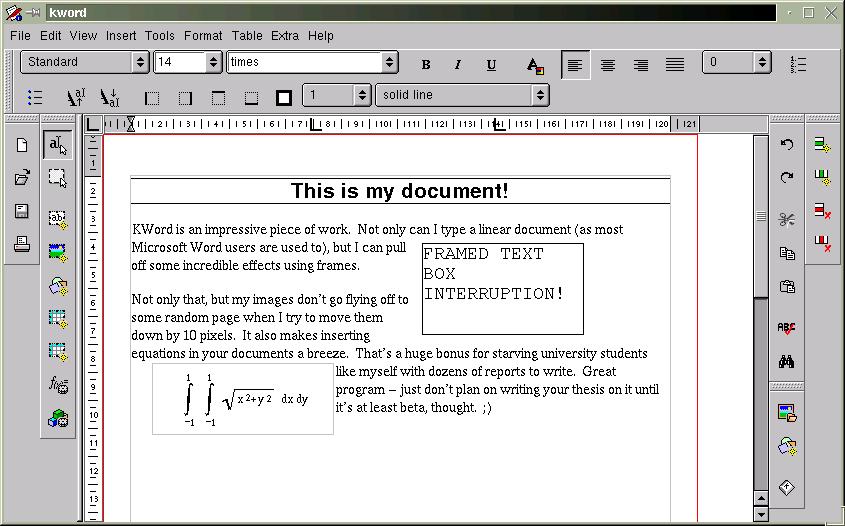
KWord is KDE2's answer to Microsoft Word. Don't take that the wrong way, though. It's not a clone of the infamous Word, but rather an amazing program that can act as either a frame-based document editor for desktop publishing (like FrameMaker), or a word-processer in the traditional sense (like Word or WordPerfect).
The first thing you'll notice about KWord is how different it feels from a classic word-processor. It sure looks like one, but the layout features take a bit of time to get used to. The first mistake you'll probably make is trying to figure out how to modify a frame you put down. Instead of right-clicking the frame to get its properties while you're in a text-editing mode (sorry, Iguess that's a leftover Windows thing), you need to use the "select frame"tool first (it's the second vertical toolbar from the left, the second button down). Once you have this tool selected, you can move and resize the frames to your heart's content. Right-clicking the frame in this mode will give you that elusive popup menu. Don't forget to go back to text mode after you're finished though (the button right above it).
You might wonder why things are implemented this way -- I assure you there is a good reason. Imagine how much time and frustration you'll save yourself knowing that all of the frame objects on your page are essentially static while you're editing text. One of my biggest beefs with the Office suite is the wonderful habit your images have of moving around the page and possibly moving a number of pages down the document if you aren't careful. As well, if you go back to a program like Word, you'll find yourself cursing every time you go to move a text box and start editing the text inside it instead or vice-versa. You don't have to worry about hitting that magical, invisible grippy border that Microsoft expects you to use to move your objects around.
I don't know if it's possible to tie a frame to a particular piece of text, however. This could be useful to ensure your image always follows a description, for instance. There might be a way to do this in the current version, but it wasn't obvious for me (believe me, I looked). It would be nice to be able to set some sort of reference marker, so the image would have position specified relative to the page (as it currently stands), or to the marker, so that moving the text around would move the frame as well.
To help to write documents with consistent layout, KOffice has a solid text style implementation. You can format your text in a number of different header styles and then generate a table of contents from those directly. The "Stylist" command allows you to go in and change these styles to your heart's content. Unfortunately, it seems as if the only table you can generate is a table of contents, and that seems to be hardwired to generate it from the headings. Allowing arbitrary index generation to the release version would be a big benefit.
There are also a number of other great features in this program, like a spell checker, support for tables, generation of tables of contents and the ability to embed any KPart in a document (like a spreadsheet or chart, for instance).
ConclusionsOverall, I'd say this program is well designed and relatively stable, especially impressive given its current alpha status. It's simple to use (after a half-hour of retraining yourself), intuitive, feels responsive and has most of the features that I'd need to write a great technical report. Of course, there are some issues with layout, but they've got enough time to work these out before the release. Best of all, it's free (as in speech) and has a great team of developers behind it.
My final KWord tip:just be careful not to hit the close button if you've got unsaved work (you did save, didn't you?). There's no warning that you haven't committed your changes to disk and no autosave. Uh oh!
Keep in mind that it's still not even a beta yet and many if not most of these issues will be gone by release time.
As the KOffice team says:
"Note: This is not even alpha so it might compile and might work (normally it does), but we do not recommend writing your master thesis with KOffice yet!"
Applixware: Applix Words (5.0 M1 Development Release)
Applixware is a long-time member of the office suite community. The latest development release version of their software, 5.0 M1, has limited support for the GTK widget set.
At the time of writing, Applixware is currently being chastised for a violation of the LGPL. The application suite is statically linked to the GTK libraries. It seems as if someone from Applix may have noticed this, however, as any official downloads seem to have disappeared from their FTP site. There's still a link off Freshmeat to an alternate download site that still has it, but I assume that it should only be a few days from the time of writing before it comes back up with a dynamically linked version.
At $99 for the 4.4.2 Deluxe Edition for Linux, it's not a bad deal for a commercial office suite. The demo lasts for a couple of months, so you can take your time evaluating the suite before committing yourself to purchasing it.
InstallationAt a whopping 80+ MB, the demo of Applixware might not be in everyone's reach. If you're on dialup, I recommend getting a friend with a Zip drive or CD burner to grab you a copy. Make sure you've got a couple hundred megabytes available on your HD as well. I thought Microsoft Office was big!
Installation of Applixware is just as simple as for KOffice. Applixware is commercial, closed-source software, so there are no source tarballs. You'll need to grab the tarball and run the installation script as room. They've set it up to put all the RPMs in the right spots without any user intervention. If you're planning on uninstalling it in the future, make sure you keep the removal script handy!
Everything should work right out of the box. As mentioned by one of the Freshmeat comments, it seems to have some trouble with pixmap themes. It doesn't affect the operation of the program, so you don't need to worry.
FeaturesApplix Words starts up with a light-weight GUI. Even though they claim GTK compatibility, it looks like they just take the colors from the theme and apply it to their custom menus and toolbars. It still looks good, but reminds more of Netscape than a GTK program.
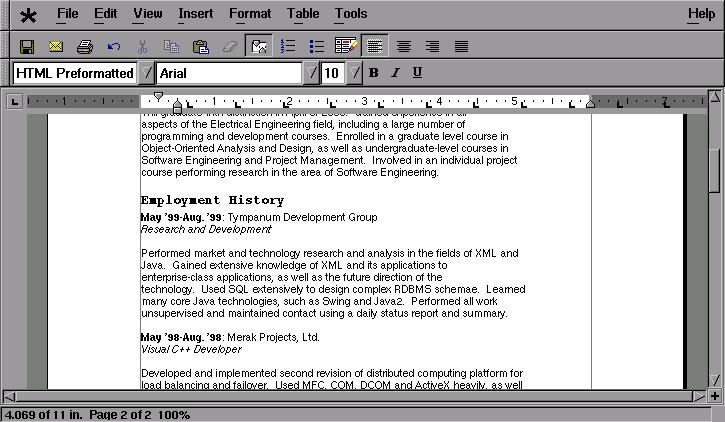
One of their big selling features are the import filters. I decided to try them out by importing my resume from Office 2000. It came out looking virtually identical to the Office version. There were a few minor layout issues, however. One of the header tables had changed size, forcing my telephone number to drop down a few lines and leftward across the page. This was fixed with a simple cut-and-paste. It also insisted on adding space between some bulleted items. Format/Paragraph Settings..., change the insert space before and after text and voila!
Now that I have a beautiful resume in Applixware, how do I get it to the masses? The File/Print... dialog in Applixware is simple and straightforward. It has support for both PostScript and PCL5 printers. In the version I have, there seems to be no way to print other than to a file, but I'm not complaining. It's nice to see my resume in all its Postscript glory. Applix Words is WYSIWYG, too.
Creating original documents isn't quite as straightforward. Coming from a Microsoft Word environment, I'm used to using styles extensively. Even though Word's support tends to be buggy at best, it's still convenient to have a common look-and-feel across a document, as many of you must realize. A blank Applix Words document doesn't come with any of the nice styles, making it virtually useless for anything more than a shopping list. That's okay -- there's an enormous selection of document templates, ranging from letters to reports to press releases. It takes a while sorting through all of the cryptic names, but you can usually find one to fit your purpose and tweak it until you like it. I must say it's nice to have more than just a single style.
In addition to slick styles, Applix Words has support for cross-referencing and a table of contents. These are two features to look for if your job requires technical report writing. As far as I can tell, there aren't any styles for figure and table captions, meaning you'll have to add a couple yourself to create a list of either of these.
If you're one of those people that enjoys using cheesy clip-art, Applixware is the right suite for you. There seems to be thousands of images from all sorts of characters. I still have nightmares about "face 04" in the People category. *shudder*
I have a few minor issues with the user interface. Every once in a while, the flicker of the document pane while using the menus is little annoying. As well, there's a problem scrolling some documents where grey bars appear. That can get annoying at times if you're trying to do a random seek on your document. Applixware is still beta, so hopefully these won't be around in the final build.
ConclusionsApplix Words is neither free as in speech or in beer, but is worth the price if you're looking to spend money on a solid-looking word processor. Add on to that the support for styles, cross-referencing, tables of contents, equations and other nifty features, and you've got yourself a great tool for developing technical documents under Linux. The import and export features ensure you'll never feel left out of the Windows community.
Feature Comparison ChartI hate to say it, but most charts of this kind are biased towards one product or another. I've tried to make this chart unbiased to reflect the requirements of a technical writer, rather than showcase the features of any single product. Any word processor can create a simple document, but there are a number of features that make creation of a technical document much simpler. These are the features (in addition to the required features of the programs) that I've chosen to include here:
- Styles: Support for document text style is important, especially from the view of the technical report writer. It allows someone to spend more time on the content, rather than the layout.
- Tables: Table support is important when organizing data in regularly-spaced, easy-to-read formats. To see why tables are important, try reading table data in a browser like Lynx. Yikes.
- Indexing: Generation of TOCs and Lists of figures and tables makes a document writer's life easier. Without them, you need to go back at each revision and manually change page numbers. I guarantee you'll miss a few.
- Printing: Why word process if you can't print? 'Nuff said.
- Import filters: In a world of Windows, it's inevitable that Word- and Wordperfect-format documents are passed around. Being able to import a number of different formats only adds value to a product and allows it to integrate more seamlessly into the work environment.
- Equation editing: Not all technical writers require equations, but those involved heavily in math, engineering or computing science theory will find this useful.
Product Devel
Status Download Size Cost Styles Tables Indexing
(TOCs and other) Printing
Capability Import Filters Equation Editing Stability Look and feel KWord pre-beta Alpha 29 MB Free Yes Yes Yes PostScript Minimal Yes "Quirky" Excellent Responsive Applix Words 5.0 M1 Beta 80 MB $99 Yes Yes Yes PostScript
or PCL5 Extensive Yes Solid Good
GUI tends to flicker ConclusionsThe concept of "Linux on the desktop" is getting closer to reality on a weekly basis. From the strong showing of KOffice and ApplixWare, we can see that the world of word processing and other office work isn't a dangerous task for Linux fans. The experience of creating documents under Linux is far from painful, especially with the fully featured office suites available.
KOffice is still a ways from being a complete, stable office suite, but is very feature-complete for being alpha status. The interface is busy, but not cluttered, and almost everything necessary for a good document is available. It's fast, responsive and feels very lightweight. Keep your eye on this one -- it's going to be great. Oh yeah... it's free too.
ApplixWare is a lot older, and being so gives it a huge headstart on KOffice in terms of features. It's way bigger and feels a little overwhelming at times. They haven't put work into making it look as pretty as it could, but it gets the job done, and does it well at that. Hopefully by the time it's past beta, they'll have done some work on the UI. At the given price ($99 for the previous version, hopefully the same for this one), it's a pretty good deal.
Whichever package you choose, you can still rest assured that Linux is and will continue to be a productive desktop environment, rather than just a hacker toy it's been seen as in the past.
-
KDE Krash Released
Amphigory writes "KDE Krash (the first 2.0 beta) has been released. You can download the source here. " Warning: This is an *unstable developer's release*, so don't complain about it crashing. KRASH is the upcoming KDE Desktop V2.0 environment. The comment from the KDE guys here is that this is not for people who don't know what they're doing. -
KDE Krash Released
Amphigory writes "KDE Krash (the first 2.0 beta) has been released. You can download the source here. " Warning: This is an *unstable developer's release*, so don't complain about it crashing. KRASH is the upcoming KDE Desktop V2.0 environment. The comment from the KDE guys here is that this is not for people who don't know what they're doing. -
Interview: KDE Developers Answer Your Questions
Last week, Microsoft and antritrust. This week, thoughts on KDE's future from some of the people who work directly on it, specifically Kurt Granroth and Richard Moore. Instead of posting their e-mail addresses here and swamping them with messages, please see http://developer.kde.org, which will tell you not only how you can contact these gentlemen, but much more about KDE development.Before we get down to business, we'd like to stress that these are the opinions of individual KDE developers. The answers below are not *necessarily* the same as the KDE Official Position on matters. If you wish to know THE official opinion on any of these, contact the KDE Core Team through any of the official representatives.
Now that's out of the way, so here we go:
1) by joshv
One of the biggest limiting factors that stops me from moving to Linux for 100% of my computer use is the poor support for MSOffice file formats in Linux Office apps.What level of support will KOffice provide for MSOffice file formats?
Kurt Granroth answers:
The level of support is entirely dictated by how much support the filter authors are willing to do. I can guarantee that we won't have 100% compliance with Office97 formats if only because it's not possible to get the complete specs for all the formats. My personal feeling is that we will have support for the most common parts of Word97, Excel97, and Powerpoint97 for KOffice 1.0 (or soon after) but the more esoteric features will be lacking.As I said, though, it's entirely up to those who are actually writing the filters. If somebody (or several somebodies) jump into filter writing fulltime, then it's entirely possible that we will have the best filters in the Unix world. We'll have to see what happens...
2) by jd
There are a number of competing environments in X, now, such as KDE and Gnome. In addition to that, there are emerging whole new windowing systems, such as Berlin. Add a sprinkling of GGI, KGI and EvStack for good measure, and you've a real gloopy mixture of ideas and strategies.In light of this, where do you see the desktop in, say, 5 or 10 years time?
Richard Moore answers:
I think the X environments will become much more interoperable as standards are defined for functionality such as .desktop files, drag and drop and the capabilities of modern window managers. The standards around at the time the KDE project started (such as the ICCM standard) do not define these service. Now that there are some real standards being defined (and implemented) such as XDND and the new window manager specification the diversity of X can be made a strength rather than a weakness.Developments such as Berlin and GGI are interesting, but they are not really much of a concern to KDE. As these projects become more mature it may be worth porting our code, but for now this is not a priority. One of the advantages of writing highly object oriented code (and using a cross-platform framework such as Qt) is that it is very easy to port, and should the need arise this would not be problem. However as X is improving anyway, especially with the current developments in XFree86 such as GLX support (hardware accelerated 3d) the arguments for a new windowing system are not very strong.
Over the next few years I expect to see evolutionary, rather than revolutionary changes to the desktop. As usual there will be lots of new ideas around, but only some of them will stand the test of time. I think there is likely to be much more emphasis on the 'look' of the desktop, and on improving the ways data is presented. Some trends such as greater use of multimedia, more 3d, more use of transparency are likely to continue, but it is hard to say what else will be around.
Kurt Granroth answers:
Personally? I don't think it will be significantly different. I know that there is a tempation to say that in 5 years, the desktop metaphor that we currently use will be dead and we'll have some radical new approach. Well, I don't believe it. "Normal" people really aren't very willing to change what they are comfortable with.. and they are now comfortable with the desktop approach. Any changes that happen will have to happen gradually over a period of time.Now whatever happens, I'm sure KDE will roll with the change. With only a few exceptions, our API is pretty well abstracted from the graphics layer. Say the next big thing is an OpenGL 3-D graphics background (is that what Berlin is?) -- all KDE needs to do is convert a few parts of the base Qt library and we'd be good to go on the new backend.
3) by Jon Trowbridge
What are your thoughts on both the current status and the future of interoperability between KDE and Gnome in areas like components, CORBA, etc.Do you see the two projects moving closer together, moving further apart, or staying about the same?
Richard Moore answers:
There are some areas where cooperation between KDE and Gnome is possible, and others where it is more trouble than it is worth. There has already been good progress to produce standards for .desktop files and window manager hints. The functionality needed for these is well understood making them relatively easy to standardise from a technical point of view. It is less obvious how more complex technologies such as component embedding and reuse can be defined in a usable standard. That said however several KDE apps have been ported to Gnome and when we release KOffice, KDE 2.0 etc. I imagine they will want to try to embed our components - if they can get it to work they are welcome to. I don't really see the projects moving closer together though as we have very different ideas about how the desktop should work.Kurt Granroth answers:
Please see my answer to question #7.4) by Zarniwoop
What do you plan to support in Konqueror, ie CSS, Java, HTML type, and will it function as a file manager or will KFM still have that function?Richard Moore answers:
Konqueror is using Lars Knoll's new DOM based HTML component - it already supports almost all of HTML 4.0. Support for Javascript is progressing, though the DOM bindings are unfinished as is support for CSS, both of these are under active development and will probably be ready for KDE 2.0 (though not for the Krash release). Java support is partially complete - most simple applets now work, but there is currently no support for applets in JAR or ZIP files. In addition it is now possible to create plugins for Konqueror that can further extend its functionality - in future there may even be a bridge that allows the use of Netscape plugins!In addition to being a web browser, Konqueror can do a lot more - it is able to embed different types of view using the new KParts framework (briefly known as Canossa). This means that it is possible to view any type of content (eg. text files, postscript, DVI files etc.) within Konqueror. The views are loaded and unloaded as needed which keeps the browser itself nice and lightweight. A view doesn't just embed the content - it also has access to the menu and status bars, drag and drop etc.
The file management component is embedded in Konqueror, so to a user it works in much the same as with the old KFM did, only better. The file view has been completely rewritten and now provides a much more polished user interface, for example you can have multiple views and you can load and save workspace layouts. As before the files are accessed using kioslaves allowing you to transparently access both local and remote files. The ioslave code has been rewritten to improve performance and to make it easy to add new protocols. There are a number of new protocols already implemented (such as SMB a.k.a. MS Windows shares) and also extensions to the existing protocols (such as SSL support).
Kurt Granroth answers:
Konqueror is a generic browser -- it has the capability to browse almost any medium that it has a component for. That is, with our treeview and iconview (and similar) parts, we can use Konqueror as a file manager. With the helpcenter component, we can browse help files (html, man, and info). With the kghostview component, we can "browse" postscript and PDF files.And with the html part, we can browse the web. This component is clearly the one that gets the most attention -- and deservedly so! We (mostly Lars Knoll, though) are working on an HTML library that is fully HTML 4.0 compliant. It is already pretty darn close. We use DOM Level 1 as our document model and should have some parts of Level 2 in by KDE 2.0. We will surely have support for CSS1 and *maybe* support for parts of CSS2. We already have minimal support for Java applets and Javascript.. and the capabilities of both will increase by KDE 2.0. In the case of Javascript, we should be able to handle 90% of the most common pages on the web.
Hmm.. I think we'll have some support for parsing xhtml and embedded XML, also.
Konqueror is essentially the next generation KFM, BTW. It does everything KFM could do.. and tons more! Furthermore, it does it much faster and using much less memory.
5) by Kris Warkentin
I've heard that KDE 2.0 will be using a new window manager KWin rather than KWM. Now I know that KWM is a big fat hog but I haven't been able to find much info about KWin. What are the advantages to this new window manager? Is it an evolution from KWM or a completely new, from the ground up program?Kurt Granroth answers:
KWin is a new, from the ground up, program. It is written to be more modular and extendible and to have theming and MDI capability built-in (kind of.. see below). It is also a tiny bit better with memory.The 'theming', BTW, is pretty cool because, technically, KWin doesn't do theming at all! KWin is really just a window manager library that you can build a window manager on top of. When you write a 'theme' for it, you are (in ways) really creating your own window manager with that particular look. This means that you aren't limited at *all* to the inherent theming capabilities of the wm if you are willing to do a little programming. And I do mean "a little" programming -- the BeOS example style is less than 200 lines of very easy to understand code.
However, I take exception to calling kwm a "big fat hog". If you use kwm with KDE, then it is no more memory intensive then any other modern window manager. In my experience, kwm is as fast and light as any other full-featured window manager out there.
6) by Otter
When designing KDE, what is the minimal hardware quality you expect it to run comfortably on? Is it currently available low-end, one year old low-end, three year old low-end...?Kurt Granroth answers:
Well, whenever I recommend computer systems these days, I always insist on at least 64M memory, a 6G hard drive, and a 366Mhz system. That said, we made sure that KDE will run on significantly less then that :-)The consensus seems to be that 32M is the minimum that you could comfortably use. You could use less.. but then you'd have trouble with just bare X, much less KDE. Hard drive size and processor speed shouldn't be a major factor at all. Video cards shouldn't play a significant role, either. We now ship high color (24-bit) icons.. but we won't drop the 8-bit icons until we're sure that all 8-bit cards are gone.
Keep in mind that the above recommendations are for the x86 platform. You may need to adjust the numbers when referring to, say, SPARC or Alpha chips.
7) by TheGreek
Has the long-standing flamewar between KDE and GNOME helped to motivate development of a better product, or has it just made you annoyed at the community at large?Richard Moore answers:
No.Kurt Granroth answers:
(This is also my answer to question #3)It may suprise some people, but most KDE developers don't wake up every morning thinking about GNOME -- I know that *I* don't! In fact, I very rarely think of them at all. I spend my time thinking of, and working on KDE.
Do I think that the KDE and GNOME "war" has motivated a better product? No! I think the whole "competition makes for better products" thing is bunk. KDE developers work to make KDE the best that they can -- and they would be doing so even if GNOME didn't exist! KDE would be exactly where it is right now regardless of the status of GNOME.
Has the "war" made me annoyed at "the community"? At times in the past, I did get annoyed at those participating in the flamewars. I think it's incorrect to say that they are "the community", though. The fact that KDE has an overwhelming majority of Linux desktops shows that "the community" (if there is one) has been behind KDE all along. Those flaming KDE are easily dismissed.
Now all that said, I'm a big supporter of working together with GNOME to standardize as much low level things as possible. Let's face it, there are some nice apps coming out of the GNOME/Gtk camp and it would be a shame if they couldn't be easily integrated into the KDE desktop. I want to be able to use, say, xchat, gvim, or gimp and have them look, feel, and act as much as possible like my other KDE apps.
This means that what needs to be standardized is things like drag 'n drop, window manager "hints", file associations, menu structure, key bindings, themes, and the like. Work is already done or in progress on the first three listed and the last bunch look promising. On the themes note, I seriously doubt that we will have 100% compatibility between GNOME and KDE themes.. but we should get pretty close by having theme
8) by twdorris
I believe that one of the MAJOR problems facing *any* UNIX system wishing to compete on the desktop fr level printer driver support. It's been a while since I've coded X-apps, but from what I recall, there was no way to "cleanly" handle print functionality. By that I mean, I always ended up with one routine to draw to the screen and a completely separate routine to write my PostScript output for printing. I believe this may still be the case give how many different print interfaces I see in various applications running under Linux. No two user interfaces are the same and no two produce similar results. To an end user (at least at the desktop level), this is extremely frustrating and it's one of the main reasons I *have* to keep Windows around. I need to print things reliably and with a high degree of quality and there's just no clean, easy way to do that under Linux or any other UNIX OS for that matter.As for device driver support, I've used Ghostscript extensively in the past and while it's impressive, it's a FAR, FAR cry from being comparable to a vendor-supplied, Windoze-based driver equivalent with regard to quality of output and reliable printing. As an example, try printing a high resolution image to an Epson Photo 700 under Windows and then do the same under Linux using Ghostscript. The two are completely different and it's not in favor of Ghostscript.
All this leads me to my question for you guys. I use KDE along with KWM as my working environment at home. How do you see printing functionality being affected or enhanced by KDE and do you have any suggestions for how to improve upon the current state of things? Is there a huge re-write of printing support under *nix systems that I don't know about and that most applications these days are being coded to? I strongly suspect so, because there's no way in hell Linux will be able to compete in the desktop market if every application is required to write out postscript data manually and/or include printer drivers for every printer known to man. Both Windows and Java take an approach to printer support that ties printing code to display code and I believe something similar is *really* needed under Linux and/or X11. Do you guys have a feel for what the future holds with regards to printer support under *nix systems? Having coded a complete office package yourselves, I'm sure you have a pretty good idea... :-)
Kurt Granroth answers:
There are a number of parts to the printing problem... and only a few can be solved at the KDE level. We actually have a very nice printing mechanism in KDE using the Qt library to do all the real work. If you've done any Windows programming, you'd see that it is *similar* to the way that MFC handles printing. Basically, we 'draw' onto objects with QPrinter and QPainter.. and really don't care if the final output medium is paper or a screen. All of that work is handled at the Qt level.Specifically, Qt will render it up into postscript if the code is intended for paper (e.g, a printer). It then uses whatever printer drivers are available to do the actual printing.
This is where the differences between printing in Windows and printing in Linux start shining through. You are correct that on most low-end printers (i.e., non-laser), the output in Windows is *much* nicer. This is out of the control of KDE, however. The drivers need to work at the OS level.. and it's there that they need to get a lot better.
I believe that there is some work to get vendors to ship official drivers for Linux. If/when that happens, then all output from KDE apps will immediately see the improvement. The actual code in the apps won't have to change at all.
09) by Ledge Kindred
I don't follow KDE development extremely closely, but it seemed to me that details about Magellan popped into sight very suddenly and vanished again nearly as quickly. Considering the power and capabilities detailed in the article linked above, this sounds like a major component to having a devastatingly powerful desktop based on KDE2, since an easy-to-use EMail client like Magellan would fulfill one of the two basic "killer apps" I imagine an average user would want from a desktop environment. (The other being a decent web browser, which KDE2 looks to also provide with Konqueror.) Is development of Magellan still on track? Can we reasonably expect it to live up to expectations? Or is this considered an "out provide and therefore outside of what you can comment on?Kurt Granroth answers:
Magellan isn't part of the KDE project... but we're glad to see it coming along. Third-party apps like Magellan, QCad, KDevelop, and KDEStudio are very valuable even if they aren't provided with the KDE core packages.Now personal opinion time on Magellan: the screen shots look *very* nice and if it has all the functionality it claims.. well, I think there will be a lot of ex-Outlook users that will be very happy. That said, I've never actually seen it working or seen one line of code from it. The author certainly has the right to keep it all hidden before release.. but until it is, it's just vaporware with very pretty screenshots.
10) by Tom Christiansen
What non-Windows systems have you evaluated in mining existing technology for ideas? How about XEROX Star or OS/2 or Amigas? Have you ever looked at AVS, the scientific visualization graphical shell? It has (or had, when I long ago looked at it) a very cool graphical representation in which datasets and filters get connected in by pipelines in a visual rather than a CLI way, which is sometimes easier to produce. IF you haven't seen it, think of what it might be to combine drag-and-drop with connect-the-dots...Kurt Granroth answers:
The systems we mine are those that we've used. So you can see elements of Windows, MacOS, NeXT, and traditional Unix desktops like CDE. We do try to emphasize the visual elements from Windows and MacOS because, let's face it, that's where the newbies are coming from and we want to make sure that they have a comfortable, intuitive environment to work in. It should be possible for an ex-Windows or ex-Mac user to sit down in front of a KDE workstation and figure out how to use it very quickly and with little or no help. It's possible that there are some OS/2 inspired elements in KDE, too.. but I don't think I'd recognize them if they were there (I haven't used OS/2 in years).As for the 'connect-the-dots' approach.. I believe that various KDE apps are doing something in that vein. aRts does (or did). I could have sworn that there were more. We currently have no plans of doing this in the core KDE stuff.. but who knows what will happen after KDE 2.0
Actually, it's interesting that you mention AVS because we *did* have a rather extensive discussion about treating everything as graphical pipes about a year ago (I think). If my memory holds true, we decided that it's a great idea but we probably couldn't pull it off by KDE 2.0 if we wanted it to be stable, usable, and intuitive. Like I said, we'll see what happens after 2.0
-
Interview: Ask the KDE Developers
Gnome has gotten the lion's share of Linux desktop publicity lately. Meanwhile, KDE has been quietly working on KDE2.0, which will hopefully contain several interesting features including a WWW browser called Konqueror and the long-anticipated KOffice, a free office suite that may provide a viable GPL *nix alternative to StarOffice and Applixware. Rather than speculating, we've decided to ask the people who are actually doing the work what they're up to. Post your questions below. Tuesday we'll send 10 - 15 of the highest-moderated ones to selected KDE developers. Answers will appear Friday. -
KDE 2.0 in Action
Stormie writes "KDE hacker Mosfet has just put up on his web page a section entitled KDE2.0 in action with a rundown of what is coming in version 2, along with a bunch of great screenshots. Exciting stuff!" -
A Linux 'Browser War' in the Making?
We all know about Mozilla. It's one of the major 'poster children' for the entire Open Source concept. Build 9, Build 10, Build 11, and so on. Someday there will be a Mozilla that will run without crashing, and we'll love it. Someday. Then there's Opera's Linux - and BeOS, Mac, EPOC and OS/2 - ports. Over the last week we've had 100+ readers submit the news that (proprietary shareware) Opera for Linux is close to beta release. But there's another potentially exciting Linux browser in the works that has hardly gotten any publicity. (continued)I learned about the new KDE browser project almost by accident. The concept is only a few months old, and active work on it only started a few days ago. Konqueror - "Konq" for short - is not the spotty KFM utility included in the current KDE release, but a whole new code base.
The people working on Konqueror are worried about getting too many people's hopes up too hard and fast; if they do, and if they run into Mozilla-type slowdowns, they'll end up with plenty of egg on their faces. All they're willing to show the world at this point is this screenshot.
It's amazing how far Konqueror has come in almost no time, especially when you realize that this is a purely volunteer project with just a few members, not a big deal with big money from a big company like AOL/Netscape behind it.
Are there other Linux browsers in the works? Good question; if you know of one, please tell us about it.
Another question: Would more volunteers help Konqueror? Perhaps, perhaps not; the KDE developers aren't sure that more bodies would necessarily help.
Should we all get behind Mozilla and push? Yet another good question - and one that's been hashed to death all over the place but hasn't been fully answered yet.
Whatever the answers, I believe most Slashdot readers agree on one thing: that a better Linux browser would be a Good Thing(tm).
We have a little poll about Linux browsers to the right of this story. And, as always, your thoughts on the subject are more than welcome.
-
A Linux 'Browser War' in the Making?
We all know about Mozilla. It's one of the major 'poster children' for the entire Open Source concept. Build 9, Build 10, Build 11, and so on. Someday there will be a Mozilla that will run without crashing, and we'll love it. Someday. Then there's Opera's Linux - and BeOS, Mac, EPOC and OS/2 - ports. Over the last week we've had 100+ readers submit the news that (proprietary shareware) Opera for Linux is close to beta release. But there's another potentially exciting Linux browser in the works that has hardly gotten any publicity. (continued)I learned about the new KDE browser project almost by accident. The concept is only a few months old, and active work on it only started a few days ago. Konqueror - "Konq" for short - is not the spotty KFM utility included in the current KDE release, but a whole new code base.
The people working on Konqueror are worried about getting too many people's hopes up too hard and fast; if they do, and if they run into Mozilla-type slowdowns, they'll end up with plenty of egg on their faces. All they're willing to show the world at this point is this screenshot.
It's amazing how far Konqueror has come in almost no time, especially when you realize that this is a purely volunteer project with just a few members, not a big deal with big money from a big company like AOL/Netscape behind it.
Are there other Linux browsers in the works? Good question; if you know of one, please tell us about it.
Another question: Would more volunteers help Konqueror? Perhaps, perhaps not; the KDE developers aren't sure that more bodies would necessarily help.
Should we all get behind Mozilla and push? Yet another good question - and one that's been hashed to death all over the place but hasn't been fully answered yet.
Whatever the answers, I believe most Slashdot readers agree on one thing: that a better Linux browser would be a Good Thing(tm).
We have a little poll about Linux browsers to the right of this story. And, as always, your thoughts on the subject are more than welcome.
-
The Battle That Could Lose Us The War
Quite a number of people have been writing to us about Dave Whitinger's column that ran on LinuxToday and was sent over here as well. Dave's contention is the browser compatibility is a crucial battle for the success of Linux - and things don't look so good. Click below to read the column, and contribute your thoughts.By Dave Whitinger, dave@wmkt.com (Temporary E-Mail account)
Linux is quickly becoming the operating system of the future, thanks in part to the advanced type of development that we refer to as Free Software, or Open Source, as well as the rock-solid features that are present in Linux. It is the ultimate server platform.
Linux is also enjoying success as a desktop workstation. My wife, Trish, makes the perfect example of the typical desktop user.
When we became married in August of 1996, she was a complete computer illiterate, having never even used a Windows or Unix machine. I presented her with a choice:
- I will give her a Windows computer, but will offer nothing in the way of technical support or training assistance.
- I will give her a Linux box, and will give her complete technical support and training assistance.
A New Hope
Not knowing the difference anyway, she chose the latter, and found herself extremely happy with a rock-solid desktop.
She enjoys her Red Hat Linux 6.1 workstation. Coupled with the K Desktop Environment and various applications that I have installed for her, she's ready to go. She has her TkRat E-Mail program, Netscape Navigator, notepad text editor, licq, games, the Gimp, and a variety of other nice applications, all accessed via a friendly interface.
Finding friends in mailing lists and on-line web-based chat groups, she was happy as a clam. She would fire up her Netscape Navigator and hit any web site she wanted, and was constantly bragging to her friends about this great computer operating system that she had the privilege of using.
The Empire Strikes Back
...Until the day that Netscape Navigator, her web browser, her window to the outside world, the major purpose for using the computer, simply disappeared from her desktop while she was browsing.
Trish turned to me, confusion spread across her face, and opined, "Dave, my Netscape has simply vanished from my screen. Perhaps you have telneted in and did a kill -9 on it?"
Dave responds, "Absolutely not! Why would I do that? Let's examine the problem more closely, that the answer to this perplexing issue will reveal itself."
Upon further investigation, it turns out that Netscape apparantly did not "like" the Java code that was being incorporated into one of the websites that Trish frequents. My solution: Turn off Java.
A very important and critical issue is realized here. At this point, Trish's computer is not as powerful as all of her friends' Windows computers. If they can access certain Java-enabled pages that she cannot, she is being left out, all because she chose to use Linux.
Fade to 2 or 3 weeks later.
Trish: "Dave, this website is telling me that I cannot use their services."
Dave: "What's the URL?"
Examining the website, it turns out that it is using some special kind of plugin that is only available for Windows or Macintosh platforms. I explained to Trish that she simply will not be able to access the services on this website, until they decide to make this plugin available for Linux. A short and polite note to the webmaster later, there was nothing we could do, and the issue was closed, and Trish's computer became even less valuable to her.
Fade to 2 or 3 more weeks later.
Trish: "Dave, this website is telling me that I am using an unsupported web browser, and cannot view the pages within."
Dave: "Okay, this is starting to make me angry. The web was initially created as a completely open environment where multimedia can be viewed, regardless of your platform. It's a platform independant medium, yet here are people making platform dependant websites."
Trish: "That's great that you feel that way, but I just want to access this coupon website! All my friends say they are getting great deals, and I'm missing out! Oh, and now my netscape just froze again! Argh, (killall -9 netscape ; rm ~/.netscape/lock) again. I want a Windows computer like all my friends have."
I hung my head in shame, realizing that if she is going to be able to take full advantage of the web, she will need a Windows computer. Trish, who has used nothing but Linux for over 3 years, and is completely happy with her computer, now feels the need to switch to Windows so that she can get the same web-browsing features as her friends.
Does this sound like a big deal to you, gentle reader? If it does, than I have accomplished my mission. If it does not, read on:
In 1994, I hated Netscape Communications, Inc. The way they were embracing and extending the HTML standards was starting to become very disturbing for me. The more websites that I found that said that it uses Netscape Extensions, the more angry I became.
Then Netscape released Navigator for Linux, and everybody loved them again. They were our saviour, completing the picture of a perfect desktop for Linux users. We were all Linux users, browsing any site we wished, enjoying the satisfaction of having a great web browser for our desktop.
Then Microsoft created Internet Explorer. Then Microsoft won the "Browser War". Then webmasters began using some of the "advanced" features of Internet Explorer, shutting out Netscape users.
Problem yet? Still not convinced? Okay, let's fast forward 1 year:
Microsoft owns 99% of the web browser market share, and they control the HTTP protocol. They start adding a huge variety of features to their "Internet Information Server", their competitor to Apache, to offer advanced features to Internet Explorer clients. At this point, sites being served by Apache become useless. Then Linux becomes obsolete as a web server platform. Then Microsoft wins the war, and we're right back to square one, and proprietary technology wins again.
Return of the Jedi
On April 1st, 1998, Netscape Communications, Inc. made one final redeeming move. They released the source code to Netscape Navigator, freeing it to the Free Software community to do with as they chose.
1 and a half years later, this browser is still nowhere near completion. There is a band of rebels working feverishly on the code, trying to bring it to a usable state as quickly as possible. Plagued with problems and set-backs, Mozilla continues forward, currently at "Milestone 10". Will we see a completely usable web browser for Linux in time to save us from seeing a new monopoly for Microsoft be created?
Attention: This is the battle that could cost us the war. If we come together and push all of our might toward a Free Web Browser for Linux, we have a good chance of winning this battle. If we fail, we will lose the war. This is the issue that Microsoft wants us to overlook.
I am making a personal committment to get involved with the Mozilla project. It is the project with the most potential to become this Free Web Browser that we so desperately need. Netscape is NOT going to save us this time. Netscape has failed us, and it's time to take matters into our own hands.
If we fail, we will lose the war.
Add that to your .signature:
If we fail, we will lose the war.
And repeat it every morning to yourself:
If we fail, we will lose the war.
When you are looking over Mozilla, finding items that could use your contribution, remember:
If we fail, we will lose the war.
The truth of the matter, friends and esteemed members of the community:
If we fail, we will lose the war.
-
KDE 2.0 Technology Overview
Recently, there was an article about a KDE 2.0 Technology overview here on Slashdot. Unfortunately, the article it linked to was missing some details and didn't give some necessary information, which caused a huge number of complaints and misunderstanding in issues like CORBA, DCOP etc. Now mofset has posted an updated Technology Overview with all the explanations about what's going on with KDE 2.0, CORBA, DCOM, KSycoca and other terms. What do you think?