Slashdot Mirror
Domain: kde.org
Stories and comments across the archive that link to kde.org.
Stories · 648
-
KDE 3.3 Beta "Klassroom" Released
twener writes "The KDE team has announced the Beta 1 development version of the upcoming KDE 3.3 release. This release is named 'Klassroom' following the 'Kindergarten' Alpha; the goal is to make this child visit the "aKademy" KDE World Summit in August. Most planned features are there, next week starts the feature freeze. Source and provided binary packages are listed on the KDE 3.3 Beta 1 Info Page next to the KDE 3.3 Requirements List." -
KDE 3.3 Beta "Klassroom" Released
twener writes "The KDE team has announced the Beta 1 development version of the upcoming KDE 3.3 release. This release is named 'Klassroom' following the 'Kindergarten' Alpha; the goal is to make this child visit the "aKademy" KDE World Summit in August. Most planned features are there, next week starts the feature freeze. Source and provided binary packages are listed on the KDE 3.3 Beta 1 Info Page next to the KDE 3.3 Requirements List." -
KDE 3.3 Beta "Klassroom" Released
twener writes "The KDE team has announced the Beta 1 development version of the upcoming KDE 3.3 release. This release is named 'Klassroom' following the 'Kindergarten' Alpha; the goal is to make this child visit the "aKademy" KDE World Summit in August. Most planned features are there, next week starts the feature freeze. Source and provided binary packages are listed on the KDE 3.3 Beta 1 Info Page next to the KDE 3.3 Requirements List." -
KDE 3.3 Beta "Klassroom" Released
twener writes "The KDE team has announced the Beta 1 development version of the upcoming KDE 3.3 release. This release is named 'Klassroom' following the 'Kindergarten' Alpha; the goal is to make this child visit the "aKademy" KDE World Summit in August. Most planned features are there, next week starts the feature freeze. Source and provided binary packages are listed on the KDE 3.3 Beta 1 Info Page next to the KDE 3.3 Requirements List." -
Interview: Xandros and KDE
Fabrice Mous writes "The Xandros Desktop OS is known for their intuitive graphical environment that works right out of the box. Their polished desktop product is based on KDE. The KDE News website had the privilege to talk to Rick Berenstein, Xandros Chairman and CTO and Ming Poon, Vice President for Software Development about Xandros and their products and the relationship between Xandros and the KDE project. Without further ado ... enjoy the interview!" -
Interview: Xandros and KDE
Fabrice Mous writes "The Xandros Desktop OS is known for their intuitive graphical environment that works right out of the box. Their polished desktop product is based on KDE. The KDE News website had the privilege to talk to Rick Berenstein, Xandros Chairman and CTO and Ming Poon, Vice President for Software Development about Xandros and their products and the relationship between Xandros and the KDE project. Without further ado ... enjoy the interview!" -
Interview: Xandros and KDE
Fabrice Mous writes "The Xandros Desktop OS is known for their intuitive graphical environment that works right out of the box. Their polished desktop product is based on KDE. The KDE News website had the privilege to talk to Rick Berenstein, Xandros Chairman and CTO and Ming Poon, Vice President for Software Development about Xandros and their products and the relationship between Xandros and the KDE project. Without further ado ... enjoy the interview!" -
KDE Conquers Astrophysics With Kst
Telex4 writes "The Free Software community is constantly inundated with interesting new projects, but occasionally something crops up which is really special. Kst is just such a project. Started by Barth Netterfield, an astrophysicist, as a personal project to plot data from his experiments, it has now taken on a life of its own, being used in numerous academic projects, and finding funding from several government agencies. Intrigued by this project's success, and with a little prod from co-developer George Staikos, I interviewed Barth and George about kst, Free Software and physics." -
KDE 3.2.2 Released
An anonymous reader writes "The KDE Project today announced the immediate availability of KDE 3.2.2, a maintenance release for the 'advanced and powerful free desktop for GNU/Linux and other UNIXes'. The new version provides corrections of problems reported using the KDE bug tracking system and enhanced support for existing translations. Mirrors found here." -
KDE 3.2.2 Released
An anonymous reader writes "The KDE Project today announced the immediate availability of KDE 3.2.2, a maintenance release for the 'advanced and powerful free desktop for GNU/Linux and other UNIXes'. The new version provides corrections of problems reported using the KDE bug tracking system and enhanced support for existing translations. Mirrors found here." -
A Taste of Qt 4
Karma Sucks writes "In 'A Taste of Qt 4', Trolltech reveals that it is positioning Qt 4 directly against Java. Qt 4 promises to be smaller and faster than its predecessors and there will be a boatload of new features including support for non-GUI applications and accessibility under Linux using Sun's ATK. More controversial is the introduction of a new and elegant foreach construct. Incidentally, for those still opposed to Qt's moc preprocessor, Havoc has some interesting comments. It is possible the idea will be adapted to provide GObject introspection in the future." -
Interview With Trolltech's CEO and CTO Eirik Eng
jlp2097 writes "There is a great and lengthy interview at the The Dot with Eirik Eng, CEO of Trolltech, and Matthias Ettrich, founder of the KDE project and CTO of Trolltech. They talk about the recent X(Free86) trouble, accessibility in QT, Trolltech's finances, Qtopia, the OS X Port and a GPL'd Windows QT - it's probably not going to happen. And, did you know that Qt is pronounced 'Cute' by its creators?" -
Demonstration Against Software Patents in Europe
bram.be writes "On April 14, FFII is organising a walking demonstration in Brussels against the legalisation of software patents in Europe, as well as a legislation benchmarking conference. Like in August last year, these events will be accompanied by an online demonstration whereby webmasters are asked to close their websites in protest. The reason for the renewed protest is that after the European Parliament voted for a great directive, it is now the Council of Minister's turn, whose working party proposes as 'compromise' to simply discard all good amendments and on top of that to even make program publication an infringement. Already more then 1300 sites participate in the online demonstration. Among them are some big sites like KDE, the GNU Project and the Gimp. Also, on April 15 the European Greens/EFA group is organising a Euro-LUG party inside the European Parliament, 'with a view to enhance the networking among the free software community in Europe [...], to inform the EP about what free software is, how it works and which ideas lie behind.' Speakers will include Gwen Hinze (EFF), Jon Lech Johansen (DeCSS), Georg Greve (FSF Europe and Alan Cox. Prior registration is mandatory for this event." -
More SUSE Linux 9.1 Reviews
JoshuaTreeCA writes "Adam Doxtater of Mad Penguin has published another excellent review... this time on the newest SUSE Linux 9.1 beta-release. This release comes complete with the latest GNOME and KDE enviroments as well as being the first distro to present a retail package built on kernel 2.6.4 Check out the review, with screenshots." rokzy also wrote in with another review from NeoLink Computers. -
SVG And The Free Desktop(s)
unmadindu writes "Christian Schaller has written an interesting article on SVG's current and possible uses on the GNU/Linux desktop. Though the article concentrates mostly on GNOME, it does mention the excellent work the KDE developers have been doing with KSVG, and refers to the upcoming SVG support in Mozilla too." -
Modernizing the Save Icon?
floppy-less asks: "In nearly every modern GUI, the floppy disk icon is used to symbolize saving files. With the fate of floppy disks becoming apparent, what will become of the esteemed 'Save to Disk' icon? Will it become a CD-R? a hard drive? a portrait of Jesus?" -
KDE 3.2.1 Released
TheSurfer writes "The KDE project today announced the immediate availability of KDE 3.2.1, a maintenance release for the latest generation of the most advanced and powerful free desktop for GNU/Linux and other UNIXes. KDE 3.2.1 ships with lot of bug fixes since KDE 3.2 and is available in 49 languages (now including Bengali, Icelandic, Japanese, Lithuanian, Low Saxon, Latin Serbian and Tajik). Sources and contributed packages are linked on the KDE 3.2.1 info page." -
KDE 3.2.1 Released
TheSurfer writes "The KDE project today announced the immediate availability of KDE 3.2.1, a maintenance release for the latest generation of the most advanced and powerful free desktop for GNU/Linux and other UNIXes. KDE 3.2.1 ships with lot of bug fixes since KDE 3.2 and is available in 49 languages (now including Bengali, Icelandic, Japanese, Lithuanian, Low Saxon, Latin Serbian and Tajik). Sources and contributed packages are linked on the KDE 3.2.1 info page." -
KDE 3.2.1 Released
TheSurfer writes "The KDE project today announced the immediate availability of KDE 3.2.1, a maintenance release for the latest generation of the most advanced and powerful free desktop for GNU/Linux and other UNIXes. KDE 3.2.1 ships with lot of bug fixes since KDE 3.2 and is available in 49 languages (now including Bengali, Icelandic, Japanese, Lithuanian, Low Saxon, Latin Serbian and Tajik). Sources and contributed packages are linked on the KDE 3.2.1 info page." -
Announcing the KDE Quality Team Project
Quique writes "The KDE Community is pleased to announce the launch of the Quality Team Project, a community of contributors who will serve as a gateway between developers and users in the KDE Project, and as a new way for people to begin contributing. KDE is a very attractive project, offering high quality software and is freely available. There is a lot of people who feel the urge to give something back, but stop in the middle of the way, frustrated by the steep learning curve. The aim of the project is to reduce these barriers by welcoming these potential contributors, and by offering documentation, support, and even guidance if requested. The objective is to support the new contributors, (programmers, documenters, testers, artists...). Have you ever wished to help KDE in some way, but never knew how? Keep reading!" -
Announcing the KDE Quality Team Project
Quique writes "The KDE Community is pleased to announce the launch of the Quality Team Project, a community of contributors who will serve as a gateway between developers and users in the KDE Project, and as a new way for people to begin contributing. KDE is a very attractive project, offering high quality software and is freely available. There is a lot of people who feel the urge to give something back, but stop in the middle of the way, frustrated by the steep learning curve. The aim of the project is to reduce these barriers by welcoming these potential contributors, and by offering documentation, support, and even guidance if requested. The objective is to support the new contributors, (programmers, documenters, testers, artists...). Have you ever wished to help KDE in some way, but never knew how? Keep reading!" -
KDE 3.2.0 Released
Quique writes "KDE 3.2 has just been released. The official announcement is available at the KDE site and the source tarballs are being replicated to the mirrors. There are already binary packages for a few distributions. Besides the usual bugfixes and new features, this release has been highly optimized and runs way faster than previous versions. This is a good opportunity for Windows users to migrate to a free desktop." -
KDE 3.2.0 Released
Quique writes "KDE 3.2 has just been released. The official announcement is available at the KDE site and the source tarballs are being replicated to the mirrors. There are already binary packages for a few distributions. Besides the usual bugfixes and new features, this release has been highly optimized and runs way faster than previous versions. This is a good opportunity for Windows users to migrate to a free desktop." -
KDE 3.2.0 Released
Quique writes "KDE 3.2 has just been released. The official announcement is available at the KDE site and the source tarballs are being replicated to the mirrors. There are already binary packages for a few distributions. Besides the usual bugfixes and new features, this release has been highly optimized and runs way faster than previous versions. This is a good opportunity for Windows users to migrate to a free desktop." -
Koffice 1.3 Released
perbert writes "On January 27th, the KDE Project released KOffice 1.3 for Linux and Unix operating systems. KOffice is a free set of office applications that integrate with the award winning KDE desktop. KOffice is a light-weight yet feature rich office solution and provides a variety of filters to interoperate with other popular office suites such as OpenOffice.org and Microsoft Office." -
KDE 3.2 Release Candidate 1 Debuts
danalien writes "Before a early Feb. release of the (stable) KDE 3.2, KDE has today announced the first 'Release Candidate', and hopefully the last pre-release, for its 'Open Source graphical desktop environment for Unix workstations'. Get it from download.kde.org, or use Konstruct if you don't feel like calling configure by yourself." -
KDE 3.2 Release Candidate 1 Debuts
danalien writes "Before a early Feb. release of the (stable) KDE 3.2, KDE has today announced the first 'Release Candidate', and hopefully the last pre-release, for its 'Open Source graphical desktop environment for Unix workstations'. Get it from download.kde.org, or use Konstruct if you don't feel like calling configure by yourself." -
KDE 3.2 Release Candidate 1 Debuts
danalien writes "Before a early Feb. release of the (stable) KDE 3.2, KDE has today announced the first 'Release Candidate', and hopefully the last pre-release, for its 'Open Source graphical desktop environment for Unix workstations'. Get it from download.kde.org, or use Konstruct if you don't feel like calling configure by yourself." -
Open Source Awards 2004
An anonymous reader writes "The first Open Source Awards 2004 have been announced. These newly created awards aspire to be the Nobel Prizes of the open source world. Congratulations to the developers of Valgrind, VideoLAN, JACK, and Pango." -
GNOME/KDE Integration Gets A Few Boosts
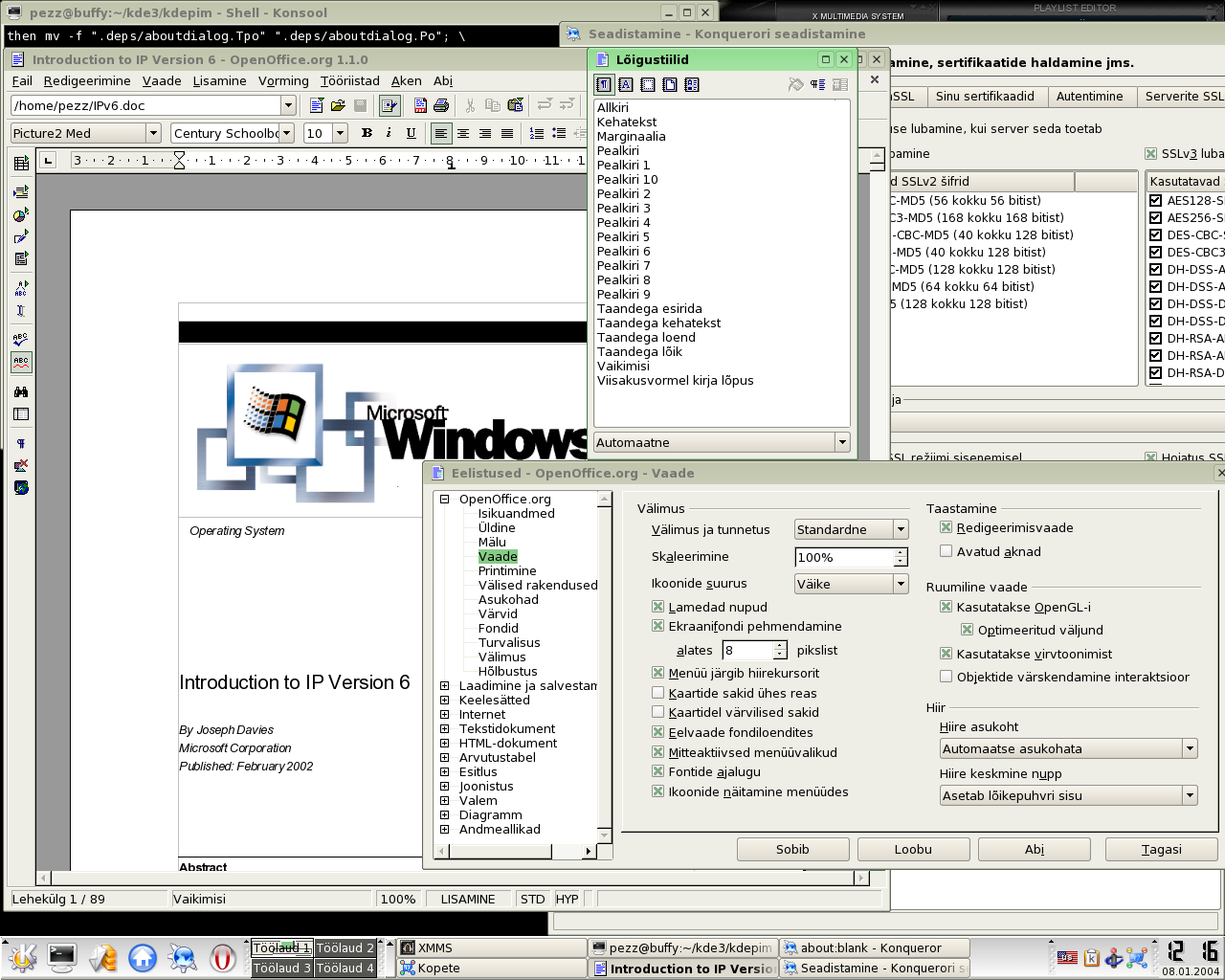
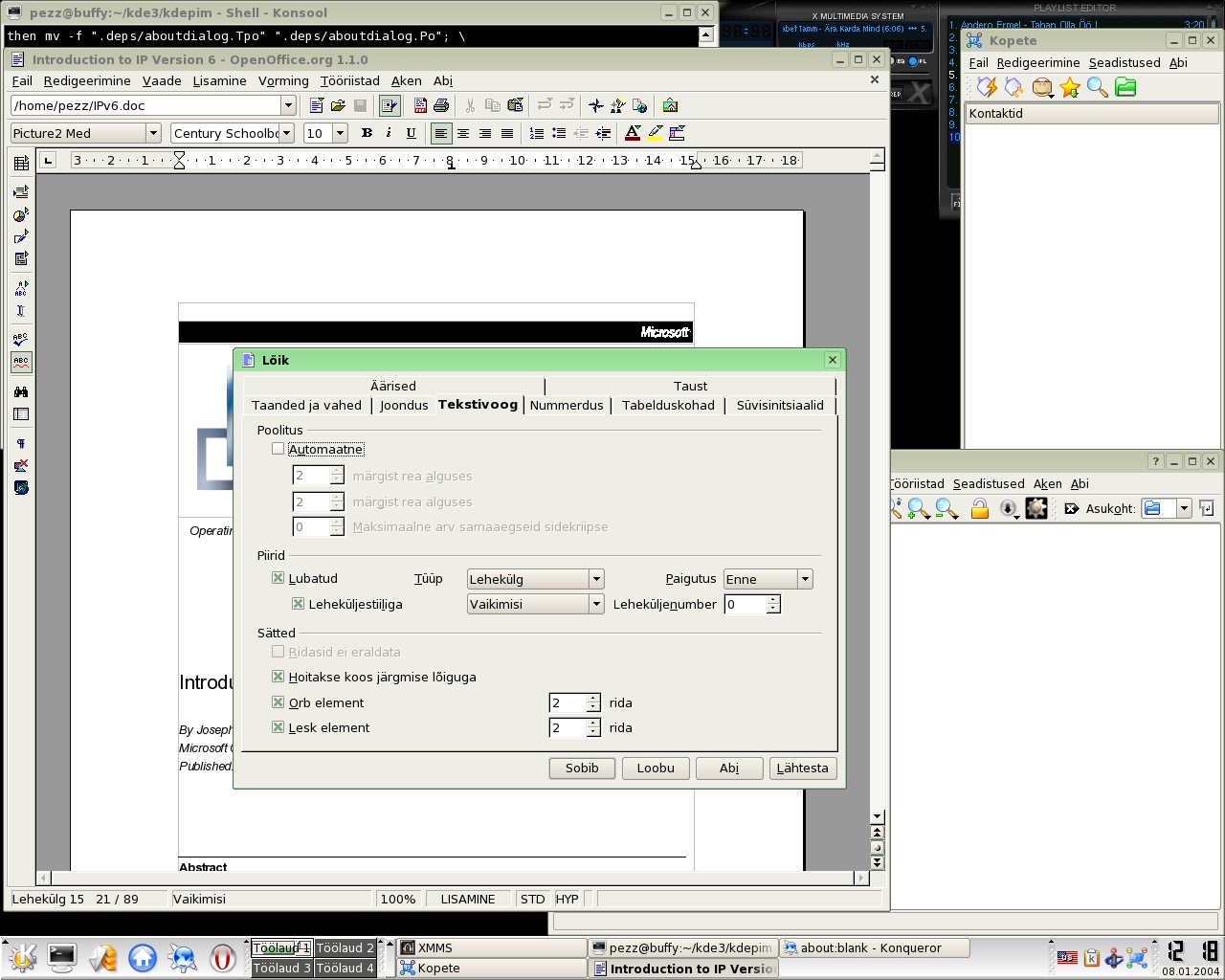
Balinares writes "Great bunch of news on the Linux desktop unification front. After the unification of GTK and Qt themes that Slashdot already reported on, it is OpenOffice's turn to get the unified look treatment (screenshot 1, screenshot 2, screenshot 3). In related news, the recently released QtGTK library allows to merge the Qt event loop with that of GTK. In other words, this means you can now easily use KDE's DCOP, IOslaves, and, last but not least, file dialogs, from inside your GTK apps. (Screenshot of this feature used in XMMS2: 1 2). It comes with a tutorial that explains the basics. Finally, the new fuse_kio tool now makes it possible to use KDE's IOslaves directly at the filesystem level, from any Linux app. 2004 is really beginning well for all those of us who use Linux as their primary desktop!" -
GNOME/KDE Integration Gets A Few Boosts
Balinares writes "Great bunch of news on the Linux desktop unification front. After the unification of GTK and Qt themes that Slashdot already reported on, it is OpenOffice's turn to get the unified look treatment (screenshot 1, screenshot 2, screenshot 3). In related news, the recently released QtGTK library allows to merge the Qt event loop with that of GTK. In other words, this means you can now easily use KDE's DCOP, IOslaves, and, last but not least, file dialogs, from inside your GTK apps. (Screenshot of this feature used in XMMS2: 1 2). It comes with a tutorial that explains the basics. Finally, the new fuse_kio tool now makes it possible to use KDE's IOslaves directly at the filesystem level, from any Linux app. 2004 is really beginning well for all those of us who use Linux as their primary desktop!" -
GNOME/KDE Integration Gets A Few Boosts
Balinares writes "Great bunch of news on the Linux desktop unification front. After the unification of GTK and Qt themes that Slashdot already reported on, it is OpenOffice's turn to get the unified look treatment (screenshot 1, screenshot 2, screenshot 3). In related news, the recently released QtGTK library allows to merge the Qt event loop with that of GTK. In other words, this means you can now easily use KDE's DCOP, IOslaves, and, last but not least, file dialogs, from inside your GTK apps. (Screenshot of this feature used in XMMS2: 1 2). It comes with a tutorial that explains the basics. Finally, the new fuse_kio tool now makes it possible to use KDE's IOslaves directly at the filesystem level, from any Linux app. 2004 is really beginning well for all those of us who use Linux as their primary desktop!" -
GNOME/KDE Integration Gets A Few Boosts
Balinares writes "Great bunch of news on the Linux desktop unification front. After the unification of GTK and Qt themes that Slashdot already reported on, it is OpenOffice's turn to get the unified look treatment (screenshot 1, screenshot 2, screenshot 3). In related news, the recently released QtGTK library allows to merge the Qt event loop with that of GTK. In other words, this means you can now easily use KDE's DCOP, IOslaves, and, last but not least, file dialogs, from inside your GTK apps. (Screenshot of this feature used in XMMS2: 1 2). It comes with a tutorial that explains the basics. Finally, the new fuse_kio tool now makes it possible to use KDE's IOslaves directly at the filesystem level, from any Linux app. 2004 is really beginning well for all those of us who use Linux as their primary desktop!" -
GNOME/KDE Integration Gets A Few Boosts
Balinares writes "Great bunch of news on the Linux desktop unification front. After the unification of GTK and Qt themes that Slashdot already reported on, it is OpenOffice's turn to get the unified look treatment (screenshot 1, screenshot 2, screenshot 3). In related news, the recently released QtGTK library allows to merge the Qt event loop with that of GTK. In other words, this means you can now easily use KDE's DCOP, IOslaves, and, last but not least, file dialogs, from inside your GTK apps. (Screenshot of this feature used in XMMS2: 1 2). It comes with a tutorial that explains the basics. Finally, the new fuse_kio tool now makes it possible to use KDE's IOslaves directly at the filesystem level, from any Linux app. 2004 is really beginning well for all those of us who use Linux as their primary desktop!" -
GNOME/KDE Integration Gets A Few Boosts
Balinares writes "Great bunch of news on the Linux desktop unification front. After the unification of GTK and Qt themes that Slashdot already reported on, it is OpenOffice's turn to get the unified look treatment (screenshot 1, screenshot 2, screenshot 3). In related news, the recently released QtGTK library allows to merge the Qt event loop with that of GTK. In other words, this means you can now easily use KDE's DCOP, IOslaves, and, last but not least, file dialogs, from inside your GTK apps. (Screenshot of this feature used in XMMS2: 1 2). It comes with a tutorial that explains the basics. Finally, the new fuse_kio tool now makes it possible to use KDE's IOslaves directly at the filesystem level, from any Linux app. 2004 is really beginning well for all those of us who use Linux as their primary desktop!" -
GNOME/KDE Integration Gets A Few Boosts
Balinares writes "Great bunch of news on the Linux desktop unification front. After the unification of GTK and Qt themes that Slashdot already reported on, it is OpenOffice's turn to get the unified look treatment (screenshot 1, screenshot 2, screenshot 3). In related news, the recently released QtGTK library allows to merge the Qt event loop with that of GTK. In other words, this means you can now easily use KDE's DCOP, IOslaves, and, last but not least, file dialogs, from inside your GTK apps. (Screenshot of this feature used in XMMS2: 1 2). It comes with a tutorial that explains the basics. Finally, the new fuse_kio tool now makes it possible to use KDE's IOslaves directly at the filesystem level, from any Linux app. 2004 is really beginning well for all those of us who use Linux as their primary desktop!" -
GNOME/KDE Integration Gets A Few Boosts
Balinares writes "Great bunch of news on the Linux desktop unification front. After the unification of GTK and Qt themes that Slashdot already reported on, it is OpenOffice's turn to get the unified look treatment (screenshot 1, screenshot 2, screenshot 3). In related news, the recently released QtGTK library allows to merge the Qt event loop with that of GTK. In other words, this means you can now easily use KDE's DCOP, IOslaves, and, last but not least, file dialogs, from inside your GTK apps. (Screenshot of this feature used in XMMS2: 1 2). It comes with a tutorial that explains the basics. Finally, the new fuse_kio tool now makes it possible to use KDE's IOslaves directly at the filesystem level, from any Linux app. 2004 is really beginning well for all those of us who use Linux as their primary desktop!" -
Native KOffice for Mac OS X
bsharitt writes "A preliminary version of KOffice has been built natively on Mac OS X. It looks like a lot of the hard part is over, and now a lot of cleaning up and bug fixes stand between Mac OS X and a free full featured office suite." There's also a story on the dot. -
KDE 3.x Installation On Solaris Discussed
Jim Hall writes " A recent Sun-hosted article looks at installing and running KDE 3.x on Solaris Operating System (Solaris OS) -based workstations. Author Corey Liu tries to shy away from the debate over GNOME vs. KDE, and focuses on how KDE is installed on Sun workstations and the Solaris OS. Both GNOME and KDE are available at freeware Web sites for users of the Solaris OS. While Sun recently began to favor GNOME as the default desktop environment on the Solaris OS, some people still enjoy using KDE." -
Free Software In Iran, KDE In Farsi
Elektroschock writes "KDE, the leading *nix desktop environment, is translated to Farsi (=Persian). Now native language KDE can be used in Iran as well. Farsi is written from left to right. Full story at Dot KDE. Arash Zeini (KDE Farsi) wrote an intresting article about FLOSS in Iran. His view: "It is not a secret anymore that FLOSS is gaining momentum all over the world. We witness an international move and acceptance of FLOSS in the private as well as in the public sector."" Update: 12/29 16:37 GMT by T : That should read "Farsi is written from right to left." (Thanks to Thomas Zander for pointing that out.) -
KDE Gains Full Accessibility Support
kandalf writes "Together with some other interesting news about making KDE and Gtk apps interoperable as well as porting OpenOffice to Qt/KDE, KDE gained accessibility support through the ATK interface from Sun with Qt - so KDE 3.2 will be 'accessibility ready' for the end user once coming out in January. Got the dot?" -
KDE Gains Full Accessibility Support
kandalf writes "Together with some other interesting news about making KDE and Gtk apps interoperable as well as porting OpenOffice to Qt/KDE, KDE gained accessibility support through the ATK interface from Sun with Qt - so KDE 3.2 will be 'accessibility ready' for the end user once coming out in January. Got the dot?" -
KDE Gains Full Accessibility Support
kandalf writes "Together with some other interesting news about making KDE and Gtk apps interoperable as well as porting OpenOffice to Qt/KDE, KDE gained accessibility support through the ATK interface from Sun with Qt - so KDE 3.2 will be 'accessibility ready' for the end user once coming out in January. Got the dot?" -
KDE Gains Full Accessibility Support
kandalf writes "Together with some other interesting news about making KDE and Gtk apps interoperable as well as porting OpenOffice to Qt/KDE, KDE gained accessibility support through the ATK interface from Sun with Qt - so KDE 3.2 will be 'accessibility ready' for the end user once coming out in January. Got the dot?" -
OpenOffice.org: KDE Integration Project Launched
vfs writes "Someone at pclinuxonline.com noticed that a OpenOffice/KDE Integration Project has been started to "provide tight (but optional) integration of the OpenOffice.org to the KDE environment beginning with KDE look and feel and ending with KDE data sources." This could offer a great opportunity for enterprises to deploy an integrated, unified desktop." (Here's the dot.kde.org post on the project.) -
KDE 3.2 beta 2 Released
KentoNET writes "The KDE dot is reporting that KDE 3.2 beta 2 has been released. 'Dobra Voda,' as the release is named, still has some rough edges, but developers are urging users to test and report bugs in the new beta. Binaries are available for SuSE, Fedora and Slackware. Also released was another beta of Gideon, KDE's in-development IDE." -
KDE 3.2 beta 2 Released
KentoNET writes "The KDE dot is reporting that KDE 3.2 beta 2 has been released. 'Dobra Voda,' as the release is named, still has some rough edges, but developers are urging users to test and report bugs in the new beta. Binaries are available for SuSE, Fedora and Slackware. Also released was another beta of Gideon, KDE's in-development IDE." -
Slashback: Matrix, Terminology, Topology
Slashback is back from a Thanksgiving hiatus with a bigger-than-usual collection of updates, corrections and followups to previous Slashdot stories, including pretty maps of the Internet, spammers' OS choices, stupidity in the wild, and more. Read on for the details. Of course, Red Hat didn't claim to be the first ... cmeyer writes in response to the news that Red Hat is expected to attain Common Criteria certification. "Linux achieved the first Common Criteria certification back in the beginning of August. It was a joint effort of IBM and SUSE." He points to this August Slashdot posting about the news and to a press release on SUSE's site.Well, it's robust, stable and handy for networking tasks ... Linux and Unix users may be justifiably smug about our machines' resistance to viruses and trogans (including ones that send spam), since most of these things are aimed at Microsoft Windows. Maybe it should be no surprise that spammers like Linux, too:
Niels Provos writes "You might remember Honeyd? I have been using it since June to capture spam emails in an attempt to better understand how spammers operate. A recent feature in Honeyd is passive fingerprinting which allows Honeyd to passively identify the operating system that contacts it. For spammers, it turns out that about 43% seem to be running Linux. And mostly Unix, Windows ranks at around 0.7%. The unknown fraction is 52%, so there might be surprises lurking there."
Apple products must be ripened before consumption. Ipodlounge.com editor Dennis Lloyd was one of several readers to note that, rather than the November date named in the recent 2-year iPod retrospective in the New York Times, the device came out just a bit earlier. "The iPod's anniversary was in October ;) The iPod was officially launched on Oct. 23, 2001. The NYT article is incorrect."
May the tide be with you. Doc Searls writes: "Thought I'd direct your attention to the first half of a transcription of the talk Linus gave on the September Geek Cruise that got Slashdotted a few weeks ago. Can't find the link to the Slashdot item, but as i recall it didn't have the benefit of a real transcription." (Here's the Slashdot post about the cruise.) "This one is not only a full transcription (by yours truly, all disclaimers apply), but features pix of his slides and demos as well."
Searls also has up the second part: "That's the Q&A, which is even longer than the prepared part of the talk," as well as the third: "The third part is a transcription of a talk Linus and others gave to the Victoria Linux Users Group. Shorter than the first two."
Searls' three-part report on the cruise itself ran in Linux Journal.
This way to the Egress! Rick Chapman, author of the recently reviewed In Search of Stupidity , writes to point out that book excerpts are available at insearchofstupdity.com, along with some of the book's illustrations.
"Also, I recently was interviewed live on a local CT business show and I've had the session digitized and am mounting on the site today. It runs about 45 minutes and I discuss a lot of the stuff in the book as well as other issues revolving around software marketing and development. ... I have a lot of samples of really bad things I brought to the taping and I think you'll get a kick out of the session."
They should sell nice prints to buy bandwidth. An anonymous reader writes "From the New Scientist article: A project to create a comprehensive graphical representation of the Internet in just one day and using only a single computer has already produced some eye-catching images."
Back pedal, back pedal, baker's man, cover that label with tape if you can. Mr. Slippery writes "According to this Yahoo! News story, L.A. County did not ban the use of 'master' and 'slave' in labeling, but made more of a polite request to vendors. A subtle but important distinction.
'"I do understand that this term has been an industry standard for years and years and this is nothing more than a plea to vendors to see what they can do," said Joe Sandoval, division manager of purchasing and contract services. "It appears that some folks have taken this a little too literally."' (As, perhaps, did those who got offended in the first place...)"
The original memo called Master and Slave labels "not acceptable" -- how non-literally can that be taken? -- and as further news stories have reported, was prompted by an employee's workplace discrimination complaint against the city. That sounds to me like more than a polite request. At least the city has found that a little tape is enough to make the world safe from misinterpreted words.
I bet Bill is a better actor than Keanu. Karma Sucks writes "After some embarrassing PR backlash it seems as if Microsoft is clamping down on distribution of pictures or videos related to the Matrix Spoof that featured Linux and Windows at COMDEX. Even more interesting are the reports that Microsoft is systematically scouting Open Source desktop technology."
And this is what percentage of the industry's profits? dlh writes "Boston.com is reporting that a federal judge Thursday approved a $143 million settlement of a lawsuit that accused major record companies and large music retailers of conspiring to set minimum music prices."
Time to get a new watch. Krellis writes "DynDNS.org, a major dynamic DNS provider, has announced that they will shut off access to any customers using the Linksys WRT54G wireless router to update their service on December 8th unless the router is patched. See the story on ExtremeTech and the DynDNS Press Release for more details. Updated firmware can be downloaded from Linksys."
-
96 Hours Of Open Source Talks In Bangalore
nileshch writes "The ongoing community-driven Linux Bangalore 2003 is upto a record of sorts. There are, hold your breath, 96 scheduled talks. That's about 96 hours of open-source talk in three days! The first day with 30 talks is already over with star speakers like Nat Friedman, Miguel De Icaza and Sirtaj Singh Kang enthralling the audience with their refreshing perspectives on Linux and Open Source. Rasmus Lerdorf and Jeremy Zawodny of Yahoo! Inc, amongst others, are also scheduled to talk at the event." -
Where Are The Founders Of The Dial-Up Revolution?
RIMBoy writes "The Atlanta Journal-Constitution recently tracked down the founders behind the dial-up modem revolution. The founders of Hayes Micromodem set the standard with their AT Command set. While Dennis Hayes finds himself inducted into the Computer Industry Hall of Fame, at the same time he is broke (with a stop as a bar owner) and trying to find the next big thing. Dale Heatherington cashed out early and has dedicated himself to several projects, including ham radio."