Slashdot Mirror
Domain: lessig.org
Stories and comments across the archive that link to lessig.org.
Comments · 268
-
This is *NOT* what she has said.Crossposting from Digital Copyright Canada where you crossposted your other reply.
I do not share this interpretation of Sarmite Bulte's words.
I was subjected to a speech from her at the Rethinking Copyright conference, and checked my interpretation with a number of other people there (some lawyers or law students, some other laypersons like myself). We all came to the same conclusion that she didn't understand technology law, and didn't separate many-to-many mediums of communication like the Internet to one-to-many broadcast media of the past.
Since you seem to have been able to reach her, try again with a few additional questions:
- Why did she not respond to the questions from the Canadian Internet Policy and Public Interest Clinic (CIPPIC)? If she wanted to prove her knowledge on technology law matters, it would seem extremely important for her to respond to the questions from a technology law clinic made up of law professors and law students specialized on technology
- Is she aware of commons-based peer production and peer distributions such as those discussed around Creative Commons and Free/Libre and Open Source Software?
- Has she read any of US law professor Lawrence Lessig's books on this topic, including and especially the most recent "Free Culture". Where does she agree and disagree with his understanding of technology law issues, given her recommendations reflect a very different belief system around technology law.
- Whether elected or not, will she be willing to talk to representatives of CIPPIC and participants in the Digital Copyright Canada forum to find out why we are so concerned? Why has she thus far seemed uninterested in our input?
-
A Clarification
In this inadvertently hilarious google translation Microsoft Brazil says they were only asking for an explaination and were misreported. First noted by Alistair Burt on the Lessig blog.
-
A Clarification
In this inadvertently hilarious google translation Microsoft Brazil says they were only asking for an explaination and were misreported. First noted by Alistair Burt on the Lessig blog.
-
Re:In many cases,
-
Re:Blog? How about design notes?It sounds like you're describing the type of blog that would appeal to you and that's great. But how exactly is that teenage girl you linked "forcing her life down your throat"? It seems more that you picked her blog out at random to illustrate your rant that some people have blogs that are of no interest to you. Just to turn it around, do you think that teenage girl would be interested in reading developers' blogs?
IMHO, 97% (or whatever high percentage) of anything that is popular is going to be crap, that doesn't mean there's anything wrong with the medium. Most of the songs on mp3.com for instance were shit but mp3.com was cool resource that turned up interesting artists from time to time. I think the blog scene could be looked at in the same way.
-
Re:So now we're back to copyright GOOD?"Let the people who have something useful to say speak for themselves and stop whoring for karma with your little slash-bites."
Give me a break. here's who I am and here's what Lessig has to say.
-
Re:Now, that's comedy
Is anyone SERIOUSLY arguing for the right to disseminate the creations of other people for free?
This guy is. This guy is. I am.
Mind you, I'm in favor of copyright, but I do believe that after a certain reasonable period of time (50 years should do it) that I should be able to reproduce other people's works however I want without paying for it. Similarly for Lessig. Stallman is... a bit more nuanced.
"information wants to be free"
You're definately right to attack this argument. Anyone who argues that this means you should copy information is missing the entire point. IWTBF isn't a moral statement, it's a summary (perhaps an overly cute one) of human nature and the growth of technology. IWTBF in much the same way that water wants to flow downhill.
The public may be behind such arguments with respect to music, but I doubt you're going to see your grandmother downloading AutoCAD 2004 and being surprised (or upset) that it is illegal to do so given the opportunity.
Actually, I expect my grandmother would be very surprised to discover sometimes it's legal to click on a link and download a program and sometimes it isn't and that sometimes it is. It's not obvious in any way. Copyright law being something that individuals need to even know about is a relatively new idea; when it was first created it was really a set of laws intended to limit publishers. It's still surprising to people to think that there is anything wrong with their individual actions. Giving friends mix-tapes is a popular pasttime that technically infringes on copyright. Good luck convincing the public as a whole that it's wrong and should be illegal. Copyright based industries have a lot of work to do if they want to convince people to follow this much more complicated system ("You can click here and download this and it's good. But if you click here and download that it's bad.").
-
Re:Please...
Not true; Lessig clerked for Justice Scalia on the Supreme Court, and for Richard Posner on the Seventh Circuit.
Conservative judges can, and do, hire liberal clerks, and vice versa. Scalia, in particular, is known for hiring liberal clerks regularly. Lessig wrote an article for The Industry Standard about why there's nothing odd about this.
-
You may all ready know this...
... but just in case you did not I'll toss it up here.
Lawrence Lessing (another lawyer who has done lots of writing about the internet, and been talked about on Slashdot often) posts what IMO is some very insightful information on "cyberlaw" at his blog from time to time. If you enjoyed this interview, and have not cheked out Lessing's work.
Here are some of the groups that Lessing is working / has worked with...
creative commons
eff
puclib knowledge
fsf
-
You may all ready know this...
... but just in case you did not I'll toss it up here.
Lawrence Lessing (another lawyer who has done lots of writing about the internet, and been talked about on Slashdot often) posts what IMO is some very insightful information on "cyberlaw" at his blog from time to time. If you enjoyed this interview, and have not cheked out Lessing's work.
Here are some of the groups that Lessing is working / has worked with...
creative commons
eff
puclib knowledge
fsf
-
Larry Lessig runs AndromedaOOPS, I botched these links: reviews and overview
Also perhaps of interest to Slashdot readers, check this out from Larry Lessig's blog
A quote from his new book, "Free Culture":
- "I have begun a large process at home of ripping all of my and my wife's CDs, and storing them in one archive. Then, using Apple's iTunes, or a wonderful program called Andromeda, we can build different play lists of our music: Bach, Baroque, Love Songs, Love Songs of Significant Others -- the potential is endless."
-
Re:The Trouble With Larry
Lessig's response can be read at his blog
-
Re:The Trouble With Larry
Lessig's response can be read at his blog
-
Lessig the Grey vs. Creative CommonsFrom something I sent to Dave Farber's IP:
Given the recent Grey Tuesday brouhaha that followed the release of DJ Danger Mouse's Grey Album, it's worth pausing for a moment to take a look at the Creative Commons:
"We work to offer creators a best-of-both-worlds way to protect their works while encouraging certain uses of them -- to declare 'some rights reserved.'"
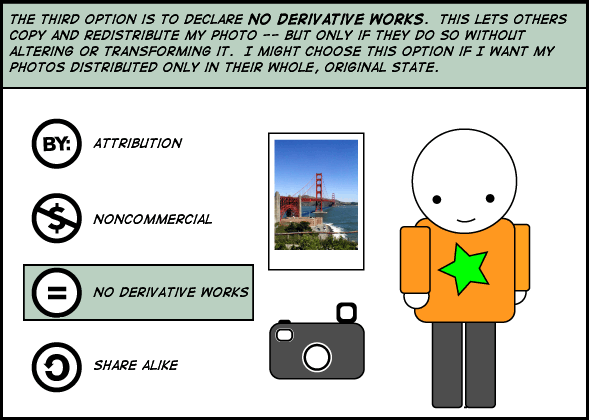
Among the rights an artist may choose to reserve when configuring their Creative Commons license is "No Derivative Works," explained in cartoon here:
http://creativecommons.org/images/comics/10.gif
Indeed, the Creative Commons' leading example musician is Roger McGuinn who: "chose the Creative Commons license that maximizes a combination of free distribution with artistic control and integrity." -- note that Roger McGuinn chose "No Derivative Works."
However, the Grey Tuesday movement seeks to take that right away. Notably, Larry Lessig (Creative Commons Chairman of the Board) commented in his blog:
http://www.lessig.org/blog/archives/001754.shtml
"Should the law give DJ Danger Mouse the right to remix without permission? I think so, though I understand how others find the matter a bit more grey."
"Should the law give DJ Danger Mouse a compulsory right to remix? That is, the right, conditioned upon his paying a small fee per sale? Again, I think so, and again, you might find this a bit less grey."
So, what exactly does Creative Commons mean by "some rights reserved" -- would it perhaps be more accurate if they said: "some rights reserved until we can cook up a new compulsory license to take those rights away"?
-
the point is?Imho, as to whether or not the Net can be regulated, the answer is a definite yes!
What most people (even tech-nerds!) seem to forget is that the Net is not a static system. The reason why the Net has been so difficult to regulate in the past is because of the way it is built.
Therefore, as was put by Lawrence Lessig in his book Code and Other Laws of Cyberspace because the Net is a completely artificial environment, the only thing you have to do is to change the environment. Then, hey presto, you can regulate that which was previously impossible to regulate (Palladium, anyone?
For example, IPv6 with geographical pin-pointing built into it could easily make us subject only to national laws again. (Or at least the people who don't know about anonymous proxies.)
Now, the US still has a lot of power over the Net and perhaps it would be possible for the US to enforce its wishes on other nations by using it's power over the Net's architecture, but it may become more difficult, the wider the Net spreads out. It may also fracture the apparent unity of the Net, and result in many "small" Nets run by different countries or groups of countries. All with their own architecture, and therefore, all with different ways of regulating it.
As for me, I don't think it would be a good idea, but my yes, it is unfortunately possible to regulate the Net. 1984, here we come...
-
Monopoly Mouse
Disney, the core of "Hollywood", is the greatest IP monopolist running amok in our marketplace of ideas. Meanwhile, they have built their empire on appropriating public domain "improperty". Somebody build a better mousetrap!
-
Re:Not another one
I acknowledged that this might be deceptivly stated. But if it is indeed as it sounds, it would not be the first time.
See this article.
See this article.
See this article.
See this article.
There are countless other articles on similar incidents and concerns as well. I wasn't blindly criticizing the entire system. Knob.
-
Re:So what? Its already been signed.
Very interesting, you should also consider trying to do a campaign to reduce copyright lengths, maybe to 20 years like patents.
I was also hoping to join an activist group / campaign (politically if they have one) at the local, national or international level to try and reduce copyright lengths. (The creative commons and Larry Lessig's blog are good sites but are not a campaign for copyright reduction laws per say).
If they can pass laws that keep on extending copyright law, I don't see why there can't be an opposition political movement that -
Misleading Title - Nothing to do with SamplesIf you RTFA, you'll see this isn't a sampling issue. There is no sample of Eminem's song in the advert. A 10-yr old is singing the song. If anything this probably counts as a cover of the original.
Artists dont have to get permission from the copyright holder to release a cover. They DO have to pay them however. Check Lessig's site for related discussion
-
You americans... also have problem!
When I saw in Lessig's blog what presidential candidate Mr Kerry has to say about enforcing IP rights I really shuddered.
Look at: Lessig blog entry and Kerry about technology -
ROFL!
Why don't you ask an extremely knowledgeable professional or two if you work for such a money-rich company?!?! You're asking a bunch of
Better yet, do your own research to find this stuff out! These 'Ask Slashdot' questions sometimes truly amaze me. The poster of this 'Ask Slashdot' probably makes 2-3 times what I make (if not 10x-20x in stock options alone) and yet he's willing to listen to my poorly informed ideas on such an important matter?! Truly hilarious! -
Re:hear that?Yeah, Lessig came up with Creative Commons. Go to his blog and you'll see. He already called EST "brilliant." He linked to the free download.
Lessig and Doctorow both work for the Electronic Frontier Foundation. They're two of my heroes.
Lessig loves creative use of the Creative Commons license, so he probably enjoyed the Fluffy Kittens remix of Alice in Wonderland, Down and Out in the Magic Kingdom, and Eastern Standard Tribe. These derivative works were made with Doctorow's permission.
-
Anything by Lawrence Lessig
Like The Future of Ideas: The Fate of the Commons in a Connected World and Code and Other Laws of Cyberspace, plus his blog and if you can find it, his grocery list.
-
Re:Living in a fact free world
I wonder if we'll see SCO-like attempts to quickly produce as many databases of as many facts as possible. Anyone using any facts whatsoever could be extorted for license fees or subject to lawsuits by rabid hordes of attorneys.
The bill is for copyright-like protections, not patent-like protections. The scenario you described above is more like a patented database situation - where the facts are protected regardless of their use (much as patents apply to alternate implementations of the same idea). Copyrights protect the "finished product" as it were, and not the "internals." In other words, you wouldn't be in violation by using facts from a database - only by making unlicensed copies of the original database.
But this underscores a serious problem with modern notions of "intellectual property." As MarkusQ said earlier today:
"(Our second big loss has been the "IP" fudge, which is blurring the distinctions between patents, copyrights, trademarks, trade secrets, competative advantages, wishful thinking, bull*, and marketing babble into one vague pile of lawyer poo)."
So what do we DO about all of this? I attended a lecture given by Lawrence Lessig at my university's law school last fall. He seemed rather pessimistic about the prospects of legal reform - going about making changes from within the system (mainly due to his defeat in Elred Vs. Ashcroft). He spoke quite a bit about his work on the Creative Commons, and his views on the "Some Rights Reserved" middle ground. I think he's right, for the time being. The system is failing in many ways to serve the good of the people. Contributing to a copyleft commons is an important way to stand up for freedom of information, whether your contribution is sotware, music, the Creative Commons Logo rendered in SVG, ad infinitum.
I was startled by one point that he made, mainly because I had recently been thinking along the same lines. My version is here. The point is that the trend of increased scope an enforcement of intellectual property has the potential to create a new feudal system based on the perpetual ownership of information and ideas. The old European feudal system was based on perpetual ownership of land. The implications of such a system for those who are left out of the ownership are easy to see, and are well-documented in the pages of history. There is a reason those years are known as "The Dark Ages."
-
Re:Is this technical or political?
Correction -- This is how the internet was *designed* to work. However, big broadband providers (cable and phone companies) have a vested interest in undermining the end-to-end principle the internet was founded on, making users into content consumers, and have done so by encourging things such as PPPoE and NAT. Sure, you can still run a PTP application from behind a NAT box, but it requires some port forwarding, which the average user won't be able to do. In fact, many all-in-one broadband "modems"/NAT devices don't even allow this these days, and many service agreements prohibit the operation of services on the user's assigned IP address, further undermining e2e. One of the promises of v6 is that it will allow every machine on the internet to have its own true IP address, if desired. This seems increasingly unlikely, as there are powerful forces that very much like the current imbalance between content providers and content consumers, and will bring great resources to bear against a return to the "wild west" of the early days of the internet, when every node could be a provider.
There's some interesting stuff on this at Digital Imprimatur and on Larry Lessig's site. A good place to start is Lessig's article called "The End of End-to-End: Preserving the Architecture of the Internet in the Broadband Era" -
Re:Is this technical or political?
Correction -- This is how the internet was *designed* to work. However, big broadband providers (cable and phone companies) have a vested interest in undermining the end-to-end principle the internet was founded on, making users into content consumers, and have done so by encourging things such as PPPoE and NAT. Sure, you can still run a PTP application from behind a NAT box, but it requires some port forwarding, which the average user won't be able to do. In fact, many all-in-one broadband "modems"/NAT devices don't even allow this these days, and many service agreements prohibit the operation of services on the user's assigned IP address, further undermining e2e. One of the promises of v6 is that it will allow every machine on the internet to have its own true IP address, if desired. This seems increasingly unlikely, as there are powerful forces that very much like the current imbalance between content providers and content consumers, and will bring great resources to bear against a return to the "wild west" of the early days of the internet, when every node could be a provider.
There's some interesting stuff on this at Digital Imprimatur and on Larry Lessig's site. A good place to start is Lessig's article called "The End of End-to-End: Preserving the Architecture of the Internet in the Broadband Era" -
Re:You went instead of his *girlfriend* ???
All Bush said was that the major combat was over.
No. He said Combat Operations in Iraq Have Ended
and it was later altered (without a notice indicating it) to say Major Combat Operations in Iraq Have Ended
When caught in this lie, the Bush administration web-masters made it harder to catch these revisionist tactics by disallowing spiders on the web-site
Another link:
http://www.lessig.org/blog/archives/001619.shtml
-
Workshop on Free Software, Free SocietyThe most promising and interesting for us is the thematic Working Group (WG) dealing with Patents, Copyrights, Trademarks (P.C.T) and related issues, within the framework of the Civil Society.
See the website of this group at http://www.wsis-pct.org/
The Working Group is holding a workshop "Free Software, Free Society" with a group of top speakers, including Richard Stallman, founder of the GNU Project, and Lawrence Lessig.
-
Re:Get a load of this
I'm sure I don't know any more about the law than you do, but Lawrence Lessig does. And he seems to think that McBride's claims are preposterous. Another source for (para)legal opinions on this nonsense is Groklaw, where even Linus Torvalds has something to say about the latest McBride open letter.
-
Incredible Article by Lessig About the GPL
IANAL, but Lawrence Lessig is. Here is the clearest easiest to understand explanation of the GPL and how it relates to US and EU copyright law (and SCO, and FUD, and the U.S. Constitution) that I have EVER read!
I HIGHLY RECOMMEND that anyone with any interest or questions in what is going on with the SCO case, Linux, or the GPL read this article; it is that good
Credit where credit is due - first seen referenced on Slashdot (somewhere) and link found on Groklaw (somewhere) -
Incredible Article by Lessig About the GPL
IANAL, but Lawrence Lessig is. Here is the clearest easiest to understand explanation of the GPL and how it relates to US and EU copyright law (and SCO, and FUD, and the U.S. Constitution) that I have EVER read!
I HIGHLY RECOMMEND that anyone with any interest or questions in what is going on with the SCO case, Linux, or the GPL read this article; it is that good
Credit where credit is due - first seen referenced on Slashdot (somewhere) and link found on Groklaw (somewhere) -
Groklaw and Lessig responds...The ineffible PJ from Groklaw has this to say.
Larry Lessig, Eldred counsel and all-around bad-ass, put aside his obligations for the morning on his visit to Japan to pen this response (typos retained for the grammar nerds):
More SCO fud, this time insulting the constitution
I apologize for the silence, but weve been in Japan this week announcing iCommons in Japan. (More on that soon). But after reading this extraordinary document by Darl McBride of SCO infamy, I could resist canceling this morning meetings to respond.
From the start of this pathetic lawsuit, Eben Moglen of the Free Software Foundation has argued that there was nothing behind the SCO claims. His arguments are persuasive. But if you want a clue of just how clueless this case is, consider the constitutional arguments made by SCO.
McBride's argument is grounded in the Constitution. (Well, close to the constitution. He quotes the text of the constitution to be:
Congress shall have Power [t]o promote the Progress of Science and useful Arts, open-source advocates argue against copyright and patent laws, and whatever measures they take to by securing for limited Times to Authors and Inventors the exclusive Right to their respective Writings and Discoveries.
Actually, the framers didn't say anything about "open source advocates.")
As he rightly is argues, the Constitution requires that Congress only grant copyrights where those copyrights "promote the Progress of Science." Thus, if Congress granted copyrights in a context where they didn't "promote progress" one might well ask whether such a law was constitutional (e.g., a law that extended the terms of existing copyrights, but let's leave that aside for the moment).
But the key move in the McBride-FUD is his claim that proponents of free software and open source software are somehow against copyright.
He claims that "GPL is exactly opposite in its effect from the 'copyright' laws adopted by the US Congress and the European Union"; that "Red Hat has aggressively lobbied Congress to eliminate software patents and copyrights"; that "the issue is clear: do you support copyrights and ownership of intellectual property as envisioned by our elected officials in Congress and the European Union, or do you support "free" - as in free from ownership - intellectual property envisioned by the Free Software Foundation, Red Hat and others?"; that "SCO argues that the authority of Congress under the U.S. Constitution to "promote the Progress of Science and the useful arts" inherently includes a profit motive, and that protection for this profit motive includes a Constitutional dimension"; and that "We believe that the "progress of science" is best advanced by vigorously protecting the right of authors and inventors to earn a profit from their work."
Let's take each of these claims in turn:
"GPL is exactly opposite in its effect from the 'copyright' laws adopted by the US Congress and the European Union"
Despite RMS's aversion to the term, the GPL trades on a property right that the laws of the US and EU grant "authors" for their creative work. A property right means that the owner of the right has the right to do with his property whatever he wishes, consistent with the laws of the land. If he chooses to give his property away, that does not make it any less a property right. If he chooses to sell it for $1,000,000, that doesn't make it any less a property right. And if he chooses to license it on the condition that source code be made free, that doesn't make it
-
Groklaw and Lessig responds...The ineffible PJ from Groklaw has this to say.
Larry Lessig, Eldred counsel and all-around bad-ass, put aside his obligations for the morning on his visit to Japan to pen this response (typos retained for the grammar nerds):
More SCO fud, this time insulting the constitution
I apologize for the silence, but weve been in Japan this week announcing iCommons in Japan. (More on that soon). But after reading this extraordinary document by Darl McBride of SCO infamy, I could resist canceling this morning meetings to respond.
From the start of this pathetic lawsuit, Eben Moglen of the Free Software Foundation has argued that there was nothing behind the SCO claims. His arguments are persuasive. But if you want a clue of just how clueless this case is, consider the constitutional arguments made by SCO.
McBride's argument is grounded in the Constitution. (Well, close to the constitution. He quotes the text of the constitution to be:
Congress shall have Power [t]o promote the Progress of Science and useful Arts, open-source advocates argue against copyright and patent laws, and whatever measures they take to by securing for limited Times to Authors and Inventors the exclusive Right to their respective Writings and Discoveries.
Actually, the framers didn't say anything about "open source advocates.")
As he rightly is argues, the Constitution requires that Congress only grant copyrights where those copyrights "promote the Progress of Science." Thus, if Congress granted copyrights in a context where they didn't "promote progress" one might well ask whether such a law was constitutional (e.g., a law that extended the terms of existing copyrights, but let's leave that aside for the moment).
But the key move in the McBride-FUD is his claim that proponents of free software and open source software are somehow against copyright.
He claims that "GPL is exactly opposite in its effect from the 'copyright' laws adopted by the US Congress and the European Union"; that "Red Hat has aggressively lobbied Congress to eliminate software patents and copyrights"; that "the issue is clear: do you support copyrights and ownership of intellectual property as envisioned by our elected officials in Congress and the European Union, or do you support "free" - as in free from ownership - intellectual property envisioned by the Free Software Foundation, Red Hat and others?"; that "SCO argues that the authority of Congress under the U.S. Constitution to "promote the Progress of Science and the useful arts" inherently includes a profit motive, and that protection for this profit motive includes a Constitutional dimension"; and that "We believe that the "progress of science" is best advanced by vigorously protecting the right of authors and inventors to earn a profit from their work."
Let's take each of these claims in turn:
"GPL is exactly opposite in its effect from the 'copyright' laws adopted by the US Congress and the European Union"
Despite RMS's aversion to the term, the GPL trades on a property right that the laws of the US and EU grant "authors" for their creative work. A property right means that the owner of the right has the right to do with his property whatever he wishes, consistent with the laws of the land. If he chooses to give his property away, that does not make it any less a property right. If he chooses to sell it for $1,000,000, that doesn't make it any less a property right. And if he chooses to license it on the condition that source code be made free, that doesn't make it
-
Re:Suits!
Sure sounds to me like Lawrence Lessig would be a pretty good candidate to play the part of "outspoken, articulate, well-educated respected law guy that suits take seriously."
-
Re:So What???
I was hoping your post would link to Lessig's blog. He's got another presidential candidate guest-blogger this week.
So far that makes Dean, Kucinich, and Edwards. I wonder if anyone else will volunteer? -
Edwards, OpenSource, & Macs (From Campaign HQ)I'm the Dir. of Internet Operations for John Edwards' presidential campaign. It's worth noting that we run our campaign blog on Apache on FreeBSD -- and the blog is actually powered by Slashcode!
(If you cruise over to Larry Lessig's blogJohn Edwards is guest blogging on a variety of tech topics this week.)
We use a handful of open-source tools here at Campaign HQ. Why? Cost and reliability. The same reason you guys choose this stuff.
Oh... And our entire Web Team runs on Mac OS X. Contrary to one of the comments posted earlier, Senator Edwards made it clear during Tuesday's debate that he prefers his Mac.
I hope you folks have a chance to learn more about John Edwards.
-
Edwards, OpenSource, & Macs (From Campaign HQ)I'm the Dir. of Internet Operations for John Edwards' presidential campaign. It's worth noting that we run our campaign blog on Apache on FreeBSD -- and the blog is actually powered by Slashcode!
(If you cruise over to Larry Lessig's blog John Edwards is guest blogging on a variety of tech topics this week.)
We use a handful of open-source tools here at Campaign HQ. Why? Cost and reliability. The same reason you guys choose this stuff.
Oh... And our entire Web Team runs on Mac OS X. Contrary to one of the comments posted earlier, Senator Edwards made it clear during Tuesday's debate that he prefers his Mac.
I hope you folks have a chance to learn more about John Edwards.
-
Re:Not just Republicans and Democrats
Here are a few good representatives to mention if you want someone to debate on intellectual property issues:
Bruce Perens, former Debian project leader.
Lawrence Lessig, Professor of Law at Stanford Law School, Chair of the Creative Commons project, author of several books on intellectual property...
and,
you. Seriously. You are the best person to represent your own views. Then we know what you think. Just make sure that you know who you are speaking for - I am sure you can represent your views well, but I don't know if you represent my views very well.
If you want someone more local, start asking librarians at the local library if any of them have viewpoints on IP and DRM issues.
please post other such 'potentially good' representatives in reply.
But really, if you want someone with a suit and a long list of credentials to represent the people in a debate on intellectual property, pick the Professor of Law at Stanford, Lawrence Lessig. That's who I would pick. I like his views and his ideas. I publish some of my work under a creative commons license, and tried to follow the Elred case.
---- -
copyrightSecondly, the section you reference empowers Congress to give authors a monopoly over their works "for a limited period of time." In my opinion (which is what the words "I feel" mean), a copyright term longer than the lifespan of your average citizens is, for all realistic intents and purposes, unlimited. While a work written the day of my birth will (barring any further Bono-esque extensions) eventually become public domain, it will never happen within my lifetime so what's the point?
I think the supreme court might disagree with you.
From Larry Lessig's blog:
The Supreme Court has ruled that Congress has the power perpetually to extend the terms of existing copyrights. This brief "experiment with the public domain," as the NYT eloquently put it, is over. In twenty years, we can expect terms will be extended again. There is no good reason to expect anything different.
-
1984 again..
This Big Brother stuff is really getting upsetting.
Shutting down the Public Domain in the United Stated is one thing but the global elimination of the Public Domain is another thing entirely.
Can the resistance stay alive?
Remember, in the early 1980s, the movie industry fought a fierce legal battle to block the sale of video-cassette recorders, claiming they would promote piracy. Finally, in 1984, the US Supreme Court denied that claim, ensuring the sales of recorded movies, a business that now generates far more revenues for the entertainment industry than theatrical distribution.
Oceania has always been at war with Eurasia. -
Re:Free Trade
It is good to focus on the problems with the FTAA, but Professor
Lessig blogs to another piece that references bi-lateral trade
agreements between the U.S. and Australia, Singapore, and presumably
anyone else that will sign that pushes the same agenda. This is
happening on several fronts.
-
Lessig's comments
Lawrence Lessig posted some interesting comments about this case in his blog.
DZM -
Re:Tinfoil for the mad hatter
Visited the NYT lately? How about LA Times? How about MIT Press? There are already hundreds, if not thousands of sites, locking their content away behind logins - they don't need DRM to do it.
You're avoiding the point. They already use logins today, and will in the future. But someday they can have these logins protected by DRM technology. They will get a minor economic advantage from this extra protection, but newspaper margins are slim, so they'll grab for it.
Then, it will be impossible to visit those sites with an untrusted OS. It will be impossible to build a PC, compile Linux, compile Mozilla, and use that to browse the web. The freedom of disorganized amateurs to create useful computer systems will be gone.
When free expression is no longer possible on US soil, US dollars will make sure there's a world of domains out there where speech remains free
That's a head-in-the-sand argument. "The government cannot now enforce a prohibition against a behavior. Therefore they will never be able to prohibit it."
Sorry, but in the face of ever-increasing computer power, that viewpoint just doesn't hold up. If you don't believe me, Lessig has published extensive documents describing exactly why. -
Re:Ian Clarke is a f*cking idiot
You are confusing Mr Ian Clarke with Mr John Gilmore. I guess you need to read Greplaw more frequently
The Gilmore flight stunt has been extensively debated. Mr John Gilmore and Professor Lawrence Lessig have issued replies to the debate on Mr John Gilmore's flight-stunt. Mr John Gilmore was rejected from a flight because Mr Gilmore wore a badge saying "Suspected Terrorist". Should the flight captain have ejected Mr Gilmore because of the button or not? The discussion has been heated, not least since Mr Seth Finkelstein suggested that Mr Gilmore's behaviour was 'a millionaire's version of trolling.' Mr Gilmore counter-trolled Mr Finkelstein and got an endorsement from Professor Lessig.
Read Mr John Gilmore's reply.
Read Professor Lessig's comment.
Read Mr Seth Finkelstein's comment on the comments above.
Best regards,
Mikael -
Re:Ian Clarke is a f*cking idiot
You are confusing Mr Ian Clarke with Mr John Gilmore. I guess you need to read Greplaw more frequently
The Gilmore flight stunt has been extensively debated. Mr John Gilmore and Professor Lawrence Lessig have issued replies to the debate on Mr John Gilmore's flight-stunt. Mr John Gilmore was rejected from a flight because Mr Gilmore wore a badge saying "Suspected Terrorist". Should the flight captain have ejected Mr Gilmore because of the button or not? The discussion has been heated, not least since Mr Seth Finkelstein suggested that Mr Gilmore's behaviour was 'a millionaire's version of trolling.' Mr Gilmore counter-trolled Mr Finkelstein and got an endorsement from Professor Lessig.
Read Mr John Gilmore's reply.
Read Professor Lessig's comment.
Read Mr Seth Finkelstein's comment on the comments above.
Best regards,
Mikael -
How to fix thisLessig just posted a good comment on the draconian fees.
Anyway, there's an easy solution: quit downloading RIAA stuff and go for independent music instead. Artist-approved downloads. If you absolutely must have an RIAA tune, buy it, but otherwise ignore their stuff entirely. They'll be bankrupt in no time, with no legal recourse whatsoever.
And the best part is, we don't need any special boycott campaign. The RIAA is taking care of that for us. All we need to do is publicize the alternatives, as vigorously as possible.
Want to do your bit? Link to independent music on your weblog. If the RIAA isn't completely braindead (which is an open question), then this is what they're afraid of more than anything. Piracy is nothing compared to irrelevance.
-
Re:China making open-source software !?!
You should read The Future of Ideas, by Lawrence Lessig. One of the things he talks about in the book is economic reasons of why entities (such as companies or countries) might "give away" their intellectual property under an open license. One argument would be if they forked an open project and kept a secret version, they would have to spend a lot more resources if they wanted to use updates to the project. IIRC, another reason is that it enhances value of assets they have in other ways. Maybe if they give away their source code it enhances the value of their computers significantly enough so that they don't need to keep it proprietary.
-
National Post on Lessig, WIPO mtg
Found link: Canada's National Post weighed in on Saturday with the article, "A reasonable discussion hijacked".
-
Re:Yes.
Kucinich's article on Lessig's blog about Airplane searches
Kucinich on Copyright
Quote: "As a father, I don't believe our government has any business locking up kids for sharing files on the Internet." -
Re:Yes.
Kucinich's article on Lessig's blog about Airplane searches
Kucinich on Copyright
Quote: "As a father, I don't believe our government has any business locking up kids for sharing files on the Internet."