Slashdot Mirror
Domain: linux-magazine.com
Stories and comments across the archive that link to linux-magazine.com.
Comments · 62
-
Re:What is the most devices....
How much Linux is in Android?
http://www.linux-magazine.com/... -
Re:what a load.
Some more comments on your replies:
-
Re:depressing
I've been playing with something called "firejail."
Here's a handy link to check it out a bit:
http://www.linux-magazine.com/... -
Not enough?
So
Linux Magazine
Linux Format
Linux Journal
Linux User and Developer
Ubuntu Userweren't enough paper Linux magazines?
-
p2p social messaging system
Perhaps there is already someone doing this?
Yes, there are a number: diaspora, Friendica, and an emerging system based around RSS, this type of thing is usually called the federated social web. This is my own overview.
meta data and messaging data is spread around different peers as encrypted chunks
This is my proposal for exactly that
-
Re:Microsoft needs to be loved again
Microsoft started out making really cool things
Like what? DOS?
Microsoft were always the cheap, crap option. DOS over Unix, Windows over Unix or Mac. I can't think of a single 'really cool thing' they've ever done.
PCs were cheap, crap devices back then. DOS made them easier to use, but the real exciting products were BASIC and Excel. 640kB of RAM was never really enough, but it was certainly easier to get work done using it with DOS than with a complicated multi-user operating system.
For all its failings, Windows did provide an enormous amount of compatibility. Binary programs run on computers from all vendors, and DOS programs can still run on Windows 8, probably. Personally, I think closed-source software is hostile to users, but even open-source software was hard to run on the dominant Unix systems of the time. Back when Windows was released, Unix was sort of crap, too.
I think there is a potential for Microsoft to make cool stuff. You can't build such a huge company without having some good ideas in there. I just think it's unlikely for Microsoft to get them out there.
-
Re:Ballmer's replacement - a possible strategy?
I've suggested previously, even before the post-Snowden cloud/privacy concerns, that Microsoft could be in a very strong position if they swam across the current a little and promoted private clouds.
That is not a significant strength for Microsoft. There is no philosophical advantage to closed-source infrastructure compared to freedom-respecting software. Microsoft might win a bunch of sales because of their tight integration and simplified controls, but if you're worried about privacy, then Microsoft is not the way to go.
If you're doing a cloud deployment and you're worried about privacy, then the only real solution is to go to some open-source cloud system.
-
DD-WRT / OpenWRT / Tomato /
And this one (of may) reason why you should flash your firmware and put a non vendor one on it. I did a review here: Security-Lessons-Linux-WAP/(language)/eng-US. The actual PDF is here 048-049_kurt.pdf
.
-
DD-WRT / OpenWRT / Tomato /
And this one (of may) reason why you should flash your firmware and put a non vendor one on it. I did a review here: Security-Lessons-Linux-WAP/(language)/eng-US. The actual PDF is here 048-049_kurt.pdf
.
-
Re:Release the secure boot key...
Did not RedHat secure a Microsoft key? Ditto for Ubuntu (although they may be simply using RedHat's); the bootloader shim was written some time back, all that was lacking was the key. The links below are fairly old and I haven't been keeping tabs on the matter since I'm not going to be doing a build soon. Last thing I recall reading, tho, indicated the whole thing was a done deal and that if one wanted to install a Linux distro it wouldn't be a problem, just a bit of hassle.
Or here: http://www.linuxuser.co.uk/news/uefi-secure-boot-key-provided-by-linux-foundation from Oct. 11 last year.
Or here: http://www.linux-magazine.com/Online/Features/UEFI-and-Secure-Boot
Or here: https://docs.fedoraproject.org/en-US/Fedora/18/html-single/UEFI_Secure_Boot_Guide/index.htmlBtw, the key itself comes from Verisign; you can get your own for $99 just like everyone else; or use any of the other approaches as above. Unless the OEM completely locks down it's board, you can also simply bypass the UEFI signing altogether, as required in the spec, as I understand it.
-
Re:Obligatory
now finally I can run a complete UNIX system without any GNU!
Tipped your hand here: UNIX predates GNU, moron. Any # of the commercial BSDs are GNU-clean. Here's another option: write your own fucking software.
In context it is obvious that I meant a complete copyFREE UNIX system, but my statement remains logically correct even if you allow proprietary systems, predicated on the words "I can". I cannot live with a costly or ancient system, as GNU components have penetrated all UNIX flavors that I know of by mid-1990s. (And if "I" don't know about it, then how "can" I run it?) And if I have to write my own software or Frankenstein together pieces of separate OS'es to avoid GPL, then how is the UNIX system "complete"?
Looking through a list of "commercial BSDs", all of them are either "historical" and/or require vendor-specific hardware. (The fact that all of them went out of business instead of endlessly "stealing" copyFREE *BSD code is further evidence in my favor.) Tru64 now even has a GPL filesystem! Even Microsoft's Interix includes GCC! FreeBSD 10 is indeed the closest thing to usable gnushit-free UNIX, with no second place contender in sight.
The only people that have a problem with GPL are those trying to profit off the work or others or trying to cater to those that are trying to profit off the work of others.
... or agree with the philosophical points I've made throughout this thread. Such people exist (you're welcome to stop by on ##copyfree on FreeNode and meet a few), therefore your claim is false.
If you don't want other people (who might, "OH NOES", make a profit from their own innovations downstream from you) to use your software, then keep your own secrets (without Mommy Government's help) and don't call it "free".
Not all people who are opposed to slavery are slaves!
I know you guys like to post this stuff to get the sdot neckbeards frothing, but it's sad because I think you partially believe it.
It is impossible to prove or disprove someone's intentions, but one piece of anecdotal evidence you'll find after enough Googling is that I've spent no less time promoting copyFREE software in libertarian circles than I have criticizing GPL among Linux users.
Of course I entirely believe everything I say, and have been consistently saying for many years (excluding obvious satire, and the few things I have explicitly retracted in light of new information and personal growth). What reason do you have to claim otherwise?
You're afraid of the GPL because it creates a free ecosystem and a stream of paid bugfixes from corporations that need to ship the code. The copyfree movement's only arguments against copyleft is that it confuses merged works (they erroneously imply that they are derived works) and that, OH NOES, the company must distribute the source if they distribute binaries.
You will find many other arguments here throughout.
Prepending a comical "OH NOES" to describing an illegitimate act of government force does not negate its illegitimacy.
It's pathetic and intellectually dishonest;
Pathetic - maybe. I'm here to promote ideas that I believe are crucial to preserving and promoting freedom in the "digital millennium", to the best of my ability, with reason as well as passion. Looking "cool" is a much lesser value for me than fighting for the Truth!
As for the accusation of intellectual dishonesty - I would be very concerned if I saw any evidence behind it.
grow the fuck up and write your own software if you want to 'do with it what yo
-
Re:Hard to ask this...
Would you care to share with us which 20,000 seat Norwegian Openoffice deployment that was? I hear the Norwegian national broadcasting orporation NRK is moving to Openoffice.
-
Re:You're in the wrong business
Some people seem to complain that Canonical doesn't contribute enough to the kernel http://www.linux-magazine.com/Online/News/Canonical-Contributing-Too-Little-to-Kernel-Development . Which I don't understand. They are not obliged to contribute to the kernel, and they instead focus on areas they feel need improvement: Ease of use, Desktop experience, UI, (Unity not withstanding.)
-
Re:I Use Words Good
I imagine a sufficiently clever hacker could think of a way to bypass the guest OS and the hypervisor and do wacky things, But it's one hell of a lot harder than breaking out of a JVM sandbox.
No, it's not:
Script Error Opens up Security Hole in Xen 3.0.3It's an easy trap to fall for, I grant you that. I was on the same line of thinking until my server got hacked with exactly the above mentioned bug.
-
BREAKING NEWS
The first of what is sure to be a deluge of Free Software comings-out. Tight butts, hard dicks, and splashing cum.
-
Re:Well they are both rectangular
The first of what is sure to be a deluge of Free Software comings-out. Tight butts, hard dicks, and splashing cum.
-
Re:FIFO
The first of what is sure to be a deluge of Free Software comings-out. Tight butts, hard dicks, and splashing cum.
-
Re:A fool and his money...
The first of what is sure to be a deluge of Free Software comings-out. Tight butts, hard dicks, and splashing cum.
-
Re:Unit cannot be resold as received?
Your post intrigued me so I Googled the event and found that the problem was that a bad driver was corrupting some nonvolatile memory on the e1000:
http://www.linux-magazine.com/Online/News/Update-on-the-Intel-e1000e-Linux-Bug
I think therefore that it didn't exactly break the card but disabled it until the NVM could be rewritten properly. -
Storing passwords (not as easy as you think)
Sadly password storage is actually tricky and most places do it wrong (using MD5/SHA1 for example). Covered in Nov 2011 article Storing your passwords properly (disclaimer: I wrote it, and it's a PDF file). One problem is that even if zappos enforces strong passwords users have a tendency to reuse their strong passwords between sites (you can only memorize so much gibberish or passphrases). Hopefully Zappos learns from this and builds a more resilient system.
-
For 11
-
Article in LinuxPro Magazine June 2011
Disclaimer I'm the author. I covered this in my June 2011 column: http://www.linuxpromagazine.com/Issues/2011/127/Security-Lessons-Bufferbloat/%28kategorie%29/0 direct link to the PDF http://www.linux-magazine.com/w3/issue/127/058-059_kurt.pdf. In a nutshell: my link latency at home is usually ~50ms to seifried.org, but with one single outbound file transfer to saturate my uplink ping times go to over 1000ms (1 second) reliably (which completely breaks VOIP/games/etc.).
-
Re:Would I have to be a fanboy...
You might not even find it funny but right now you're playing the role of giant stick in the mud. There's two pieces of that: not allowing any position between utterly unfunny and "hoo-hawing to the point of passing out", and insisting that anybody who doesn't think it utterly unfunny (and who is therefore "hoo-hawing" and "slapping [their] knees") must have a profound irrational emotional position to one or both of these companies.
It's a damn prank, not an attempt at the a transcendent humour experience. It's petty vandalism, and as such the vandals should pay back Apple any cost to undo the vandalism and accept the legally required slap on the wrist. But there's not much call to read any deeper into it. People do this all the time for sports rivalries that they don't even care about, they slap stickers for company A on their competitors' products, etc..
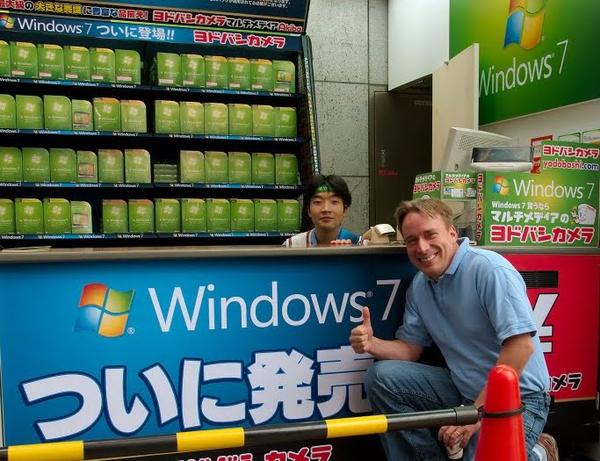
It's kind of like this picture that made many slashdotters smile: http://www.linux-magazine.com/var/linux_magazin/storage/images/media/linux-magazine-eng-us/images/news-images/linus-windows-7-rocks/380058-1-eng-US/Linus-Windows-7-rocks.jpg. The difference is just that a little more went into this prank, but it's the same kind of prank.
-
Re:Learn VBScript
With SharePoint & Exchange interaction with these in VBScript is a serious pain. Best to use PowerShell, can do more with about 1/10th the coding required of VBScript. I would only use VBScript if you require it for backwards compatibility with older systems. (i.e. pre-XP) Some comparisons between Bash and PowerShell http://w3.linux-magazine.com/issue/78/Bash_vs._Vista_PowerShell.pdf Resources on the net are everywhere for PowerShell just google. If you do tasks in Exchange 2007/2010 management console you'll get to see the powershell scripts used to perform the task.
-
I coveed it in detail in this months column
I cover how to measure buffer bloat, recreate the problem (trivially easy, in my case a single high speed upload saturates my 3 megabit uplink and ping times go from 50-60ms to 1000+ms. http://www.linux-magazine.com/Issues/2011/127/Security-Lessons-Bufferbloat/%28kategorie%29/0
-
Problem is that JavaScript obfuscation is easy
-
LibreOffice relies heavily on Java,
Disaster awaits if something isn't done about this...
-
Re:Death-- or revival?
Actually as I understood it, the current downloads on the LibreOffice site are actually based on the go-oo-source:
"A beta version of LibreOffice is available for download at the LibreOffice Web site. The current release is basically a rebranded version of Go-oo."
-
Thank you!
I would like to thank Stuart Parmenter, director of Firefox development Mike Beltzner, manager of Firefox's front-end-features team Johnathan Nightingale and Firefox principal engineer Vladimir Vukievi. Here is the photo: http://www.webmonkey.com/2009/11/after_five_years_on_the_web__firefox_preps_for_the_next_round/
and certainly the Mozilla Foundation chairwoman, the great Mitchell Baker. Here is the photo: http://www.linux-magazine.com/Online/News/Firefox-and-Codecs-Face-of-Mozilla-at-Will-of-Community
A Russian poet Nikolay Nekrasov wrote about such people. Something like: "Mother Nature, if from time to time you have not sent such people to the world, the field of Life would be exhausted."
-
Re:Karma
As far as I'm concerned, Novell stabbed the community in the back. I don't use Novell products and neither should you.
Funnily enough when Hovsepian took over as CEO in 2003 I remember him saying how much Novell would do for the Linux Community. Then a few years ago this Interview.
Lets look at what he did for the Linux Community and for the Developers he thinks are so great:
Novell Plans To Lay Off 20% Of Workforce
-
Re:Idiotic Moderators.
Powershell is by far, one of the best Microsoft has created on the scripting side. Why? They basically took a shell and enhanced it by making it object aware, and giving it access to
I am not a fan of the naming conventions they use in powershell! It makes it harder to write terse scripts.
Please see
http://w3.linux-magazine.com/issue/78/Bash_vs._Vista_PowerShell.pdf for a comparison of powershell vs Bash.
http://blog.brandonbloom.name/2009/04/powershell-condemned-to-reinvent.html
-
Do Some Research!!!
You've got your facts wrong. Scott McNealy was never slated to become the Obama administration's Open Source Technology adviser. According to the articles you referenced, all he was going to do was write a paper:
Scott McNealy "revealed he has been asked to prepare a paper on the subject (open source technologies and products) for the new administration."
http://news.bbc.co.uk/2/hi/technology/7841486.stm
"According to BBC News, the Obama administration has asked Sun chairman McNealy for a position statement justifying the administration's use of open source software. The BBC wasn't clear on who specifically asked him, but McNealy's spokesperson, on a query by the Linux community, acknowledged that McNealy had been meeting over the last year with members of the administration's new technology initiative, which apparently led to this request."
http://www.linux-magazine.com/Online/News/Sun-s-McNealy-Advises-Obama-Administration-on-Open-Source
I don't know if Scott ever got around to writing that paper. Searching the White House website for papers on Open Source, the only one I found was here:
Open Source Software and Cyber Defense
A White Paper provided to the National Security Council and Homeland Security Council as input to the White House Review of Communications and Information Infrastructure.
Bob Gourley, Chief Technology Officer, Crucial Point LLC
http://www.whitehouse.gov/files/documents/cyber/Gourley_Bob_Open_Source_Software_and_Cyber_Defense_01_April_2009.pdf -
Re:The CA's are not doing their due dilligence
The original article I wrote at http://www.linux-magazine.com/w3/issue/114/054-055_kurt.pdf (that was copied by this guy) covers that:
for the phone verification, you can just use an anonymous prepaid cell and mumble; it’s automated and doesn’t care
The phone check does nothing security wise, it is just a bit of security theater
-
Re:Sometimes
That's exactly right. The primary email contact is taken from WHOIS, but there are a few addresses that seem to be alternatives for most CAs (e.g. hostmaster). But for some CAs, the list of alternate addresses is rather long, ie:
administrator@seifried.org
admin@seifried.org
info@seifried.org
hostmaster@seifried.org
root@seifried.org
ssladmin@seifried.org
sysadmin@seifried.org
webmaster@seifried.org
info@seifried.org
postmaster@seifried.orgThis is the revised list which is in use by RapidSSL (a Verisign subsidiary) now, before the discussion was started. The original list was longer and contained generic addresses like is, it and mis (mis?!). It's not surprising that some mail providers didn't prevent people from registering a few of those.
The whole thing is documented on https://bugzilla.mozilla.org/show_bug.cgi?id=556468 and in the Kurt Seifried's original article on the issue http://www.linux-magazine.com/Issues/2010/114/BREACH-OF-TRUST (which are really the two links the Slashdot summary should have had).
-
Re:Linux is vulnerable too
If Linux has made malware creation easier, it has also made defense against them easier too. For example, a simple SELinux policy change should nix this kind of exploit without forcing the PDF application to not follow the (shitty) standard and refuse to
Or if you're feeling geeky, do it in your sandbox. http://www.linux-magazine.com/Online/News/SELinux-Sandbox-for-Untrusted-Programs
-
Re:-1 Misses the point
So in fact it seems Miguel was right all along - right about the need, right about the solution, right that Microsoft would not attempt to "destroy Linux" by leveraging patents. Instead they specifically promised in writing not to do that. Why? Probably because they don't care about Linux anymore. The world has moved on, what once seemed like a threat to their business no longer is.
Right, it's not a threat to their business, and they've been insightful enough to realize that. Which is why they haven't leveraged their patents against Linux in any way. Have you been living in a cave for the last 5 years?
On the other hand, there's no evidence from all of the above saber-rattling that Linux is infringing upon any of their patents. If they really have a credible infringement case, why haven't they sued Canonical, Red Hat, Mandriva, or any other company that hasn't agreed to "build bridges" with them? One also could wonder why they haven't publicly stated which patents are infringed, but the answer is of course that with or without a credible case, publicly stating which patents are infringed upon would allow the FOSS community to fight back with workarounds or invalidations of those patents.
-
Re:-1 Misses the point
So in fact it seems Miguel was right all along - right about the need, right about the solution, right that Microsoft would not attempt to "destroy Linux" by leveraging patents. Instead they specifically promised in writing not to do that. Why? Probably because they don't care about Linux anymore. The world has moved on, what once seemed like a threat to their business no longer is.
Right, it's not a threat to their business, and they've been insightful enough to realize that. Which is why they haven't leveraged their patents against Linux in any way. Have you been living in a cave for the last 5 years?
On the other hand, there's no evidence from all of the above saber-rattling that Linux is infringing upon any of their patents. If they really have a credible infringement case, why haven't they sued Canonical, Red Hat, Mandriva, or any other company that hasn't agreed to "build bridges" with them? One also could wonder why they haven't publicly stated which patents are infringed, but the answer is of course that with or without a credible case, publicly stating which patents are infringed upon would allow the FOSS community to fight back with workarounds or invalidations of those patents.
-
Ksplice explanation - with pretty pictures!
Easier to read explanation: http://www.linux-magazine.com/w3/issue/95/052-054_ksplice.pdf. In short: it's all done with clever (Mario style) trampoline jumps.
-
Re:Ubuntu One Killer App
Kroah-Hartman Attacks Canonical, Linux Magazine (September 19th, 2008)
Zimmerman [Canonical] objected primarily to Kroah-Hartman's definition of "Linux ecosystem," finding it "odd" in that he included GCC, binutils, X.org and Glibc in with the Linux kernel. Also, "He disregards most of the desktop stack (including GNOME and KDE), all desktop and server applications, and most anything else that is recognizable to an end user as 'Linux'." Not least of all, Zimmerman accused Kroah-Hartman of failing to acknowledge his link with Novell, a key Canonical competitor.
While I don't know how much Canonical employees (or people sponsored by Canonical) contribute to other projects I don't think it's fair to limit the contributions to those before mentioned projects.
Also from Canonical Contribution Chronicles, Linux Magazine (September 23rd, 2008):
In Amanda's blog, she asks, "What constitutes a contribution?" She says, "They [Canonical] focus on building a usable, more polished, more designed, better branded and better supported Linux distribution for the consumer market. By any one’s measure they have been successful in that endeavor. By my measure that is a very valuable contribution to the greater Linux movement."
-
Re:Ubuntu One Killer App
Kroah-Hartman Attacks Canonical, Linux Magazine (September 19th, 2008)
Zimmerman [Canonical] objected primarily to Kroah-Hartman's definition of "Linux ecosystem," finding it "odd" in that he included GCC, binutils, X.org and Glibc in with the Linux kernel. Also, "He disregards most of the desktop stack (including GNOME and KDE), all desktop and server applications, and most anything else that is recognizable to an end user as 'Linux'." Not least of all, Zimmerman accused Kroah-Hartman of failing to acknowledge his link with Novell, a key Canonical competitor.
While I don't know how much Canonical employees (or people sponsored by Canonical) contribute to other projects I don't think it's fair to limit the contributions to those before mentioned projects.
Also from Canonical Contribution Chronicles, Linux Magazine (September 23rd, 2008):
In Amanda's blog, she asks, "What constitutes a contribution?" She says, "They [Canonical] focus on building a usable, more polished, more designed, better branded and better supported Linux distribution for the consumer market. By any one’s measure they have been successful in that endeavor. By my measure that is a very valuable contribution to the greater Linux movement."
-
Re:How about Spotlight? That works on shared volum
Whoops, wrong link:
"The Beagle [1] developers decided to fill this search gap using Apple’s MacOS X search function as basic material."
http://www.linux-magazine.com/w3/issue/58/Beagle_Search_Tool.pdf
-
Since it is already down...
How GNOME and KDE spend their money
Sep 16, 2009 10:20pm GMT
Bruce Byfield
Quarterly reports are the stuff of business. In most people's minds, they are as far from the spirit of free and open source software (FOSS) as anyone can imagine. All the same, as non-profit organizations, many FOSS projects issue them. And while your first reaction may be to avoid quarterly reports, they can give some insights into projects, especially if you read between the lines.
For instance, if you have been assuming, as I have, that GNOME has more corporate support than KDE, and a larger budget, a look at the latest report for GNOME and KDE may surprise you. Together, the two reports give an entirely different impression than you might assume.
Neither quarterly report has much in common with the glossy publications offered by multi-national publications. Both are PDF files with undistinguished layouts and a minimum of graphics. Even head shots of people mentioned or reporting are absent. Compared to corporate reports, those of both GNOME and KDE are practical, unadorned publications.
Of the two, GNOME's (its first, covering June, July, and August 2009) comes closest to the spirit of a corporate report. It includes not only the obligatory message from GNOME's executive directory, but also reports from the Release, Bugsquad, Marketing, Web, Usability, Accessibility, Documentation, Art and Localizations Teams. Although some of these reports were outdated by the time the report was released, their overall impression is of a multi-tiered multi-national's executives reporting in. In general, the report fits in well with GNOME's traditional tendency to favor the corporate side and with its recent interest in marketing. Like most quarterly reports, it is as much a public relations document as an effort to provide concrete information (although it does both). The one non-corporate note is at the beginning, when executive director Stormy Peters asks readers, "please let us know if you find it useful!"
In comparison, KDE's report for March through June 2009 is less than one quarter the size of GNOME's. Although it includes the usual redundant introduction -- this time by Aaron Seigo, it contains far fewer individual summaries from GNOME's report. These differences may reflect the greater experience that KDE e.V. -- the German non-profit that manages KDE -- has with the whole idea of reports, and has the advantage that it is more likely to be read completely. At the same time, because it is so short, the KDE report seems less corporate, an impression that is fitting for the project's more community-based orientation.
Beyond these general impressions, what is most interesting is the financial accounting in the reports. The two reports are not strictly comparable, given that many FOSS activities occur in the northern hemisphere's summer rather than spring. Nor is it always obvious in either report what falls under each line item. Still, some differences emerge.
For instance, GNOME lists an income of just over $102,000 for the quarter covered by its report. This income includes $65,000 from the Desktop Summit, $20,000 from "advisory board fees" (which I interpret mainly as donations from corporate sponsors), and $12,400 collected by the Friends of GNOME, a promotional and fund-raising project.
Omitting the Desktop Summit as a one-time source of income, these figures mean that GNOME has traditionally relied on corporate supporters. Corporate supporters continue to provide the bulk of GNOME's income, but the total from Friends of GNOME suggests that GNOME may be switching to a more community-based source of income. However, given that GNOME reported an approximate income of $54,000 per quarter in 2008 (ht
-
Since it is already down...
How GNOME and KDE spend their money
Sep 16, 2009 10:20pm GMT
Bruce Byfield
Quarterly reports are the stuff of business. In most people's minds, they are as far from the spirit of free and open source software (FOSS) as anyone can imagine. All the same, as non-profit organizations, many FOSS projects issue them. And while your first reaction may be to avoid quarterly reports, they can give some insights into projects, especially if you read between the lines.
For instance, if you have been assuming, as I have, that GNOME has more corporate support than KDE, and a larger budget, a look at the latest report for GNOME and KDE may surprise you. Together, the two reports give an entirely different impression than you might assume.
Neither quarterly report has much in common with the glossy publications offered by multi-national publications. Both are PDF files with undistinguished layouts and a minimum of graphics. Even head shots of people mentioned or reporting are absent. Compared to corporate reports, those of both GNOME and KDE are practical, unadorned publications.
Of the two, GNOME's (its first, covering June, July, and August 2009) comes closest to the spirit of a corporate report. It includes not only the obligatory message from GNOME's executive directory, but also reports from the Release, Bugsquad, Marketing, Web, Usability, Accessibility, Documentation, Art and Localizations Teams. Although some of these reports were outdated by the time the report was released, their overall impression is of a multi-tiered multi-national's executives reporting in. In general, the report fits in well with GNOME's traditional tendency to favor the corporate side and with its recent interest in marketing. Like most quarterly reports, it is as much a public relations document as an effort to provide concrete information (although it does both). The one non-corporate note is at the beginning, when executive director Stormy Peters asks readers, "please let us know if you find it useful!"
In comparison, KDE's report for March through June 2009 is less than one quarter the size of GNOME's. Although it includes the usual redundant introduction -- this time by Aaron Seigo, it contains far fewer individual summaries from GNOME's report. These differences may reflect the greater experience that KDE e.V. -- the German non-profit that manages KDE -- has with the whole idea of reports, and has the advantage that it is more likely to be read completely. At the same time, because it is so short, the KDE report seems less corporate, an impression that is fitting for the project's more community-based orientation.
Beyond these general impressions, what is most interesting is the financial accounting in the reports. The two reports are not strictly comparable, given that many FOSS activities occur in the northern hemisphere's summer rather than spring. Nor is it always obvious in either report what falls under each line item. Still, some differences emerge.
For instance, GNOME lists an income of just over $102,000 for the quarter covered by its report. This income includes $65,000 from the Desktop Summit, $20,000 from "advisory board fees" (which I interpret mainly as donations from corporate sponsors), and $12,400 collected by the Friends of GNOME, a promotional and fund-raising project.
Omitting the Desktop Summit as a one-time source of income, these figures mean that GNOME has traditionally relied on corporate supporters. Corporate supporters continue to provide the bulk of GNOME's income, but the total from Friends of GNOME suggests that GNOME may be switching to a more community-based source of income. However, given that GNOME reported an approximate income of $54,000 per quarter in 2008 (ht
-
Symphony vs OO
According to this article Lotus Symphony is based on OpenOffice.
http://www.linux-magazine.com/Online/News/IBM-Throws-Out-Microsoft-Office
-
Re:side effects
Probably the best example if what they got up to in what is apparently the poorest region of the country, Extremadure. I think the Debian conference link will give you enough to find out more.
Basically (as far as I remember), they created their own distro for schools, and subsequently it went into gov use as well, with a small group of techs doing the support for the whole region. Running a business? Get your own CD and have a direct interface with the local government, I think for taxation etc.
It looked like a sterling effort of the type that must have left MS grinding its teeth. Simple, functional, focused, effective. Sterling effort IMHO. -
Article on this and related technologies
Shameless self plug: I wrote about this in my column: Web security - Protecting your site and your clients in September of 2008 and I'm VERY glad to see this is moving forwards as it means I (as a site owner) can actually do something to protect my site and my users against flaws in my site that is relatively easy and non-intrusive (that's the key!). The thing I really love about this is if your clients don't support site security policy, things still work, and if your browser supports it but the remote web site doesn't, things still work, but if both ends support it you get a nice added layer of protection. What would be really wild is if Microsoft added support for it, although "not invented here" they have been making efforts to protect users from XSS attacks in IE8 with mixed success, so who knows. You can do similar things with mod_security potentially and outgoing filters but it is nowhere near as simple as site security policy should be to deploy (hopefully).
-
Re:Quite the opposite Rioting Pacifist
I said at least 1. from here
September 8, 2008: London Stock Exchange
The London Stock Exchange had to stop trading for more than seven hours due an issue with its new trading platform, co-developed with Microsoft.
They had specificially chosen windows for reliability
The incident could prove to be particularly embarrassing for Microsoft who at the end of 2006 launched a huge advertising campaign stating that the London Stock Exchange had chosen Windows over Linux because of reliability issues. An opinion obviously not shared by the New York Stock Exchange who has been using Linux and AIX for over a year without any outage at all.
note the NYSE is has been running for years with no major outages (even most 'major' outages last an hour not a day)
june 3, 2008: OMX Nordic Exchange and the Oslo Stock Exchange
The OMX Nordic Exchange and the Oslo Stock Exchange opened five and a half hours late due to a problem with the trading system. Just the day before, the start of trading had been delayed by 40 minutes due to the same problem. Stock exchanges in Stockholm, Copenhagen, Helsinki and Oslo were all affected (they use the same backend system).
oh OMX = NASDAQ OMX, but finding out what software they're running is a bit tricky unless microsoft are gloating about the switch (as they were in with LSE)
-
Re:It was a nightmare for regular users in 2000...
An implementation of the Atheros HAL just came out recently (http://www.linux-magazine.com/online/news/open_source_hal_for_atheros_wlan_chipsets). The proprietary HAL would never be included, but since there is now an open source HAL it is unlikely that you will have such problems down the road.
-
Copyright
OK, so who holds the copyright, so we can tell Noh "Maddog" Hall?
-
Re:Not bad, but...
I would like to see a stabilized and standardized device interface API for standard devices, something exposing a limited subset of the kernel that would simplify simple devices like block, serial, and network types of devices.
FUSD. Seriously, closed source drivers running in kernel space are a bad idea. If companies want to release closed source drivers, and apparently they do since this whining about the lack of a fixed-forever ABI comes up every now and again, then those drivers should run in their own process space and not as part of the kernel.
(4)Native File Versioning
Bzzt. Its called automatic backup people.If you care about recovering previous versions of files, then you should be using a proper Revision Control System. What the article author really wants is RCS integrated and used as default for his desktop file browser in $HOME.
(6)Graphical User Interface
He sort of has a point about this and it has often been a problem.The "committee" that he advocates sounds very similar to freedesktop.
(8)Commercially Hosted Backup And Restore
Bzzt Wrong. This is not "Linux" being broken, it is 3rd party vendors being stupid.There are plenty of providers which give some remote storage space which you can ssh or rsync to for backup. What he wants is something like the Bacula Systems reseller deal with Mandriva expanded to all distributions.