Slashdot Mirror
Domain: metaresearch.org
Stories and comments across the archive that link to metaresearch.org.
Comments · 58
-
Re:The deep insecurity of Islam
> What about the big bang???
What about it? "Something" just "magically" appeared from nothing without any cause ??? Can I have some of what you're smoking please?
> Where have you been these last 100 years, hiding in a church?
Considering a Catholic Priest Georges Lemaitre invented the Big Bang theory your lame attempts to be condescending are misguided at best. There are numerous problems with it but let's conveniently ignore those.
-
Re: I'm a bit skeptical
You are, because you are making an assumption:
1. There appears to be a speed limit of 'c' because of 2 reasons:
a) As velocity approaches 'c' the mass approaches infinity, and
b) There is a singularity at v == c, aka a divide by zero.Ergo, everyone assumes (with good reason mind you) that 'c' is a speed limit.
However there is no law or reason that you can't have v > c aside from the inconvenient square root of an imaginary number. Physicists are used to this in electricity when they treat imaginary numbers as a phase shift. We are not yet advanced enougth to know an analogue for what this means to velocity, yet.
The "simply" solution to travelling faster then light is to shift dimensions, move which covers more distance then physical reality, then shift back to physical reality. Left as an exercise for the reader.
2. You are ignoring the speed of gravity
* http://metaresearch.org/cosmol...3. You are ignoring the speed of consciousness.
-
Re:Theory as it stands is wrong
Depending on who you talk to, evidence either contradicts or makes the Big Bang incomplete.
Wikipedia Big Bang mentions these 3 problems:
* the horizon problem,
* the flatness problem,
* and the magnetic monopole problem.The typical kludge is "Cosmic Inflation", but that hack creates even more problems. (" inflation is the expansion of space in the early universe at a rate much faster than the speed of light temporarily.") Paul J. Steinhardt, one of the founding fathers of inflationary cosmology, has recently become one of its sharpest critics.
There are numerous other problems with the Big Bang:
The first law of thermodynamics says Energy can neither be created nor destroyed, only change form, yet "magically" the Big Bang appeared out of nothing ?!?!?
* The Big Bang attempts to explain "How", but it still doesn't explain why it happened in the first place?I've included the top 11 of the full list of 30 Problems of the Big Bang:
* Static universe models fit observational data better than expanding universe models.
* The microwave "background" makes more sense as the limiting temperature of space heated by starlight than as the remnant of a fireball
* Element abundance predictions using the Big Bang require too many adjustable parameters to make them work.
* The universe has too much large scale structure (interspersed "walls" and voids) to form in a time as short as 10-20 billion years.
* The average luminosity of quasars must decrease with time in just the right way so that their average apparent brightness is the same at all redshifts, which is exceedingly unlikely.
* The ages of globular clusters appear older than the universe.
* The local streaming motions of galaxies are too high for a finite universe that is supposed to be everywhere uniform.
* Invisible dark matter of an unknown but non-baryonic nature must be the dominant ingredient of the entire universe.
* The most distant galaxies in the Hubble Deep Field show insufficient evidence of evolution, with some of them having higher redshifts (z = 6-7) than the highest-redshift quasars.
* If the open universe we see today is extrapolated back near the beginning, the ratio of the actual density of matter in the universe to the critical density must differ from unity by just a part in 1059. Any larger deviation would result in a universe already collapsed on itself or already dissipated.
* Under Big Bang premises, the Fine Structure Constant must vary with time. WHOOPS! Feynamn, founder of QED, once wrote:There is a most profound and beautiful question associated with the observed coupling constant, e - the amplitude for a real electron to emit or absorb a real photon. It is a simple number that has been experimentally determined to be close to 0.08542455. (My physicist friends won't recognize this number, because they like to remember it as the inverse of its square: about 137.03597 with about an uncertainty of about 2 in the last decimal place. It has been a mystery ever since it was discovered more than fifty years ago, and all good theoretical physicists put this number up on their wall and worry about it.) Immediately you would like to know where this number for a coupling comes from: is it related to pi or perhaps to the base of natural logarithms? Nobody knows. It's one of the greatest damn mysteries of physics: a magic number that comes to us with no understanding by man. You might say the "hand of God" wrote that number, and "we don't know how He pushed his pencil." We know what kind of a dance to do experimentally to measure this number very accurately, but we don't know what kind of dance to do on the computer to make this number co
-
Re:Faster than Light?
Oh that's why F=G(m1*m2)/r^2 has the "speed limit" of 'c' in it. Oh wait it doesn't.
http://en.wikipedia.org/wiki/Newton's_law_of_universal_gravitationOh that is why Gravity is capped by the "speed limit" of 'c'. Oh wait it doesn't.
http://metaresearch.org/cosmology/speed_of_gravity.aspThat's why we can measure the speed of gravity with light. Oh wait we can't.
"Propagation Speed of Gravity and the Relativistic Time Delay"
http://iopscience.iop.org/0004-637X/590/2/683/fulltext/57516.text.htmlYou are ignorant. period.
-
Re:Einstein replied "Check your measurements, son"
Sure about that? According to some, the math doesn't work out.
http://metaresearch.org/cosmology/speed_of_gravity.asp
-
Re:Am I the only one
> Am I the only one who gets absolutely frustrated that people are still proposing the possibility of time-travel?
Am I the only one who gets frustrated that people still propose the possibility of lighter-than-air travel?
Oh wait, balloons and airplanes proved that one true.Am I the only one who gets frustrated that people still propose the possibility of breaking the sound barrier?
Oh wait, the supersonic airplane also proved that one true.Am I the only one who gets frustrated that people still propose the possibility that nothing faster then can move faster than light?
Oh wait, gravity proves that true too. (See: http://metaresearch.org/cosmology/speed_of_gravity.asp )Am I the only one who gets frustrates that people still propose the possibility that the arrow of time is actually bidirectional?
Oh wait, Feynman and QED showed 'backwards' in time makes sense. (i.e. Positrons are electrons going "backwards in time.", and "And what about photons? Photons look exactly the same in all respects when they travel backwards in time, so they are their own anti-particles. You see how clever we are at making an exception part of the rule! (Feynman, 1985)." Also see: http://en.wikipedia.org/wiki/RetrocausalityYour frustration with time travel is failing to learn from history -- assumptions have proven to be incomplete, pardon the pun, time and time again. Scientists (and Science) are still CLUELESS on the fine-structure constant*, what an electric charge is, what a potential is, what gravity is, etc. You are complaining about not understanding meta-physics when we are still struggling to understands basics?!?! At the risk of being a jerk, methinks your priorities are messed up!
As a mystic I have a different perspective of what time is -- your understanding of space and time is incomplete. If you practiced meditation eventually you would realize that you don't have to _physically_ move to either:
a) travel faster than the speed OR
b) to time travel
you _already_ can, because of 2 truths the scientific community does not yet understand:
1. At the highest level, the past, present, and future is really "one now" -- they are simply _interpretations_ and perspectives.
2. Time is simply a dimension of mind. Obviously that begs the question: WHICH mind, but I'll leave that fun question up to you to explore.
(Note: If you are _serious_ about expanding your consciousness and understanding of meta-physics you will want to start with Lucid Dreaming, and eventually practice Out-Of-Body / Astral Travel specific forms of meditation WITHOUT DRUGS. Reddit has a good forum: http://www.reddit.com/r/LucidDreaming/ that I would recommend.)To quote a famous scientist:
"The scientific community has always been this way, in its fierce resistance to really innovative developments.
* Resisted Mayer's original statement of energy conservation; hounded him so much that he attempted suicide and was institutionalized.
* Laughed and slandered Ovshinsky on his "insane" amorphous semi-conductor. "Everybody knew" a semiconductor had to have a crystalline structure. The Japanese who funded Ovshinsky are still laughing all the way to the bank.
* Made Wegener's name a synonym for "utter fool" because of his continental drift theory. Why, imagine continents floating and moving! Insane!" (NOTE: Madame Blatavsky predicted continental drift even before the concept existed!)
* Refused to accept the Aharonov-Bohm effect for 25 years (as pointed out by Feynman). Prior to the MEG, the AB effect appears never to have been applied for COP > 1.0 from "two-energy reservoir" electrical power systems.
* Uses an EE model that assumes every EM field, EM potential, and joule of EM ene
-
Re:Short answer: No
> "Oh, there has to be something mysterious at work here, we'll call it dark matter.".
Ah, I see, the aether by any other name.You can't see, touch, taste, smell, or hear dark matter or dark energy, yet you have faith that it exists ??
> B) assuming that the big bang theory is valid
That assumption is full of holes. There are numerous problems with the Big Bang
http://www.metaresearch.org/cosmology/bb-top-30.asp--
Inner Space not Outer Space is the FINAL frontier. -
Re:Frame of Reference Problem
> Gravitation works at the speed of light.
Um, no. Try again.
http://metaresearch.org/cosmology/speed_of_gravity.asp
http://iopscience.iop.org/0004-637X/590/2/683/57516.text.html -
Re:CPT = Lorentz Invariance
Please read this:
http://www.metaresearch.org/cosmology/gravity/gps-twins.asp
In short:
According to Special Relativity, since all motion is relative, time should pass slower on a spaceship speeding by Earth (as seen from Earth), but from the spaceship traveller's view, time should equally pass slower at the same rate on Earth, compared to the clock on the spaceship.This might also interest you:
http://www.orgonelab.org/miller.htm -
Re:Not news
We have absolutely no evidence that FTL travel or communication is possible.
Absence of evidence != evidence of absence.
Our theories of Physics do not predict the possibility of FTL travel.
They don't predict many things. Our theories are incomplete, full of major assumptions, and still there are so many of them. The hope is that LHC will weed some out by proving them wrong. But we are not yet at the stage where we can definitively proclaim that FTL travel or messaging is impossible. Near-instant communication that we enjoy today would be a preposterous impossibility to a medieval king because no horse can run that fast.
Today we have theories that challenge some foundations. For example, this paper points out that if the speed of gravity were to be limited to 1c then our Solar system (just as all other) would spiral into the Sun pretty fast. It turns out, orbital mechanics calculations use infinite speed of gravity, and Pluto always "knows" exactly and instantly where the Sun is - not where it used to be hours ago. This is a very interesting paper.
Merely getting from there to here would consume so much energy
An ideal round trip in a potential field consumes zero energy. A pendulum can swing for a very long time, limited only by losses in the thread. Our rockets consume a lot of energy just because they are so incredibly inefficient.
About slow communications. I am indeed pessimistic about prospects of communicating if FTL messaging is proven to be impossible. There would be very little reason for dissimilar civilizations to spend vast resources on talking over light years and centuries of round trip time. If you want to ask "do you have antigravity?" it will require you a millennium to establish the dictionary, then ask the question and then to receive a response. Probably by that time you could figure it out yourself. And the answer would be probably already superceded by the newest research done at either end.
You do mention the continuous streaming of knowledge, and that might work, but it depends on willingness to spend considerable energy on an exchange that you will gain little out of (if you are an advanced civ.) Earth has nothing to say, except basics of our life.
Xenophobia is misplaced in this situation.
I only described concerns that would be valid if we encountered a version of our own civilization. To dismiss those concerns you need to show that our civilization is unusually violent and bloodthirsty. And I see nothing particularly unusual in how we developed so far. At every moment of our history our civilization was acting pretty logically for their time. There was no divine enlightenment, for example, no black monolith with 1x4x9 proportions - we arose from animals by just being more violent and more smart, and taking our time.
-
Re:GPS clocks
Well, this is not quite correct. Gravity and relative speed both affect the clocks. The gravitational affects are actually more significant.
I found a pretty good primer on all the issues.
-
Re:general relativity at work
What I think is really cool about GPS is that without Einstein's theory of general relativity, it wouldn't work.
Oh, it would work just fine alright, in fact it would be a heck of a lot simpler to build and maintain, and probably somewhat cheaper, too. The folks that built the satellites and the base station that sets each satellite clock would have much less headache.
See:
http://www.metaresearch.org/cosmology/gps-relativity.asp
which claims to be a rehash of a chapter of the book "Open Questions in Relativistic Physics"
"Rather than have clocks with such large rate differences, the satellite clocks are reset in rate before launch to compensate for these predicted effects
-
Re:Obviously: Correlation != Causation
If you're talking about physical causality, there are a number of varying definitions. It's actually a pretty complicated subject.
Wikipedia gives a basic overview, this article seems good, but I didn't read it all the way.
Your conclusion should not have been correlation = causation, but that correlation can strongly imply causation, without being sufficient evidence in itself.
-
Re:Since looking farther = further in time
Apparently there is some debate about whether gravity "travels" at the speed of light at all, because observing planetary orbits under that paradigm means your telescope ends up looking at empty space, whereas when you do your calculations with gravity as "instanteneous" you end up looking at your planet.
see:
http://metaresearch.org/cosmology/speed_of_gravity.asp
of course I am no physicist, i just read slashdot.
-
Re:I think you're misinterpreting...
> since nothing can travel faster than light (and c is finite)
Both of those are assumptions. If they were true, there wouldn't be a logical explaination for tachyons.
Part of the problem is that we are confined to observing this dimension. In other dimensions things DO move faster then light.
Furthermore, the speed of gravity is much greater then c.
-
Re:ermmm...
The speed of light is also the maximum speed of causation...if these "super structures" are outside the observable universe, how in the hell are they affecting anything within the observable universe?
The speed of gravity waves is theorized to be the same as the speed of light. However the effect of gravity is not necessarily constrained http://metaresearch.org/cosmology/speed_of_gravity.asp . Gravitational effects that originate in some far off elseplace may affect the observable instantly. We accept such an instantaneous effect with quantum entanglement, one violation of Bell's Theorem. If gravity is a quantum force http://en.wikipedia.org/wiki/Quantum_gravity it may well be subject to the same "spooky action at a distance" that works on things like particle spin and wave polarization. Or it may be instantaneous for reasons far more fundamental and interesting than what we see happen to particles and waves existing within our universe, as it might be an effect on the universe itself rather than an effect seen within it.
-
Re:An interesting question...
But if we have yet to successfully detect a gravity wave or graviton, how do you know it travels at c, and not some other speed? I admit I'm not a physicist, but this article has some interesting information that makes me inclined to believe gravity travels significantly faster than c. Admittedly, its mostly he-said-she-said right now, since nobody has measured the speed of gravity yet without a great deal of uncertainty in the results.
-
Re:It's been a while ...Falsifiable prediction: http://metaresearch.org/solar%20system/origins/original-solar-system.asp
Conclusion
If we make allowance for special cases that have most probably been altered from their original condition since the solar system's beginning, as judged by lines of evidence existing before this analysis began, we may conclude that the undisturbed solar system members provide a spectacularly good match to the predictions of the tidal fission theory. That includes major planets and large, regular moons.
At one point I began to wonder about the inference in Table 1 that the Earth was much closer to the Sun in the early solar system than it is now. Would Earth at that distance have been too hot to have oceans? Then I opened the May 23rd (1997) issue of Science magazine and found an article on "the early faint Sun paradox," trying to figure out what kept the Earth from freezing four billion years ago, when the Sun had 25%-30% less luminosity than it does today (Sagan and Chyba, 1997).[190] A good theory should always provide pleasant surprises, not new mysteries; and this one had just produced a very pleasant one--a solution to the early faint Sun paradox.
But to be a scientific theory, a model must be falsifiable; and to be useful it must make successful predictions. So we conclude with an important prediction, the failure of which will falsify the hypothesis. The astronomy news has been filled over the past two years with announcements of discoveries of planets orbiting other stars. The fission theory predicts that such planets will tend to occur in twin pairs, with some exceptions, as we have seen in our solar system. However, extra-solar planets cannot be viewed directly, even with the Hubble Space Telescope. Their existence must be inferred by indirect means, such as looking for a periodic wobble in the position of a visible parent star.
If extra-solar planets do occur as twins, that will not be immediately evident in the earliest observations because it is difficult to separate out periods for bodies of similar mass that are either close to the same value or are in resonance with one another. The first data will reveal just a single member of each pair. Observations over a longer time span will make it appear that the orbit is highly eccentric, when in reality the wobble of the star reflects the beating of two near-resonance periods. But with a still longer time span of data, the dual nature of the planets will be revealed. We predict that many of the discoveries of extra-solar planets recently announced will follow that course as the span of observations lengthens in the coming years. But that was posted by AC, and I owe apology to AC and/or pln2bz for incorrectly conflating their unfamiliar [to me] ideas with one anothers' [gr?].
Shite, I h8 the Internet when I question my gr/sp! -
Re:Old EarthEarth after the collision that resulted in the Moon That hypothesis has been challenged.
http://metaresearch.org/solar%20system/origins/original-solar-system.asp
IMO, solar fission is a better theory than dust accretion, where "better" is defined as:
1. Provides genuine insight.
2. Does not contradict existing data.
3. Makes predictions that, if falsified, would disprove the hypothesis.
Short version: in order for a collision to produce a moon in a stable orbit, the impacting body must fall into a very narrow range of mass, velocity, and impact angles. This could have happened for one or two moons, but there are simply too many in the solar system to have all formed in this way. Furthermore, there is little evidence of all the failed attempts that must have also occurred. It is far more likely for candidate collisions to simply do damage, scatter some mass perhaps, or even shatter the unlucky planet.
Solar fission hypothesizes that planets are a necessary consequence of stellar evolution, and moons are a necessary consequence of planetary formation. As they age, heavier elements build up in their cores, causing a spinup - like a figure skater tucking their arms in. At first the parent body would swell at its equator, due to gravity being partially cancelled by centripetal force. Eventually the surface velocity exceeds escape velocity, and a chunk of matter is thrown. Stars and gas giants would throw chunks in pairs, one from each side, whereas rocky planets such as Earth and Venus would only create one moon at a time, since the planet would spin down before the second chunk can breach the crust.
Poke fun all you want. The physics are valid.
Cheers. -
Re:Question about gravity
Some people think gravity travels faster than c.
Larry
-
Re:Targeting that is going to be a bitch.I just read this the other day:
http://metaresearch.org/media%20and%20links/press/SOG-Kopeikin.asp
Abstract: New findings were announced on 2003/01/08 by S. Kopeikin, claiming to have measured the "speed of gravity" and finding it essentially equal to the speed of light. These findings are invalid by both experimental and theoretical standards because the quantity measured was already known to propagate at the speed of light. The hyped claims therefore do a disservice to science in general and the advancement of physics in particular because the announced findings do not represent the meaning of the actual experimental results and cannot possibly represent the physical quantity heretofore called "the speed of gravity", which has already been proved by six experiments to propagate much faster than light, perhaps billions of times faster. Several mainstream relativists have also stated their disagreement that the experiment really measured what it claimed to measure.Emphasis is mine. If you're interested, we can dig up more research on it, as it's a subject that interests me (anything that is faster then light is a cause for celebration).
-
Unexpected origins
Perhaps asteroids are not what we thought they were. Someone has suggested that they come from a planet that somehow exploded (of which Mars was originally a moon, maybe). Unfortunately, people poo-poo this hypothesis because they are unimaginative boobs and cannot imagine how a planet could possibly explode.. details details.
Its interesting that, as I recall, this model led to some predictions about Mars that seemed to pan out. But then again, I don't remember anything accurately anymore, and primarily entertain myself by listening to dodgy late night radio. Thank you, pharmaceutical industry! -
Re:Speed of Gravity
-
Artificial Structures?
Has anyone seen this?
http://www.metaresearch.org/solar%20system/cydonia /asom/artifact_html/default.htm
Anonymous coward -
Re:Drinking to much funny-juiceit doesn't make sense to talk about one's velocity through time
All well and good, except that we've already proved in practice that time has a different rate of passage for different people. Quote: "For GPS satellites, General Relativity predicts that the atomic clocks at GPS orbital altitudes will tick faster by about 45,900 ns/day because they are in a weaker gravitational field than atomic clocks on Earth's surface. Special Relativity predicts that atomic clocks moving at GPS orbital speeds will tick slower by about 7,200 ns/day than stationary ground clocks."
The difference is about 38,000 ns/day. Since the speed of light is about one foot per ns, if relativity were wrong (because time passed at the same rate for everyone), GPS would accumulate an error of about 7 miles per day. Such an error would be blindingly obvious to everyone using the system, and wouldn't require any fancy equipment to measure.
I'm interested to hear Mr Savain give an alternate explanation for how GPS works.
-
Re:Interesting Background...
Could it be that Pioneer isn't really slowing down, but it's just the signal being blueshifted?
According to that guy it seems so. Also there seems to be this notion of "tired light" floating around in various articles trying to falsify the red-shift/distance relation. These theories seems to have problems though. I don't know the weak spots in LaViolette's gravity/light model, but it sure was very interesting. Maybe there's some cosmological paradigm shift sneaking upon us. See e.g., http://www.metaresearch.org! -
Another hypothesis
Here's one based on the 'satellite model' of comets. http://www.metaresearch.org/solar%20system/eph/De
e pImpact.asp -
Re:One prediction...
Oops. I should point out that the prediction is here: http://www.metaresearch.org/solar%20system/eph/De
e pImpact.asp -
Re:Of course GTR has been confirmed many timesNot only has it been confirmed many times, but it's even been confirmed by satellite. Take a look here for an interesting article which explains how the GPS satellite system must correct for relativity, and how it does so (and in doing so verifies the time-dialation postulate of Einstein's theories).
Of course, the GPS system is not anywhere near the first proof of this or many other relativistic phenomena; atomic clocks on board jetliners can test whether gravity affects the speed of a clock (it does) and other phenomena. Another example is found in cosmic rays; many short-lived particles, formed in the Earth's upper atmosphere when high-energy rays hit the atoms in air, would be unobservable if not for time dialation; "common sense" predicts that they would decay only a few meters from their starting position, but relativity tells us that since the particles are moving extremely fast, their decay rate will be slowed enormously from our frame of reference, and the particles will still be observable from the ground.
If you know where to look, proofs of general and special relativity are all around us. All you need in most cases is an atomic clock or good cloud chamber, yours for not more than a few million dollars.
-
Happy moose on Mars
Excellent site. If you poke around, you can find that there's a happy moose on Mars!
-
Re:Mars Worms?
The threads info and photo can be found here.
Could these be the worm tubes you are refering to? More on them here and here. The worm tubes are a heck of a lot larger than the microscopic images from the rovers. As mentioned in the linked articles, Arthur C. Clark, proposed the glass worm tubes idea.
-
Re:boy am I glad!
-
Re:the usual misstatement
If you say that this experiment "confirms" GR, then it also "confirms" many theories that otherwise wildly disagree with GR.
I would concur.
The assumption is often that, since a particular mechanism was proposed along with a particular equation, that if the equation is right, the mechanism has to be.
That simply doesn't have to be the case, any more than deriving an equation describing the falling activity of Slashdot threads would lend 100% credence to my hypothesis that the light from the Slashdot home page casts light evenly on the topics, and thus causes activity, until they pass beyond the Oldnewsii Shell at some distance and get progressively more shielded from the light by other articles.
There are plenty of means to get to the same sorts of relationships as GR presents in terms of light bending. Etheric, tired light, and other particle, flux, or field-based theories can arrive at the same observations.
Sometimes it's a primacy (who got there first) or popularity contest. That's perhaps sad in a way, but the devil is really in the anomalies - sometimes brushed away as 'error', other times requiring some other body acting on it (that can lead to discovering Pluto, or a need for dark matter). The anomalies are where alternate explanations might really prove their mettle.
Here's an example:
There are anomalies in the in-track acceleration of the LAGEOS satellites.
Do you try for the General Relativity solution (section 3.7.3)? Or something "wilder" (near the bottom)?
I guess it's easier to say "X confirms GR" than "X confirms list of equations here", but it does imply that much more in physics has been 'set in stone' than actually has been.
-
Re:Lorentzian Relativity
One of the alternate theories to General Relativity is Lorentzian Relativity. It doesn't require (or indeed, perhaps, allow) time to run backwards, or time to stop, which also doesn't leave us in the lurch the same way trying to imagine what a 0 or -n result from General Relativity means.
Tom Van Flandern uses it to postulate FTL behavior of gravity and electromagnetic effects. Electromagnetic effects include the deflection of particles based on the other particle's "actual location" (as would be based on a much faster than light propagation) as opposed to their "apparent location" (which would be based on a propagation of the field at the speed of light). He proposes something similar for gravity.
Far-flung, perhaps, but objecting to it solely on the grounds that GR is "right" would fly in the face of the whole research process.
-
Re:Applications?
Read this link to answer your questions. To sum this up, the clocks in the satellites don't record the same time as those on earth, because of relativity.
-
Speed of Gravity: Metaresearch.org
I just recently stumbled across Metaresearch.org's speed of gravity page.
The article "The Speed of Gravity - Repeal of the Speed Limit" says "[a binary pulsar experiment] places the strongest lower limit to the speed of gravity: 2 x 10^10 x c." It tackles the Special Relativity objection mentioned in another reply.
The article "Possible New Properties of Gravity" goes even further with it. It talks about the orbital effect you mentioned as a specific example right away. It might be a little bit easier to understand than the article above. It dives head-first into what some of the observable consequences are--and that discussion is what makes it much more believable to me. It's what moves him from the "just another crackpot" bucket to the "if he's a crackpot, he's one with a convincing case" bucket.
-
Speed of Gravity: Metaresearch.org
I just recently stumbled across Metaresearch.org's speed of gravity page.
The article "The Speed of Gravity - Repeal of the Speed Limit" says "[a binary pulsar experiment] places the strongest lower limit to the speed of gravity: 2 x 10^10 x c." It tackles the Special Relativity objection mentioned in another reply.
The article "Possible New Properties of Gravity" goes even further with it. It talks about the orbital effect you mentioned as a specific example right away. It might be a little bit easier to understand than the article above. It dives head-first into what some of the observable consequences are--and that discussion is what makes it much more believable to me. It's what moves him from the "just another crackpot" bucket to the "if he's a crackpot, he's one with a convincing case" bucket.
-
Speed of Gravity: Metaresearch.org
I just recently stumbled across Metaresearch.org's speed of gravity page.
The article "The Speed of Gravity - Repeal of the Speed Limit" says "[a binary pulsar experiment] places the strongest lower limit to the speed of gravity: 2 x 10^10 x c." It tackles the Special Relativity objection mentioned in another reply.
The article "Possible New Properties of Gravity" goes even further with it. It talks about the orbital effect you mentioned as a specific example right away. It might be a little bit easier to understand than the article above. It dives head-first into what some of the observable consequences are--and that discussion is what makes it much more believable to me. It's what moves him from the "just another crackpot" bucket to the "if he's a crackpot, he's one with a convincing case" bucket.
-
Re:Some wood to the fire...
-
Re:gravity effects are instantaneous
As someone pointed out, its work in progress(everything is). Kopeikin will try to settle this once and for all but One should know that there is people who disagree with Kopeikin's experiment model(pdf), e.g. H.Asada. He's view is that it will measure the EM speed, which everybody(well almost..) agrees on.In this(pdf) paper he points to the Light-cone effect on the Shapiro time delay (and here is Kopeikin's answer to that). There are a people out there, mostly physics and astronomers who questions the Gravity propagation speed(yeah..what speed are we talking about?), many of them called crackpots. Among famous astronomers you'll find Tom Van Flandern and friends here. You'll find he's wrap-up on the matter here. And if you want more, follow this thread.
Please try to use EM instead of just light, some people get confused -
Re:gravity effects are instantaneous
As someone pointed out, its work in progress(everything is). Kopeikin will try to settle this once and for all but One should know that there is people who disagree with Kopeikin's experiment model(pdf), e.g. H.Asada. He's view is that it will measure the EM speed, which everybody(well almost..) agrees on.In this(pdf) paper he points to the Light-cone effect on the Shapiro time delay (and here is Kopeikin's answer to that). There are a people out there, mostly physics and astronomers who questions the Gravity propagation speed(yeah..what speed are we talking about?), many of them called crackpots. Among famous astronomers you'll find Tom Van Flandern and friends here. You'll find he's wrap-up on the matter here. And if you want more, follow this thread.
Please try to use EM instead of just light, some people get confused -
Re:The way I like to look at it...Gravity does not propogate at the speed of light. If the sun winks out it takes Jupiter (for example) so many minute to see this. Any EM waves traveling at light speed from the sun take time to "wink-out" so Jupiter remains "ignorant" of the suns disappearance for awhile. Except for gravity. Jupiter knows instantly that it has nothing to orbit (or at minimum 20 billion times faster than it knows there is no more EM energy coming from the sun). If you introduce a delay in the propogation of gravity - slow it down to light speed - the solar system would fall apart. Check it out
The most amazing thing I was taught as a graduate student of celestial mechanics at Yale in the 1960s was that all gravitational interactions between bodies in all dynamical systems had to be taken as instantaneous. This seemed unacceptable on two counts. In the first place, it seemed to be a form of "action at a distance". Perhaps no one has so elegantly expressed the objection to such a concept better than Sir Isaac Newton: "That one body may act upon another at a distance through a vacuum, without the mediation of any thing else, by and through which their action and force may be conveyed from one to the other, is to me so great an absurdity, that I believe no man who has in philosophical matters a competent faculty of thinking, can ever fall into it." (See Hoffman, 1983.) But mediation requires propagation, and finite bodies should be incapable of propagate at infinite speeds since that would require infinite energy. So instantaneous gravity seemed to have an element of magic to it.
The second objection was that we had all been taught that Einstein's special relativity (SR), an experimentally well established theory, proved that nothing could propagate in forward time at a speed greater than that of light in a vacuum. Indeed, as astronomers we were taught to calculate orbits using instantaneous forces; then extract the position of some body along its orbit at a time of interest, and calculate where that position would appear as seen from Earth by allowing for the finite propagation speed of light from there to here. It seemed incongruous to allow for the finite speed of light from the body to the Earth, but to take the effect of Earth's gravity on that same body as propagating from here to there instantaneously. Yet that was the required procedure to get the correct answers.
These objections were certainly not new when I raised them. They have been raised and answered thousands of times in dozens of different ways over the years since general relativity (GR) was set forth in 1916. Even today in discussions of gravity in USENET newsgroups on the Internet, the most frequently asked question and debated topic is "What is the speed of gravity?" It is only heard less often in the classroom because many teachers and most textbooks head off the question by hastily assuring students that gravitational waves propagate at the speed of light, leaving the firm impression, whether intended or not, that the question of gravity's propagation speed has already been answered.
Yet, anyone with a computer and orbit computation or numerical integration software can verify the consequences of introducing a delay into gravitational interactions. The effect on computed orbits is usually disastrous because conservation of angular momentum is destroyed. Expressed less technically by Sir Arthur Eddington, this means: "If the Sun attracts Jupiter towards its present position S, and Jupiter attracts the Sun towards its present position J, the two forces are in the same line and balance. But if the Sun attracts Jupiter toward its previous position S', and Jupiter attracts the Sun towards its previous position J', when the force of attraction started out to cross the gulf, then the two forces give a couple. This couple will tend to increase the angular momentum of the system, and, acting cumulatively, will soon cause an appreciable change of period, disagreeing with observations if the speed is at all comparable with that of light." (Eddington, 1920, p.94) See Figure 1.
www.metaresearch.org/cosmology/speed_of_gravity.as p
Crazy stuff. -
Re:The way I like to look at it...
way to click preview. (kicks self)
Speed of Gravity -
weird things deptwow, that's a website for freaks. [...] I'm all for speculation, but when you start making up crap like that site, you give everyone a bad name and a bad taste.
Yep that's the problem.
With the hundreds of hobbyists pouring over the thousands of Nasa Mars photos, they are sure to find some wierd things.
But unfortunately, the fruitcakes are the ones who will be most dedicated to promoting their agenda, etc. When the weirdos get a hold of it, watch out! NASA has received more than it's share of heart burn from these guys.
Take for example this news story from a couple of weeks ago where a relatively recent collision spawned a family of asteroids. This story combines well with this one on the BBC, which goes into the comet that killed off the Dinosaurs. It note how something fundamental changed in the Solar system 65 Million years ago.
This starts to coordinate well with this proposition, that something destroyed a planet back then, but the wacko elements on the site make the whole proposition less palettable.
Interesting mars photos all the same. I have no explanation, yet.
-
Exploded Planet Hypothesis
Combine that with the exploded planet hypothesis and you got yourself a great book.
-
GPS Satelites know this !
AFAIK the current GPS satelite system makek adjustments for relativity in the signals it is sending around and they have been adjusting for this for years. See the articles at Metaresearch and lsu.edu for more info.
-
Relativity and Navigation with GPS
Even today H4's legacy remains very much alive. "What H4 was doing is still current today because in GPS, for example, accurate time standards are required for navigation," said Jonathan Betts. "You'd be surprised how clocks rule our modern lives."
Time's important for GPS, and what's interesting is that relativity predicts time rate differences for pairs of clocks (and thus GPS) due to velocity and gravity differences:
Clocks in heavier gravitational fields tick at a slower rate.
Clocks in faster relative motion tick slower.
So:
A clock at the equator ticks slower than a clock at the north pole, because the relative velocity of objects at the equator is higher than those at the poles (the axis of spin) due to earth's rotation, but,
The equator clock will tick faster because it's located farther from the earth's center of mass (due to earth's spin, it bulges a bit in the middle) resulting in slightly lower gravity- and the effects don't always cancel each other out.
So then,
Relativity predicts that atomic clocks onboard GPS satellites will tick faster by about 50 microseconds per day (compared to ground-based clocks), due to the weaker gravitational field in orbit, but,
They also will tick slower by about 7.2 microseconds per day, due to the satellites' orbital velocity.
GPS's designers compensate for this by changing base time rate for the clocks onboard satellite.
Fun facts:
The cesium atomic clocks onboard GPS satellites are accurate to about one nanosecond, and light travels about one foot in one nanosecond. Hence, the best accuracy of GPS is about one foot.
GPS satellites have been used to experimentally verify that light moves at constant speed at all times/locations visited by earth.
And there are other confirmed predictions as well. One other I've heard is that GPS's radio signals experience frequency shift due to earth's gravitational field (photons want top accelerate but can't surpass C, so the acceleration energy increases their frequency) and this had to be compensated for as well.
Time be time. -
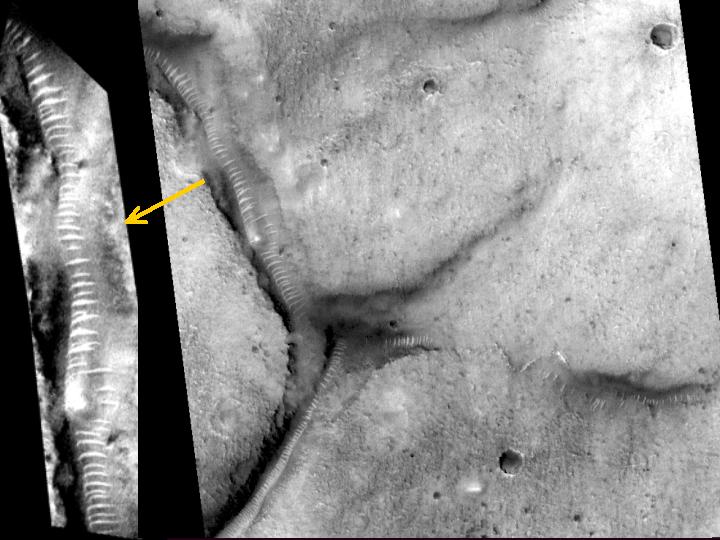
[not so] strange lines?
Bah! This is just a blurred b&w photo of someones wiring closet.
-- -
/. on Mars!!
The "exclamation point" shown on http://www.metaresearch.org/solar%20system/cydoni
a
Probably the Techno Talking Babes or Neil & Bob -
Triangles?
Dude, those triangles are just sticky-up rocks with shadows falling from the sun positioned at the top of the picture. My guess would be that it was setting at the time...
Either that or they are ALIENS!