Slashdot Mirror
Domain: mit.edu
Stories and comments across the archive that link to mit.edu.
Comments · 7,673
-
Re:I'm confused
Yep, here's a version of it ported to Java.
-
Re:Let the E-Wars begin!
The proton-Boron fusion idea sounded good a while back, but then a clever MIT grad student (link to his thesis) wrote a thesis proving that it (along with a bunch of other clever ideas) would never work. Bummer.
-
Re:brain mechanism
Oops sorry-forgot to change it to html formatted. Anyway, here is the fixed link. I didnt believe this illusion the first time I saw it (I had to go check it in paint).
-
brain mechanism
On a related note, check out this
As the light enters our eyes and into our brain, our brain automatically processes the information (in this example, if we see an object in a shadow we automatically assume that it must be lighter than it appears). What's happening in this example is probably similar to the low-hanging moon illusion. -
Viola
http://www.mit.edu/~jcb/jokes/viola.html
I'll get me coat... -
Russia Rules!
The Russians are going to Mars? At least, they shouldn't have any problems converting measurements.
-
Image Gallery
Image Gallery
(Schirotzek is sooo cute. I'm in geek love) -
Re: Changing a Light Bulb
Q: How many engineering students does it take to change a light bulb?
A: 376. One to hold the bulb and 375 to drink until the room starts spinning around. -
My QCPod needs upgrade :(
Were's the f*cking http://web.mit.edu/adorai/timetraveler/party??
Hmmm...seems my QCPod misunderstood the date (May 7, 2005, 10:00pm EDT (08 May 2005 02:00:00 UTC) Hell!! Posting in slashdot from inside a PentiumIII... Arghhhhhhhhhh -
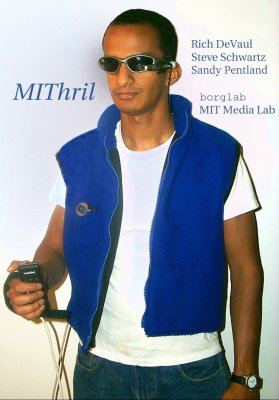
Re:How about...Well, according to the site, the final design will eventually be packaged inside a vest, like this. Also, from the site:
Note that this system is ordinary packaged in a black button-down-the-front shirt which completely conceals the equipment, making the wearable all but invisible except for the head mounted display and Twiddler.
MIThril seems to use USB for its "body bus", so I think that qualifies as a "common interface."
Finally, the problem I see with having everything directly attached is that it becomes bulkier and inflexible. You'd end up with a single big chunk either the shape of a laptop or a CharmIT (or Mac Mini), and either way it's less ergonomic than distributing the components around the body. For example, I would personally like to have the batteries in my back pants pockets, the hard drive, CPU, and tranciever in a vest, and the slate display in my backpack. Or something like that, anyway. I guess the main idea would be that I would just want separate devices and strategically designed pockets, like the Scott eVest and such. -
robocraft looks fun...
i have to admit i have never gone to the trouble(well it may not be trouble) to set it up and try this, but competitions like this seem like theyd push the way i think... sure sems like a nice escape from my typical DB business app...
http://robocraft.mit.edu/
or
http://ocw.mit.edu/OcwWeb/Electrical-Engineering-a nd-Computer-Science/6-370January--IAP--2005/Course Home/index.htm
-
robocraft looks fun...
i have to admit i have never gone to the trouble(well it may not be trouble) to set it up and try this, but competitions like this seem like theyd push the way i think... sure sems like a nice escape from my typical DB business app...
http://robocraft.mit.edu/
or
http://ocw.mit.edu/OcwWeb/Electrical-Engineering-a nd-Computer-Science/6-370January--IAP--2005/Course Home/index.htm
-
Re:How about...
Ah ha! So I'm not the only one who wants that!
The way I see it, it should be divided into the following modules: storage (hard drive/flash), tranceiver (cellular/wifi), CPU, input, and display. It could use either a Twiddler and head-mounted display, or a touchscreen slate (like a Star Trek PADD, or unusually large-but-thin PDA) interchangably. It would connect with wires instead of Bluetooth (except for the PADD), though, because everything should use the same battery anyway. It would turn out something like MIThril, except more streamlined.
Is that what you had in mind? -
Re:Corporations preclude competition on the cheap.
Never point me to RMS as a source for legal advice. You're only going to annoy me, and still fail to make your point.
RMS continues to be a guiding authority for how the free software community interprets software patents, and for good reason. I could not care less about annoying you, but you show your stripes well enough by not explaining why you disagree with his arguments. That's not the way mature people engage in discussion. It's sad, really, that you dismiss his advice in this way. It not only reflects badly on you but it means that if you had any good advice to offer contrary to what we've heard and read, we can't benefit from it because you apparently refuse to divulge it.
Legal battles are not always expensive. Most large corporations keep lawyers on staff anyway, so it never hurts to see if you can get the judge to make a speedy decision.
IBM has the most patents and they have lots of lawyers on staff ready to file patent applications and handle patent infringement cases. IBM says they get an order of magnitude more value from cross-licensing than pursuing lawsuits. This article clearly illustrates the value of cross-licensing. Since, for IBM, the burden of losing a patent infringement case is not very real, the burden must be very real for any other patent holder.
-
Re:Keyboard layoutThe reason for maintaining a standard QWERTY or Davork(sic?) layout
Actually the dvorak keyboard is an entirely different layout than the 'qwerty' layout.
-
This is (probably) not the way to go
One might argue that most innovation in software engineering, program analysis and verification in the past decade has been realized in the OO/formal semantics community. So for instance, since this exciting piece of work is implemented in a framework of OO-like interfaces, it is inamenable to crude pipe-based scripting languages. There has long been a debate between academics and designers of popular scripting languages like perl on which way to go (eg. http://www.ai.mit.edu/projects/dynlangs/ll1/). Although no one side has really won, one conclusion that stands is that scripting defines its own programming paradigm which should not be confused with anything else that comes close. Scripting languages MUST facilitate quick and dirty solutions that just work, or they're not scripting languages anymore. Usually, the more loaded a language gets with type information and rigid control constructs, the less capable it gets of letting you produce results without having to design and debug much.
-
Re:The Numbers Game:
Nope, there was a program called AppleWorks for the Apple II before ClarisWorks, but that was a completely different program. The history of ClarisWorks is here.
-
Re:The Numbers Game:
-
Re:The Numbers Game:
No, AppleWorks doesn't have half the features of word. Then again, do you use half the features of Word ? It occupies that niche for folks who aren't going to pay for Office. It's $79 new, and though I doubt they sell a lot of copies that way, it's still a hell of a lot cheaper than Office.
And for those of us that already own a copy of AppleWorks (I think it came with my iBook years ago), it fills many roles just fine. Like you said, it's a bit dated, and there are one or two little features that I would like to have, but by and large it works fine for lightweight word processing, vector drawing, and spreadsheet use. It came with MacLink, so I can read and write mostly MS Office-compatible files. It's fun to see such old still useful.
-
Re:Steve Jobs' experience was unique..You mean like OpenCourseWare?
Of course, you can't get a real degree from it, but someone with real motivation could certainly use this stuff to study up, possibly test out of a few classes so that they have less credits (and thus $$) in the way of themselves and a degree. There are probably plenty of other ways to use it, as well. And it's all free.
-
Re:Steve Jobs' experience was unique..
funny you should mention this - just a little while ago (a year or so maybe? can't remember) MIT started up a program called open courseware. It's NOT an open degree...they won't give you one, there aren't tests profs etc, but it DOES open up their course materials to anyone who wants them. And while access to open course material certainly isn't going to solve the problem of lack of accessibility for real degrees, it's definately an interesting program, and a step in the right direction. Plus, it's a fantastic resourse, and some of the courses they have opened area REALLY interesting...I've learned a lot off this site.
-
Gershenfeld Course on OCW
If you haven't been there already, spend days (or weeks) at MIT's open courseware site. Gershenfeld's course as well as many others are available free to the public here
-
Re:I'll agree with what Steve says
-
At the Fab Lab
I've had the opportunity to use the Fab Lab in Boston, and it has been a wonderful experience, but it has some drawbacks too.
The biggest source of dissapointment is that, due to litigation concerns, the Boston Fab doesn't have access to the same breadth of equipment as some of the labs abroad. That being said, there is a lot of interesting stuff to be done there. So no TIG welder for me (or the plasma cutter. Damn!)
The biggest challenge is ditching preconceptions of what can and can't be accomplished with the current technology, and learning to work with the available materials. Bring on the plexiglass, cardboard, wood and PCBs. And machining wax, for making molds.
I have a few pictures up from my first session (he cringed): Fab Lab Pics.
I should have some more pictures of finished projects up soon, and those I'll post on the Fab Lab site, SETC. -
Re:Almost?
From the classes currently online at Neil's Center for Bits and Atoms it looks like they are already working on this. How To Make Something That Makes (almost) Anything
-
Re:Almost?
From the classes currently online at Neil's Center for Bits and Atoms it looks like they are already working on this. How To Make Something That Makes (almost) Anything
-
Favorite parallel language?
-
Hidden markov models
One approach to this is to assume that the other players are markov processes with unknown internal states (sorry for the PDF) . Gathering enough data (and probing the opponents with various betting strategies) helps estimate the internal patterns of the opponents. Humans are terrible at creating random patterns needed for perfect playing strategies. This approach can be used, for example, to create a hard-to-beat paper-rock-scissors game that quickly found the non-random patterns in human players.
-
Ballroom dance robot
One of the really neat robots at the expo that I read about was a ballroom dance robot. There were articles on it at CNN and Yahoo. Basically, as it dances it matches the upper body movements of a human partner, sort of like what happens in real ballroom dancing.
It reminded me of research by an MIT student last year on swing dancing robots. Clever haptic interfaces are cool. -
Re:consolidation is good
There is market room for at least 3, and possibly 4 architectures out there
That's interesting, because all the different architectures were doing quite well, until Intel spread all the BS about how Itanium was going to destroy them all if they didn't jump on the bandwagon.
This is a very good read:
http://projects.csail.mit.edu/gsb/archives/old/gsb -archive/gsb2001-06-29.html
We seem to be very quickly approaching one single CPU, and not for technical or economic reasons, but simply because of Intel bluffing everyone into submission. -
The Wizard Book!
-
MIT OpenCourseWare
Check out MIT's OpenCourseWare. Many of MIT's classes materials all available freely online. If you are looking to learn computer science, it's hard to find a better curriculum.
-
as said before
Companies that have moved to intel arent doing very good now
-
Reminds me of something else . . .
Now if he just customized some 4 color LED fans he could combine this case with the USB-controlled LED dance floor we saw a while back, he would really have something going on.
-
Re:steved.
The old MIT thing about SGI and Compaq throwing away their innovative technologies and betting the farm on x86
Do you have a link to that? I'd be interested in comparing it with the old MIT thing about SGI and Compaq throwing away their innovative technologies and betting the farm on IA-64.
-
I hope you're really joking...
(but you missed the obligatory "Oh, wait.." that would've given you a +5 funny)...
because John C. Dvorak did NOT invent the Dvorak keyboard. Dr. August Dvorak did. -
Re:And what did the UPS guy say?Encryption is difficult to get right, but fortunately it's already been done, many time. Unless you are Bruce Schneier or Ron Rivest, you're not going to invent a secure encryption algorithm on your own. Therefore, it's smarter to use an off-the-shelf product which has been tested and reviewed, and has already weathered a storm of attacks.
Secure file transfer is a solved problem. There are several options available for secure file transfer which don't require any more coding than a simple shell script -- scp, sftp, nfs or rsync over an ssh tunnel, etc. You can easily replicate a relational database in real time over an encrypted channel using a VPN.
Even if you require a custom solution, you don't need to implement your own encryption algorithms -- there are open-source crypto libraries available for virtually every language and operating system imaginable. Not only is reinventing the wheel foolish, when you're talking about cryptosystems, it's downright dangerous.
-
Re:O/T: Getting started?
I've been looking at getting this kit, or waiting for this kit to become available. There are plenty of Verilog tutorials out on the web. Not sure of any good sites for teaching digital design... you might want to try MIT's OpenCourseWare for 6.111.
-
Re:Thoughts on virtual thoughts
I liked Foundations of Cellular Neurophysiology whose material overlaps with Biophysics of Computation a little. The former is more focused on channels while Biophysics of Computation seems to focus on neuron operations. I have read only a little bit of it, but I understand that it is good, too.
-
Re:Dupe(?) + My thoughts.... (terorist states lst)
North Korea is a recognized terrorist state
Overview of State-Sponsored Terrorism
This page is over 4 years old but still seems to be official as it is still 'up' at the time of this post.
Cuba, Iran, Iraq, Libya, Sudan, and Syria are also on this list for various reasons. Read the page for more information if you want to.
P.S. Want to export crypto outside USA/Canada and are in the USA? Read this first!
Crypto is (ultimately?) math.
Why treat a reversible mathematical transformation as a 'dangerous weapon' just because it can be used to hide secrets?
The 'terrorists' are using strong crypto in defiance of any countries rules on the subject. Why hamstring e-commerce and computer programmers world wide because of it?
Well, as a last resort, there is always Chaffing and Winnowing: Confidentiality without Encryption Let's see governments worldwide outlaw that!
-
speaking of me (company co-founder)
Four quick comments:
(1) I don't think that we really know how to engineer biology yet. Progress at the moment is taking the form of adapting (stealing?) past lessons from other engineering disciplines, from when they got started back in the "good old days," and seeing if they are worth a damn in biology. Ideas like (i) standardization, (ii) abstraction, and (iii) decoupling. We've got a lot of work to do. Help. Check out the Registry of Standard Biological Parts as one place to get started.
(2) I'm really freaked out by the idea that we might see a "microsoft equivalent" developing in biological engineering. Imagine if our wheat in the year 2050 is running the equivalent of Windows95. That seems like a "bad idea." Please see comment (4) below.
(3) I'm also concerned by the possible, future mis-application of biological technology. But, I think that the only way to deal with this problem is to (i) expect that it will, at some point in time, happen, and (ii) make sure that there are many, many, many more people who understand what is going on and who can work together to fix the problems. Mitigation of future biological risk feels like solving problems related to the security of an open distributed network. Imagine if I told you that nobody was going to write computer viruses and not to worry about network security. The same thing is going to become true in biology, we just have to make sure that the numbers of folks who are disposed to cause harm are very small relative to the numbers of folks who are empowered and want to be constructive. See this PDF for more thoughts on this topic (apologies if it seems a bit abstract).
(4) We (some folks at MIT and all over) are starting a not-for-profit called the BioBricks Foundation (BBF) to help promote the development of open biotechnology. Here's the current plan (very early). Please help if you want (or by a T-shirt when they are ready)! I'm donating all stock/income that I might receive from working with Codon to the BBF.
Thanks/take it easy!
Drew
-
speaking of me (company co-founder)
Four quick comments:
(1) I don't think that we really know how to engineer biology yet. Progress at the moment is taking the form of adapting (stealing?) past lessons from other engineering disciplines, from when they got started back in the "good old days," and seeing if they are worth a damn in biology. Ideas like (i) standardization, (ii) abstraction, and (iii) decoupling. We've got a lot of work to do. Help. Check out the Registry of Standard Biological Parts as one place to get started.
(2) I'm really freaked out by the idea that we might see a "microsoft equivalent" developing in biological engineering. Imagine if our wheat in the year 2050 is running the equivalent of Windows95. That seems like a "bad idea." Please see comment (4) below.
(3) I'm also concerned by the possible, future mis-application of biological technology. But, I think that the only way to deal with this problem is to (i) expect that it will, at some point in time, happen, and (ii) make sure that there are many, many, many more people who understand what is going on and who can work together to fix the problems. Mitigation of future biological risk feels like solving problems related to the security of an open distributed network. Imagine if I told you that nobody was going to write computer viruses and not to worry about network security. The same thing is going to become true in biology, we just have to make sure that the numbers of folks who are disposed to cause harm are very small relative to the numbers of folks who are empowered and want to be constructive. See this PDF for more thoughts on this topic (apologies if it seems a bit abstract).
(4) We (some folks at MIT and all over) are starting a not-for-profit called the BioBricks Foundation (BBF) to help promote the development of open biotechnology. Here's the current plan (very early). Please help if you want (or by a T-shirt when they are ready)! I'm donating all stock/income that I might receive from working with Codon to the BBF.
Thanks/take it easy!
Drew
-
speaking of me (company co-founder)
Four quick comments:
(1) I don't think that we really know how to engineer biology yet. Progress at the moment is taking the form of adapting (stealing?) past lessons from other engineering disciplines, from when they got started back in the "good old days," and seeing if they are worth a damn in biology. Ideas like (i) standardization, (ii) abstraction, and (iii) decoupling. We've got a lot of work to do. Help. Check out the Registry of Standard Biological Parts as one place to get started.
(2) I'm really freaked out by the idea that we might see a "microsoft equivalent" developing in biological engineering. Imagine if our wheat in the year 2050 is running the equivalent of Windows95. That seems like a "bad idea." Please see comment (4) below.
(3) I'm also concerned by the possible, future mis-application of biological technology. But, I think that the only way to deal with this problem is to (i) expect that it will, at some point in time, happen, and (ii) make sure that there are many, many, many more people who understand what is going on and who can work together to fix the problems. Mitigation of future biological risk feels like solving problems related to the security of an open distributed network. Imagine if I told you that nobody was going to write computer viruses and not to worry about network security. The same thing is going to become true in biology, we just have to make sure that the numbers of folks who are disposed to cause harm are very small relative to the numbers of folks who are empowered and want to be constructive. See this PDF for more thoughts on this topic (apologies if it seems a bit abstract).
(4) We (some folks at MIT and all over) are starting a not-for-profit called the BioBricks Foundation (BBF) to help promote the development of open biotechnology. Here's the current plan (very early). Please help if you want (or by a T-shirt when they are ready)! I'm donating all stock/income that I might receive from working with Codon to the BBF.
Thanks/take it easy!
Drew
-
speaking of me (company co-founder)
Four quick comments:
(1) I don't think that we really know how to engineer biology yet. Progress at the moment is taking the form of adapting (stealing?) past lessons from other engineering disciplines, from when they got started back in the "good old days," and seeing if they are worth a damn in biology. Ideas like (i) standardization, (ii) abstraction, and (iii) decoupling. We've got a lot of work to do. Help. Check out the Registry of Standard Biological Parts as one place to get started.
(2) I'm really freaked out by the idea that we might see a "microsoft equivalent" developing in biological engineering. Imagine if our wheat in the year 2050 is running the equivalent of Windows95. That seems like a "bad idea." Please see comment (4) below.
(3) I'm also concerned by the possible, future mis-application of biological technology. But, I think that the only way to deal with this problem is to (i) expect that it will, at some point in time, happen, and (ii) make sure that there are many, many, many more people who understand what is going on and who can work together to fix the problems. Mitigation of future biological risk feels like solving problems related to the security of an open distributed network. Imagine if I told you that nobody was going to write computer viruses and not to worry about network security. The same thing is going to become true in biology, we just have to make sure that the numbers of folks who are disposed to cause harm are very small relative to the numbers of folks who are empowered and want to be constructive. See this PDF for more thoughts on this topic (apologies if it seems a bit abstract).
(4) We (some folks at MIT and all over) are starting a not-for-profit called the BioBricks Foundation (BBF) to help promote the development of open biotechnology. Here's the current plan (very early). Please help if you want (or by a T-shirt when they are ready)! I'm donating all stock/income that I might receive from working with Codon to the BBF.
Thanks/take it easy!
Drew
-
Re:bad article summary from bad article titleNot surprising, since it was a very bad article to start with. I found it impossible to figure out exactly what this company is doing based on the article. It was one of the worst examples of hi tech business journalism I've seen in a long time.
However, if you look at the interested of some of the founders (Jay Keasling http://www.lbl.gov/pbd/about/people/keasling.htm/
, and Drew Endy http://web.mit.edu/endy/www/index.html/) my best guess is the the company is working on technologies to make large scale genetic alterations easier. Both of those guys have interests that require the manipulation of lots of genes at once, which is still rather difficult. -
Re:Oh, great.
"That's just what we needed -- a bunch of no-good self-proclaimed "genetic engineers" "creating" "new" genes by doing copy-paste hacks."
Drew Endy.
If a professor of Biological Engineering from MIT isn't a genetic engineer, I'd like to know what is. -
This seems fishy
The description of this projects seems incredibly similar to
http://web.media.mit.edu/~stefan/hc/projects/tuna/ Tuna -
Re:are there any well known exceptions to the ster
Were there ever any highly regarded scientists that also possessed above average social skills? Like picking up girls, telling jokes, that kind of thing.
How about Richard Feynman?
-
Dear sweet Mother of Pearl!
William Shatner, a (*gasp*) cock-gobbler?
That is so un-cool! -
Negroponte's calculationAt the recent WSIS conference which I discussed just now in the Researching Open Source thread, Nicholas Negroponte from the MIT Media Lab talked about his $100 laptop again. I think he said they have 3-4 companies and need another 1 or 2, located in different countries, to manufacture the device.
He gave some rough calculations about how it would become cheaper than an ordinary pc, and the biggest cost reduction was the display, which he thinks can be brought down to $30 (presumably by electronic ink). FYI. Anyway they're planning to make enough for 1 per student. Millions not trillions though.
What was quite interesting is an anecdote about how he was interviewing a candidate to run the company. The candidate was apparently turned down because he immediately talked about creating more expensive "pro" versions, which is just what Negroponte does not want to have. He says he wants a single full powered machine, and he wants to be able to make it continually cheaper instead of continually rising in cost. For whatever you want to say about the project, you have to admit this is a massive change from the way U.S. industry and M$ in particular work to bloat everything so you never have enough power.
For example, I was really happy with my Apple II running PIE (Programmer's Interactive Editor).. it had lots of control key combinations and a great feature which would jump you to recent cursor positions by hitting the 0 key. I also loved writing newspaper stories on the dedicated word processor at high school think it was a Wang (vertical green screen, 8" floppies). I think I'd really enjoy having that program on my linux laptop and do without OOo if I can. (The point being not to flame but that you don't really need bloatware, and anyway the laptop is a 1GHz machine!).It is a different definition of what you need, and anyway the need is to get more connectivity as well as hardware out to the developing world and assist with solving social problems there. Raising educational levels and using these pcs to communicate better is a good start.