Slashdot Mirror
Domain: nasa.gov
Stories and comments across the archive that link to nasa.gov.
Comments · 16,365
-
Re:the real question
A short list of things the ISS is doing for humanity in general:
1. The practicalities of human habitation in space, something that cannot be reproduced on earth.
2. Construction techniques on earth and in space
3. All that tech developed that NASA licenses to anyone who asks
4. A detailed look at how gravity influences any number of physical processes both in and out of vacuum
5. Probably the best cover of Space Oddity ever made
6. Showing the world concrete proof that they can accomplish great things if they work together (oh, except for China, but they take it as a challenge of equals instead of a condescending geopolitical stance which is nice at least)
7. An orbital launch platform for commercial microsats
8. A rationale for the commercial space industry to exist in any capacity beyond satellite launches
9. The secure knowledge that someone will be around to witness the end of the world and appreciate it -
Re:Once again, hydrogen looks to be the future
Watts' headline is based on comparing Scenario A to observations but in reality Scenario B is closest to reality but slightly higher than observations.
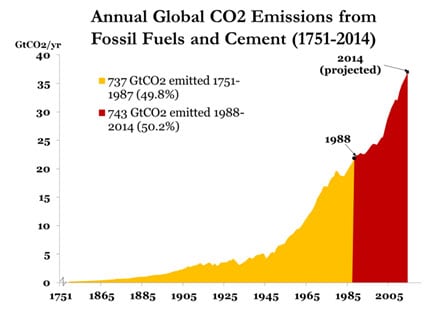
Hansen's scenario A has mankind's CO2 output rising exponentially at 1.5% per year (see the second paragraph on page 5 of the original paper) since 1988, but the actual rate of increase has been substantially higher - about 2% per year based on this graph from the Union of Concerned Scientists.
Hansen's scenario A has the average global surface temperature rising over 1 C between 1988 and 2014 (see figure 3 on page 7 of Hansen's paper). The actual temperature rise during that period was somewhere between 0.2 C and 0.4 C depending on which of the many data sets you believe.
Since Hansen's basic hypothesis was "more CO2 emissions = faster warming", scenario B certainly was not "closest to reality"; in fact none of his scenarios is at all realistic, since (empirically) he completely failed to accurately predict the relationship between CO2 and temperature - which was the entire point of his paper.
Hansen's model also had too high a value for climate sensitivity (around 4.2 IIRC) while subsequent research came up with a value around 3.2.
[1 C] * [3.2/4.2] = [0.76 C], which is still about double the observed temperature rise.
There is a reason that so much effort has been invested by alarmists into trying to make excuses for the lower-than-predicted temperatures - it's because temperatures have been lower than they predicted! That's still true, even if you use more recent models with less dramatic sensitivity to CO2.
There are already cities like Miami and Norfolk, VA that are flooding in areas when the king tides occur.
Don't be ridiculous - Miami (1.8 m) and Miami Beach (1.2 m) were both built practically at sea level to begin with; they have always been highly vulnerable to flooding since their founding. The sea level has only risen perhaps 0.25 m since that time, whereas the natural range of tides + waves + storm surges is 5+ m (especially in hurricane country!).
Norfolk, Virginia is likewise built at such a low elevation (2.1 m) that flooding problems are inevitable, although in their case the founding was long enough ago (1682) that the danger may be due to subsidence and pre-AGW sea level rise, rather than it originally being an obviously bad location.
If you look closely that EPA graph does show some acceleration.
Hardly, unless you want to count the little bump at the end which is too short to be statistically significant given how chaotic the climate system is.
In the Guardian article I think you misread "several meters" as "7 meters".
No, the original paper contains numerous statements along these lines: "Sea level reached 6–9 m in the Eemian, a time that we have concluded was probably no more than a few tenths of a degree warmer than today."
The introduction also makes reference to an earlier paper: "This uncertainty is illustrated by Pollard et al. (2015), who found that addition of hydro-fracturing and cliff failure into their ice sheet model increased simulated sea level rise from 2 to 17 m, in response to only 2 C ocean warming and accelerated the time for substantial change from several centuries to several decades."
Several meters of sea level rise this century is impossible to rule out. We don't know much about the dynamics of ice
-
Re:What are they going to do with the savings?..
To be fair, coffee-making is a serious business in Italy.
They designed and built an espresso maker for the ISS. That was complex enough. But they also had to design cups that work in space because you don't drink espresso out of a bag. Without gravity, a traditional cup doesn't work too well - the current solution uses a specially shaped cup that uses surface tension to hold the liquid inside it, with a special spout that lets you suck it in like you drink coffee normally.
There's a photo of it near the bottom.
https://blogs.nasa.gov/ISS_Sci...
Coffee is serious business.
-
Re:Lies
I'm not going to make an exhaustive list, but I will offer a few sources.
1) The predictive record:
a) Temperature and CO2: James Hansen - one of the most prominent climate scientists in the world, and former head of the NASA Goddard Institue for Space Studies - gave highly influential testimony to the United States Congress in 1988 based on his efforts at numerical modeling of future AGW. The actual increase in temperature is approximately that of his best-case scenario, in which he assumed far lower CO2 emissions than have actually occured; the actual increase in CO2 since that time has exceeded his worst-case scenario.
(Despite this unambiguous falsification of his models, Hansen continues to prophesy CO2-induced doom real soon now to this day - and the media still takes him seriously.)
The temperature predictions of the early IPCC reports have also been falsified; over time the group has gradually lowered their estimation of the climate's sensitivity to CO2, while maintaining that doom is as imminent as ever (or more so).
b) Sea level rise: "A senior environmental official at the United Nations, Noel Brown, says entire nations could be wiped off the face of the earth by rising sea levels if global warming is not reversed by the year 2000. Coastal flooding and crop failures would create an exodus of "eco-refugees," threatening political chaos, said Brown, director of the New York office of the U.N. Environment Program." - San Jose Mercury News (June 30, 1989)
2) Vague, mutually contradictory models: Amusingly, this very thread contains a fine example about sea level rise - phantomfive's "real, peer reviewed scientific paper" predicts seven meters of sea level rise in the near future (and I have seen other papers predicting even larger rises), but both the Guardian article he linked, and the Solomon Islands paper in the OP have other climate scientists are predicting a rise of less than one meter.
Another good example of the self-contradictory nature of the "settled science", is the myriad efforts to explain away the unpredicted 15+ year long "pause" in statistically significant global warming that has occured since about 2000 (although the strong El Nino this year may finally end it, at least temporarily): there are now 50+ official excuses, ranging from "the missing heat is hidden in the oceans" and "excess volcanic dust is dimming the sun", to "the pause isn't real; it's just an error in the measurements". Many of these excuses are mutually contradictory - the pause cannot be just a measurement error and also have a real physical cause.
(Suspiciously missing from the above, is any serious consideration of the possibility that the models were just wrong about the magnitude of the climate's sensitivity to CO2.)
3) Low quality data: There are two main problems with the data sets upon which modern climate science is based. The first is that claims about the long-t
-
Re:energy densities are the key
For mass-transit, it really doesn't matter!
There are plenty of advances and savings with not having a fuel system, starter system, throttle, ballast pumping system and all the rest that a dirty fuel burning plane needs, but all of them will never EVER equal the displacement in power-to-weight ratio that a hydrocarbon plane has over solar, for one simple reason:
The sun is just not bright enough from Earth
Even if we did manage to make solar cells 100% efficient, they just won't capture enough light from the sun to power a plane for a long period of time with that much weight.
There are only so many advances you can go before you start to hit physical limits and math limits. Takeoff weight, and power needed to fight gravity are concepts we understand pretty well (just ask NASA, the guys with huge R&D budgets). The sad fact is, we can only derive about 1KW/square meter of solar energy. One could say it's a design challenge to just make the plane bigger, but one would need ever increasing structures and weight to capture the increasing size of the solar power plant on top the craft. See here for NASA's explanation of a similar issue with rocket power. So, one would be wrong.
What might be the answer is: batteries. If you could make a battery 100X the density of a modern battery, then it would take 1/3 the weight and volume of the fuel modern aircraft expend during their journeys, making them equivalent to throwing out the fuel through the engines as planes do today. Charging them in flight is a silly notion because such a small amount of energy in the form of sunlight actually hits the plane vs. the total energy required to physically overcome gravity with the mass of a few hundred souls, luggage, and craft. You would need these batteries to charge very fast while on the ground, have long life-spans and cycle-count ratings for it to be economically worth it. Maybe when our ability to work with single-atom thick graphene sheets has advanced we could achieve this. There are probably things we need to do better to the electric motor to produce that kind of horsepower, but that seems like the next problem to solve, not the current one. -
Re: Hmm
Probably works using GPS, so while a 16,000+ mph snap would be awesome, I don't think it would happen.
It's in a MUCH lower orbit than GPS satellites, so there's no reason why GPS shouldn't work. The ISS actually uses GPS for attitude adjustments.
The problem would be getting a connection to a cell tower to upload the snap. -
Re:"Habitable Zone"
Why assume life out there would be carbon based, breath, and require water?
Plenty of life doesn't "breathe", so nobody is assuming that. Early life on earth was almost certainly anaerobic. But carbon and water have some very useful properties, and they are both extremely common in the universe. So assuming that life is carbon based in a liquid water medium is reasonable.
Also, we are searching in extreme environments outside the habitable zone. For instance, we are planning missions to Europa which has far more liquid water than earth.
-
Re:creationist?
The bit of video I saw showed Dr Spencer arguing against genetic randomness. Maybe he believes the only other possibility is Intelligent Design? I don't know. I haven't looked into it. [GiordyS]
Ironically, GiordyS says this in response to my pointing out that Dr. Spencer has been making his "intelligent design" views public for years... and in that bit of video Dr. Spencer was repeating classic "intelligent design" arguments. "Maybe?" You still "don't know"? Seriously?
But I know nothing about competing genetic randomness theories, so my lack of surprise has nothing to do with the actual science, in case you misunderstood. (I haven't looked into it.) [GiordyS]
They're not "competing genetic randomness theories. That's the entire point. "Intelligent Design" is a supernatural "explanation" which violates methodological naturalism and therefore would destroy science if it were confused with a scientific hypothesis. If the scientific process included a "supernatural" option, it would be used on a daily basis because people (including scientists) are lazy. As I've said before, I believe that science absolutely requires naturalism for two reasons. First, supernatural explanations are compatible with any and all eventualities, therefore they are not falsifiable and do not provide unique predictions.
Second, if science allowed supernatural explanations as a legitimate recourse, they would be used far too often because we can't distinguish poorly understood natural phenomena from genuinely supernatural phenomena:
- Laplace never would've studied the stability of the solar system, so NASA wouldn't know to put the SOHO and WMAP satellites in their respective Lagrange points.
- The question of why atoms are stable despite the predictions of classical electrodynamics would've been answered in the same way Newton explained the solar system's stability, so quantum mechanics (along with much of modern technology) wouldn't have been discovered.
- The precession of Mercury's orbit would've been dismissed as "Allah pushing the planet around," so we never would have discovered Einstein's General Theory of Relativity, without which GPS devices can't function accurately.
- The missing 2/3 of solar neutrinos would've been explained as "Ra's chariot soaking up the neutrinos on their way to earth," so neutrino oscillation would never have been proposed and proven, which would cause our cosmological models (if 'science' of this kind could even lead to such models) to be inaccurate because we wouldn't know that neutrinos have a non-zero rest mass.
- Cosmic rays with energies above the GZK limit are currently unexplained. Should we bother looking for a naturalistic explanation, or just say they're "Jesus particles"?
- Should we continue to try to quantize gravity, or announce that the obvious impossibility of such a feat is proof that the universe contains a message from its Intelligent Designer?
If you think that any of these examples are silly, exactly how are they differen
-
Re:creationist?
The bit of video I saw showed Dr Spencer arguing against genetic randomness. Maybe he believes the only other possibility is Intelligent Design? I don't know. I haven't looked into it. [GiordyS]
Ironically, GiordyS says this in response to my pointing out that Dr. Spencer has been making his "intelligent design" views public for years... and in that bit of video Dr. Spencer was repeating classic "intelligent design" arguments. "Maybe?" You still "don't know"? Seriously?
But I know nothing about competing genetic randomness theories, so my lack of surprise has nothing to do with the actual science, in case you misunderstood. (I haven't looked into it.) [GiordyS]
They're not "competing genetic randomness theories. That's the entire point. "Intelligent Design" is a supernatural "explanation" which violates methodological naturalism and therefore would destroy science if it were confused with a scientific hypothesis. If the scientific process included a "supernatural" option, it would be used on a daily basis because people (including scientists) are lazy. As I've said before, I believe that science absolutely requires naturalism for two reasons. First, supernatural explanations are compatible with any and all eventualities, therefore they are not falsifiable and do not provide unique predictions.
Second, if science allowed supernatural explanations as a legitimate recourse, they would be used far too often because we can't distinguish poorly understood natural phenomena from genuinely supernatural phenomena:
- Laplace never would've studied the stability of the solar system, so NASA wouldn't know to put the SOHO and WMAP satellites in their respective Lagrange points.
- The question of why atoms are stable despite the predictions of classical electrodynamics would've been answered in the same way Newton explained the solar system's stability, so quantum mechanics (along with much of modern technology) wouldn't have been discovered.
- The precession of Mercury's orbit would've been dismissed as "Allah pushing the planet around," so we never would have discovered Einstein's General Theory of Relativity, without which GPS devices can't function accurately.
- The missing 2/3 of solar neutrinos would've been explained as "Ra's chariot soaking up the neutrinos on their way to earth," so neutrino oscillation would never have been proposed and proven, which would cause our cosmological models (if 'science' of this kind could even lead to such models) to be inaccurate because we wouldn't know that neutrinos have a non-zero rest mass.
- Cosmic rays with energies above the GZK limit are currently unexplained. Should we bother looking for a naturalistic explanation, or just say they're "Jesus particles"?
- Should we continue to try to quantize gravity, or announce that the obvious impossibility of such a feat is proof that the universe contains a message from its Intelligent Designer?
If you think that any of these examples are silly, exactly how are they differen
-
Re:Earth shifts
Your demands for citations are cute. If they're not in the right format, you won't read them. I'm sure that will make them go away.
To illustrate, that we've seen both kinds of predictions, and that the climate science has a long way to go to establish its credibility. These cooling papers came after Arrhenius, did not they?
Again, we can find contrarian research published about plate tectonics decades after it was accepted science. The existence of papers is not an argument for their credibility.
Arrhenius' first paper on the subject of warming is here. His prediction was about 4-6 degrees per doubling of CO2, with greater effects at the poles. That's on the high end of current estimates, but given the amount of hand-calculation he had to do, it's still a pretty impressive result.
Most of the early work on climate change was proving that it was possible for the climate to change at all, and as you can see in Arrhenius' paper, they mostly deal with the planet in an equilibrium state, and don't account for ever-increasing levels of CO2. One early attempt at modeling the globe in order to make these sorts of predictions was Hansen et al, 1988. He overestimated warming by about 15-25%; this article gives a post-mortem on his predictions. Essentially, using the same model with one slightly different physical constant reproduces the temperature trend far more precisely. An earlier study (Plass 1956) predicted a rise of 1.1 degrees C per century, assuming 1950s emissions levels. Warming since the 1950s has been on the order of
However, you're also reversing the burden of proof. Basic physical laws suggest that a higher partial pressure of CO2 will warm the Earth, and simple laboratory experiments show a strong positive feedback from H2O.
Great! And this was all known this for decades (if not centuries), right?
The laboratory experiments on the infrared absorption of various gases date back to Tyndall (1859), and general radiative laws derived by Boltzmann (1884). A more specific overview of radiative forcing effects can be found in Myhre et al, 1998, if you're interested. So for the general idea that CO2 affects the temperature on Earth, you can look to any of the above for confirmation, or grab an IR camera and take a photograph.
So if CO2 affects the global temperature, and CO2 is measured to be increasing (which presumably you do not dispute), then wouldn't it be obvious that temperature must also increase? Not so fast! The absorption bands of CO2 and H2O overlap, and the atmosphere is so full of water vapor that it periodically precipitates. Clearly anything CO2 could do, H2O must already be doing, right? Bzzt. The flaw in this thinking is that because H2O precipitates out before it reaches the upper atmosphere and CO2 does not, allowing the latter to build up in the upper atmosphere (Kaplan 1952). Specifically, it extends the CO2-rich layer further out into space. There are a couple more details about where emission happens at what probability for a given photon of a given energy, and how many times it can expect to hit something on its way up, but again, your IR photograph should tell you that the mean free path is pretty short. This paper gives an overview of Earth's radiative balance.
I don't have to offer my own theory — because I do not seek to convince and/or compel you to alter your way of life. You seek to do that t
-
Re:Gullibility is the true global catastrophe75%......Your math is off by quite a bit.
-
First man, not first "man"
Note that Peake is not the first person to do this-- Suni Williams ran the 2007 Boston Marathon in the ISS.
-
Re: Suicide Pact
Of course, global warming isn't science. It's fiction. People have caught on, so global warming is no longer about definite predictions.
Here's a graph for you: http://data.giss.nasa.gov/gist... Look at the red line. It's global, and it's warming.
-
Re: Please stop drinking the Koolaid
You say that you are not a troll, but then you link to a troll video. It makes the bogus claim that Bill Nye wants to Clinton to become president so she can get the DOJ to start filing criminal charges and imprisoning global warming skeptics. He then refers to the interview in which he did not mention Hillary Clinton, nor anything about her directing the DOJ to do anything. He did not mention skeptics, and was only talking about company executives who produce the anti-science FUD that they know is incorrect (just like the Enron and tobacco execs).
Here is what else it gets wrong. The word "denier" is not reserved for discussions about holocaust, and to suggest other wise is just being manipulative. But being offended by that term doesn't stop him from calling liberals "fascists". It doesn't stop him from saying that the leftist, tyrannical government will start imprisoning THEN EXTERMINATING Christians!! He then reveals that it is all being directed by Lucifer. Being called a denier seems rather tame compared that vitriol.
I could end there, but there are other lies in the video that need correction. The claim that the leaked emails from Climategate showed that the data had been fabricated and fudged gets traced back to a the choice of a single word in one email. Pretty flimsy. According to NASA, the term global warming was first used in a 1975 paper entitled "Climatic Change: Are We on the Brink of a Pronounced Global Warming?". Both terms were used together right from the start.
Then there is the ultimate of trolls - 1998. The initial claims were that it was getting colder since 1998, then it was that the warming had stopped, and now the deniers have to say that there is "no significant warming" since that year. And yet the temperature records keep getting broken. And why are people so focused on that one period? If you look at the temperature graphs since modern records began, it is easy to find other periods when the graph levels out, and even goes down substantially. Those periods have never signaled the end of the warming trend. I can't imagine that anyone who uses this claim has not seen a similar graph to the one that I linked above, so why do they think that looking at such a short time frame will be indicative of any trend. The answer must be that they either want to mislead us or they are genuinely stupid and are willing to cherry-pick any data that they can find to match their preconceived ideas.
-
Re: Please stop drinking the Koolaid
You say that you are not a troll, but then you link to a troll video. It makes the bogus claim that Bill Nye wants to Clinton to become president so she can get the DOJ to start filing criminal charges and imprisoning global warming skeptics. He then refers to the interview in which he did not mention Hillary Clinton, nor anything about her directing the DOJ to do anything. He did not mention skeptics, and was only talking about company executives who produce the anti-science FUD that they know is incorrect (just like the Enron and tobacco execs).
Here is what else it gets wrong. The word "denier" is not reserved for discussions about holocaust, and to suggest other wise is just being manipulative. But being offended by that term doesn't stop him from calling liberals "fascists". It doesn't stop him from saying that the leftist, tyrannical government will start imprisoning THEN EXTERMINATING Christians!! He then reveals that it is all being directed by Lucifer. Being called a denier seems rather tame compared that vitriol.
I could end there, but there are other lies in the video that need correction. The claim that the leaked emails from Climategate showed that the data had been fabricated and fudged gets traced back to a the choice of a single word in one email. Pretty flimsy. According to NASA, the term global warming was first used in a 1975 paper entitled "Climatic Change: Are We on the Brink of a Pronounced Global Warming?". Both terms were used together right from the start.
Then there is the ultimate of trolls - 1998. The initial claims were that it was getting colder since 1998, then it was that the warming had stopped, and now the deniers have to say that there is "no significant warming" since that year. And yet the temperature records keep getting broken. And why are people so focused on that one period? If you look at the temperature graphs since modern records began, it is easy to find other periods when the graph levels out, and even goes down substantially. Those periods have never signaled the end of the warming trend. I can't imagine that anyone who uses this claim has not seen a similar graph to the one that I linked above, so why do they think that looking at such a short time frame will be indicative of any trend. The answer must be that they either want to mislead us or they are genuinely stupid and are willing to cherry-pick any data that they can find to match their preconceived ideas.
-
Re:Very Serious Flaws
Only one who has no clue about physics would write such nonsense.
That's rich considering the rest of your post.
random gravitational perturbations
There is no randomness in gravity.Only if you want to get pedantic about it. On the scale we're talking, your mom standing next to this thing would actually have more effect on the acceleration due to her gravitational mass than the engine would. Even if she was an anorexic supermodel. A small earthquake, new building construction, or an abnormally large number of cargo ships passing underneath this thing would probably perturb the orbit enough to matter on the scale of thrust being measured here.
solar radiation
Does not influence orbits of satellites around earth.NASA says you should take your own advice and not show yourself to be a complete ignoramus when calling someone the same: http://ntrs.nasa.gov/archive/n...
interaction with atmosphere
There is none if you go high enough.The specific altitude wasn't mentioned. Additionally, big solar flares can make enough trace atmosphere "bulge" in various directions enough to perturb satellite orbits quite farther out than one would think. Especially someone as well informed as you are about these kinds of things.
collisions with space dust
Would not have an effect on the probe as the dust comes from everywhere.I don't think you put much thought into your post before you wrote it. I think most other readers of slashdot are smart enough that the ridiculousness of what you just said there is self evident.
measurement accuracy Irrelevant.
I measure a distance of 1mm today
If you measure something today with some digital calipers accurate out to the nearest 1/10thmm and it's
If something moves in one direction, like global warming, it does not matter how accurate your measuring is. After a reasonable amount of time, you see: it is moving.
What a perfect example. Do you realize just how much of the world thinks man made global warming is total BS? My initial claim was that putting this thing in space is no more helpful than the experiments done to it on the ground, and your example backs it up perfectly.
-
Clickbait
Clickbait article is clickbait.
Xenon drive has been around since the 1950s
The article's touted monster gain -- ten times better than chemical rockets -- is the same ten times gain NASA has been using in actually-launched-into-space rockets for years, if not tens of years.
The article talks about a $65M program to try to make even greater gains...and provides zero details. Probably because making "huge" gains in a technology that is over sixty years old ain't easy.
In summary, this article is about as interesting as GM announcing they are working to make fuel injectors ten times better than carburetors. -
Re:Still Not Buying
So you don't care about a decade long series of heat waves that caused the dust bowl. Which resulted is massive repeated crop failures that then resulted in the Great Depression. If your "models" conveniently ignore all data prior to 1960 so that they don't have to explain an actual disaster what credit should be given to predicting worse events in the future? As for your referenced "data". I didn't say there wasn't more CO2, and the chart from the Mauna Loa Observatory is cute. How about the Optical Depth data that shows the SO2 light reflection that is relevant to what I claimed, and to what the article claims to have found. Or how about the GHCN dataset which if you dive in and pull out the Precipitation, and Evaporation you have some interesting problem with Global Warming. One 'Claim' from Global Warming is the increase in heat increases evaporation, increasing humidity, thus increasing rain and Precipitation. The problem is you get this nice little graph that I'm sure you're going to ignore because all these lovely scientists cant possibly be wrong. It doesn't even matter to you that NASA predicted that cycle 24 would be particularly bad. If my analysis is correct, which it is, and nasa's prediction was correct, which it was, then there is a serious problem. It means that the Pan Evaporation mesurments were sensitive enough to pick up a nasty level of solar activity, but not sensitive enough to pick up your phantom global warming since 1950 when the US Geologic Survey fine tuned the measurement process because they needed to know how much evaporated off of lake mead that the prior data was so variant it was unusable. If I'm right, which I am, then that means Global warming from 1950 to 2010 is nothing compared to what the CME's have been doing to us. And this all brought to you by the Sun's northern field deciding to take some time off. So yea your 25% increase in overall CO2 since 1960 is pretty meaningless in the scope of the overall data because if it was It should have moved the evaporation long before 2010.
-
Re:Still Not Buying
So you don't care about a decade long series of heat waves that caused the dust bowl. Which resulted is massive repeated crop failures that then resulted in the Great Depression. If your "models" conveniently ignore all data prior to 1960 so that they don't have to explain an actual disaster what credit should be given to predicting worse events in the future? As for your referenced "data". I didn't say there wasn't more CO2, and the chart from the Mauna Loa Observatory is cute. How about the Optical Depth data that shows the SO2 light reflection that is relevant to what I claimed, and to what the article claims to have found. Or how about the GHCN dataset which if you dive in and pull out the Precipitation, and Evaporation you have some interesting problem with Global Warming. One 'Claim' from Global Warming is the increase in heat increases evaporation, increasing humidity, thus increasing rain and Precipitation. The problem is you get this nice little graph that I'm sure you're going to ignore because all these lovely scientists cant possibly be wrong. It doesn't even matter to you that NASA predicted that cycle 24 would be particularly bad. If my analysis is correct, which it is, and nasa's prediction was correct, which it was, then there is a serious problem. It means that the Pan Evaporation mesurments were sensitive enough to pick up a nasty level of solar activity, but not sensitive enough to pick up your phantom global warming since 1950 when the US Geologic Survey fine tuned the measurement process because they needed to know how much evaporated off of lake mead that the prior data was so variant it was unusable. If I'm right, which I am, then that means Global warming from 1950 to 2010 is nothing compared to what the CME's have been doing to us. And this all brought to you by the Sun's northern field deciding to take some time off. So yea your 25% increase in overall CO2 since 1960 is pretty meaningless in the scope of the overall data because if it was It should have moved the evaporation long before 2010.
-
Re:Thanks, Summary
NASA calls this the Skipping Stone Theory aka, Incorrect Theory #2.
-
Re:Thanks, Summary
Likewise, Airplane wings don't produce lift because of the vacuum on the upper surface. They produce lift because the pressure on the lower surface is higher than the pressure on the upper surface so the wing is PUSHED up.
NASA calls this the Skipping stone theory aka, the Incorrect Theory #2
-
Re:Satellite data in 1880?
-
Re: Semantics
You're fucked!
Okay, so point 4, the seas were not rising prior to 1900.
http://www.giss.nasa.gov/resea...Yawn. You guys think you're so smart... but you're so stupid.
Your only citation instantly debunked using a source you can't impeach without cutting the dick off your own argument.
-
Most Likely Explanation
The most likely explanation was that it was just a spurious signal (as your source notes). Quoting Wikipedia:
However, observations using the INTEGRAL telescope, through the all-sky SPI-ACS instrument, indicate that the amount of energy in gamma-ray and hard X-ray emission from the event was less than one part in a million of the energy emitted in the form of gravitational waves, concluding that "this limit excludes the possibility that the event is associated with substantial gamma-ray radiation, directed towards the observer." If the signal observed by the Fermi GBM was genuinely astrophysical, SPI-ACS would have detected it with a significance of 15 sigma above the background.[50] The AGILE space telescope also did not detect a gamma-ray counterpart of the event.[51]
It's also worth noting that while Fermi can tell the origin of a signal to some degree, it's not what you would call pinpoint accurate. "The region not occulted by the Earth contains 75% of the probability of the localization map," which means that the other 25% was pointing towards a terrestrial gamma ray burst but that's not what we're here to science, darn it! Later they say, "The best-fit location is towards the Earth but the large uncertainty on the location allows an arrival direction from the sky."
This event has consumed ink wildly out of proportion to its merit.
-
Re:Climate Change Happens
>> Please note there will be another ice age at some point.
> As I said before, with current CO2 levels: unlikely. With increasing CO2 levels: definitely not.Probably not a "Snowball Earth" ice age, but a mini-ice-age is a definite possibility, if polar meltwater messes up the conveyor currents that circulate warm water north from the tropics:
http://pmm.nasa.gov/education/videos/thermohaline-circulation-great-ocean-conveyor-belt
-
Re:0.2C
The article says "Likely reason" but the independent investigation only found it to be the "most probable cause" which doesnt at all mean "likely reason"
Very true. It could have lost it's propellant because of an badly designed valve. It could have been hit by a meteor. It could have been screwed up by a solar flare. It could have been that a squirrel accidentally got in there and ate the wires. It could have been that space aliens abducted the craft.
You found a non-authoritative source that agreed with you [...]
Actually, I didn't find that non-authoritive source. You did. You're the one who referenced the wikipedia article in your reply. I merely pointed out that the article you referenced said that the likely reason was a leak.
[...] and then you stopped, rather than you finding an authoritative source. You obviously don't care about veracity.... about facts.
Well, I wouldn't go that far. Again, you're the one who gave the reference. So if anyone should be checking their sources, it's you.
But, okay, I went and dug out NASA's "Mars Observer Loss of Signal: Special Review Board Final Report." On page 7-62, the report says that the meteoroid impact scenario was credible, but very unlikely.
-
Re:10%. 90%
The conversation was about the Cook study. And apparently you can't tell how bad a study is even if it's atrociously bad. "From the start we would never be able to claim that ratings were done by independent, unbiased, or random people anyhow." http://www.hi-izuru.org/forum/...
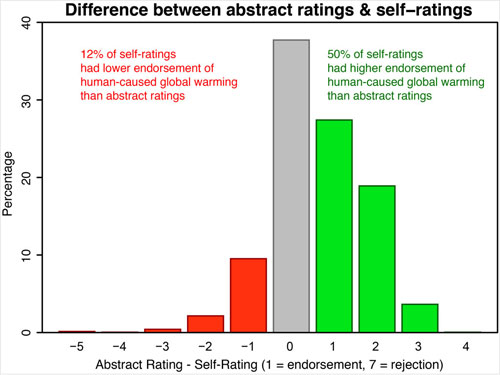
Again, you meant to accuse me and NASA of apparently not being able to tell how bad a study is. And specifically, the conversation was about how the Cook study compared their own ratings to self-ratings done by the authors. Isn't it strange that all your supposedly "atrocious" rater problems actually caused the Cook et al. raters to underestimate the consensus rate compared to the authors' self-ratings?
Funny you should link the Zimmerman study - they surveyed 3145 respondents, but only used 77 of those to get the magic 97% number.
If you surveyed doctors about a topic involving heart surgery and only 77 out of 3145 of those doctors were actively practicing heart surgeons, wouldn't you be more interested in what those experts have to say? From Doran and Zimmerman 2009:
"In our survey, the most specialized and knowledgeable respondents (with regard to climate change) are those who listed climate science as their area of expertise and who also have published more than 50% of their recent peer-reviewed papers on the subject of climate change (79 individuals in total). Of these specialists, 96.2% (76 of 79) answered "risen" to question 1 and 97.4% (75 of 77) answered yes to question 2."
Doran and Zimmerman reported all the results in Fig. 1, which reveals a common (indeed, expected) increase in accuracy as one's subject expertise increases.
... The question asked was "Do you think human activity is a significant contributing factor in changing mean global temperatures?" Most skeptics and luke-warmers, including me, would answer 'yes' to that question. So the survey is essentially meaningless.
Since they show all their results in Fig. 1, and over 30% of the general public answered "no" to that question, it's not clear how Doran and Zimmerman 2009 was "essentially meaningless". Their survey revealed that even using such a broad definition, the general public has been grievously misled. Possibly by compulsive contrarians who don't have any real expertise, but who nevertheless have fun baselessly accusing scientists of dishonesty and fraud.
And remember, Anderegg et al. 2010 used a more precise definition. What regurgitated excuse "justifies" ignoring Anderegg et al. 2010?
Here's a much better discussion on consensus: https://judithcurry.com/2013/1...
If GiordyS and Jane Q. Public's accusations aren't baseless, why do they keep "citing" blog posts, while I'm citing peer-reviewed papers along with statements from NASA and many other scientific organizations?
GiordyS just linked a blog post which proclaims a "52% 'consensus'" because of a 2013 survey of the American Meteorological Society. Had GiordyS really just not read about the new 2016 AMS survey revealed different results?
"Specifically: 29% think the change is largely or entirely due to human activity (i.e., 81 to 100%); 38% think most of the change is caused by human activity (i.e., 61 to 80%); 14% thi
-
Re:10%. 90%
The conversation was about the Cook study. And apparently you can't tell how bad a study is even if it's atrociously bad. "From the start we would never be able to claim that ratings were done by independent, unbiased, or random people anyhow." http://www.hi-izuru.org/forum/...
Again, you meant to accuse me and NASA of apparently not being able to tell how bad a study is. And specifically, the conversation was about how the Cook study compared their own ratings to self-ratings done by the authors. Isn't it strange that all your supposedly "atrocious" rater problems actually caused the Cook et al. raters to underestimate the consensus rate compared to the authors' self-ratings?
Funny you should link the Zimmerman study - they surveyed 3145 respondents, but only used 77 of those to get the magic 97% number.
If you surveyed doctors about a topic involving heart surgery and only 77 out of 3145 of those doctors were actively practicing heart surgeons, wouldn't you be more interested in what those experts have to say? From Doran and Zimmerman 2009:
"In our survey, the most specialized and knowledgeable respondents (with regard to climate change) are those who listed climate science as their area of expertise and who also have published more than 50% of their recent peer-reviewed papers on the subject of climate change (79 individuals in total). Of these specialists, 96.2% (76 of 79) answered "risen" to question 1 and 97.4% (75 of 77) answered yes to question 2."
Doran and Zimmerman reported all the results in Fig. 1, which reveals a common (indeed, expected) increase in accuracy as one's subject expertise increases.
... The question asked was "Do you think human activity is a significant contributing factor in changing mean global temperatures?" Most skeptics and luke-warmers, including me, would answer 'yes' to that question. So the survey is essentially meaningless.
Since they show all their results in Fig. 1, and over 30% of the general public answered "no" to that question, it's not clear how Doran and Zimmerman 2009 was "essentially meaningless". Their survey revealed that even using such a broad definition, the general public has been grievously misled. Possibly by compulsive contrarians who don't have any real expertise, but who nevertheless have fun baselessly accusing scientists of dishonesty and fraud.
And remember, Anderegg et al. 2010 used a more precise definition. What regurgitated excuse "justifies" ignoring Anderegg et al. 2010?
Here's a much better discussion on consensus: https://judithcurry.com/2013/1...
If GiordyS and Jane Q. Public's accusations aren't baseless, why do they keep "citing" blog posts, while I'm citing peer-reviewed papers along with statements from NASA and many other scientific organizations?
GiordyS just linked a blog post which proclaims a "52% 'consensus'" because of a 2013 survey of the American Meteorological Society. Had GiordyS really just not read about the new 2016 AMS survey revealed different results?
"Specifically: 29% think the change is largely or entirely due to human activity (i.e., 81 to 100%); 38% think most of the change is caused by human activity (i.e., 61 to 80%); 14% thi
-
Re:10%. 90%
If "anyone can see for themselves that the Cook paper is utter garbage" then it's strange that you and Jane Q. Public only link to confused blog posts, while NASA publicly endorses the Cook paper.
-
Re:10%. 90%
And just FYI: I'm not going to argue about that fact. If anybody doubts that "C13" was garbage, all they have to do is spend a few minutes on Google and view the evidence.
I spent a few minutes on Google and viewed the evidence from NASA. They don't agree with Jane Q. Public's "utter garbage" accusation.
-
Re:Starwisp
According to this paper there is one dust particle per million cubic meters in local interstellar space (a figure that surprised me, it seemed much higher than I expected).
That seemed high to me, too. But this is what was really surprising from that link:
Starship deceleration caused by tether-dust collisions is about an order of magnitude less than deceleration caused by collisions between the tether and interstellar hydrogen atoms.
"Vacuum" is weird.
-
Re:Starwisp
But would they? I wonder what the odds are?
There's a whole lot of empty between us and the nearest star. I wonder what the actual odds are of collision over that distance. Would be a neat problem for someone who knows this stuff
As I post this there are 160 posts, but nobody has tried to make an actual estimate, so here goes. According to this paper there is one dust particle per million cubic meters in local interstellar space (a figure that surprised me, it seemed much higher than I expected).
A one square centimeter spacecraft would sweep out a volume 4.5 LY long, with is 4.5E13 km, or 4.5E18 cm. A million cubic meters is 1E12 cm^3, So the 1 cm^2 area would get by 4.5E6 dust particles on its way, or an average impact density of one per 20 square microns. You will need a distributed mesh that can function after this level of dust penetration.
Since a dust particle impact on a film would create an explosion (of 1E-4 J) the obvious solution is to make the mesh a true net with empty space between nodes. An impact on the mesh filament would vaporize that segment, but the number of such impacts (location random) could be estimated in advance, and the design based on preserving functionality reliably with that level of random disconnection.
-
Re:Having worked for NASA during 8 COTS years
-
Why Emergency Mode uses more fuel
User Statistical at Ars Technica explained it nicely:
Normally Kepler (in K2 mode) uses the pressure from sunlight combined with the two remaining reaction wheels to maintain orientation. It still does need periodic thruster usage but the heavy lifting is done by solar pressure and reaction wheels which makes the propellent usage very efficient. However it is a complicated and precarious balancing act. It needs full instrumentation, computer operation, and periodic updates from Earth to work.
When it goes into emergency mode it falls back on 100% station keeping thrusters because that is simpler although far more expensive in terms of fuel. They don't know exactly why it went into emergency mode but for whatever reason Kepler believed it could not maintain orientation without it.
In emergency mode it has to expand propellent because without some station keeping it would begin to tumble uncontrollably. If you have a spacecraft millions of kms away from Earth, tumbling out of control with its communication array no longer pointed at Earth you will probably never regain control. So it is a last ditch effort to maintain proper orientation on the hope that command & control update can fix the problem. It begins "looking" for an command & control signal from Earth (using propellent to orient the spacecraft). If/when it finds it, it then tries to keep that orientation using 100% station keeping thrusters regardless of fuel consumption. It will continue to do so until standard operation is restored or it runs out of fuel.
About Kepler's K2 mode:
-
UPDATE -- EM over...
As of Sunday morning, the Emergency Mode was resolved; and the spacecraft was returned to normal mode. https://www.nasa.gov/feature/m...
-
Re: Why Better than Parachute?
"Parachutes will slow down the descent..." - only in relation to the speed it was previously doing. The shuttle's SRBs splashed down at speeds in the region of 50mph. Soyuz capsules descend at about 24 ft/s (16mph) and use retro rockets to reduce the speed further.
"...thrusters would only need to be fired horizontally..." - thrusters that the 1st stage doesn't have. It has some cold RCS thrusters at the top for attitude control, but the amount of fuel needed for horizontal translation against a modest 10kt breeze would be massive. This stage landed on a rotating and vertically translating ship in a 40-50kt gale.
"...vertical thrust for super smooth landing" - which is exactly what SpaceX are doing. Remember, a single Merlin engine provides too much thrust to hover, so it'll have to fire at exactly at the right time anyway.
Put simply, explain how to slow a stage from 7,000 + km/h using just parachutes so it lands within a previously designated area of 300x170 ft in gale force winds. If you can, ESA, ULA & Roscosmos have a job for you.
-
Re:About time
Sure you did, the idea is almost 60 years old. http://grin.hq.nasa.gov/ABSTRA...
-
Re:Yeah, that's sounds REAL secure
800 miles above the surface of the planet, living in a fucking TENT! "No space debris could possibly puncture the fabric walls of this baby!"
Yeah, they never would have thought of that...
http://ntrs.nasa.gov/archive/nasa/casi.ntrs.nasa.gov/20160001632.pdfAnd the ISS is between 254-258 miles up.
-
Re:"is currently 75M miles away right now"?
"is currently" is the correct phrase. Kepler is in an Earth-trailing orbit with a 371 day period. So it is constantly moving further from the Earth (at least until it reaches opposition, after which it'll start to get closer). The orbit reduces interference from the Earth (RF, thermal, and gravitational) while requiring less energy than reaching the L2, L4, or L5 Lagrange points.
-
Re:Reaction wheel failure?
Given that we know that Kepler has a bad batch of reaction wheels, that two of the four have already failed, and that this emergency mode happened while the spacecraft was being repointed to the Galactic Center for a microlensing campaign, which inevitably would mean a lot of reaction wheel use, I very much fear that this means that another reaction wheel has failed and the K2 mission is over.
-
Re:Why more fuel than usual?
From the SOHO spacecraft web page:
ESR (Emergency Sun Reacquisition) Mode
This is the "ultimate safety net" for SOHO. In ESR, the spacecraft attitude is controlled entirely by hardware that senses the approximate position of the Sun and fires thrusters autonomously to ensure that the spacecraft is pointed towards the Sun (plus/minus 2 degrees on each axis). The spacecraft roll is not controlled by the hardware, but it can be controlled by ground intervention.
In other words, the spacecraft goes into a mode where the only thing it does it point at the Sun, to keep the power flowing, and it does so by using fuel, not the reaction control wheels. As fuel is a limited resource, that would be bad if it continued too long.
-
Re:Shifting masses
Wow, way to research. As of less than 6 months ago, on land ice growth is killing it compared to sea ice.
-
Re:Shifting masses
Here you go. These guys know a bit about all this science thang,
-
Re:Millenials
You should read this FAQ. It contains links to papers that explain the reasons and methods used for adjustments to the raw data. You might learn something. Even if you had the raw data you would still have to make your own adjustments to account for things like station moves, instrument changes, changes in the time of observation, etc.
-
Re:Semantics
Meanwhile, the Antarctic ice cap is adding 82 billion tons of ice a year... Enough to offset the arctic ice loss, so the total ice mass stays the same...
-
Re:Semantics
Lots of claims about ice-free Arctic waters... Even though there's a net increase in total ice at the poles, mainly due to the Antarctic adding 82 billion tons of ice a year.
-
Well, in our school...
Just the other day I had a conversation with an 11th grade student and a science teacher about global warming. Turns out, the students were doing a research essay on the subject, one page, and the teacher accepts every paper that's backed up with good sources. And they have a good conversation even evaluating some of the sources. He openly tells students that he firmly believes global warming is real, but it's an open dialog with students.
Not every school discourages open conversation regarding climate change. And I'm equally frustrated that there's just as much closed-minded fervor from both sides of the conversation.
In my study of the topic, I've concluded that climate change is happening, and humans are partially responsible for the change. But the Earth has ways of compensating for the change, though some of these compensations will necessitate either adaptations or extensions from all walks of human life. We humans have had such success in adapting to our environment that we should have no troubles adjusting, but ironically, we resist change. In order to adapt, we need to talk about the changes taking place and how to respond to them accordingly. That's becoming incredibly difficult; climate-change believers are so self-righteous, they feel humans need to take full responsibility for its existence and pretentiously claim we have to "undo" it all; and climate-change deniers don't want to accept any responsibility at all, especially due to the costs.
Climate is changing every moment of every day, and the complete calculus that is climate is so complex, it's nothing short of arrogance to think we alone are at fault. Milankovich cycles. Volcanic vents. Solar output. Water vapor. Not to mention butterflies, methane emissions from cattle (and don't forget buffalo), forest fires, surface volcanic eruptions, and who knows what else. The only explanation I have for taking a ~30 year warming trend within the billions of years of our planet's existence and constituting it as a global crisis is because we humans like to imagine that we're in control of this world. But we're not.
It angers me even further that, just because there's so much in this world that we do not and cannot control, there's no good reason -not- to do what we can to clean up our planet. Until we can find another one to take its place, and find a way to get a subset of the human population there, this is the only one we have. So let's not fuck it up.
-
Re:Millenials
-
Re:Semantics
-
Computers
It's interesting how quickly what was a job title for someone, became so quickly a term used solely the device. Where in the 1940's a "computer" was someone who did math, then by the 1960's, someone who did the same job as her peers 20 years prior was given that as a nickname. http://crgis.ndc.nasa.gov/hist...