Slashdot Mirror
Domain: nasa.gov
Stories and comments across the archive that link to nasa.gov.
Comments · 16,365
-
Re:the Simple Answer and the Complex AnswerAs noted by parent, there's an easy answer, and a complex answer. For the basics of the problem, all you really need is the two-body equations of motion. A basic Hohmann transfer (an elliptical orbit connecting the near-circular orbits of the Earth and Mars) will get you there with a pretty close guess as to the fuel usage and mission duration. If you actually want to do the calculations, that's where you should start.
As for the procedure, for most missions to Mars, the launch vehicle takes care of steps 1-4, they pretty much happen within a few hours at the most. The Mars Reconnaissance Orbiter was separated from the launch vehicle and on it's way to Mars in a little over an hour after launch.
There's usually at least one mid-course correction manuever, and then a final braking burn to bring set the craft up for a landing, or multiple braking burns if you're just going to go into orbit around Mars.
As to how NASA actually models the trajectory, they probably use numerical integrators that take into account the basics (Earth, Sun, and Mars gravity), but also the gravity of the moon and maybe the other planets, and the solar radiation force. When you're calculating mid-course corrections these little things really start to matter (especially if you're going to be landing on the surface!). And if you're going to be orbiting Mars, then you would also take into account the fact that Mars is not a perfect sphere and how this affects your orbit. You could even use atmospheric drag to change your orbit like the Mars Odyssey spacecraft, cool stuff.
Also, you don't really need to worry about the inclination you get launching from the Cape for a Mars mission. Once you get away from the Earth you're pretty much in the ecliptic plane relative to the sun and your inclination relative to the Earth is moot. And the units you're looking for in the first paragraph of the parent post are km/s.
-
Re:the Simple Answer and the Complex AnswerAs noted by parent, there's an easy answer, and a complex answer. For the basics of the problem, all you really need is the two-body equations of motion. A basic Hohmann transfer (an elliptical orbit connecting the near-circular orbits of the Earth and Mars) will get you there with a pretty close guess as to the fuel usage and mission duration. If you actually want to do the calculations, that's where you should start.
As for the procedure, for most missions to Mars, the launch vehicle takes care of steps 1-4, they pretty much happen within a few hours at the most. The Mars Reconnaissance Orbiter was separated from the launch vehicle and on it's way to Mars in a little over an hour after launch.
There's usually at least one mid-course correction manuever, and then a final braking burn to bring set the craft up for a landing, or multiple braking burns if you're just going to go into orbit around Mars.
As to how NASA actually models the trajectory, they probably use numerical integrators that take into account the basics (Earth, Sun, and Mars gravity), but also the gravity of the moon and maybe the other planets, and the solar radiation force. When you're calculating mid-course corrections these little things really start to matter (especially if you're going to be landing on the surface!). And if you're going to be orbiting Mars, then you would also take into account the fact that Mars is not a perfect sphere and how this affects your orbit. You could even use atmospheric drag to change your orbit like the Mars Odyssey spacecraft, cool stuff.
Also, you don't really need to worry about the inclination you get launching from the Cape for a Mars mission. Once you get away from the Earth you're pretty much in the ecliptic plane relative to the sun and your inclination relative to the Earth is moot. And the units you're looking for in the first paragraph of the parent post are km/s.
-
a first pass vs. the real dealAs others have noted, for the basics of the problem, all you really need is the two-body equations of motion. A basic Hohmann transfer (an elliptical orbit connecting the near-circular orbits of the Earth and Mars) will get you there with a pretty close guess as to the fuel usage and mission duration. If you actually want to do the calculations, that's where you should start.
As to how NASA actually does it, they probably use numerical integrators that take into account the basics (Earth, Sun, and Mars gravity), but also the gravity of the moon and maybe the other planets, and the solar radiation force. When you're calculating mid-course corrections these little things really start to matter (especially if you're going to be landing on the surface!). And if you're going to be orbiting Mars, then you would also take into account the fact that Mars is not a perfect sphere and how this affects your orbit. You could even use atmospheric drag to change your orbit like the Mars Odyssey spacecraft, cool stuff.
-
TransX!
Duncan Sharpe's TransX
C'mon Orbiter fans, you were thinking the exact same thing when you read this article... Planning a trip to Mars? Just hit Shift-J and start plotting your Hohmann transfer orbit insertion burn.
For those who are lost:
ORBITER is a free flight simulator that goes beyond the confines of Earth's atmosphere. Launch the Space Shuttle from Kennedy Space Center to deploy a satellite, rendezvous with the International Space Station or take the futuristic Delta-glider for a tour through the solar system - the choice is yours.
But make no mistake - ORBITER is not a space shooter. The emphasis is firmly on realism, and the learning curve can be steep. Be prepared to invest some time and effort to brush up on your orbital mechanics background. A good starting point is JPL's Space Flight Learners' Workbook.
also...
TransX is [Duncan Sharpe's] eXtended Transfer MFD. It's designed for planning trips across the solar system, or even just to the moon. It's full-featured, with support for complex flight plans, including slingshot trajectories. And naturally, there's a manual that comes with it. -
Basics of Space Flight
Check out the Basics of Space Flight page at NASA's Jet Propultion Laboratory.
-
Trajectory MathI recently wrote some trajectory software for NASA. What I worked on is an approximation used for mission planning, not actual trajectories. I work with people who live and breathe this stuff and have worked on high-thrust and low-thrust trajectories for missions to the outer planets. I am mostly a software engineer, but I learned a lot from them while working on this project.
The key here is the energy required. Space travel is still dominated by propulsion. That is, the engines and the fuel they need, and the fuel needed to launch that fuel to orbit, etc., is where most of the cost is.
It is important to travel on a trajectory, called the transfer orbit, that requires the least energy. For a high thrust spacecraft, the minimum energy trajectory is called a Holman transfer. Simply, it is an orbit that just touches the orbits of both planets. The periapsis, the closest point to the sun, touches the orbit of the one planet and the apoapsis, the furtherest point, touches the other planet. For this to work, the destination planet needs to be half an orbit away when the spacecraft arrives. This is a lot easier to see in a picture.
For Earth to Mars, the spacecraft launches and then the thrusters fire to change the spacecraft's orbit of the sun from Earth's orbit to the transfer orbit. It then travels half of the transfer orbit and fires its thrusters to change its orbit to match Mars. This can be done by aerocapture, aerobraking or propulsion. The opportunity for a Holman transfer to Mars occurs every 26 years. It is based on the length of the orbit for the bodies being transferred between. The return trip also needs to be a Holman transfer to save fuel. The opportunity does not occur until many months after arrival. I forget the actual number. That is why Mars trips will have a long stay on Mars before returning.
Low thrust is different. Low thrust spacecraft thrust all or most of the time during the trip and the trajectory is more complicated. It is not usable for manned flight because it is to slow but is useful for unmanned spacecraft sometimes.
This is called Celestial Mechanics. When you add propulsion, it becomes Orbital Mechanics.
The best site I have found is NASA's Spacefligh Basics.
Also good is this site.
For explanation of gravity assists see this site.
Also see, Science World at Wolrram
-
Trajectory MathI recently wrote some trajectory software for NASA. What I worked on is an approximation used for mission planning, not actual trajectories. I work with people who live and breathe this stuff and have worked on high-thrust and low-thrust trajectories for missions to the outer planets. I am mostly a software engineer, but I learned a lot from them while working on this project.
The key here is the energy required. Space travel is still dominated by propulsion. That is, the engines and the fuel they need, and the fuel needed to launch that fuel to orbit, etc., is where most of the cost is.
It is important to travel on a trajectory, called the transfer orbit, that requires the least energy. For a high thrust spacecraft, the minimum energy trajectory is called a Holman transfer. Simply, it is an orbit that just touches the orbits of both planets. The periapsis, the closest point to the sun, touches the orbit of the one planet and the apoapsis, the furtherest point, touches the other planet. For this to work, the destination planet needs to be half an orbit away when the spacecraft arrives. This is a lot easier to see in a picture.
For Earth to Mars, the spacecraft launches and then the thrusters fire to change the spacecraft's orbit of the sun from Earth's orbit to the transfer orbit. It then travels half of the transfer orbit and fires its thrusters to change its orbit to match Mars. This can be done by aerocapture, aerobraking or propulsion. The opportunity for a Holman transfer to Mars occurs every 26 years. It is based on the length of the orbit for the bodies being transferred between. The return trip also needs to be a Holman transfer to save fuel. The opportunity does not occur until many months after arrival. I forget the actual number. That is why Mars trips will have a long stay on Mars before returning.
Low thrust is different. Low thrust spacecraft thrust all or most of the time during the trip and the trajectory is more complicated. It is not usable for manned flight because it is to slow but is useful for unmanned spacecraft sometimes.
This is called Celestial Mechanics. When you add propulsion, it becomes Orbital Mechanics.
The best site I have found is NASA's Spacefligh Basics.
Also good is this site.
For explanation of gravity assists see this site.
Also see, Science World at Wolrram
-
JPL has a good intro
I was an intern at JPL a couple of decades ago, and they always started with a "porkchop plot" (or "butterfly plot") of possible trajectories and their energy requirements. Here is a webpage that documents that to some extent:
http://marsprogram.jpl.nasa.gov/spotlight/porkchop All.html -
Re:The problem is power
Well the best example I know of is an Ion drive they've started using.
http://nmp.jpl.nasa.gov/ds1/tech/ionpropfaq.html
We just need a really big power source to move larget objects. -
Re:Gotta Love the Russians!
To me it's more evidence that NASA is a fossilised bueuracracy. Of course the Russians being strapped for funds have a great motivator to be open minded, but still. That's sort of the point: if NASA was forced to operate with less lavish budgets, new possibilites might suddenly "appear".
Read the CAIB Report, specifically Volume 1, Chapter 5 Section 5.3 entittled "An Agency Trying to do Too Much with Too Little." The Board found problems with NASA... beurocracy is certainly a large part of it. A lavish budget is not. -
Re:It won't work, and why bother anyway?
-
Re:It won't work, and why bother anyway?
Everybody out there read the NASA's PDF that parent's Venus link refers to before you reply and comment it.
It does not propose altering the current atmosphere of Venus. It proposes establishing cloud cities floating on it.
Parent's opinions regarding global warming are most likely totally baseless, but the said paper about colonizing Venus seems to be very insightful. Or at least interesting. -
Re:50 degrees?
50 degrees? Damn that's chilly!
(Surely you mean celsius, try to be clear. Next time the number might not be so obvious. You could end up crashing a space probe or something.)
No, that doesn't make sense either. Earth, which is half the distance from Sun and has thousands upon thousands of tons of water vapor in the atmosphere to cause a greenhouse effect can barely hit 50 degree Celsius at the equator (according to NASA the highest temperature ever recorded on Earth (discounting the craters of erupting volcanoes and such, obviously) is 136 Fahrenheit, which, according to Google, is 57.8 degree Celsius, and was measured at Al' Aziziyah, Libya in September of 1922), so there's no way Mars could possibly reach it.
Since this can't be Kelvin either (because that would be colder than it is now - cold enough to liquidate nitrogen, actually), the unit remains unknown.
-
It won't work, and why bother anyway?Global warming on Earth is not a sure thing at all. I think it's downright silly to propose this kind of thing for Mars, which is probably not the best place to colonize anyway.
More attention should be paid toward colonizing Venus instead.
-
NASA's Vision - Autonomous NanoTechnology Swarm
NASA's support for nanotech R and D is not surprising, given their concepts for the future of space exploration. A cornerstone of this new initiative depends completely on nanotechnology [or more properly molecular engineering] namely ANTS, the Autonomous NanoTechnology Swarm. NASA's ANTS site has very nice overviews and movies of the concepts and potential missions, in particular PAM, the Prospecting Asteroid Mission.
Briefly, PAM envisions spacecraft in the shape of a cube with a 10 cm edge, each with a mass of 1 kg. Constructed mainly of carbon nanotubes in autonomous space-based factories, a thousand are assembled into a cube with a 1 m edge and launched from the Lagrange points on a 2 1/2 year journey to the asteroid belt. Each 1 m cube separates into its component sub-cubes, each of which deploys a solar sail. The 1,000-strong swarm separates into subswarms, each of which seeks out and surveys a single asteroid. All data collected during the survey is entrusted to a single cube, which then returns to earth for recovery, while the remaining members of the subswarm move on to another target and repeat the process. Fascinating QuickTime movies are available on the site.
-
NASA's Vision - Autonomous NanoTechnology Swarm
NASA's support for nanotech R and D is not surprising, given their concepts for the future of space exploration. A cornerstone of this new initiative depends completely on nanotechnology [or more properly molecular engineering] namely ANTS, the Autonomous NanoTechnology Swarm. NASA's ANTS site has very nice overviews and movies of the concepts and potential missions, in particular PAM, the Prospecting Asteroid Mission.
Briefly, PAM envisions spacecraft in the shape of a cube with a 10 cm edge, each with a mass of 1 kg. Constructed mainly of carbon nanotubes in autonomous space-based factories, a thousand are assembled into a cube with a 1 m edge and launched from the Lagrange points on a 2 1/2 year journey to the asteroid belt. Each 1 m cube separates into its component sub-cubes, each of which deploys a solar sail. The 1,000-strong swarm separates into subswarms, each of which seeks out and surveys a single asteroid. All data collected during the survey is entrusted to a single cube, which then returns to earth for recovery, while the remaining members of the subswarm move on to another target and repeat the process. Fascinating QuickTime movies are available on the site.
-
The Only Podcasts That I Have Found Worthwhile
I have tried the podcast 'thing' for several months. Using iPodder, searching for podcasts all over the web, and then loading them to my Dell DJ.
Overall if I had to guess, I would say that I sampled over 200 podcast 'shows' over a 6 month period. There are now only two 'subscriptions' left in my iPodder interface: Science@NASA and StarDate. All of the others came and went. I found that I just could not listen to them for multiple reasons.
I am really into amateur astronomy and space science, so the recordings of the same articles that I would read at the Science@NASA and StarDate websites now loaded onto my mp3 player made it even easier to gain timely information about my hobby. I could even sit and listen to the articles via mp3 while at work doing something mindnumbingly repetitive.
Anyhoo, I would summarize by saying that if you find a worthwhile 'podcast' or two that provide a regular source of information in mp3 format instead of print, you will benefit. Otherwise I can't see much utility in just listening to people's podcasts just because the technology is there.
-
Re:The orgy must endSo your position is to continue to rape the planet, full speed ahead?
Funny, I don't remember saying that. Hmm... Re-reading my words, I see that I did not say that. And I don't believe in that, in any case, because I'm too frugal a person to want to waste stuff.
But, I'm also a realistic person. There are things that can be changed, and things that can not be changed. Extending resources is not necessarily going to "fix" the planet's climate, but it will save me money... A big factor.
Spending some time relocating my data sources, I discovered I made an error in the periods of various factors affecting long-term climate. The wobble of the axis is on a 41,000 year period, our orbit oscillates closer to the sun every 22,000 years, and there's a 100,000 year period over which our orbit changes inclination relative to the solar plane... which changes the amount of solar dust and rocks we accumulate.
And a graph of temps since life evolved on the planet I found midway down this page shows that we're pretty close to the bottom (cool), working our way up to "average". I think that, if you check around, you'll find that man didn't evolve until pretty late in the scheme of things, and all of the really hot times on this planet came before bipeds started building cars and factories!
-
Re:high school?
I'm doing an internship at NASA Ames Research Center in the Intelligent Robotics group, while I'm a first year Ph.D. student, I work with several high school students in the group. One is working on integratin g an open source speech-to-text and text-to-speech engine into a larger system designed to facilitate humans and robots working together. Another is developing a joystick control application for a nifty 8-legged robot. There are a few more who are working on things I might not be able to mention. They'll give you a project that challenges your skills (often half of the skills you'll need for the project you'll learn while you are there) and they provide excellent guidance when you need it.
http://server-mpo.arc.nasa.gov/Services/eap/About/ associate.tml
If you think you're good, they'll find something hard enough to challenge you. -
Re:What is Peat?
Remember that at some points we just had a big land mass, rather than the layout we have today.
A map of Pangea (http://antwrp.gsfc.nasa.gov/apod/ap001002.html) shows that Kamchatka was near the equator, and Finland in the middle of the n. hemisphere.
Just how old is this peat? -
Re:Pseudoscience?
Stirlings really do work. The biggest problem is getting them to produce decent amounts of power.
They generally use exotic materials and hermetically sealed, unlubricated crackcases to boost the pressure of the working gas to thousands of PSI (the stirling cycle is completely closed). Usually hydrogen is the gas of choice, but methane and helium are also used.
But you can build a working model out of old tin cans if you were so inclined. Mechanically, the simplest stirling cycle engine has only two moving parts!
=Smidge= -
not all internships are through Google
I spent my summer working on Swift http://swift.gsfc.nasa.gov/ at Los Alamos National Laboratory. They pay very nicely for undergraduates, and a lot of the work to be done here is not classified that vastly improves your employability and resume. http://lanl.gov/education/ is how to apply to Los Alamos for next summer.
The best way in, however, is to poke around http://lanl.gov/ and find a project that interests you, contact the person in charge, and see if they're willing/have the money to take on a student. The student programs here are absolutely fantastic and it's a long standing tradition of training the next generation of scientists/engineers during the summer.
My entire life has changed because of my experiences at LANL. I've met the leaders in the gamma ray burst field, started feeling out graduate schools, published about 10 papers, and I still have 2 years until I graduate!
Seriously, I love my work, I love my job, and my summer was amazing. I just want more people to know about this opportunity. -
Just lip service
The Japanese have their own rocket that can launch satellites into geosynchronous orbit. But considering their failing space program, I have doubts that their "plan" will be realized, if ever.
Just yesterday their new space observatory had one of its instruments failed.
http://suzaku.gsfc.nasa.gov/docs/astroe/news/xrsen d.html -
Re:And the (back of the) envelope please...From the press kit:
Resolution at 300km altitude is 30 cm per pixel for targeted observations (one of 3 modes). I beleve the 1% number is for targeted imaging only.
For the high gain, the pipe to Earth is up to 3.5 Mbit/sec (receiving at a 70m antenna) and about 2.4 Mbit/sec for a 34m antenna.
Expected total data volume for the prime mission only, (through 2010) is 34 terabtes!
-
NASA website for HiRISE
NASA website for HiRISE: http://marsoweb.nas.nasa.gov/HiRISE/
-
Re:Good to know.
Incorrect. "and was the commander on STS-93 (July 22-27, 1999)." http://www.jsc.nasa.gov/Bios/htmlbios/collins.htm
l -
Hamcasting
I also listened to the shuttle mission live on my VX2R handheld (about the size of an iPod), courtesy of NA6MF, the NASA Ames amateur radio club retransmitting their internal audio feed on 145.585 MHz.
And just for funsies, I made a sample PodCast RSS of W1AW Morse code practice. -
Re:What was that?
Yeah, it's the fuel efficiency. It burns really, really hot and spins a turbine that generates the hydraulic pressure used to control several of the other devices on the orbiter. A few years ago, we built a prototype electric APU to replace the hydrazine model. NASA eventually canned the idea (and our funding, presumably) and decided that they would stick with the current APU. I found some more info about how the APU works, if you're interested.
-
Re:CFC-based insulation killed Columbia
Some "Post landing Reports" are available for the shuttle, however the available reports seem to be relatively recent (STS-98 through STS-113), and some sleuthing is required to pair the orbiters with their external tanks. The "Flight Readiness Reports" contain this type of information, but not all of these are available online. Luckily, they can be requested through foia
-
Re:"Pilot"Looking at the facts, it seems that only one shuttle mission has ever landed manually, the rest have been computer controlled. The pilot just launches the landing gear.
OK, let's look at the facts, which you clearly didn't do, or did you just forget to put your references in? This is from the landing 101 page at NASA's web site.
Landing-5 minutes
The orbiter's velocity eases below the speed of sound about 25 statute miles from the runway. As the orbiter nears the Shuttle Landing Facility, the commander takes manual control, piloting the vehicle to touchdown on one of two ends of the SLF.
Which facts were you referring to?
The fact is, shuttle pilots train for years and do hundreds of landing approach practice runs, and it's pretty sad when slashdotters, who have no idea and who think that cynicism is the same thing as sophistication, post bullshit like you just did.
Perhaps it makes you feel better to imagine that, but for a random twist of fate, it could have been you pressing that landing gear button. Well, it wasn't and you couldn't. Accept it, and move on. -
Re:So lemme get this straight...
Actually, NASA published it as a "podcast," even though it doesn't really fall under the "official" definition of one.
http://www1.nasa.gov/returntoflight/crew/robinson_ podcast.html
So the proper steps are:
1. NASA gets MP3.
2. NASA calls it a podcast.
3. ???
4. Profit!!! -
Re:woman driver lands shuttle safely
Yeah, but at least the woman is cute. I think she is, anyway.
-
Re:Waste
Cost of the apollo mission to get to the moon somewhere around $25 billion (wikipedia so not definate figure) Cost of running the shuttle somewhere around $3 billion a year http://www.hq.nasa.gov/office/budget/fy96/hsf_3.h
t ml.
Even with inflation I think it is a fact the shuttle is a monumental waste of money.
This does not mean that space exploration as a whole is not without merit. Just that the current method of getting into (and out of) orbit is not very efficient. If we are to find new resources that seem to be the justification from many posters we need a new scaleable launch platform.
PS Mod down first mention of space elevator! -
Re:CFC-based insulation killed Columbia
You're confusing facts. I know Columbia was using the older foam, and nowhere in my post did I imply that the CFC-11 was responsible for Columbia's loss. Read the damn post before acusing me of mixing things up.
Now, as for backing my damage assertion up: how's this: (for the math challenged, 308/40=approx. 8 times the damage). That's just during the initial imspection.
Who's wrong now enviro-boy? -
Re:Almost Home
-
Re:Groan...Feynman's published comments are
The computer system is very elaborate, having over 250,000 lines of code. It is responsible, among many other things, for the automatic control of the entire ascent to orbit, and for the descent until well into the atmosphere (below Mach 1) once one button is pushed deciding the landing site desired. It would be possible to make the entire landing automatically (except that the landing gear lowering signal is expressly left out of computer control, and must be provided by the pilot, ostensibly for safety reasons) but such an entirely automatic landing is probably not as safe as a pilot controlled landing. During orbital flight it is used in the control of payloads, in displaying information to the astronauts, and the exchange of information to the ground. It is evident that the safety of flight requires guaranteed accuracy of this elaborate system of computer hardware and software.
source
So, let me get this straight.
The Landing gear extension is placed under manual control because an accidental deployment of the gears could strand the shuttle in orbit, as no mechanism for retraction is provided.
Why does the shuttle need landing gear in the first place? -
Re:Almost Home
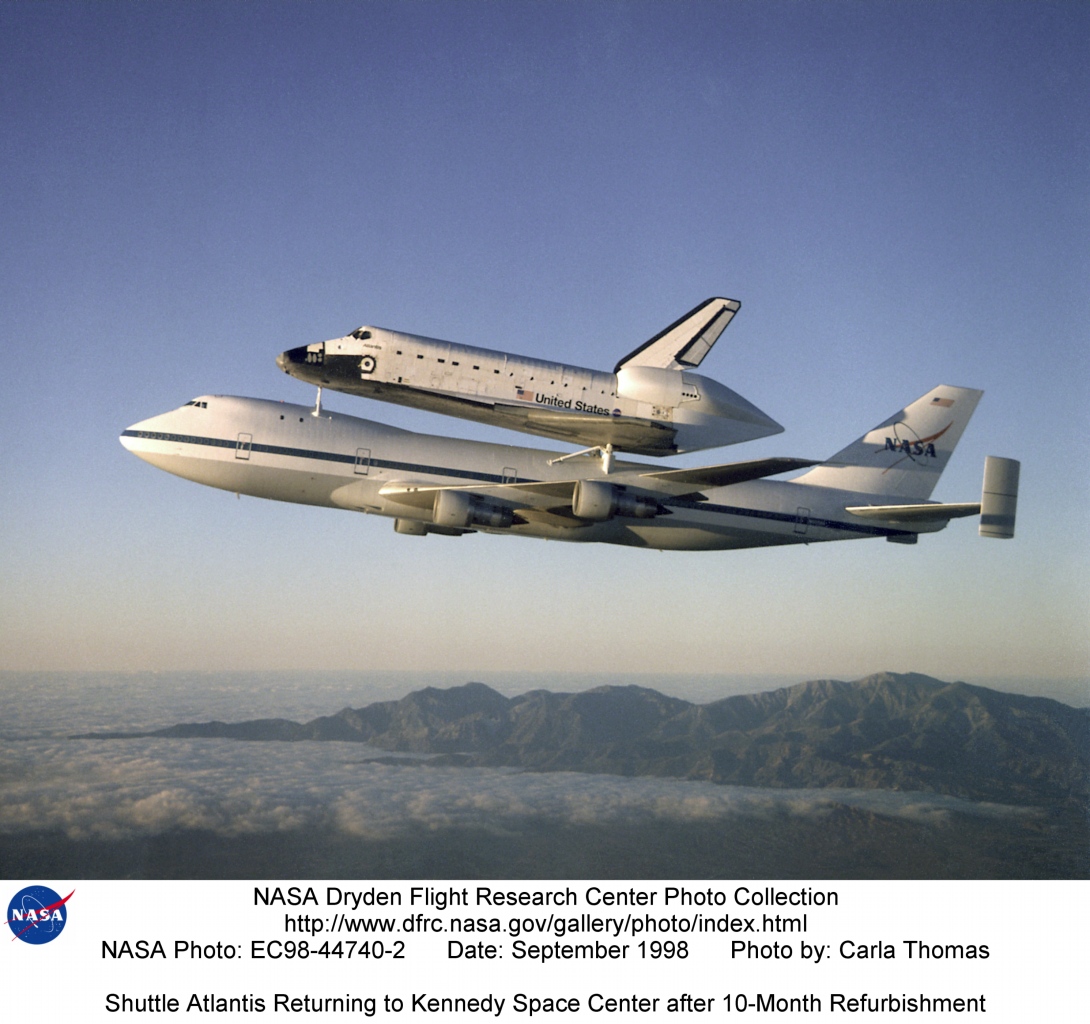
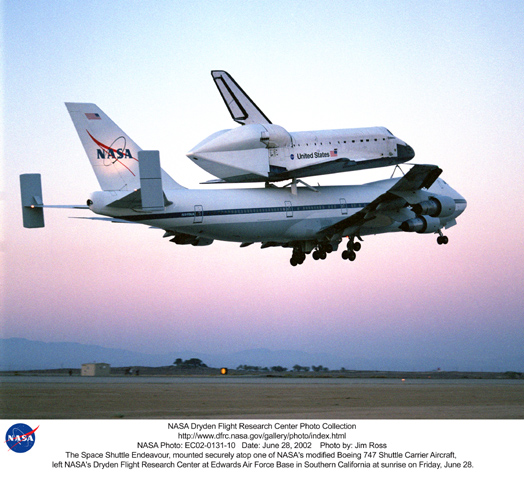
Here's a picture of the shuttle getting a ride home on the back of a 747.
-
Like This
I can't believe no one has posted a picture!
-
Groan...
according to Feynman the shuttle pilot does only 2 things:
1. pushes the button for which base to land at
2. lowers the landing gear
and they only do number 2 because they don't like to feel completely like passengers.
Neither point is accurate and somewhat condescending. Rather than going by somebody who claims to be an expert on everything, why don't you look at the source?
Start with NASA MISSION EVENTS SUMMARY and scroll down to "Deorbit" and "Entry" to see what the shuttle astronauts really do when the shuttle leaves orbit (a lot more than just press a button).
As to the landing gear control, this is a safety of flight issue and is discussed in SHUTTLE AVIONICS Design Constraints and Considerations in the "GNC" section. The decision to make the gear down command a manual operation has nothing to do with making the astronauts not "feel completely like passengers".
myke -
Groan...
according to Feynman the shuttle pilot does only 2 things:
1. pushes the button for which base to land at
2. lowers the landing gear
and they only do number 2 because they don't like to feel completely like passengers.
Neither point is accurate and somewhat condescending. Rather than going by somebody who claims to be an expert on everything, why don't you look at the source?
Start with NASA MISSION EVENTS SUMMARY and scroll down to "Deorbit" and "Entry" to see what the shuttle astronauts really do when the shuttle leaves orbit (a lot more than just press a button).
As to the landing gear control, this is a safety of flight issue and is discussed in SHUTTLE AVIONICS Design Constraints and Considerations in the "GNC" section. The decision to make the gear down command a manual operation has nothing to do with making the astronauts not "feel completely like passengers".
myke -
Re:What was that?
On CNN the commentator was pointing those out as Auxiliary Power Units that provide the hydraulic power for the aerodynamic control surfaces, rocket engine gimballing, landing gear, and brakes. The APUs are fueled by hydrazine, and what you were seeing were thermal plumes from the exhaust, both during the approach and on the ground.
-
Re:"Pilot"
actually, they do land the shuttle. Deorbit is automatic and all, but the final approch is done by the commander manually. Check out the landing 101 on the Nasa web site before spreding bullshit all over the place.
http://www.nasa.gov/returntoflight/launch/landing1 01.html -
Re:woman driver lands shuttle safely
Umm... doesn't the pilot land the Shuttle? In that case it would have been James Kelly and not Eileen Collins who was "at the yolk".
-
Re:Almost Home
Like this.
-
Re:Preposterous
The Columbia Accident Investigation Board (CAIB) report talks about the switch to non-Freon based foam. For those interested in the details, please see CAIB report Volume VI, pages 29-30 (transcripts of interviews discussing the exact issue of the foam formulation and switchover from CFC to HCFC). Also pages 180-181.
Volume I also talks briefly about this issue (describing with pictures which areas of foam on the shuttle tank are what formulation) on pages 51 and 129.
In specific answer to your comment, they aren't phasing out all of the CFC-11 foam, and it is the foam they have used and still use for the hand shaped portions. CFC-11 is Freon based, according to the report.
From my reading, the switch from CFC to HCFC foam does not appear to be implicated as a safety problem, above and beyond the serious issue of foam shedding itself. I hope that those people, elsewhere in this thread, who are making such accusations, will at least read the CAIB report in full before continuing their claims.
http://caib.nasa.gov/news/report/pdf/vol6/part01.p df
http://caib.nasa.gov/news/report/pdf/vol6/part06.p df
http://caib.nasa.gov/news/report/pdf/vol1/full/cai b_report_volume1.pdf -
Re:Preposterous
The Columbia Accident Investigation Board (CAIB) report talks about the switch to non-Freon based foam. For those interested in the details, please see CAIB report Volume VI, pages 29-30 (transcripts of interviews discussing the exact issue of the foam formulation and switchover from CFC to HCFC). Also pages 180-181.
Volume I also talks briefly about this issue (describing with pictures which areas of foam on the shuttle tank are what formulation) on pages 51 and 129.
In specific answer to your comment, they aren't phasing out all of the CFC-11 foam, and it is the foam they have used and still use for the hand shaped portions. CFC-11 is Freon based, according to the report.
From my reading, the switch from CFC to HCFC foam does not appear to be implicated as a safety problem, above and beyond the serious issue of foam shedding itself. I hope that those people, elsewhere in this thread, who are making such accusations, will at least read the CAIB report in full before continuing their claims.
http://caib.nasa.gov/news/report/pdf/vol6/part01.p df
http://caib.nasa.gov/news/report/pdf/vol6/part06.p df
http://caib.nasa.gov/news/report/pdf/vol1/full/cai b_report_volume1.pdf -
Re:Preposterous
The Columbia Accident Investigation Board (CAIB) report talks about the switch to non-Freon based foam. For those interested in the details, please see CAIB report Volume VI, pages 29-30 (transcripts of interviews discussing the exact issue of the foam formulation and switchover from CFC to HCFC). Also pages 180-181.
Volume I also talks briefly about this issue (describing with pictures which areas of foam on the shuttle tank are what formulation) on pages 51 and 129.
In specific answer to your comment, they aren't phasing out all of the CFC-11 foam, and it is the foam they have used and still use for the hand shaped portions. CFC-11 is Freon based, according to the report.
From my reading, the switch from CFC to HCFC foam does not appear to be implicated as a safety problem, above and beyond the serious issue of foam shedding itself. I hope that those people, elsewhere in this thread, who are making such accusations, will at least read the CAIB report in full before continuing their claims.
http://caib.nasa.gov/news/report/pdf/vol6/part01.p df
http://caib.nasa.gov/news/report/pdf/vol6/part06.p df
http://caib.nasa.gov/news/report/pdf/vol1/full/cai b_report_volume1.pdf -
Re:Theft != Thrift
Yes, stealing is much cheaper... forget the library just go to the mall at night with a box van (if you don't have one you can steal that too) and rob the music store, brilliant, why didn't I think of that.
If you buy retail music on disc you are getting 60 minutes or less regardless of maximum capacity.
I dug up some records I have with their original retail price stickers circa the early to mid 80s or so, the prices ranged from 4.99 to 9.99, which adjusted for inflation fell between the ranges of $9.07 and $18.16 (for the year 1984). Adjusted for inflation I paid $12.07 ($6.99 in 1984) for Pink Floyd's "Dark Side of the Moon", and how much is it today? $11.99, it is the same length as the LP, same tracks, wow, it's 8 cents cheaper.
Burning DVDs has nothing to do with buying retail LPs and proves in no way that LPs are more expensive or less economical. I hope you understand. -
Re:A drop in the ocean?
NASA's once-in-a-blue-moon launches
This shuttle mission is the 114th, the mission identifier being is "STS-114". However, not all mission numbers flew (they skipped the 10's), a few had letters (eg: 41-A, 41-B), and not all missions flew in order. For example STS-107 was the previous flight to launch, yet STS-113 flew before it 107. I assume numbers are round-robin allocated to the shuttles - and if a mission slips or is canned, they can launch out of order.
Anyway, there have been a lot of missions (not sure of the exact number [can't be bothered to look it up] but we know there were at least 100 planned out so far) - and this current one is the 31st time the shuttle Discovery has been into space. In 1985 the shuttle flew nine times, including one pair of missions that were only seventeen days apart. If they have one launch a month, the capacity for environmental damage on a localised scale is absolutely enormous.
And the shuttle could still have a lot of work ahead of it before it's replaced if they go back to a crowded flight schedule - they still need around 30 more shuttle flights to complete the international space station as it was originally planned.
So yes, it would be nice if they didn't make a section of the world all bad and polluted. -
Re:CFC insulation == less polution from explosions
Sorry, but this NASA document says that they switched foam formulations as recently as 2001 to comply with EPA regulations.