Slashdot Mirror
Domain: nasa.gov
Stories and comments across the archive that link to nasa.gov.
Comments · 16,365
-
Re:Spacecraft RTGs
Uh yeah thanks but I think I just MIGHT know what I'm talking about here. The RTG heater units (NOT the 1 watt RHUs) are called GPHS modules (general purpose heat sources). Read this chapter!! The probabilities of RTG breakup and dispersal in the atmosphere are calculated for you, you don't even have to think. THE PROBABILITY IS NON ZERO! I can't make this any clearer.
-
Re:Spacecraft RTGs
You are mistaken. If you had read the full environmental impact statement for Cassini you'd know that a significant portion of the RTG heater units were expected to burn up and disperse on re-entry should that've occured. These things are not indestructable. A fast flying shard of metal during an on pad explosion could easily slice right through an RTG.
-
Re:Better
I haven't tried World Wind, but I checked out some screenshots. The topo feature is cool, but look at, e.g., http://worldwind.arc.nasa.gov/graphics/screenshot
s -
Better
It is like NASA World Wind, but better.
-
Google flame,
C'mon, let's fan it!
Soar, to the tune of
Satriani: Crystal Planet.
Foam poses no threat,
Can it?
Burma Shave -
Re:Debate?!?
The problem is, which debate is he referring to?
This one. Let's see, "some "greenhouse skeptics" subvert the scientific process, ceasing to act as objective scientists, rather presenting only one side, as if they were lawyers hired to defend a particular viewpoint. But some of the topics focused on by the skeptics are recognized as legitimate research questions " (emphasis mine).
Legitimate research questions? That sounds like, scientifically, there is a real debate, because there are some things we do not know.
From the same page: "We now know (Hansen et al. 1998a, 1998b) that the growth rate of greenhouse gases in the period 1988-1998 has been flat". And "it is apparent that the model did a good job of predicting global temperature change. But the period of comparison is too short and the climate change too small compared to natural variability for the comparison to provide a meaningful check on the model's sensitivity to climate forcings.".
That sounds to me like the current models do not know whether or not man is impacting the climate and causing global warming. Don't let the actions of extemists cloud your views on the subject. Just because there are a large amount of people arguing that there isn't global warming, using only the facts that support their case and omitting others, does not mean that the case against global warming relies on omitting fact. Just because some people are arguing a case badly doesn't mean that there isn't a case to argue.
-
Re:Horizons and light pollution
This doesn't really invalid your post at all, but the GP's point about darkness being hours (as you point out 2 hours for non-BosWash) still stands, and it's disappointing that there's so much light pollution in North America and most of the first world countries from energy, astronomy, and crimals standpoint.
-
World Wind
-
Re:I don't like it...I agree. My version of Civ IV would look something like a cross between WorldWind and Civ II, with games that last for 6 months realtime. Games where geography/terrain really matters, weather patterns, etc. Dachanniens comment above about Firaxis not having to do testing is dead on, adn the best thing that could happen. To really deliver a perfectly balanced Civ game that plays for months takes a huge amount of playtime and tweaking, resources that no software company has.
Spore is looking very interesting right now. Procedural generation will hopefully generate the kind of epic scale I'm looking for.
-
Re:Note To NASA
Although they may be "very excited and looking forward to the encounter", they won't be able to see the results very well.
Well... actually, it depends on how you define "they." And if "they" are "everyone on the science and engineering teams," that includes a lot of people who aren't hunkered down over screens at JPL. In fact, academics outnumber NASA folks on the science team.I only know the whereabouts of one science team member on that fateful night - my colleague at U. of Hawaii's Institute for Astronomy, Karen Meech. She'll be at one of the observatories on Mauna Kea, which, like all the others up there, and at least one over on Haleakala, will be watching the impact in whatever wavelengths work best.
Given that the impact has been timed to make it observable from Hawaii, it's a fairly big deal out here. I'll be part of the public outreach program over on Maui that night, and my only regret is that I'll have to miss the program here in Hilo to do that.
(I wouldn't really be at all surprised if some other science team members are out here for the impact - I've seen more than one astronomer from far away point out that the advantages of siting telescopes in Hawaii include periodically having to take a trip to Hawaii.)
-
Re:Note To NASA
Although they may be "very excited and looking forward to the encounter", they won't be able to see the results very well.
Well... actually, it depends on how you define "they." And if "they" are "everyone on the science and engineering teams," that includes a lot of people who aren't hunkered down over screens at JPL. In fact, academics outnumber NASA folks on the science team.I only know the whereabouts of one science team member on that fateful night - my colleague at U. of Hawaii's Institute for Astronomy, Karen Meech. She'll be at one of the observatories on Mauna Kea, which, like all the others up there, and at least one over on Haleakala, will be watching the impact in whatever wavelengths work best.
Given that the impact has been timed to make it observable from Hawaii, it's a fairly big deal out here. I'll be part of the public outreach program over on Maui that night, and my only regret is that I'll have to miss the program here in Hilo to do that.
(I wouldn't really be at all surprised if some other science team members are out here for the impact - I've seen more than one astronomer from far away point out that the advantages of siting telescopes in Hawaii include periodically having to take a trip to Hawaii.)
-
Note To NASAIf the telescope defect was detectable before launch, whomever was responsible for making that check should have lost their job due to the telescope being out of focus.
The press release is a masterpiece of indirection. It takes them 5 paragraphs to admit they have a problem and then this little gem:
"This in no way will affect our ability to impact the comet on July 4," said Rick Grammier, Deep Impact project manager at NASA's Jet Propulsion Laboratory (JPL), Pasadena, Calif. "Everyone on the science and engineering teams is getting very excited and looking forward to the encounter."
Although they may be "very excited and looking forward to the encounter", they won't be able to see the results very well. -
NASA World Wind: free, open, & ready to downlo
http://worldwind.arc.nasa.gov/ operators are standing by.
-
NASA's WorldWind
Does very similar things... is getting better every release... and it's free.
http://worldwind.arc.nasa.gov/ -
Re:A make believe space
Your kidding right ?
http://saturn.jpl.nasa.gov/multimedia/images/image -details.cfm?imageID=1544
You know this is a picture of Titan ?....A moon of Saturn, taken by a spacecraft we have sent there ?
Let it sink in. -
OSS version already under developmentThe OSSIM http://www.ossim.org/ project already has a working version of this, called osgPlanet. It was demonstrated at the Open Source GIS conference last week. http://mapserver.gis.umn.edu/mum/mtg2005.html
OsgPlanet can stream imagery from any MapServer using WMS protocol. (Check JPL's wms server for one http://wms.jpl.nasa.gov/) It builds a 3D model of the world on the fly using SRTM terrain data that you can download from the USGS for most of the globe.
The difference between this and something like Google maps is that osgPlanet and Vplanet let you actually fly around in the terrain, instead of just looking down at it.
-
How does this compare ....
How does this compare to NASA's World Wind?
-
If you like this...
I'd recommend World Wind to complement it. Although perhaps not as slick because it's not built on Javascript (although I was intruiged, however, to learn it works on managed DirectX), I just searched for about a half-dozen places near where I live, and where my girlfriend visited in Japan, and I think World Wind gives higher resolution (plus, some of the Google images look somewhat skewed). Not an exhaustive comparison by any means, and YMMV
- shadowmatter -
Re:Are there any simulations available for viewing
To see what it looks like you could go to APOD, which is good for your little daily Astronomy fix/news.
-
Re:Mr President, Dr. Evil is on the line...
Are you crazy. The article explains why people have the illusion. A theory is an explanation of sorts. Agreed that this article doesn't go into details but still. According to and article I found on http://www.spaceweather.com/ link -- http://science.nasa.gov/headlines/y2005/20jun_moo
n illusion.htm/ -
Re:OMG, seriously.
Doh, I really should use the preview button.
Nasa article
-> Fritz -
Eye of God?
This looks similar to the "Eye of God" the hubble space telescope hubble found. http://antwrp.gsfc.nasa.gov/apod/image/0305/helix
0 3_hst_big.jpg -
This is news?
Slow news day, eh?
I remember seeing a picture that says a thousand words about this a few years ago. -
Re:This is no mystery, its an optical illusion.
-
Enjoy the picture from NASA gallery
-
Re:"Low-hanging" moon?
They left out the key word:
Not since June 1987 has the full moon been this low in the sky
See this story for a bit more detail. -
Explanations
The moon illusion can't be caused by an atmospheric effect, because that would affect cameras as well. Since the illusion is sometimes experienced without reference points the Ponzo affect probably isn't the cause. NASA has links to several papers on the subject.
-
Re:With all this talk of going to Mars...
Oh, great, another time consuming argument with a Zubrin fanboy.
You haven't read his book
Outright wrong. Unlike you, I wouldn't be caught dead debating material I haven't read about.
Really? Please site.
The word is "cite". A "site" is a location. Here is your "cite": Goal #4 of the Apollo program was to "develop man's capability to work in the lunar environment.". Here's a Lunar Colony from 1969. Complete with a smelter. The concept of extracting resources from the moon continued with numerous R&D processes in the late 60s and early 70s; ton-quantities of regolith simulant were produced for the experiments. There was renewed interest in the 1980s with Reagan's call for lunar colonies by 2005.
Mining under most proposals was to be done simply on regolith, using a three drum slasher. Cutler and Krag proposed and investigated a carbothermal oxygen production plant that processed ilmenite desposits. Another 1985 study investigating an entire proposed colony ("Selenopolis"), was to produce 500,000 tons of oxygen per year.
And automatic mining equipment really isn't that complex.
That's bloody hilarious. *Manned* mining equipment produced where weight is no object (here on earth) is quite complex. Have you ever seen the work that goes into setting up, for example, a tunnel boring system? Mining equipment costs millions of dollars per piece, and it's not for no good reason. Add to that the ridiculous weight, the oxygen-requiring temperature-sensitive engines, etc, and you're stuck paying brand new R&D costs without the benefit of bulk sales and having to use things like lithium-aluminum to cut mass.
Also, Zubrin et al created a scale model of some of the oxygen mining gear. Worked great, needs to be tested.
We don't even know specifically where water ice is, yet! (we have some ideas). By the way, have you seen how well electryolysis devices as such perform in hostile environments, even with extensive testing and two decades of development? The US has nothing like it qualified for long term missions - Elektron is the best thing out there (we have some heavy short-term devices).
Loss of a critical component, and that's the end on Mars. No "repairs" being sent up on "the next flight", no massive backups to "tide you over" (this refers not only to oxygen, but to everything critical for life).
Apples to oranges comparison. And 100% WRONG. I honestly can't think of ONE of the missions which it could be claimed with any certainty would NOT have been saved without a human around to check things out.
That's because you've never read about the subject. I hate having to replace a textbook for people like you.
Mars 1960A: Failed to reach earth orbit due to catastrophic vehicle launch failure. Nothing humans could have done.
Mars 1960B: Same
Mars 1962A: Broke into pieces after being launched; pieces remained in Earth orbit for a few days. The equivalent of having more dead humans.
Mars 1: Communication lost in transit for unknown reasons. Depending on the cause, humans may or may not have been able to salvage it.
Mars 1962B: Made it to earth orbit. Rocket fire for transfer orbit destroyed the craft. Humans would have perished.
Mariner 3: Protective shield from earth launch failed to detach. The extra weight prevented it from reaching Mars. As most manned Mars missions don't allow for EVA due to the difficulty and extra mass, at the -
Re:With all this talk of going to Mars...
Oh, great, another time consuming argument with a Zubrin fanboy.
You haven't read his book
Outright wrong. Unlike you, I wouldn't be caught dead debating material I haven't read about.
Really? Please site.
The word is "cite". A "site" is a location. Here is your "cite": Goal #4 of the Apollo program was to "develop man's capability to work in the lunar environment.". Here's a Lunar Colony from 1969. Complete with a smelter. The concept of extracting resources from the moon continued with numerous R&D processes in the late 60s and early 70s; ton-quantities of regolith simulant were produced for the experiments. There was renewed interest in the 1980s with Reagan's call for lunar colonies by 2005.
Mining under most proposals was to be done simply on regolith, using a three drum slasher. Cutler and Krag proposed and investigated a carbothermal oxygen production plant that processed ilmenite desposits. Another 1985 study investigating an entire proposed colony ("Selenopolis"), was to produce 500,000 tons of oxygen per year.
And automatic mining equipment really isn't that complex.
That's bloody hilarious. *Manned* mining equipment produced where weight is no object (here on earth) is quite complex. Have you ever seen the work that goes into setting up, for example, a tunnel boring system? Mining equipment costs millions of dollars per piece, and it's not for no good reason. Add to that the ridiculous weight, the oxygen-requiring temperature-sensitive engines, etc, and you're stuck paying brand new R&D costs without the benefit of bulk sales and having to use things like lithium-aluminum to cut mass.
Also, Zubrin et al created a scale model of some of the oxygen mining gear. Worked great, needs to be tested.
We don't even know specifically where water ice is, yet! (we have some ideas). By the way, have you seen how well electryolysis devices as such perform in hostile environments, even with extensive testing and two decades of development? The US has nothing like it qualified for long term missions - Elektron is the best thing out there (we have some heavy short-term devices).
Loss of a critical component, and that's the end on Mars. No "repairs" being sent up on "the next flight", no massive backups to "tide you over" (this refers not only to oxygen, but to everything critical for life).
Apples to oranges comparison. And 100% WRONG. I honestly can't think of ONE of the missions which it could be claimed with any certainty would NOT have been saved without a human around to check things out.
That's because you've never read about the subject. I hate having to replace a textbook for people like you.
Mars 1960A: Failed to reach earth orbit due to catastrophic vehicle launch failure. Nothing humans could have done.
Mars 1960B: Same
Mars 1962A: Broke into pieces after being launched; pieces remained in Earth orbit for a few days. The equivalent of having more dead humans.
Mars 1: Communication lost in transit for unknown reasons. Depending on the cause, humans may or may not have been able to salvage it.
Mars 1962B: Made it to earth orbit. Rocket fire for transfer orbit destroyed the craft. Humans would have perished.
Mariner 3: Protective shield from earth launch failed to detach. The extra weight prevented it from reaching Mars. As most manned Mars missions don't allow for EVA due to the difficulty and extra mass, at the -
Re:With all this talk of going to Mars...
Oh, great, another time consuming argument with a Zubrin fanboy.
You haven't read his book
Outright wrong. Unlike you, I wouldn't be caught dead debating material I haven't read about.
Really? Please site.
The word is "cite". A "site" is a location. Here is your "cite": Goal #4 of the Apollo program was to "develop man's capability to work in the lunar environment.". Here's a Lunar Colony from 1969. Complete with a smelter. The concept of extracting resources from the moon continued with numerous R&D processes in the late 60s and early 70s; ton-quantities of regolith simulant were produced for the experiments. There was renewed interest in the 1980s with Reagan's call for lunar colonies by 2005.
Mining under most proposals was to be done simply on regolith, using a three drum slasher. Cutler and Krag proposed and investigated a carbothermal oxygen production plant that processed ilmenite desposits. Another 1985 study investigating an entire proposed colony ("Selenopolis"), was to produce 500,000 tons of oxygen per year.
And automatic mining equipment really isn't that complex.
That's bloody hilarious. *Manned* mining equipment produced where weight is no object (here on earth) is quite complex. Have you ever seen the work that goes into setting up, for example, a tunnel boring system? Mining equipment costs millions of dollars per piece, and it's not for no good reason. Add to that the ridiculous weight, the oxygen-requiring temperature-sensitive engines, etc, and you're stuck paying brand new R&D costs without the benefit of bulk sales and having to use things like lithium-aluminum to cut mass.
Also, Zubrin et al created a scale model of some of the oxygen mining gear. Worked great, needs to be tested.
We don't even know specifically where water ice is, yet! (we have some ideas). By the way, have you seen how well electryolysis devices as such perform in hostile environments, even with extensive testing and two decades of development? The US has nothing like it qualified for long term missions - Elektron is the best thing out there (we have some heavy short-term devices).
Loss of a critical component, and that's the end on Mars. No "repairs" being sent up on "the next flight", no massive backups to "tide you over" (this refers not only to oxygen, but to everything critical for life).
Apples to oranges comparison. And 100% WRONG. I honestly can't think of ONE of the missions which it could be claimed with any certainty would NOT have been saved without a human around to check things out.
That's because you've never read about the subject. I hate having to replace a textbook for people like you.
Mars 1960A: Failed to reach earth orbit due to catastrophic vehicle launch failure. Nothing humans could have done.
Mars 1960B: Same
Mars 1962A: Broke into pieces after being launched; pieces remained in Earth orbit for a few days. The equivalent of having more dead humans.
Mars 1: Communication lost in transit for unknown reasons. Depending on the cause, humans may or may not have been able to salvage it.
Mars 1962B: Made it to earth orbit. Rocket fire for transfer orbit destroyed the craft. Humans would have perished.
Mariner 3: Protective shield from earth launch failed to detach. The extra weight prevented it from reaching Mars. As most manned Mars missions don't allow for EVA due to the difficulty and extra mass, at the -
Re:With all this talk of going to Mars...
Oh, great, another time consuming argument with a Zubrin fanboy.
You haven't read his book
Outright wrong. Unlike you, I wouldn't be caught dead debating material I haven't read about.
Really? Please site.
The word is "cite". A "site" is a location. Here is your "cite": Goal #4 of the Apollo program was to "develop man's capability to work in the lunar environment.". Here's a Lunar Colony from 1969. Complete with a smelter. The concept of extracting resources from the moon continued with numerous R&D processes in the late 60s and early 70s; ton-quantities of regolith simulant were produced for the experiments. There was renewed interest in the 1980s with Reagan's call for lunar colonies by 2005.
Mining under most proposals was to be done simply on regolith, using a three drum slasher. Cutler and Krag proposed and investigated a carbothermal oxygen production plant that processed ilmenite desposits. Another 1985 study investigating an entire proposed colony ("Selenopolis"), was to produce 500,000 tons of oxygen per year.
And automatic mining equipment really isn't that complex.
That's bloody hilarious. *Manned* mining equipment produced where weight is no object (here on earth) is quite complex. Have you ever seen the work that goes into setting up, for example, a tunnel boring system? Mining equipment costs millions of dollars per piece, and it's not for no good reason. Add to that the ridiculous weight, the oxygen-requiring temperature-sensitive engines, etc, and you're stuck paying brand new R&D costs without the benefit of bulk sales and having to use things like lithium-aluminum to cut mass.
Also, Zubrin et al created a scale model of some of the oxygen mining gear. Worked great, needs to be tested.
We don't even know specifically where water ice is, yet! (we have some ideas). By the way, have you seen how well electryolysis devices as such perform in hostile environments, even with extensive testing and two decades of development? The US has nothing like it qualified for long term missions - Elektron is the best thing out there (we have some heavy short-term devices).
Loss of a critical component, and that's the end on Mars. No "repairs" being sent up on "the next flight", no massive backups to "tide you over" (this refers not only to oxygen, but to everything critical for life).
Apples to oranges comparison. And 100% WRONG. I honestly can't think of ONE of the missions which it could be claimed with any certainty would NOT have been saved without a human around to check things out.
That's because you've never read about the subject. I hate having to replace a textbook for people like you.
Mars 1960A: Failed to reach earth orbit due to catastrophic vehicle launch failure. Nothing humans could have done.
Mars 1960B: Same
Mars 1962A: Broke into pieces after being launched; pieces remained in Earth orbit for a few days. The equivalent of having more dead humans.
Mars 1: Communication lost in transit for unknown reasons. Depending on the cause, humans may or may not have been able to salvage it.
Mars 1962B: Made it to earth orbit. Rocket fire for transfer orbit destroyed the craft. Humans would have perished.
Mariner 3: Protective shield from earth launch failed to detach. The extra weight prevented it from reaching Mars. As most manned Mars missions don't allow for EVA due to the difficulty and extra mass, at the -
Re:Moons made of rocks
"Better to send a probe to one of those moons with liquid like Titan or Europa. Much more interesting things to find there." I agree. That's why we are doing it. (Titan) http://www.nasa.gov/mission_pages/cassini/whycass
i ni/16jan_titan.html Off Topic: I know we have a lot of time to plan ahead for the death of our sun (and planet) with it being about 4.5 to 5 billion years away. But, as we discovered with Y2K, we do tend to wait to the last minute to take care of things. I just hope "we" have a plan for somewhere to go so that our entire species doesn't disappear forever. That said, it's never too soon to start hopping planets and planet like objects. Even if we could just stay a million years ahead of the next disaster, we should be ok. -
Re:Dusty surface
Isn't that award going to go to Deep Impact.
A probe designed specifically for this purpose (unlike Beagle 2) -
Re:With all this talk of going to Mars...
Slightly offtopic, but not too far considering the Russian's work in this area. The other day I was poking around to provide some references for the M2P2 technology when I ran across this little beauty. This electric thruster makes Ion engines look downright primitive. According to the various articles, this engine would provide a specific impluse as high as 11,000 (one of the most efficient designs ever created!), but with a relatively high thrust ratio. According to NASA's webpage, they have been testing a workbench model at powers of up to 30 Mw (!), and they believe that such engines could be used for both deep space missions to Mars, as well as providing more efficient second stage engines for ground launched vehicles.
Apparently the Russians have done significant work on this area, and continues to perform experiements on behalf of JPL. It's quite possible that the development of this engine could have an even greater effect on space travel than the Ion engine did!
The only downside to this engine is that it will be likely to require a nuclear reactor for power. This increases weight and adds the danger of a nuclear reactor. The upshot to this is that it is inherently safer than the Orion or NERVA engines, doesn't polute, and can go to Mars and back several times on the same tank of lithium! (Delta-V from LEO to Mars Orbit is about 3900 m/s. Do your own calcs on what that means for an engine with an ISP of 11,000 and a craft that is a mere 25% gas tank.)
Once again, I'm amazed at the technology already in our posession, or close to being so. Now more than ever, I really feel that we're on the cusp of a true space age. -
Re:This Quote Makes Me Wonder
Neutron stars have superfluid cores. Superfluidity isn't quite the same as superconductivity, but it's related. See http://imagine.gsfc.nasa.gov/docs/ask_astro/answe
r s/970213.html, for example.
-- Steve -
Re:Picture of the actual 3D images?
Many firms already provide this sort of datasets to customers with deep enough pockets. This is just a specialized implementation of LiDAR, with cool data filtering. Firms like http://www.terrapoint.com/ provide these datasets all day long for various sorts of clients for various purposes. Resolution down to a few centimeters. Really fascinating stuff. This orgy of mapping is by no means over the top, in the world of geodsy there are very pressing needs for these sorts of data sets, like geological studies, and biological studies. Cool LiDAR datasets can be seen here: http://earthobservatory.nasa.gov/Newsroom/NewImag
e s/images.php3?img_id=16721 and http://www.nasa.gov/vision/earth/lookingatearth/ms helenslidar.html -
Re:Picture of the actual 3D images?
Many firms already provide this sort of datasets to customers with deep enough pockets. This is just a specialized implementation of LiDAR, with cool data filtering. Firms like http://www.terrapoint.com/ provide these datasets all day long for various sorts of clients for various purposes. Resolution down to a few centimeters. Really fascinating stuff. This orgy of mapping is by no means over the top, in the world of geodsy there are very pressing needs for these sorts of data sets, like geological studies, and biological studies. Cool LiDAR datasets can be seen here: http://earthobservatory.nasa.gov/Newsroom/NewImag
e s/images.php3?img_id=16721 and http://www.nasa.gov/vision/earth/lookingatearth/ms helenslidar.html -
Re:Interstellar
If you want a sail driven by solar wind/protons, you've got the Mini-Magnetospheric Plasma Propulsion idea, M2P2.
From the link:
M2P2 would generate a magnetic field and then inject plasma (ionized gas) that would drag the magnetic field lines out and form a plasma bubble 30 to 60 km (18-36 mi) in diameter.
And, the plasma bubble is very light... lighter than a solar sail.
-
Even NASA uses it...
Before somebody bitches that the only real legit use is for game demos and linux distros...even NASA uses torrent:
World Wind
And yes, they have normal download servers, but the torrent is a lot faster. -
Don't blame Microsoft for that...
...or Google Maps for that matter, either. They both use the same USGS Urban Area Ortho pictures that NASA World Wind can use. (I don't mean you, I mean any pending "M$" conspiracy theorists.)
Blame the government for trying to keep their own buildings from being seen in the Urban Ortho. (Interestingly, it's not concealed in the somewhat-lower-quality aerial ortho, also a USGS creation.)
-
I'm not shocked.
Their sizes are so different, it's as if we can consider HD-DVD a missing link between DVD and Blu-Ray.
I wouldn't mind seeing both of them. Besides, big game makers would probably use the extra Blu-Ray space by keeping their video uncompressed or something. Someone's gonna find a way and excuse to fill any media. (My own installation of World Wind, combined with its cache, already takes up 1.35GB, and I've only used it two days. I've been looking around a lot of the world though, and the Tsunami pictures and Landsats...)
-
Re:Wow...
I suspect that he did, in fact mean electrically charged. See here: http://rtreport.ksc.nasa.gov/techreports/2001repo
r t/200/206.html -
Re:Take THAT, space science nay-sayers!
Unfortunately this is also a reminder of the risks we'll have to take if we ever get serious about colonizing space..
This is from a page linked from the article in the story about shear thinning..
http://science.nasa.gov/headlines/y2002/07jun_ela
s tic_fluids.htmResearchers hope that a space-experiment called CVX-2 (short for "Critical Viscosity of Xenon-2") will soon provide new data about the basic physics of such fluids. Berg is the principal investigator for the experiment, which is slated to fly this summer onboard space shuttle Columbia (STS-107).
Experiments with simple chemicals rather than ZBLAN and other actually useful substances is probably critical for getting data that physicists can actually work with to try to understand shear thinning in general... And this CVX-2 experiment was conducted on Columbia's last mission.
Apparently they relayed most of the results of the CVX-2 experiment back to earth while still in orbit, according to this page.
-
Re:Ambitious Maritius
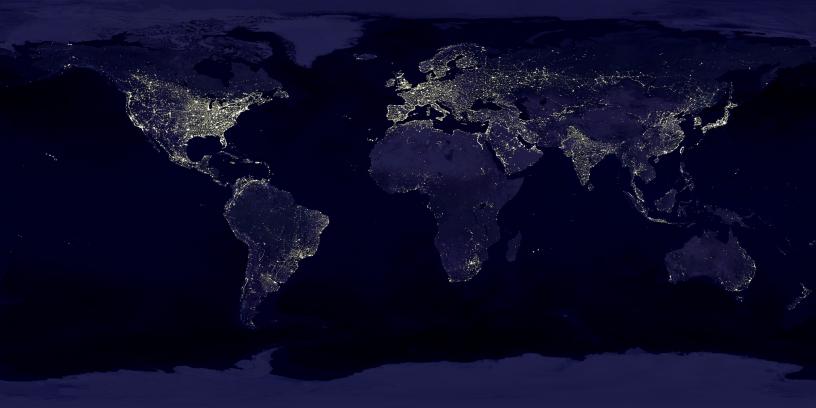
How about a link to the map in question: Earth At Night.
And to those who question brightness as a valid measure of economic and social advancement, take a look at South vs North Korea. The difference is shocking.
(More info about this type of data is available from NASA, NOAA). -
Re:Ambitious Maritius
How about a link to the map in question: Earth At Night.
And to those who question brightness as a valid measure of economic and social advancement, take a look at South vs North Korea. The difference is shocking.
(More info about this type of data is available from NASA, NOAA). -
Re:But OTOH
Have you heard of NASA's subvocal speach?
"We took the alphabet and put it into a matrix -- like a calendar. We numbered the columns and rows, and we could identify each letter with a pair of single-digit numbers," Jorgensen said. "So we silently spelled out 'NASA' and then submitted it to a well-known Web search engine. We electronically numbered the Web pages that came up as search results. We used the numbers again to choose Web pages to examine. This proved we could browse the Web without touching a keyboard," Jorgensen explained."
http://www.nasa.gov/lb/home/hqnews/2004/mar/HQ_040 93_subvocal_speech.html -
Cost of Space Products
One of the space products has been Microspheres several magnitudes more precise than those made on earth. Other of the NASA Microgravity projects can lead directly to ultrapure chip development for use in, for example, pinhead size medical and scientific gas chromatographs and mass spectrometers.
Because the microgravity should allow for high chip yield and high quality, the remaining issue is cost of production.
Allowing for $10,000 per Kg (source) for a mature launch/return system like the Saturn 5, Delta, or Titan series, a 100 Kg furnace containing 10 Kg of product would cost $1,000,000 to orbit. If the output is 0.01 gram chips at 95% yield, that gives you 950,000 chips. If you can sell them for a bit over $1.05 per chip, you're in the money. At only $5000/Kg, you are way ahead!
The medical market alone for $5-10 one-shot broad spectrum biochemical testers would easily absorb the 10 million-plus that could be produced with monthly launches.
1. Insert sample into tester
2. Plug tester into USB/Firewire port
3. Read results from software support package
4. (Profit!) -
Re:This is just pricelesslooks like I'll have to wait for a Mac/Linux version
hm not sure, see the WorldWind forum:
Have you tried Wine on Linux?
We'd be thrilled to see World Wind ported to other platforms, but we have limited development resources to do this ourselves. Anyone who wants to help with the effort is exceedingly welcome to do so. Indeed Nick Whitelegg is soliciting help for a Mono/Gtk#/OpenGL port--see the Developers' Corner pinned thread. -
This is all well and fine ...
.. but have a look at Worldwind http://worldwind.arc.nasa.gov/. It lets you view the whole world in sat images, and it includes height data, making the experience truly 3D!
-
BTW, some interesting graphs
In 1996 with 1996 dollars, NASA was spending 15 Billion / year. But Apollo was more than 25 Billion / year in 1996 dollars Now, GWB is spending 15 Billion but with 2005 Dollars.
So, GWB is spending less than Clinton, and Clinton certainly spent less than Kennedy/Johnson.