Slashdot Mirror
Domain: nasa.gov
Stories and comments across the archive that link to nasa.gov.
Comments · 16,365
-
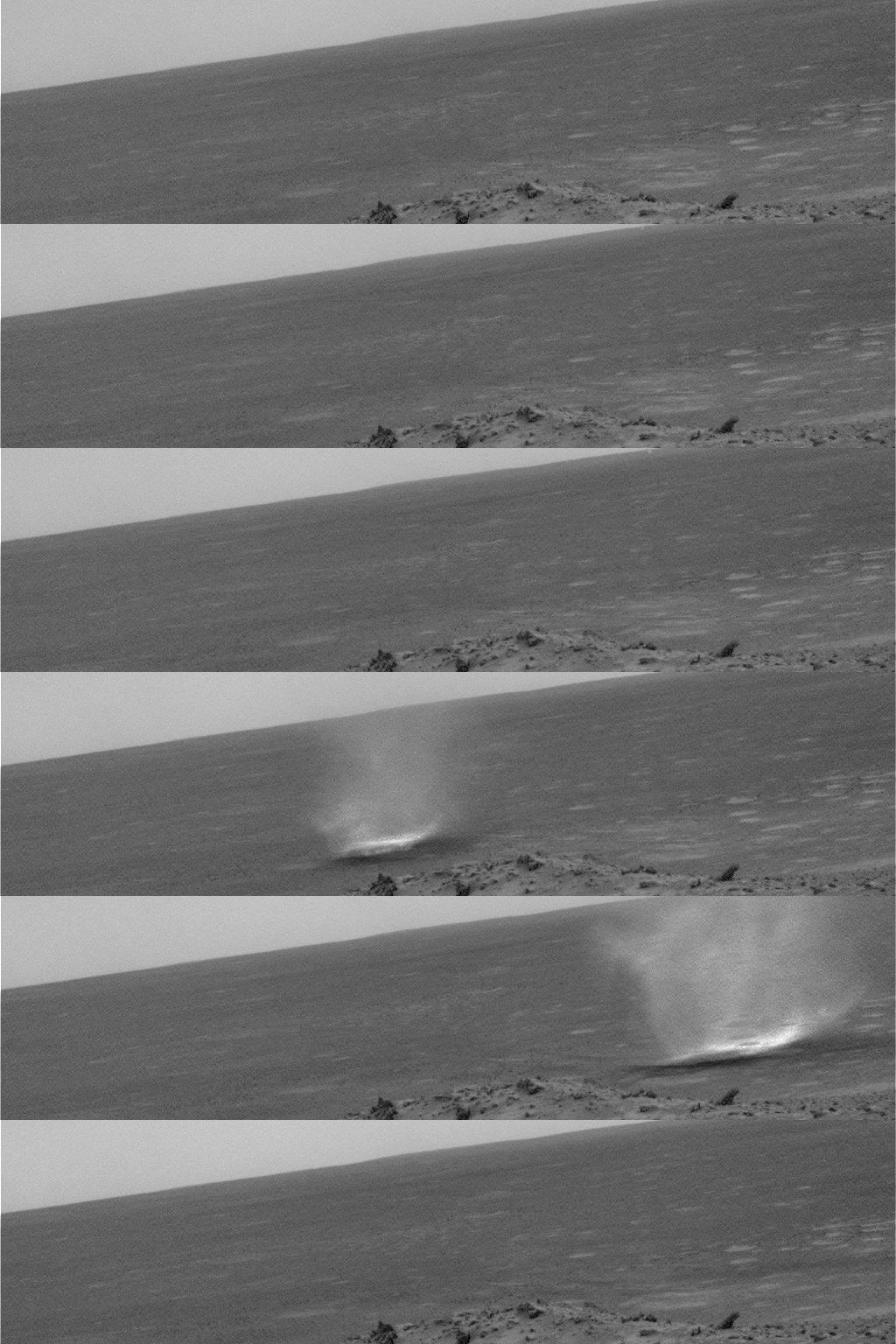
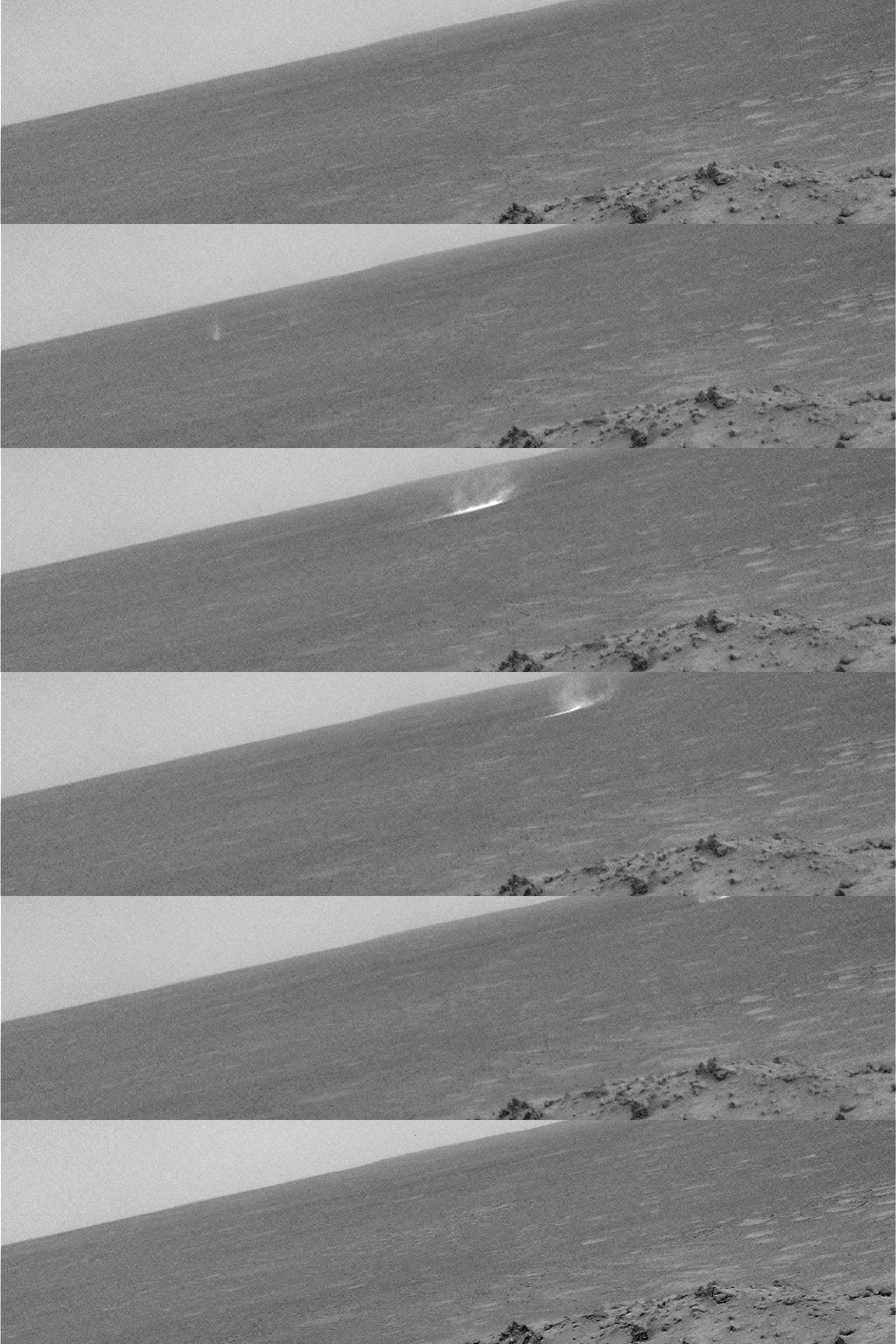
Animated GIFs, not movies...
Direct links to the animated GIFs are here:
PIA07861.gif and PIA07863.gif.
To those of you that don't want to download 3MB of animated GIFs for a 2 second view of a whirlwind on Mars let me sum it up for you. Dust, a small hill, and what appears to be a UFO dancing around on the screen.
For those of you that are conspiracy theorists... This could be a UFO sighting! It also could have been made in any one of the deserts in the USA (or abroad!) -
Animated GIFs, not movies...
Direct links to the animated GIFs are here:
PIA07861.gif and PIA07863.gif.
To those of you that don't want to download 3MB of animated GIFs for a 2 second view of a whirlwind on Mars let me sum it up for you. Dust, a small hill, and what appears to be a UFO dancing around on the screen.
For those of you that are conspiracy theorists... This could be a UFO sighting! It also could have been made in any one of the deserts in the USA (or abroad!) -
Not First App OS
This is not the first app that NASA has open sourced, just the first one on sf.net. NASA has an OS website at
http://opensource.arc.nasa.gov/ -
Screenies at press release
-
Screenies at press release
-
First SF for NASA, maybe; first OS, no
World Wind ( http://worldwind.arc.nasa.gov/index.html )is also open source. I think there are other NASA open source projects as well. This definitely isn't NASA's first venture into open source, although it may be their first project release on SourceForge.
-
Re:50 million downloadsOn the other hand, did you see today's APOD? http://antwrp.gsfc.nasa.gov/apod/astropix.html
It is a multiple frame sequence of a dust-devil on Mars, courtesy of the martian rover. Very cool, and worth the bandwidth (yes - I don't mean the local bandwidth, I mean the interplanetary transmission, for which bits are in somewhat limited supply).
-
Re:why do disks not work in a vacuum?
Well, here's a counterpoint.
The weight of the nitrogen partial pressure is relatively insignificant, especially as it neither has to be replenished (beyond leakage losses, which are minor) nor recycled like the O2-CO2 loop. Remember that the total weight of nitrogen on the ISS is roughly 380 kg (75% by weight of air, 425 cubic meters habitable volume, 1.2 kg/m^3 is the weight of dry sea level air) which is simply not that much to worry about in terms of differential launch costs when you compare it to the costs of redesigning large amounts of electrical/electronic equipment.
The Russians already have, and NASA are working on, EVA suits with a high enough pressurization to reduce the current rigorous pre-breathe to 30 minutes, by the way. I think NASA has also worked on experimental suits designed to eliminate pre-breathe altogether (I see contrasting numbers for whether a
I'll be surprised if most settlements aren't run at sea-level, actually. There is significant biomedical evidence showing that humans living in atmospheres similar to the Apollo/Gemini lowered pressure, full partial pressure, atmosphere suffer adverse medical effects ranging from nuisance effects like eye/ear/noise irritation to potentially significant issues like a time-related decrease in red blood cell mass (Richardson et al., 1972), though that has subsequently (Skylab era) been found to be self-regulating, though still worrisome. Some info on this can be found at one of NASA's history sites here. This publication analyzing biomedical effects of spaceflight offers some other reasons, including toxic oxidation byproducts, against a pure oxygen atmosphere.
Considering the benefits (using standard electrical/electronic components, a more normal biomedical environment) as compared to the downsides (minor one-time weight increase, pre-breathing which is likely to be eliminated with the next generation of pressure suits), I suspect future colonies will be sea-level atmosphere. -
Re:why do disks not work in a vacuum?
Well, here's a counterpoint.
The weight of the nitrogen partial pressure is relatively insignificant, especially as it neither has to be replenished (beyond leakage losses, which are minor) nor recycled like the O2-CO2 loop. Remember that the total weight of nitrogen on the ISS is roughly 380 kg (75% by weight of air, 425 cubic meters habitable volume, 1.2 kg/m^3 is the weight of dry sea level air) which is simply not that much to worry about in terms of differential launch costs when you compare it to the costs of redesigning large amounts of electrical/electronic equipment.
The Russians already have, and NASA are working on, EVA suits with a high enough pressurization to reduce the current rigorous pre-breathe to 30 minutes, by the way. I think NASA has also worked on experimental suits designed to eliminate pre-breathe altogether (I see contrasting numbers for whether a
I'll be surprised if most settlements aren't run at sea-level, actually. There is significant biomedical evidence showing that humans living in atmospheres similar to the Apollo/Gemini lowered pressure, full partial pressure, atmosphere suffer adverse medical effects ranging from nuisance effects like eye/ear/noise irritation to potentially significant issues like a time-related decrease in red blood cell mass (Richardson et al., 1972), though that has subsequently (Skylab era) been found to be self-regulating, though still worrisome. Some info on this can be found at one of NASA's history sites here. This publication analyzing biomedical effects of spaceflight offers some other reasons, including toxic oxidation byproducts, against a pure oxygen atmosphere.
Considering the benefits (using standard electrical/electronic components, a more normal biomedical environment) as compared to the downsides (minor one-time weight increase, pre-breathing which is likely to be eliminated with the next generation of pressure suits), I suspect future colonies will be sea-level atmosphere. -
Learn to solder.
I'm not kidding. This is a perfect opportunity to learn a useful skill. Take the $50 you'd spend to get your unit repaired and spend the money on a used soldering iron and a shiny new tip instead.
Then (here's the important part) practice on stuff that you won't miss before you try repairing the drive. Raid your neighbor's garbage for old electronics and spend a few hours removing components, replacing them, tinning wires, etc.
Two nice online introductions to soldering (both originally produced by Nasa) are located here:
http://radiojove.gsfc.nasa.gov/elab/soldering.htm
http://socrates.berkeley.edu/~phylabs/bsc/PDFFiles
Or, if you really don't want to learn to solder, talk to your neighbors. See if there's a ham radio club in your neighborhood. Hunt for a radio/television repair shop. Drop by the electronics shop at your local community college. Or, chat up the guy selling refurbished electronics at the nearest swap-meet.
-
Is this science fiction?Because there ain't no way the Bush White House is paying for this.
http://prometheus.jpl.nasa.gov/contentImages/Blim
p _over_Titan211_br.jpgIf that above picture happens in my lifetime, I will drop a load.
I hope they start with something more resonable than this. A big project will get bloated and is less likely to happen. Instead of going to Jupiter, how about getting to Mars with a little more reliability, with people?
-
JPL
Project Prometheus has recently started a new web page (under JPL)
Wow. Am I the only one that thought the JPL must be some license agreement like the GPL, and the wondered why the hell a web page needed to be released with a special license?
Jet Propulsion Labratory -
Re:... just curious ...
"What does a soyuz look like (on the outside) after it makes bumpdown?"
Use http://spaceflight.nasa.gov/gallery/search.cgi to search for "soyuz" and "landing". Mostly landing party, but also some interesting pictures of the capsule. -
How massive?
The National Geographic story refers to the asteroid belt as "massive", but neither NG nor NASA say just how massive. So why is it being referred to as "massive"? Are we talking mass-of-Jupiter here?
-
Re:Urbanization
"...you'd think we live on a gigantic ball of oil and grease surrounded by a black haze of car exhaust and soot." You mean, like this...? http://earthobservatory.nasa.gov/NaturalHazards/n
a tural_hazards_v2.php3?img_id=12829 -
Spreadsheets get used in weird placesSpreadsheets get used in the weirdest, most unexpected places. For example, both JPL's Project Design Center, and the Aerospace Corporation's Concept Design Center, use multiple Excel spreadsheets to design spacecraft. Not to the "nuts and bolts" level, but a preliminary design concept that can be used for rapid feasibility and trade studies, and rough cost estimates. Note that most JPL missions pass through the PDC during their development. And the bulk of the new generation of USAF spacecraft get their requirements, cost, and payload complements hammered out in Aerospace's CDC.
ESA has a similar facility, as does NASA Goddard. And from what I've heard contractors like Boeing have experimented with the same kinds of ideas.
-
Re:Thaaaank you!
There's actually something of this around already.
Some of the stations crew logs are available for public viewing on the web.
These are pretty interesting accounts of the daily life of an on-orbit station crew.
Here's a link to Expedition 1's (the first crew of ISS) page, with a link there for the Ship's Logs. Not all the Expeditions have one, but some do.
Some are rather interesting.
http://spaceflight.nasa.gov/station/crew/exp1/
Meanwhile, the life of an astronaut prior to flight is training, training, training, and more training. Post flight is debrief, debrief, debrief, and more debriefs. -
There's a precedent: recongnize THESE people?
http://dayton.hq.nasa.gov/IMAGES/MEDIUM/GPN-2000-
0 01363.jpg
"The Shuttle Enterprise rolls out of the Palmdale manufacturing facilities with Star Trek television cast members. From left to right they are: Dr. James D. Fletcher, NASA Administrator, DeForest Kelley (Dr. "Bones" McCoy), George Takei (Mr. Sulu), Nichelle Nichols (Lt. Uhura), Leonard Nimoy (the indefatigable Mr. Spock), Gene Rodenberry (The Great Bird of the Galaxy), and Walter Koenig (Ensign Pavel Checkov)"
taken from http://grin.hq.nasa.gov/ABSTRACTS/GPN-2000-001363. html
This is the Space Shuttle Enterprise, which is not usually counted among the shuttles. It's not spaceworthy, and was made to test Shuttle landings from the air (among other non-space tests), and was releasted from atop a (large) airplane for its flights, as shown here:
url:http://www.nasm.si.edu/research/dsh/art ifacts/ HS-Enterprise.htm
There's tons more on the (Space Shuttle) Enterprise, it's supposedly in the Smithsonian and you can see it in person - just google.
But looking back historically, that photo has a lot more class (even without Shatner - was he making another record? Okay, ESPECIALLY without Shatner!) than this thing with the series Enterprise (I haven't even seen it - the video doesn't play for me on Firefox 1.0.3 - NASA's not down with Firefox?) and the heroic but failed attempt at saving it. -
There's a precedent: recongnize THESE people?
http://dayton.hq.nasa.gov/IMAGES/MEDIUM/GPN-2000-
0 01363.jpg
"The Shuttle Enterprise rolls out of the Palmdale manufacturing facilities with Star Trek television cast members. From left to right they are: Dr. James D. Fletcher, NASA Administrator, DeForest Kelley (Dr. "Bones" McCoy), George Takei (Mr. Sulu), Nichelle Nichols (Lt. Uhura), Leonard Nimoy (the indefatigable Mr. Spock), Gene Rodenberry (The Great Bird of the Galaxy), and Walter Koenig (Ensign Pavel Checkov)"
taken from http://grin.hq.nasa.gov/ABSTRACTS/GPN-2000-001363. html
This is the Space Shuttle Enterprise, which is not usually counted among the shuttles. It's not spaceworthy, and was made to test Shuttle landings from the air (among other non-space tests), and was releasted from atop a (large) airplane for its flights, as shown here:
url:http://www.nasm.si.edu/research/dsh/art ifacts/ HS-Enterprise.htm
There's tons more on the (Space Shuttle) Enterprise, it's supposedly in the Smithsonian and you can see it in person - just google.
But looking back historically, that photo has a lot more class (even without Shatner - was he making another record? Okay, ESPECIALLY without Shatner!) than this thing with the series Enterprise (I haven't even seen it - the video doesn't play for me on Firefox 1.0.3 - NASA's not down with Firefox?) and the heroic but failed attempt at saving it. -
Don't like the Flash?
-
Don't like the Flash?
-
Re:Article's missing/wrong on a few points
See Computers in Spaceflight: The NASA Experience by James E. Tomayko.
-
Tufte, anyone?
It sounds like he's trying to one-up Edward Tufte, who had published a well-read report on the slide presentation that led to the Columbia Disaster. I guess we could use a few more such public analyses before people will begin to realize the reach of what falls under "Interface Design" and how critical it is our functioning in the complex system we've created.
THE INTERFACE IS THE INFORMATION. If you don't have an interface, you don't have any information. Period.
Incidentally, I can think of a few reasons not to implement some of the changes that Storey suggests:
- Bolded and highlighted text may draw the eye toward material that was incorrectly analyzed; or the burdern of analysis may fall upon the reader of that (original) memo.
- The threat level may not be something that is established, but rather something that is established through decisions that come from this document
Whether these kinds of metrics are appropriate in the case of the President is unknown to me. My main here is to illustrate that Storey's ideas, though thoughtful, are perhaps a bit sensational.
.
-shpoffo
kNOw Research -
astronauts use winamp in space
-
Re:All for the best, I suppose.
Are you sure? Just because this mission is STS-114 doesn't mean that there were 113 before it. Look at the Consolidated Launch Manifest site at NASA. The next planned launch, after STS-114, is STS-121 which will be Atlantis.
Admittedly I haven't counted the previous missions, so you may well be correct. Feel free to add them up. -
Re:All for the best, I suppose.
Are you sure? Just because this mission is STS-114 doesn't mean that there were 113 before it. Look at the Consolidated Launch Manifest site at NASA. The next planned launch, after STS-114, is STS-121 which will be Atlantis.
Admittedly I haven't counted the previous missions, so you may well be correct. Feel free to add them up. -
Re:The most stunning astronaut
-
Re:Don't believe the HypeThe seven crewmembers of STS-114 ain't dead, and hopefully the extra time taken before launching them will keep them that way for the duration of the mission.
Yet you have to admit that NASA's recent record is not encouraging in their ability to keep spacecraft intact.
The Genesis probe quickly comes to mind, and Landing on other planets is hard too.
Now if you are referring to Astronauts who have lost their lives in NASA craft, the number would be 17.
-
Re:Don't believe the HypeThe seven crewmembers of STS-114 ain't dead, and hopefully the extra time taken before launching them will keep them that way for the duration of the mission.
Yet you have to admit that NASA's recent record is not encouraging in their ability to keep spacecraft intact.
The Genesis probe quickly comes to mind, and Landing on other planets is hard too.
Now if you are referring to Astronauts who have lost their lives in NASA craft, the number would be 17.
-
The most stunning astronautIs Julie Payette.
Speaks six languages. Played with the Tafelmusik Baroque Orchestra (one of the foremost in the world). Commercial pilots license. More scholarships and honourary degrees than you can shake a stick at. Diver's license, and deep-sea diving operator. CAPCOM op. Fighter pilot.
And she's damned cute on top of it all.
-
Re:It was a saint
While I'm sure they prayed, the crew was in fact trained for this: (from the original Spectrum article):
But Swigert and the rest of the crew powered up the Odyssey, seemingly effortlessly. "Therein lies the reason we chose test pilots" to be astronauts, says Kraft. "They were used to putting their lives on the line, used to making decisions, used to putting themselves in critical situations. You wanted people who would not panic under those circumstances. These three guys, having been test pilots, were the personification of that theory," explains Kraft.
Nor are the facts "highly classified". You can read them in excruciating detail here, and the air to ground audio is also available, as is quite a bit of the mission control loop audio.
They did get lucky, but as the saying goes "chance favors the prepared mind." The huge amount of preparation, skill and teamwork, onboard and on the ground, made the difference between success and failure: the gods help those who help themselves, after all.
Disclaimer: I'm the author of the Spectrum article -
Re:They are smarter than you!
The shuttle Commander is a babe, too.
-
Re:Houston We('ve) ha(d/ve) a problem?From the actual air-to-ground transcript:
02 07 53 12 CMP Okay. Stand by.
02 07 55 19 LMP Okay, Houston - -
02 07 55 20 CDR I believe we've had a problem here.
02 07 55 28 CC This is Houston. Say again, please.
02 07 55 35 CDR Houston, we've had a problem. We've had a MAIN B BUS UNDERVOLT.
02 07 55 42 CC Roger. MAIN B UNDERVOLT.
-
30:1 says
that the next shuttle to launch will be Atlantis
-
Re:Looks like UK satellite views soon too...
In fact entire global image is there in the google satellite images. These images are called NASA Blue marble Images. A zoom of up to 6 notches we can see images. India is not far in Googles sight...
-
Re:Great...
I should imagine there will be the same problem, as with Worldwind, in that it is up to the government or the license holders to release the sat images.
-
Yep.. NASA confirms it!
-
Re:Yes it could cause problems.
I was in agreement with you, until you laid down the challenge and I remembered an FAA site. In searching for it, I found some other interesting stuff.
Interference and model jets Ironic?
2002 CAA Omega interference PDF
Did Personal Electronic Devices(PEDs) cause TWA 800 to explode??
US House Commitee
2001 NASA Report PDF
2002 NASA Report PDF
I never could find the FAA listing of aircraft incidents. It showed several cases of problems with avionics that the cockpit crew attributed to PEDs -
Re:Yes it could cause problems.
I was in agreement with you, until you laid down the challenge and I remembered an FAA site. In searching for it, I found some other interesting stuff.
Interference and model jets Ironic?
2002 CAA Omega interference PDF
Did Personal Electronic Devices(PEDs) cause TWA 800 to explode??
US House Commitee
2001 NASA Report PDF
2002 NASA Report PDF
I never could find the FAA listing of aircraft incidents. It showed several cases of problems with avionics that the cockpit crew attributed to PEDs -
Indeed
Given recent Photographic Evidence, the presence of chocolate compounds would seem to necessitate biological activity.
-
Not so
-
For all the chicken littles ...
If you check the nasa site, you'll see this "world killer" rates a "1" on the Torino Scale
1 - Normal (Green Zone) - A routine discovery in which a pass near the Earth is predicted that poses no unusual level of danger. Current calculations show the chance of collision is extremely unlikely with no cause for public attention or public concern. New telescopic observations very likely will lead to re-assignment to Level 0.
*phish* Time to go pop-in Armageddon
-
Re:Another thing
Well, I found something related to this - http://neo.jpl.nasa.gov/faq/
-
Re:Other effects
Its a lot less likely than 0.042%. More like 0.015%. Yet, this is really troubling to me. Its not such a remote possibility at those odds. I'd still side with the house if the loss was only money, but... Or to look at it another way, you're more likely to have civilization wiped out than win the lottery...
-
What about 2046? Distance r(earth)=0.05
4x more likely to hit then in 2035. Impact risk
-
Re:Orion Project
Why Orion? it's all new, untested technology.
Exactly, all we'd really need would be an ion engine, one of which has been successfully flown in interplanetary space during the NASA Deep Space 1 mission. http://www.nasa.gov/centers/glenn/about/history/ds 1.html You can either power it with electic or nuclear generators (small ones like on Navy subs). All of these involve far more mature technology than the Orion project, which has only flown on paper. -
Re:Other effects
I don't know about you but with these numbers from NASA I'm getting ready to move to Mars.
-
Re:Good!
Establishing an off planet colony isn't exactly the same as getting up to turn the TV off, even if we started really focusing on this idea now, without some new propulsion technology i doubt even by 2029 we will have this option.
We have the engine technology now, electrostatics such as ion engines ( http://www.nasa.gov/centers/glenn/about/history/ds 1.html http://www.nasa.gov/centers/glenn/about/history/ip sworks.html), hook them up to nuclear generators and you can send robotic or crewed probes anywhere in the solar system. Their are plausible answers for other technological concerns as well. We have the way, all we need is the will and funding, and if there is the will then the funding will be forth-coming. -
Re:Good!
Establishing an off planet colony isn't exactly the same as getting up to turn the TV off, even if we started really focusing on this idea now, without some new propulsion technology i doubt even by 2029 we will have this option.
We have the engine technology now, electrostatics such as ion engines ( http://www.nasa.gov/centers/glenn/about/history/ds 1.html http://www.nasa.gov/centers/glenn/about/history/ip sworks.html), hook them up to nuclear generators and you can send robotic or crewed probes anywhere in the solar system. Their are plausible answers for other technological concerns as well. We have the way, all we need is the will and funding, and if there is the will then the funding will be forth-coming. -
Actual energy yields: