Slashdot Mirror
Domain: nasa.gov
Stories and comments across the archive that link to nasa.gov.
Comments · 16,365
-
A Better Idea
Take a look at this http://antwrp.gsfc.nasa.gov/apod/ap001127.html
Simply mandating that cities turn off every other street light after 2300 hours would save tens of thousands of barrels per day. -
Pope dies, Charles moves wedding, Fawsley eats hatFrom this Monday's Sun:
PRINCE CHARLES' wedding to Camilla Parker Bowles would not be postponed if the Pope's funeral was also held on Friday, a constitutional expert claims.
So not only was Fawsley rather ill informed about the pope's funeral arrangements, but also misjudged what the royals reaction to the news would be, but he was also completely unaware that April actually had a solar eclipse.The Vatican today revealed that Pope John Paul II's funeral was likely to take place between Wednesday and Friday.
But Lord Fawsley said of the Royal couple: "I think they are so anxious to get April 8 out of the way. "If there was an eclipse of the sun they would stick to that date.
"I know they are absolutely determined to get it out of the way as soon as they possibly can.
"It might turn people's attention away from them, but that would not be entirely unwelcome.
"My feeling is that nothing will make them move their wedding. They just want to get it out of the way.
Lord Fawsley, a committed Catholic, added: "I do not see anything inappropriate about it.
"It is a very unfortunate thing about the English - they can never resist an invitation to a party."
Enjoy your hat, Lord Fawsley!
-
Re:Why?
> How about the C-130 transport aircraft? It still uses fricking props!
You say that as if propellors are less desirable than jet propulsion for aircraft. (Of course, after typing out this long reply, I now see that you and I are largely making the same point, but why waste such a good explanation?) This is true only if we are talking about props powered by internal combustion engines--but the C-130 is powered by turbo-prop engines.
It is really a matter of different strengths and weaknesses. In the case of the C-130, a turbo-prop engine was "the best tool for the job". In a way, it is already a jet aircraft--except that the propulsion comes from the propellor rather than from the exhaust.
And in order to stay on topic... a random comment about STS
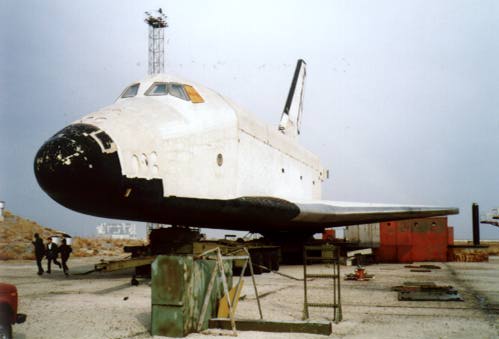
The most flawed aspect of the STS is the Solid Rocket Boosters(SRBs). The soviet shuttle system (Often called Buran, after the name of the first soviet orbiter) recognized this and did away with solid propellant altogether.
It was in my opinion a superior launch system and orbiter, even if it was a blatant rip-off. Buran also looked cooler too. Too bad it is now scrap. The one intact Buran shuttle that survived the fall of the soviet union did not survive the fall of the ceiling in the building it was housed in. So sad.
But eh. Yeah. Props still have their place. -
Re:CracksI don't see the relevance of your comment to the space shuttle, you're comparing two hugely different pieces of equipment for two vastly different purposes
The difference between the purposes of an airplane and shuttle isn't that vast. They're both intended to fly, and undergo similar sorts of stress and strain; the shuttle just gets bigger loads.
Leaving aside ultra-pure crystals, pretty much everything has cracks, whether nanoscale or macroscale. If you put the material under strain, the cracks grow. The bigger the crack, the faster it grows; linear for small cracks, but exponential (=rapid failure) past a threshold.... but the threshold can be suprisingly large. And, as the grandparent noted, there's been a lot of work put into studying how cracks grow and propogate for this reason. Google quickly turns up some moderately technical material that's still understandable if you've an elementary engineering background.
The short of it is, a crack isn't necessarily a, er, fatal flaw, if well below the critical size, and the engineering calculations needed to try and predict that critical size are expert level. Assuming that the engineers considered the erosive effects of re-entry along with the usual mechanical strain sources of propogation, I wouldn't worry.
-
Re:Risk vs Reward
NASA is timid in losing those few lives because we are talking about astronauts here. There are not very many people who have the physical prowess, intelligence, and overall ability to handle extreme situations in space in this world as they do.
They're very talented people, but the fact is there's no shortage of people who would be suitable to become astronauts. I quote from a NASA page on the matter:
After that, the crucial thing to remember is that the demand for such jobs vastly exceeds the supply. NASA's problem is not finding qualified people, but thinning the lineup down to manageable length. It is not enough to be qualified; you must avoid being *dis*qualified for any reason, many of them in principle quite irrelevant to the job.
And as for the nobility of the sacrifice, what's more noble - dying in the pursuit of knowledge for all humanity, or dying in the process of attempting to kill other people, sadly necessary as that may be on occasion?
-
Re:wow, glad hpulley came up with all these q's...
And I'm sure they'll never crash a spacecraft because somebody forgot to convert from kilometers to miles.
Oh, whoops.
I'm also sure that NASA will (because it has so little red tape) manage to make rational decisions to protect their manned spaceflight.
Whoops again.
I have no doubt that the engineers who are patched the Shuttle back together again mean well. But that doesn't automatically guarantee that the correct call is the outcome from all the internal politics. -
Re:Wish We Had A Plan
And if not part of the plan, then like number 2: already in effect
-
I'm jealous, my next eclipse is in 2044
I'm jealous. The next total solar eclipse that I expect to see is August 23rd 2044. (Calgary Canada)
The "sunearth" NASA web site is a great site for seeing what eclipses hit your part of the earth over the next hundred years or so...
http://sunearth.gsfc.nasa.gov/eclipse/SEpath/SEpat h2001/SE2044Aug23T.html -
Re:Wish We Had A Plan
To say we don't have a plan is pretty ignorant. Go look at http://exploration.nasa.gov/ and you'll see it in great detail. I think what you mean to say is that you don't agree with it -- so say that instead. And going to Mars is a very small, far off part of that plan.
Finally, most of your six points are part of that plan -- except for the maglift sci-fi you propose.
Respectfully, it looks like you have some reading to do. -
Hybrid and Partial
Just to be clear...
http://sunearth.gsfc.nasa.gov/eclipse/SEmono/HSE20 05/HSE2005.html
This is also a Hybrid solar eclipse, the path of which runs through Panama. It starts out Annular over the ocean, goes to total over the ocean, and resumes annular through Panama. So parts of the Americas will also see an annular eclipse.
This is a relatively rare event, the next of which will occurr on Nov. 3, 2013.
There are several groups webcasting this event from Panama. -
Re:Sooner than you think
It'd be great if NASA (or someone higher up on the food chain) had the cojones to put an orion drive on a probe.
You mean like Deep Space 1? It sounds like you have a good proposal for a mission. Personally, I think particle and fields science is pretty dull.
-
NASA Conspiracy?
You insensitive clod! We have never visited the moon.
Capricorn One
http://www.imdb.com/title/tt0077294/
NASA - Response To FOXTV's 'Moon Conspiracy'
http://www.virtuallystrange.net/ufo/updates/2001/f eb/m16-007.sh
Did Apollo astronauts really visit the Moon
http://science.nasa.gov/headlines/y2001/ast23feb_2 -
Re:Well, it's difficult to answer that
Frankly, Voyager is useless now
Useless?
"For the past two years or so, Voyager 1 has detected phenomena unlike any encountered before in all its years of exploration. These observations and what they may infer about the approach to the termination shock have been the subject of on-going scientific debates. While some of the scientist believed that the passage past the termination shock had already begun, some of the phenomena observed were not what would have been expected. So the debate continues while even more data are being returned and analyzed."
-
Re:Scratched Lenses
>>As an amateur photog, I can attest to how difficult it is to get a photo to look as good as those the lunar landing team took did.
I guess you have never used 70mm film format Hasselblad cameras (with Zeiss lenses no less) in a vacuum!
There is lots of resolution redundancy in that combination!
If you have seen the Kipp Teague, et al, ALSJ scans (http://www.hq.nasa.gov/alsj/frame.html/ - go to the Image Library) - the high resolution images have been very well done and far surpass any printed equivalent I have ever seen. -
OK, then going to the moon sounds risky...
... so let's go to Mars!
NASA recently found undeniable evidence that there's plenty of water on Mars too!
And for some reason, Slashdot, in all its April Fool craze, missed to post that one! Grrr! -
Re:A question on budgetsYes, far in the future in someone else's administration. It's the cheapest promise you can make to promise that someone else will do something later on.
Nice theory, but the ball is already rolling on this one. NASA issued this RFP on March 1st (due May 2nd) for the CEV. The RFP clearly states that the third spiral of development will include long duration missions of length suitable for a manned Mars mission. Granted not much money will be spent until the contract is awarded, and this could just be a ploy to say "see... I told you it was too expensive" and bail... but this is more than any other administration has done (towards a Mars mission that is).
-
Re:A question on budgetsAs to the Mars program actually getting done? Bush has been talking about going to Mars every year. Still nothing to show for it, as far as I can tell.
Look a little harder. NASA issued this RFP on March 1st (due May 2nd) for the CEV. The RFP clearly states that the third spiral of development will include long duration missions of length suitable for a manned Mars mission. I have no idea why this isn't being covered by the media as no one seems to know about it...
-
Another Analogy: Tsuami Warning System
This is a hard core analogy to try and explain to congress critters just why it is not only short sighted, but incredibly foolish to cut the funding to the Voyager program.
One of the major complaints about the Indian Ocean Tsuami last Christmas holiday was that the technology and even the money was available to set up a warning system throughout the Indian Ocean that would give people living throughout the region as much as several hours advance notice before the Tsuami actually struck.... potentially saving the lives of thousands of people if it had been in place.
Both Voyager space craft are just like weather bouys in the ocean collecting data, but in this case they are in deep space collecting weather data.
The concept of space weather is a relatively new concept, however this is so mainstream that It has become a seperate bureau independent of NASA. Knowledge of space weather has significant economic impact on modern society, where utility grids have to prepare for increased surges in power systems, telecommunications systems need to know when to shut down telecomm sattelites, and perhaps most critical: Manned spacecraft need to have (if possible) advanced warning to know when to get into shielded areas to avoid the effects of a major solar storm. This is a storm of charged particles, and can be predicted using somewhat similar techniques as have already been developed for forecasting rain and snow storms here on the Earth.
By turning off Voyager, it is the equivalent to turning off an ocean bouy in the Pacific ocean, because the million or so dollars needed to service that bouy can't be found. What happens when you record the Tsumai wave the next day and wipes everything out, but it went unmonitored because you shut down the radio recievers that were recieving the bouy data?
Although unlikely, major magnetic storms can also come from extra-solar sources, and the Voyager probes would be in a unique position to be able to record these disturbances well before it would be a problem here on the Earth, giving us several months or even up to a year to prepare for the effects of such a cosmic event. That by itself could justify IMHO the reason to keep Voyager going for the next 10 years alone.
Also, by having the data collected by the Voyager and Pioneer space probes to continue, it will give us additional data points to understand space weather in general as we move out into the rest of the solar system. Right now there are a bunch of questions regarding how dangerous it will be to launch manned spacecraft from the Earth to Mars or even asteroids, and knowing just what the environment is like in space is critical to assess the risks and protection needed to carry out missions like these. This is a very rich source of data that is simply irreplaceable at any price for the next century. -
Current Pictures from Voyager
If you want to get a glimpse of what Voyager would see of the solar system, check these photos out
These were taken in 1990, but it is IMHO one of the "cool" images ever taken by the Voyager project, and an example of real images that could be taken by Voyager even now.
If you want to see what actual science (including what will be lost when the Voyager program gets shut down) check out the mission page here
In fact, what voyager is able to provide really amounts right now to a weather bouy that is sitting in a known position and when triangulated with other outer solar system space probes are giving us a very rich picture of the environment within the solar system. This is going to be critical information when manned spaceflight starts to go beyond LEO or even just to the moon.
Think of it as having weather data points for ancient China (about 1 AD or even 1000 BC) and being able to use those weather observations to help with climate models currently being worked on.
As with weather forecasting, although individual data points are by themselves meaningless, when combined with similar data points and other data collected over time it becomes something as a whole that is almost priceless.
According to the project page, "the cosmic ray detector, magnetometer, plasma wave detector and low-energy charged particle detector all still operational." For much more than $4 million per year similar missions have been launched. This is very real science, and something that can be incredibly useful, such as knowledge of a galactic shock wave front going through the solar system, with a warning of weeks or even months before the main burst of charged particles will wipe out the telecom sattelites that our society depends on. -
Current Pictures from Voyager
If you want to get a glimpse of what Voyager would see of the solar system, check these photos out
These were taken in 1990, but it is IMHO one of the "cool" images ever taken by the Voyager project, and an example of real images that could be taken by Voyager even now.
If you want to see what actual science (including what will be lost when the Voyager program gets shut down) check out the mission page here
In fact, what voyager is able to provide really amounts right now to a weather bouy that is sitting in a known position and when triangulated with other outer solar system space probes are giving us a very rich picture of the environment within the solar system. This is going to be critical information when manned spaceflight starts to go beyond LEO or even just to the moon.
Think of it as having weather data points for ancient China (about 1 AD or even 1000 BC) and being able to use those weather observations to help with climate models currently being worked on.
As with weather forecasting, although individual data points are by themselves meaningless, when combined with similar data points and other data collected over time it becomes something as a whole that is almost priceless.
According to the project page, "the cosmic ray detector, magnetometer, plasma wave detector and low-energy charged particle detector all still operational." For much more than $4 million per year similar missions have been launched. This is very real science, and something that can be incredibly useful, such as knowledge of a galactic shock wave front going through the solar system, with a warning of weeks or even months before the main burst of charged particles will wipe out the telecom sattelites that our society depends on. -
fast but boring:
try World Wind. much more flexible with sat images...
-
Solar system portrait
Ah, here is Voyager 1's picture of the solar system. As awesome as the first pictures of the Earth and the Moon together!
These are the kind of pictures that give us a kind of perspective on life... -
Re:Open it up to the amateurs?
1. Okay, here's your DSN at 1/250th scale:
http://deepspace.jpl.nasa.gov/dsn/educ/model.html
We can build 4 of them and obtain a virtual 70m dish(at scale).
2. Now, multiply all dimensions, parts quantities, and tool sizes by 250.
3. ?
4. Profit. -
Re:Why not auction this off on ebay?
How much of the yearly cost of the Voyager program is access to, and time on the NASA Deep Space Network for receiving the data? Even if another country or a company wanted to pay for the program, if they can't access this telemetry network, then they'll never be able to receive any data Voyager sends. This may be most of the cost and most of the problem leading to the program being killed.
-
Re:$4 million? Jeez, I'll do it for $500,000!I mean, cmon, how much work do you HONESTLY have to do except keep the phone line open and record the itsy bitsy data stream. What could be costing $4 mil?
Maybe access to DSN (URL:http://deepspace.jpl.nasa.gov/dsn/) and other radio telescopes so you can get your bitsy data stream?
-
That's just the Earth-Sun Exploration Division!
NASA's full budget is $16.4 billion -- a 2.4% increase from last year. See it here.
No offense to you, but how did your post get modded +5 Interesting? I guess the Washington Post does cause illiteracy. -
Why this is good news! (RTFB!)
Read the budget: Here
Yes, smaller programs have been cut 20 to 30 percent, from 300 million to 200, etc. Yes it hurts, that education and some long term missions are being toned down. But the manned space exploration budget is being doubled. Doubled to the tune of billions of dollars.
Read Extending Human Presence into the Solar System if you want to really know how we are going to do this. It includes the plans for the new Crew Exploration Vehicle.
This should make you very happy.
kulakovich -
Re:Every Million Counts
They should keep things the way they are there is so much more to know.
The war in Iraq costs us 5.8 BILLION every MONTH
The overall defense spending is 511 billion a year.
TO keep this project alive for another decade would cost only 40 million. That's like a half day of war.
Bill Gates could come up with that money by checking all his couches and jacket pockets for gods sake.
Man our nation sure has messed up priorities.
-
ShortsightednessThough the article focusses on cutting Voyager, cutting all of the other spacecraft is at least as troubling. The other spacecraft are also still providing good data. Its extremely shortsighted to shut down still functioning spacecraft which don't have a replacement in the works. These spacecraft cost many millions to build and launch - throwing them away is ludicrous.
Its particularly sad turn-off the magnetospheric spacecraft, since the magnetospheric is such a complex system and being able to collect data from mulitple spacraft is so vital to understanding the system. Though the instruments on spacecraft do degrade over time, I know that the Polar spacraft, for exaple, is still collecting useful data. it is still being used in multi-spacecraft studies, along with newer spacecraft like Cluster, to better understand the magnetosphere.
-
Re:Oh bugger...
I wonder how much equipment is required to receive signals from the voyager?
Just a little.
The Deep Space Network's 63 meter dishes were actually upgraded to 70 meter dishes specifically for the Voyager spacecraft around 1980. Access to the 70 meter dishes is hotly contested and likely ends up being more than a small fraction of that $4 million per year. -
Re:Every Million Counts
http://voyager.jpl.nasa.gov/
Contributions:
Both spacecraft are still going strong and are returning valuable science data. Each Voyagers' cosmic ray detector, magnetometer, plasma wave detector and low-energy charged particle detector all still operational. In addition, the Ultraviolet Spectrometer on Voyager 1 and the Plasma Science instrument on Voyager 2 continue to return data. Both spacecraft are expected to continue to operate and send back valuable data until at least the year 2020.
The mission currently employs the equivalent of about 10 full-time people at JPL.
Screeeech - Math time. 4 mil a year and 10 employees lets say they're using really good equipment and replacing it like crazy plus utilities making the total 3 mil a year. 1 mill / 10 != "research for the love of it". -
Re:Erm
I was playing around with Worldwind and saw the same thing. Actually, they appear to be the exact same images.
So I guess Google's using the same source as Worldwind. -
Re:More likely...
Except that Aerial Ortho dataset was produced by the USGS and is public domain. Check out World Wind 1.3 for a smooth-scrolling, translatable, 3d globe that dynamically downlads any dataset you request and grabs higher res versions as you zoom in.
-
Re:Sounds like good technology for lots of uses
You want nasa world wind. Satelite photos of the entire earth applied to a 3D model of it. In some areas you can make out individual buildings!
SERIOUSLY cool.
-
First in the industry
How can this be first in the industry. Terraserver has been doing it for atleast 6 years and NASA's World Wind does a fantastic job.
-
Re:Gigabyte, gigapixel artwork?
I realize this is now somewhat offtopic, but I was interested enough in the parent post to explore further. Indeed these images are still available. But instead of some complicated "low-tech bandwidth management system," you can link to them directly off Nasa's website
Here is an 8192x4096 of Earth. Created as a mosiac with 1km square tiles with no clouds
A version with clouds is also available.
Here is a 30000x15000 (yah, you heard me) GIF of the entire planet's city lights at night.
A 16394x8192 TIF version is also available.
In addition to the "entire planet" shots, theres some other high res pictures of fires, floods, and dust storms in localized areas - I recommend checking them out! -
Re:Gigabyte, gigapixel artwork?
I realize this is now somewhat offtopic, but I was interested enough in the parent post to explore further. Indeed these images are still available. But instead of some complicated "low-tech bandwidth management system," you can link to them directly off Nasa's website
Here is an 8192x4096 of Earth. Created as a mosiac with 1km square tiles with no clouds
A version with clouds is also available.
Here is a 30000x15000 (yah, you heard me) GIF of the entire planet's city lights at night.
A 16394x8192 TIF version is also available.
In addition to the "entire planet" shots, theres some other high res pictures of fires, floods, and dust storms in localized areas - I recommend checking them out! -
Re:Gigabyte, gigapixel artwork?
I realize this is now somewhat offtopic, but I was interested enough in the parent post to explore further. Indeed these images are still available. But instead of some complicated "low-tech bandwidth management system," you can link to them directly off Nasa's website
Here is an 8192x4096 of Earth. Created as a mosiac with 1km square tiles with no clouds
A version with clouds is also available.
Here is a 30000x15000 (yah, you heard me) GIF of the entire planet's city lights at night.
A 16394x8192 TIF version is also available.
In addition to the "entire planet" shots, theres some other high res pictures of fires, floods, and dust storms in localized areas - I recommend checking them out! -
Re:Gigabyte, gigapixel artwork?
I realize this is now somewhat offtopic, but I was interested enough in the parent post to explore further. Indeed these images are still available. But instead of some complicated "low-tech bandwidth management system," you can link to them directly off Nasa's website
Here is an 8192x4096 of Earth. Created as a mosiac with 1km square tiles with no clouds
A version with clouds is also available.
Here is a 30000x15000 (yah, you heard me) GIF of the entire planet's city lights at night.
A 16394x8192 TIF version is also available.
In addition to the "entire planet" shots, theres some other high res pictures of fires, floods, and dust storms in localized areas - I recommend checking them out! -
Re:Gigabyte, gigapixel artwork?
I realize this is now somewhat offtopic, but I was interested enough in the parent post to explore further. Indeed these images are still available. But instead of some complicated "low-tech bandwidth management system," you can link to them directly off Nasa's website
Here is an 8192x4096 of Earth. Created as a mosiac with 1km square tiles with no clouds
A version with clouds is also available.
Here is a 30000x15000 (yah, you heard me) GIF of the entire planet's city lights at night.
A 16394x8192 TIF version is also available.
In addition to the "entire planet" shots, theres some other high res pictures of fires, floods, and dust storms in localized areas - I recommend checking them out! -
Re:I'm not sure why this is so significant
Think of the mars rover. That was remotely controlled (correct me if I'm wrong).
It depends what you mean by "remotely controlled." The one-way light time between Earth and Mars varies from about 5 to 20 minutes, so you can't drive the rovers with a joystick. Also complicating the issue is that rover controllers no longer work around the clock like they did during the primary mission - it's too expensive to have people to have people work like that for 6+ months. Instead, rover commands are generated during regular working hours rather than during local Mars rover time. It's probably more correct to say that the rovers are "remotely commanded."
The rovers do have some autonomous capabilities. Ground controllers can send up commands to tell the rover to drive to certain way points and avoid any obstacles along the way. (See here.) However, ground controllers still need to double-check the rovers' final position after autonomous drives. Issues like wheel slippage on slopes and sandy surfaces can mean the wheel odometry may not match the actual distance travelled. Also, the rovers don't have the capability to automatically decide what's scientifically important and what's not - people still have to make those decisions. The rovers are a considerable way from being autonomous.
-
Re:Obvious marijuana jokes aside...
very true, thankfully there is nothing to worry about in that area as there is no evidence that sea levels are rising signifigantly. In fact all current measurements show that it has risen a maxumum of 15 milimeters in 7 YEars, and even at that it peaked higher than that in conjunction with the 1998 El Nino, and that the temprature of the water is the most signifigant factor in both short and long term measurements. Global mean sea level variations 1993 - 2000 I don't like this graph as it is variation, and the 0 point is not explained, however deviation from 1993 - 2000 is ~ 15mm
In fact Tuvalu is in the epicenter of a large area of falling sea levels. That has been falling for 50 years.
Find Tuvalu Below is a mean sea level mark as made in 1841 in Tasmania. Current measurements of mean sea level are below that mark.
Isle of the dead -
Re:Obvious marijuana jokes aside...
very true, thankfully there is nothing to worry about in that area as there is no evidence that sea levels are rising signifigantly. In fact all current measurements show that it has risen a maxumum of 15 milimeters in 7 YEars, and even at that it peaked higher than that in conjunction with the 1998 El Nino, and that the temprature of the water is the most signifigant factor in both short and long term measurements. Global mean sea level variations 1993 - 2000 I don't like this graph as it is variation, and the 0 point is not explained, however deviation from 1993 - 2000 is ~ 15mm
In fact Tuvalu is in the epicenter of a large area of falling sea levels. That has been falling for 50 years.
Find Tuvalu Below is a mean sea level mark as made in 1841 in Tasmania. Current measurements of mean sea level are below that mark.
Isle of the dead -
Re:Doesn't this... already happen?
According to their fact sheet (pdf) the mission will be completely autonomous. The DART spacecraft even has collision avoidance algorithms. It seems that this spacecraft was designed only to repair one particular satellite (MUBLCOM), although several of this satellite currently exist. Anyone know if the services of this DART spacecraft can only be used once, or can it travel the LEO repairing all MUBLCOM's it comes in contact with?
--
NoVa Underground: Where Northern Virginia comes out to play. This means you Fairfax County -
Re:Deorbit
Oh, I should have put this link into my first reply. JWST is scheduled for launch in 2011.
-
Re:On Discovery Channel last night....
It still takes energy to compress that air, though. Nevertheless, it's an interesting development - not as a power source, but as a battery. But that's a good thing. Power is no problem. Storing it is. Also, you're right: a 747 wouldn't run off solar, but there are aircraft that do: Helios could run both day and night with solar panels and batteries. Mind you, the cruising speed of this aircraft was below 50 mph, not a very efficient means of getting around. But hey: you put those solar panels on the ground, use the energy to compress a bunch of air, stick some wings to the canister and hold on for dear life... cool. I bet it would make one hell of a racket though. Unless you discharged the air internally and used it to drive a turbine...
-
The real link
The picture on the link posted changes every day. Here's the permanent URL of the one referred to:
http://antwrp.gsfc.nasa.gov/apod/ap050401.html. -
Link Broken...
The link got switched because it's next day now, the correct one is this
-
A dupe, but my "Water on Mars" story rejected?
Yes, I submitted this story earlier last evening, but it was rejected, in favor of a DUPE
MY Story has an actual nasa.gov link in it. Does the dupe? Nope.
Water found on Mars!
NASA has released a photo proving there is Water On Mars. This is certainly the most dramatic picture I've seen of such, leading credence to the idea that there was once Life on Mars. -
Shitty Stories Preview
Developers: Idle Loop Optimized
Posted by CmdrTaco in The Mysterious Future!
from the more-efficient-use-of-clock-time dept.
seebs writes "Every so often someone makes a joke about optimizing the idle loop, but this article actually does it. " It's about time too- that process has been eating up clock cycles for to long.
Science: Positive Proof of Water on Mars
Posted by CmdrTaco in The Mysterious Future!
from the now-we-can-put-that-one-to-rest dept.
pauliecronopolis was one of many people that noted that the popular Astronomoy Picture of the Day page has photographic proof of water on mars. It will be a little difficult for those of you who don't have a degree on geology to spot the evidence, but with a little efort, I think you'll be able to make it out.
Apple: Monkeys Don't Like Macs
Posted by CmdrTaco in The Mysterious Future!
from the but-they-fling-a-helluva-poo dept.
sebFlyte writes "silicon.com is reporting on a new twist on some oft-done probability research, into the suggestion that an infinite number of monkeys will eventually produce a perfect script for Hamlet , given typewriters (or indeed keyboards) and enough time. The researchers claims that the monkeys used in their test preferred using systems running Windows XP to those running Mac OSX. Which begs the question -- do only monkeys use windows, or can even monkeys tell macs aren't worth bothering with?"
ePlus
Posted by CmdrTaco in The Mysterious Future!
from the - - dept.
anonymous writes "
"
Magic Supersecret Anagram T-Shirt
Posted by CmdrTaco in The Mysterious Future!
from the black-is-the-new-pink dept.
Jesus Christ Himself, No Really The One Who Died For Your Sins On a Big Wooden Cross a Couple Thousand Years Ago and is a Little Cranky that You've Only Gone To Church Twice so Far This Decade wrote in to say "Hey you guys should check out the Magic Supersecret Anagram T-Shirt. It'll really blow your mind. It's available from ThinkGeek. (TG is owned by OSTG, the parent company of Slashdot, so activate all conspiracy theories now). You can also look into the new iPod accessory iCopulate which allows intimacy between mp3 players never before fantasized. And for the suit that has everything, Executve Pong.
Think Geek Shafts O' Poo
Apple: Steve Jobs to Become Ikea CEO
Posted by CmdrTaco in The Mysterious Future!
from the third-times-the-charm dept.
RLewis1241 writes "According to The Register, Steve Jobs seems to be broadening his horizons: "IKEA will employ Jobs as "acting CEO", from next month. The technology icon will maintain his twin CEO roles at Apple Computer Inc. and Pixar Inc. but will also take command with a wide-ranging brief at the retail giant""