Slashdot Mirror
Domain: nasa.gov
Stories and comments across the archive that link to nasa.gov.
Comments · 16,365
-
Re:I support space research.
Yes, the space station was built for a single purpose. Space Whisky. For the past 17 years this is the best they have done. They may now come home to a hero's welcome for a job well done. You know they do other things up there, right? http://www.nasa.gov/mission_pa...
-
Re:Bender says
It looks like it got back in: from their 2014 Strategic Plan (sorry for the PDF):
Page 6
"Our Mission: Drive advances in science, technology, aeronautics, and space exploration to enhance knowledge, education, innovation, economic vitality, and stewardship of Earth."
-
Re:Geologist's Core Samples
There's not much info there but notice that every 125,000 years, which points to orbital changes driving warming, the dust goes up, then the temperature goes up fast, perhaps driven by methane, a very potent greenhouse gas, and then the methane turns into CO2 and the temps drop as CO2 isn't the strongest greenhouse gas.
That's an interesting hypothesis. The dust does seem to have a vague lead on the temperature rise. To check out methane specifically, you can look at this graph (note that the time line is reversed).
The real question is what happens when something else such as burning large amounts of fossil fuels drives CO2 levels up and it looks like we're doing the experiment
Yes, too bad we don't have multiple earths to test on.
-
Re:They should know better
I RTFA and this is the graphic I was referring to. http://www.nasa.gov/sites/defa...
-
There were issues with Post Katrina ET's
We had issues with Post Katrina ET's because many of the technicians were displaced after Katrina and they lost institutional knowledge. The Ground Umbilical Carrier Plate (GUCP) was not installed within the tolerances and we had problems for the rest of the program with leaking hydrogen gas from this connection which caused quite a few scrubbed launches.
-
Re:"...need to be prepared..."
Hmm, from a few pixels on the last graph.
Yet other data sources simply don't support this.
http://1.bp.blogspot.com/_nB6y... http://www.giss.nasa.gov/resea... http://www.giss.nasa.gov/resea...
https://upload.wikimedia.org/w... http://www.forbes.com/sites/er... -
Re:"...need to be prepared..."
Hmm, from a few pixels on the last graph.
Yet other data sources simply don't support this.
http://1.bp.blogspot.com/_nB6y... http://www.giss.nasa.gov/resea... http://www.giss.nasa.gov/resea...
https://upload.wikimedia.org/w... http://www.forbes.com/sites/er... -
measured data [Re:Oversimplification]
Scientists dumb down data so science magazines can understand. Mainstream media further simplifies for the general population to understand. Even the summary states that this guestimation is based on a different guestimation of how many gigatons of ice have melted. If 360 gigatons of ice on land melt, it is estimated that it will raise the sea level by 1 mm. However, if the ice is already in the sea, it won't raise the sea level. The dumbed down story doesn't say how much of the missing ice was already in the ocean vs on the land, so we can't use numbers to say that sea level has risen 8mm over that decade.
The 303 gigaton number was for Greenland ice. Greenland ice is on land.
Since we are talking about NASA, why don't they measure the actual sea level instead of playing this numbers game?
They do. Read the linked articles. These are satellite measurements of sea level.
http://www.jpl.nasa.gov/news/n...
http://www.nasa.gov/risingseas... -
measured data [Re:Oversimplification]
Scientists dumb down data so science magazines can understand. Mainstream media further simplifies for the general population to understand. Even the summary states that this guestimation is based on a different guestimation of how many gigatons of ice have melted. If 360 gigatons of ice on land melt, it is estimated that it will raise the sea level by 1 mm. However, if the ice is already in the sea, it won't raise the sea level. The dumbed down story doesn't say how much of the missing ice was already in the ocean vs on the land, so we can't use numbers to say that sea level has risen 8mm over that decade.
The 303 gigaton number was for Greenland ice. Greenland ice is on land.
Since we are talking about NASA, why don't they measure the actual sea level instead of playing this numbers game?
They do. Read the linked articles. These are satellite measurements of sea level.
http://www.jpl.nasa.gov/news/n...
http://www.nasa.gov/risingseas... -
Re:What paradox?
Yes, we do have motion relative to the CMB, and this causes one side of the CMB sky to appear hotter than the other. Here's an APOD describing it. So everything discussed in the article already happens to us, here on Earth, but in a much less significant way.
-
Venera and Pioneer [Re:US vs THEM in space is...]
Politically the Viking 1 success was a huge win for the U.S. against the competing Soviet space program.
I always thought it was kind of a "gentleman's agreement", we went to Mars and the Russians went to Venus.
Nope. The Russians sent probes to both planets. it just happened that their Mars probes failed, and their Venus probes (after the first handful) mostly succeeded.
Why bring politics into it. The Russians have physically landed on Venus and no one else has even come close,
Two of the NASA Pioneer atmospheric probes landed on the surface, even though landiing was not a mission objective. One of them continued to transmit after landing, so no, the Russian are not the only ones to successfully land on the surface of Venus.
so can they claim the same "political victory"?
-
Venus [Re:Mars is bad luck for Russia]
What is the radiation level at 53km over Venus?
Pretty reasonable-- at that level, you're still underneath about 10 tons/m2 of shielding by atmosphere
And fiction aside, why would someone want to colonize a floating death trap? Why not colonize the surface of the ocean for 1 billionth the price and risk?
-
Re:How did they do soft landing with tech at time?
Try here as a starting point. The fact sheet has lots of technical info, but little in the way of how it operated.
-
Re:Is this a good thing?
Is there any serious defense of the ISS in terms of a results per unit spend or unit lift capacity?
You do realize that ISS has ZERO lift capacity?
As for science, there is science done on ISS.
http://science.nasa.gov/scienc...
And no, that experiment would not be possible without ISS because of power demands.
And without ISS, there would be no Americans in space.. This means ZERO US research on effects of near-space and its environment of living organisms. ZERO other research done by these individuals. No experience in on-orbit assembly of structures. Spacewalks that are routine with ISS were "exception to the rule" before ISS... but maybe China should take over leading role in space anyway?? Right?
http://www.nasa.gov/mission_pa...
Finally, without it, there would be no Space X because they would never get contract to supply ISS.
To me it is kind of mind-blowing to even ask if ISS is beneficial. Obviously the answer is YES! Even if the only thing we get from ISS is stroking Musk's ego to get to Mars, it's worth it. Vertical landing of 1st stage for re-use has been something that's been quite unimaginable before SpaceX and probably never tried with Boeing or Lockheed.
-
Re:Is this a good thing?
Is there any serious defense of the ISS in terms of a results per unit spend or unit lift capacity?
You do realize that ISS has ZERO lift capacity?
As for science, there is science done on ISS.
http://science.nasa.gov/scienc...
And no, that experiment would not be possible without ISS because of power demands.
And without ISS, there would be no Americans in space.. This means ZERO US research on effects of near-space and its environment of living organisms. ZERO other research done by these individuals. No experience in on-orbit assembly of structures. Spacewalks that are routine with ISS were "exception to the rule" before ISS... but maybe China should take over leading role in space anyway?? Right?
http://www.nasa.gov/mission_pa...
Finally, without it, there would be no Space X because they would never get contract to supply ISS.
To me it is kind of mind-blowing to even ask if ISS is beneficial. Obviously the answer is YES! Even if the only thing we get from ISS is stroking Musk's ego to get to Mars, it's worth it. Vertical landing of 1st stage for re-use has been something that's been quite unimaginable before SpaceX and probably never tried with Boeing or Lockheed.
-
Check your sources [Re:Water vapor]
Sorry, but here's an important lesson for you. Memorize this simple rule:
Never get your science information from the opinion/editorial pages of Forbes magazine.Forbes is a business magazine. It's not a science magazine. It doesn't even pretend to be a science magazine. It's a bad source for science information, because they are editorializing to make a point, not to understand how climate works.
Track down original sources. Don't rely on editorials in Forbes.
Since you get your data from business magazines and blogs, here's a blog post you might look at: http://variable-variability.bl... But, let's look at that Forbes link. The particular editorial you linked has two links... one to a graph with no source listed, and the second to a long paper... with no information on where this paper was published (or if it was) or who it was reviewed by. But-- paydirt!-- that paper does list where the data comes from: the NASA Water Vapor Project. So let's look at the data from the source.Here's the data: https://eosweb.larc.nasa.gov/p...
here's the data graphed: https://climatedataguide.ucar....
here's the data analyzed: https://www.cira.colostate.edu...
here's the conclusion of the analysis: "at this point we are unable to prove or disprove a robust global trend in total precipatible water."So the answer is... inconclusive.
-
Re:there is no climate change ? who said that?
> Oh, the answer to your "non anthropogenic GW" is CO2 still.
Actually it's water vapor, that 'other' greenhouse gas, that is doing most of the warming on Earth. Yes, CO2 is also a greenhouse gas, but its contribution to GW has been greatly exaggerated.
To see this consider the planet Mars, where the concentration of CO2 is 950,000 parts per million! Of course you can't compare that number to Earths 400 ppm because the Martian atmosphere is very, very thin. Yet, if you do the math to compute the actual weight of CO2 above each square meter of surface area, you'll find that Mars has about 28 times more CO2 per unit of surface area than Earth.
So how much warmer is Mars now, compared to its theoretical black-body temperature? Well, the black-body temp is 210K. The measured average temp is also 210K. So CO2 is not doing any warming of the Martian atmosphere, even though it is a greenhouse gas.
http://nssdc.gsfc.nasa.gov/pla...On Earth, the BB temp is 255K, but the average temp is 288K. So Earth's atmosphere raised the temp by 33K, almost entirely due to the ubiquitous water vapor which blankets the surface of our planet.
http://nssdc.gsfc.nasa.gov/pla...The main CO2 absorption band is 15microns, smack dab in the middle of Earths longwave radiation spectrum. So there will be some absorption and mechanical heating due to "Earthshine". But heated air at the surface most likely will rise due to convection which tends to have a cooling effect. That's why scientists have not actually measured the actual warming effect of CO2 in the atmosphere (note that I didn't say 'estimate' or 'model', they haven't measured the CO2 contribution to GW with a thermometer). It's like peeing in the ocean. You know it made the sealevels rise, but it can't actually be measured because of other climate 'noise'.
-
Re:there is no climate change ? who said that?
> Oh, the answer to your "non anthropogenic GW" is CO2 still.
Actually it's water vapor, that 'other' greenhouse gas, that is doing most of the warming on Earth. Yes, CO2 is also a greenhouse gas, but its contribution to GW has been greatly exaggerated.
To see this consider the planet Mars, where the concentration of CO2 is 950,000 parts per million! Of course you can't compare that number to Earths 400 ppm because the Martian atmosphere is very, very thin. Yet, if you do the math to compute the actual weight of CO2 above each square meter of surface area, you'll find that Mars has about 28 times more CO2 per unit of surface area than Earth.
So how much warmer is Mars now, compared to its theoretical black-body temperature? Well, the black-body temp is 210K. The measured average temp is also 210K. So CO2 is not doing any warming of the Martian atmosphere, even though it is a greenhouse gas.
http://nssdc.gsfc.nasa.gov/pla...On Earth, the BB temp is 255K, but the average temp is 288K. So Earth's atmosphere raised the temp by 33K, almost entirely due to the ubiquitous water vapor which blankets the surface of our planet.
http://nssdc.gsfc.nasa.gov/pla...The main CO2 absorption band is 15microns, smack dab in the middle of Earths longwave radiation spectrum. So there will be some absorption and mechanical heating due to "Earthshine". But heated air at the surface most likely will rise due to convection which tends to have a cooling effect. That's why scientists have not actually measured the actual warming effect of CO2 in the atmosphere (note that I didn't say 'estimate' or 'model', they haven't measured the CO2 contribution to GW with a thermometer). It's like peeing in the ocean. You know it made the sealevels rise, but it can't actually be measured because of other climate 'noise'.
-
Related to gamma ray bursts?
Is this related to gamma ray bursts generated by strong lightning, also a recent observation?
http://www.nasa.gov/vision/uni...
sPh
-
Re:Why geosynchronous orbit?
I've looked at various other orbits.
http://ntrs.nasa.gov/archive/n...A problem with non-synchronous orbits is that 75% of the Earth's surface is ocean, and a vast amount of the remainder is uninhabited, so if a satellite isn't geostationary over the place you want, it will spend much of its time over places where you have no place to put a receiver or no market for power.
Nevertheless, I think that there may be clever solutions with other orbits; it could definitely use more thinking.
-
Re:We've learned a lot
Hi Geoff. Dani Eder here. I would say the most important thing we have learned is "there are a whole lot of Near Earth Asteroids". In 1980 there were 52 known NEA's ( http://neo.jpl.nasa.gov/stats/ ). Today we are rapidly approaching 13,000 at a rate of about 1,500 new ones a year. This has completely changed the accessibility of raw materials. Given that we now have well developed electric propulsion, 90% of NEA's take less fuel to reach than the surface of the Moon.
Even if you want to go to the Moon, the math says to mine asteroids for propellant to get there. Some asteroids are up to 20% water and carbon. This can be reformed to Oxygen and Hydrocarbons, which makes good high-thrust chemical propellant for landers.
Next I would say the advances in computers, automation, robotics, and high bandwidth communication are important. O'Neill assumed 10,000 people in a colony, because that's how many people it would take to build solar power satellites and all of the supporting tasks to keep them alive. Today we can think about automating it or controlling a lot of that from the ground. That means we can bootstrap construction with a small team of actual humans in space (some tasks still have to be hands-on).
Lastly, I would mention that the "O'Neill Cylinder" design, while pretty, is a nightmare from an engineering safety standpoint. One meteorite or out of control cargo ship hitting those giant windows, and all your air leaks out. You want stuff like multi-layered Whipple shields to break up incoming objects, and a layered and compartmentalized pressure hull. If you want natural sunlight, bring it in through protected openings.
-
Re:If Only
because the "global warming" predicted by their models failed to happen
Just for kicks, look at this set of organizations that disagree with you.
For what you're saying to be true, not only every one of those organizations would have to be concealing data or faking models, every single organization on the planet would have to be in on it - - because science is science.
So the claim is that the entire global scientific community is suddenly full of shit, but only on this one subject (although of course the implication is that nothing affiliated with any university or mainstream research institute can be trusted, because scientist == liar in that world).
-
Vegetables grown in space for years
The article seems to imply that these are the first ever vegetables grown in space by astronauts, but this isn't true.
According to NASA's website about the International Space Station "Since 2002, the Lada greenhouse has been used to perform almost continuous plant growth experiments on the station. Fifteen modules containing root media, or root modules, have been launched to the station and 20 separate plant growth experiments have been performed. "
-
Re: Light Bulb?
Oh, and also:
http://science1.nasa.gov/scien...
Basically, Apolo astronauts found a camera from a probe mission whose previous handlers sneezed on it. It was on the moon for a total of three years, and the bacteria were still growing.
A similar outcome found here, this time deliberately:
-
NASA link
Article on NASA site: http://earthobservatory.nasa.gov/IOTD/view.php?id=86353&src=iotdrss
-
Re:Compiler optimizer bugs
It's my personal computer, but I am not the only one to get this kind of error:
http://www.jpl.nasa.gov/news/n... -
Re:Oh boy, here we go...
As our tech gets better and better, we'll be able to find new ways to reduce CO2 emissions, and if it's increasing slowly enough we can use other means (such as trees) to reduce CO2 in the air. Therefore, the rate at which things get worse matters.
Sure it does, if the assumptions you've just made are true.
They aren't.
We're adding way too much CO2 per year for any slow reduction to help.
We're adding a pretty steady 2 PPM CO2 to the air every year.
We recently passed 400 PPM CO2. The various sites estimate that anything between 450 and 500 is the tipping point.
So we have between 25 and 50 years, at our current production rate of CO2, before we're beyond the point of no return.
To stop the rise, we'd have to cut nearly 50% of the worldwide CO2 production. This just isn't going to happen.
If it takes 25 years, 50 years, or 100 years, we're still in trouble.
The changes proposed don't make enough of a difference to change the outcome.
-
truck based CO2 monitoring vs. OCO2
The CO2 monitoring is useful for finding major sources of LOCAL pollution, but, it really can not deal well with large 'Whiffs' of it.
OTOH, OCO2 is already showing where the REAL CO2 comes from, and is making a mockery of the numbers that the far left comes up with. Keep in mind that CO2 numbers are predicated on various items:
1) the first is via monitoring. That works well if you have monitors all over the nation. This is used heavily for doing calcs in the western nations. However, when monitors are NOT all over the nations, then you have an issue.
2) calculations based on gov. supplied numbers. This is what is used in most of the world, in particular, for China. THis fails since nearly ALL govs. CHEAT on these numbers.
3) Space based monitoring. OCO2 is now showing that numbers are wrong.
So, while I would not fully trust the numbers from Google, they will give an idea of where bad emissions are from. OTOH, Sats will give a better idea of which area CO2 is coming from, as well as being sucked up.
Thankfully, OCO3 is now being worked on, and will give a much better idea of where CO2 emissions are coming from within locations. -
Solar Flares
I like electric cars for basic transport. Truly no nonsense.
Gas cars are actually more fun in the end imo.
But wait until that X class solar flare hits and knocks the power grid out for a day or two. Doesn't matter if you have a garage at that point. Then we'll see if electric makes sense.
-
Re:What will kill me next?
That's pretty standard for all aviation training. Flying is easy, much easier than driving in a lot of ways. Not killing yourself is a lot harder. That's why pilots have reams and reams of checklists covering pretty much every conceivable problem that can happen. Similarly when training in a simulator, the operators can pretty much throw the book at you to see how you react to losing all your instruments and a wing while flying through a thunderstorm.
NASA's generic rulebook is over 2000 pages long and is well worth a flick through if you're a space geek http://www.jsc.nasa.gov/news/c...
-
Re:Copyright?
There's no music on this disc, only greetings by unknown people who probably signed off to NASA anyway.
Wrong. They even put Glenn Gould on the disk so Sony most likely will be selling records and interstellar performance rights to the aliens who come to earth to find out who the hell played the piano like that and what why it has evil discordant humming in the background!
My favourite piece is the gavotte en rondeaux from partita 3 of Bach which I play on the guitar. But as far as the RIAA and US
-
Re:So what?
I care. A dress code sends a message about a company's culture. The stricter the code, the more that company cares about having a professional appearance, and less about professional performance.
Is that why these guys were never able to land people on the moon?
-
Re:During Pluto's day - how light is it?
NASA made this site to give you an idea http://solarsystem.nasa.gov/pl...
-
Re:2 time the gravity thought
from TFA, mass of the planet is 5x Earth Mass.
I'm not sure what you were reading.... From the page linked to the summary:
Scientists do not know if Kepler-452b can support life or not. What is known about the planet is that it is about 60 percent larger than Earth, placing it in a class of planets dubbed "super-Earths." While its mass and composition are not yet determined, previous research suggests that planets the size of Kepler-452b have a better than even chance of being rocky.
So I'm not sure where you got 5 times the mass from.
In fact, if we assume composition similar to earth, a planet 1.6 times the size of earth would have 4.096 (1.6 cubed) times the mass of earth
Because gravitational pull falls with the square of the distance, we could divide 1.6 cubed times the mass of earth by the square of 1.6 gives us exactly 1.6 times earth's gravitational pull at the surface of the planet. Thus, assuming identical composition, surface gravity scales linearly with diameter. While it probably doesn't have absolutely identical composition to Earth, there is not yet any compelling reason at this time to speculate that its composition would be drastically different either. Certainly if its density were 25% heavier than that of earth, then the mass (and surface gravity) would be exactly as you described. According to the page, we do not know that information yet, however.
-
Re:2 time the gravity thought
Though as one of the questions during the briefing asked, they don't actually know the mass. They're pretty much guessing based on the size by using the distribution of a smaller pool of past planets that they do have mass estimates for.
From the caption for figure 4 from their presentation: "While its mass and composition are not yet determined, previous research suggests that planets the size of Kepler-452b have a better than even chance of being rocky."
http://www.nasa.gov/keplerbrie... -
Re:PixarVoyager 2 launched in August 1977. I suppose it's possible that every last bit of code was been updated from earth since then (there is only 64kB in total after all), but the hardware itself is still operating.
-
Re:More Republican corporate welfare
If we can reach other stellar objects, there is no need to make anything sustainable.
Just the resources available in our own solar system, heck just with what is available in the main asteroid belt is estimated to be able to support 10 QUADRILLION humans
http://nix.nasa.gov/search.jsp...
The way our current economic system works, it depends on infinite growth. However we are on a planet with finite resources. The moment our ability to increase production of one of key resources can no longer keep up with the growth in demand,the entire thing comes crashing down like a house of cards. New science and technology has so far kept this problem at bay (by either allowing us to use the resource more efficiently, or increases efficiency in extraction or both, but we are on borrowed time. WE NEED TO EXPAND TO THE STARS, or find another economic model, and we are running out of time. If the global economy comes to a crash before we do, there will not be a second chance (as we will have used up all cheap resources and it will likely takes millions, if not billions of years before the Earth can replenish them).
-
It's not just audio triangulation
The sound triangulated was in cryogenic liquid oxygen at 50 PSI. The speed of sound in that is approximately 1 kilometer per second.This paper is about calculating the exact speed. Elon talked in the conference about reading telemetry with millisecond accuracy. But this would yield only 1 meter resolution.
-
Re:The Gods
You mean something like changing data sets ?
http://data.giss.nasa.gov/gist...
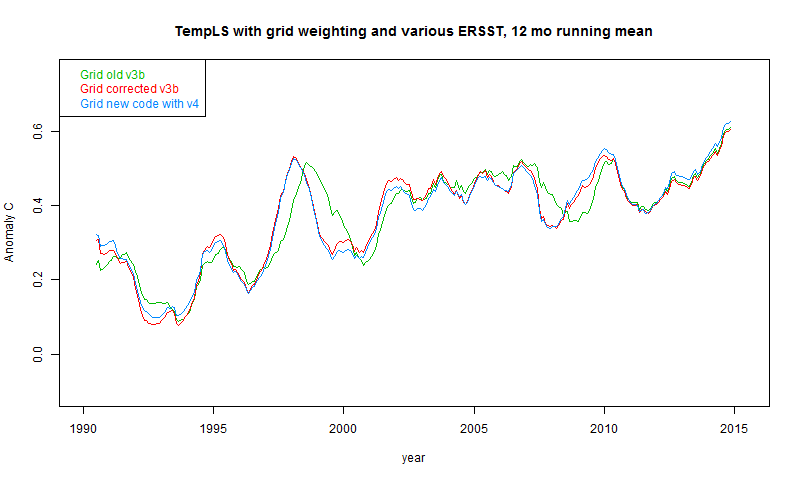
uly 15, 2015: Starting with today’s update, the standard GISS analysis is no longer based on ERSST v3b but on the newer ERSST v4. Dr. Makiko Sato created some graphs and maps showing the effect of that change. More information may be obtained from NOAA’s website. Furthermore, we eliminated GHCN’s Amundsen-Scott temperature series using just the SCAR reports for the South Pole.
And eliminating pesky data ?
Yes, you can see how this change has dramatically changed everything. http://www.moyhu.org.s3.amazon...
-
Adjustments were minor [Re:The Gods]
This is definitely old news and the answer already known. The "adjusted" data shows it to be the hottest year on record but the original data does not.
If you actually looked at the site, which apparently you didn't, you'd see that both the original and the reanalyzed data show 2015 to be the hottest year on record.
http://data.giss.nasa.gov/gist...As does, for that matter, the data from the Japanese Meteorogical Agency.
And the adjustments are not arbitrary-- they are quite well documented: https://www.ncdc.noaa.gov/data...
-
Re:Actually there is a 34% CHANCE...
Oh... so many places...
First:
http://www.ncdc.noaa.gov/sotc/...Just as an interesting appetizer.
to continue:
http://www.metoffice.gov.uk/ha...Just so you can see where this is starting to come from...
And more:
ftp://podaac.jpl.nasa.gov/allD...And more:
http://www.ncdc.noaa.gov/monit...and more
https://en.wikipedia.org/wiki/...and finally:
http://www.ncdc.noaa.gov/sotc/...Here is the thing... this shit is "estimated"... there are high levels of uncertainty at EVERY step. There is a lot of guestimation going on and that adds up.
What temperature it even was in a given year has a margin of error of AT LEAST
What they do know is that 2014 was warm. It was arguable that it was as warm as the last 5 or so hottest years since 1850... keeping in mind that uncertainty and imprecision INCREASE as we go back farther in the record. By around 1920 the imprecision is so bad it is up to whole degrees. That is... today... they're saying they know to within about
You asked.
They don't know. It... "could" be the hottest year. They're certain to about 30~40 percent... based on which data sets they use. Of course... their data doesn't really go back to 1850 or so with that level of precision. So... maybe a 30 percent chance of being the hottest year in the last 20~30 years?... sounds about right.
-
Re:Heart Oblique Impact?
It seems more complicated than that (even ignoring that impacts don't generally make heart shapes). For example, have you seen the carbon monoxide data? It's all clustered in that area. Why would an asteroid make carbon monoxide cluster there?
There's some really interesting things going on. Take a look at this picture and think of what it looks like to you:
Link.
Doesn't it look like... well... a shoreline?
Now take a look at those fractures in Sputnik Planum - notice how they have a curious inner ridge:
Where else have we seen that before? Oh right, Europa:
It's the shape of a liquid welling up through a crack and freezing due to a drop in pressure.
To me, this shows all the signs of a cryosea underneath an ice cap. Which leads to the question: can that occur on Pluto? And the answer is, "probably". With N2, CO, and CH4, you can get eutectics with triple points as low as 51K (a naive solar equilibrium-temperature calculation for pluto's surface, without any other sources of heat, reaches up to 55K). Add neon into the mix and it gets down to 24,6K. The key is, these liquids can't exist on the surface - they require pressure to exist. Which means that they can only exist as aquifers and subglacial lakes/seas. Pure nitrogen requires about 18 meters of pure nitrogen ice (more because it'd have pore space and be mixed with lower density ices). Pure neon would require about 3x as much.
The flat areas in Tombaugh Regio have two radically different appearances. One is the aforementioned area that looks like sea ice with frozen cracks (Sputnik Planum). The other is what's being called a "pitted" terrain. The latter touches the "shore" of the regio, while the former is deep in the middle (at least, from the pictures revealed so far). If one wanted to step even further out onto the limb here, they could posit that the "pitted" terrain involves these ices sitting directly on "bedrock" (which in a pluto context here is water ice), while the terrain that looks like sea ice would have liquid dozens of meters or more down.
But this is all just along one line of thinking. There's just so many possibilities right now. One notices, for example, similarities with various pluto features and frost-heaving earth features like pingos and ice wedges. But it could be something completely new entirely. This isn't water we're dealing with.
A real crazy thing is to think about how there might be vertitable explosive processes on Pluto. Solid nitrogen that forms due to decompression undergoes an energetic glass to crystalline transition. And overall does really weird stuff when freezing (start about a minute in).
Also note that there is nitrogen being lost from Pluto. Lots - 500 tonnes an hour. Over geological timeperiods, that's a massive, massive amount. Pluto loses its atmosphere 2 1/2 orders of magnitude faster than Mars. And yet it's still there. So where's it coming from? The team already pointed out that there doesn't seem to be a planetwide layer of deep nitrogen ice. To me that only seems to leave the possibility that it comes from deeper within the planet. But for it to move from deeper within to the top means a fluid (an aquifer), not an ice (either that or serious tectonics dragging up 500 tonnes an hour!). And given that Pluto's crust provides pre
-
Re:Heart Oblique Impact?
It seems more complicated than that (even ignoring that impacts don't generally make heart shapes). For example, have you seen the carbon monoxide data? It's all clustered in that area. Why would an asteroid make carbon monoxide cluster there?
There's some really interesting things going on. Take a look at this picture and think of what it looks like to you:
Link.
Doesn't it look like... well... a shoreline?
Now take a look at those fractures in Sputnik Planum - notice how they have a curious inner ridge:
Where else have we seen that before? Oh right, Europa:
It's the shape of a liquid welling up through a crack and freezing due to a drop in pressure.
To me, this shows all the signs of a cryosea underneath an ice cap. Which leads to the question: can that occur on Pluto? And the answer is, "probably". With N2, CO, and CH4, you can get eutectics with triple points as low as 51K (a naive solar equilibrium-temperature calculation for pluto's surface, without any other sources of heat, reaches up to 55K). Add neon into the mix and it gets down to 24,6K. The key is, these liquids can't exist on the surface - they require pressure to exist. Which means that they can only exist as aquifers and subglacial lakes/seas. Pure nitrogen requires about 18 meters of pure nitrogen ice (more because it'd have pore space and be mixed with lower density ices). Pure neon would require about 3x as much.
The flat areas in Tombaugh Regio have two radically different appearances. One is the aforementioned area that looks like sea ice with frozen cracks (Sputnik Planum). The other is what's being called a "pitted" terrain. The latter touches the "shore" of the regio, while the former is deep in the middle (at least, from the pictures revealed so far). If one wanted to step even further out onto the limb here, they could posit that the "pitted" terrain involves these ices sitting directly on "bedrock" (which in a pluto context here is water ice), while the terrain that looks like sea ice would have liquid dozens of meters or more down.
But this is all just along one line of thinking. There's just so many possibilities right now. One notices, for example, similarities with various pluto features and frost-heaving earth features like pingos and ice wedges. But it could be something completely new entirely. This isn't water we're dealing with.
A real crazy thing is to think about how there might be vertitable explosive processes on Pluto. Solid nitrogen that forms due to decompression undergoes an energetic glass to crystalline transition. And overall does really weird stuff when freezing (start about a minute in).
Also note that there is nitrogen being lost from Pluto. Lots - 500 tonnes an hour. Over geological timeperiods, that's a massive, massive amount. Pluto loses its atmosphere 2 1/2 orders of magnitude faster than Mars. And yet it's still there. So where's it coming from? The team already pointed out that there doesn't seem to be a planetwide layer of deep nitrogen ice. To me that only seems to leave the possibility that it comes from deeper within the planet. But for it to move from deeper within to the top means a fluid (an aquifer), not an ice (either that or serious tectonics dragging up 500 tonnes an hour!). And given that Pluto's crust provides pre
-
Improving data [Re:The Gods]
I'm not sure what your point is. The way science works is that scientists are constantly improving their work. You would be more worried if they didn't upgrade their data analysis methods from time to time.
It's not "eliminating pesky data": when you compare the old and new data reconstruction--which they show on their link --the difference is almost trivial:
1998 indeed was the warmest year on record... and kept that record until 2005. But that didn't change with the new data analysis-- the same years hold the same records.
The data analysis methods are discussed in detail here: https://www.ncdc.noaa.gov/data-access/marineocean-data/extended-reconstructed-sea-surface-temperature-ersst-v4
-
Re:The Gods
You mean something like changing data sets ?
http://data.giss.nasa.gov/gist...
uly 15, 2015: Starting with today’s update, the standard GISS analysis is no longer based on ERSST v3b but on the newer ERSST v4. Dr. Makiko Sato created some graphs and maps showing the effect of that change. More information may be obtained from NOAA’s website. Furthermore, we eliminated GHCN’s Amundsen-Scott temperature series using just the SCAR reports for the South Pole.
And eliminating pesky data ?
-
Blame the far right and left for this.
Both groups of ppl deserve to be blamed for this nightmare.
If the west , esp America's far left, REALLY wanted to solve this, they could within 10 years:
BTW, that is why I oppose the idea of putting taxes on JUST OUR CO2. America has one thing that we can really batter about, which is the fact that we are the largest importer in the world. As such, we should be taxing ALL CONSUMED GOODS (local and imported) based on the CO2 from the nations/states that the item and its sub-parts came from.
1) we need ACCURATE numbers of what CO2 is going into and coming from what areas. The only way to do that, is from orbit with OCO2 and shortly, with OCO3. Already, China has been shown to emit a great deal more than is widely accepted.
http://www.nasa.gov/sites/defa...
2) we need a SANE normalization. Skip this garbage of per capita. Ppl do NOT create the bulk of the CO2. BUSINESSES do. In particular, utilities, iron works, even commercial vehicles, etc are the major polluters.
So, instead, do emissions / $ GDP (REAL). THis has to be real GDP, and not PPP GDP. The later is a calculated value that allows them to basically cheat on their exports. By using REAL GDP, it means that if a nation drops their monetary value, then they also need to drop their emissions, or suffer higher taxes.
3) now create a tax that starts at 5% of the product and increases by 10% a year.
If you have a product in which all sub-parts are from a clean area, then you simply register it, and list the parts and country/state of origin. Then a % of the above tax is applied.
So, assume that some is 100% from Sweden. It is one of the cleanest nations in the world. As such, it would likely get 0% of the tax. Even when the tax hits 100% of the product value, it would still get nothing.
Assume that one of the parts comes from China, which is by far the WORST nation. As such, it would get 100% of the taxation, so, it would get 5% the first year, 15% the next, 25% the next and so on.
However, assume that a good comes from a relatively clean place such as say Colorado (which is in the middle of states). We might get around 33% of the tax, but lets assume 50% of the tax. That means that the good would be taxed at 2.5% and then 7.5%, and 12.5%, and so.
This approach will make each state responsible for cleaning up their own emissions. They might choose to go after cars, or they might choose to go after coal plants, etc.
Point is, that this tax takes the feds out of the equation and allows LOCAL govs, along with other nation's gov to make choices to clean up. -
Re:Question about deep space pictures
To get an idea of how bright the sun is at Pluto, try Pluto Time.
Sunlight is much weaker there than it is here on Earth, yet it isn't completely dark. In fact, for just a moment near dawn and dusk each day, the illumination on Earth matches that of noon on Pluto.
We call this Pluto Time. If you go outside at this time on a clear day, the world around you will be as bright as the surface of Pluto at noon
-
Re:Interesting study
I kind of misspoke when I wrote that. The 0.2% is the difference between maximum solar forcing and minimum solar forcing in a Maunder Minimum scenario given the Sun's variability so the potential change is more like half of that.
Less than that. That's 1360 W/m**2 at solar noon on a black sun-facing surface at the top of atmosphere. The actual solar radiation--accounting for the fact that the Earth is a sphere, and is somewhat reflective-- input to the Earth is 340 W/m^2. http://missionscience.nasa.gov...
-
link to image
TFS contains a link to tha NASA main page, and to a finished
live stream on an unrelated media site, now without content.
Way to go!
NASA press release, with picture. -
Re:July 1?
Why would you go there instead of the official NASA New Horizons site?