Slashdot Mirror
Domain: nasa.gov
Stories and comments across the archive that link to nasa.gov.
Comments · 16,365
-
TPF != SETL
-
TPF != SETL
-
Re:yeah but....
Here you can see some pictures of the FAA intentionally crashing a Boeing 720 drone...not exactly a small aircraft.
Oh, and circa 1984, I might add. Drones aren't anything new, and large drones, while rare, have been around for quite a while. -
poles in the RHHPI was in the dark Palmdale night when this happended an was at the Skunk Works the next day and saw the long faces. It was a divergent control problem. This kind of things happend with autonomous control.
-
Science and sci-fi influencing each otherThis story was posted here on December 7, 2002. An interesting excerpt follows:
Science fiction has a long and distinguished history of anticipating the future and inspiring generations of scientists, who have in turn inspired sci-fi writers to extrapolate upon their research--the two professions enjoy a wonderfully symbiotic relationship, each having a profound respect for the other. In the area of space exploration, Jules Verne described the effects of weightlessness during mankind's first voyage to the moon in his 1865 novel "From the Earth to the Moon". Russian schoolteacher Konstantin Tsiolkovsky was the first to describe a true space station, complete with a greenhouse, a laboratory, living quarters, a docking port for spacecraft and an international crew of six, in his 1920 novel "Beyond the Planet Earth". In 1895, Russian scientist Konstantin Tsiolkovsky suggested a fanciful Celestial Castle in geosynchronous Earth orbit attached to a tower on the ground. The idea was picked up by Russian engineer Yuri Artsutanov in 1960, American oceanographer John Isaacs in 1966, and Jerome Pearson of the Air Force Research Laboratory in 1975, before the space elevator was used in Arthur C. Clarke's 1976 novel "The Fountains of Paradise". -
Science and sci-fi influencing each otherThis story was posted here on December 7, 2002. An interesting excerpt follows:
Science fiction has a long and distinguished history of anticipating the future and inspiring generations of scientists, who have in turn inspired sci-fi writers to extrapolate upon their research--the two professions enjoy a wonderfully symbiotic relationship, each having a profound respect for the other. In the area of space exploration, Jules Verne described the effects of weightlessness during mankind's first voyage to the moon in his 1865 novel "From the Earth to the Moon". Russian schoolteacher Konstantin Tsiolkovsky was the first to describe a true space station, complete with a greenhouse, a laboratory, living quarters, a docking port for spacecraft and an international crew of six, in his 1920 novel "Beyond the Planet Earth". In 1895, Russian scientist Konstantin Tsiolkovsky suggested a fanciful Celestial Castle in geosynchronous Earth orbit attached to a tower on the ground. The idea was picked up by Russian engineer Yuri Artsutanov in 1960, American oceanographer John Isaacs in 1966, and Jerome Pearson of the Air Force Research Laboratory in 1975, before the space elevator was used in Arthur C. Clarke's 1976 novel "The Fountains of Paradise". -
Re:Indeed, there *will* be lawsuits. . .Well, you sort of steal someone else's rain. But if you make the ground wetter there will be somewhat more evaporation than before in that spot.
There may be places such as Washington State with more than enough rain, where some more moisture could be allowed to go eastward. The reason there is so much rain is the mountains, and there are a lot of them -- do we have enough thermonuclear bombs for some nuclear engineering?
- Let's see...
- Washington is about 550 km long and 380 km wide.
- Mean elevation 518m, highest 4392m.
- Meteor Crater was 10-megaton blast which made a crater 1.2km by 180m deep.
- A 20-megaton blast makes a crater about 2.2km by 240m deep.
- Let's estimate a 20 MT crater on average is 1km wide and 150m deep.
- To go the width of the state requires about 550 craters, to make one stripe 1km wide and about 1/4th the mean height of the state.
- If a horizon-to-horizon distance is meteorologically significant, standing in the middle and making it flat on both sides is about 10km.
- 550 craters for a 1km stripe... 10km needs 5,500 craters (looks like a flat valley flat up to the mountains which are visible from 100km away).
- 10 km may look like a lot when standing in the middle, but that is 1/38th the width of the state. See any weather map with a weather front to see the scale of weather events.
- 1/38th is near 1/40th, or 2.5 percent. Yeah, that should be measurable.
- Making 5,500 20MT bombs is quite a task. And don't put the environmental impact statement there or it will fill in the whole valley.
Answer: Not enough bombs. Have to hit Washington State with space rocks.
-
Re:Why not gravity?
a more efficient type of fuel cell onto a solar powered wing, thereby allowing it to store energy so that it can remain powered overnight.
The need for power overnight isn't to keep it powered overnight (are you thinking payload?) so much as it is to keep the whole thing aloft. Their site or somewhere said the plane consumes about 30 kW. Obviously, you can't use the engines to produce electricity and thrust simultaneously.
More data on Helios and fuel cells. -
Re:We did this already?I
Read the Greenwood dissent, Justices Marshall and Brennan agreed with you, and mention the mailbox analogy. Now, they're both dead, the decision was 6-2, and the Court is now more conservative. You can see the chances of the decision being reversed are zero.
The modern Court does not always rule against the 4th A. (as in the Kyllo thermal imaging case -- see this proposal to use satellite surveillance!) but it has given it a pretty hard time.
Note even without Greenwood, a workaround would not be difficult. Most trash collection and landfills are handled by the gov't; they could require you to sign off any property rights as a condition of collection or disposal. You also need to draw a line somewhere that abandonment has occurred even without the consent of the owner -- for example, in most places that car of yours if left parked more than a certain amount of time (48 hours in Boston) could be ticketed, towed and impounded as abandoned (no, this doesn't mean you've lost ownership, but they can search it for inventory pursuant to impoundment to guard against claims of theft. They would then notify you, and if you don't claim it your ownership right would lapse.) Do you expect your ownership right in the garbage in the dump to persist forever? That could have some unexpected consequences, like if it becomes a Superfund site.
Oh yeah, they could always try to get a warrant, too... But showing probable cause is a drag.
Your disagreement is not with me but the SC! And perhaps with your state, for not imposing greater privacy standards which would at least restrict state actors. -
Re:Hundred Years?
Well first of all we did learn how to split the atom and how to fuse several of them together. We also learned how to make materials that can conduct electricity without resistance at fairly high temperatures. We can travel underwater for months at a time without coming to the surface. We managed to get to outer space and visit the moon. Some of our creations have even left the solar system.
Not only that, we also have devices as small as a match-head that can do billions of calculations every second. These devices can be put together into a machine that can hold their own against the best chess players in the world. People can not only fly, but many do so for less than a week's wages and they travel from one part of the world to another in just a few hours, going faster than sound can travel in some instances. There are now devices which can create light so intense and organized that it can cut through just about any substance. Many diseases which have killed billions of people in their childhood have been eradicated. We have managed to learn how to replace broken-down organs in order to prolong life and even how to make copies of people and animals.
In short, we have come a long way in the past 100 years. If you were to bring someone from 1902 to the present they would most likely be utterly astounded by what we have accomplished in so short of a time. Many theorists already have some ideas of how we might be able to eventually "teleport" physical objects, they have done it for information and are seeking to expand it further. Where will we be in 100 years? 1000 years? I'm not sure, but judging from the past 100 years it would not surprise me to find out that a lot of the discoveries that you have just scoffed at are around in a century, or even less. -
Re:Why should we be surprised?
Every time the topic od N. Korea comes up I can't help thinking of it in terms of this image.
That is a compsite image created by NASA of "The Earth at Night". The light is man-made light. The brightness is the product of population density and development.
N. Korea is that BLACK HOLE between S. Korea and China. Notice the sharp edge were all the lights suddenly vanish? That's N. Korea.
For those who aren't familiar with the geography, look to the top right. The long and really bright "snake" shape is Japan. Just above the bottom tip is a bright circle, South Korea. The sharp edge on top is NOT a coastline, it is the border with North Korea. The single white dot to up-left from that border is the capital of North Korea.
North Korea and South Korea are relatively equivalant in population density, climate, terrain, and resources. The primary difference between them is the government. South Korea is vibrant and prosperous. North Korea is a black hole.
Forget the propagand from either side. That picture is all the evidence that I need to see that the North Korean goverment is stragling its own people.
THAT is the government that has declared they will not allow the rest of the world to exist if that government does not exist.
The N Korean government is repressive and paranoid. They are falling farther and farther behind as the rest of the world progresses. They see the prosperity of their neighbors and and want it. And they think it's unjust that they don't have it. They belive that S Korea and all of its prosperity RIGHTFULLY BELONGS TO THEM. That is a recipie for trouble. I sure hope they don't have nukes.
P.S.
Interesting feature:
The thin solid white line on the top right of Africa is the densly populated Nile River.
- -
Re:The UK Government strikes again! :/> Just the materials science aspect of the Apollo programme must have added billions to the economy - Just how much velcro and teflon is sold each year?
Velcro was invented in the 1940's by a Swiss inventor. Not NASA.
Teflon was invented in the 1930's by Dupont. Not NASA.
NASA has a page which lists real spinoffs from Apollo, not urban legends.
-
Fiscal RealityLet's think about this rationally for a moment. The FY 2003 budget for NASA is $15.1 billion, of which $6.1 billion is for human space flight.
The ESA Human spaceflight budget is a bit harder to pin down due to multi-year authorizations and various breakdowns, but appears to be about 1 billion euros for the four year period from 2002-2006, so roughly 250 million euros per year. Note from the link that the bulk of this figure is contributions to the ISS, not human spacecraft development.
Since the euro and dollar are roughly equivalent lately, at current levels the ESA would need to increase it's human spaceflight budget by 24X just to match NASA spending on the same. However, at that level, NASA isn't even vaguely contemplating a return to the Moon, much less going to Mars.
Given the current economic situation in Europe, I'd put the chance of any of this happening at just about zero.
When (if?) mankind finally returns to the moon, it will most likely be via a private company in some sort of for-profit venture. Unless there is some sort of new political goal to be gained, governments will not (and should not, IMHO) be part of the picture. Its just too damn expensive for taxpayers to stomach. - Necron69
-
Re:"Blowing up" was a little rude.
In issue 10.12 of Wired Magazine there was a NASA Timeline sort of article -- it had a timeline of NASA's projected accomplishments and also what it had successfully achieved. Sending humans to Mars was on the agenda -- in fact, according to the projected timeline, we should have been ready to set up a base on Mars already!
I suspect that a manned Mars mission has always been 10-30 years out on every NASA timeline (or other space-exploration timeline) you could dig up. I have a little paperback from 1961 called First American Into Space that makes these predictions for what would happen:
- 1961-1962: first orbital manned flights around the Earth. Unmanned probes to the Moon.
- 1963-1964: unmanned probes to Mars and Venus. "Soft" instrument landings on the Moon. Continued unmanned satellite research.
- 1965-1966: orbital flights around the Earth by multi-manned capsule laboratories. Unmanned orbiting of the Moon.
- 1968: manned orbital flights around the Moon.
- 1970: manned landing on the Moon. Construction of permanent space stations in orbit around Earth.
- Mid-1970s: manned landings on Mars, Venus. Establishment of pioneer settlements on the Moon. Unmanned orbiting probes to the outer planets.
- 1980: first large-scale exploration and settlement of Mars and Venus by scientific research teams.
- Mid-1980s: first manned flights to the moons of Jupiter and Saturn. Beginning of the exploration of the outer planets.
- 1990: commercial development of space by private enterprise. Health centers on the Moon, resorts on space stations. Interplanetary tourism.
Up to 1970, their timeline wasn't too far off the mark. Friendship 7 (the third Mercury flight) orbited the earth in 1962. The Ranger missions sent cameras to the moon's surface beginning in 1964. Gemini III put two astronauts in orbit in 1965. Apollo 8 orbited the moon in 1968. Apollo 11 landed on the moon in 1969.
After that, things started slipping. Skylab was launched into orbit in 1973, but it was used for less than a year before it was mothballed (and eventually allowed to burn up in 1979). They predicted manned missions to Mars (and Venus!) in ~15 years. It's been more than 40 years since that book was published, and the closest we've gotten to Mars is a handful of movies that try to guess at what it would be like.
-
Re:"Blowing up" was a little rude.
In issue 10.12 of Wired Magazine there was a NASA Timeline sort of article -- it had a timeline of NASA's projected accomplishments and also what it had successfully achieved. Sending humans to Mars was on the agenda -- in fact, according to the projected timeline, we should have been ready to set up a base on Mars already!
I suspect that a manned Mars mission has always been 10-30 years out on every NASA timeline (or other space-exploration timeline) you could dig up. I have a little paperback from 1961 called First American Into Space that makes these predictions for what would happen:
- 1961-1962: first orbital manned flights around the Earth. Unmanned probes to the Moon.
- 1963-1964: unmanned probes to Mars and Venus. "Soft" instrument landings on the Moon. Continued unmanned satellite research.
- 1965-1966: orbital flights around the Earth by multi-manned capsule laboratories. Unmanned orbiting of the Moon.
- 1968: manned orbital flights around the Moon.
- 1970: manned landing on the Moon. Construction of permanent space stations in orbit around Earth.
- Mid-1970s: manned landings on Mars, Venus. Establishment of pioneer settlements on the Moon. Unmanned orbiting probes to the outer planets.
- 1980: first large-scale exploration and settlement of Mars and Venus by scientific research teams.
- Mid-1980s: first manned flights to the moons of Jupiter and Saturn. Beginning of the exploration of the outer planets.
- 1990: commercial development of space by private enterprise. Health centers on the Moon, resorts on space stations. Interplanetary tourism.
Up to 1970, their timeline wasn't too far off the mark. Friendship 7 (the third Mercury flight) orbited the earth in 1962. The Ranger missions sent cameras to the moon's surface beginning in 1964. Gemini III put two astronauts in orbit in 1965. Apollo 8 orbited the moon in 1968. Apollo 11 landed on the moon in 1969.
After that, things started slipping. Skylab was launched into orbit in 1973, but it was used for less than a year before it was mothballed (and eventually allowed to burn up in 1979). They predicted manned missions to Mars (and Venus!) in ~15 years. It's been more than 40 years since that book was published, and the closest we've gotten to Mars is a handful of movies that try to guess at what it would be like.
-
Re:"Blowing up" was a little rude.
In issue 10.12 of Wired Magazine there was a NASA Timeline sort of article -- it had a timeline of NASA's projected accomplishments and also what it had successfully achieved. Sending humans to Mars was on the agenda -- in fact, according to the projected timeline, we should have been ready to set up a base on Mars already!
I suspect that a manned Mars mission has always been 10-30 years out on every NASA timeline (or other space-exploration timeline) you could dig up. I have a little paperback from 1961 called First American Into Space that makes these predictions for what would happen:
- 1961-1962: first orbital manned flights around the Earth. Unmanned probes to the Moon.
- 1963-1964: unmanned probes to Mars and Venus. "Soft" instrument landings on the Moon. Continued unmanned satellite research.
- 1965-1966: orbital flights around the Earth by multi-manned capsule laboratories. Unmanned orbiting of the Moon.
- 1968: manned orbital flights around the Moon.
- 1970: manned landing on the Moon. Construction of permanent space stations in orbit around Earth.
- Mid-1970s: manned landings on Mars, Venus. Establishment of pioneer settlements on the Moon. Unmanned orbiting probes to the outer planets.
- 1980: first large-scale exploration and settlement of Mars and Venus by scientific research teams.
- Mid-1980s: first manned flights to the moons of Jupiter and Saturn. Beginning of the exploration of the outer planets.
- 1990: commercial development of space by private enterprise. Health centers on the Moon, resorts on space stations. Interplanetary tourism.
Up to 1970, their timeline wasn't too far off the mark. Friendship 7 (the third Mercury flight) orbited the earth in 1962. The Ranger missions sent cameras to the moon's surface beginning in 1964. Gemini III put two astronauts in orbit in 1965. Apollo 8 orbited the moon in 1968. Apollo 11 landed on the moon in 1969.
After that, things started slipping. Skylab was launched into orbit in 1973, but it was used for less than a year before it was mothballed (and eventually allowed to burn up in 1979). They predicted manned missions to Mars (and Venus!) in ~15 years. It's been more than 40 years since that book was published, and the closest we've gotten to Mars is a handful of movies that try to guess at what it would be like.
-
Re:"Blowing up" was a little rude.
In issue 10.12 of Wired Magazine there was a NASA Timeline sort of article -- it had a timeline of NASA's projected accomplishments and also what it had successfully achieved. Sending humans to Mars was on the agenda -- in fact, according to the projected timeline, we should have been ready to set up a base on Mars already!
I suspect that a manned Mars mission has always been 10-30 years out on every NASA timeline (or other space-exploration timeline) you could dig up. I have a little paperback from 1961 called First American Into Space that makes these predictions for what would happen:
- 1961-1962: first orbital manned flights around the Earth. Unmanned probes to the Moon.
- 1963-1964: unmanned probes to Mars and Venus. "Soft" instrument landings on the Moon. Continued unmanned satellite research.
- 1965-1966: orbital flights around the Earth by multi-manned capsule laboratories. Unmanned orbiting of the Moon.
- 1968: manned orbital flights around the Moon.
- 1970: manned landing on the Moon. Construction of permanent space stations in orbit around Earth.
- Mid-1970s: manned landings on Mars, Venus. Establishment of pioneer settlements on the Moon. Unmanned orbiting probes to the outer planets.
- 1980: first large-scale exploration and settlement of Mars and Venus by scientific research teams.
- Mid-1980s: first manned flights to the moons of Jupiter and Saturn. Beginning of the exploration of the outer planets.
- 1990: commercial development of space by private enterprise. Health centers on the Moon, resorts on space stations. Interplanetary tourism.
Up to 1970, their timeline wasn't too far off the mark. Friendship 7 (the third Mercury flight) orbited the earth in 1962. The Ranger missions sent cameras to the moon's surface beginning in 1964. Gemini III put two astronauts in orbit in 1965. Apollo 8 orbited the moon in 1968. Apollo 11 landed on the moon in 1969.
After that, things started slipping. Skylab was launched into orbit in 1973, but it was used for less than a year before it was mothballed (and eventually allowed to burn up in 1979). They predicted manned missions to Mars (and Venus!) in ~15 years. It's been more than 40 years since that book was published, and the closest we've gotten to Mars is a handful of movies that try to guess at what it would be like.
-
Re:"Blowing up" was a little rude.
In issue 10.12 of Wired Magazine there was a NASA Timeline sort of article -- it had a timeline of NASA's projected accomplishments and also what it had successfully achieved. Sending humans to Mars was on the agenda -- in fact, according to the projected timeline, we should have been ready to set up a base on Mars already!
I suspect that a manned Mars mission has always been 10-30 years out on every NASA timeline (or other space-exploration timeline) you could dig up. I have a little paperback from 1961 called First American Into Space that makes these predictions for what would happen:
- 1961-1962: first orbital manned flights around the Earth. Unmanned probes to the Moon.
- 1963-1964: unmanned probes to Mars and Venus. "Soft" instrument landings on the Moon. Continued unmanned satellite research.
- 1965-1966: orbital flights around the Earth by multi-manned capsule laboratories. Unmanned orbiting of the Moon.
- 1968: manned orbital flights around the Moon.
- 1970: manned landing on the Moon. Construction of permanent space stations in orbit around Earth.
- Mid-1970s: manned landings on Mars, Venus. Establishment of pioneer settlements on the Moon. Unmanned orbiting probes to the outer planets.
- 1980: first large-scale exploration and settlement of Mars and Venus by scientific research teams.
- Mid-1980s: first manned flights to the moons of Jupiter and Saturn. Beginning of the exploration of the outer planets.
- 1990: commercial development of space by private enterprise. Health centers on the Moon, resorts on space stations. Interplanetary tourism.
Up to 1970, their timeline wasn't too far off the mark. Friendship 7 (the third Mercury flight) orbited the earth in 1962. The Ranger missions sent cameras to the moon's surface beginning in 1964. Gemini III put two astronauts in orbit in 1965. Apollo 8 orbited the moon in 1968. Apollo 11 landed on the moon in 1969.
After that, things started slipping. Skylab was launched into orbit in 1973, but it was used for less than a year before it was mothballed (and eventually allowed to burn up in 1979). They predicted manned missions to Mars (and Venus!) in ~15 years. It's been more than 40 years since that book was published, and the closest we've gotten to Mars is a handful of movies that try to guess at what it would be like.
-
Re:"Blowing up" was a little rude.
In issue 10.12 of Wired Magazine there was a NASA Timeline sort of article -- it had a timeline of NASA's projected accomplishments and also what it had successfully achieved. Sending humans to Mars was on the agenda -- in fact, according to the projected timeline, we should have been ready to set up a base on Mars already!
I suspect that a manned Mars mission has always been 10-30 years out on every NASA timeline (or other space-exploration timeline) you could dig up. I have a little paperback from 1961 called First American Into Space that makes these predictions for what would happen:
- 1961-1962: first orbital manned flights around the Earth. Unmanned probes to the Moon.
- 1963-1964: unmanned probes to Mars and Venus. "Soft" instrument landings on the Moon. Continued unmanned satellite research.
- 1965-1966: orbital flights around the Earth by multi-manned capsule laboratories. Unmanned orbiting of the Moon.
- 1968: manned orbital flights around the Moon.
- 1970: manned landing on the Moon. Construction of permanent space stations in orbit around Earth.
- Mid-1970s: manned landings on Mars, Venus. Establishment of pioneer settlements on the Moon. Unmanned orbiting probes to the outer planets.
- 1980: first large-scale exploration and settlement of Mars and Venus by scientific research teams.
- Mid-1980s: first manned flights to the moons of Jupiter and Saturn. Beginning of the exploration of the outer planets.
- 1990: commercial development of space by private enterprise. Health centers on the Moon, resorts on space stations. Interplanetary tourism.
Up to 1970, their timeline wasn't too far off the mark. Friendship 7 (the third Mercury flight) orbited the earth in 1962. The Ranger missions sent cameras to the moon's surface beginning in 1964. Gemini III put two astronauts in orbit in 1965. Apollo 8 orbited the moon in 1968. Apollo 11 landed on the moon in 1969.
After that, things started slipping. Skylab was launched into orbit in 1973, but it was used for less than a year before it was mothballed (and eventually allowed to burn up in 1979). They predicted manned missions to Mars (and Venus!) in ~15 years. It's been more than 40 years since that book was published, and the closest we've gotten to Mars is a handful of movies that try to guess at what it would be like.
-
Re:moon
Jupiter doesn't have rings, eh? NASA might disagree with you there...
-
Mission to Mars
Why isn't NASA interested in sending people to Mars?
NASA has plenty of stuff on the Mars menu as it is. Personally I hope they take a pass on sending humans, there's just so little point to it. Odds are Europe will come to the same conclusion. On the other hand, if they want to pay for it, go for it!
Send the robots, you don't even have to pay them and they can be programmed to say historic things like, "This is one small step for [a] man-bot, one giant leap for man-bot-kind." I just don't think it's cost-effective to send humans with all their frailties -- and send enough extra stuff to get them back.
These folks disagree and these guys are already colonizing Mars/Utah. Certainly the idea captures the imagination.
In the meantime, part of Mars has been conveniently discovered in Canada. -
Mission to Mars
Why isn't NASA interested in sending people to Mars?
NASA has plenty of stuff on the Mars menu as it is. Personally I hope they take a pass on sending humans, there's just so little point to it. Odds are Europe will come to the same conclusion. On the other hand, if they want to pay for it, go for it!
Send the robots, you don't even have to pay them and they can be programmed to say historic things like, "This is one small step for [a] man-bot, one giant leap for man-bot-kind." I just don't think it's cost-effective to send humans with all their frailties -- and send enough extra stuff to get them back.
These folks disagree and these guys are already colonizing Mars/Utah. Certainly the idea captures the imagination.
In the meantime, part of Mars has been conveniently discovered in Canada. -
Re:Rubble,rubble
Yes, it turns out that narrow sharp rings typically indicate one or more small satellites nearby acting as "shepards."
Saturn has at least five "Shepard Moons" - S15 bounds the outer edge of the A ring, S13 and S14 dance with the F ring, giving it a braided appearance, and S10 and S11 lie just outside the ring system.
Jupiter also has a ring satellite, J9, as does Neptune, Galatea, and I suspect that Uranus has some undiscovered ones also.
All of these satellites are small, and most if not all were discovered by the Voyager spacecraft.
More fun ring images and facts can be found on the ringmaster web site. -
Moons orbital data chart
Here is a link to an intersting chart with orbital data for all moons in the solar system, including S2002 J1.
Planetary Satellite Mean Orbital Parameters -
Re:11th unanswered QuestionYet some other uneducated guesses
Then, throw in the concepts of Conservation of Angular Momentum and Gravity. The first tends to place explosive debris in the rotational plane of the exploding source, and the second tends to reinforce that by attracting additional matter.
This leads to the *density thing*. Viewing a (relatively) fairly dense region of space, say after a stellar explosion, the greatest density of the ejecta will end up in the rotational plane, making the explosion look circular. Just a guess though.
-
Easier way, and they're working on it...Space-based interferometers... Take a few smaller telescopes, separate them and fly them in formation, then combine the images while playing with phase to remove the light from the target star, thus exposing the planets around it.
Here is the details on the first one... The eventual plan, as far as I've heard, is to put a pair (or more) out at the orbit of Jupiter, on opposite sides (maybe near the Jovian L4 and L5 points... though watch out for the Trojans!) of the solar system.
-T http://www.jpl.nasa.gov/missions/future/sim.html
-
A Certain Shade Of Green
They never agreed on the colour of the universe, either. Is the cosmic spectrum turquoise? Or is it beige? These guys reckon they know, but I think this is another mystery - albeit a lot less important - that various groups will be disproving eachother over for a while.
-
God and the Trolls
Does God read the musings of regular trolls on Slashdot?
Guess we know the answer to that one. -
Memory metals??
Here's a link,
Here's a link,
why don't I just
link the google search page?
Anyone remember memory metals? They were sort of a greeting card fad for a
while..You would mail a loved one what looked like an unbent paper clip, with
instructions to dip it into hot coffee. Upon hitting the hot coffee the metal
would bend itself into a message. Really neat stuff if you ever got to play with
it. -
Re:Why 4 bases?
well techincally the 6 finger gene is dominant, it's just that for whatever reason, 5 fingers have an evolutionary advantage in either survival, or mating. i'm sure there's a 4 finger gene, and maybe even a 3 finger gene, but for whatever reason, be it picking fruit or killing prey, it didn't work out that well.
of course, there's the possibility that it has to do with cellular growth patterns, and if that's the case, you might want to check out this phenomenon. -
Re:How long has there been a gov. mandate?MS Office is the NASA standard for document exchange and has been for years. If you type up a report or send a document it should be in Word format. They also expect Excel spreadsheets, powerpoint presentations, etc. It's annoying really, but you can't fight government standards. The few times I've tried to use StarOffice they've complained the formatting is screwed up when they open it in Office 2000.
By the way, this is NOT going to change anytime soon. NASA CIO Paul Strassmann loves the e-mail environment at Johnson and wants to implement the same thing (MS Exchange) across the entire agency as part of the OneNASA initiative. So, basically we'd probably see the one or two mail servers per center replaced with hundreds of Exchange servers centralized at Johnson or Marshall. Such progress!!
-
Re:It is NASA's business
One of Nasa's three stated mission objectives is "to inspire the next generation of explorers".
Arguably, they have succeeded magnificently. Unit conversion jokes and quibbles about current management aside, there are some remarkable achievements happening in NASA, as well as other national/international space agencies, notably Japan and the ESA, and hopefully China sometime soon.
Exactly how could the next generation be inspired if they think NASA was lying up-front about its most inspiring accomplishment?
Of course they wouldn't. There will always be doubters and/or feeble-minded individuals. But remember - we know that scientists and engineers in the 20th Century from a variety of backgrounds managed to shoot stuff and people all over the solar system. There was no NASA before that to inspire them, and somehow they still did it because the science was sound, and they took the time to learn about it and work out how to use it.
The real issue is how many people are discouraged from pursuing a career in the space industry, and how many people with cash are willing to fund the industry in the first place. Somehow I (optimistically) doubt FOX FUDumentary viewers are a significant proportion of those groups.
-
Additional Landsat images
What a nice project, to correlate (which does not prove causation*) ground and orbital studies. It must have been difficult -- which suggests skills acquired for future challenges.
On the more aesthetic side, "Earth as Art" is just starting out, but very encouraging.
USGS has done a Landsat study of environmental change and NASA's general collection.
Wasn't it Al Gore who proposed a live video feed from a satellite watching Earth. Please don't share your opinion on Gore or the cost -- but wouldn't that be a nice little channel to have? I could name about 20 cable channels I'd surrender to get it (small loss). You could be one of the first to detect the first nuclear conflict. See, I'm not all that optimistic.
And linked from my home page is the Earth Science Image of the Day with explanations.
There are a lot of amazing photos out there, I am always interested in hearing of more, especially if explicated. I'm glad to see them coming to increasingly creative use, beyond assessing crops and measuring ocean temperatures -- useful as these things are!
*semi-inside joke -
Additional Landsat images
What a nice project, to correlate (which does not prove causation*) ground and orbital studies. It must have been difficult -- which suggests skills acquired for future challenges.
On the more aesthetic side, "Earth as Art" is just starting out, but very encouraging.
USGS has done a Landsat study of environmental change and NASA's general collection.
Wasn't it Al Gore who proposed a live video feed from a satellite watching Earth. Please don't share your opinion on Gore or the cost -- but wouldn't that be a nice little channel to have? I could name about 20 cable channels I'd surrender to get it (small loss). You could be one of the first to detect the first nuclear conflict. See, I'm not all that optimistic.
And linked from my home page is the Earth Science Image of the Day with explanations.
There are a lot of amazing photos out there, I am always interested in hearing of more, especially if explicated. I'm glad to see them coming to increasingly creative use, beyond assessing crops and measuring ocean temperatures -- useful as these things are!
*semi-inside joke -
Apollo History Lesson
Quoted from NASA:
The Apollo program was designed to land humans on the Moon and bring them safely back to Earth.
President John F. Kennedy gave his historic speech to congress on May 25th, 1961. "...I believe this nation should commit itself to achieving the goal, before this decade is out, of landing a man on the Moon and returning him safely to the Earth."
Starting in October 27, 1961 there were 5 Saturn Rocket Test Launches, 5 Saturn Apollo Boilerplate Test Launches, and 3 Saturn/Apollo Vehicle Test Launches ending on July 5, 1966.
Remember the first attempt: Apollo 1. On January 27, 1967 one of the worst tragedies in the history of spaceflight occurred when the crew were killed in a fire in the Apollo Command Module during a preflight test at Cape Canaveral. The changes made to the Apollo Command Module as a result of the tragedy resulted in a highly reliable craft which, with the exception of Apollo 13, helped make the complex and dangerous trip to the Moon almost commonplace. The eventual success of the Apollo program is a tribute to Gus Grissom, Ed White, and Roger Chafee, three fine astronauts whose tragic loss was not in vain.
No missions were ever designated Apollo 2 or 3.
Apollos 4, 5, and 6 were uncrewed.
Apollos 7 and 9 were crewed in Earth Orbit.
Apollo 9
Apollos 8, 10, and 13 were Lunar Flybys.
Apollo 10 Command/Service Modules seen from Lunar Module after separation
View of damaged Apollo 13 Service Module
Telescopic Picture of Apollo 13
Apollos 11, 12, 14, 15, 16, 17 landed on the Moon.
No amount of message threads is going to convince anyone. Take a look at NASA's images and decide for yourself:
http://cass.jsc.nasa.gov/expmoon/apollo_landings.h tml
http://cass.jsc.nasa.gov/expmoon/Appendix.html
http://nssdc.gsfc.nasa.gov/planetary/lunar/apollo. html
http://science.nasa.gov/headlines/y2001/ast23feb_2 -
Apollo History Lesson
Quoted from NASA:
The Apollo program was designed to land humans on the Moon and bring them safely back to Earth.
President John F. Kennedy gave his historic speech to congress on May 25th, 1961. "...I believe this nation should commit itself to achieving the goal, before this decade is out, of landing a man on the Moon and returning him safely to the Earth."
Starting in October 27, 1961 there were 5 Saturn Rocket Test Launches, 5 Saturn Apollo Boilerplate Test Launches, and 3 Saturn/Apollo Vehicle Test Launches ending on July 5, 1966.
Remember the first attempt: Apollo 1. On January 27, 1967 one of the worst tragedies in the history of spaceflight occurred when the crew were killed in a fire in the Apollo Command Module during a preflight test at Cape Canaveral. The changes made to the Apollo Command Module as a result of the tragedy resulted in a highly reliable craft which, with the exception of Apollo 13, helped make the complex and dangerous trip to the Moon almost commonplace. The eventual success of the Apollo program is a tribute to Gus Grissom, Ed White, and Roger Chafee, three fine astronauts whose tragic loss was not in vain.
No missions were ever designated Apollo 2 or 3.
Apollos 4, 5, and 6 were uncrewed.
Apollos 7 and 9 were crewed in Earth Orbit.
Apollo 9
Apollos 8, 10, and 13 were Lunar Flybys.
Apollo 10 Command/Service Modules seen from Lunar Module after separation
View of damaged Apollo 13 Service Module
Telescopic Picture of Apollo 13
Apollos 11, 12, 14, 15, 16, 17 landed on the Moon.
No amount of message threads is going to convince anyone. Take a look at NASA's images and decide for yourself:
http://cass.jsc.nasa.gov/expmoon/apollo_landings.h tml
http://cass.jsc.nasa.gov/expmoon/Appendix.html
http://nssdc.gsfc.nasa.gov/planetary/lunar/apollo. html
http://science.nasa.gov/headlines/y2001/ast23feb_2 -
Apollo History Lesson
Quoted from NASA:
The Apollo program was designed to land humans on the Moon and bring them safely back to Earth.
President John F. Kennedy gave his historic speech to congress on May 25th, 1961. "...I believe this nation should commit itself to achieving the goal, before this decade is out, of landing a man on the Moon and returning him safely to the Earth."
Starting in October 27, 1961 there were 5 Saturn Rocket Test Launches, 5 Saturn Apollo Boilerplate Test Launches, and 3 Saturn/Apollo Vehicle Test Launches ending on July 5, 1966.
Remember the first attempt: Apollo 1. On January 27, 1967 one of the worst tragedies in the history of spaceflight occurred when the crew were killed in a fire in the Apollo Command Module during a preflight test at Cape Canaveral. The changes made to the Apollo Command Module as a result of the tragedy resulted in a highly reliable craft which, with the exception of Apollo 13, helped make the complex and dangerous trip to the Moon almost commonplace. The eventual success of the Apollo program is a tribute to Gus Grissom, Ed White, and Roger Chafee, three fine astronauts whose tragic loss was not in vain.
No missions were ever designated Apollo 2 or 3.
Apollos 4, 5, and 6 were uncrewed.
Apollos 7 and 9 were crewed in Earth Orbit.
Apollo 9
Apollos 8, 10, and 13 were Lunar Flybys.
Apollo 10 Command/Service Modules seen from Lunar Module after separation
View of damaged Apollo 13 Service Module
Telescopic Picture of Apollo 13
Apollos 11, 12, 14, 15, 16, 17 landed on the Moon.
No amount of message threads is going to convince anyone. Take a look at NASA's images and decide for yourself:
http://cass.jsc.nasa.gov/expmoon/apollo_landings.h tml
http://cass.jsc.nasa.gov/expmoon/Appendix.html
http://nssdc.gsfc.nasa.gov/planetary/lunar/apollo. html
http://science.nasa.gov/headlines/y2001/ast23feb_2 -
Apollo History Lesson
Quoted from NASA:
The Apollo program was designed to land humans on the Moon and bring them safely back to Earth.
President John F. Kennedy gave his historic speech to congress on May 25th, 1961. "...I believe this nation should commit itself to achieving the goal, before this decade is out, of landing a man on the Moon and returning him safely to the Earth."
Starting in October 27, 1961 there were 5 Saturn Rocket Test Launches, 5 Saturn Apollo Boilerplate Test Launches, and 3 Saturn/Apollo Vehicle Test Launches ending on July 5, 1966.
Remember the first attempt: Apollo 1. On January 27, 1967 one of the worst tragedies in the history of spaceflight occurred when the crew were killed in a fire in the Apollo Command Module during a preflight test at Cape Canaveral. The changes made to the Apollo Command Module as a result of the tragedy resulted in a highly reliable craft which, with the exception of Apollo 13, helped make the complex and dangerous trip to the Moon almost commonplace. The eventual success of the Apollo program is a tribute to Gus Grissom, Ed White, and Roger Chafee, three fine astronauts whose tragic loss was not in vain.
No missions were ever designated Apollo 2 or 3.
Apollos 4, 5, and 6 were uncrewed.
Apollos 7 and 9 were crewed in Earth Orbit.
Apollo 9
Apollos 8, 10, and 13 were Lunar Flybys.
Apollo 10 Command/Service Modules seen from Lunar Module after separation
View of damaged Apollo 13 Service Module
Telescopic Picture of Apollo 13
Apollos 11, 12, 14, 15, 16, 17 landed on the Moon.
No amount of message threads is going to convince anyone. Take a look at NASA's images and decide for yourself:
http://cass.jsc.nasa.gov/expmoon/apollo_landings.h tml
http://cass.jsc.nasa.gov/expmoon/Appendix.html
http://nssdc.gsfc.nasa.gov/planetary/lunar/apollo. html
http://science.nasa.gov/headlines/y2001/ast23feb_2 -
Apollo History Lesson
Quoted from NASA:
The Apollo program was designed to land humans on the Moon and bring them safely back to Earth.
President John F. Kennedy gave his historic speech to congress on May 25th, 1961. "...I believe this nation should commit itself to achieving the goal, before this decade is out, of landing a man on the Moon and returning him safely to the Earth."
Starting in October 27, 1961 there were 5 Saturn Rocket Test Launches, 5 Saturn Apollo Boilerplate Test Launches, and 3 Saturn/Apollo Vehicle Test Launches ending on July 5, 1966.
Remember the first attempt: Apollo 1. On January 27, 1967 one of the worst tragedies in the history of spaceflight occurred when the crew were killed in a fire in the Apollo Command Module during a preflight test at Cape Canaveral. The changes made to the Apollo Command Module as a result of the tragedy resulted in a highly reliable craft which, with the exception of Apollo 13, helped make the complex and dangerous trip to the Moon almost commonplace. The eventual success of the Apollo program is a tribute to Gus Grissom, Ed White, and Roger Chafee, three fine astronauts whose tragic loss was not in vain.
No missions were ever designated Apollo 2 or 3.
Apollos 4, 5, and 6 were uncrewed.
Apollos 7 and 9 were crewed in Earth Orbit.
Apollo 9
Apollos 8, 10, and 13 were Lunar Flybys.
Apollo 10 Command/Service Modules seen from Lunar Module after separation
View of damaged Apollo 13 Service Module
Telescopic Picture of Apollo 13
Apollos 11, 12, 14, 15, 16, 17 landed on the Moon.
No amount of message threads is going to convince anyone. Take a look at NASA's images and decide for yourself:
http://cass.jsc.nasa.gov/expmoon/apollo_landings.h tml
http://cass.jsc.nasa.gov/expmoon/Appendix.html
http://nssdc.gsfc.nasa.gov/planetary/lunar/apollo. html
http://science.nasa.gov/headlines/y2001/ast23feb_2 -
Apollo History Lesson
Quoted from NASA:
The Apollo program was designed to land humans on the Moon and bring them safely back to Earth.
President John F. Kennedy gave his historic speech to congress on May 25th, 1961. "...I believe this nation should commit itself to achieving the goal, before this decade is out, of landing a man on the Moon and returning him safely to the Earth."
Starting in October 27, 1961 there were 5 Saturn Rocket Test Launches, 5 Saturn Apollo Boilerplate Test Launches, and 3 Saturn/Apollo Vehicle Test Launches ending on July 5, 1966.
Remember the first attempt: Apollo 1. On January 27, 1967 one of the worst tragedies in the history of spaceflight occurred when the crew were killed in a fire in the Apollo Command Module during a preflight test at Cape Canaveral. The changes made to the Apollo Command Module as a result of the tragedy resulted in a highly reliable craft which, with the exception of Apollo 13, helped make the complex and dangerous trip to the Moon almost commonplace. The eventual success of the Apollo program is a tribute to Gus Grissom, Ed White, and Roger Chafee, three fine astronauts whose tragic loss was not in vain.
No missions were ever designated Apollo 2 or 3.
Apollos 4, 5, and 6 were uncrewed.
Apollos 7 and 9 were crewed in Earth Orbit.
Apollo 9
Apollos 8, 10, and 13 were Lunar Flybys.
Apollo 10 Command/Service Modules seen from Lunar Module after separation
View of damaged Apollo 13 Service Module
Telescopic Picture of Apollo 13
Apollos 11, 12, 14, 15, 16, 17 landed on the Moon.
No amount of message threads is going to convince anyone. Take a look at NASA's images and decide for yourself:
http://cass.jsc.nasa.gov/expmoon/apollo_landings.h tml
http://cass.jsc.nasa.gov/expmoon/Appendix.html
http://nssdc.gsfc.nasa.gov/planetary/lunar/apollo. html
http://science.nasa.gov/headlines/y2001/ast23feb_2 -
Apollo History Lesson
Quoted from NASA:
The Apollo program was designed to land humans on the Moon and bring them safely back to Earth.
President John F. Kennedy gave his historic speech to congress on May 25th, 1961. "...I believe this nation should commit itself to achieving the goal, before this decade is out, of landing a man on the Moon and returning him safely to the Earth."
Starting in October 27, 1961 there were 5 Saturn Rocket Test Launches, 5 Saturn Apollo Boilerplate Test Launches, and 3 Saturn/Apollo Vehicle Test Launches ending on July 5, 1966.
Remember the first attempt: Apollo 1. On January 27, 1967 one of the worst tragedies in the history of spaceflight occurred when the crew were killed in a fire in the Apollo Command Module during a preflight test at Cape Canaveral. The changes made to the Apollo Command Module as a result of the tragedy resulted in a highly reliable craft which, with the exception of Apollo 13, helped make the complex and dangerous trip to the Moon almost commonplace. The eventual success of the Apollo program is a tribute to Gus Grissom, Ed White, and Roger Chafee, three fine astronauts whose tragic loss was not in vain.
No missions were ever designated Apollo 2 or 3.
Apollos 4, 5, and 6 were uncrewed.
Apollos 7 and 9 were crewed in Earth Orbit.
Apollo 9
Apollos 8, 10, and 13 were Lunar Flybys.
Apollo 10 Command/Service Modules seen from Lunar Module after separation
View of damaged Apollo 13 Service Module
Telescopic Picture of Apollo 13
Apollos 11, 12, 14, 15, 16, 17 landed on the Moon.
No amount of message threads is going to convince anyone. Take a look at NASA's images and decide for yourself:
http://cass.jsc.nasa.gov/expmoon/apollo_landings.h tml
http://cass.jsc.nasa.gov/expmoon/Appendix.html
http://nssdc.gsfc.nasa.gov/planetary/lunar/apollo. html
http://science.nasa.gov/headlines/y2001/ast23feb_2 -
Re:How to cool a space suit?? Ice ice baby
(?) It has nothing to do with rockets even by analogy, that's Newtonian physics 101. Same in space or atmosphere, the "pushes against" was always bogus.
As I said, use Google first. Answer is radiation/sublimation of water ice. -
Re:Why Blindly trust your government?
The Soviets have come close (I couldn't find a link, but I've read a couple books and seen a few documentaries on their secret scrapped program). They did land unmanned probes, and they scrapped their largely unsuccessful manned program for the same reason we canceled the Apollo program before we launched all the planned missions: Once someone won the race (the U.S.) there wasn't much point in going back again and again for little day trips.
As for proof, that's easy. The Apollo program has left laser reflectors on the moon. These reflectors have been 'pinged' by many organizations independent from NASA and the U.S. government, including schools and government programs in the U.K., France, Japan, and even the former Soviet Union (what reason would they possibly have to back up false U.S. claims?), Canada and others.
Anyone with the money to rent a properly equipped telescope and the necessary laser equipment can verify this. Including the skeptics.
As for the point about the abductees, I've never heard anyone assert (even Whitley Striber) that they're talking about numbers in the millions. You and I both know that it's technologically possible. That's (I think) not what's in dispute here. But there is, in my opinion, as much reason to believe that man went to the moon as there is to believe that we've gone to Antarctica. I've never been there. And unlike the moon, I've never met anyone who's claimed to have been there! That doesn't mean I don't believe we've gone. It's not an absurd claim. Alien abduction... well, I think of it like an afterlife or lots of religious concepts. I'd *love* to believe in it. I've love to believe that not only are there aliens (which I believe do exist. We probably aren't the only intelligent life in the universe), but they are here visiting us. But I don't. I see no evidence, nor do I see any reason to believe it's more likely than not. Just like I'd love to think that after I did, that's not it. But I see no reason to believe that that is anything more than wishful thinking. -
It is NASA's business
NASA's core business is delivering science and engineering, not education.
One of Nasa's three stated mission objectives is "to inspire the next generation of explorers". Exactly how could the next generation be inspired if they think NASA was lying up-front about its most inspiring accomplishment?
-
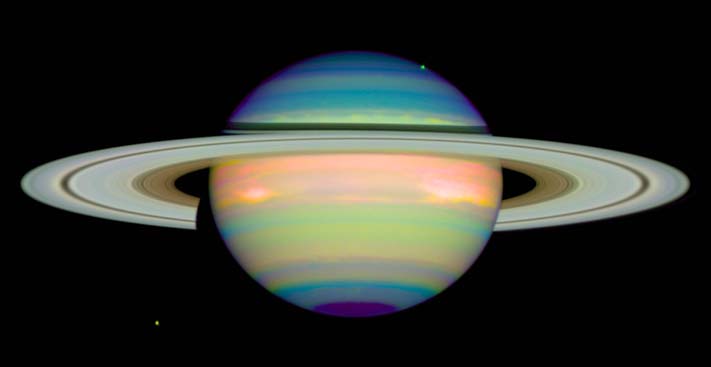
Re:Saturn's Rings
Yep, those do look kinda familiar.
Saturn was at opposition last week, and thus as close as it can get to Earth. However, the view will be favourable until well in to the new year (it starts to deteriorate in April).
The rings will remain at about their maximum tilt for a couple of years yet. It's far from the all-or-nothing-one-night-in-a-lifetime spectacle the science news folks would have you believe. Try JPL's Solar System Simulator to see how slowly the rings change. Saturn's 29.5 year orbit, y'know.
I had an excellent view last night while testing a new telescope, and saw four moons while I was at it. I expect to see the rings well until 2007 or so.
...laura
-
Look an awful lot like Hubble's version
The images you reference sure look an awful like this one taken by the Hubble. You too can flip one of them 180 degrees and put your name on it if you like.
-
Re:Not good for gamers
If memory serves me right, latency for satellite net access is something like 100 ms per kilometer. At 13 miles (roughly 20 kilometers), you'd be looking at 2000 ms minimum just to reach the device, and at least 2000 ms from the device to the server.
For starters, the speed of light in a vacuum is approximately 299,792,458 m/s i.e. 3.3 us/km (that's microseconds per km). You're off by 4 orders of magnitude.Next, a geostationary satellite orbits at an altitude of approximately 35,790 km. Thus, it "only" takes 240 ms for a round trip between Earth and the satellite (propagation delay).
-
Re:85 ideas and some gross mistakes
... Three full years before the launch of the first Sputnik (as everybody knows, the first satellite).
Correct. From this (Googled) page:
Although not the first communications satellite, Telstar is the best known of all and is probably considered by most observers to have ushered in the era of satellite communications. This impression was a result of the tremendous impact upon the public by the first transmission of live television across the Atlantic Ocean. Telstar I was launched on July 10, 1962, and on that same day live television pictures originating in the United States were received in France.
So, yeah, they're just completely wrong. -
How about a serious discussion
The author is a nutcase and a crank, so is the reviewer.
Nevertheless, it would be nice to have a serious discussion on the possibility of extrasolar life.
A number of points (I'm a biologist) that need consideration:
1) How narrow is the range of conditions that would allow life to arise? We have exactly 1 observation on this point, the Earth.
2) How broad are the range of conditions under which life might persist, once formed? Again, we have only the earth to look at, but the range of conditions found on the earth, were life is found, are broad indeed.
3) When these conditions exist, how likely are the events required for life to form? To endure? Evidence indicates that life began fairly quickly in the formation of the early earth - therefore, we are inclined to believe that these events are LIKELY. The confidence we can have in this estimate is very much open to debate.
3) Once life has formed, will it always evolve into complex life? It took aeons (billions of years) for complex life - which I define as Eukaryotic single celled organisms, which are our immediate single-celled acnestors - to arise on earth - therefore, we are inclined to believe that these events are UNLIKELY, if they happen randomly. It is possible that other events (the oxygenation of the atmosphere, for example) are effectively precursors to the rise of complex cells, and these pre-requisite events might just take a long time, but still be LIKELY. I don't think so, though.
My best guess? Yes, extra-solar life exists. However, the first extra-solar life we find will be boring to anyone other than a micro- or molecular- biologist.
Some features of the earth which might be key to any of the above:
a) An early solar event caused the formation of dense planets fairly close to the sun.
b) Our moon reduced the number of large objects that have struck the earth's surface throughout it's history.
c) The earth's temperature has always been such that liquid water can exist on the surface.
d) The atmosphere and photodensity on the early earth were such that complex molecules could exist in shallow water without being totally shredded by radiation.
e) Nonetheless, the atmosphere and photodensity were such that radiation triggered chemical events still occurred in shallow water with some frequency.
f) The earth has a seismically active core, which releases chemicals (such as certain metal ions) which might be relatively scarce otherwise, and which helps to counteract certain effects of erosion, and to sustain others for longer periods. -
Re:DS1
Perhaps you should familiarise yourself with Cassini-Huygens
If it takes 6 years to get there, you want to be able to do as much as possible, rather then do the equivilant of 'You know, we should have brought that metric set of spanners' when you get there.
Cheap, low cost is OK for scouting and test missions, where the turnaround time is short. Say the Moon, Mars, Venus and testing engine designs
Saturn is a bloody long way away. Cassini is the orbiter, and Huygens is going to go way beyond 'Pretty Picutres' - it's going to enter Titan's atmosphere, land in the ocean and perform spectral analysis on anything it can find.
Low Cost is a waste of time here - you want it to work first time, keep working and not break, otherwise it'll be 10 years before we build another one and get back there.
I see no reason at all to 'Scoot around taking pictures' - Been There Done That. Let's try something new and risky for a change.