Slashdot Mirror
Domain: nasa.gov
Stories and comments across the archive that link to nasa.gov.
Comments · 16,365
-
Re:The last sentence in the summary...
The whole story is. 4 years != climate. Not by anyone's measure. If skeptics tried to debunk AGW on this board with a 4 year trend, everyone would be all over them like white on rice. But 4 years in favor of AGW in the summary? A O K!
Yes but before the ESA satellite there were the GRACE satellites launched in 2002 that also showed West Antarctica losing ice and Antarctica overall is losing ice at a rate of almost 69 GT/year (graph). So it's more like 12 years of data. Even that is a rather short time period compared to the standard climatological period of 30 years. But the standard climatological variables such as temperature, precipitation and wind are very noisy compared the rate of ice loss so it takes longer to discern a significant trend with them than with ice. So 12 years may be long enough for significance. I'm not sure.
-
Re:Does NASA get paid this way?
> I know that NASA has had a technology transfer program for decades. Funny, I've never heard of *them* getting paid for this stuff
It took me literally one google search for "nasa patent licensing" to prove you wrong. Shame on you for being such a narcissist that you'd rather flap your gums and be wrong than spend the same amount of time and find out the truth.
All NASA licenses are individually negotiated with the prospective licensee, and each license contains terms concerning commercialization (practical application), license duration, royalties, and periodic reporting.
NASA Ames Partnership Licensing Agreements -
Re:This is good: we didn't send a camera on ours
Just put up some of the latest pictures from Mars Reconnaissance Orbiter which is still up there snapping away at 1 meter resolution. The following is from http://www.nasa.gov/jpl/mro/bo...
"The track left by an oblong boulder as it tumbled down a slope on Mars runs from upper left to right center of this image. The boulder came to rest in an upright attitude at the downhill end of the track. The HiRISE camera on NASA's Mars Reconnaissance Orbiter recorded this view on July 3, 2014." -
Re:The best photo...
That tweeter is a numbskull. There are and were plenty of female scientists involved with (and celebrating) space missions, going back all the way to Voyager at least (e.g. Carolyn Porco was on the Voyager team, and now leads the Cassini imaging science team).
NASA has on at least one occasion planned a day where all of the staff on duty for a science mission (e.g. for Spirit and Opportunity) was female.
Just because photos don't make it to mainstream news outlets doesn't mean it's not happening. -
Re:Way to compare apples to light bulbs
The problem is that NASA is not allowed to pay too much for an engineer and have to hire scores of affirmative action candidates instead: http://odeo.hq.nasa.gov/
Especially in an environment like NASA one single capable engineer can easily outperform ten mediocre hires. Of course NASA would have to do strict qualification tests to get these engineers - and those tests are illegal in the US.
India may be corrupt and all, but after you pay the bribe at least you can do the job. You are not forced to hire deadwood in India.
There is no ODEO in the Indian space program. -
Re:Way to compare apples to light bulbs
Just a quick follow up:
The total cost of the Mariner 4 mission is estimated at $83.2 million. Total research, development, launch, and support costs for the Mariner series of spacecraft (Mariners 1 through 10) was approximately $554 million.
From http://nssdc.gsfc.nasa.gov/nmc...
If you divide the cost up between the missions it averages under $60 million per probe. Cheaper than the Indian probe! That's a much more realistic comparison of scientific programs. Folks, the U.S. did the sub $100 million probes to Mars in the 1970s. India didn't even have a rocket to reach Low Earth Orbit during that decade and only got there in the last fifteen years! Baby steps, and they've got a lot of catching up to do and have the benefit of some of our experience as they are our allies.
-
Re:Way to compare apples to light bulbs
That is a valid point. However, we have to see whether NASA can manage to send the "$5000 car" at the same cost or lower than ISRO.
What is your logic behind that demand? What if NASA and other space agencies don't see the comparative value in sending the "$5000 car"?
Or how about, the information sent back from a $5000 probe wouldn't give us much insight. We've already sent the cheaper probes. India hasn't. People are projecting the U.S. status on other countries that are just now getting objects in orbit and to other planetary bodies like we're all in the same boat. It's like complaining about the cost of a microwave oven when the other guy only has flint and steel.
-
Re:Emma Watson is full of it
NASA officially calls it "Human Space Program", it is in their writing styleguide and has been for awhile.
http://history.nasa.gov/styleg...
Manned Space Program vs. Human Space Program:
All references referring to the space program should be non-gender specific (e.g. human, piloted, un-piloted, robotic). The exception to the rule is when referring to the Manned Spacecraft Center, the predecessor to the Johnson Space Center in Houston, or any other official program name or title that included "manned" (e.g. Associate Administrator for Manned Spaceflight).
-
Re:The simple fact that we can't talk about this..
You are wrong. I am not a climate scientist. Almost all the people here are not climate scientists. However, if 97% of climate scientists around the world agree on something, it tends to sway me into their favor. Arguments to the contrary are always welcome but, from what I've seen, they aren't credible (because they are so easily debunked in ways I can understand). When the community of climate scientists is swayed, those of us with open minds will be swayed, too. Same goes with relativity, evolution, and whatever else. I have an open mind but if the overwhelming majority of the experts in a field agree on something, it gets my attention. It seems that what gets the attention of deniers is only what they want to hear.
-
Re:Is this anything other than a press release?
If you ignore the part about coming back, then I could see there being a Mars landing in the next 25 years. But I'm with you on the 50 year outlook. There's very little we could gain by sending people there that we couldn't accomplish by sending robots. And as the years pass, and robots gets more and more capable, that will only become more true. People forget (or don't know) how far away Mars is. The minimum time required for a round trip to Mars is around 21 months. Also, they estimate you would need 3 million pounds of supplies to get to Mars. Just lifting that into space would take 60 shuttle launches.
-
Re: There are numerous other obvious flaws
So, the government is too inept to pull off a hoax of this magnitude, but actually performing the real feat was within its scope of capabilities?
They still had to build the giant rocket and land something on the moon in order for the telemetry to work. So they had all the complexity of building Saturn V and the Apollo stack but in addition they had to seamlessly pull off the greatest hoax in history with the greatest concentration of pedantic nerd geniuses in the world watching.
Apollo succeeded in spite of its failures. The Apollo 1 fire, the Apollo 13 explosion. Apollo 12's repeated lightning strikes and then the astronauts destroying their only video camera, etc etc. All with thousands of experts watching over them. Going back to the various cluster-fucks during Mercury and Gemini when they were trying to learn EVAs and later docking; but they could keep trying until they got it right. And once it was done, it was done. It didn't matter if new people came in and went through the archives, didn't matter if people looked at the hardware. There was nothing to hide.
A giant conspiracy to fake the moon landings had to get everything right the first time, with a skeleton crew, and it was not only vulnerable to a single major leak or screw-up at the time, it has continued to be vulnerable for 50 years. The hoaxers can never stop the cover-up.
For example, the LRO imaged the Apollo landing sites, showing tracks and vehicles. Was that faked? A brand new cover-up during the LRO program, adding a whole new conspiracy they had to seamlessly pull of under the noses of the LRO science team, and then keep secret forever.
And each layer of cover-up adds more things to go wrong, more people able to leak now or in the future. With every single person involved, every astronaut and technician, knowing that they are sitting on the greatest secret in history. It just needs one person, diagnosed with terminal cancer, conscience, or greed, to say, "Fuck it..."
-
Re:In lost the will to live ...
So? You link something that supports my argument without any sentence of "what you think about it"?
What is the point of that?
Let me link you something without any explanation/argument
-
Ames Research Center science payloads
Friday night at Ames Visitor Center (the big white tent just before main gate) had presentations by Ames project scientists on bioscience payloads, and had Q&A from audience. Also nice pamphlets and brochures for these programs were handed out (real cool to get hardcopy unlike typical webpage downloads). They intended to show launch on the big screen (NASA-TV) but it was scrubbed.
Ames student Fruit-Fly Experiment (AFEx)
Rodent Research-1 will examine how microgravity affects the rodents.
Seedling Growth-2 will germinate and grow seeds of the Arabidopsis thaliana plant.
Micro-8 will examine how spaceflight affects potentially infectious organisms.
More at http://www.nasa.gov/ames/resea... -
It's a "scaterometer"
I thought I knew my instruments, I never heard of such a thing. I thought the "scat" part was maybe an error, but it's not.
http://www.jpl.nasa.gov/news/f... -
Re:Not a problem...
It's not really extraordinary, but here you go:
http://earthobservatory.nasa.g...parts of the world relate to each other? who would have thought?
-
Re:I hate to be this guy...
Here's how the war on poverty is doing: http://dailycaller.com/2014/09...
Thanks for the link, it has some numbers that show how relatively little NASA costs.
From the article:
The government has spent some $22 trillion on means-tested welfare programs since the War on Poverty began (in constant 2012 dollars).
This does not include Social Security, Medicare, nor unemployment insurance.All of NASA's spending since 1958 totals 790 billion (inflation adjusted).
http://en.wikipedia.org/wiki/B...This provides some data on the direct benefits of the space program:
http://er.jsc.nasa.gov/seh/eco...Keep in mind that without the space program, there would be no DirectTV and we would be dependent upon Comcast.
-
Re:ozone layer
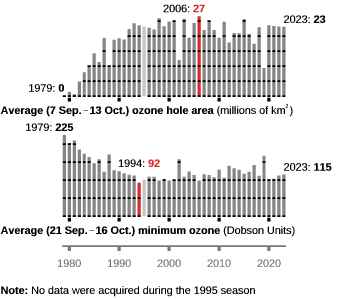
In fact, the Ozone hole was there the first time it was recorded.
Not even close. Ozone levels in Antarctica started being recorded in 1956 and the ozone hole didn't appear until the 1980's. Here's the graph.
-
Re:Time for new terminology
that's a funny claim to make when the fact is the hottest year in our very short records was 1998.
Nope. 2010
-
Re: It's getting hotter still!
Here you go: http://www.nasa.gov/topics/ear...
You're welcome!
-
Re:Not always
many people inspired Van Braun: http://history.msfc.nasa.gov/v...
-
Re:ozone layer
Guys, the ozone hole hasn't gone anywhere, it's still with us. You can view it here.
Don't believe me? Go to New Zealand and spend a day sunbathing without SPF30+.
-
Re:It's getting hotter still!
There's also this. Prepare to get wet feet.
-
Re:Saw it at the Smithsonian a few years ago
Many manuals of style indicate italicizing for names of vessels
- Wikipedia: http://en.wikipedia.org/wiki/W...
- National Geographic: http://stylemanual.ngs.org/hom...
- NASA: http://history.nasa.gov/printF...
- US Navy: http://www.navy.mil/tools/view...
-
EROEI
This allows the Peak Oil argument that oil won't be extracted if the ratio of energy return on energy invested drops too low (usually below about 3) to be discounted. Values well below one can now be exploited. Additionally, source rock may be injected with renewably sourced hydrogen to get at carbon that normally would be completely immobile. Kharecha and Hansen attempted to look at the effects of Peak Oil on climate. http://pubs.giss.nasa.gov/docs... It appears they may have been seriously too optimistic. Exploiting source rock to mobilize all the carbon using renewable energy could lead to three or four doublings of carbon dioxide in the atmosphere. In essence, renewable energy provides the means to make most of the continents uninhabitable.
-
Re:Knee-jerk reaction
Between the surrounding plain and the topography of Mt. Sharp, not really. The slope starts changing pretty gradually and the transition is full of a bunch of irregular mesas. But geologically there is a line on the map between the stratigraphy of the crater floor and the first stratigraphic unit on Mt. Sharp (the Murray Formation) which has been known from early in the mission. They're just at that boundary, and one of the samples they analyzed ("Bonanza King") seems to be an example of it, although they'll soon be driving on better outcrops of it.
-
Re:Hahahaha
you get 10-20 telescopes together and let people look at what they've been missing.
-
Let's look at the data
http://ozonewatch.gsfc.nasa.go...
The graphs can be seen here:
http://ozonewatch.gsfc.nasa.go...Whatever effect can be traced to 1987, it looks like a one-time step change, without a definite trend.
-
Let's look at the data
http://ozonewatch.gsfc.nasa.go...
The graphs can be seen here:
http://ozonewatch.gsfc.nasa.go...Whatever effect can be traced to 1987, it looks like a one-time step change, without a definite trend.
-
Predicted propogation ...
If you want a picture / movie that's actually based on this event's data
Select the 'ISEP' tab, and then choose one that mentions 'CME WSA' and looks like a swirl. (there are three of 'em
You'll notice that even though the center of the cloud is expected to go ahead of the earth, they're predicting it'll be wide enough that we'll still get hit by it.
(disclaimer : I work for the Solar Data Analysis Center at GSFC)
-
Re:spaceweather.com
Bah
- NOAA SWPC
- CCMC's iSWA
- Helioviewer
- SDO's daily movies
You might also want to check The Sun Today, which tends to have good explanations of what's happened, and they have a few movies for this event.
(disclaimer : I work at the Solar Data Analysis Center, and have worked on some of the sites that I've mentioned, and know the sysadmins for all but one of 'em)
-
Re:spaceweather.com
Bah
- NOAA SWPC
- CCMC's iSWA
- Helioviewer
- SDO's daily movies
You might also want to check The Sun Today, which tends to have good explanations of what's happened, and they have a few movies for this event.
(disclaimer : I work at the Solar Data Analysis Center, and have worked on some of the sites that I've mentioned, and know the sysadmins for all but one of 'em)
-
Re:spaceweather.com
Bah
- NOAA SWPC
- CCMC's iSWA
- Helioviewer
- SDO's daily movies
You might also want to check The Sun Today, which tends to have good explanations of what's happened, and they have a few movies for this event.
(disclaimer : I work at the Solar Data Analysis Center, and have worked on some of the sites that I've mentioned, and know the sysadmins for all but one of 'em)
-
Directly facing!
Or facing towards. A quick search and here is the best I could find showing propagation.
-
Re:Talking Point
Perhaps you need to learn to count? http://data.giss.nasa.gov/gist...
-
One themometer won't do
You need a global array. Last December-January-February together were the seventh warmest on record globally. http://data.giss.nasa.gov/gist...
-
Re:Science creates understanding of a real world.
The global warming people haven't shown us the value of anything, so far as I can see.
Try opening your eyes wider:
-
Re:Coincidence? Or conspiracy?
That's what I was thinking too--we got hit by something's little brother *again*? But OTOH, there's a whole metric crapload of stuff that passes us close by, check this out: http://neo.jpl.nasa.gov/ca/
-
Re:1 week's warning
The implied point is that perhaps we should be putting some effort into getting more warning and finding all the dino killers (and frankly, stuff a lot small than that rock was).
That is in fact what NASA has been doing for the past two decades: http://neo.jpl.nasa.gov/stats/ They have found about 90% of the 1-km or larger class. Chixulub the dino killer is estimated at 6 km, and impact energy scales as the cube of diameter. Unfortunately, asteroid tracking doesn't help with long-period comets. Those come in from the dark reaches of the outer Solar System, and therefore cannot be found until they are within a couple of years of hitting us.
-
Re:1 week's warning
Now what could we possibly have done in such a short time, should it have been heading directly towards us?
Evacuate 20 miles from the expected point of impact. Its not a dinosaur-killer, its much smaller than the meteor crater object. https://solarsystem.nasa.gov/s...
-
Re:60 feet... means what?
The meteor crater impact (160 foot object) is believed to have killed everything within about 2 miles, killed half of everything out to about 8 miles,
https://solarsystem.nasa.gov/s...
I believe that in general water impacts are considered more dangerous. Unlike air, water will transmit the energy over greater distances and the tsunami can do more damage than an impact itself. -
Distance discrepency
All other source I've seen mention 0.0002664... AU or approx. 40'000 km. That would be above geosynchronous orbit altitude, not below.
For example, from JPL:
http://ssd.jpl.nasa.gov/sbdb.c... -
JPL small body orbital information page
-
Re:Screw DARPA, give it to NASA
There has been a satellite servicing project at NASA/Goddard for about, uh, 3 decades. While for most of its existence it was focused on servicing performed by astronauts, there has always been some work going on in robotic servicing. One of the recent accomplishments was a robotic refueling demonstration
http://ssco.gsfc.nasa.gov/robo...
The only time the robotic effort was funded it a relatively high level was during the space station freedom era, and that only lasted for a couple of years before congress pulled the plug. To make matters worse, most of the money that was appropriated went to Martin-Marietta for concept studies
-
Re:What will it take?Despite the shorter longevity of methane in the atmosphere, the danger it poses for runaway greenhouse warming well overwelms any benefit from its short lifespan, as is well recognised, such as its triggering of ground-level ozone, yet another potent greenhouse gas. As you note, fracking is yet another voluminous source of methane, so its short lifespan in the atmosphere is no comfort. In short, it's a runaway effect because CO2 releases lead to Methane releases, which lead to more and more Methane release, which dominoes to other potent greenhouse gases. Textbook runaway warming. So, what was your objection?
-
Re:unfair policyNot according to Zwally, et al. (abstract, pdf)
Melting has always occurred around Antarctica. That doesn't mean it's losing ice.The net gain (86 Gigatons / year) over the West Antarctic (WA) and East Antarctic ice sheets (WA and EA) is essentially unchanged from revised results for 1992 to 2001 from ERS radar altimetry.
[emphasis mine]
Funny how these contrary studies have never seemed to make the headlines on Slashdot. -
Re:How Does SpaceX Do it?
NASA is not supposed to have vision
Bullshit. The law authorizing NASA directs NASA at numerous points to plan and promote things that fall under "having vision". For example:
Congress further declares that such activities shall be the responsibility of, and shall be directed by, a civilian agency exercising control over aeronautical and space activities sponsored by the United States
he Administration seek and encourage, to the maximum extent possible, the fullest commercial use of space
The development and operation of vehicles capable of carrying instruments, equipment, supplies, and living organisms through space.
The establishment of long-range studies of the potential benefits to be gained from, the opportunities for, and the problems involved in the utilization of aeronautical and space activities for peaceful and scientific purposes.
The most effective utilization of the scientific and engineering resources of the United States, with close cooperation among all interested agencies of the United States in order to avoid unnecessary duplication of effort, facilities, and equipment.
Later on, there's:
plan, direct, and conduct aeronautical and space activities;
That's the vision mandate. It's worth remembering here that Congress isn't the experts on space exploration in the US government, NASA is supposed to be. Nor does Congress have responsibility for promoting and insuring that the US has viable and useful NASA activities. Once again, that's NASA's particular responsibility.
NASA is an engineering and scientific agency (with an overlay of flags-and-footprints) and always has been, not an exploratory agency. They do not exist to feed the wet dreams and masturbation fantasies of the space fanboys.
The above law also has numerous places where it directs NASA to do space exploration or to encourage space exploration by US private sources.
What gets missed in all these clueless and misguided posts about "space fanboys", is that technology and the economics of space activities are progressing and getting into space need not stay as hard and as costly as it is now. Rather than merely decree without much thought that something is permanently impossible or unprofitable, it makes more sense to figure out what thresholds need to be crossed in order for an activity to be possible or profitable.Even with significant investment, that's unlikely to change for decades, maybe centuries.
Decades is the usual shortest time frame discussed for this sort of thing anyway. You're not in disagreement with most "space fanboys" on that. I think it's a bit dishonest to downplay someone's ambitions as delusions and hallucinations while simultaneously admitting that the only real problem is that you think their estimates of time to achievements are mildly ambitious.
-
It worked on Spirit
they had to do this type of thing on spirit shortly after it arrived on mars..
read more here: http://trs-new.jpl.nasa.gov/ds...
or the PDF linked therin here http://trs-new.jpl.nasa.gov/ds...
its got all sorts of awesome details.
We commanded a shutdown, which terminated the
current communication window, and the loss of signal occurred at the predicted time. Fifty minutes later, we commanded a beep at 7.8125 bps to alert us if the shutdown command did not work, and much to our disappointment, the beep was received!really a fun read.
-
It worked on Spirit
they had to do this type of thing on spirit shortly after it arrived on mars..
read more here: http://trs-new.jpl.nasa.gov/ds...
or the PDF linked therin here http://trs-new.jpl.nasa.gov/ds...
its got all sorts of awesome details.
We commanded a shutdown, which terminated the
current communication window, and the loss of signal occurred at the predicted time. Fifty minutes later, we commanded a beep at 7.8125 bps to alert us if the shutdown command did not work, and much to our disappointment, the beep was received!really a fun read.
-
Re:Cable Lacing
If you have an opportunity to try it, it can be actually relaxing, almost meditative. Granted, it is rough on the hands on a large job, but for me, it is worth the pain.
Check out section 9 of this NASA manual: http://www.hq.nasa.gov/office/...
-
Re:Time to travel 11 light years
traveling with a 1G acceleration:
And where is such a craft? Our current fastest space shuttles go ~ 17,500 mph, at that pace, it would take over half a million years... (ref: How fast does a Shuttle travel