Slashdot Mirror
Domain: nasa.gov
Stories and comments across the archive that link to nasa.gov.
Comments · 16,365
-
Re:The secret is in the storageNASA has looked at hydrogen as an aircraft fuel as far back as 1955. For those who want the comprehensive details, here's all of NASA's hydrogen fuel research from 1945-1959
Because hydrogen has 1/4 the energy density of the kerosene fuel currently used, we'll need lots of it. This means either flying our current planes with very few passengers (most of the cabin would be taken up by fuel tanks!).
Airbus has a project called Cryoplane which will assess the technical feasibility, safety, environmental compatibility and economic viability of using liquid hydrogen as an aviation fuel.
No one seems to be seriously pursuing the metal hydride storage route, although some research has been conducted on so-called "slush" hydrogen, which is a combination of liquid and solid hydrogen. Slush hydrogen has a lower temperature and a higher density than liquid hydrogen.
-
Re:Liquid Hydrogen is not Hydrazine
I think you're confusing your propellants. The shuttle does launch on liquid Oxygen and liquid Hydrogen, a fact confirmed by this. The explosion of the Challenger was caused when the LO2 and the LH mixed in the presence of the heat from the rocket motors. Liquid hydrogen itself is quite explosive. As for the hydrazine, I believe that shuttles do carry it, but use it for their on-orbit manuevering thrusters because it doesn't require a spark to ignite. I think most satelites use it also.
-
Highly Explosive as Gas, but gelled might workBecause using highly explosive fuel is a much better idea. If stored properly (gelled) it is possible that hydorgen could be used safely, however the quantities that are needed would most likely be needed preclude that. Besides... Anyone remember the Hindenburg? Or rather I should say that compressed hydrogen would be bad....
Besides they don't necessarily need to switch to hydrogen, see the following http://trc.dfrc.nasa.gov/gallery/photo/CID/HTML/i
n dex.html, where they talk about using fire suppresants in the fuel to stop the fires after crashes...See NASA for alternative fuels, for gelled hydrogen http://www.grc.nasa.gov/WWW/TU/launch/GELLED.htm.
Other alternative fuels are at http://www.lerc.nasa.gov/WWW/TU/launch/foctopsb.ht m -
Highly Explosive as Gas, but gelled might workBecause using highly explosive fuel is a much better idea. If stored properly (gelled) it is possible that hydorgen could be used safely, however the quantities that are needed would most likely be needed preclude that. Besides... Anyone remember the Hindenburg? Or rather I should say that compressed hydrogen would be bad....
Besides they don't necessarily need to switch to hydrogen, see the following http://trc.dfrc.nasa.gov/gallery/photo/CID/HTML/i
n dex.html, where they talk about using fire suppresants in the fuel to stop the fires after crashes...See NASA for alternative fuels, for gelled hydrogen http://www.grc.nasa.gov/WWW/TU/launch/GELLED.htm.
Other alternative fuels are at http://www.lerc.nasa.gov/WWW/TU/launch/foctopsb.ht m -
Highly Explosive as Gas, but gelled might workBecause using highly explosive fuel is a much better idea. If stored properly (gelled) it is possible that hydorgen could be used safely, however the quantities that are needed would most likely be needed preclude that. Besides... Anyone remember the Hindenburg? Or rather I should say that compressed hydrogen would be bad....
Besides they don't necessarily need to switch to hydrogen, see the following http://trc.dfrc.nasa.gov/gallery/photo/CID/HTML/i
n dex.html, where they talk about using fire suppresants in the fuel to stop the fires after crashes...See NASA for alternative fuels, for gelled hydrogen http://www.grc.nasa.gov/WWW/TU/launch/GELLED.htm.
Other alternative fuels are at http://www.lerc.nasa.gov/WWW/TU/launch/foctopsb.ht m -
Bad mindsetIMHO NASA is having trouble because they are sticking with a 60s/70s mentality that just doesn't work anymore. Running the space shuttle and re-supplying the ISS isn't what NASA should be doing. NASA needs to hand some of that stuff over to the commercial sector. Then they could use the lowest bidder for launches. Ariane 5 cheaper than the shuttle? Then USE it. Stop making every thing home made, use off the shelf components. Making everything made sense when they were the only ones making space components but now there are competing products.
NASA should be focusing on things that the private sector can't do, like expensive R&D, non profitable science missions, going to mars, etc. They need to stop competing with private companies and start working with them. NASA has something like $13.6 billion a year to play with. The reason they only have a couple of hundred million left over for mars missions is that they are currently building a white elephant in low earth orbit.
NASA has screwed up priorities. Here is what I would like to see them doing:
- Help fund private missions that look promising.
- Do R&D on new propulsion, launch mthods, etc. Think long term. Asteroid mining is something that will probably be important in the future so do more NEAR style missions.
- Lead operations to go to Mars and other interesting places. Design and fund them while relying on other companies to build everything and launch them.
Another thing, try to make some money out of space. Put advertising on the side of spacecraft, etc. Install HDTV cameras everywhere. Strap IMAX cameras to the side of the shuttle and get some fantastic footage that could help make space interesting again.
Right now if you do a word association test with someone on the street and say "NASA" and they will probably say something about the recent Mars probe losses. We need to get that back to being "Cool!!"
-
Bad mindsetIMHO NASA is having trouble because they are sticking with a 60s/70s mentality that just doesn't work anymore. Running the space shuttle and re-supplying the ISS isn't what NASA should be doing. NASA needs to hand some of that stuff over to the commercial sector. Then they could use the lowest bidder for launches. Ariane 5 cheaper than the shuttle? Then USE it. Stop making every thing home made, use off the shelf components. Making everything made sense when they were the only ones making space components but now there are competing products.
NASA should be focusing on things that the private sector can't do, like expensive R&D, non profitable science missions, going to mars, etc. They need to stop competing with private companies and start working with them. NASA has something like $13.6 billion a year to play with. The reason they only have a couple of hundred million left over for mars missions is that they are currently building a white elephant in low earth orbit.
NASA has screwed up priorities. Here is what I would like to see them doing:
- Help fund private missions that look promising.
- Do R&D on new propulsion, launch mthods, etc. Think long term. Asteroid mining is something that will probably be important in the future so do more NEAR style missions.
- Lead operations to go to Mars and other interesting places. Design and fund them while relying on other companies to build everything and launch them.
Another thing, try to make some money out of space. Put advertising on the side of spacecraft, etc. Install HDTV cameras everywhere. Strap IMAX cameras to the side of the shuttle and get some fantastic footage that could help make space interesting again.
Right now if you do a word association test with someone on the street and say "NASA" and they will probably say something about the recent Mars probe losses. We need to get that back to being "Cool!!"
-
Re:larger power ones - power your server!
"Trivial?"
I beg to disagree. You have to dump the waste heat in order to recycle the steam - and where are you going to dump the waste heat in space? There's no matter to convect it away, so you're left with radiation as your only possibility.
Keep in mind that space isn't 'cold' in the normal, conversational sense. You could expose your arm to outer space for a minute or two, and it would be absolutely fine, not frozen instantly as most people would assume. Outer space isn't significantly different from a vacuum in a laboratory here on earth, and a vacuum is the universe's most perfect insulator. Here's proof that things don't freeze instantly in space.
Until someone comes up with a way of dramatically improving the efficiency of heat radiation (e.g. a heat-powered laser), the satellite is stuck with the heat for very long periods of time. Sure, you could shut the reactor off and wait a few weeks, then power it up for another four seconds, then shut it off and wait a few weeks again... but somehow a thermoelectric solution just seems a lot more straightforward. Plus, we actually know how to build those. -
Yet More Information...
Here is the link of the actual Mars mission along with the status and risks. And check out all the robotics projects behind the scene. Cool...
-
Yet More Information...
Here is the link of the actual Mars mission along with the status and risks. And check out all the robotics projects behind the scene. Cool...
-
Yet More Information...
Here is the link of the actual Mars mission along with the status and risks. And check out all the robotics projects behind the scene. Cool...
-
Yet More Information...
Here is the link of the actual Mars mission along with the status and risks. And check out all the robotics projects behind the scene. Cool...
-
More Information...
Here is the lab of Jet propulsion labs that does the robot thingie. This is the software to test the robustness of the robots. NASA has learnt from several failures apparently.
A picture of martian rock with some explanations, if you're interested. Along with some interesting rock with bug patterns!
-
More Information...
Here is the lab of Jet propulsion labs that does the robot thingie. This is the software to test the robustness of the robots. NASA has learnt from several failures apparently.
A picture of martian rock with some explanations, if you're interested. Along with some interesting rock with bug patterns!
-
More Information...
Here is the lab of Jet propulsion labs that does the robot thingie. This is the software to test the robustness of the robots. NASA has learnt from several failures apparently.
A picture of martian rock with some explanations, if you're interested. Along with some interesting rock with bug patterns!
-
More Information...
Here is the lab of Jet propulsion labs that does the robot thingie. This is the software to test the robustness of the robots. NASA has learnt from several failures apparently.
A picture of martian rock with some explanations, if you're interested. Along with some interesting rock with bug patterns!
-
More Information...
Here is the lab of Jet propulsion labs that does the robot thingie. This is the software to test the robustness of the robots. NASA has learnt from several failures apparently.
A picture of martian rock with some explanations, if you're interested. Along with some interesting rock with bug patterns!
-
larger power ones - power your server!
>How long before these things can power my handheld?
Yes! They can provide 100's of watts!
These have been used for years to power deep-space satellites such as Pioneer 10 (solar power tends to not work too well when you get away from the sun). Plus, no moving parts to fail. They use radioactive decay as their heat source.
They use plutonium-238. It half-life is 87.8 years and emits primarily alpha particles, a non-penetrating type of radiation which requires little shielding.
Here's a good page from nasa and another from the doe
Power ranges from milliwatts in 1964, to "multi-hundred-watt" in 1977 (the sole power source for voyager), to 208 Watts electrical (+4500W thermal!) in 1990, to 507 Watts (electical) in 1997.
Practically, there's that whole radiation thing, plus some costs to enrich the material, and then also disappating the thermal energy released (it operates on a gradient, so you've got to have a cold end to counter the hot end) -
Re:Drinkable? (tangent)
The Space Shuttle gets much or all of its electricity from fuel cells, and the Shuttle astronauts drink the water produced from the fuel cells. (Or they use that water to rehydrate dried food, and then eat the food.)
http://www.jsc.nasa.gov/pao/factsheets/factsheets/ 9508001.html
That is not their only source of water, but it is one of the sources.
steveha -
Re:mobile robot teleoperationI'm on the JPL portion of TMR. TMR stands for Tactical Mobile Robotics and is the DARPA program headed by Lt. Col. John Blitch before he retired. Its the tracked robot with flippers in the front. The chassis is made by IRobot and JPL is doing the Sensors/Autonomous behavior portion of the program. You can see last year's effort on the previous version of the chassis at our website: http://robotics.jpl.nasa.gov/tasks/tmr
Those things are not easy to drive. One of the most difficult things is getting a perspective on where the robot is in relation to it's surroundings (very rough rubble). This is an ongoing research area for many robotics teams, and one we have been working on also.
Yes, they are very difficult and disconcerting at first. It does take training. One of our most difficult long distance runs was with the operator out of sight of the robot and the robot having to navigate through a forested area, go to a tower across a parking lot using cover, and climb up a set of stairs. The hard part were the questions, "Where am I?" and "Where can I go?" The operator had to depend heavily on the 360 degree view camera and the computer bread-crumb trail to figure out where he was and where to go, but the question of traversal across obstacles.
With a simple black-and-white camera it is hard to tell what's out there. Is there something behind that grass? Is it a rock, a hole? or a log that can high-center us? Now roll in trying to do that autonomously. The computer can see the clump of grass, but if its thick enough, it'll see it as an obstacle instead of something it can just roll over. And even if it knows it can roll over it, it can't see if there are any obstacles hidden in the grass. We're trying to use laser scanners and radars to try to solve that problem.
Multiple cameras helps, but adds significant complexity and disjoint views. A technology which really makes this easier is an Omni-directional Video sensor (which has a 360 deg. field of view around the sensor).
Yup, we have one of those from a company called Remote Reality. Nifty items. The one with the hole in the center of the picture gives the best resolution at the horizon. 180 degree fisheyes don't give the hole in the center, but suck at resolution on the horizon.
--Carlos V.
-
Re:Warp factors
The closest star to our own is 4.3 light-years away.
From NASA, according to the Gliese star catalog, there are 63 stars within 5 parsecs (parsec = 3.26 ly's), 328 within 10, 1008 within 15, 2127 within 20 & 3496 within 25.
16.3, 32.6, 48.9, 65.2 & 81.5 light-years, respectively. -
Re:The Klingons are too close
I wondered about that myself.
Here's the math :
Neptune : 4.2 light hours from the sun
Earth : 8.3 light minutes
"She can get to Neptune in 6 minutes"
4 * 24 * 60 / 6 = 960
So 4 days is 960 times the distance from earth to neptune. Assuming the greatest distance (earth is diametrically opposed to Neptune in the solar system),
4.3 light hours * 960 = 4165 light hours =
0.475 light years.
From nasa
Which stars are closest to the Sun? The closest is Proxima Centauri, one of three stars that orbit each other about 4 light-years away in the Alpha-Centauri system.
So, ideally this trip should have taken 4/(0.475 / 4) days (light years / (distance in four days / 4)) = 33.65 days to get to the closest star
So the Klingon homeworld should have been months and months away. Possibly years, according to the quote on their speed. From what I understand about warp (as much as one can understand something fictional), it's a lot harder to get from 8 to 9 than 7 to 8, and impossible to achieve warp 10. So I think that this series would have been better served starting at a higher warp - maybe 7. Otherwise these characters aren't even going to be able to have an adventure every few months, let alone every week - there's a lot of empty space out there. -
Re:More than simple logistical problems.But these are not amateur sats.
The ST5 nanosatellites will be "full service", meaning they will carry a wide range of spacecraft services including guidance, navigation and control, attitude control, propulsion, high bandwidth and complex communication functions.
This is what NASA is trying to develop - a new generation of smart sats, with an exciting set of new technologies -
Re:How the Ion Engine Works
It's a matter of exhaust velocity. The higher your exhaust velocity, the more efficiently your engine can turn each ounce of fuel into speed. For a more technical description, see the NASA definition of specific impulse - ion engines have a much higher specific impulse compared to chemical ones.
Also, as a rule of thumb, your engine becomes very inefficient once your spacecraft has exceeded its exhaust velocity. Chemical rocket engines have a maximum exhaust velocity of something like 3km/s - ion engines are more like 10-15km/s.
-
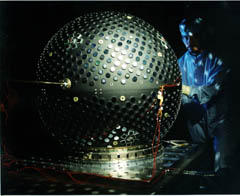
That's a pretty big birthday cake
The page says that the satellite is the size of a birthday cake, and also that it is "42 centimeters (17 inches) across . . . weighs about 21.5 kilograms (47 pounds)". I don't know about you, but on my last birthday I didn't get a cake that big
More seriously, this is cool stuff. My favorite item from the list of new technologies is the "electrically tunable coating that can change its properties from absorbing heat when the spacecraft is cool to reflecting or emitting heat when the spacecraft is in the sun by applying electrical power". When you look at conventional ways of managing heat on a spacecraft (such as large and heavy radiators on the Space Station), this is pretty exciting.
-
Re:Microsats flew some years ago
Well, the microsats sent out from my home state were fairly well one-purpose, one-use machines (amateur radio for webersat, rotation/attitude manipulation with tracking for the JAWSAT)- see here for an optimistic description. See here for other previous microsats. NASA's microsats, according to their page, "carry a wide range of spacecraft services including guidance, navigation and control, attitude control, propulsion, high bandwidth and complex communication functions," some of which are diagrammed on that page and its successor. With the previous story and the other ways in which NASA has exceeded expectations on almost all of their craft in mind, I think this is an idea whose time has come.
-
Re:what does an ion engine do?
Someone else has already mentioned how they work. The weakness of an ion engine is that it's incapable of accelerating very quickly. On the other hand, it's extremely efficient, and capable of eventually producing extremely high speeds. You can read more information on NASA's ion propultion FAQ
Oh - and anyone who's ever played TIE Fighter knows that an Imperial fighter has a hell of a lot more get-up-and-go than Deep Space 1. So ion engines with that kind of punch are still a long way off. -
Re:what does an ion engine do?
For the best explanation of ion propulsion that's used in the DS1 probe, see the Ion Propulsion FAQ at NASA's JPL site.
For more information on the DS1 probe itself (and the technologies that it tested), see the DS1 Home Page, also on the JPL site.
-
Re:what does an ion engine do?
For the best explanation of ion propulsion that's used in the DS1 probe, see the Ion Propulsion FAQ at NASA's JPL site.
For more information on the DS1 probe itself (and the technologies that it tested), see the DS1 Home Page, also on the JPL site.
-
Re:what does an ion engine do?
-
Behind the timesYou missed yesterday's, which was a brilliant X2.6. Today's was only an M8 (equiv to X0.8). If today's is a chest x-ray, yesterday's was three. The largest recorded since we've started measuring these things was an X20 in 1989. Quebec's power system overloaded that year.
Spaceweather.com reported yesterday:
This morning at 1038 UT a powerful X2.6 solar flare erupted near the large sunspot 9632. A radiation storm (currently S2-class) is in progess and intensifying.The explosion also hurled a lopsided halo coronal mass ejection (CME) into space. The Earth-directed CME, pictured right in a SOHO coronagraph animation, will sweep past our planet late Tuesday or Wednesday and probably trigger geomagnetic storms.Interested in what the solar flares have affected in the past (from Roman legions to gas line explosions to Galaxy IV)?
We're at the height of the 11 year solar flare cycle. I wonder what will happen tomorrow..
-
Another resource
Another great resource for information on solar activity is SpaceWeather.com.
NASA always has several informative mailing lists that can at times be very interesting. -
Another resource
Another great resource for information on solar activity is SpaceWeather.com.
NASA always has several informative mailing lists that can at times be very interesting. -
Um... Special Bottle?
Unfortunately it doesn't lend itself to the traditional frosty glass mug! Instead, beverages are dispensed into a special bottle (pictured above) that screws onto the dispenser.
Looks like a powerade bottle to me, but I could be wrong. -
Re:Any pictures?
While you may be right about the thrusters running out of fuel, you're wrong about the ion engines. The ion engines use a xenon propellant (according to NASA's site.). When that runs out, the engines are useless. It does go though the xenon propellant much slower than conventional propellants (like hydrogen+oxygen), but it still needs it. Solar sails and that mini-magnetosphere solar sail thing (there was some
-
[mlp] Positions of DS1 and Borrley
NASA has a few bits of eye candy detailing the position of DSA relative to Borrley, the position of DS1 relative to the sun, and two viwes of the position of Borrlley (1, 2). The image page is here; the DS1 page is here.
-
[mlp] Positions of DS1 and Borrley
NASA has a few bits of eye candy detailing the position of DSA relative to Borrley, the position of DS1 relative to the sun, and two viwes of the position of Borrlley (1, 2). The image page is here; the DS1 page is here.
-
[mlp] Positions of DS1 and Borrley
NASA has a few bits of eye candy detailing the position of DSA relative to Borrley, the position of DS1 relative to the sun, and two viwes of the position of Borrlley (1, 2). The image page is here; the DS1 page is here.
-
[mlp] Positions of DS1 and Borrley
NASA has a few bits of eye candy detailing the position of DSA relative to Borrley, the position of DS1 relative to the sun, and two viwes of the position of Borrlley (1, 2). The image page is here; the DS1 page is here.
-
[mlp] Positions of DS1 and Borrley
NASA has a few bits of eye candy detailing the position of DSA relative to Borrley, the position of DS1 relative to the sun, and two viwes of the position of Borrlley (1, 2). The image page is here; the DS1 page is here.
-
[mlp] Positions of DS1 and Borrley
NASA has a few bits of eye candy detailing the position of DSA relative to Borrley, the position of DS1 relative to the sun, and two viwes of the position of Borrlley (1, 2). The image page is here; the DS1 page is here.
-
DS1 Location
Earlier this year, I was somehow under the impression that this space vehicle was out of our solar system. I was wrong.
Here is a nice view of where DS9 actually is in relation to our solar system planets. -
"Deep Space 1 comet flyby highly sucessful"
-
Correction to JPL link
Ho hum, not that anyone seems to be too fussed anyway but here is the correct link to the JPL news item. Good luck DS1.
-
Re:Just wondering......I believe that it is Wallops Island in Virginia.
-
cool picture & more info
There's a picture of the Starshine 3 sattelite at the AziNet site.
Also, information on tracking both satellites is here at the NASA Starshine Observers page. -
Looking for the pure video...
Hi,
I am looking now for a long time for a high quality video of the first moon landing WITHOUT any music, comments etc.
I just downloaded this rm audio copy from the link above. Now I want the pictures to this, too.
Has someone a link or can recommend a video to buy?
Again, there are lots of them out there, but none of the ones I found is uncut and uncommented. Many have background music. But I want the pure stuff!
Thanks! -
More MLP!
Here's another link to an apollo archive. Lost of stuff here; video, audio, stills, radio transcripts, technical stuff...
-
Flight upside downSo, explain how a "barnstormer" plane can fly upside-down.
Negatively cambered wings still cause fluids to take a longer path over the top at positive angles of attack (I don't have any wind tunnel pics to show you, but a quick google search revealed this interesting 1932 NACA wind tunnel study). It's less efficient, but most small aircraft still manage to spec a few negative G's as part of their flight envelope.
Yes, almost all aerobatic aircraft have symmetrical (zero-camber) wings, not to make their maneuvers possible, but to make them easier.
-
Re:Nasa Satellite Images of Smoke plume
The same site now has images from the Space Station. I wonder what it must feel like to be orbiting our world at such a time.