Slashdot Mirror
Domain: nasa.gov
Stories and comments across the archive that link to nasa.gov.
Stories · 2,550
-
Deepest Optical Image Of The Universe To Date
fenimor writes "The deepest optical view of the universe, obtained by Hubble Space Telescope, may turn out to be some of the earliest star-forming galaxies. The telescope has looked 95 percent of the way back to the beginning of time, to glimpse whether the hottest stars in these early galaxies may have provided enough radiation to 'cool' the universe after the big bang." -
Soyuz Damage May Delay Space Station Trip
SeaDour writes "As if the failed oxygen generator on the International Space Station wasn't bad enough, rumor has it that the planned launch of a Russian Soyuz capsule to change crews onboard the station may be delayed due to a mishap during ground testing. Apparently one of the small explosive bolts, used to separate sections of the capsule during landing, prematurely exploded, which means the bolts may all have to be inspected for defects. Russian space officals haven't officially confirmed any delay of the October 9 launch date, but I'm sure it's something the two astronauts on the station are thinking about as they repressurize the station with reserve air supplies." -
Mysterious Force Affects Pioneer 10 & 11 Probes
JabbaTheFart writes "The Guardian is writing that something strange is tugging at America's oldest spacecraft. As the Pioneer 10 and 11 probes head towards distant stars, scientists have discovered that the craft - launched more than 30 years ago - appear to be in the grip of a mysterious force that is holding them back as they sweep out of the solar system. Some researchers say unseen 'dark matter' may permeate the universe and that this is affecting the Pioneers' passage. Others say flaws in our understanding of the laws of gravity best explain the crafts' wayward behaviour." -
Mysterious Force Affects Pioneer 10 & 11 Probes
JabbaTheFart writes "The Guardian is writing that something strange is tugging at America's oldest spacecraft. As the Pioneer 10 and 11 probes head towards distant stars, scientists have discovered that the craft - launched more than 30 years ago - appear to be in the grip of a mysterious force that is holding them back as they sweep out of the solar system. Some researchers say unseen 'dark matter' may permeate the universe and that this is affecting the Pioneers' passage. Others say flaws in our understanding of the laws of gravity best explain the crafts' wayward behaviour." -
Genesis Capsule Crashes; Chutes Blamed
Cyclotron_Boy writes "The Genesis probe (reported here) has crashed to the ground, near a road in the Utah desert. The stunt chopper pilots were not to blame, though. The drogue chute didn't open on re-entry. NASA TV is covering it currently. The choppers have landed near the probe, but no word yet as to the condition of the space dust." Many readers have also pointed to CNN's coverage. Update: 09/08 16:39 GMT by J : MSNBC has more coverage and a sad photo of the half-buried capsule: "The capsule broke open on impact. It was not yet clear whether the $260 million Genesis mission was ruined." -
NASA Genesis Reentry Visible from Oregon to Utah
An anonymous reader writes "The Genesis spacecraft will be visible as an artificial meteor starting in early morning over Oregon until its spectacular helicopter capture above the Utah desert (11 AM EST in the US). Although today's reentry simulates meteor physics, the valuable payload for Genesis is a billion billion atoms on semiconductor wafers now showered with solar wind particles. Unlike the Russian space program, few American capsules have tried overland reentries until the two extraterrestrial sample return missions, Genesis today and Stardust in 2006." Update: 09/08 16:04 GMT by T : RossCarlson writes "Stuck at work today and can't watch Nasa capture the Genesis probe live on TV? You can stream it in both Windows Media and Real (Video | Audio) formats from Nasa TV. Looks like the estimated capture time is around 10:10 a.m. PST. I for one can't wait to see them capture it!" -
NASA Genesis Reentry Visible from Oregon to Utah
An anonymous reader writes "The Genesis spacecraft will be visible as an artificial meteor starting in early morning over Oregon until its spectacular helicopter capture above the Utah desert (11 AM EST in the US). Although today's reentry simulates meteor physics, the valuable payload for Genesis is a billion billion atoms on semiconductor wafers now showered with solar wind particles. Unlike the Russian space program, few American capsules have tried overland reentries until the two extraterrestrial sample return missions, Genesis today and Stardust in 2006." Update: 09/08 16:04 GMT by T : RossCarlson writes "Stuck at work today and can't watch Nasa capture the Genesis probe live on TV? You can stream it in both Windows Media and Real (Video | Audio) formats from Nasa TV. Looks like the estimated capture time is around 10:10 a.m. PST. I for one can't wait to see them capture it!" -
NASA Genesis Reentry Visible from Oregon to Utah
An anonymous reader writes "The Genesis spacecraft will be visible as an artificial meteor starting in early morning over Oregon until its spectacular helicopter capture above the Utah desert (11 AM EST in the US). Although today's reentry simulates meteor physics, the valuable payload for Genesis is a billion billion atoms on semiconductor wafers now showered with solar wind particles. Unlike the Russian space program, few American capsules have tried overland reentries until the two extraterrestrial sample return missions, Genesis today and Stardust in 2006." Update: 09/08 16:04 GMT by T : RossCarlson writes "Stuck at work today and can't watch Nasa capture the Genesis probe live on TV? You can stream it in both Windows Media and Real (Video | Audio) formats from Nasa TV. Looks like the estimated capture time is around 10:10 a.m. PST. I for one can't wait to see them capture it!" -
NASA Genesis Reentry Visible from Oregon to Utah
An anonymous reader writes "The Genesis spacecraft will be visible as an artificial meteor starting in early morning over Oregon until its spectacular helicopter capture above the Utah desert (11 AM EST in the US). Although today's reentry simulates meteor physics, the valuable payload for Genesis is a billion billion atoms on semiconductor wafers now showered with solar wind particles. Unlike the Russian space program, few American capsules have tried overland reentries until the two extraterrestrial sample return missions, Genesis today and Stardust in 2006." Update: 09/08 16:04 GMT by T : RossCarlson writes "Stuck at work today and can't watch Nasa capture the Genesis probe live on TV? You can stream it in both Windows Media and Real (Video | Audio) formats from Nasa TV. Looks like the estimated capture time is around 10:10 a.m. PST. I for one can't wait to see them capture it!" -
NASA Genesis Reentry Visible from Oregon to Utah
An anonymous reader writes "The Genesis spacecraft will be visible as an artificial meteor starting in early morning over Oregon until its spectacular helicopter capture above the Utah desert (11 AM EST in the US). Although today's reentry simulates meteor physics, the valuable payload for Genesis is a billion billion atoms on semiconductor wafers now showered with solar wind particles. Unlike the Russian space program, few American capsules have tried overland reentries until the two extraterrestrial sample return missions, Genesis today and Stardust in 2006." Update: 09/08 16:04 GMT by T : RossCarlson writes "Stuck at work today and can't watch Nasa capture the Genesis probe live on TV? You can stream it in both Windows Media and Real (Video | Audio) formats from Nasa TV. Looks like the estimated capture time is around 10:10 a.m. PST. I for one can't wait to see them capture it!" -
NASA Genesis Reentry Visible from Oregon to Utah
An anonymous reader writes "The Genesis spacecraft will be visible as an artificial meteor starting in early morning over Oregon until its spectacular helicopter capture above the Utah desert (11 AM EST in the US). Although today's reentry simulates meteor physics, the valuable payload for Genesis is a billion billion atoms on semiconductor wafers now showered with solar wind particles. Unlike the Russian space program, few American capsules have tried overland reentries until the two extraterrestrial sample return missions, Genesis today and Stardust in 2006." Update: 09/08 16:04 GMT by T : RossCarlson writes "Stuck at work today and can't watch Nasa capture the Genesis probe live on TV? You can stream it in both Windows Media and Real (Video | Audio) formats from Nasa TV. Looks like the estimated capture time is around 10:10 a.m. PST. I for one can't wait to see them capture it!" -
NASA Genesis Reentry Visible from Oregon to Utah
An anonymous reader writes "The Genesis spacecraft will be visible as an artificial meteor starting in early morning over Oregon until its spectacular helicopter capture above the Utah desert (11 AM EST in the US). Although today's reentry simulates meteor physics, the valuable payload for Genesis is a billion billion atoms on semiconductor wafers now showered with solar wind particles. Unlike the Russian space program, few American capsules have tried overland reentries until the two extraterrestrial sample return missions, Genesis today and Stardust in 2006." Update: 09/08 16:04 GMT by T : RossCarlson writes "Stuck at work today and can't watch Nasa capture the Genesis probe live on TV? You can stream it in both Windows Media and Real (Video | Audio) formats from Nasa TV. Looks like the estimated capture time is around 10:10 a.m. PST. I for one can't wait to see them capture it!" -
NASA Genesis Reentry Visible from Oregon to Utah
An anonymous reader writes "The Genesis spacecraft will be visible as an artificial meteor starting in early morning over Oregon until its spectacular helicopter capture above the Utah desert (11 AM EST in the US). Although today's reentry simulates meteor physics, the valuable payload for Genesis is a billion billion atoms on semiconductor wafers now showered with solar wind particles. Unlike the Russian space program, few American capsules have tried overland reentries until the two extraterrestrial sample return missions, Genesis today and Stardust in 2006." Update: 09/08 16:04 GMT by T : RossCarlson writes "Stuck at work today and can't watch Nasa capture the Genesis probe live on TV? You can stream it in both Windows Media and Real (Video | Audio) formats from Nasa TV. Looks like the estimated capture time is around 10:10 a.m. PST. I for one can't wait to see them capture it!" -
Space Shuttles Survive Hurricane Frances
maggeth writes "In an update to a previous story, NASA damage assessment teams have begun work at the Kennedy Space Center, which was hit by Hurricane Frances. It appears that there was no damage to any of the space shuttles, according to the first word from NASA. Although more details still are to be released, we know that Frances died down in strength before making landfall, limiting the amount of wind damage." Reader knix writes, though, that "It looks like NASA did have quite a bit of damage from Hurricane Frances," pointing to an AP story which adds some detail, and noting that besides a knocked over Mercury-Redstone rocket, the massive VAB (Vehicle Assembly Building) had 1000 panels missing after the storm hit. According to the AP, "The holes left by the missing panels created 40,000 square feet of 'open window' on two sides of the building." -
Astronomers Find Smaller Extrasolar Planets
SABME writes "NASA has announced the discovery of a new class of extra-solar planets. Here's a link to the NASA news release. These planets are only 10-15 times bigger than Earth; how far off are we from discovering Earth-sized planets orbiting other stars? Future NASA missions aimed at broadening these discoveries include Kepler, the Space Interferometry Mission and the Terrestrial Planet Finder. More info available at NASA's Extrasolar Planets webiste."
-
Astronomers Find Smaller Extrasolar Planets
SABME writes "NASA has announced the discovery of a new class of extra-solar planets. Here's a link to the NASA news release. These planets are only 10-15 times bigger than Earth; how far off are we from discovering Earth-sized planets orbiting other stars? Future NASA missions aimed at broadening these discoveries include Kepler, the Space Interferometry Mission and the Terrestrial Planet Finder. More info available at NASA's Extrasolar Planets webiste."
-
Mars Odyssey Begins Overtime
thhamm writes "NASA's Mars Odyssey orbiter begins working overtime today after completing a prime mission that discovered vast supplies of frozen water, ran a safety check for future astronauts, and mapped surface textures and minerals all over Mars, among other feats. An extended Mission until 2006 has been approved, and I hope it will last that long, maybe doing more safety checks for astronauts :)" -
Mars Odyssey Begins Overtime
thhamm writes "NASA's Mars Odyssey orbiter begins working overtime today after completing a prime mission that discovered vast supplies of frozen water, ran a safety check for future astronauts, and mapped surface textures and minerals all over Mars, among other feats. An extended Mission until 2006 has been approved, and I hope it will last that long, maybe doing more safety checks for astronauts :)" -
Composite Of Earth At Night
crmartin writes "Today's Astronomy Picture of the Day is an incredible composite image of Earth from space at night. Actually a composite from many pictures from the Defense Meteorological Satellites Program (DMSP), it's like a skeletal view of the Earth in tiny lights. If you really like it, there are hi-res images up to a 40 megabyte TIFF." -
Composite Of Earth At Night
crmartin writes "Today's Astronomy Picture of the Day is an incredible composite image of Earth from space at night. Actually a composite from many pictures from the Defense Meteorological Satellites Program (DMSP), it's like a skeletal view of the Earth in tiny lights. If you really like it, there are hi-res images up to a 40 megabyte TIFF." -
Composite Of Earth At Night
crmartin writes "Today's Astronomy Picture of the Day is an incredible composite image of Earth from space at night. Actually a composite from many pictures from the Defense Meteorological Satellites Program (DMSP), it's like a skeletal view of the Earth in tiny lights. If you really like it, there are hi-res images up to a 40 megabyte TIFF." -
Composite Of Earth At Night
crmartin writes "Today's Astronomy Picture of the Day is an incredible composite image of Earth from space at night. Actually a composite from many pictures from the Defense Meteorological Satellites Program (DMSP), it's like a skeletal view of the Earth in tiny lights. If you really like it, there are hi-res images up to a 40 megabyte TIFF." -
Solder in Space
crmartin writes "NASA discovers soldering in space. Cool pictures, and some surprises." Nice illustration of how flux works. -
Mars Rovers Find More Evidence of Water
loconet writes "Space.com and JPL are reporting that the Mars Rovers might be on the verge of confirming that large amounts of water once flowed in a region of Mars that has looked curiously dry until now. Such a finding could be comparable to their discovery earlier this year of an ancient shallow sea on the other side of the red planet. Opportunity has found lumpy, odd rock unlike anything its seen to date. The rock concentration seems much rougher than the 'blueberries' found earlier on in the mission. Researchers hope to swing by the rock on the way out of Endurance for further study. 'It could just be one big mass of concretions,' Squyres said. 'I just don't know.' Meanwhile, Spirit, which has now climbed about 10 yards up a hillside, getting above the Gusev plain, found an interesting rock dubbed 'Longhorn'. Both rovers have been exploring more than twice as long as they were designed to last. And even though the Martian winter is at its coldest, engineers are confident that the rovers will continue, despite showing signs of mortality." -
Mars Rovers Find More Evidence of Water
loconet writes "Space.com and JPL are reporting that the Mars Rovers might be on the verge of confirming that large amounts of water once flowed in a region of Mars that has looked curiously dry until now. Such a finding could be comparable to their discovery earlier this year of an ancient shallow sea on the other side of the red planet. Opportunity has found lumpy, odd rock unlike anything its seen to date. The rock concentration seems much rougher than the 'blueberries' found earlier on in the mission. Researchers hope to swing by the rock on the way out of Endurance for further study. 'It could just be one big mass of concretions,' Squyres said. 'I just don't know.' Meanwhile, Spirit, which has now climbed about 10 yards up a hillside, getting above the Gusev plain, found an interesting rock dubbed 'Longhorn'. Both rovers have been exploring more than twice as long as they were designed to last. And even though the Martian winter is at its coldest, engineers are confident that the rovers will continue, despite showing signs of mortality." -
Mars Rovers Find More Evidence of Water
loconet writes "Space.com and JPL are reporting that the Mars Rovers might be on the verge of confirming that large amounts of water once flowed in a region of Mars that has looked curiously dry until now. Such a finding could be comparable to their discovery earlier this year of an ancient shallow sea on the other side of the red planet. Opportunity has found lumpy, odd rock unlike anything its seen to date. The rock concentration seems much rougher than the 'blueberries' found earlier on in the mission. Researchers hope to swing by the rock on the way out of Endurance for further study. 'It could just be one big mass of concretions,' Squyres said. 'I just don't know.' Meanwhile, Spirit, which has now climbed about 10 yards up a hillside, getting above the Gusev plain, found an interesting rock dubbed 'Longhorn'. Both rovers have been exploring more than twice as long as they were designed to last. And even though the Martian winter is at its coldest, engineers are confident that the rovers will continue, despite showing signs of mortality." -
Mars Rovers Find More Evidence of Water
loconet writes "Space.com and JPL are reporting that the Mars Rovers might be on the verge of confirming that large amounts of water once flowed in a region of Mars that has looked curiously dry until now. Such a finding could be comparable to their discovery earlier this year of an ancient shallow sea on the other side of the red planet. Opportunity has found lumpy, odd rock unlike anything its seen to date. The rock concentration seems much rougher than the 'blueberries' found earlier on in the mission. Researchers hope to swing by the rock on the way out of Endurance for further study. 'It could just be one big mass of concretions,' Squyres said. 'I just don't know.' Meanwhile, Spirit, which has now climbed about 10 yards up a hillside, getting above the Gusev plain, found an interesting rock dubbed 'Longhorn'. Both rovers have been exploring more than twice as long as they were designed to last. And even though the Martian winter is at its coldest, engineers are confident that the rovers will continue, despite showing signs of mortality." -
Two New Saturnian Moons
Mixel writes "NASA's Cassini spacecraft, which has been orbiting saturn since the 30th of June has uncovered two previously unknown bodies. 'The moons are approximately 3 kilometers (2 miles) and 4 kilometers (2.5 miles) across -- smaller than the city of Boulder, Colorado.' The Huygens probe will be deployed to the large (bigger than Mercury!) yet mysterious moon, Titan, in December." -
Two New Saturnian Moons
Mixel writes "NASA's Cassini spacecraft, which has been orbiting saturn since the 30th of June has uncovered two previously unknown bodies. 'The moons are approximately 3 kilometers (2 miles) and 4 kilometers (2.5 miles) across -- smaller than the city of Boulder, Colorado.' The Huygens probe will be deployed to the large (bigger than Mercury!) yet mysterious moon, Titan, in December." -
Messenger En Route To Mercury
Soft writes "NASA's Messenger space probe has lifted off on its second try on a Delta 2-Heavy rocket. As mentioned earlier on Slashdot, it is poised to orbit Mercury in 2011 after three flybys, as well as two flybys of Venus and one of Earth for course corrections. It will be the first probe to visit the innermost planet since Mariner 10 in 1974 and 1975. Stories on the BBC and SpaceflightNow." -
Soyuz To The Moon?
colonist writes "The Americans won the first race, but the Russians might beat them back to the moon. The reliable Soyuz, currently the only means of transport to the International Space Station, may send tourists on a voyage around the moon (gallery of illustrations). Constellation Services International's plans call for the Soyuz spacecraft to dock with a logistics module and an upper stage. The upper stage fires to send the Soyuz on a free-return circumlunar trajectory." -
The World's Largest Environmental Experiment
Roland Piquepaille writes "The Amazon in South America is more than a forest or an habitat. It's a climate regulator which has to absorb between 200 and 300 million tons of carbon dioxide emissions produced by the 8,000 square miles of destroyed forests every year. In 1998, the Brazilian community, helped by many international institutions, launched the Large Scale Biosphere-Atmosphere Experiment (LBA). The LBA Experiment is made up of 120 projects, 61 of which are already complete. The status of these projects is currently being reviewed by 800 delegates from 170 Brazilian and foreign institutions at the III LBA Scientific Conference held in Brasilia between July 27 and 29. NASA says it plays a key role in the LBA experiment through the use of its satellites and its computer scientists. But Inter Press Service reports that the Mega-Amazon Research Project Holds Surprises -- Good and Bad: good because it provides opportunities for 400 researchers to work on postgraduate studies in the area, bad because it's still not known if the forests absorb enough carbon to compensate the emissions caused by deforestation, therefore contributing to global warming. Please read this overview for more details, references and a map of the LBA sites spanning the Amazon." -
SGI & NASA Plan 10240-Processor Altix Cluster
green pizza writes "NASA has announced plans to cluster twenty 512-processor Silicon Graphics Inc Altix supercomputers connected to a 500-terabyte SGI InfiniteStorage SAN. The Altix uses Itanium2 CPUs running Linux atop an Origin 3000-derrived architecture. NASA and SGI scaled Linux to 512 CPUs late last year. There are also strong hints that SGI plans to bring its clustered ATI graphics to Altix in the near future. Lots of neat big iron project on the horizon!" -
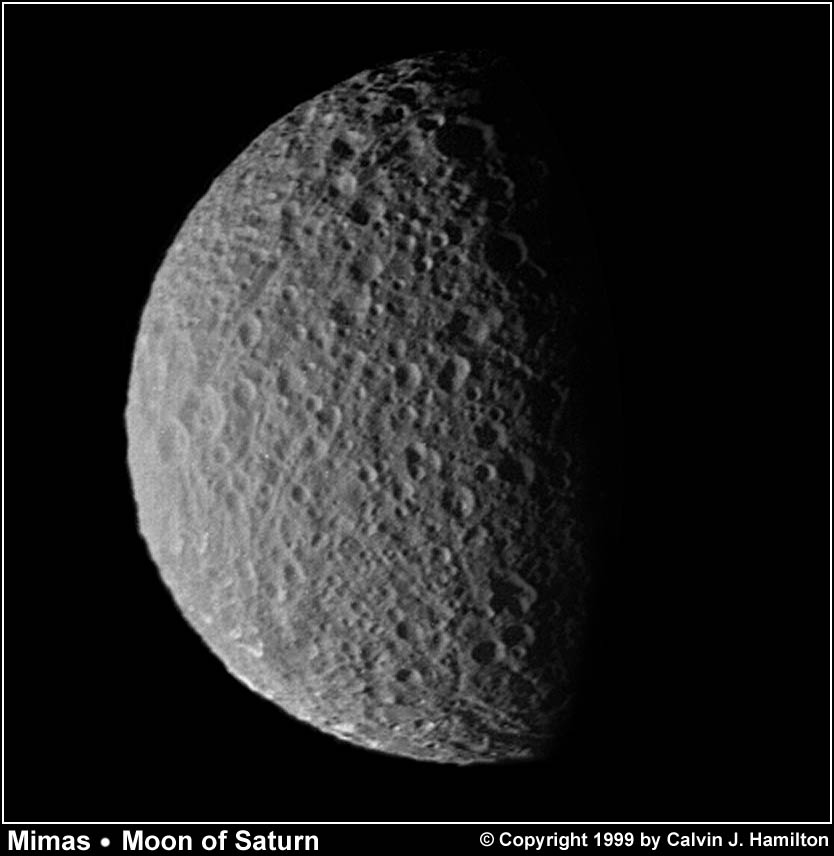
Tiny Moon is No Space Station
An anonymous reader writes "With today's image release, Cassini's tour of Saturn's remarkable system of 31 moons has taken the probe past one of the ringed planet's natural wonders: Mimas. The 250 mile wide satellite suffered a catastrophic impact that opened a wound one third of its diameter and nearly split the moon in half. Today, Mimas bears a striking resemblance to the original Star Wars' Death Star, which wreaked havoc on planets using its laser-focusing dish. In place of the laser dish, Mimas carries a crater peak the size of Mount Everest." -
NASA Predicts A Good Year For Perseids
xCepheus writes "According to this article on NASA's website, the year 2004 will be a good one for the annual meteor shower known as the Perseids. Quoth the article, 'This is a good year for Perseids, for two reasons, explains Bill Cooke of the NASA Marshall Space Flight Center. First, the Moon is new in mid-August; moonlight won't spoil the show. Second, in addition to the usual shower on August 12th, there might be an extra surge of meteors on August 11th caused by a filament of dust newly drifting across Earth's orbit.'" -
Operation Moon Bounce
linuxwrangler writes "Today marks the 50th anniversary of the first transmission of human voice via moon bounce. The voice was that of James Trexler and the technique became an important method of communication for the military that was used until the advent of the communications satellite. It is still a popular activity for ham radio operators." -
Plans for International Space Station Cut Back
Sajma writes "Reuters is reporting: NASA and its space partners on Friday approved a scaled-down International Space Station with fewer astronauts and less science so the United States can meet a 2010 deadline for ending shuttle flights, a top NASA official said. Space agencies in Russia, Europe, Canada and Japan gave unanimous approval to a NASA plan that means the orbiting platform, now about half completed, will never become the beehive of scientific and commercial research once envisaged." -
Plans for International Space Station Cut Back
Sajma writes "Reuters is reporting: NASA and its space partners on Friday approved a scaled-down International Space Station with fewer astronauts and less science so the United States can meet a 2010 deadline for ending shuttle flights, a top NASA official said. Space agencies in Russia, Europe, Canada and Japan gave unanimous approval to a NASA plan that means the orbiting platform, now about half completed, will never become the beehive of scientific and commercial research once envisaged." -
Plans for International Space Station Cut Back
Sajma writes "Reuters is reporting: NASA and its space partners on Friday approved a scaled-down International Space Station with fewer astronauts and less science so the United States can meet a 2010 deadline for ending shuttle flights, a top NASA official said. Space agencies in Russia, Europe, Canada and Japan gave unanimous approval to a NASA plan that means the orbiting platform, now about half completed, will never become the beehive of scientific and commercial research once envisaged." -
Apollo 11 Photographs Unfrozen
-
Apollo 11 Photographs Unfrozen
-
Apollo 11 Photographs Unfrozen
-
Blogging a Ride on the 'Vomit Comet'
An anonymous reader writes "Four Duke engineering students have launched a weblog to document their preparations and impending ride on NASA's 'vomit comet.' The students will study the effects of microgravity on the shapes of cells and the positions of their organelles, such as the nucleus. The schedule is subject to change, but the students expect to take their 12,000 foot plunges Monday in NASA's KC-135A. They plan to provide photos and video." -
Congress Cuts NASA's Budget On Apollo Anniversary
colonist writes "A House appropriations subcommittee voted to cut NASA's budget request by 7 percent on the 35th anniversary of Neil Armstrong's first steps on the Moon. The panel also cut environment and science programs, but increased funding for veterans' affairs. NASA would get $15.1 billion next year, $229 million below this year and $1.1 billion below the President's request. Most of the cuts are on new initiatives. The subcommittee is the first step of a long budget process and major changes to the bill are expected." -
Shoemaker-Levy 9's 10th Anniversary
Chuck1318 writes "July 16 is the 10th anniversary of the first impact of pieces of the comet Shoemaker-Levy 9 on the planet Jupiter. The Planetary Society is marking this occasion with a call for applications for Shoemaker grants to fund "amateur and underfunded professional observers anywhere in the world." Shoemaker-Levy 9 created impact features on Jupiter that were larger than the Earth and helped stimulate the search for possible earth-impacting objects." -
NASA Preps Mars Underground Mole
Roland Piquepaille writes "People at NASA never cease to surprise me. Searching for water or presence of past life of Mars obviously needs drilling beneath the surface. So NASA is developing the Mars Underground Mole (MUM), based on a previous device used for the European Beagle 2 mission. But here is the twist. MUM will include sensors which were previously used to collect spectral imagery of Earth from pilotless aircrafts, especially Hawaii, according to NASA. While the Mole will stay on the surface on Mars and drill up to 5 meters deep, it will transmit data via a fiber optic cable to a digital array scanning interferometer (DASI). And the spectral images produced by the DASI will enable researchers to identify possible water, ice, organics and minerals under the surface on Mars. And this MUM will be a small one, weighing less than a kilogram for a length of only 50 centimeters. For more details and pictures about MUM, please read this overview." -
NASA Prize Program Releases Workshop Report
colonist writes "NASA's prize competitions program, Centennial Challenges, held its first workshop June 15-16, 2004 to brainstorm ideas, define rules and set prize amounts. The post-workshop report (PDF) is available. New ideas for challenges should be sent to <ccideas@hq.nasa.gov>. The Centennial Challenges program is supported by the X Prize Foundation, the Aldridge Commission and some members of Congress, but not all." -
NASA Prize Program Releases Workshop Report
colonist writes "NASA's prize competitions program, Centennial Challenges, held its first workshop June 15-16, 2004 to brainstorm ideas, define rules and set prize amounts. The post-workshop report (PDF) is available. New ideas for challenges should be sent to <ccideas@hq.nasa.gov>. The Centennial Challenges program is supported by the X Prize Foundation, the Aldridge Commission and some members of Congress, but not all." -
NASA Prize Program Releases Workshop Report
colonist writes "NASA's prize competitions program, Centennial Challenges, held its first workshop June 15-16, 2004 to brainstorm ideas, define rules and set prize amounts. The post-workshop report (PDF) is available. New ideas for challenges should be sent to <ccideas@hq.nasa.gov>. The Centennial Challenges program is supported by the X Prize Foundation, the Aldridge Commission and some members of Congress, but not all." -
Apollo 11's 35th Anniversary
colonist writes "35 years ago, on July 16, 1969, Apollo 11 began to achieve the goal set by the late President Kennedy: '...before this decade is out, of landing a man on the moon and returning him safely to the earth'. On July 20, Michael Collins orbited the moon in the command module Columbia while Neil Armstrong and Buzz Aldrin descended to the lunar surface in the lunar module Eagle. The descent engine was halfway through its final 12-minute burn when a yellow caution light lit up on the display of the lunar module computer. [ARMSTRONG: Program Alarm... It's a 1202. ALDRIN: 1202. (Pause) ARMSTRONG: (To Buzz) What is it? Let's incorporate (the landing radar data). (To Houston) Give us a reading on the 1202 Program Alarm.] Buzz Aldrin's recollection: 'Back in Houston, not to mention on board the Eagle, hearts shot up into throats while we waited to learn what would happen. We had received two of the caution lights when Steve Bales the flight controller responsible for LM computer activity, told us to proceed... We received three or four more warnings but kept on going. When Mike, Neil, and I were presented with Medals of Freedom by President Nixon, Steve also received one. He certainly deserved it, because without him we might not have landed.' Fred Martin describes the incidents, and Peter Adler looks at the design of the system."