Slashdot Mirror
Domain: nasa.gov
Stories and comments across the archive that link to nasa.gov.
Comments · 16,365
-
Re:Stationary Thorium Reactor
Even so, this slug of uranium has a mass of only 6.5 kg.
The actual uranium mass of the 1 KWe model is 28.4 kg. The reactors thermal output is 4.3 KW.
-
Re:Same for the moon.
That's the whole point of the kilopower project, to make a small reactor with low weight and decent output, with minimal maintenance required. I can't find the projected weight for the eventual product, but they don't look huge in the pictures. Output ranges from 1kW to 10 kW. See https://www.nasa.gov/directora... for specs and more information. They expect to use 4 units for a mission to mars, for a base electric output of 40kW. Their video shows a rocket cutaway with 4 of these packed with other mission gear. I don't think weight is going to be a big issue.
-
Re:Read Karl Popper
Really, it's about "stop wasting our time with your stupidity, and let us get some work done".
Agreed. People love to toss out examples that they think disprove or at least weaken the overall conclusions, mostly because the overall conclusions go against something they want, be it religious or otherwise. They do it pretty much for everything, and politics is no exception.
Something as complex as weather is inevitably going to involve averages and long term trends such as the one shown here. link
Because it is cold or snows at some place at some time for some duration does not disprove the theory. It is the long term averages throughout the world that matter.
-
Re:No Alternatives???
As I mentioned, a major requirement for a martian base is going to be rocket propellant production, which is an activity that can work intermittently quite well. In addition, you could siphon off a little bit of the hydrogen for fuel cell usage. Chances are that the total mass of the system would be quite a bit lower than if you had to use a nuclear unit. The kilopower system mentioned in the article is expected to yield about 3 kW while weighing about 750 kg. A solar system of a comparable weight would have 50 kW of top output at Mars, and around 13 kW on average. That is a significant improvement already. And I'm comparing space solar system available today to a reactor that is still on a drawing board.
-
Re:No Alternatives???
Solar? Have you heard of Martian dust storms? Read on:
“Every year there are some moderately big dust storms that pop up on Mars and they cover continent-sized areas and last for weeks at a time,” said Michael Smith, a planetary scientist at NASA’s Goddard Space Flight Center in Greenbelt, Maryland.
Beyond Mars’ large annual storms are massive storms that occur more rarely but are much larger and more intense.
“Once every three Mars years (about 5 ½ Earth years), on average, normal storms grow into planet-encircling dust storms, and we usually call those ‘global dust storms’ to distinguish them,” Smith said.
Mars’ dust storms aren’t totally innocuous, however. Individual dust particles on Mars are very small and slightly electrostatic, so they stick to the surfaces they contact like Styrofoam packing peanuts.
“If you’ve seen pictures of Curiosity after driving, it’s just filthy,” Smith said. “The dust coats everything and it’s gritty; it gets into mechanical things that move, like gears.”
The possibility of dust settling on and in machinery is a challenge for engineers designing equipment for Mars.
This dust is an especially big problem for solar panels. Even dust devils of only a few feet across -- which are much smaller than traditional storms -- can move enough dust to cover the equipment and decrease the amount of sunlight hitting the panels. Less sunlight means less energy created.
-
NASA project: Kilopower
There are more information about the Kilopower project at NASA: https://www.nasa.gov/directorates/spacetech/kilopower
-
Re:Global Warming Alarmism
I didn't watch the video, but NASA's own published data on sea level seems to agree with the previous assertion. Take a look yourself. That line looks more or less linear to me since the mid 1800's.
-
Re:Just a PR release
Because going to nasa.gov and looking on the front page is too much effort for you: https://www.nasa.gov/press-rel...
-
Re:Wait a dang minute!
hahaha! You should read NASA's website and learn the reality:
How good are we at finding and tracking NEOs?
Over 2015-2016, observers discovered more than 1500 previously unknown NEOs each year. Roughly half of the known catalogue of NEOs are objects larger than about 460 feet (140 meters) in size. The estimated population of NEOs of this size is about 25,000. Current surveys are finding NEOs of this size at a rate of about 500 per year.The 460-foot cutoff point was established by a NASA NEO survey science definition team (SDT) in 2003. The SDT determined that impacts from objects of that size would only produce regional effects, while larger objects would have corresponding wider effects such as large sub-global effects from impacts of a 984-foot (300-meter) object and global effects from 0.6 mile (1-kilometer) object impacts. In 2016, NASA appointed a new NEO survey SDT to reevaluate this cutoff point in light of research conducted and events occurring since 2003. The new SDTâ(TM)s recommendations should be available in 2017.
Ground-based telescopes alone have limitations - for instance, they can only survey the skies at night and in clear skies. Based on statistical population estimates, about 74 percent of NEOs larger than 460 feet still remain to be discovered.
What can be done to improve the NEO detection rate?
Larger ground-based telescopes and a dedicated space-based infrared asteroid survey telescope would substantially increase the discovery rate and meet the goal in the NASA Authorization Act of 2005 to detect, track, catalogue, and characterize the physical characteristics of 90 percent of the NEO population down to 140 meters in size. NASAâ(TM)s currently operating NEOWISE space-based survey was not designed for this purpose. NEOWISE is a repurposed astrophysics spacecraft, and while it has made significant contributions to NEO discovery and characterization, its capabilities are limited. -
Re:sour grapes
I read this a few weeks ago after being linked to it from somewhere: https://history.nasa.gov/SP-4206/contents.htm
Basically, they took big steps so they could meet JFK's challenge. For example, the first launch of Saturn V was a "full stack" launch, with both the second and third stages. That alone saved them two or three launches over the "right" way to do it.
-
Re:Mars direct?
No, but you can orbit a satellite that can locate the largest metal deposits. (My god, it was hard to find that link through all the bullshit about Kerbal and Space Engineers.)
-
Re:Uh huh
Holy fucken shit, no climate scientists ever in the history of the world has ever thought of "solar cycles" impacting climate change!
Motherfucker, you're the smartest person on the planet!Oh wait, no, a few seconds in Google proves you're a moron, here's the first link I clicked on:
https://www.giss.nasa.gov/rese...
and here's the second link:
https://www.scientificamerican...
you may continue to keep clicking on the list, just Google "do solar cycles cause climate change". -
Re:Same Ol' Argument...
Meanwhile in Europe we have been having much too warm temperatures for this time of year. Last week it was 15C (59 F) in central Europe where I live, which is practically spring temperature today it was 8C (46F) when it should be around the freezing point. It's not the first time that Northern America receives all the dose of winter cold from from Europe. A couple of years ago we had the same situation - record lows in the US, much too high temperatures across Europe and Eurasia.
Nevertheless, global warming is a scientifically proven fact regardless what happens in Northern America, which is only a relatively small area of our globe. The oceans which cover two-thirds of our planet are warming, this is fact. The polar ice caps are melting, also fact. The glaciers are retreating, another fact.
Please just check this website of one very credible, US agency for the details if you still feel like denying it because Trump says so: https://climate.nasa.gov/
That Earth is warming up is a provable fact. That this is due to anything humans have done is not.
-
Not exclusive to SpaceX
NASA and the Air Force (which provides the range safety systems) have been working on the autonomous flight safety system for at least a decade. SpaceX is just the first customer to use it.
-
Re:Theories are falsifiable, global warming is not
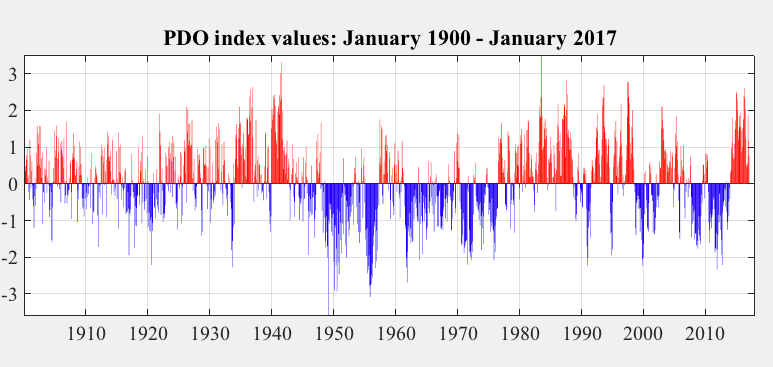
It's not quite compelling if you zoom out his graph for the PDO index.
http://research.jisao.washingt...
As you can see, the index since 2000 has been mostly negative, while we continued record high temperatures.
https://data.giss.nasa.gov/gis...
> it's hard to say things are warmer by 0.03 deg C when your tolerance/error bar is 1 deg C).
Things are warmer by more than 1 deg C, and the error bar is about 0.1 deg C.
-
Re: Climate change is not climate
We have about 50 years of good satellite data which shows warming, vs 150 years of ground based samples that don't.
The ground based samples are better quality. A satellite doesn't measure surface air temperature. Instead it measure the IR radiation coming from the surface, mixed in with the radiation coming from the entire column of air, and then has to perform complicated modelling to figure out what portion of the IR actually comes from the bottom layer.
And the 150 years of ground data clearly show warming. https://data.giss.nasa.gov/gis...
It doesn't help that East Anglia climatologists were caught cherry picking
They weren't. Here's a nice article explaining the temperature adjustments: https://skepticalscience.com/u...
Even without the adjustments, there's a very clear warming. A team of scientists from Berkeley had doubts about these adjustments, so they started with the raw data, and redid everything themselves. They ended up with almost the same graph.
Here's some more info: http://berkeleyearth.org/summa...
-
Re:Theories are falsifiable, global warming is not
We've now seen probably millions of prediction over decades on how global warming will reveal itself to us, and millions of them did not come true
What's the probability that the temperature rise we have seen since the 1960s is a result of random weather ?
https://data.giss.nasa.gov/gis...
If you want to argue that the rise is not due to random weather, what alternative explanation would you suggest ?
-
Re:Same Ol' Argument...
Meanwhile in Europe we have been having much too warm temperatures for this time of year. Last week it was 15C (59 F) in central Europe where I live, which is practically spring temperature today it was 8C (46F) when it should be around the freezing point.
It's not the first time that Northern America receives all the dose of winter cold from from Europe. A couple of years ago we had the same situation - record lows in the US, much too high temperatures across Europe and Eurasia.Nevertheless, global warming is a scientifically proven fact regardless what happens in Northern America, which is only a relatively small area of our globe. The oceans which cover two-thirds of our planet are warming, this is fact. The polar ice caps are melting, also fact. The glaciers are retreating, another fact.
Please just check this website of one very credible, US agency for the details if you still feel like denying it because Trump says so:
https://climate.nasa.gov/ -
At least we don't do this...
These kinds of errors are not just related to Russia.
Mars Climate Orbiter probe lost due to Math error:
English to Metric math conversion error
https://edition.cnn.com/TECH/s...
https://mars.nasa.gov/msp98/ne...
http://articles.latimes.com/19...ExoMars Schiaparelli lander crashed due to failure to recognize the proper height.
http://spaceflight101.com/exom...
https://www.forbes.com/sites/b... -
Re:Summary is terrible, risk is real
The earth is shielded by its magnetic field, through a shock wave formed with solar wind, in which many particles that don't bounce off become trapped and bounce/twist toward the poles. So it's a very large funnel, of several earth areas, that dumps into a relatively small area on the earth. During solar flares (SPE) local concentrations of radiation can be quite high and actually be quite dangerous for short times in limited locations. The original NASA link shows research to predict these events, is in fact, warranted.
-
Summary is terrible, risk is real
The atmosphere dosent protect earth inhabitants like the magnetic fields do. During solar storms, flights are already diverted due to risk of radios not working. A single polar flight has been shown to dose people with 12% of a years safe dose in a single one way trip. There should be monitoring of workers on routes near the magnetic poles, as we should monitor people who frequently (once a week) make these trips.
-
Re:Typical Businessinsider.com Clickbait Bullshit
Minor correction - the earths atmosphere does far less to protect the inhabitants from radiation than the earths magnetic fields. It is common for flights to be diverted due to communication issues near the poles already. Air crews working polar routes really should have the same radiation exposure protection as any other high risk job. As should any person frequently traveling these routes.
-
Re:A precursor to China's future problems?
1. Feeding, clothing and sheltering around 1.7 billion people--around 20% of Earth's human population.
This is just stupid Goldilocks talk, we get that a lot on
2. A massive air and water pollution problem that is already affecting the health of many Chinese.
Life expectancy is 76 years, far above the world average of 71.5 years and trailing the US by <3 years. China's GDP/capita is now around the world average, half the world is poorer than China and in total they're second only to the US. They have a huge net export ($500,000 million/year) and very low national debt (41% compared to 106% in the US). Basically they're already in good health and have a massive unused economic muscle they could use to buy polluting goods from others, create greener tech, subsidize greener tech, levy taxes on polluting goods they produce and so on.
Truth is that China is far from worst in class: Smog-cloaked Delhi looks with envy at Beijing's cleaner air. Not only particulates, but China's Sulfur Dioxide Emissions Drop, India's Grow Over Last Decade. Those are the two biggest local pollution issues. Their total energy consumption and CO2 emissions are growing but that's a global problem that won't more adversely affect China than anyone else. If you think any of these are "collapse of China" class problems you're wildly delusional.
-
Re:Communications?
Well, we're still able to communicate with the Voyager spacecraft and the signal from them is on the order of 10^-16 watts.
-
Super-alloys
Look at the uses for high-temperature alloys like Inconel and Hastelloy. Everything from cryogenic conditions to rocket engine parts and nuclear reactors. Just the things you would want from a UFO
https://www.hpalloy.com/Alloys...
https://en.wikipedia.org/wiki/...
But rocket motors are already beyond alloys. They also require ceramics and other materials based on silica
https://www.extremetech.com/ex...
https://ntrs.nasa.gov/archive/... -
Re:Lucky....
Having read Bradbury's "Rocket Summer" or "R is for rocket", at a young age, the whole idea of rockets still feels exciting and romantic to me; I'm very glad there is a revival in interest after the long (and unexpected) 50 years slump.
This said, and with all respect for Musk and the people at SpaceX, I don't believe rockets can deliver the space revolution we're hoping for. The rocket equation puts a hard limit on their capabilities. And if some hypothetical very energetic propellant is discovered, having large quantities of it fly around and perhaps fall back to the surface in case of accidents would be risky.
Moreover, rockets are still very very expensive. Even reusing all stages of the rocket won't make them cheap enough for mass adoption. I believe a different technology is needed to really open space travel to humanity. Space elevators offer a possible solution, with rockets taking over once the payload is outside Earth's gravity well. Or some even more exotic technology that doesn't exist yet.
Of course, rockets are available now, and they're good enough for exploration. Every time somebody like SpaceX makes them just a bit cheaper, huge new opportunities for discovery open up. But, for me, the best thing is that at least some people are looking outwards to the stars again - and doing something about it.
-
Re:"Water-sculpted" landscape?
https://www.nasa.gov/sites/def...
Wind doesn't produce branching riverbeds filled with rounded stones.
-
Under the surface [Re:Geology...]
I would like to see the next Mars rover mission equipped tools to "see" deep below the surface. For example, a moveable geophone system or ground-penetrating radar, or land stationary seismic detectors around the planet to monitor long-term like we do on Earth.
Your wish is granted: the next NASA mission, Insight, has a five-meter drill, and also a seismometer.
https://insight.jpl.nasa.gov/h...
Launches May 2018.Mars missions so far have only scratched the surface (literally) and taken photos.
Two of the Mars orbiters had ground-penetrating radar: SHARAD on the Mars Reconnaissance Orbiter and MARSIS on Mars Express.
SHARAD: https://mars.nasa.gov/MRO/mission/instruments/sharad/
MARSIS: http://sci.esa.int/mars-express/34826-design/?fbodylongid=1601
-
Under the surface [Re:Geology...]
I would like to see the next Mars rover mission equipped tools to "see" deep below the surface. For example, a moveable geophone system or ground-penetrating radar, or land stationary seismic detectors around the planet to monitor long-term like we do on Earth.
Your wish is granted: the next NASA mission, Insight, has a five-meter drill, and also a seismometer.
https://insight.jpl.nasa.gov/h...
Launches May 2018.Mars missions so far have only scratched the surface (literally) and taken photos.
Two of the Mars orbiters had ground-penetrating radar: SHARAD on the Mars Reconnaissance Orbiter and MARSIS on Mars Express.
SHARAD: https://mars.nasa.gov/MRO/mission/instruments/sharad/
MARSIS: http://sci.esa.int/mars-express/34826-design/?fbodylongid=1601
-
Planetary Geology [Re:Geology?]
Do planetologists use the term "geology" when they're talking about another planet?
Technically, no, the proper term for the study of Mars planetary formation, mineral chemistry etc is areology.
It etymologically ought to be areology, but it turns out that having a different word for the geology of each planet was too cumbersome, so they are all lumped together as "Planetary geology."
http://planetary-science.org/planetary-science-3/planetary-geology/
and geologists routinely use the term "Martian geology" and "geology of Mars"
https://mars.nasa.gov/programmissions/science/goal3/
http://planetary-science.org/mars-research/surface-geology-of-mars/
-
Planetary Geology [Re:Geology?]
Do planetologists use the term "geology" when they're talking about another planet?
Technically, no, the proper term for the study of Mars planetary formation, mineral chemistry etc is areology.
It etymologically ought to be areology, but it turns out that having a different word for the geology of each planet was too cumbersome, so they are all lumped together as "Planetary geology."
http://planetary-science.org/planetary-science-3/planetary-geology/
and geologists routinely use the term "Martian geology" and "geology of Mars"
https://mars.nasa.gov/programmissions/science/goal3/
http://planetary-science.org/mars-research/surface-geology-of-mars/
-
Venus! [Re:Titan]
There is a nice layer of atmosphere that has a comfortable temperature on... err above Venus. Why have cities when you can have floating cloud cities?
My thought exactly!
https://ntrs.nasa.gov/archive/nasa/casi.ntrs.nasa.gov/20030022668.pdf
-
Re:We're already getting stuff from a comet
I should remind Slashdot readers that we already have a cometary probe planned, funded and soon to be launched I think: OSIRIS-rex. While I really like comets and would love to get samples back, we've (sort of) been there done that.
OSIRIS -REx is an asteroid sample retrieval mission. https://www.asteroidmission.or...
Similar, but we would learn very different things from a comet sample....
(While we're dreaming, a submersible probe to Titan would also be cool.
Yes!! Let's do it!
https://www.nasa.gov/content/t...
http://geology.com/articles/titan-submarine/
(full disclosure: ok, I worked on that one: http://adsabs.harvard.edu/abs/...
By the way, ARE there any short wavelengths that would be transparent to the hydrocarbon seas of Titan? Otherwise, just sonar.)
Turns out that liquid methane and ethane are moderately transparent to radio frequency.
-
NASA Link
For those who want the direct link to the NASA release:
I don't know if there's a page for the comet sample return mission, but Dragonfly has a page (with video) here: http://dragonfly.jhuapl.edu/
-
Re:Weird
I had a little more time to go looking for solid numbers, and it's proving difficult to find anyone that wants to talk about the durability of solar panels in space. NASA does have an excellent writeup regarding their panels, though their longevity isn't discussed
https://www.nasa.gov/centers/g...
Wikipedia also has a decent writeup that's closer to our topic, discussing viability in a variety of settings, but again doesn't really hit on life-expectancy.
https://en.wikipedia.org/wiki/...
The closest answer I found is "The space environment is hostile; panels suffer about 8 times the degradation they would on Earth (except at orbits that are protected by the magnetosphere)."
So where you put it has a major impact on lifespan.
-
Re:Rendezvous with Rama
It is estimated that three interstellar objects enter [and leave] the Solar System everyday. There will be plenty of opportunities in the future, as we refine our techniques.
Without a qualification for size and how close it comes to the Sun talking about how often they enter the Solar System is meaningless (i.e. how large and how close determines rate). According to this FAQ from NASA about this:
Yes, scientists expect to find more interstellar objects, especially when next-generation asteroid search programs come online. They estimate that an interstellar object similar to 1I/2017 U1 passes inside the orbit of the Earth several times a year, but up until now they have been too faint and hard to detect. Recent upgrades to survey telescopes such as Pan-STARRS increase the chances of finding these objects, and those odds will increase even more when next-generation survey telescopes begin operations.
So, "several times a year" for something this large and this close or closer to the Sun (close approach is important in making detections)
However there is something that does not quite add up. They also state that scientists expect most of these objects will be comets. Comets approaching this close should be relatively easy to detect, even with older systems/techniques. Not sure what the story is here.
-
That's great marketing there
You want to advertise how good your lenses are, so you use the name Hubble. Genius.
-
Re:What what?
That's a good argument for the believers. I like it. But it's not going to sway non-believers because it's taking too many liberties with history.
They're going to scoff at "NASA paid back at least 5:1 every investment ever made in it." and ask how that could possibly be true given NASA's ~$580 billion since it's inception. When you try and give NASA credit for:
computer era: They'll say that it would have happened with or without NASA, and I have to agree.
memory foam mattresses and velcro: Ok, but those are pretty minor things, and haven't paid out $2.5 Trillion.
insulin pumps: That's a more legit example.
LCD displays: I'd put that more at the feet of RCA. Just because the space shuttle had LCD displays doesn't mean they were exclusively developed for NASA.
photovoltaic cells: They'll point out that solar cells certainly existed prior to NASA. Of course NASA developed them further and has a practical application. The argument is that without that basic research to make them more viable, solar cells would not have been anywhere near commercially viable and private industry wouldn't have wanted to sink in the money to get it there.
NASA has a list of spinoff technologies. A lot of these aren't all that well known, but they're more concrete examples.
-
Re:Meh. M. E. H. Meh.
Robot landers have been to mars, need to make robots that can repair each other and 3d print new parts.
Once you get self repairing robots sent to mars they can mine out a radiation free tunnel system.
Once it has a underground greenhouse established, human survival is viable there long term.
I'd make separate tunnel systems to avoid the "all eggs in one basket" issue.
For power on mars I lean towards a LFTR reactor as tested at ORNL in the 1960's.
I think they proved sub surface water on mars so that solves that.
I think if we took 10% of the warfare budget it would EASILY be done.
https://nssdc.gsfc.nasa.gov/nm...
Done for 4,000 times less then the F-35 funny enough.
-
Re:This sexist drivel again
It's worrying that this story has been tagged "cultural Marxism" and "fake news". Someone apparently feels so threatened by what is largely considered an uncontroversial historical fact that they think it's an attempt to destroy our culture.
I like to think that stuff like that is mostly the work of paid shills.
Think about that. Do they think that remembering things used to be worse will harm us, that we are that fragile? Or do they want to white-wash the past so they can go back to the 1950 model society without resistance?
I think we want to view the history of women in tech through shit covered lenses. I always told people that computers were always women, maybe I just liked the way it sounded but while looking up historical programmer salaries I stumbled across something at nasa that says that isn't really true. I'm uncomfortable that I can think of women who would fling accusations of sexism in my workplace that would get taken very seriously. But feel fortunate that I don't currently work with anyone like that. Certainly women experienced sexism in tech but I think tech may have been better to women than most other careers.
Here's that nasa article : https://www.nasa.gov/feature/w...
-
Re:Good luck with that 30% cut to NASA's budgetAdding to this: This was the original intention way back in the 1970s: NOAA comes up with the experiments, NASA helps to jam them into an appropriate satellite or whatever, and get it into space. Then, after massive budget cuts to NASA, NOAA, and the USGS (who also likes looking down at Earth for learnin' stuff) that took place shortly after this plan, NOAA had to drop out of the satallite climate change investigation, and NASA had to cancel much of its planetary and lunar investigation programs. So they did cheaper terrestrial research instead, since, you might as well do something useful while you're learning how to get better at doing space stuff. During that time, NASA did indeed do some things that inherently simultaneously taught them about "Air And Space" as well as about climate-change. Looking into the effect of the ozone layer, solar-activity, and investigation into the atmosphere on Venus, which is what initially tipped us off that carbon-dioxide operates as a greenhouse gas. But certainly, if there's a desire to move back to the model where NASA works in tandem with NOAA for the sake of climate change research, that's perfectly fine by me at least...So long as NOAA has a sufficient budget to participate in the development and execution of these experiments, and NASA has sufficient budget to help get their experiments and equipment up into orbit or wherever else it may need to be.
-
Re:No Need to Go to the Moon or Mars
Yeah, it's not like NASA could ever develop something like an ion engine https://www.nasa.gov/centers/g...
-
GW Bush cancelled the Space Shuttle, not ObamaThe Space Shuttle program was cancelled by George W. Bush in 2004. See:
-
Re:Good luck with that 30% cut to NASA's budget
Less Climate Change, more Aeronautics and Space. Let NOAA deal with the climate.
Well, NASA launches satellites for NOAA, of course: https://www.nasa.gov/press-rel...
But it's so small a part of NASA's total budget that cutting this won't make very much more money available to NASA.
-
Re:The sleeping elephant in the room
What data is there to push the anthropomorphic global climate change concept? Actual real data, not output from models. Because the actual data shows sea level changes incredibly linear for the last ~150 years, the actual warming being a lot less than the models predict, and the modeled sensitivity of climate to CO2 levels being a factor of 2 to 3 too high
There is no data to push an anthropomorphic climate change concept.
Definition of anthropomorphic
1 : described or thought of as having a human form or human attributes
anthropomorphic deities
stories involving anthropomorphic animals2 : ascribing human characteristics to nonhuman things
anthropomorphic supernaturalism
anthropomorphic beliefs about natureThe word you want is anthropogenic.
Definition of anthropogenic
: of, relating to, or resulting from the influence of human beings on nature
anthropogenic pollutantsRegarding sea level changes being linear for the last ~150 years here is a statistician's analysis of that. It doesn't appear linear to me.
-
Re: uh oh
...
As far as Antarctica, what study shows the mass of snow and ice is not accumulating? it's gaining - not losing. In every single study you'll find that covers the entire continent (not just cherry-picked little areas).
The GRACE satellites beg to differ. They show an average of 125 gigatons per year of ice loss on Antarctica from 2002 to 2016, mostly in West Antarctica. The GRACE satellites measure changes in gravity. As Antarctica loses ice the change in the mass of the ice result in changes in gravity.
-
Re: uh oh
Combined, Antarctica (~90%) and Greenland (10%) contain ~99% of all freshwater on Earth. Antarctica is increasing its total ice mass. And surprisingly to many, Greenland is as well. Now, the other 1% of freshwater - all those glaciers - may be losing, but they are offset by what is happening on the two main ice sheets. Overall, the world seems to be accumulating ice in spite of localized losses, meaning the global climate is towards ice accumulation whilst local weather may be towards ice loss.
-
Re:The sleeping elephant in the room
What data is there to push the anthropomorphic global climate change concept? Actual real data, not output from models. Because the actual data shows sea level changes incredibly linear for the last ~150 years, the actual warming being a lot less than the models predict, and the modeled sensitivity of climate to CO2 levels being a factor of 2 to 3 too high
-
Re: uh oh
Funny, we just ended an 11 streak of no hurricanes in the US. Tornado activity continues to trend down. Antarctica is accumulating snow and ice mass faster than it's losing it. Methane has been increasing steadily since the 50s and Russia, the source of that permafrost was massively down in the 2000s, and still not close to the peak back in 1990. So that's all four of four of your "checked" predictions that are actual failures, not successes.
-
Mars weather "quite nice"
For reference, this will let you know where the missions landed. Viking 1 is close to the equator and 2 is about half way to the pole.
Actual temperature measurements at the Viking landers' site range from 17.2 C (256.0 K; 1.0 F) to 107 C (166 K; 161 F).
This of course ignores the lack of atmosphere, water and being bombarded by radiation. Other than that - "nice".