Slashdot Mirror
Domain: nasa.gov
Stories and comments across the archive that link to nasa.gov.
Comments · 16,365
-
Deep Space Network real time
FYI, you can see what each antenna in NASA's Deep Space Network is doing at any given moment by Looking at this site..
Below each antenna is the craft being communicated to. Clicking on the antenna and then "+ more detail" will get you some info about signal strengths, transmission rates, round trip light times, and more.
I don't see one right this moment but it is common to find one of the 70m antennas talking to one of the Voyagers. Right now Goldstone antenna 14 (70m) is talking with New Horizons.
Captcha = acquire
-
Semantics? It's all interstellar, right?
The space between the stars? Show me somewhere that isn't between two stars.
It seems NASA has an answer at https://spaceplace.nasa.gov/in...
-
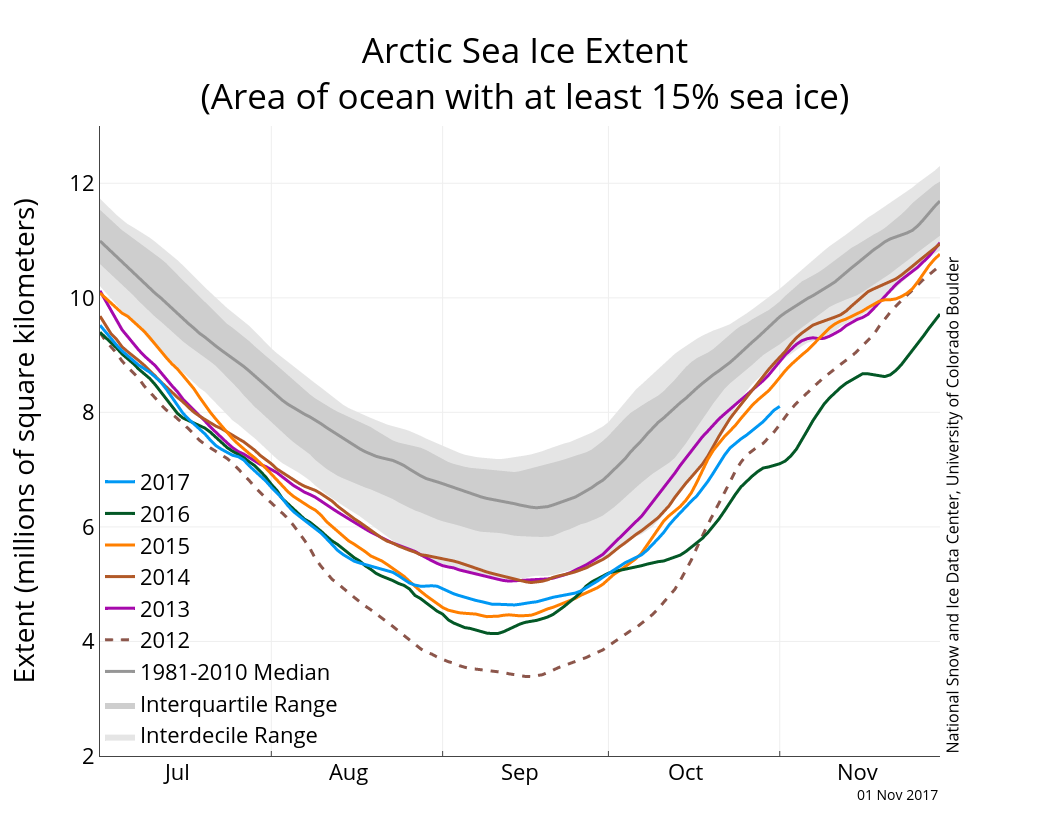
Extend of sea ice
If you wish to prove a point, claiming "I already did!'" is not evidence. Global warming is happening, but you must be consistent and not lie to convince others. 2017 arctic ice is within historical norms unless very, very careful selection of beginning and ending years to start at peaks (1972, 1981, 1996, 2008) and end in valleys (1985, 1995, 2007, 2013, 2016).
I agree with your points that it's important to be careful with data, but no, at the moment it looks like Arctic ice is significantly lower than historical norms. Here's the graph as of last month: http://nsidc.org/arcticseaicen...
Interactive chart is here: https://nsidc.org/arcticseaice...
If you want total volume, and not coverage, the best data is from the NASA GRACE mission (measuring gravity). That mission is now over. But here's data: http://polarportal.dk/en/groen... , and here's a visualization through 2014: https://gracefo.jpl.nasa.gov/r...
-
Re:How Were All of the Last Predictions?
That's how scientific models work. You have a quote from the IPCC saying that almost all predicted more warming than was observed by 2014, and a lot of speculation, If I take a look a NASA graph, I see an increase from a baseline temperature, which looks about 1975, to 1 degree about now. 1975 to 2015 is forty years, so that would be one degree over four decades, or 0.25 degrees per decade, pretty close to the 0.3 you claim didn't happen. Where are you getting your claim that the warming was about half that?
-
Re:Bad assumptions
>Storms are caused by differentials, not absolute heat levels
Which is why it's called 'global warming', not 'even warming around the globe'. Even then, there are other effects in play.
https://earthobservatory.nasa....
>rest of your idiocy, just can't be arsed to argue with an idiot.
Uh huh. So I assume you avoid talking to mirrors.
-
Re:I did some simple calcs
That massive iceberg (4x the size of Manhattan) that broke off earlier this year was estimated at 1 trillion tons. While that's a huge amount to lose all at once, it's less than half the amount Antarctica needs to lose every year to maintain equilibrium. The press likes to hype up outlier events like that because it appears to confirm the belief that Antarctica's ice is melting. But outliers are just that - outliers, and not necessarily representative of what's actually happening. The last scientific net gain/loss study I saw actually concluded that Antarctica is gaining ice. Not losing it. Enough to lower sea levels by 0.23 mm per year.The GRACE satellites disagree with that study that shows a net gain of ice on Antarctica. By measuring changes in gravity the GRACE satellites find that Antarctica is actually losing ice overall, about 118 gigatonnes/year mostly in West Antarctica. GRACE Ice Sheets and Glaciers
-
Re:I did some simple calcs
That massive iceberg (4x the size of Manhattan) that broke off earlier this year was estimated at 1 trillion tons. While that's a huge amount to lose all at once, it's less than half the amount Antarctica needs to lose every year to maintain equilibrium. The press likes to hype up outlier events like that because it appears to confirm the belief that Antarctica's ice is melting. But outliers are just that - outliers, and not necessarily representative of what's actually happening. The last scientific net gain/loss study I saw actually concluded that Antarctica is gaining ice. Not losing it. Enough to lower sea levels by 0.23 mm per year.The GRACE satellites disagree with that study that shows a net gain of ice on Antarctica. By measuring changes in gravity the GRACE satellites find that Antarctica is actually losing ice overall, about 118 gigatonnes/year mostly in West Antarctica. GRACE Ice Sheets and Glaciers
-
I did some simple calcs
Each new iceberg that breaks away exposes taller and taller cliffs
Antarctica's average precipitation is 166 mm per year. Its surface area is 14 million square km. Therefore it receives an average of:
(0.166 meters)*(14 million km^2)*(1000 m/km)^2 = 2.324 trillion cubic meters of precipitation each year
Since water weighs one ton per cubic meter, that.s 2.324 trillion tons of water falling onto Antarctica every year. Unlike most of the other continents, this precipitation does not flow to the sea as water. it mostly ends up locked up as snow or ice (there are a handful of "rivers" - mostly small streams of glacial meltwater running to the sea). If you assume the ice on the continent has reached equilibrium (amount it gains equals amount it loses each year), that means it has to lose 2.324 trillion tons of ice each year, mostly as icebergs. If it loses more than that, sea levels go up. If it loses less than that, sea levels go down.
That massive iceberg (4x the size of Manhattan) that broke off earlier this year was estimated at 1 trillion tons. While that's a huge amount to lose all at once, it's less than half the amount Antarctica needs to lose every year to maintain equilibrium. The press likes to hype up outlier events like that because it appears to confirm the belief that Antarctica's ice is melting. But outliers are just that - outliers, and not necessarily representative of what's actually happening. The last scientific net gain/loss study I saw actually concluded that Antarctica is gaining ice. Not losing it. Enough to lower sea levels by 0.23 mm per year. -
Re:Really?
This post is completely and utterly wrong, neglects how coral numbers dwindled to almost nothing during major extinction events related to temperature, and makes the common mistake that it isn't just the temperature, it is the rate of change. Thrived when the environment changes quickly when, exactly? Not the Ordovician extinction event! Extinction is what happens when species fail to adapt to changes in their environment. Never has the Earth been warming more rapidly than it is now. https://climate.nasa.gov/evide...
-
Re:Flowing liquid water was never that plausible
The whole discussion has always seemed more academic to me than anything else. Deliquescent perchlorate brine concentrates aren't somewhere you'd look for life, they're something you'd use to sterilize a surface. Even normal levels in Martian regolith are probably enough to slowly burn your skin from handling it, in a manner akin to lye.
-
Re:This strange stuff I heard of once...
Nature produces and absorbs more than 10x the CO2 than that, even climate alarmists admit that: https://www.skepticalscience.c...
The extra CO2 we produce is allowing plants to grow faster, causing the earth to become greener over the past 30 years (since we have sattelites measuring it): https://svs.gsfc.nasa.gov/1222...
These are facts the establishment won't tell you because it disrupts their agenda for more government power. When you're only and always hearing about the negatives of one thing (fossil fuels) and only and always hearing about the positives of another (green energy), you're probably being bamboozled. -
Re:First?
So they flew a linear aerospike on an SR-71? Interesting.
-
Re:Worlds fastest?
In fairness, they never intended to measure the speed of the end cap.
However, NASA has built wind tunnles of a sort, capable of 60,000 m/s for a very short time for experiments on reentry on Jupiter. Fnu read:
-
Re:Is climate change one of the topics?
So.. ONE year out of 12 since has a couple of bad storms since Al Gore predicted higher and more intense hurricanes and you think he was right?
We are running WAY below average for 11 out of 12 years since Al, made his wrong prediction. I think he was wrong, even with 2017's season (which seemed about normal to me.) Do you have any better information than Al had 12 years ago?
How did I know this would be your answer? You asked about more powerful hurricanes, I show you that there have been more powerful hurricanes, and you move the goalposts. There is a trend of more powerful storms since the 1970's. https://earthobservatory.nasa.... Storms have been getting more frequent and more powerful. It's not just one year..
-
TFA [Re:More accurately [Re:Interesting details]]
I was referring to the numbers in the article being discussed here, which were not the generic "$/kg to LEO" but were the specific $paid-per-launch-for-delivery-to-ISS divided by payload-delivered-to-ISS.
-
Re: NASA: get back to exploring
Quite right. And it took an outsider (Musk) to ask a game changing question ("Can first stage rockets be salvaged and reused to save money?") because when NASA got started doing launches, that wasn't possible at all.
That was true when NASA first started doing launches, which was in 1950 (project Bumper 2). The first re-usable rocket to launch to orbit was, of course, the space shuttle. So, NASA started doing reusable rocket launches back when Elon Musk was 11 years old.
So over the years as technology changed, nobody at NASA ever thought about it because they were too entrenched in the old way of doing launches to ask any new questions.
Or, more to the point, for the thirty years after developing the shuttle, NASA was not given the authority to work on developing a next generation booster.
When they finally did get to replacing the shuttle... the replacement was to fund SpaceX to develop a booster for cargo flights to the ISS.
(Also Rocketplane Kistler. Not all commercial launcher development programs worked.)
-
Roots [Re:Obviously, back when it was only...]
If it sounds like turtles all the way down it is: just try to trace the claim of "97% scientists agree" to its roots in reality
OK, I traced it. The 97% figure came from the several references: J. Cook, et al., "Consensus on consensus: a synthesis of consensus estimates on human-caused global warming," Environmental Research Letters, Vol. 11, No. 4, 13 April 2016. DOI:10.1088/1748-9326/11/4/048002
It states: "The number of papers rejecting AGW [Anthropogenic, or human-caused, Global Warming] is a miniscule proportion of the published research, with the percentage slightly decreasing over time. Among papers expressing a position on AGW, an overwhelming percentage (97.2% based on self-ratings, 97.1% based on abstract ratings) endorses the scientific consensus on AGW.”
Another reference is J. Carlton et al., "The climate change consensus extends beyond climate scientists," Environmental Research Letters, Vol. 10, No. 94, 24 September 2015. Their results show a 96.7% agreement on anthropogenic contribution to rising temperatures among the group who indicated that 'The majority of my research concerns climate change or the impacts of climate change.'" (The agreement was "only" 91.9% when the group was expanded to all scientists and not just climate scientists.)
A slightly later paper by Cook et al. included a table summarizing fourteen other surveys of scientists, is here: http://iopscience.iop.org/article/10.1088/1748-9326/11/4/048002
And a nice site summarizing what scientific societies say is here: https://climate.nasa.gov/scientific-consensus/
and you'll see it's based on a long chain of implicit trust based on implicit credibility. (Who did they poll? What was the poll? Did scientist accurately report their convictions? Who reported the news? etc. etc.)
Questions which are all answered.... if you had done the work that you suggested: "trace the claim to its roots."
That doesn't mean our scientific knowledge is not useful -- on the contrary, whether it is useful is the (only) criteria to go by. But it means it is acquired statistically, as if humanity were one giant neural network. If you need a confirmation, here's a quote (supposedly) from Max Planck who (we believe) had enough experience to see the pattern: "A new scientific truth does not triumph by convincing its opponents and making them see the light, but rather because its opponents eventually die, and a new generation grows up that is familiar with it."
The greenhouse effect isn't a "new scientific truth". It's been known and pretty well understood for well over a hundred years. It is the tool we use to understand planetary temperatures.
-
Rocket engineering [Re:Nice idea but]
Material limits set what we can do with conventional rockets. Not just melting points but thermal shock and fatigue.
No. Chemical rockets are limited by the energy content of the chemical fuel. They haven't been limited by materials for well over fifty years.
Those material limits are the same for a nuclear power source - and shoving water through a barely sub-critical reactor to heat it seems like a laughable idea. Water is hellish corrosive at high temperatures so odds are you'd be leaving a trail of reactor guts behind you before the engine had been running long.
Nobody proposes using water as reaction mass in a nuclear thermal rocket-- Specific impulse (Isp) is not high enough; you might as well use chemical propellants.
Hydrogen isn't a lot better. See "hydrogen embrittlement"
Hydrogen is a lot better. It is pretty much what everybody (or at least, everybody who knows the technology) would use for a NTR.
Since nuclear engines were designed, built and tested with hydrogen reaction mass back in the 1960s and early 1970s, your belief that they couldn't work is quaint.
A nuclear powered ion-drive seems a lot more likely to work.
Yes...and no. Ion drives put out a very low thrust per unit power. Thermal rockets are high thrust. There are some applications where you can get there slowly but efficiently, but it's definitely an engineering trade-off.
"A nuclear powered ion-drive seems a lot more likely to work." Indeed. Hydrogen is sort of stupid, but that is where they started decades back, and it is perhaps best if they continue along those lines and develop it properly.
Yes, nuclear thermal is very simple, and it has been demonstrated.
Then load up with Xenon and get serious. Get the Reactor nice and toasty, both heat and ionize the Xenon with it, and then work with what Plasma Physicists have been doing, in accelerating the product and shooting it out the back end.
Really you want to do one or the other, not both. Either use the thermal energy, in which case you want hydrogen, or convert the thermal energy to electrical power and use an ion engine, but not both at once.
(Accelerators are notoriously thirsty, but that is another thing Reactors are good at providing.) 135Xe is a particularly good candidate, as it has a very high Thermal Neutron Cross Section, and can carry some of those pesky Neutrons away with them.
That makes little sense. If you're using the reaction mass for neutron shielding, basically you want the lowest atomic mass you can get. And a fuel that decays with a half life of 9 hours means you'd have to breed the fuel in situ.
-
Re:Actual science
Why do you keep talking about prediction? Is it because it's the only place you can cultivate uncertainty? If you want certainty, look backward. The climate has warmed: https://climate.nasa.gov/vital... A smart rock could see the trend. A dumb slug would be worried that the recent trend of acceleration of historically rapid warming. It takes a whole bunch of motivated reasoning to ignore the obvious.
-
Oxygen Clean is Hard
Working with LOX is just hard. Everyone that work with high purity oxygen eventually burns up something unexpected.
NASA Oxygen Gleaning Team websiteLox makes almost everything flammable, even the pipes we use to convey it.
LOX Safety VideoDon't do this, common materials become DANGEROUS when exposed to LOX
LOX as a fire starterGuess - some FOD was inside the engine, perhaps some lint or hair. Proving the cause is going to take work.
-
Re: This shows we can handle environmental problem
The annual ozone hole is a natural phenomenon, but historically the hole was a small fraction of the size than what we have had since the 1980's.
https://ozonewatch.gsfc.nasa.g...
Compare the 1979-1982 ozone hole size and Antarctica ozone levels before 1983 to after.That the ozone depletion/ozone hole continued to grow after the Montreal agreement was predicted.
The problem we faced is that the rate of production of CFCs vastly exceeded the rate of degradation of CFCs in the atmosphere so we were facing an accelerating rate of ozone depletion. The ozone hole was growing rapidly in size every year, and the global ozone levels were decreasing.
https://www.esrl.noaa.gov/csd/...The problem CFCs and related compounds have a very long lifetime in the lower atmosphere, on the order of a century, and on the order of decades in the stratosphere. Once a CFC is degraded by UV and releases a free chlorine or bromine, the free Cl or Br atom can continue to catalyze ozone to O2 for a few years before the free atom binds with hydrogen and falls back down to the lower atmosphere and get washed out.
Here's a document with graphs showing the continuing post-Montreal increase and subsequent drop-off in atmospheric concentrations.
https://www.esrl.noaa.gov/csd/...Here's an executive summary of the situation in 2014.
https://www.esrl.noaa.gov/csd/...Actions taken under the Montreal Protocol have led to decreases in the atmospheric abundance of controlled ozone-depleting substances (ODSs), and are enabling the return of the ozone layer toward 1980 levels.
The sum of the measured tropospheric abundances of substances controlled under the Montreal Protocol continues to decrease. Most of the major controlled ODSs are decreasing largely as projected, and hydrochlorofluorocarbons (HCFCs) and halon-1301 are still increasing. Unknown or unreported sources of carbon tetrachloride are needed to explain its abundance.
Measured stratospheric abundances of chlorine- and bromine-containing substances originating from the degradation of ODSs are decreasing. By 2012, combined chlorine and bromine levels (as estimated by Equivalent Effective Stratospheric Chlorine, EESC) had declined by about 10–15% from the peak values of ten to fifteen years ago. Decreases in atmospheric abundances of methyl chloroform (CH3CCl3), methyl bromide (CH3Br), and chlorofluorocarbons (CFCs) contributed approximately equally to these reductions.
Total column ozone declined over most of the globe during the 1980s and early 1990s (by about 2.5% averaged over 60S to 60N). It has remained relatively unchanged since 2000, with indications of a small increase in total column ozone in recent years, as expected. In the upper stratosphere there is a clear recent ozone increase, which climate models suggest can be explained by comparable contributions from declining ODS abundances and upper stratospheric cooling caused by carbon dioxide increases.
The Antarctic ozone hole continues to occur each spring, as expected for the current ODS abundances. The Arctic stratosphere in winter/spring 2011 was particularly cold, which led to large ozone depletion as expected under these conditions.
Total column ozone will recover toward the 1980 benchmark levels over most of the globe under full compliance with the Montreal Protocol. This recovery is expected to occur before midcentury in midlatitudes and the Arctic, and somewhat later for the Antarctic ozone hole. -
Re:Who put the fucking anti-science morons in char
Lets be real here. Private industry is the best place for science developments. Government shouldn't be in this business, wasting taxpayer dollars on boondogles.
That's really only true if you posit that the only point of research is to maximize shareholder value. If instead, you believe research is there to maximize benefit to humanity, then handing all research off to private industry is a horrible choice, because this goal is often ad odds with profit.
A trivial thought experiment is the comparison between research and distribution of a vaccine which can eliminate a crippling and/or fatal disease entirely (similiar to the Polio vaccine) and research for a treatment that allows people to live with said disease. In the hypothetical case where both were known to be possible, private industry would quite obviously pick the latter, as it would have the best projected profit margin.
I wonder if your position isn't largely based on ignorance regarding inventions coming from the public sector. While government research isn't always focused on providing financial value, there is no shortage of technologies we use that have come from publicly-funded research. A great example of this is NASA itself. You may want to peruse NASA's Spinoff site to get a glimpse of how useful public research can be.
-
Re:ceaseless
It's entirely possible for there to be 10 different wrong views on climate change...
You want him to... ignore the consensus because the people contributing to it are routinely proven to be hilariously incorrect?
10 different wrong views do not make a consensus. This does.
-
Re:Game changing?
The full-scale Raptor is now the 1.7 MN version. The old test a year ago was indeed the smaller unit. But do you have ANY information or reason to believe that the unit in the video is NOT the full unit? For example, the *full-scale* oxygen preburner was already tested two years ago.
-
Re:Those were the days.The level of panic is not what we have to worry about as the Atlantic boils for the next however many years it takes for the Pacific to switch around to El Niño again. What we do have to worry about is a longer succession of seasons of high ocean temps in the Atlantic and the shift in the cycle caused by global warming. Like all short sighted comments about what is going on the failure here is to see obvious trends and it is these trends to climate extremes that are the thing we have to worry about the most.
The existence of ocean weather patterns created by the movement of warm water has been known for centuries. The existence of a cycle between El Niño and La Niña has been known for a very long time and the cycle is usually about 4 to 6 years. This has changed and if the cycle continues to expand in years it is a direct result of rapid climate change. The extended duration of the last cycle cause the Pacific blob, a patch of warmer water much further north in the Pacific, something never seen before.
As we see the global mean temperatures are increasing more rapidly directly because of the corresponding increase in atmospheric C02.
As a direct result of these rapid changes we can expect a much more violent climate. Plain and simple storms that cause damage will increase in frequency and severity and there is nothing we can do about it accept try to reduce the use of fossil fuels to slow the increase in atmospheric CO2. These are just the inconvenient truths about how messing up our atmospheric gas balance with the unrelenting and ever increasing burning of fossil fuels is causing more trouble than it is worth. Facts do not cause the panic however failure to act does. We still have people who believe in the idiotic NIMBY dictum that "the solution to pollution is dilution" shilling for the energy giants. Scott Pruitt is one of the worst.
Yes C02 is not a pollutant by definition but a sudden atmospheric imbalance of gases is something which is obviously going to effect our civilization in ways that we might regret. A slightly warmer earth is not necessarily a dangerous thing provided the change is not too fast for us to adapt as a species. Humans are causing an unnatural cycle to occur in atmosphere whether or not we survive our stupidity as a species remains to be seen. Then again just perhaps these short sighted greedy assholes that think they are capable of running the world will teach us to work together as a species for a change. Either that or they will blow us all up and thus solve the very real problem of mankind changing the earth's atmosphere too rapidly. The next phase of Trumpification of truth will most likely be the removal of the data to show what is happening simply do that by dissolving NASA now that muzzling the scientists working there is not working. Make America Great Again is the biggest lie ever foisted upon a peoples!
-
Re:Those were the days.The level of panic is not what we have to worry about as the Atlantic boils for the next however many years it takes for the Pacific to switch around to El Niño again. What we do have to worry about is a longer succession of seasons of high ocean temps in the Atlantic and the shift in the cycle caused by global warming. Like all short sighted comments about what is going on the failure here is to see obvious trends and it is these trends to climate extremes that are the thing we have to worry about the most.
The existence of ocean weather patterns created by the movement of warm water has been known for centuries. The existence of a cycle between El Niño and La Niña has been known for a very long time and the cycle is usually about 4 to 6 years. This has changed and if the cycle continues to expand in years it is a direct result of rapid climate change. The extended duration of the last cycle cause the Pacific blob, a patch of warmer water much further north in the Pacific, something never seen before.
As we see the global mean temperatures are increasing more rapidly directly because of the corresponding increase in atmospheric C02.
As a direct result of these rapid changes we can expect a much more violent climate. Plain and simple storms that cause damage will increase in frequency and severity and there is nothing we can do about it accept try to reduce the use of fossil fuels to slow the increase in atmospheric CO2. These are just the inconvenient truths about how messing up our atmospheric gas balance with the unrelenting and ever increasing burning of fossil fuels is causing more trouble than it is worth. Facts do not cause the panic however failure to act does. We still have people who believe in the idiotic NIMBY dictum that "the solution to pollution is dilution" shilling for the energy giants. Scott Pruitt is one of the worst.
Yes C02 is not a pollutant by definition but a sudden atmospheric imbalance of gases is something which is obviously going to effect our civilization in ways that we might regret. A slightly warmer earth is not necessarily a dangerous thing provided the change is not too fast for us to adapt as a species. Humans are causing an unnatural cycle to occur in atmosphere whether or not we survive our stupidity as a species remains to be seen. Then again just perhaps these short sighted greedy assholes that think they are capable of running the world will teach us to work together as a species for a change. Either that or they will blow us all up and thus solve the very real problem of mankind changing the earth's atmosphere too rapidly. The next phase of Trumpification of truth will most likely be the removal of the data to show what is happening simply do that by dissolving NASA now that muzzling the scientists working there is not working. Make America Great Again is the biggest lie ever foisted upon a peoples!
-
Re:Calcium Oxide methodology?
If you are going to get calcium from sedimentary rocks then limestone is your source. But being at the meeting of the North Atlantic and European plates Iceland has access to volcanic (igneous/metamorphic) rocks. They get their calcium from basalt. https://www.washingtonpost.com...
If you wait long enough for erosion to liberate calcium from volcanic rocks the CO2 in the oceans will form limestone. Typically, this is river runoff. https://earthobservatory.nasa.... Alas, waiting hundreds of millions of years isn't going to fight global warming so the Icelandic project is kind of hurrying things along.
-
Re:CO2 is not bad....
Because of the low levels of CO2 today, we have and increasingly large areas on earth, were nothing grows anymore...
Well, we should soon have no problem growing crops all over the world, then: https://climate.nasa.gov/syste...
-
Re:a pattern lately
-
50 year old spaceship [Re:Downmaxx]
There's no spacecraft other than SpaceX's at the moment with a downmass capacity in the 100+ pound region.
Soyuz.
Yeah, let us now compare capabilities a 7 year old rocket/ship to another with over 50 years of history. Soyuz can carry three astronauts at most to ISS, and is a single purpose ship.
The post to I was responding was about downmass capacity. The statement was incorrect: Soyuz--as you pointed out-- routinely brings down three astronauts, which is a down mass of a lot more than 100 pounds.
The fact that Soyuz has "over 50 years of history" and Dragon doesn't was not brought up in the statement to which I was responding, so I didn't mention it.
Crew Dragon can carry 7, and also some cargo making the transportation to station cheaper overall.
If we're comparing to vehicles that haven't flown yet, we'd have to also add Boeing CST "Starliner", NASA Orion and Sierra Nevada Dream Chaser, among others
-
Re:Summary is wrong - not about dark matter
The Cosmic Microwave Background Radiation (CMBR) indicates that the universe is composed of about 5% baryonic matter, 24% non-baryonic matter, and 71% dark energy.
-
Re:You Troll, but there is a kernel of Truth
Don't be so sure that it's obvious. Even NASA themselves are comparing the International Space Station with the rotating space station from the movie 2001 even though the ISS doesn't rotate, which was the main obvious feature in the movie.
-
Re: Conspiracy theories aren't always wrong
Some years before people realized that Sputnik would be a problem? What? The first and immediate fears caused by Sputnik to the US was that the USSR had superior technology.
Note that I wrote that some people knew what it meant, and most didin't.
Here's a bit from a really nice and in-depth history that pretty much sums up my thoughts on the matter. the link is https://www.hq.nasa.gov/office..., but the whole history piece is excellent, give it a read.
"American response to the Russian triumph varied considerably, depending on its source. The alarm exhibited by large sections of the public did not materialize immediately. In New York City, on "Sputnik night," phone calls poured into the offices of the Hayden Planetarium and the American Museum of Natural History. Practically all were from people seeking more information than the Soviet bulletin to the American press had provided-mostly amateur astronomers and ham radio operators eager to get down to the happy business of trying to acquire and track the world's first man-made satellite. At central police headquarters, a spokesman at the big switchboard, the activity of which is regarded as an index to public anxiety, reported no inquiries whatsoever. On the following day a Newsweek correspondent in Boston wrote that the "general reaction here indicates massive indifference." From Denver another Newsweek writer wired his home office that there "is a vague feeling that we have stepped into a new era, but people aren't discussing it the way they are football and the Asiatic flu.""
and a little later....
"Most Americans were aware that Russia had created an atom bomb more quickly than American authorities had considered likely. They knew that Soviet work on the hydrogen bomb had kept pace with that of the United States. As recently as August 1957, the U.S.S.R. had claimed a successful intercontinental ballistic missile test. None of these facts, however, had registered deeply in this country. Nor had the occasional story in the press hinting at an upcoming space breakthrough by the Soviet Union."
I'll stick with the concept that it took some time to actually register with most people that Sputnik and the ability to put a rocket in space meant that they could do the same with bombs.
Just like it still hasn't registered with most people that the internet was not designed with privacy - indeed the opposite is true. Just a fact that no amount of wishful thinking can change. You can do some things to make it a little better, but it will never be secure. Anyhow, whether you agree with me or not, that history of Vanguard is just delicious reading. Here's the index page. https://www.hq.nasa.gov/office...
-
Re: Conspiracy theories aren't always wrong
Some years before people realized that Sputnik would be a problem? What? The first and immediate fears caused by Sputnik to the US was that the USSR had superior technology.
Note that I wrote that some people knew what it meant, and most didin't.
Here's a bit from a really nice and in-depth history that pretty much sums up my thoughts on the matter. the link is https://www.hq.nasa.gov/office..., but the whole history piece is excellent, give it a read.
"American response to the Russian triumph varied considerably, depending on its source. The alarm exhibited by large sections of the public did not materialize immediately. In New York City, on "Sputnik night," phone calls poured into the offices of the Hayden Planetarium and the American Museum of Natural History. Practically all were from people seeking more information than the Soviet bulletin to the American press had provided-mostly amateur astronomers and ham radio operators eager to get down to the happy business of trying to acquire and track the world's first man-made satellite. At central police headquarters, a spokesman at the big switchboard, the activity of which is regarded as an index to public anxiety, reported no inquiries whatsoever. On the following day a Newsweek correspondent in Boston wrote that the "general reaction here indicates massive indifference." From Denver another Newsweek writer wired his home office that there "is a vague feeling that we have stepped into a new era, but people aren't discussing it the way they are football and the Asiatic flu.""
and a little later....
"Most Americans were aware that Russia had created an atom bomb more quickly than American authorities had considered likely. They knew that Soviet work on the hydrogen bomb had kept pace with that of the United States. As recently as August 1957, the U.S.S.R. had claimed a successful intercontinental ballistic missile test. None of these facts, however, had registered deeply in this country. Nor had the occasional story in the press hinting at an upcoming space breakthrough by the Soviet Union."
I'll stick with the concept that it took some time to actually register with most people that Sputnik and the ability to put a rocket in space meant that they could do the same with bombs.
Just like it still hasn't registered with most people that the internet was not designed with privacy - indeed the opposite is true. Just a fact that no amount of wishful thinking can change. You can do some things to make it a little better, but it will never be secure. Anyhow, whether you agree with me or not, that history of Vanguard is just delicious reading. Here's the index page. https://www.hq.nasa.gov/office...
-
Re:This is never going to happen.
Failure mode. If the Concorde had a catastrophic failure, true, it was likely that all aboard were toast, but engine failures, loss of fuel, etc were all theoretically survivable without losing the entire craft. Any suborbital spacecraft has some pretty shitty options in terms of failure.
The reliability of spacecraft over time doesn't warm the heart about avoiding that fatal loss of life event where people are then unwilling to use the craft. Before someone brings up the Soyuz program... it was/is less reliable than the Shuttle, which itself was demonstrated unreliable over time.
Bottom line: being atop a huge stack of combustible materials where over 90% of the mass is volatile fuel is not a safe thing and cannot be made safe, by any reasonable standard. I might ride it because I am ok with chopper flights in war zones and the like, and haven't minded much being shot at in the past. But will my mother? Would I consider it reasonable to bring a child on such a craft? My wife? No.
As a side note, the Concordes also pushed the envelope in terms of takeoff speed because of design decisions, and this is what caused the only fatal crash of the airplane, essentially.
-
Re:This is never going to happen.
The O-Ring temperature specs were always known and engineers warned the management that it was too cold to fly and not to launch that day but the warning was overridden. https://www.nasa.gov/centers/l...
The problem is that there was no evidence that the O-Rings would definitely fail at launch temperatures, so management chose to ignore the warnings. Saying "It has never been tested at that temperature and is only certified down to 40 degrees" is a lot different than saying "We've done exhaustive testing and concluded that the O-Rings are going to fail to seal at 35 degrees or below"
So yes, the engineers said that they thought the O-Rings would fail, but they didn't have conclusive proof that could have convinced management to scrub the launch. Clearly the wrong decision was made, but after 10 years of successful launches, management felt emboldened to push the limits.
-
Re:Also known as...
Of course the pretty clear lesson of global warming today and rising sea levels, pretty much a demonstration of what the lost lands were. Coastal plains flooded underneath the end of the ice age sea level rise of around 120m https://www.giss.nasa.gov/rese... (look they are finally using metric, good on you NASA). This substantiated by underwater caves with stalagmites and stalactites and well as cores of all major coral reefs proving that they were totally destroyed as marine biospheres when they were something like 100m above sea level and a couple of kilometres inland.
Want to know what humanity was up to for 20,000 thousands year, something like 10,000 years ago, then you got to look underwater and under 10,000 of mud to find out. You might think inland could provide information but people live next to rivers and those rivers would have been flooded like no ones business by melting ice. People of course would have added to the destruction ie coastal people aggressively moving inland in spite of the populations already there. There is probably a whole world of under water archaeology to explore 120m down, or more likely 110m and under 10m of mud, across large portions of the planet.
-
Re:Companies want cheap workers
Then maybe you should have thought about that when you decided to never learn anything new on the job. I could word my resume any number of a dozen different ways depending on what the job position asked for. But that meant going above and beyond showing up to work every day.
I volunteered for new projects. I learned how to do skill X and apply it to my desk job.
Getting a college degree doesn't set you for life. It gives you a bit of breathing room and a head start until the rest of the world catches up. I graduated ~15 years ago. There is a clear divide between type A and type B workers.
Type A seems to be the loudest that everyone is stealing their job. They can't find any jobs with their skill sets. A has sat on their hands for the last decade and turned the crank and nothing more. Forget Indians, Jenkins is stealing their jobs daily. We used to build software manually. If your only skillset you picked up is how to compile software, flash and test it your job relevancy is fading fast.
Type B took on new opportunities. They didn't see a new technology as 'stealing' their job they used it to supplement their work. They stayed up to date on which direction their industry was going.
When faced with being replaced by computers Dorthy Vaughan and other 'human computers' stepped up operate the computers. I wonder if her peers that didn't sat around complaining about electrons stealing their jobs.
-
Re:More Accurate Pi Day
> 22/7 is a slightly better approximation to pi than 3.14.
VERY slightly.
22 / 7 = approx. 3.14285714285714
3.14285714285714 - 3.14159265358979 = 0.00126...
3.14159265358979 - 3.14 = 0.00159...The difference in the differences is about 0.000328 in favor of 22 / 7.
In other words, either will do for casual work. Even NASA only uses Pi out to 15 decimal places. https://www.jpl.nasa.gov/edu/n...
By cutting pi off at the 15th decimal point... our calculated circumference of the 25 billion mile diameter circle would be wrong by 1.5 inches.
Which means I could work at NASA because one of my classrooms had a big PI banner in the front of the room and I memorized PI to 17 places from looking at it all year.
-
Re:That's the one?!
I have a LONG list of [MS gripes]. The three finger salute is very, very low on my list.
For all the others, both God and I give him the one-finger solute.
-
Greenhouse effect is well understood
I cannot believe how freaked out everyone is about carbon, when it is a basic and abundant element of the planet...
People are "freaked out" about carbon-- specifically, carbon dioxide in the atmosphere-- because it is known to absorb outgoing infrared radiation, so the amount of carbon dioxide in the atmosphere affects the temperature balance of the planet. This is an effect that has been known for a very long time (here's a good review from the American Institute of Physics: https://history.aip.org/climate/co2.htm), but only recently has the amount of carbon dioxide put in the atmosphere by humans been enough to make the effect visible.
You're correct that it is "basic and abundant", although I'm not sure why that's relevant
the amount in the atmosphere is minuscule to begin with,
Correct. It was the great discovery of Tyndall in 1859 that extremely small amounts of trace gasses can affect the infrared absorption. https://earthobservatory.nasa....
never mind whatever we are adding in being a tiny fraction of what it is already.
Humans have increased the carbon dioxide content of the atmosphere by about 45% since preindustrial times, most of that in the last century (graph: https://www.esrl.noaa.gov/gmd/...). Depends on whether you call that a "tiny fraction."
But, indeed, the natural greenhouse effect of about 30C (ref) is about much larger than the human contribution. That's one reason we understand the greenhouse effect; it's large enough to be easily measured.
The entire ecosystem of the Earth is built to process carbon, to consume carbon, to use carbon to sustain life.
Correct again. Over a period of few hundred thousand years, this will undoubtably be removed from the biosphere.
It would be lot faster than that, except we're cutting down trees a lot faster than we're growing trees.
It is so sad to see rational people get lost in a death cult that makes absolutely no sense to anyone with a shred of scientific understanding of the climate, or indeed basic material science...
I will assure you that I have a pretty good scientific understanding of climate, and also of basic materials science. This is how we understand the atmospheres of all the planets, not just Earth. The basic physics of the greenhouse effect is quite well understood science, and the absorption coefficients of trace gasses in the infrared are all well measured.
-
Sorry, no Global Cooling!
Perhaps you don't remember this far back, but "global cooling" actually was the widely hyped fear back in the 1960s and part of the 1970s.
No, it wasn't. That claim is something deniers say all the time, but it just isn't true. Here, for example, is the American Meteorological Society: http://journals.ametsoc.org/do...
I know a lot of people today (many of whom were born in the 1980s or even the 1990s!) will wrongly claim that it was only "the media" pushing those claims back then, but the media was just reporting on what those in various scientific fields were claiming.
I was born in the 1950s, and you are wrong.
It wasn't until into the 1970s that the "global warming" hype really started up.
Wrong again. Here's the American Institute of Physics's history of Global Warming: https://history.aip.org/climat... -- the effect has been known for well over a century.
I remember the greenhouse effect being discussed in my science classes back in high school. Of course, back then it was "here's an effect that, if we keep on burning fossil fuels, might be measurable sometime by the 1990s or 2000" (which seemed impossibly far in the future back then.) Well, guess what: we kept on burning fossil fuels, the 1990s and then 2000 came, and the effect was measurable.
When it became clear by the late 1990s that we weren't really seeing any significant warming, the name was changed again to the much vaguer "climate change".
Wrong, and wrong. We were seeing significant warming by the late 1990s (check the data), and the name was changed by the Bush administration in order to get people less excited about the effect.
This is convenient, because it allows any normal variation in the Earth's dynamic, chaotic, and unpredictable weather systems to be claimed to be evidence of this alleged "climate change".
Now, on that one I'll agree with you: it annoys me when people attribute weather events to global warming. No single weather event, no hot summer in one location, no warm winter in another location, can be particularly attributed to global warming. Global warming is real, and is well understood-- but it is a long-term, global phenomenon. It is not a local thing.
-
Nitrogen oxides
Its even worse than that. NOx reacts with Methane to remove it from the atmosphere, and Methane is much MUCH worse that CO2 with regards to greenhouse effects.
News flash: oxygen reacts with methane to remove it from the atmosphere. Nitrogen oxides are 0.00003% of the atmosphere. Oxygen is 20% of the atmosphere. Putting more nitrogen oxides into the atmosphere has a negative effect on health, but doesn't reduce the amount of methane in the atmosphere enough to notice.
Estimates vary, however the accepted figure appears to be that the net effect of global diesel use is 20% net cooling effect.
Another news flash: making shit up really isn't a substitute for science.
So yes, Diesel contributes to global cooling! Climate change! Disaster!
To repeat: making shit up really isn't a substitute for science.
(Also, lightning creates about the same amount of NOx as small vehicles, and both are much less than shipping, aircraft, or heavy industry..)
Lightning produces some nitrogen oxides. Specifically, "over the United States lightning accounts for only about 5 percent of the total U.S. nitrogen oxide annual emissions and about 14 percent of the total emissions in July."
And lightning-produced nitrogen oxides are randomly distributed through the atmosphere. Nitrogen oxides produced by automobiles are concentrated where the most automobiles are, which coincidentally happens to be where people live. Lightning-produced nitrogen oxides are important to global atmospheric chemistry, but they're not a major player in pollution. https://www.nasa.gov/home/hqne...
-
Re:Why marked troll?
I'm happy to have a discussion with anyone on any topic, even if I think they're a climate alarmist.
I think climate panic is bullshit because those conclusions and predictions have been countered by the science:
http://petitionproject.org/gw_...
Furthermore most fear mongering climate predictions follow the following pattern:
1. Make a vague prediction
2. Get lots of attention
3. Make new prediciton(s) before it turns out the previous one is false.
https://www.thenewamerican.com...
It's very similar to Christian preachers predicting the end of the world and then getting more victims when it doesn't happen.
Only the 'predictions' are far worse, they don't include a verifiable outcome or time when it will supposedly occur.
Thus they should be rejected out of hand.
It's interesting that the media are having more and more trouble pushing this propaganda:
1. The term has changed from global warming to climate change, did anyone explain you why? Climate change is redundant because the climate is defined as the average weather over the past 30 years. So it will always change, by definition.
2. They almost never show charts of how environmental weather extremes changed over time. They probably know it would prove their bullshit wrong. Like the hurricane energy that hasn't increased: http://www.globalwarming.org/2...
3. They never talk about the positives of fossil fuels or CO2. Like with fossil fuels enabling us to defend ourselves against the climate, greatly reducing the number of climate deaths, while the population grows. Or how CO2 made the planet greener: https://climate.nasa.gov/news/.... When people are always and only telling you about one side of an argument, it's a hint of propaganda.
Please honestly investigate this stuff, don't just believe what the establishment tells you. -
Re: RIP
Rather than pile on from that ivory tower, how about you tell me how many fucking US jobs this created. How many families were fed, how much production to the GDP was done, how any of this shit made any real sense at all other than to a few propeller heads. Go.
I found a 2010 picture of the Cassini team and it looks like it created about 100 primary jobs related to the mission itself, I saw a later photo and there were a lot more people in the team. So at least 100 families were fed from STEM roles in the US. How is that bad, for the US or any other country for that matter.
In terms of the GDP and propeller head it's much better that these skilled people were working for NASA and the product of their intellectual output can be utilized in the GDP, indirectly, instead of being unavailable through secret military or commercial contracts. Knowledge is the harvest from economies that generate surplus resources.
It's true that it is easy to mod you out of existence however it's much better to dismantle the premise of your troll so that people see your rationale as the kind of regressive ignorance that prevents the whole human race from evolving. ANY spending on science and exploration is a win especially in the 21st century where knowledge is the new driver of economies.
Perhaps that doesn't make a lot of sense to you, which is ok, because if you have to ask the question, you wouldn't understand the answer anyway.
-
Re:Coronal Mass Ejection for Life On Earth, Alex..
Actually a perfectly valid defense (which people won't like, so will probably be ignored) is to just shut the grid down prior to the magnetic disturbance reaching the Earth. This would result in a temporary grid-wide blackout. Since the magnetic disturbance reaches Earth after the light, we would have sufficient advance notice to shut the grid down.
captcha: current
-
Carbon dioxide correlates with Temperature
Bullshit. Water is the major greenhouse gas in the atmosphere.
Correct. And water goes into the atmosphere in the form of evaporation, and leaves the atmosphere in the form of precipitation. This is known as "weather". It's the major factor accounted for in climate science.
CO2 makes up only 4% or greenhouse gasses, and of that 4%, only 4% is attributed to man.
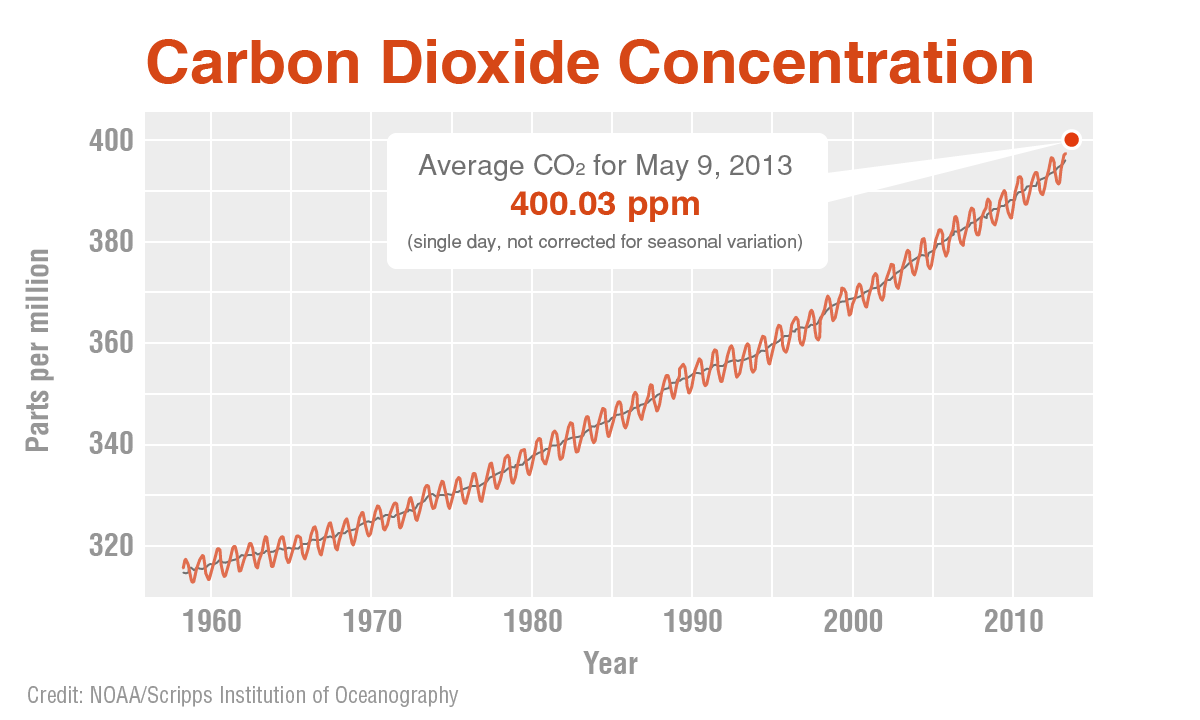
Basically: wrong. Here's the graph of measured change in carbon dioxide since 1958: https://climate.nasa.gov/syste...
The rise is a lot more than "4%".
It's not a mystery why CO2 and temperatures have shown no correlation.
Again: wrong. Here's a graph of carbon dioxide and temperature over the last fifty years: https://www.e-education.psu.ed...
And here's a graph of carbon dioxide and temperature over the last four hundred thousand years: http://www.dokimiscience.com/u...
Your claim "no correlation" is silly. Get some facts before posting, Mr. Coward.
But it's not politically expedient to point out the obvious.
But it does seem to be politically correct to post false facts if you're an anonymous coward.
-
Re:One active season and now everything is differe
Please read this page very carefully:
https://climate.nasa.gov/evide...
Also the other tabs.Causes, Effects, Scientific Consensus...
-
Water [Re:Deforrestation of the Amazon]
Massive deforestation is not being considered? Seriously.
indeed. A fascinating image of carbon dioxide concentration in the atmosphere here: https://www.nasa.gov/feature/g...
The thing to look at is not merely the carbon dioxide being emitted from the northern hemisphere-- it's fascinating to look at the plume of carbon-dioxide depleted air wafting off of the rain forests of south America.
One unit of burnt coal or gas produces 1 unit of CO2 and one of H2O! Yes, water is a greenhouse gas.
Indeed, water is a greenhouse gas. But.
But water precipitates out of the atmosphere very very fast, so the water actually emitted by humans doesn't really contribute for very long. The carbon dioxide, on the other hand, sticks around for an estimated lifetime of about a hundred years. More to the point, the hundred and fifty million square miles of ocean surface evaporates so much water into the atmosphere that the amount emitted by humans really is, in this case, trivial-- the equilibrium water content of the atmosphere is driven by evaporation, not by direct emission.
For the most part, the humidity in the atmosphere is driven by the temperature, not vice versa.
-
Re:El Nino and climate changes
40% of NASA's budget was going to global warming research
Where did you get that number, by the way ?
I can't really find it in their 2016 budget. https://www.nasa.gov/sites/def...
He was lying. The budget figures are correct.