Slashdot Mirror
Domain: nasaspaceflight.com
Stories and comments across the archive that link to nasaspaceflight.com.
Comments · 215
-
'not the only possibility'
= certainly not correct.
It's CRS4 - the fourth launch to ISS.http://forum.nasaspaceflight.c...
The logo wasn't painted quite the same each time, and is very clear from the part.
-
This is the top of stage 1 of falcon 9.
http://www.spacex.com/sites/al...
I don't know if it's clear what launch it's from. Several have gone into the ocean, both from attempts at landing on the barge, and ditching in the ocean.
This is the top of the first stage. There may be an empty helium tank inside this acting as flotation. The helium tanks are really robust, and have separately survived even really fast impacts.
http://forum.nasaspaceflight.c... -
Will someone please "upgrade" the eds.?
Please could someone explain what "upgraded to lower cost" mean?
As for "upgraded for the launch"...what? Could it not lauch prior to the upgrade?
The linked article makes no referenece to either.Much better information here:
http://www.nasaspaceflight.com...
And even here:
-
moscow girls really knock me out...
As a straight guy I think I'd rather spend my time with this crew on a lunar expedition: http://www.nasaspaceflight.com...
-
Re:the USA is Portugal
JAXA is currently flying its second asteroid material return mission, Hayabusa 2. The first was not a total success but the craft did get to its target and return a capsule to Earth. Number of NASA asteroid material return missions, zero.
Hayabusa 2 is carrying a lander built by the French CNES and three smaller "hopping" landers as well as an IED meant to blow a hole in the asteroid's surface to expose fresh material for inspection and analysis.
http://www.nasaspaceflight.com...
There's a lot of difficult science to be done (tm GlaDOS) out in the solar system, we can't expect the US to do all of it.
-
Full Text + links from Hacked.com
Scientists Confirm 'Impossible' EM Drive Propulsion
Science News, Space / July 27, 2015 / by Giulio Prisco/
Later today, July 27, German scientists will present new experimental results on the controversial, "impossible" EM Drive, at the American Institute for Aeronautics and Astronautics' Propulsion and Energy Forum in Orlando. The presentation is titled "Direct Thrust Measurements of an EmDrive and Evaluation of Possible Side-Effects."
Presenter Martin Tajmar is a professor and chair for Space Systems at the Dresden University of Technology, interested in space propulsion systems and breakthrough propulsion physics.
A Revolutionary Development for Space Travel
The EM Drive (Electro Magnetic Drive) uses electromagnetic microwave cavities to directly convert electrical energy to thrust without the need to expel any propellant. First proposed by Satellite Propulsion Research, a research company based in the UK founded by aerospace engineer Roger Shawyer, the EM Drive concept was predictably scorned by much of the mainstream research community for allegedly violating the laws of physics, including the conservation of momentum.
However, NASA Eagleworks – an advanced propulsion research group led by Dr. Harold G. “Sonny” White at the Johnson Space Center (JSC) – investigated the EM Drive and presented encouraging test results in 2014 at the 50th Joint Propulsion Conference.
White proposes that the EM Drive’s thrust is due to virtual particles in the quantum vacuum that behave like propellant ions in magneto-hydrodynamical propulsion systems, extracting "fuel" from the very fabric of space-time and eliminating the need to carry propellant. While a number of scientists criticize White's theoretical model, others feel that he is at least pointing to the right direction. The NASASpaceFlight website and forums have emerged as unofficial news source and discussion space for all things related to the EM Drive and related breakthrough space propulsion proposals such as the Cannae Drive.
Shawyer has often been dismissed by the research establishment for not having peer-reviewed scientific publications, but White and Tajmar have impeccable credentials that put them beyond cheap dismissal and scorn. Physics is an experimental science, and the fact that the EM Drive works is confirmed in the lab. "This is the first time that someone with a well-equipped lab and a strong background in tracking experimental error has been involved, rather than engineers who may be unconsciously influenced by a desire to see it work," notes Wired referring to Tajmar's work.
Hacked has obtained a copy of Tajmar's Propulsion and Energy Forum paper, co-authored by G. Fiedler.
"Our measurements reveal thrusts as expected from previous claims after carefully studying thermal and electromagnetic interferences," note the researchers. "If true, this could certainly revolutionize space travel."
“The nature of the thrusts observed is still unclear.”
"Additional tests need to be carried out to study the magnetic interaction of the power feeding lines used for the liquid metal contacts," conclude the researchers. "Nevertheless, we do observe thrusts close to the magnitude of the actual predictions after eliminating many possible error sources that should warrant further investigation into the phenomena. Next steps include better magnetic shielding, further vacuum tests and improved EMDrive models with higher Q factors and electronics that allow tuning for optimal operation."
Contrary to sensationalist reports published by the sensationalist press, the EM Drive is not a "warp drive" for faster than
-
Full Text + links from Hacked.com
Scientists Confirm 'Impossible' EM Drive Propulsion
Science News, Space / July 27, 2015 / by Giulio Prisco/
Later today, July 27, German scientists will present new experimental results on the controversial, "impossible" EM Drive, at the American Institute for Aeronautics and Astronautics' Propulsion and Energy Forum in Orlando. The presentation is titled "Direct Thrust Measurements of an EmDrive and Evaluation of Possible Side-Effects."
Presenter Martin Tajmar is a professor and chair for Space Systems at the Dresden University of Technology, interested in space propulsion systems and breakthrough propulsion physics.
A Revolutionary Development for Space Travel
The EM Drive (Electro Magnetic Drive) uses electromagnetic microwave cavities to directly convert electrical energy to thrust without the need to expel any propellant. First proposed by Satellite Propulsion Research, a research company based in the UK founded by aerospace engineer Roger Shawyer, the EM Drive concept was predictably scorned by much of the mainstream research community for allegedly violating the laws of physics, including the conservation of momentum.
However, NASA Eagleworks – an advanced propulsion research group led by Dr. Harold G. “Sonny” White at the Johnson Space Center (JSC) – investigated the EM Drive and presented encouraging test results in 2014 at the 50th Joint Propulsion Conference.
White proposes that the EM Drive’s thrust is due to virtual particles in the quantum vacuum that behave like propellant ions in magneto-hydrodynamical propulsion systems, extracting "fuel" from the very fabric of space-time and eliminating the need to carry propellant. While a number of scientists criticize White's theoretical model, others feel that he is at least pointing to the right direction. The NASASpaceFlight website and forums have emerged as unofficial news source and discussion space for all things related to the EM Drive and related breakthrough space propulsion proposals such as the Cannae Drive.
Shawyer has often been dismissed by the research establishment for not having peer-reviewed scientific publications, but White and Tajmar have impeccable credentials that put them beyond cheap dismissal and scorn. Physics is an experimental science, and the fact that the EM Drive works is confirmed in the lab. "This is the first time that someone with a well-equipped lab and a strong background in tracking experimental error has been involved, rather than engineers who may be unconsciously influenced by a desire to see it work," notes Wired referring to Tajmar's work.
Hacked has obtained a copy of Tajmar's Propulsion and Energy Forum paper, co-authored by G. Fiedler.
"Our measurements reveal thrusts as expected from previous claims after carefully studying thermal and electromagnetic interferences," note the researchers. "If true, this could certainly revolutionize space travel."
“The nature of the thrusts observed is still unclear.”
"Additional tests need to be carried out to study the magnetic interaction of the power feeding lines used for the liquid metal contacts," conclude the researchers. "Nevertheless, we do observe thrusts close to the magnitude of the actual predictions after eliminating many possible error sources that should warrant further investigation into the phenomena. Next steps include better magnetic shielding, further vacuum tests and improved EMDrive models with higher Q factors and electronics that allow tuning for optimal operation."
Contrary to sensationalist reports published by the sensationalist press, the EM Drive is not a "warp drive" for faster than
-
Falcon Heavy will land 3 boosters per mission
Check out this video of Falcon Heavy. They plan to land and reuse all 3 boosters at the landing site they have leased at the Kennedy Space Centre. Saving 9 engines from a Falcon 9 is a considerable savings but saving all 27 engines from a Falcon Heavy launch would bring the cost per kg down to perhaps $100.
-
Re:Icehouse Earth
I haven't heard the idea of seeding algal blooms with iron salts in the ocean in order to fix carbon being disproved.
I don't in general trust politicians as they tend to break more than they fix (usually due to either greed, or oversimplification).
I haven't heard of any good proposed solutions:
Carbon Cap & Fail is more central control (theft & waste), and disastrous for it.
Everyone biking isn't going to happen.
Everyone riding the bus shouldn't happen.
In general it seems to be alot more media to the tune of 'the world's on fire', and no decent solutions, let alone decent proposals.
On the other hand that is assuming all the facts are accurate, and that the assumptions based on them are correct. I don't believe that we understand this planet well enough to determine the cause yet, and probably not within my life time:
How accurate is the next days weather forecast, to a single degree? Let alone a week out, or a year...
'Climatology' is a rather young science.
Physics is rather mature (by our standards). Do you believe in the conservation of momentum? It actually doesn't hold. This has been proven by three separate groups, over the last few years, yet we still believe in this 'conservation of momentum': http://www.nasaspaceflight.com...
In all seriousness, my point is that the world is far more complicated than we would like to believe. We only feel we understand a topic when it is comfortable to us, and that comfort is our understanding (fear of the unknown), but it is ALWAYS a gross oversimplification. We are always wrong, about everything, all of the time. The question is 'how wrong are we?'. The question is not 'are we right?'. We are never accurate enough to be called right, only, hopefully 'good enough' for the task at hand.
I don't see anything in this other than more central government control, and media buzzwords. What of the algal blooms? I am not arguing we should geo-engineer the planet, but I haven't seen that (the only viable idea) defeated by anyone, on its merits,
Regardless we shouldn't ruin ourselves in a blind frenzy to 'save the planet' (or centralize control, which is the same thing). Either way I support more research dollars for things like Thorium reactors, and solar power, as they may be the solution anyway, and the could only help. -
Re:ablation by laser
Beam enough laser light at the object to heat its surface to the point that it ablates
Another extreme light solution, also reliant on melting its surface are giant parabolic mirrors deployed near the object. This interesting discussion points out some of the realities of gathering and focusing sunlight.
Once our civilization hits Stage 1.5 on the Kardashev scale we might revisit an idea proposed in 1993 by Paul Birch, How to Move a Planet through the use of what he calls a 'solar windmill' to transfer angular momentum between the sun and planets. It's Rube Goldberg as hell!
"We conclude that through the use of high-velocity dynamic compression member to apply forces efficiently, planetary orbits can be modified on convenient engineering timescales ~30 years, that the cost of such operations is not excessive in conjunction with terraforming or artificial-planet-building projects, that energy can be converted to and from orbital energy with little loss, and that the technique may also apply to the regularisation of stellar motions."
Then we could just bob the Earth and scoot it out of the way. If lowly earthworms are deserving of our protection, surely an asteroid may be.
-
Re:Sort-of-worked.
No, OP's remark was correct, he is not discussing the planned pitch over towards the sea after half a second, but a visible puff of smoke around the 4 second mark and some subsequent 'wobble', as if one of the 8 thrusters is switched of. See the zoomed video here. This proves the effectiveness of having 8 redundant thrusters, instead of having only 4. It is still not clear if this was a real engine failure (which might be verified via post-mortem examination of the motor), or if this was a deliberate, unannounced test of the 'engine out' capability. Credit: the discussion in the forum over at nasaspaceflight.com.
-
Who's saying it is a warp drive?
While some are claiming this means things like warp drive [...] are right on the horizon
Who are these "some"? The article linked to by the sentence makes no mention of any claims of it being a warp drive.
And then this from the Forbes article:
When you come across an announcement like the one made by NASA Spaceflight a week ago: that NASA has made a successful test of the EM Drive — a propulsion engine that uses no propellant, seemingly violating one of the most fundamental laws of physics, while warping space in the process — you’d better make sure you aren’t fooling yourself.
The linked announcement makes no mention of warping space, so the bolded section seems inaccurately disparaging.
It sounds to me like the guy who wrote the article has fooled himself into believing that someone has claimed it's a warp drive for the purpose of being able to find something to write indignantly about.
Come to think of it, the writer doesn't even seem to be sure of who's who in this scenario. "When you come across an announcement [...] you'd better make sure you aren't fooling yourself." Why would I be fooling myself by simply reading an announcement? Surely it's the people who make the announcement that should make sure they're not fooling themselves. Which I might think they were, if they'd said anything about warping space. Which they didn't.
So just who are these apparently imaginary people that the summary/article is railing against?
-
Re:This is not a photon drive
Bzzt. Wrong. Those conjectures were from from Paul March who is "an engineer at NASA Eagleworks". None of the authors are named March.
The article text you quoted is completely ambiguous as to where "EM Drive propulsion conjectures" come from. If March had his own theory, then we'd be hearing about it more than the EM drive inventors' theory. I haven't. You find me the post where he claims to have this theory in the megathread the article was based on, and I'll concede the point.
I see no signs of such evidence here.
There is sufficient evidence of an anomolous result. Whether this result can be accounted for by conventional physics, either due to experimental error or because of some hitherto untested combination of physical mechanisms, remains to be seen.
-
Re: Elon Musk
-
Re:why is this needed?
Because the old ports use a mechanical capture mechanism that will soon exceed its planned lifetime. The new ports will use an electromagnetic soft capture mechanism which is much more durable.
http://www.nasaspaceflight.com/2015/02/astronauts-spacewalk-re-wire-iss-commercial-crew/
-
Re:The sea isn't very stable.
They want to land on the sea platform, refuel from fuel tanks on the sea platform, then take off again and fly back to the launch location. http://www.nasaspaceflight.com...
-
Re:Why not on land?
It's FAA, but both SpaceX and FAA are working on that.
-
Re:Faith in future
NASA isn't even planning on the first crewed flight until the year 2024. Yeah, I have faith in the U.S. government getting things right.
-
Re:There's a reason why...
-
Re:Horrible track record
You mean like this?
http://www.nasaspaceflight.com...
Two of their engines have blown caught fire, or blown up on the test harness. This adds a third explosion. They have successfully launched 3 times. Thus 3 time engines have blown up and 3 successful launches. Depending on how you look at this you will get different percentages.
4 engines have been destroyed, 6 have operated to their objective. You could also look at it as there are 3 disasters and 3 successes. You could also look at it that there have been 3 successful launches and 1 failed launch.
The way I look at it is that Orbital has cost NASA probably a few billion dollars in failures, and thousands of man hours. Two of those failures have been this year. I would call that pretty abysmal. -
Re:Would this kind of system have saved Challenger
Second, the boosters cannot be shut off. That's the big safety drawback of solid rockets - you light them, and they aren't going out until they're out of fuel.
*sigh* This is one of the biggest pieces of misinformation about solid rockets floating about out there, spread and repeated by shuttle detractors in a cargo cult like fashion until it's now regarded as a law of nature. What most people (including engineers who should know better) don't realize is that you don't need to shut them down in the first place- you just need them to produce net zero thrust. This is done via blowout panels in the front dome, and sometimes by blowing off the nozzle as well. And it's not like this is a new fangled technique either... It was used on the Polaris A-1 and A-2, Poseidon C-3, SUBROC, ASROC, Minuteman I and -II, and Peacekeeper missiles. It would have been used of the SRB's of the Titan IIIC booster for manned Dyna-Soar and MOL launches. It's used by Minuteman III missiles...
It wasn't used by the Shuttle because during the SRB burn, the SRB's are essentially 'dragging' the ET behind it... and thrust termination would have resulted in them 'hanging' from the ET or having to be jettisoned and the resulting changes in structural loads would have shredded the ET and tossed the Orbiter into the airstream where it would be broken up. (Which is essentially what happened to Challenger.) A normal SRB jettison doesn't shred the ET, because the loads come off gradually as SRB thrust decays and they're jettisoned as the T/W ratio passes through 1.
NASA looked at using an Orbiter mounted solid rocket to power it away from the stack, but even if the motor was used on a normal flight for orbital insertion after ET jettison it was too heavy.
Third, the Main engines are nearly useless in-atmosphere. They're lit mainly because they sometimes fail to light, and having that failure occur halfway to orbit would suck. The "boosters" provide about 80% of the thrust, if memory serves. The SSMEs aren't even at full throttle for much of the flight - Challenger had just set them to full when the stack exploded.
A friend of mine, an aerospace engineer by trade, once explained it thusly - "during first stage flight, the SRB's lift the ET and the SSME's lift the orbiter". This isn't entirely true, but it's a useful first approximation. And that being said, other than a brief time right around Max-Q (when the throttles are backed off to control aerodynamic loads) and as MECO approaches (when the throttles are backed off to control G loads) the engines are in fact run at full throttle during powered flight.
-
Re:Real results announced here
The official news (not WSJ speculation) will be revealed on a live feed today at 4PM EDT. Lots of info in the link below. Link: http://forum.nasaspaceflight.c...
Bingo. OTH (and to add more fuel to the speculation pyre), WP is reporting that the news will announce contracts will be awarded to both Boeing and SpaceX. http://www.washingtonpost.com/...
-
Real results announced here
The official news (not WSJ speculation) will be revealed on a live feed today at 4PM EDT. Lots of info in the link below.
Link: http://forum.nasaspaceflight.c... -
Re:You keep using that word
I tried to find an example Space Shuttle mission that I could use to compare, but I can't even find a comprehensive list of "anomalies". I can find rollbacks, where the problem required bringing the vehicle back to the assembly building, but I can't find a list even of countdown stops.
The problem is that nearly every Shuttle flight had significant "anomalies". These were all reported in-house with things like this report for what in this case was very late in the flight history of the Shuttle program. For that matter, I don't think you could find a single flight by anybody other than perhaps North Korea (because you know how excellent the aerospace engineers are that work for that country) which didn't have at least some sort of technical problem on each and every flight.
BTW, I agree with the rest of your statement here too. This letter by these congressmen is in fact fodder for an opponent to really crucify them, assuming that the general public cared much about space policy in the first place.
-
Re:Digital vs analog
No, codec was MPEG4 as explained by the author of ffmpeg!
-
Re:Digital vs analog
Codec was MPEG4 in an MPEG-TS transport stream. The author of ffmpeg confirms it here.
-
Re:Summary of techniques used?
Hi, I'm the user "Princess" on the NSF site and I've mainly been involved with cleaning up the file at the TS level. I can answer any questions you like. The best summary for the Slashdot audience would be this one by Lourens, it explains things simply without dumbing things down. The types of problems we have are basically that bits have been either flipped or (rarely) omitted. The flips tend to clump together, i.e. you'll get an area that's good and then an area that's awful. The work is approximately divided into two parts: fixing up the file, and fixing up the video that results. I work on fixing the file, and from that I can find extra frames and pieces of MPEG4 data for the video people. Fixing the video is done by using a modified version of ffmpeg that can change macroblock pointers, ordering, luma and chroma. This work is not done on the file directly and can't easily be mapped back to the file, so it's not just a question of flipping bits once you get to the video level. Other technical info: The video itself is a broadcast (fixed bandwidth) MPEG-TS stream containing one video stream, a 704x480 MPEG4 stream at approx. 15 fps (technically half the NTSC framerate which is 15000 / 1001 fps).
-
Some calculations
So NASA spent $1.6 billion for the CRS program, that is for 12 missions [1]. That is $75 million for mission. The payload of the CRS-3 mission, the biggest so far by the way, was 4,605 pounds (the declared maximum is 7,300 lb)[2], in other words $16,200 for pound of payload, including packaging. I'd like to know how does that compare to other space transport services.
-
Re:Test and launch are the same, it is GREAT!
RTLS, TAL and AOA all relied on the main engines. If all three SSMEs failed they would have ditched it in the Atlantic. The scenarios aren't really comparable - they had a lot more fuel to work with but also a much heavier vehicle to return.
RTLS is easier for the Falon 9. After separation the stage 1 assembly is quite light: it has shed the payload, second stage, and most importantly, most of its own fuel; the remainder is about 5% of the original mass. It can therefore make a pretty quick burn to reverse its course.
They have some real numbers over here: http://forum.nasaspaceflight.c... .
-
Re:However..
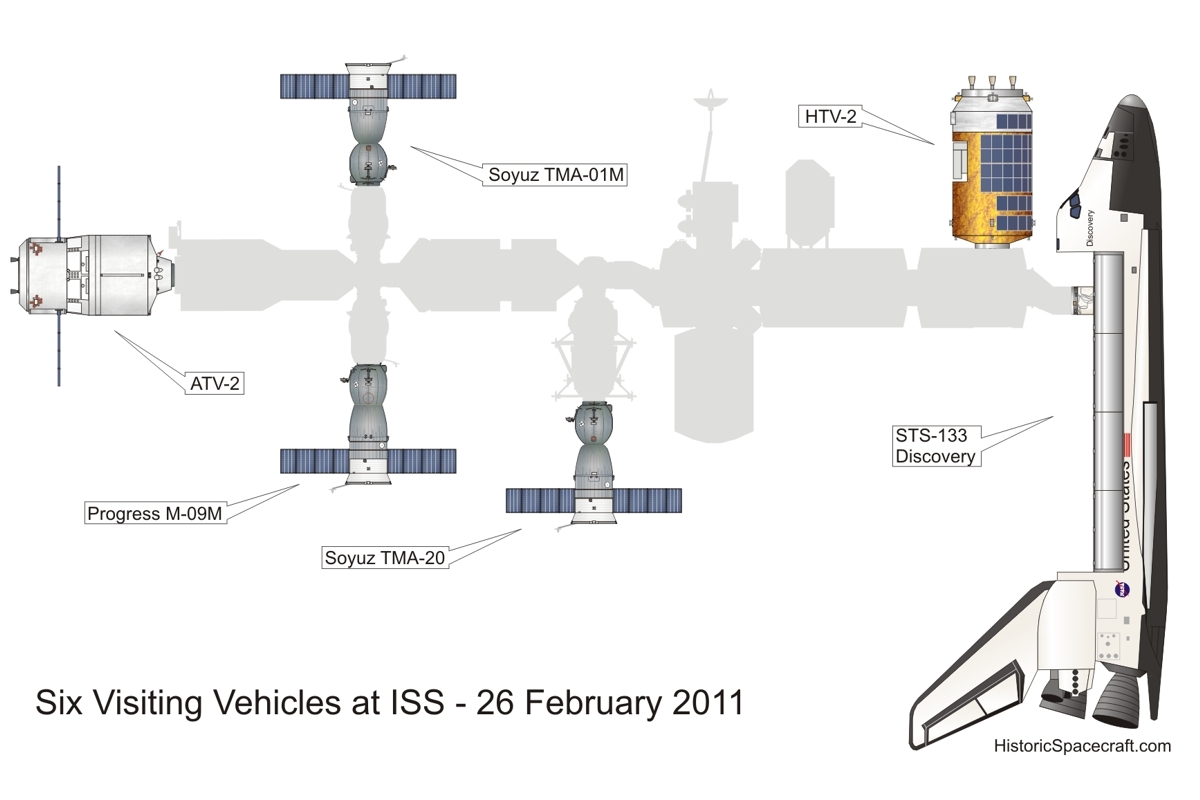
Seems like they could have launched some kind of lifeboat or three up to dock with them within 30 days.
How long would it have taken the Russians to prep a Proton rocket to deliver unmanned Soyuz capsules (and an airlock adapter) to them?Eh, it would have looked bad to ask for help from the Russians. Nevermind.
http://www.nasaspaceflight.com...
http://historicspacecraft.com/... -
Re:"Back to the launch site"?
How does this work? The rocket will have gone far down range before the first stage separates.
* First stage reverses direction and comes back. Very fuel expensive, I'd be amazed if they're planning this.
That's exactly what they intend to do. They refer to it as "boost back." Fuel is cheap compared to the price of a rocket. Right now they are working on a fully reusable first stage and a capsule that lands under propulsive power. After that they'll work on the second stage returning (it can just complete an orbit instead of boosting back. Here's an animation they put out to show the concept.
Here's an article explaining the current status of the effort and what they hope to achieve with this test.
-
SpaceX
Recovering the first stage (not this time but maybe this year) will make a huge difference in cost. Saving the 9 engines on the first stage alone is huge.
Much more detail here:
http://www.nasaspaceflight.com... -
Further Insight into the Cargo
-
Fixed link
...to the second picture.
-
manned cabin
since Boeing showed these 2 years ago, I'm sure the retrofit is ready by now. The Air Force will never give up their backdoor access to space. This picture here is about all I can find...but if they drew out plans like that then the Air Force probably has it built already.
-
Re:OK
-
Re:Wall Street Journal
And here's a detailed write-up with lots of background and pictures: http://www.nasaspaceflight.com/2013/09/spacex-debut-falcon-9-v1-1-cassiope-launch/
-
New or old data link format?
There's a data link between the ISS and docking vehicles. A new version of that was developed recently. Here's the presentation on that. But it doesn't seem to be operational yet. NASA has been talking about the new C2V2 system for years, and commercial spacecraft were supposed to be designed to use it. But it's not ready yet.
So Space-X and Orbital Sciences had to also develop a temporary capability to use the old automated docking system, which, I think, is derived from the Soviet-era Kursk system.
-
Re:GNSS
India just launched their first satellite for their version of GPS yesterday.
This one was successful. The Chinese version is successful too
-
Re:These flights have nothing to do really with sp
You were right the first time. SSO only reached 112km, which is roughly equivalent to 1.5km/s of d-V.
Hmmm, when I last did the calculation, I thought there was considerable horizontal velocity (of 1,200 m/s, but that turns out to be the maximum speed during the trajectory). That is quite wrong since the trajectory was almost straight up. It does simplify the calculation though.
So let's take your number of 1.5 km/s of delta-v for the highest trajectory. For that trajectory, the engines burned for 80 seconds straight up (I had 65 seconds which I believe was for the first flight which barely passed 100km). That's roughly 750 m/s of delta-v lost to gravity losses, meaning the engine plus initial velocity produced roughly 2,250 m/s of delta-v. Even if we assume White Knight was flying at 300 m/s straight up when SpaceShipOne detached, that's at least 1,950 m/s of delta-v from the rocket engine.
So you still end up with roughly quarter of the delta-v required to get to orbit. -
Space:1999
You might be interested in the Eagle lander's great grandfather: Masten are doing a study for Lockheed Martin on the Dual thrust axis moon lander (DTAL). [pdf, 19 pages] Which has led to their Xeus concept.
-
Gogo Canada!
Also on the PSLV-C20 launch are the Canadian military satellite SAPPHIRE, and the twin spacecraft BRITE-Austria and UniBRITE, developed in Canada for TU Graz and University of Vienna respectively. ISRO put out a pretty good brochure describing the launch.
You can find some good photos of the stacking and launch vehicle integration here, here, and here. You can watch the launch live on Monday morning here.
Needless to say, we're all pretty stoked around here ^__^
-
Re:Of course
A complete analysis of the case has been given on NasaSpaceFlight forum: http://forum.nasaspaceflight.com/index.php?topic=11734.msg1007858#msg1007858
Also quoting from foxnews:
onathan McDowell, a Harvard astronomer who tracks rocket launchings and space activity, also said this week's monkey space flight was real, but he had a slightly different explanation for the photo mix-up. He claimed the light gray monkey with the mole died during a failed space mission in 2011."The monkey with the mole was the one launched in 2011 that died. The rocket failed. It did not get into space," McDowell said. "They just mixed that footage with the footage of the 2013 successful launch."
http://www.foxnews.com/science/2013/02/02/iranian-space-official-says-photo-shows-wrong-monkey/ -
Re:WRONG
I know what was said in the article. It was a HORRIBLE article.
But think about it. There are no launchers today that can launch more than 21 tonnes. Delta IV heavy is the largest going today.
And yet, they are claiming that it would be 65 tonnes within 2 years? The author in this article is messing up all sorts of facts.
What is really missing is, that this can NOT be assembled in space. These are single units, i.e. it must be launched as one unit. here you go. -
Re:Inexpensive way to send up inert objects
As the vehicle bleeds off energy to atmospheric drag and gravitational forces as it coasts upward, it has to leave the muzzle of the gun at considerably more than orbital velocity... essentialy exposing the payload to re-entry conditions at launch.
The video discusses this point. He really did cover all the bases.
Nobody that I'm aware that's even remotely serious is proposing to do [an Apollo-style mission to Mars]
NASA seems to be at least remotely serious about this mission, an Apollo-style launch. It's not a manned launch (even though Wikipedia seems to report that it is). The plan seems to be that astronauts would rendezvous with the sample return package, but astronauts would not ride this thing to Mars and back. Still, the sample-return mission is indeed an Apollo-style mission: everything launches on a single heavy lift rocket.
http://www.nasaspaceflight.com/2012/11/nasa-interest-2024-mars-sample-return-sls-orion/
I'm pretty sure I saw some newspaper article about a manned mission done with a single launch, but perhaps I was mistaken.
-
Summary is misleading.
The summary makes absolutely no mention at all of the next-gen rocket, SLS (capable of well over 100mT to orbit), which is being finished up. The boosters for it have been test-fired already (as have the main engines, which are left-over Shuttle main engines, and the upper stage for now is a big version of the Delta IV upper stage), and it is on-track for CDR. SLS will use LC-39A and the VAB. NASA and Florida are just looking for others who would also like to use the facilities, since they won't be in constant use. Boeing is already using one of the Shuttle processing buildings for their CST-100, which is part of NASA's "commercial crew" program and is already very far along, having tested its parachutes, heatshield, abort thrusters, airbags, etc.
Now, I'm quite skeptical with the idea of going back to 100+mT rockets for exploration instead of multiple commercial 15-30mT rockets (which have other, current customers and so are cheaper and will be around as long as the US is a country and which may shortly be capable of reusable flight), and especially I'm skeptical of the zipcode-engineered SLS, but it IS the current plan and it has lots of Congressional support and I'll cheer it along and enjoy its launches. People deserve to know that it's actually being built and that the VAB and LC-39A are going to be used by it, not all this BS about "oh, 'Bama canceled NASA, so they're having a fire sale." NASA's budget is still about the same (which is only about half of a percent of the federal budget, by the way), and the International Space Station is doing just fine with NASA astronauts in it, being resupplied with cargo by American spacecraft (SpaceX's Dragon right now has made two successful supply runs up and safely back down, soon to be joined by Orbital Science's Cygnus), and soon Dragon will be also shuttling the astronauts up and down to Station. http://www.nasaspaceflight.com/2013/01/yir-part4-iss-new-year-successful-2012/
Oh, another thing is that NASA is currently experimenting with a deep space habitat based on ISS modules and a Space Exploration Vehicle for going to asteroids or the moons of Mars. NASA retired Shuttle, and a dang good thing, too! Now we can really go explore beyond the confines of the Earth's gravitational influence.
Also, NASA's Orion capsule is VERY far along, has done several tests already and will do its first orbital test in the late 2014 time frame. This means by the time President Palin (or whathaveyou) is inaugurated, NASA will have essentially 3 man-rated capsules (Dragon, Orion, and Boeing's CST-100) already flight tested and a big-ass rocket built and prepping for launch (in 2017). NASA is NOT fracking canceled.
http://www.nasaspaceflight.com/2013/01/sls-cdr-engineers-work-baffling-issue/.
.About the SEV: http://www.nasa.gov/exploration/technology/space_exploration_vehicle/index.html
About the Deep Space Hab using ISS heritage or possibly even just existing ISS spares: http://www.nasaspaceflight.com/2012/03/dsh-module-concepts-outlined-beo-exploration/ -
Summary is misleading.
The summary makes absolutely no mention at all of the next-gen rocket, SLS (capable of well over 100mT to orbit), which is being finished up. The boosters for it have been test-fired already (as have the main engines, which are left-over Shuttle main engines, and the upper stage for now is a big version of the Delta IV upper stage), and it is on-track for CDR. SLS will use LC-39A and the VAB. NASA and Florida are just looking for others who would also like to use the facilities, since they won't be in constant use. Boeing is already using one of the Shuttle processing buildings for their CST-100, which is part of NASA's "commercial crew" program and is already very far along, having tested its parachutes, heatshield, abort thrusters, airbags, etc.
Now, I'm quite skeptical with the idea of going back to 100+mT rockets for exploration instead of multiple commercial 15-30mT rockets (which have other, current customers and so are cheaper and will be around as long as the US is a country and which may shortly be capable of reusable flight), and especially I'm skeptical of the zipcode-engineered SLS, but it IS the current plan and it has lots of Congressional support and I'll cheer it along and enjoy its launches. People deserve to know that it's actually being built and that the VAB and LC-39A are going to be used by it, not all this BS about "oh, 'Bama canceled NASA, so they're having a fire sale." NASA's budget is still about the same (which is only about half of a percent of the federal budget, by the way), and the International Space Station is doing just fine with NASA astronauts in it, being resupplied with cargo by American spacecraft (SpaceX's Dragon right now has made two successful supply runs up and safely back down, soon to be joined by Orbital Science's Cygnus), and soon Dragon will be also shuttling the astronauts up and down to Station. http://www.nasaspaceflight.com/2013/01/yir-part4-iss-new-year-successful-2012/
Oh, another thing is that NASA is currently experimenting with a deep space habitat based on ISS modules and a Space Exploration Vehicle for going to asteroids or the moons of Mars. NASA retired Shuttle, and a dang good thing, too! Now we can really go explore beyond the confines of the Earth's gravitational influence.
Also, NASA's Orion capsule is VERY far along, has done several tests already and will do its first orbital test in the late 2014 time frame. This means by the time President Palin (or whathaveyou) is inaugurated, NASA will have essentially 3 man-rated capsules (Dragon, Orion, and Boeing's CST-100) already flight tested and a big-ass rocket built and prepping for launch (in 2017). NASA is NOT fracking canceled.
http://www.nasaspaceflight.com/2013/01/sls-cdr-engineers-work-baffling-issue/.
.About the SEV: http://www.nasa.gov/exploration/technology/space_exploration_vehicle/index.html
About the Deep Space Hab using ISS heritage or possibly even just existing ISS spares: http://www.nasaspaceflight.com/2012/03/dsh-module-concepts-outlined-beo-exploration/ -
Summary is misleading.
The summary makes absolutely no mention at all of the next-gen rocket, SLS (capable of well over 100mT to orbit), which is being finished up. The boosters for it have been test-fired already (as have the main engines, which are left-over Shuttle main engines, and the upper stage for now is a big version of the Delta IV upper stage), and it is on-track for CDR. SLS will use LC-39A and the VAB. NASA and Florida are just looking for others who would also like to use the facilities, since they won't be in constant use. Boeing is already using one of the Shuttle processing buildings for their CST-100, which is part of NASA's "commercial crew" program and is already very far along, having tested its parachutes, heatshield, abort thrusters, airbags, etc.
Now, I'm quite skeptical with the idea of going back to 100+mT rockets for exploration instead of multiple commercial 15-30mT rockets (which have other, current customers and so are cheaper and will be around as long as the US is a country and which may shortly be capable of reusable flight), and especially I'm skeptical of the zipcode-engineered SLS, but it IS the current plan and it has lots of Congressional support and I'll cheer it along and enjoy its launches. People deserve to know that it's actually being built and that the VAB and LC-39A are going to be used by it, not all this BS about "oh, 'Bama canceled NASA, so they're having a fire sale." NASA's budget is still about the same (which is only about half of a percent of the federal budget, by the way), and the International Space Station is doing just fine with NASA astronauts in it, being resupplied with cargo by American spacecraft (SpaceX's Dragon right now has made two successful supply runs up and safely back down, soon to be joined by Orbital Science's Cygnus), and soon Dragon will be also shuttling the astronauts up and down to Station. http://www.nasaspaceflight.com/2013/01/yir-part4-iss-new-year-successful-2012/
Oh, another thing is that NASA is currently experimenting with a deep space habitat based on ISS modules and a Space Exploration Vehicle for going to asteroids or the moons of Mars. NASA retired Shuttle, and a dang good thing, too! Now we can really go explore beyond the confines of the Earth's gravitational influence.
Also, NASA's Orion capsule is VERY far along, has done several tests already and will do its first orbital test in the late 2014 time frame. This means by the time President Palin (or whathaveyou) is inaugurated, NASA will have essentially 3 man-rated capsules (Dragon, Orion, and Boeing's CST-100) already flight tested and a big-ass rocket built and prepping for launch (in 2017). NASA is NOT fracking canceled.
http://www.nasaspaceflight.com/2013/01/sls-cdr-engineers-work-baffling-issue/.
.About the SEV: http://www.nasa.gov/exploration/technology/space_exploration_vehicle/index.html
About the Deep Space Hab using ISS heritage or possibly even just existing ISS spares: http://www.nasaspaceflight.com/2012/03/dsh-module-concepts-outlined-beo-exploration/ -
Re:If rockets worked, this wouldn't be a problem
Fair enough. Out of 56 launches, ULA has had one partial failure, in 2007: the upper stage of an Atlas V rocket cut out early, so the NRO satellite didn't reach its proper orbit. That equates to a failure rate of less than 2 percent, so either someone's launching a lot of duds or the OP pulled the 5- to 10-percent figure out of his ass.
-
False alarm: stand down everyone....
According to this French site (as related on http://forum.nasaspaceflight.com/ Michael Cabane, scientific co-investigator on SAM says that there is no spectacular findings from the SAM instrument: http://www.cieletespace.fr/node/9823 I think that the announcement, if any, will concern hydrated minerals at Glenelg, possibly newly hydrated minerals such as salts. A Big Deal for planetary geologists, but not a bio-signature.