Slashdot Mirror
Domain: naturalgas.org
Stories and comments across the archive that link to naturalgas.org.
Comments · 24
-
Re:renewable resource
Hmm, shouldn't feed the anonymous trolls but here you go jackass. http://www.naturalgas.org/overview/background.asp
Trace amounts of He are in natural gas. You know natural gas is a chemical compound consisting of multiple elements?
-
Re:long term view missed, as mentioned
http://www.naturalgas.org/environment/naturalgas.asp
Even if you want to be willfully ignorant about Global Warming you are going to have trouble claiming the combustion of natural gas does not produce smog producing wastes like Nitrogen Oxides.
-
Re:NG
It looks like natural gas is going to be the fuel of choice for most new plants.
And then there are the conversions from gas to coal. GE has technology that can burn coal as clean as NG - so they say, but it costs too much compared to just using NG at current prices. And with the current boom in gas producton around the World and especially here in the US, gas prices are going to be low for a long time.
Frakking frakkers!
-
NG
It looks like natural gas is going to be the fuel of choice for most new plants.
And then there are the conversions from gas to coal. GE has technology that can burn coal as clean as NG - so they say, but it costs too much compared to just using NG at current prices. And with the current boom in gas producton around the World and especially here in the US, gas prices are going to be low for a long time.
-
Re:How is natural gas less carbon-intensive than c
Natural gas power plants are frequently combined-cycle, where the combustion of the gas occurs in a turbine engine driving a generator, and the waste heat then boils water to drive a second steam turbine. "Because of this efficient use of the heat energy released from the natural gas, combined-cycle plants are much more efficient than steam units or gas turbines alone. In fact, combined-cycle plants can achieve thermal efficiencies of up to 50 to 60 percent." from: http://www.naturalgas.org/overview/uses_eletrical.asp (their misspelling)
-
Re:What about impact on environment
-
Don't worry
There is so much unconventional methane available that we can just about forget about any other source of energy for centuries to come. We're seeing the leading edge of this as new technology makes shale gas economically feasible.
http://www.naturalgas.org/overview/unconvent_ng_resource.aspObama wasn't fibbing when he said America is: "The Saudi Arabia of Natural Gas". http://articles.latimes.com/2012/jan/26/nation/la-na-obama-energy-20120127
-
Re:Wow
Sorry for the double follow-up, hit submit too early.
And fracking is related to global warming because natural gas burning is yet another co2 producer. So unless you're one of those people convinced the evidence on co2 as a greenhouse gas is false, it's certainly related to global warming. Or are you trying to make the argument that the production of natural gas is unrelated to its consumption?
http://www.naturalgas.org/environment/naturalgas.asp#greenhouse
-
Re:Solving the wrong problem
You are quite correct, but you're misunderstanding the error. People know that a significant portion of our electric generation is from natural gas (24%), and they know that the majority of the world's reserves are in the Middle East. What you need to correct them on is the reasonable (but false) assumption that what portion of our supply we import comes from there and not Canada.
-
Re:No, think big oil and property taxes
big oil is healthy and Ain't gonna let it happen
Why not? Trains run on diesel just like buses and VW TDI cars.
Any new-built HSR system will be electric.
And guess what electric utility generators burn: fossil fuel. Big oil still has a major advantage over renewables on a calm night.
-
Nope, there's an awful lot of gas left....
Yearly consumption is about 20 billion cubic feet
Reserves are measured in hundred of trillions of cubic feet
So...enough for tens of thousands of years even if we double or triple the consumption, plenty to keep going until somebody invents the ZPM.
(Assuming I haven't mixed up what Americans think of as "billion" and "trillion")
-
Re:Not new age
There has been some nice work recently on what is available for uranium: http://www.physorg.com/news177839133.html Looks pretty scant. Unconventional gas has boosted estimated reserves here and in Europe quite a lot. Here is a description for the US. http://www.naturalgas.org/overview/unconvent_ng_resource.asp
-
Re:Quote from the Future
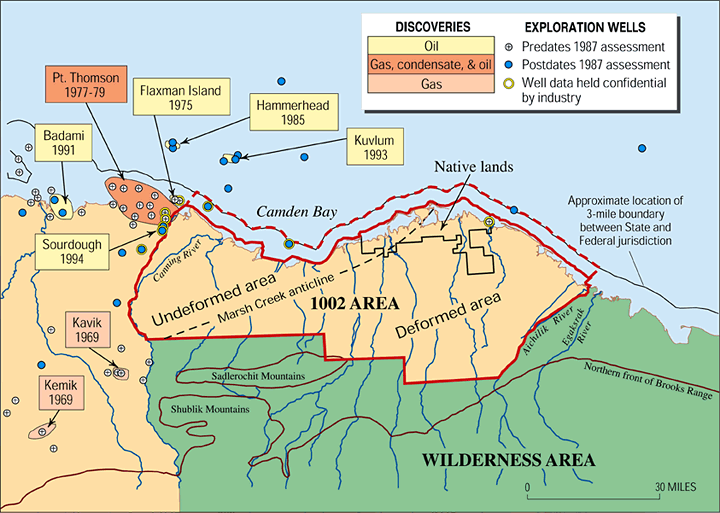
What were you trying to show with that link? Someone repeating a bunch of debunked talking points? Because that's what she's doing. For example, that "2000 acre" thing. The oil is not concentrated in one 2,000 acre area; it's in more than 30 deposits spread across 640,000 acres of Alaska's North Slope coastal plain (out of 1.5 million), which means stretching roads, pipelines, and other infrastructure that practically renders the area uninhabitable for large wildlife. Even if you only want to look at the "touching the ground" measure of how much land it takes up, the combination of oil infrastructure, drill sites, airports and roads, and gravel mines is *12,000* acres, not 2,000. No rivers in the North Slope? Um, BS. I mean, come on -- you think that all the water on the north side of Alaska drains all the way to the south? I could go on and on. This is a woman who thinks that an animal that spends most of its life hunting on ice flows isn't going to be adversely impacted by their imminent disappearance, and you're acting like she's some kind of environmentalist? Give me a break.
Actually it means horizontal drilling at safe distances below sea level.
It's not rocket science.
Department of Geology at Univ. of Wisconsin
http://www.geology.wisc.edu/courses/g115/oil/4.html
http://www.horizontaldrilling.org/Natural Gas Horizontal Drilling
http://www.greencarcongress.com/2008/01/researchers-say.html
Geothermal Conference on HD
http://www.nationaldriller.com/CDA/Articles/Industry_News/BNP_GUID_9-5-2006_A_10000000000000399698
NaturalGas.org
http://www.naturalgas.org/naturalgas/extraction_directional.asp
-
Re:Stability may be a big problem here.
-
Re:Compressed Air StorageThe above example uses an abondoned mine for compressed air storage, but the technology used to create Natural Gas Storage caverns has existed for a while.
In a location with salt,limestone or sandstone rock formations, they are dug with non-potable water injection (at 1100m) and pumping the slurry. NETL has a bit on Rock Storage Caverns dug in areas where the geology doesn't allow for water slurry construction.
I used to work for TransGas and they operate 901 million cubic meters of gas storage facilities. I toured the cavern facility at Regina, SK Canada a few years ago, it's a few miles from my house.
I sleep like a baby on a -20C winter night knowing there is 3 or 4 Penta Joules of gas tucked away there. -
Re:Nice Misleading Headline
And much effort is spent removing sulphur from the raw gas...
-
Natural Gas is plentiful
Please. Heating a house has nothing to do with America's dependency on foreign oil. Nearly all houses that don't use electricity directly for heating use natural gas, which is plentiful according to http://www.naturalgas.org/overview/resources.asp - 1090.997 Tcf (trillion cubic feet).
-
Re:Wait wait wait...
ya frick'n noob while natural gas is a fossil fuel there are other ways to produce it for example from http://www.naturalgas.org/
Natural gas can also be formed through the transformation of organic matter by tiny microorganisms. This type of methane is referred to as biogenic methane. Methanogens, tiny methane producing microorganisms, chemically break down organic matter to produce methane. These microorganisms are commonly found in areas near the surface of the earth that are void of oxygen. These microorganisms also live in the intestines of most animals, including humans. Formation of methane in this manner usually takes place close to the surface of the earth, and the methane produced is usually lost into the atmosphere. In certain circumstances, however, this methane can be trapped underground, recoverable as natural gas. An example of biogenic methane is landfill gas. Waste-containing landfills produce a relatively large amount of natural gas, from the decomposition of the waste materials that they contain. New technologies are allowing this gas to be harvested and used to add to the supply of natural gas.
So production of natural gas isn't fininte like with oil.
However the price of natural gas is the result of the frick'n energy companies since the 80's reducing the number of refineries and thus creating shortages(speculations) so they can reap the profits.
Which the gov should require energies companies to run at a min a number of refineries so this sh*t don't happen again.
greedy bastards. -
Re:US is getting desperateLOL! Another source, from another "Peak Oil" doomsdayer website. Any articles not from the fringe that you are able to offer up? As for searching in Google, I decided to do just that and found plenty of evidence that disproves your statement. Care to argue with petroleum engineers? I'll take their word over a kook with a webpage and a cursory knowledge of HTML any day.
P.S. Current production levels are not the same as resource availability. Learn the difference.
-
Re:Could you?
Bull. Show me one...
The particular one I had in mind was in a physical document, not online. Remember, that for space use you will spend enough to use top of the line parts no matter what method you choose. Online, the best I could find was in this link:
http://www.naturalgas.org/overview/uses_eletrical. asp
It has a micro-turbine generator available that is 80% efficient. (I don't know where that came from, the highest I had ever heard of was 70%)
As for the rest, we have never made any near a century life atomic batteries, and we have never tried to make a generator from this technology. It seems silly to argue about which would be better - at this point almost certaintly you would use an atomic battery, the other is not developed yet (R is done, D is not).
I'm just saying that working on this is a good idea!
-
Re:oil company's unite!
Methane is, at best, a byproduct of oil production.
Sorry, you're just plain wrong. Natural gas exploration, drilling, and extraction is a major activity of the petrolium industry. Alternate sources of methane such as rotting organic matter are a promising way to generate methane without drilling from renewable sources, but that is not the major source today.Crispin
-
Re:Awsome troll!LOL! Now that is the best troll that I have seen in quite some time! I usually do not respond to them, but some people migh fall for the parent comment.
I'm not trolling. I may be in error, but on the same site that you linked to, in the Background section it states that Natural Gas, in its purest form, such as the natural gas that is delivered to your home, is almost pure methane. Methane is a molecule made up of one carbon atom and four hydrogen atoms, and is referred to as CH4. This is exactly what I claimed Natural Gas is, ie: scrubbed methane.
Searching for PG&E documents I'm not able to find any that describe the exact make-up of end-user Natural Gas in California, more exact than the overly broad "mostly methane." I did find CPUC documents that require that any Natural Gas piped into the state must have a statutory minimum of 90.8% methane (the bulk of the remainder is made up of ethane, propane, CO2, and SO2. I know from friends who work at PG&E though that at least the SO2 is removed before it is put into any of the residential supply (my fill-ups come from substations that are attached to the residential supply network.)
-
Awsome troll!
You are confusing natural gas with propane. Natural Gas is just scrubbed methane. Methane is produced from innumerable sources, and is absolutely renewable; while it is often found in the same pockets as oil reserves, there is no reason at all that natural gas has to be obtained by mining; any decaying plant or animal waste will produce ample quantities of methane.
LOL! Now that is the best troll that I have seen in quite some time! I usually do not respond to them, but some people migh fall for the parent comment.
Propane is certainly not a gas that came straight from the ground. It requires more processing than gasoline. It is no more renewable than it's parent source and was created by a fellow who thought gasoline companies were ripping everybody off.
Natural Gas is the stuff that comes from the ground and is non-renewable.
Methane is "renewable" and the EPA also identifies it as a "greenhouse gas" (for those of you who believe in that greenhouse nonsense).
Now, if you have the instructions to a gas grill, see what those instructions have to say about propane, methane and naturel gas. They usually say the three are not interchangable or that modifications must be performed before switching.
-
Re:Methane, a "greenhouse" gas...
I think the above post is slightly misleading. If you release methane, it is a very harmful greenhouse gas. However, if you burn it, its not too bad. References below:
http://www.naturalgas.org/ENVIRON2.HTM
http://www.iclei.org/efacts/natgas.htm
Also you can actually harvest naturally occurring methane to power things:
http://www.att.com/press/0692/920625.cha.html