Slashdot Mirror
Domain: nature.com
Stories and comments across the archive that link to nature.com.
Stories · 1,757
-
Huge Phytoplankton Bloom Found Under Arctic Ice
ananyo writes "Researchers have been shocked to find a record-breaking phytoplankton bloom hidden under Arctic ice. The finding is a big surprise — few scientists thought blooms of this size could grow in Arctic waters. The finding implies that the Arctic is much more productive than previously thought — researchers now think some 25% of the Arctic Ocean has conditions conducive to such blooms (abstract). The discovery also helps to explain why Arctic waters have proven such a good carbon dioxide sink." -
Committee Offers Scenarios for Japan's Energy Future
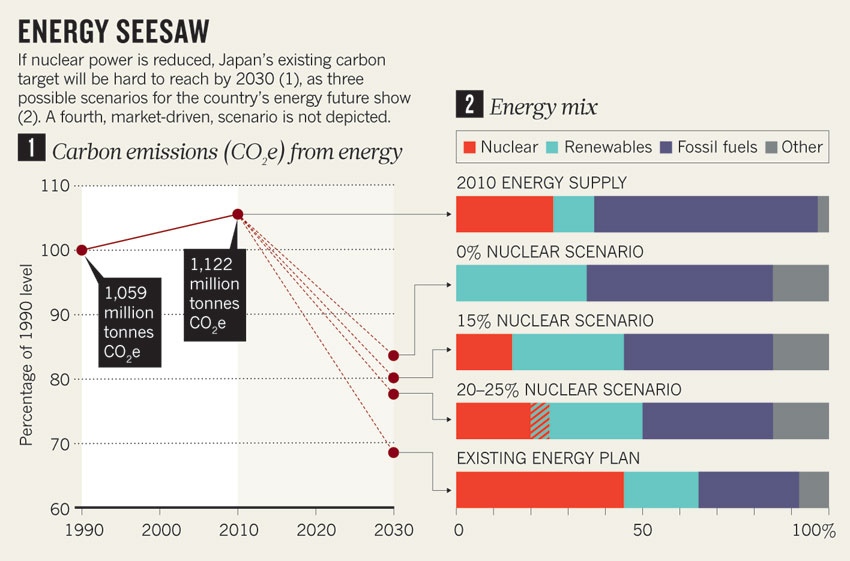
ananyo writes with a story about more concrete plans for a reduced or nuclear-free energy future for Japan. From the article: "It's official: nuclear power will have a much smaller role in Japan's energy future than was once thought. Since the meltdowns and gas explosions at the Fukushima Daiichi nuclear power station in March 2011, all of Japan's remaining reactors have been shut down for inspections and maintenance. The government offered a glimpse of their future, and that of the country's nuclear power in general, when it published an outline of four ways to satisfy Japan's future energy demands. One scenario recommends using a market mechanism to determine the nuclear contribution. Under the other three, nuclear power would supply at most one-quarter of Japan's energy by 2030 — and in one case, none at all. The scenarios come from a 25-person advisory committee to the industry ministry. The sharp reductions in the nuclear power part of the country's energy mix mean that Japan will struggle to reach the 31% reduction in carbon dioxide emissions that it had planned by 2030 (PDF)." -
Committee Offers Scenarios for Japan's Energy Future
ananyo writes with a story about more concrete plans for a reduced or nuclear-free energy future for Japan. From the article: "It's official: nuclear power will have a much smaller role in Japan's energy future than was once thought. Since the meltdowns and gas explosions at the Fukushima Daiichi nuclear power station in March 2011, all of Japan's remaining reactors have been shut down for inspections and maintenance. The government offered a glimpse of their future, and that of the country's nuclear power in general, when it published an outline of four ways to satisfy Japan's future energy demands. One scenario recommends using a market mechanism to determine the nuclear contribution. Under the other three, nuclear power would supply at most one-quarter of Japan's energy by 2030 — and in one case, none at all. The scenarios come from a 25-person advisory committee to the industry ministry. The sharp reductions in the nuclear power part of the country's energy mix mean that Japan will struggle to reach the 31% reduction in carbon dioxide emissions that it had planned by 2030 (PDF)." -
South Korea Surrenders To Creationist Demands On Evolution Textbooks
Med-trump writes "A petition to remove references to evolution from high-school textbooks claimed victory in South Korea last month after the Ministry of Education, Science and Technology (MEST) revealed that many of the publishers would produce revised editions that exclude examples of the evolution of the horse or of avian ancestor Archaeopteryx." -
What Struck Earth in 775?
ananyo writes "Just over 1,200 years ago, the planet was hit by an extremely intense burst of high-energy radiation of unknown cause, scientists studying tree-ring data have found. The radiation burst, which seems to have hit between 774 and 775, was detected by looking at the amounts of the radioactive isotope carbon-14 in tree rings that formed during the 775 growing season in the Northern Hemisphere. The increase in 14C levels is so clear that the scientists conclude that the atmospheric level of 14C must have jumped by 1.2% over the course of no longer than a year, about 20 times more than the normal rate of variation (abstract). Yet, as the only known events that can produce a 14C spike are supernova explosions or giant solar flares, and neither event was observed at the time, astronomers have a cosmic mystery on their hands." -
What Struck Earth in 775?
ananyo writes "Just over 1,200 years ago, the planet was hit by an extremely intense burst of high-energy radiation of unknown cause, scientists studying tree-ring data have found. The radiation burst, which seems to have hit between 774 and 775, was detected by looking at the amounts of the radioactive isotope carbon-14 in tree rings that formed during the 775 growing season in the Northern Hemisphere. The increase in 14C levels is so clear that the scientists conclude that the atmospheric level of 14C must have jumped by 1.2% over the course of no longer than a year, about 20 times more than the normal rate of variation (abstract). Yet, as the only known events that can produce a 14C spike are supernova explosions or giant solar flares, and neither event was observed at the time, astronomers have a cosmic mystery on their hands." -
Andromeda On Collision Course With the Milky Way
ananyo writes "From the Nature story: 'The Andromeda galaxy will collide with the Milky Way about 4 billion years from now, astronomers announced today. Although the Sun and other stars will remain intact, the titanic tumult is likely to shove the Solar System to the outskirts of the merged galaxies. Researchers came to that conclusion after using the Hubble Space Telescope between 2002 and 2010 to painstakingly track the motion of Andromeda as it inched along the sky. Andromeda, roughly 770,000 parsecs (2.5 million light years) away, is the nearest large spiral galaxy to the Milky Way.'" -
Milky Way's Black Hole Wasn't Always Such a Wimp
scibri writes "Sagittarius A*, the dormant supermassive black hole that lies at the center of our galaxy, was much more active not that long ago. Astronomers using the Fermi Gamma-ray Space Telescope have picked up some faint gamma-ray signals that suggest Sagittarius A* was emitting a pair of powerful gamma-ray jets like other galactic black holes as recently as 20,000 years ago (arXiv paper). If our black hole was more active in the past, it could explain why Sagittarius A* seems to be growing about 1,000 times too slowly for it to have reached its current mass of about four million solar masses since the Galaxy formed about 13.2 billion years ago." -
All Researchers To Be Allocated Unique IDs
ananyo writes with information on a new scheme to help uniquely identify authors in the face of ambiguous names. From the article: "In 2011, Y. Wang was the world's most prolific author of scientific publications, with 3,926 to their name — a rate of more than 10 per day. Never heard of them? That's because they are a mixture of many different Y. Wangs, each indistinguishable in the scholarly record. The launch later this year of the Open Researcher and Contributor ID (ORCID), an identifier system that will distinguish between authors who share the same name, could soon solve the problem, allowing research papers to be associated correctly with their true author. Instead of filling out personal details on countless electronic forms associated with submitting papers or applying for grants, a researcher could also simply type in his or her ORCID number. Various fields would be completed automatically by pulling in data from other authorized sources, such as databases of papers, citations, grants and contact details. ORCID does not intend to offer such services itself; the idea is that other organizations will use the open-access ORCID database to build their own services." -
Researcher Develops Chemical Circuit Using Ion Transistors
cylonlover writes news of ion based logic gates. From the article: "While the silicon chips found in the electronic devices that we rely on every day are built around the flow of electrons through circuits, with the development of an 'integrated chemical chip,' a doctoral student in Organic Electronics at Sweden's Linköping University has created the basis for an entirely new circuit technology based on the transmission of ions and molecules. Like silicon-based chips, the integrated chemical chip contains logic gates, such as NAND gates, that form the basis of digital electronics by allowing for the construction of all logical functions." -
Scientific Literacy vs. Concern Over Climate Change
New submitter gmfeier writes "An interesting study reported in Nature Climate Change indicates that concern over climate change did not correlate with scientific literacy nearly as much as with cultural polarization. Quoting: 'For ordinary citizens, the reward for acquiring greater scientific knowledge and more reliable technical-reasoning capacities is a greater facility to discover and use—or explain away—evidence relating to their groups’ positions. Even if cultural cognition serves the personal interests of individuals, this form of reasoning can have a highly negative impact on collective decision making. What guides individual risk perception, on this account, is not the truth of those beliefs but rather their congruence with individuals’ cultural commitments. As a result, if beliefs about a societal risk such as climate change come to bear meanings congenial to some cultural outlooks but hostile to others, individuals motivated to adopt culturally congruent risk perceptions will fail to converge, or at least fail to converge as rapidly as they should, on scientific information essential to their common interests in health and prosperity. Although it is effectively costless for any individual to form a perception of climate-change risk that is wrong but culturally congenial, it is very harmful to collective welfare for individuals in aggregate to form beliefs this way.'" -
'Eco-Anarchists' Targeting Nuclear and Nanotech Workers
scibri writes, quoting Nature: "A loose coalition of eco-anarchist groups is increasingly launching violent attacks on scientists. A group calling itself the Olga Cell of the Informal Anarchist Federation International Revolutionary Front has claimed responsibility for the non-fatal shooting of a nuclear-engineering executive on 7 May in Genoa. The same group sent a letter bomb to a Swiss pro-nuclear lobby group in 2011; attempted to bomb IBM's nanotechnology laboratory in Switzerland in 2010; and has ties with a group responsible for at least four bomb attacks on nanotechnology facilities in Mexico. Another branch of the group attacked railway signals in Bristol, UK, last week in an attempt to disrupt employees of nearby defense technology firms (no word on whether anyone noticed the difference between an anarchist attack and a normal Wednesday on the UK's railways). A report by Swiss intelligence says such loosely affiliated groups are increasingly working together." -
'Eco-Anarchists' Targeting Nuclear and Nanotech Workers
scibri writes, quoting Nature: "A loose coalition of eco-anarchist groups is increasingly launching violent attacks on scientists. A group calling itself the Olga Cell of the Informal Anarchist Federation International Revolutionary Front has claimed responsibility for the non-fatal shooting of a nuclear-engineering executive on 7 May in Genoa. The same group sent a letter bomb to a Swiss pro-nuclear lobby group in 2011; attempted to bomb IBM's nanotechnology laboratory in Switzerland in 2010; and has ties with a group responsible for at least four bomb attacks on nanotechnology facilities in Mexico. Another branch of the group attacked railway signals in Bristol, UK, last week in an attempt to disrupt employees of nearby defense technology firms (no word on whether anyone noticed the difference between an anarchist attack and a normal Wednesday on the UK's railways). A report by Swiss intelligence says such loosely affiliated groups are increasingly working together." -
Chemists Make Olympic Rings On a Molecular Scale
ananyo writes "Chemists in the UK have made a five-ring polyaromatic hydrocarbon and dubbed it 'olympicene'. The molecule is just a couple of nanometers wide and can be regarded as a little fragment of graphene. Strictly speaking, of course, the molecule might constitute an 'unofficial use' of the motif and land the scientists in court for copyright infringement." -
A Wrinkle For Biometric Systems: Irises Change Over Time
scibri writes "The iris scanners that are used to police immigration in some countries, like the UK, are based on the premise that your irises don't change over your lifetime. But it seems that assumption is wrong. Researchers from the University of Notre Dame have found that irises do indeed change over time, enough so that the failure rate jumps by 153% over three years. While that means a rise from just 1 in 2 million to 2.5 in two million, imagine how that will affect a system like India's — which already has 200 million people enrolled — over 10 years." -
Australia and South Africa To Share the Square Kilometer Array
ananyo writes "The battle for the world's largest radio telescope has ended in a draw. As an earlier Slashdot story suggested, South Africa and Australia are to split the Square Kilometre Array, a €1.5 billion (US$1.9 billion) project made up of 3,000 15-meter-wide dishes and an even larger number of simple antennas. The decision was announced at a meeting outside of Amsterdam in the Netherlands, following a vote by SKA's international board." -
SETI Pioneer Jill Tarter Retires
ananyo writes "After 35 years, astronomer Jill Tarter is retiring from the Search for Extraterrestrial Intelligence (SETI) — a field she helped pioneer and popularize, most recently at the SETI Institute in Mountain View, California. Tarter, who inspired the late Carl Sagan to create the fictional character Ellie Arroway, heroine of the book and movie Contact, says she will instead focus her efforts on what she calls 'the search for intelligent funding.'" -
Nanotech Solar Cell Minimizes Cost, Toxic Impact
bonch writes "Researches at Northwestern University have developed an inexpensive solar cell intended to solve the problems of current solar cell designs, such as high cost, low efficiency, and toxic production materials (abstract). Based on the Grätzel cell, the new cell uses millions of light-absorbing nanoparticles and delivers the highest conversion efficiency reported for a dye-sensitized solar cell." -
Little Health Risk Seen From Fukushima's Radioactivity
gbrumfiel writes "Two independent reports show that the public and most workers received only low doses of radiation following last year's meltdowns at the Fukushima Daiichi nuclear power plant in Japan. Nature reports that the risks presented by the doses are small, even though some are above guidelines and limits set by the Japanese government. Few people will develop cancer as a result of the accident, and those that do may never be able to conclusively link their illness to the meltdowns. The greatest risk lies with the workers who struggled in the early days to bring the reactors under control. So far no ill-effects have been detected. At Chernobyl, by contrast, the highest exposed workers died quickly from radiation sickness." -
Little Health Risk Seen From Fukushima's Radioactivity
gbrumfiel writes "Two independent reports show that the public and most workers received only low doses of radiation following last year's meltdowns at the Fukushima Daiichi nuclear power plant in Japan. Nature reports that the risks presented by the doses are small, even though some are above guidelines and limits set by the Japanese government. Few people will develop cancer as a result of the accident, and those that do may never be able to conclusively link their illness to the meltdowns. The greatest risk lies with the workers who struggled in the early days to bring the reactors under control. So far no ill-effects have been detected. At Chernobyl, by contrast, the highest exposed workers died quickly from radiation sickness." -
Russia To Establish Bases On the Moon
ananyo writes "Vladimir Popovkin, the head of Roscosmos, the Russian space agency, has said that Russia will pursue extensive, long-lived operations at the Moon's surface. 'We're not talking about repeating what mankind achieved 40 years ago,' Popovkin said, through a translator at the Global Space Exploration Conference in Washington DC. 'We're talking about establishing permanent bases.' The heads of the space agencies for Europe, Canada and Russia, along with senior representatives from the space agencies of India and Japan were in Washington DC talking about the benefits of international collaboration. JAXA, the Japanese Space Agency, also issued a clear pronouncement about targeting the Moon." -
Human Water Use Accounts For 42% of Recent Sea Level Rise
scibri writes "During the latter half of the twentieth century, global sea level rose by about 1.8 millimeters per year. The combined contribution from heating of the oceans, which makes the water expand, along with melting of ice caps and glaciers, is estimated to be 1.1 millimeters per year, which left some 0.7 millimeters per year unaccounted for. It seems that the effects of human water use on land could fill that gap. Researchers report in Nature Geoscience that land-based water storage could account for 0.77 millimeters per year, or 42%, of the observed sea-level rise between 1961 and 2003. The extraction of groundwater for irrigation and home and industrial use, with subsequent run-off to rivers and eventually to the oceans, represents the bulk of the contribution. It would be even worse if we weren't also locking up lots of water from rivers behind dams like the Hoover Dam." -
Human Water Use Accounts For 42% of Recent Sea Level Rise
scibri writes "During the latter half of the twentieth century, global sea level rose by about 1.8 millimeters per year. The combined contribution from heating of the oceans, which makes the water expand, along with melting of ice caps and glaciers, is estimated to be 1.1 millimeters per year, which left some 0.7 millimeters per year unaccounted for. It seems that the effects of human water use on land could fill that gap. Researchers report in Nature Geoscience that land-based water storage could account for 0.77 millimeters per year, or 42%, of the observed sea-level rise between 1961 and 2003. The extraction of groundwater for irrigation and home and industrial use, with subsequent run-off to rivers and eventually to the oceans, represents the bulk of the contribution. It would be even worse if we weren't also locking up lots of water from rivers behind dams like the Hoover Dam." -
Allowing the Mind To Wander Aids Creative Problem Solving
ananyo writes "From the Nature story: 'Scientists from Archimedes to Isaac Newton and Albert Einstein are said to have had flashes of inspiration while thinking about other things. But the mechanisms behind this psychological phenomenon have remained unclear. A study now suggests that simply taking a break does not bring on inspiration — rather, creativity is fostered by tasks that allow the mind to wander.' The researchers gave 145 students 2 minutes to list as many possible uses for an everyday object (the creative thinking task). Participants then either rested, undertook a demanding memory activity that required their full attention or engaged in an undemanding reaction-time activity known to elicit mind-wandering. A fourth group of students had no break. The researchers then set the students a second set of unusual-uses tasks and found those that had, in the interim, been set the undemanding task that encouraged mind-wandering performed an average of around 40% better than they did before. The students in the other three groups showed no improvement." -
California Considers DNA Privacy Law
ananyo writes "California lawmakers are weighing a bill aimed at protecting their state's citizens from surreptitious genetic testing but scientists are voicing their growing concerns that, if passed, such a law would have a costly and damaging effect on research. The bill, dubbed the Genetic Information Privacy Act, would require an individual's written consent for the collection, analysis, retention, and sharing of his or her genetic information—including DNA, genetic test results, and even family disease history. The University of California has submitted a formal letter objecting to the bill, estimating that the measure could increase administrative costs by up to $594,000 annually — money which would come out of the cash-strapped state's General Fund. The university has also expressed concern that its researchers would suffer competitive losses in obtaining research grants." -
Slo-mo Microbes Extend the Frontiers of Life
ananyo writes "A newly-discovered microbial community living tens of meters beneath the Pacific Ocean floor uses so little oxygen that researchers believe they may be living at the absolute minimum energy requirement needed to subsist. For years, scientists thought that the ascetic conditions of the deep sub-seabed — high pressure, minimal oxygen and a low supply of nutrients and energy — made such environments uninhabitable to any form of life. The discovery extends the lower bound for life (abstract). The surface of Mars, for instance, may be inhospitable, but there may be conditions below the surface that are reminiscent of the deep subsurface on Earth. As microbiologist Bo Jørgensen comments in the Nature piece, while the discovery does not mean there is life on Mars, 'it's now really challenging to show where there is no life.'" -
Americans Happy To Pay More For Clean Energy, But Only a Little More
Fluffeh writes "A recent study of over 1,000 folks for a paper published in Nature Climate Change has found that the average U.S. citizen is inclined to pay a premium to ensure that by 2035, 80% of U.S. power comes from clean energy. At random, respondents received one of three "technological treatments" or definitions of clean energy that included renewable energy sources alone, renewable sources plus natural gas, and renewable sources plus nuclear power. Delving into the socioeconomics, researchers found that Republicans, Independents, and respondents with no party allegiance were less likely by 25, 13 and 25 percentage points respectively to support a NCES than respondents that identified themselves as Democrats." -
Iranian Physics Student From UT Gets 10 Years In Jail For Spying
scibri writes "Omid Kokabee, a laser physics graduate student from the University of Texas who has been imprisoned in Tehran for the past 15 months, was sentenced to 10 years in jail on Sunday for allegedly conspiring with foreign countries against Iran. Kokabee was arrested in February 2011 while on a trip home, and charged with 'communicating with a hostile government' (i.e. Israel) and 'illegal earnings.' He has consistently denied the charges, and refused to speak at his trial, where no evidence against him was presented. Several international science groups, including the American Physical Society, have spoken up in his defense, and an online petition has been set up in support." -
Iranian Physics Student From UT Gets 10 Years In Jail For Spying
scibri writes "Omid Kokabee, a laser physics graduate student from the University of Texas who has been imprisoned in Tehran for the past 15 months, was sentenced to 10 years in jail on Sunday for allegedly conspiring with foreign countries against Iran. Kokabee was arrested in February 2011 while on a trip home, and charged with 'communicating with a hostile government' (i.e. Israel) and 'illegal earnings.' He has consistently denied the charges, and refused to speak at his trial, where no evidence against him was presented. Several international science groups, including the American Physical Society, have spoken up in his defense, and an online petition has been set up in support." -
Iranian Physics Student From UT Gets 10 Years In Jail For Spying
scibri writes "Omid Kokabee, a laser physics graduate student from the University of Texas who has been imprisoned in Tehran for the past 15 months, was sentenced to 10 years in jail on Sunday for allegedly conspiring with foreign countries against Iran. Kokabee was arrested in February 2011 while on a trip home, and charged with 'communicating with a hostile government' (i.e. Israel) and 'illegal earnings.' He has consistently denied the charges, and refused to speak at his trial, where no evidence against him was presented. Several international science groups, including the American Physical Society, have spoken up in his defense, and an online petition has been set up in support." -
Wireless Implants Promise Superior Vision Restoration
ananyo writes, quoting Nature: "The development of retinal implants has been dogged by problems of unwieldiness since the first implantable stimulator for vision restoration was developed in 1968. Now researchers have come up with a solution that overcomes many of the problems by the use of special glasses that fire infrared signals into the eye and onto an implanted array of silicon photodiodes. The system, tested in rats, simplifies what needs to be implanted and both transmits visual data and power directly to the implants, eliminating the need for any bulky external power source (abstract)." -
Wireless Implants Promise Superior Vision Restoration
ananyo writes, quoting Nature: "The development of retinal implants has been dogged by problems of unwieldiness since the first implantable stimulator for vision restoration was developed in 1968. Now researchers have come up with a solution that overcomes many of the problems by the use of special glasses that fire infrared signals into the eye and onto an implanted array of silicon photodiodes. The system, tested in rats, simplifies what needs to be implanted and both transmits visual data and power directly to the implants, eliminating the need for any bulky external power source (abstract)." -
UK To Give Peer-Reviewed Science Libel Protection
scibri writes "England is finally getting around to updating its notoriously plaintiff-friendly libel laws, which have been extensively criticized for stifling scientific debate in the past few years, such as in the case of Simon Singh. The government introduced a defamation bill last week that would extend explicit protection to statements in scientific or academic journals — providing the work was properly peer reviewed. The protection would also extend to reports of academic and scientific conferences. The proposed legislation is popular among the UK's researchers and journalists, but a similar law on whistleblower protection has had mixed reviews in the U.S." -
UK To Give Peer-Reviewed Science Libel Protection
scibri writes "England is finally getting around to updating its notoriously plaintiff-friendly libel laws, which have been extensively criticized for stifling scientific debate in the past few years, such as in the case of Simon Singh. The government introduced a defamation bill last week that would extend explicit protection to statements in scientific or academic journals — providing the work was properly peer reviewed. The protection would also extend to reports of academic and scientific conferences. The proposed legislation is popular among the UK's researchers and journalists, but a similar law on whistleblower protection has had mixed reviews in the U.S." -
UK To Give Peer-Reviewed Science Libel Protection
scibri writes "England is finally getting around to updating its notoriously plaintiff-friendly libel laws, which have been extensively criticized for stifling scientific debate in the past few years, such as in the case of Simon Singh. The government introduced a defamation bill last week that would extend explicit protection to statements in scientific or academic journals — providing the work was properly peer reviewed. The protection would also extend to reports of academic and scientific conferences. The proposed legislation is popular among the UK's researchers and journalists, but a similar law on whistleblower protection has had mixed reviews in the U.S." -
Positive Bias Could Erode Public Trust In Science
ananyo writes "Evidence is mounting that research is riddled with positive bias. Left unchecked, the problem could erode public trust, argues Dan Sarewitz, a science policy expert, in a comment piece in Nature. The piece cites a number of findings, including a 2005 paper by John Ioannidis that was one of the first to bring the problem to light ('Why Most Published Research Findings Are False'). More recently, researchers at Amgen were able to confirm the results of only six of 53 'landmark studies' in preclinical cancer research (interesting comments on publishing methodology). While the problem has been most evident in biomedical research, Sarewitz argues that systematic error is now prevalent in 'any field that seeks to predict the behavior of complex systems — economics, ecology, environmental science, epidemiology and so on.' 'Nothing will corrode public trust more than a creeping awareness that scientists are unable to live up to the standards that they have set for themselves,' he adds. Do Slashdot readers perceive positive bias to be a problem? And if so, what practical steps can be taken to put things right?" -
Positive Bias Could Erode Public Trust In Science
ananyo writes "Evidence is mounting that research is riddled with positive bias. Left unchecked, the problem could erode public trust, argues Dan Sarewitz, a science policy expert, in a comment piece in Nature. The piece cites a number of findings, including a 2005 paper by John Ioannidis that was one of the first to bring the problem to light ('Why Most Published Research Findings Are False'). More recently, researchers at Amgen were able to confirm the results of only six of 53 'landmark studies' in preclinical cancer research (interesting comments on publishing methodology). While the problem has been most evident in biomedical research, Sarewitz argues that systematic error is now prevalent in 'any field that seeks to predict the behavior of complex systems — economics, ecology, environmental science, epidemiology and so on.' 'Nothing will corrode public trust more than a creeping awareness that scientists are unable to live up to the standards that they have set for themselves,' he adds. Do Slashdot readers perceive positive bias to be a problem? And if so, what practical steps can be taken to put things right?" -
Mini Mammoth Once Roamed Crete
ananyo writes "Scientists can now add a 'dwarf mammoth' to the list of biological oxymorons that includes the jumbo shrimp and pygmy whale. Studies of fossils discovered last year on the island of Crete in the Mediterranean Sea reveal that an extinct species once thought to be a diminutive elephant was actually the smallest mammoth known to have existed — which, as an adult, stood no taller than a modern newborn elephant (abstract). The species is the most extreme example of insular dwarfism yet found in mammoths." -
Jars of Irradiated Russian Animals Find a New Purpose
scibri writes with bits and pieces from the article: "From the early 1950s to the end of the cold war, nearly 250,000 animals were systematically irradiated in the Russian town of Ozersk. Fearful of a nuclear attack by the United States, the Soviet Union wanted to understand how radiation damages tissues and causes diseases such as cancer. Now, these archives have become important to a new generation of radiobiologists, who want to explore the effects of the extremely low doses of radiation — below 100 millisieverts — that people receive during medical procedures such as computed-tomography diagnostic scans, and by living close to the damaged Fukushima nuclear reactors in Japan." -
A Boost For Quantum Reality
Eponymous Hero sends this excerpt from Nature: "The philosophical status of the wavefunction — the entity that determines the probability of different outcomes of measurements on quantum-mechanical particles — would seem to be an unlikely subject for emotional debate. Yet online discussion of a paper claiming to show mathematically that the wavefunction is real has ranged from ardently star-struck to downright vitriolic since the article was first released as a preprint in November 2011. ... [The authors] say that the mathematics leaves no doubt that the wavefunction is not just a statistical tool, but rather, a real, objective state of a quantum system." -
A Boost For Quantum Reality
Eponymous Hero sends this excerpt from Nature: "The philosophical status of the wavefunction — the entity that determines the probability of different outcomes of measurements on quantum-mechanical particles — would seem to be an unlikely subject for emotional debate. Yet online discussion of a paper claiming to show mathematically that the wavefunction is real has ranged from ardently star-struck to downright vitriolic since the article was first released as a preprint in November 2011. ... [The authors] say that the mathematics leaves no doubt that the wavefunction is not just a statistical tool, but rather, a real, objective state of a quantum system." -
Tidal Heating Shrinks Goldilocks Zone Around Red Dwarfs
scibri writes "An overlooked factor could shrink the habitable zone for planets around M-class dwarf stars by as much as 50%. For these smaller, cooler stars, the habitable zone was thought to extend to relatively close orbits. But as you get closer to a star, the tidal force it exerts on a planet increases. Since planets do not have perfectly circular orbits, tidal forces cause the planet to flex and unflex each time it moves closer to or further from its star; kneading its interior to produce massive quantities of frictional heat — enough to scour the planet of any liquid water. Because M-class dwarf stars are the most numerous in the galaxy, and close-in planets are easier to spot than more distant ones, such stars have been a major target for planet hunters seeking Earth-like worlds. But now it seems we may have been looking in the wrong place for Earth's twin." -
Low Oxygen Cellular Protein Synthesis Mechanism Discovered
New submitter _prime writes "Until recently the mechanism by which cells make proteins in low-oxygen environments has been unknown. As published in Nature (paywall) this week, the discovery of the mechanism by an Ottawa-based team of researchers potentially means it could be 'very easy to kill cancer cells' without harming normal cells because cancer cells leverage the same low-oxygen protein synthesis mechanism even in the presence of normal oxygen levels." -
Scientists 'Switch Off' Brain Cell Death In Mice
fishmike sends this excerpt from a Reuters report: "Scientists have figured out how to stop brain cell death in mice with brain disease and say their discovery deepens understanding of the mechanisms of human neurodegenerative diseases such as Alzheimer's and Parkinson's. British researchers writing in the journal Nature (abstract) said they had found a major pathway leading to brain cell death in mice with prion disease, the mouse equivalent of Creutzfeld-Jacob Disease (CJD). ... Mallucci's team found that the buildup of mis-folded proteins in the brains of mice with prion disease activated a natural defense mechanism in cells, which switches off the production of new proteins. This would normally switch back on again, the researchers explained, but in these ill mice the continued build-up of misshapen proteins keeps the switch turned off. This is the trigger point leading to brain cell death, because key proteins essential for cell survival are not made. By injecting a protein that blocks the "off" switch, the scientists were able to restore the production of the survival proteins and halt the neurodegeneration." -
Nanoparticles Heated By Radio Waves Switch On Genes In Mice
ananyo writes "Researchers have used radio waves to remotely activate engineered insulin-producing genes in mice. In the long term, the work could lead to medical procedures in which patients' genes are triggered on demand. The researchers coated iron oxide nanoparticles with antibodies that bind to a modified version of a temperature-sensitive ion channel. They injected these particles into tumors grown under the skins of mice, then heated the nanoparticles with low-frequency radio waves. The nanoparticles heated the ion channel, activating it and allowing calcium to flow into cells. The influx of calcium switched on an engineered calcium-sensitive gene that produces insulin (abstract)." -
NASA Boss Accused of Breaking Arms Trade Laws
ananyo writes "The head of NASA Ames Research Center may have fallen victim to restrictive arms regulations — just as a US government report recommends changing them to help the space industry. Simon 'Pete' Worden, who recently announced that Mars exploration would be done by private companies, has been accused of giving foreign citizens access to information that falls under the International Traffic in Arms Regulations (ITAR). ITAR has hampered U.S. firms seeking to export satellite technology. The allegations against Worden come just as the new report recommends moving oversight of many commercial satellites and related activities from the State department to the Commerce department, and some fear they could provide lawmakers with reasons to not ease export controls." -
One of Two Hotly Debated Avian Flu Papers Finally Published
daveschroeder writes "After a marathon debate over a pair of studies that show how the avian H5N1 influenza virus could become transmissible in mammals, and an unprecedented recommendation by the National Science Advisory Board for Biosecurity (NSABB) to block publication, and its subsequent reversal, a study by Yoshihiro Kawaoka at the University of Wisconsin–Madison was finally and fully published today. 'Experimental adaptation of an influenza H5 HA confers respiratory droplet transmission to a reassortant H5 HA/H1N1 virus in ferrets' appears in the journal Nature." -
Pigeons May 'Hear' Magnetic Fields
ananyo writes "Individual neurons in birds' brains can relay crucial information about Earth's magnetic field, possibly providing the animals with an 'internal GPS.' Pigeons' remarkable navigational feats have long been pegged to the birds' ability to sense magnetic fields, but pinning down how they do so has frustrated scientists for years. Work published in Science (abstract) shows that individual cells seem to encode information on a magnetic field's direction, intensity and polarity. The work also suggests that these signals come from a part of the inner ear called the lagena, further complicating matters for researchers in the field. The Science paper comes just days after a report in Nature (abstract) revealed that cells in pigeons' upper beaks, previously thought to be magnetoreceptors, are actually immune cells called macrophages." -
Pigeons May 'Hear' Magnetic Fields
ananyo writes "Individual neurons in birds' brains can relay crucial information about Earth's magnetic field, possibly providing the animals with an 'internal GPS.' Pigeons' remarkable navigational feats have long been pegged to the birds' ability to sense magnetic fields, but pinning down how they do so has frustrated scientists for years. Work published in Science (abstract) shows that individual cells seem to encode information on a magnetic field's direction, intensity and polarity. The work also suggests that these signals come from a part of the inner ear called the lagena, further complicating matters for researchers in the field. The Science paper comes just days after a report in Nature (abstract) revealed that cells in pigeons' upper beaks, previously thought to be magnetoreceptors, are actually immune cells called macrophages." -
Analytic Thinking Can Decrease Religious Belief
Freshly Exhumed writes "A new University of British Columbia study finds that analytic thinking can decrease religious belief, even in devout believers. The study, which will appear in tomorrow's issue of Science (abstract), finds that thinking analytically increases disbelief among believers and skeptics alike, shedding important new light on the psychology of religious belief."