Slashdot Mirror
Domain: neu.edu
Stories and comments across the archive that link to neu.edu.
Comments · 152
-
Re:Yes, we can imagine
That is obvious, but also only a problem on constrained networks. QUIC may not be the solution to my parent's ADSL, but what about my gigabit fibre to the home?
No difference of substance between TCP and QUIC on loss free unconstrained networks so no affirmative reason to use QUIC in this instance.
Much of the world is stuck with wireless and assorted low bandwidth morbidly oversubscribed last mile. Gigabit to the home with a reasonable oversubscription ratio to actually support using it is currently very much an outlier. Of course the Internet itself isn't just limited by last mile.. tier-2 and tier-1 networks and associated long haul links are often constantly saturated as well. Best achievable performance is dictated by weakest link not last mile.
To put it into perspective people who use the Internet for bulk data transfers often use a "trick" to move data. They don't move it all at once from point a to point b. What they do is move it regionally during times of low local utilization when everyone is sleeping and in doing so are able to transfer way more data in the aggregate per unit time than would be possible directly copying data across the Internet in one step.
https://www.ccs.neu.edu/home/k...
Interesting comparison. There is a well researched phenomenon (that we even covered on Slashdot about 10ish years ago) that to make optimum use of infrastructure and flow the maximum number of people you need 30%-60% of people to drive aggressively depending on town planning and road designs of different countries.
Only intent was to convey an example of the idea of aggression leading to suboptimal outcomes.
Dynamics of road networks at this level of detail don't map to the Internet which is way better engineered than road networks. The goal is to keep it that way. To prevent devolution of the Internet where road dynamics become applicable.
In real life anyone can drive anywhere at any time regardless of capacity of road network. You can't delete cars from existence if there are too many drivers on the road. Unless you live in a dictatorship you can't do much to control when people chose to drive. It's chaos day in and day out with very little in the way substantively of usable congestion avoidance leading to predictable outcomes: millions stuck in daily rush hour bumper to bumper traffic.
The Internet is way different. Each packet travels at the same speed. Number of packets on the road is dynamically controlled by the originator based on continuous feedback acting as proxy for current capacity of the network. Each node of the network performs some manner of queue management deleting packets from existence as thresholds are exceeded. As a result generally only the repercussions of having insufficient capacity to meet demand are felt rather than more dire outcome of congestion precipitating reduction of usable capacity.
When you take away congestion avoidance or in this case eat into it with aggression and evolutions between competing actors to gain advantage the Internet not only devolves into uncontrolled, unmanaged roadways. The attempts to make up for data loss with aggressive policies can when taken too far create even more packets driving loss even further creating a feedback loop known as congestive collapse.
What we should be doing is improving the network by creating mechanisms to provide better more unambiguous feedback so senders can make better estimations not participating in power grab evolutions that don't actually help anyone.
Indeed it does, but from what I've read on IETF presentations on the topic it relies on proper routing and handling of traffic between server and client and a there's a significant portion of TCP connections that despite attempting to be negotiated as fast open proceed to fall back due to network support. It's one fo the key benefits QUIC pr
-
Re:Has Slashdot been sold?
Feminists [...] I've yet to see them decide to start running over people with cars, threaten jews and other minorities
Valerie Solanas, the mother of radical feminism, wrote the SCUM Manifesto, in which she calls for the systematic extermination of men, as punishment for the supposed sins of men and "patriarchy". (Honestly, it makes Mein Kampf look tame.) Julie Bindel, a reporter at The Guardian, has called for all men to be put into camps
In terms of the sheer number of people calling for genocide, and in terms of the political power those people have, feminism today far exceeds Nazism.
-
Re:Yey!
"Coding is easy"
It is, if you learn from proper books.
-
Re:Privacy? Fuck you.
Super heterodyne receivers can actually be detected. This poster presentation may be of interest.
-
Re:Checklist-based education
-
That's interesting
That's an interesting situation. I can certainly see a VPN with a port forward as being a reasonable solution, especially if you need a lot of storage. I'm assuming your ISP doesn't -also- offer IPv6 as well as the NAT IPv4.
SSH port forwarding is a fast, easy way to set up a VPN with port forwarding in one command. Even if you don't use it for this purpose, it's a good tool to have in your toolbox. It requires that you have a shell account internet-facing box, which might be a $5/month web hosting account. On Linux, Mac, Unix, BSD etc the command is:
ssh -R 2121:localhost:21 ShellAccountHost.comThat means connecting to port 2121 on ShellAccountHost.com actually connects to port 21 on your local machine. On Windows, you can use puTTY to SSH, including port forwards:
http://howto.ccs.neu.edu/howto...
SSH port forwarding is very flexible and you can set up new ports with one quick command. That flexibility does mean the syntax takes some getting used to. For a long time I used a script like this on my Mac to make it accessible from an internet-facing IP:while ssh -R 2222:localhost:22 ShellAccountHost.com
do
sleep 30
doneIf you have a recent iPad, there are Lightning flash drives that clip over the iPad.
A 50 GB "web hosting" account from Amerinoc.com provides FTP and http for $5-$10/month.
-
Ugh...
To achieve this, it seems like all we need is to show people how to give the computer instructions, but that's teaching people how to put words on the page. We need the equivalent of composition, the skill that allows us to think about how things are computed.
Ugh...if only we had something like this...we could call it "computer science" or something like that. We could even write textbooks about it! But that's just a pipe dream, right?
-
Re:Balance taxes?
Not everyone can or should be a programmer: Not everyone is a writer, Not everyone is a photographer, Not everyone is a painter. Sure, everyone should be given basic skills in writing, and perhaps in drawing or painting as a child, and so perhaps everyone should be given basic skills in programming, but beyond that, why? Not everyone is able to understand calculus; why should we automatically expect that everyone should be able to write Java, Python, or whathaveyou?
Perhaps people should at least try it seriously on some level so that we could catch some precious talent that would otherwise go to waste.
-
Re:digital divide
The people I have seen who don't know how to use computers
-
Re:There's at least a reasonable argument here
1. One reason oil and coal appear to be cheaper is that the costs of CO2 emissions are completely externalized. Introduce a cap-and-trade system or a CO2 tax and suddenly those won't look quite as economically attractive. (Obviously, you'll have to ignore this point if you think that there are no costs of CO2 emissions, as some do.)
I looked online for estimates of the CO2 externality cost per gallon of gas. Estimates I found ranged from 6 to 29 cents per gallon - quite insignificant.
The total externality per gallon came out to about $1.50 per gallon. (Most of that is due to congestion, traffic accidents, and local pollution.) Raising the gas price by that amount would have a quite noticeable, but not revolutionary, economic impact.
http://www.becker-posner-blog....
http://www.economics.neu.edu/e... -
Scheme, How To Design Programs
Let Tim Gurney have a look at How To Design Programs, which is free to download and cheap on paper.
It teaches Scheme, which is an easy way to get a toe in the programming door, and you *can* subsequently do really awesome things with it, not just make trivial games.
See http://www.ccs.neu.edu/home/matthias/HtDP2e/
-- hendrik
-
Re:Lol
Not to mention the beautiful expressiveness and readability of things like:
(and (or (= (string-length "hello world") (string->number "11"))
(string=? "hello world" "good morning"))
(>= (+ (string-length "hello world") 60) 80))Especially for the average 9th grader.
-
Re:Emacs and Guile need each other
One goal does not need to interfere with the other. Emacs Lisp and Scheme are trivial to learn. Scheme is a more of a general purpose programming language. It's trivial to learn (see HERE)It's also worth learning simply because one of the best CS books, the SICP, is using Scheme. As for Emacs Lisp, I don't see a need to get very deeply into. Scheme is nicer and more simple. Emacs Lisp is the language much of emacs is written in as well as its modules. Unless you have in mind writing Emacs modules, picking up elisp from Emacs's built in tutorial is more than enough for hacking your personal
I honestly, don't know why Scheme hasn't picked up steam in the mainstream. Yes, we know people don't like the aesthetics of s-expressions, but other than that it's a fantastic programming language. It has the nicest cleanest implementation of lexical scope and closures I have seen so far, dead simple syntax (you can write a minimal scheme interpreter in Python or Scheme in 100-200 lines), first class functions, higher order functions, dynamic memory management, powerful lambda expressions (this is to name just a few features). In fact, Scheme had things 20 years ago that other programming languages are still copying from it.
-
Cryptographic IPv6 Ranges
There's an interesting paper on using IPv6 addresses as cryptographic material for this kind of thing.
-
RE: The Little Schemer?Amazon recommends for age 18 and up, which is probably a bit conservative, but the book summary mentions building on algebra, so unless the 9 year old is profoundly gifted (which is a possibility, of course) I would think the book would be too advanced.
Looking at the sample chapter at http://www.ccs.neu.edu/home/matthias/BTLS/sample.pdf seems to confirm this.
BTW, I'll add my vote for Scratch. Also, Mindstorms is intended for ages 10+, of course that may be adjusted down with mechanical *and* language giftedness but I find it's more than what my 7yo is comfortable with. There is a simpler LEGO product called WeDo for ages 7-12 (http://www.legoeducation.us/eng/categories/products/elementary/lego-education-wedo), it's for the education market but I've seen it available online. It's also a touch less expensive. Interestingly, there is an option to program it with Scratch (http://info.scratch.mit.edu/WeDo).
-
Re:Can't we ask for at least...
Actually no, it can't, because after BIOS reset you have control over boot device order, because console redirection will be disabled. All PCs must be configured with a keyboard and a monitor before anything can be done "headless", and the same procedure has to be repeated if by any chance BIOS is reset, ESCD is erased, or CMOS battery died (yes, they ALL still have those things).
Not necessarily. Some BIOSes default to not wait if there's no attached keyboard, and will boot off just about anything you have connected to a typical location (floppy on first connector, first hard disk found with an active partition, USB storage, USB CD, fucking USB ZIP, whatever.) The ones that demand a keyboard can be fooled.
-
Northeastern in Boston: the first College of C.S.From http://www.ccs.neu.edu/about/index.html --
Northeastern created the nation’s first college devoted to computer science in 1982, and today’s College of Computer and Information Science remains a national leader in education and research innovation...
I graduated with the first five-year class of NUCCS in 1988. Five years because Co-Op experience was mandatory and built into the curriculum. Freshmen and Sophomores used Pascal; by Middler (3d year) you had to take the 1-credit "lab" course in C to move into the Operating Systems track. We also had VAX Assembler and FORTRAN... Until 1985, the whole University's enrollment system still ran on punch-cards.
-
Re:WITTY SUBJECT LINE
This isn't a new claim. See: Do We Need Inheritance? [PDF], Evolution of Object Behavior using Context Relations, Selective Open Recursion: Modular Reasoning about Components and Inheritance [PDF], Encapsulation and inheritance in object-oriented programming languages and many other academic sources.
It's widely acknowledge that inheritance violates encapsulation. It's a fundamental problem with OOP.
If you prefer a less academic and more practical discussion, try a Google search for OOP criticism.
-
How To Design Programs
Seriously, whatever you end up doing in more advanced or more applied courses (if that's the right word for homeschooling), start with "How To Design Programs". It teaches you how to *think* about just about everything else in computing. There's a second edition in progress. Both the original book and the draft second edition (which is probably much better) are available for free downloads. The original can also be purchased on paper.
The software system that goes with it is also free: Dr. Scheme, now renamed as Racket.
-- hendrik
http://www.cs.rice.edu/CS/PLT/Teaching/Lectures/Released/Companion/index.htm
http://www.ccs.neu.edu/home/matthias/HtDP2e/
http://mitpress.mit.edu/catalog/item/default.asp?ttype=2&tid=3879
-
Why computer training never actually IS
A recurring theme in the criticisms -- perhaps the most painfully misanthropic -- is that, since staff are trained to use MS Office, they simply can't figure out Open Office, and everyone who's switched back to MSO from OOO has seen support time and staff frustration drop like a rock. (Of course, going from MS Office 2k3's traditional interface to MS Office 2k8's "Ribbon" caused absolutely no confusion at all!)
But why is this? Why are people trained eat the bread and sip the MS Kool Aid so utterly helpless when faced with an alternative that doesn't look the same?
Well, it's because people with minimal computer skills teach other people with no computer skills that, in order to make this word look blue, you click this button in this place. Not "look for a color changer and select blue". No, it has to be under THIS menu, with THAT name, and looks like THIS button.
We don't teach people how to use computers or even software. We teach them very specific, contextless mundane steps.
What saddens me most is that I was able to document this twelve years ago and it's still the same today.
-
Co-op minesweeper
Indeed, to me Minesweeper quickly becomes boring, since most of the clicking obeys pretty simple rules ("2-3-2 along an edge - that's clear-3mines-clear"); then at the end it often becomes undecidable and it's eeny-meeny-clicky-boom.
That's when you start playing games that slowly solve the boring stuff for you. My own Luminesweeper is one of them: a line periodically sweeps across the screen and solves squares using the single-point method. So it almost feels like you're playing co-op, and the goal is to do as much as you can to promote a healthy alternation between the hard stuff (your task) and the easy stuff (the CPU's task).
-
Re:Not random and not predictable?
From the website http://arora.ccs.neu.edu/ "We collect data from various sources and we show it to you in two windows, - one window plots the actual data, - the other plots the data randomly permuted (tech note: we permute the derivative of the data)."
So the test is really "can you recognize a natural data set from the same set with a randomly permuted derivative".
The notion of "randomness" is independent of the statistics of the distribution. And since distributions with different statistics usually look quite different whether this is a surprising result depends entirely on what statistical model they have chosen.
-
Re:Good Read.
Only if you look at them in a vacuum. When you consider the size of the Red Army and Soviet violations of their wartime agreements with the Western Allies the picture becomes more balanced. The Soviet Union had more men under arms than all of the Western Allies combined. Until relatively late in the Cold War it was believed that any Soviet attack on Western Europe would quickly overwhelm Allied defenses and the only two options available would be surrender or the nuclear option.
The disparity in conventional forces was the key factor in many decisions made by the Allies. It was the main reason they allowed the West Germans to rearm -- they needed German manpower to help offset the Soviet advantage. It was the main reason the Western Allies poured so many resources into advanced weapons systems and technology. It was the main reason that the Western Allies invested in nuclear weapons the way they did.
Ever heard of Operation Unthinkable? It was a British General Staff study made at Churchill's detailing the odds facing the Western Allies in a war against the Soviet Union and the ability to conduct an offensive against them. It shows the odds facing the Allies quite clearly. Consider that context along with the Soviet actions in Eastern Europe and it becomes much easier to understand the choices made by the Western Allies after WW2.
-
Re:Why is Verbosity Bad?
Why should I mod up a statement like "verbosity is the inverse of expressivenes" when I disagree? And I don't think I am the only one unless "expressiveness" means something completely different than I thought. Unfortunately, there seems to be no formal definition, but I like the approach outlined in Felleisen's On the Expressive Power of Programming Languages.
For example, I consider Scheme more expressive than, e.g., COBOL (at least the older standards, haven't seen the newer ones), since COBOL has no notion of lexical closures, first-class functions etc. On the other hand, Bourne shell does not have these notions either, yet shell scripts tend to be quite compact when applied to tasks for which shell is a suitable tool. Scheme actually has to go out of its way if you want to write equivalent scripts of comparable length in it, which is why projects like scsh have emerged. I find it really difficult to correlate expressiveness and verbosity in any simple way. -
Re:Correlation...
That's a different scenario.
- Philip Morris said cigarettes were non-addicting. They didn't say they were addictive but that the addiction can be overcome. This is a possible red herring for the current discussion.
- Smoking a cigarette and taking in nicotine is the same act as smoking a cigarette and taking in nicotine. Committing simulated violence in a game and committing an actual act of violence against an actual person are not the same act. Any attempt at making one of these equivalent to the other, as one is a tautology and one is the very link in question, show that you are begging the question of the link from simulated violence to commission of actual acts of violence.
- Even if someone becomes physiologically addicted to committing simulated violence in a computer game, there remains a difference between that addiction and performing an actual physical act against an actual living person.
- The causal link between simulated violence in computer games and actual acts of violence is exactly what is at question. You are begging that question. (You cannot assume a priori the answer to a question and use that answer as support for answering the question. That's the fallacy of circular reasoning) or "begging the question".)
- Your use of demonizing Philip Morris and comparing myself to that company appears to be the genetic fallacy or somethign related to it.
- The press linking a few game players to crimes and that meaning all players of violent video games commit violent acts is the spotlight fallacy.
- Even if there's a correlation between players of violent video games and commissions of violent acts, one still has to consider and rule out the fallacies of confusing cause and effect, post hoc, ignoring a common cause, and even division (since the link between the two would likely to be stronger for certain types of people (like those with a mental failure distinguishing between fantasy and reality already)).
- Saying that either games cause real violence or they don't is a fallacy in itself, that of false dilemma. Surely even if playing violent video games is a contributing factor to actual violent acts, it is unlikely to be a sole or final cause. It is also unlikely to be a major cause compared to more significantly correlated contributing factors. It is unlikely to be the same level of contributing factor for people with different mentalities and different levels of faculties.
If you want to argue logically, please get your factual information correct and police your statements for logical fallacies.
-
Re:That's because
-
Re:First steps towards the Militarization of NASA
The problem lies with the individual acquiescing individual sovereignty to the State. There would be no "vacuum" if individuals would insist on what is right and not allow for excuses.
If you are innocent and are killed, it does not matter if it were "by accident" or by intent. And besides, firebombing civilians is no "accident". And just because "everyone else is slaughtering innocents" is no accuse to commit atrocities yourself.
How are they "innocent" if they just acquiesced their sovereignty to the state? In a total war civilians contribute at least as much (if not more) to the war effort as the military does. They are legitimate targets. That fact may make you squeamish but war isn't supposed to be pretty.
One who can see a better way.
If you want the "better way" then I suggest you stop focusing your energies on the United States and start focusing them on the true evils in this World. The United States didn't even have a standing army until fairly recently. The United States was content to hide behind our geography until technology made that geography a moot point.
As far as "Peace by means of MAD", we come perilously close once or twice to hitting that MAD button. And now we carry this insanity out into space?
Convince Russia and China to get rid of their nuclear weapons and I'll support the United States getting rid of ours. Like them or hate them nuclear weapons successfully deterred the Soviet Union. Go read the papers from Operation Unthinkable and contemplate the huge superiority in ground forces that the Soviet Union had. Then tell me if you think that Stalin (being the wonderful chap that he was) wouldn't have tried to conquer Western Europe if it hadn't been for our nuclear deterrent.
Well maybe I should stop giving a damn and let homo sapiens eradicate itself from existence due to their own stupidity and refusal to put behind them the sad tribalism of their evolutionary past and think with the neocortex that evolution graced them with.
I didn't say you should stop giving a damn. I just think you should be a little bit more realistic. It only takes one Adolf Hitler to render every single idealist such as yourself a moot point. Frankly I'm glad the United States has the power that we do.
-
At Northeastern, yes
Second semester freshman course is mostly about constructing machine-checkable proofs about programs. http://www.ccs.neu.edu/course/csu290/syllabus.html
-
Re:Imperialism Gone Mad
This wasn't voluntary, it was done forcefully to support a military infrastructure that the West had a right to fear.
Indeed. Go read the papers from Operation Unthinkable for a better idea of exactly what the West was up against. If Stalin had decided to try and expand his empire the Allies would have had a hell of a time trying to stop him. I for one am glad that we developed a nuclear deterrent -- the alternative could very well have been a Third World War and tens of millions more deaths.
Don't think Stalin would have tried to expand his empire if he could have? Look at the Baltic States and the Winter War -- all the proof you need of his motivations even before Hitler attacked him.
-
Re:Scheme
. . . for many people I suspect HtDP is probably a better programming book.
In what sense is HtDP better? The authors mention that it "works extremely well as a preparation for a course on object-oriented programming [1];" which betrays a certain reverence for the status quo (i.e. university as Java mill).
The great thing about SICP is its irreverence for the "real world" (metacircular evaluator?!), which is why it remains relevant twenty years after its publication; HtDP, on the other hand, will be forgotten after the present publication cycle.
-
Re:First they attack it
Mahatma Gandhi actually said, "First they ignore you, then they ridicule you, then they fight you, then you win."
The tool custodians of the massively complex relational database warehouse tools are seeing their world turn obsolete as the lighter weight MySQL and the more flexible mapreduce and the BASE worlds evolve beyond them, so yes, they are going to kick up a fight. Don't let the screen door hit you in butt on the way out, guys.
-
Videos of the behavior
PLoS has multiple videos of the magpies' behavior, all linked in the journal article.
-
Re:Slashdotted.
http://releases.ubuntu.com/8.04/ubuntu-8.04-desktop-i386.iso.torrent http://torrents.thepiratebay.org/4153415/Ubuntu_8.04_Hardy_Heron_-_Desktop_i386.4153415.TPB.torrent http://releases.ubuntu.com/8.04/ubuntu-8.04-desktop-i386.iso http://mirror.csclub.uwaterloo.ca/ubuntu-releases/8.04/ubuntu-8.04-desktop-i386.iso http://mirrors.ccs.neu.edu/releases.ubuntu.com/8.04/ubuntu-8.04-desktop-i386.iso http://mirrors.rit.edu/ubuntu-releases/8.04/ubuntu-8.04-desktop-i386.iso http://ubuntu.media.mit.edu/ubuntu-releases/8.04/ubuntu-8.04-desktop-i386.iso http://ubuntu.osuosl.org/releases/8.04/ubuntu-8.04-desktop-i386.iso http://banner.uits.indiana.edu/8.04/ubuntu-8.04-desktop-i386.iso http://mirror.anl.gov/pub/ubuntu-iso/CDs/8.04/ubuntu-8.04-desktop-i386.iso ----- Features: http://techwatch.reviewk.com/2008/04/ubuntu-hardy-heron-8-04-2/
-
Anonymous Karmawhoring!
The server was overloaded; it's back up now, but in case it becomes unstable again... Cached lists of mirrors (for all versions):
* http://www.ubuntu.com.nyud.net/getubuntu/downloadmirrors
* http://www.google.com/search?q=cache:http%3A%2F%2Fwww.ubuntu.com%2Fgetubuntu%2Fdownloadmirrors
Torrent for 8.04 desktop version i386 ISO:
* http://releases.ubuntu.com/8.04/ubuntu-8.04-desktop-i386.iso.torrent
* http://torrents.thepiratebay.org/4153415/Ubuntu_8.04_Hardy_Heron_-_Desktop_i386.4153415.TPB.torrent
(Piratebay mirror because official tracker is unstable)
Direct links to 8.04 desktop version i386 ISOs:
* http://releases.ubuntu.com/8.04/ubuntu-8.04-desktop-i386.iso
* http://mirror.csclub.uwaterloo.ca/ubuntu-releases/8.04/ubuntu-8.04-desktop-i386.iso
* http://mirrors.ccs.neu.edu/releases.ubuntu.com/8.04/ubuntu-8.04-desktop-i386.iso
* http://mirrors.rit.edu/ubuntu-releases/8.04/ubuntu-8.04-desktop-i386.iso
* http://ubuntu.media.mit.edu/ubuntu-releases/8.04/ubuntu-8.04-desktop-i386.iso
* http://ubuntu.osuosl.org/releases/8.04/ubuntu-8.04-desktop-i386.iso
* http://banner.uits.indiana.edu/8.04/ubuntu-8.04-desktop-i386.iso
* http://mirror.anl.gov/pub/ubuntu-iso/CDs/8.04/ubuntu-8.04-desktop-i386.iso -
Re:This is a shame
I wish I could mod parent up.
Scheme is absolutely a better pedagogical choice.
Northeastern University also uses Scheme in their introductory course (see How To Design Programs).
By the end of my first semester, I was using functions as first class values. Throw in functions as member data of structs, and you have objects. The gradual transition to full-fledged Java was an absolute cinch the second semester, as has been the transition to learning any other language after being exposed to the functional concepts of Scheme.
I only wish more people could "see the light".
-
Re:Get the Little Schemer
Free resources for Scheme.
The classic, Structure and Interpretation of Computer Programs:
http://mitpress.mit.edu/sicp/full-text/book/book.html
SICP videos:
http://swiss.csail.mit.edu/classes/6.001/abelson-sussman-lectures/
How To Design Programs (somewhat PLT Scheme specific):
http://www.htdp.org/2003-09-26/Book/
The Scheme Programming Language (somewhat Chez Scheme specific):
http://www.scheme.com/tspl3/
Teach Yourself Scheme in Fixnum Days (also PLT to an extent):
http://www.ccs.neu.edu/home/dorai/t-y-scheme/t-y-scheme.html
Of course there are others, and most of these can be bought in dead-tree form. -
Get the Little Schemer
Like a lot of people have commented on this thread, it's past time for you to learn a functional language. I'm not sure if it is true, but new CS students at MIT used to have to learn Scheme as their first language. Learning a functional language will transform your programming ability.
I recommend the book The Little Schemer This book is like no other programming book you have ever used. It is a socratic dialog between you and the interpreter. Questions on the left, answers on the right. It is meant to be used with an interpreter.
Once you make it through this book you'll be a much, much better programmer. You'll also have an easy time learning languages like Haskell, which is used quite a bit in academia and is useful for real world software.
So buy a copy of the Little Schemer and download an interpreter, Dr. Scheme is pretty good, and get cracking. -
Re:Former student
I am a recent former student, and my experience is quite opposite of yours. Prof Baclawski, besides having the added benefit of speaking English natively, was an excellent teacher both for myself and the handful of others in my class that I spoke with regularly. He usually referenced "back in the day" stories, but in a humorous way that lead into the subject at hand, and I ended up learning more than most in that class. Also rediculously apparent was his apathy for monetary compensation, he just wanted to teach and research new things, hell the guy wore the same damn dirty coat for the 5 years I was there! The move on google is most likely a move by the NU corp, as they are bloodthirsty when it comes to money, just look at tution costs of NU.http://www.neu.edu/admissions/costs/tuition.html
-
the DIY solution
http://www.ccs.neu.edu/home/bchafy/pstrip/dpmspowerstrip.html
It works with any monitor, or anything else that runs on AC for that matter, and cheap/easy to build. -
Re:These quotes appeared in Ron's newsletter
Do a little research. Here's a few links to get you started.
http://www.racialprofilinganalysis.neu.edu/reporting/reports.php
http://www.aclu.org/racialjustice/racialprofiling/index.html -
Re:whoa.
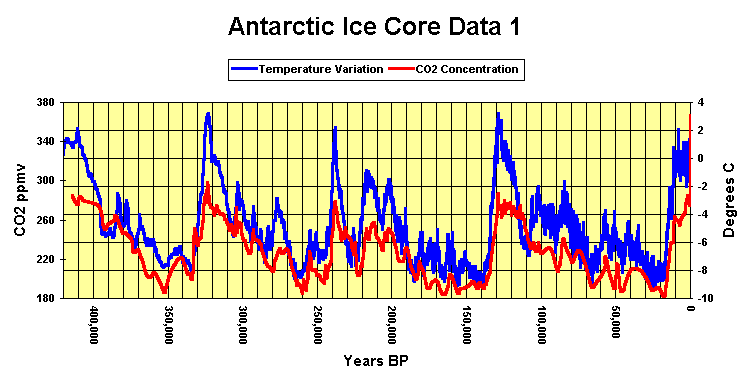
I disagree with the statement that "we are (geologically speaking) getting out of an ice age." If you look at a graph of temperature over the past 400,000 years or so, for example the graph 3rd from the bottom of this page: http://www.ccs.neu.edu/home/gene/peakoil/node3.html, you see that the passage from ice age -> warm period is much quicker than warm period -> ice age. You also see that at the present time, we're in one of those warm periods following a relatively recent (10,000 years ago) ice age. I think that it's reasonable to say that based on past behavior, things would not be getting any warmer as part of this natural cycle (since in the past the maximum temperature was reached fairly quickly after an ice age).
And moreover, you see that the concentration of CO2 has increased far above its natural levels, and that CO2 and temperature have been correlated in the past. And I don't think many would disagree that humanity has caused the increase in CO2. I will grant that this is not by any means proof that we're responsible for current temperature increases, but it's definitely (I think quite compelling) circumstantial evidence. -
Getting There From Here -- With Co-op
But beyond that- I just don't see any way for a young person graduating from high school to become a software engineer anymore. Sure, you can probably get the 4 years of schooling. But you'll be competing with people who earn $2.50/hr halfway around the world when it comes to getting experience. And that's not a winning bet when it comes to paying back your $40,000 of student loans it will take to get that Bachelor's degree
Allow me to take this opportunity to flaunt Northeastern University's co-op program. At NEU, 6 month co-ops are incorporated into our undergradute (and graduate) curriculum. After your sophomore year, you essentially take classes for 6 months, and then work for 6 months, and alternate until you graduate. It's a great program -- companies get to hire help cheaply, and students gain experience working with real technologies in the real world. It is a perfect solution to the catch 22 situation that "you need experience to get a job, and you need a job to get experience."
By the time I have my bachelor's degree next Spring, I will have 18 months of industry experience. I worked with low level embedded systems at my first co-op (loved it), decided to try something new for my second co-op, and ended up writing backend applications for Wall Street (that was interesting), and now I'm on my final co-op for a Big Company out in Silicon Valley. I am completely confident in my ability to find a job after I graduate, and that confidence is absolutely due to NEU's co-op program.
And oh yeah, I'm getting a kick-ass education, too.
-
Getting There From Here -- With Co-op
But beyond that- I just don't see any way for a young person graduating from high school to become a software engineer anymore. Sure, you can probably get the 4 years of schooling. But you'll be competing with people who earn $2.50/hr halfway around the world when it comes to getting experience. And that's not a winning bet when it comes to paying back your $40,000 of student loans it will take to get that Bachelor's degree
Allow me to take this opportunity to flaunt Northeastern University's co-op program. At NEU, 6 month co-ops are incorporated into our undergradute (and graduate) curriculum. After your sophomore year, you essentially take classes for 6 months, and then work for 6 months, and alternate until you graduate. It's a great program -- companies get to hire help cheaply, and students gain experience working with real technologies in the real world. It is a perfect solution to the catch 22 situation that "you need experience to get a job, and you need a job to get experience."
By the time I have my bachelor's degree next Spring, I will have 18 months of industry experience. I worked with low level embedded systems at my first co-op (loved it), decided to try something new for my second co-op, and ended up writing backend applications for Wall Street (that was interesting), and now I'm on my final co-op for a Big Company out in Silicon Valley. I am completely confident in my ability to find a job after I graduate, and that confidence is absolutely due to NEU's co-op program.
And oh yeah, I'm getting a kick-ass education, too.
-
Re:Dyson's predictions with a grain of salt, pleas
Here's a curve that's a lot more precise:
Hilarious. In answer to a graphic covering 600 million years which shows no correlation between CO2 and temperature at all, you reply with a selected 400kyr slot (far less than 1/1000th of the period) in which there is good correlation
http://www.ccs.neu.edu/home/gene/peakoil/co2-400k- years.gif
What's more, correlation doesn't imply causation. To anyone with any clue about climatology, your curve says exactly the same thing as the good ol' Keeling Curve has always said, that with increased warmth you get increased biological activity and the net result of that is always short-term increase in atmospheric CO2 from decay at season end followed by long term increase in CO2 from oceanic upwelling once it pops out of the carbon cycle. There is nothing new there at all
If it's causal, you need to see its contributory effect, ALWAYS. Over 600m years, you don't see any such effect. I'm sorry, but you can't wish raw scientific data away just like that, nor handwave away everything because of magic geological boundaries. CO2 must continue to be a causal effect as a contribution even across geological discontinuities and mass cosmic mishaps. Yet it's not.
You just don't want to accept it. And that's why real scientists no longer give the GW zealots (both pseudo-scientists and simple wanabes like you) the time of day. You'll see, in due course. In the meantime, you'd better find a reason why where is no correlation between CO2 and temperature even in the periods of calm between "geological boundaries".
It'll be fun to see you try. You just can't wish those 600myr away.
[Hint: the world is not a simple illuminated test tube, in which you just add CO2 and the temperature inside raises a fraction. The climate depends on numerous factors that vastly outweight that tiny contribution from CO2, and if it were not so then we would not have had a collosal ice age at the end of the Ordovician when CO2 was well over 4000ppm. CO2 is secondary, and is utterly swamped by the effect of cloud cover, biotic activity over the carbon cycle, changing albedo, and energy dispersal from the various circulatory systems.]
By the way, the attribution was on the 600myr graphic, but of course you can't see what you don't want to see. -
Re:Dyson's predictions with a grain of salt, pleas
I gave you a graphic of approximate temperature and CO2 variation over 600m years, which shows absolutely no relationship whatsoever between their levels. Indeed quite often the curves move in opposite directions.
You gave me an unsourced curve that looked like your 5-year-old scrawled it in MS Paint. Here's a curve that's a lot more precise:
http://www.ccs.neu.edu/home/gene/peakoil/co2-400k- years.gif
I trust the correlation doesn't have to be pointed out. Back to your curve - did you even look at it? Did you think it was just coincidences that those cool periods fall right on geological boundaries?
Since those boundaries tend to be associated with events - like, you know, nuclear-winter effects following asteroid impacts - did it occur to you that trying to develop a correlation between temp and CO2 at that gross scale was probably bullshit?
No, I guess not. Which is how I know you haven't got the slightest idea what you're talking about.
And yet, you persist with the total fantasy of "increased CO2 levels are associated with warming", even when faced with disparities of such a huge scale.
It's physically impossible for elevated CO2 not to be associated with warming in the absence of any other influence. If CO2 weren't a greenhouse gas life would be impossible on Planet Earth. Plus we know that CO2 absorbs in the infrared spectrum, that can be tested in the lab.
We know that it's not possible for human industry to dump millions of tons of CO2 - to the tune of 2-3 Pinatubo eruptions every year - into the atmosphere without it raising atmospheric CO2 concentration. To suggest otherwise is akin to suggesting that magic fairies show up to scrub the atmosphere.
Warming on the Earth is like filling a pot with holes in the bottom. Whether or not the pot fills to the brim is a question of how much water goes in versus how much spills out. If now the level of water is stable (because input equals output) but we do something to plug a few of the holes, it's obvious that the pot will begin to fill in the future.
That's basic logic. Unless you're arguing that magic is at work in the Earth's atmosphere, the fact that we don't know everything there is to know about the Earth's atmosphere is irrelevant - we know enough to understand the basic consequences of increasing the atmospheric concentration of greenhouse gases. (It's the exact same thing that happened in the past - the climate warms.)
you would have found out the above by yourself, if you had any interest in understanding rather than in following blindly what others say.
If you had any interest in finding out for yourself, you would have realized by now how specious your global warming denial really is. Although I suspect you do know, since you've chosen to post these remarks as an anonymous coward. -
Let's get serious,
Five minutes of thoughtful searching brought up useful, important information for anybody willing to take these sciences and technologies seriously. The National Institute of Health (NIH) stem cell page has some paper abstracts as well as listed universities with programs in these United States (and some online resources). Useful sources of information at this bibliography re: human reproductive cloning, at Boston University and this one. CiteSeer popped up the paper on nuclear transfer / human cloning. Apparently there's at least one dedicated research foundation out there.
Granted, most of these links are preliminary- check those deep databases, like over at PubMed Central, for those detailed reviews of the state of the art. And just for kicks, one last link which (still) impresses me. -
Re:Automatic tagging
Seeing as it has possibility for future software development (of which I plan to pursue) I don't want to put it where the entirety of the internet can get ahold of it, but I'd be quite happy to share it with a few interested parties. Please contact me via email and we'll chat. Here's my Bio so you know I'm for real
-
Re:ballpark
Some people (notably Matthias Felleisen) have made a pretty good argument that functional programming has more in common with OO (or perhaps more to teach OO) than might be apparent at first glance. This presentation (warning: PPT) makes the case.
-
Re:Incorrect.What I am saying is that those 3000 years are not "A-OK", unless you count people starving to death as "A-OK". How you constructed this as comparative to other cultures in that timeframe I have no idea of - I wasn't comparing to those cultures, I was comparing to the capabilities we have NOW, due to a single occurence: The greek civilization inventing debate, leading (after a while) to science and democracy. This is a singular occurence.
The chinese did not have science. Your belief that they did shows a misunderstanding of science and/or China. The chinese system has always been based on authority, hierarchies and loyalty, which is the opposite of how science works: Science is based on investigation of how the world works and ultimately only accepts the world as an authority.
I recommend "Uncommon Sense" by Alan Cromer for background on this.
As for relating to a timescale that "only they are comfortable with" - I'm not an american, so my culture stretch over a thousand years back locally, with known history. And I personally relate to all of history, including evolutionary time. However, I also relate to the fact that the time now is unique in history, as is the present kind of culture.
Eivind.
-
Re:The full list
They've obviously never visited University of Massachusetts at Boston's website or Northeastern University's School of Professional and Continuing Studies. Just try to find a course listing on these pathetically designed sites; I dare you. Note especially how you need to look up a code that corresponds to "Fall 2006" on the UMass site before you can even search for a fall course, and you have to go through this horrific Peoplesoft data entry screen. I am sure that the average high school student could have designed a simpler, more usable site than either of these.
Fooey on bad web sites, made by multimillion dollar organizations, that cause hundreds of people to have to call up the institution and ask how to navigate to the information they need. Simpler and more cost effective would have been to simply put the university's logo and a phone number, since you're going to have to call them anyway.