Slashdot Mirror
Domain: noaa.gov
Stories and comments across the archive that link to noaa.gov.
Comments · 2,602
-
shameless NOAA site plug
I work for the Climate Monitoring and Diagnostics Laboratory which is part of NOAA (National Oceanic and Atmospheric Administration). If anyone is interested, our lab launches balloons that help measure the level of ozone in the atmosphere at the South Pole.
More information can be found at the South Pole Ozone Page.
Eric -
NOAA Website LinkHere is the link:
http://www.noaanews.noaa.gov/stories/s792.htm
lots of links and pretty pictures available.
(And just a note: Radio Free Nation had this back in the middle of October, but what do I know? [smile])
-
Press Releaseis at http://www.publicaffairs.noaa.gov/releases2001/oc
t 01/noaa01104.html.
To summarise the findings, it seems the density of Chlorine from CFCs has peaked, and it is expected the Ozone hole will gradually (i.e. over the next 50 years!) disappear.
It now seems to be an interesting case of us screwing up our environment, working out what we'd done, and fixing it. However, you could consider that we just 'got lucky':
- The fact that it was concentrated in one spot meant that the problem was identified before we'd managed to strip the whole atmosphere of ozone.
- It was concentrated over the least populated part of the globe. Compare the increase in awareness/incidence of skin cancer in Australia/New Zealand with what might have happened if it was concentrated around the equator.
- The solution (banning CFCs) had relatively little economic impact making it easily implementable. It was also a universally accepted solution.
Compare this with the current situation re global warming, and this looks less like a successful victory and more like a warning shot across the bows -
not in USA Time?
is it a coincidence that the USian Time wouldn't carry that story, and there's no mention of this on NOAA's site?
it doesn't sit right with me. -
Question/misunderstanding
From what I understand from this page, if you are located at magnetic latitude 50 degrees, the activity level needs to be at 10+ before you can see the Northern Lights. The activity level is currently listed at a 6 and I don't see anywhere saying it's expected to rise in activity. So shouldn't the article say people at 60 degrees and above (not 50) should be able to see the Aurora?
-
Aurora... check your *magnetic* latitude
Ahh, yes. I'm still waiting for a clear night with visible aurora in this solar cycle. During the last cycle on 13-March-1989, I saw one of the most amazing displays I have ever seen. If remember correctly my magnetic latitude is about 50degN. The display reached the zenith. I understand it was visible in the Caman Islands that night. I saw many displays growing up, as I lived quite a bit north of my present location. (About 60degN Magnetic)
If you're curious about what the aurora is doing, this is a good place to check. (If you're in the northern hemisphere)
Remember that aurora forecasts almost always list the magnetic latitude, so check to see if your location is expected to have visible aurora. For example, this forecast projects aurora at 50degN Magnetic and north (Yea!). You may (especially in North America) be further north (or south) than you think!
Milalwi
-
Aurora... check your *magnetic* latitude
Ahh, yes. I'm still waiting for a clear night with visible aurora in this solar cycle. During the last cycle on 13-March-1989, I saw one of the most amazing displays I have ever seen. If remember correctly my magnetic latitude is about 50degN. The display reached the zenith. I understand it was visible in the Caman Islands that night. I saw many displays growing up, as I lived quite a bit north of my present location. (About 60degN Magnetic)
If you're curious about what the aurora is doing, this is a good place to check. (If you're in the northern hemisphere)
Remember that aurora forecasts almost always list the magnetic latitude, so check to see if your location is expected to have visible aurora. For example, this forecast projects aurora at 50degN Magnetic and north (Yea!). You may (especially in North America) be further north (or south) than you think!
Milalwi
-
Re:Photo buffs please chime in!!
You can always check out the Aurora gallerys on this page, the photographers decsribe a bit about how they did and what equipment they used to get those beautiful pictures. Mostly people use ASA 400 with a 10 to 20 sec exposure time, but of course that depends on which lens you use. And the best way to learn is to try several exposure times and or films and remember to make notes for each photo you take (just to know what you did right and what went wrong). Often you can get pretty good pictures even if the aurora is faint, but thats a matter of exposure time and luck. But look at the photo details at the page, those guys know how to do it right
I havent seen any predictions about where on the scale this blob is, but it is possibly a R2 (or lower) - which means moderate effects. That is, only limited radio blackouts on the sunlit side. -
NOAAOk, as some of you may (esp. in Dalnet #linux) or may not know, I am a system administrator for NOAA (National Oceanic & Atmosperic Adminsitration). I am responsible for the main webserver (Running Solaris & apache) and several auxiliary servers (running RH 7.1, apache & a load of other Free/Open Software).
One reason to use Free/Open Software? At least where I work, it's less hassle to get permission to download & install free stuff than it is to fill out endless forms, get a purchase order, etc. -
NOAA and NIH
Here at NOAA, I know the line office I work in uses Suns and HPs extensively for servers, as well as some VAX and DECAlphas, and we do a lot of cool things with them. We also happen to do a lot of cool things with Windows 2000, but more on the workstation level. I can't really speak for all of NOAA, or the Department of Commerce, of which NOAA is a part, but I'm sure there are plenty of government agencies that use Unix and Linux.
I'm also familiar with several labs at NIH that use Linux almost exclusively. The few exceptions in these labs are things like some SGI and Solaris machines, and a very small number of laptops which dual boot Windows and Linux. If you look, you can find many government job opportunities that require Unix and/or Linux knowledge, and a lot of them are challenging.
-
URLs for Aurora monitoring
My apologies for not mentioning that the utility was Windoze only.
Here are the URLs for some useful aurora data.
NOAA POES satellite
http://www.sec.noaa.gov/pmap/pmapN.html
GOES8 Proton Flux
http://www.sec.noaa.gov/rt_plots/pro_3d.html
Space Weather Now
http://www.sec.noaa.gov/SWN/
For images of recent auroras, go to Space Weather
http://www.spaceweather.com -
URLs for Aurora monitoring
My apologies for not mentioning that the utility was Windoze only.
Here are the URLs for some useful aurora data.
NOAA POES satellite
http://www.sec.noaa.gov/pmap/pmapN.html
GOES8 Proton Flux
http://www.sec.noaa.gov/rt_plots/pro_3d.html
Space Weather Now
http://www.sec.noaa.gov/SWN/
For images of recent auroras, go to Space Weather
http://www.spaceweather.com -
URLs for Aurora monitoring
My apologies for not mentioning that the utility was Windoze only.
Here are the URLs for some useful aurora data.
NOAA POES satellite
http://www.sec.noaa.gov/pmap/pmapN.html
GOES8 Proton Flux
http://www.sec.noaa.gov/rt_plots/pro_3d.html
Space Weather Now
http://www.sec.noaa.gov/SWN/
For images of recent auroras, go to Space Weather
http://www.spaceweather.com -
Coronal mass ejection hit earth
Looks like around 2000UT, the CME hit our earth, pushing the veolicity up to around 800, and now it's about 750.. if it's clear out where you live, probably, above 55 degrees magnetic latitude will have a good chance of seeing some northern lights.. keep your eye on POES Auroral Activity or space.com's Aurora Cam. Plus, watch spaceweather.com for updates in the next day about the storm
-
Coronal mass ejection hit earth
Looks like around 2000UT, the CME hit our earth, pushing the veolicity up to around 800, and now it's about 750.. if it's clear out where you live, probably, above 55 degrees magnetic latitude will have a good chance of seeing some northern lights.. keep your eye on POES Auroral Activity or space.com's Aurora Cam. Plus, watch spaceweather.com for updates in the next day about the storm
-
Best source for monitoring this flare
The best way to monitor this flare is to go to http://www.sel.noaa.gov/rt_plots/pro_3d.html, which is the plot of proton flux measured by satellite GOES-8, averaged on a 5-minute period.
The 3 curves are the "event counts" for particles with an energy of at least 10, 50 and 100 MeV respectively. The curve has been leaping 4 orders of magnitude (10,000-fold) in the last 24-hours. Quite a nice flare.
If you have the dubious privilege of working at a large helpdesk, it would be interesting to see if the number of computer crashes actually increases. Modern, ultra-dense DRAM chips are requiring only minute energies to flip a bit, and this flare should provide more than enough SEUs (single-event upsets), even at sea level, to trigger random bitflips all over the world.
Anyone cares to provide empirical stats?
Sysadms who are in the process of a corporate deployment of Windows 2000 need not answer: We know you'll see plenty of random crashes
-- SysKoll
-
Northern Lights Predictor
I use this site to guage the probability of northern lights. If it's red and you're north of NYC, you've got a good chance to see some.
---
Simpsons Quote:
Skinner: [faking a yawn] Well, that was wonderful. Good time was had
by all. I'm pooped.
Chalmers: Yes, I guess I should be --
[notes entire kitchen is on fire]
Good Lord, what is happening in there?
Skinner: Aurora Borealis?
Chalmers: Aurora Borealis? At this time of year? A this time of day?
In this part of the country? Localized entirely within your
kitchen?
Skinner: Yes.
Chalmers: May I see it?
Skinner: Oh, erm... No.
-- Skinner and Superintendent,
"Twenty-Two Short Films About Springfield"
--- -
Re:More information at spaceweather.com
I don't want to seem overly picky here, but it's actually an X2.6 class flare - the resulting radiation storm is an S3 class event.
-
Re:should hit sometime in the next couple of days?Yeah, what he said - also the particle stream will most likely be spread out over several days.
For example, look at the various graphs at the Space Environment Center and you can see that different things hit at different times. Right now were getting bombarded by the EM and high energy protons, while the matter from the coronal mass ejection will not get here for a few days. The radio blackouts and sensor dazzling are from the EM (X-rays mostly) and we're getting that NOW. But the matter from the coronal mass ejection is hurtling through space towards earth at some (relatively unknown) speed that depends on the speed at which it was ejected. THAT's the stuff that generates drag on satellites, causes the aurora, etc.
Also it's nearly impossible to calculate when you'll see the aurora, because that depends a lot on local conditions and a lot of other stuff that is completely unknown to science. Best bet is to keep an eye on the data from the POES satellite, which has some great plots showing likely auroral activity.
-
Re:should hit sometime in the next couple of days?Yeah, what he said - also the particle stream will most likely be spread out over several days.
For example, look at the various graphs at the Space Environment Center and you can see that different things hit at different times. Right now were getting bombarded by the EM and high energy protons, while the matter from the coronal mass ejection will not get here for a few days. The radio blackouts and sensor dazzling are from the EM (X-rays mostly) and we're getting that NOW. But the matter from the coronal mass ejection is hurtling through space towards earth at some (relatively unknown) speed that depends on the speed at which it was ejected. THAT's the stuff that generates drag on satellites, causes the aurora, etc.
Also it's nearly impossible to calculate when you'll see the aurora, because that depends a lot on local conditions and a lot of other stuff that is completely unknown to science. Best bet is to keep an eye on the data from the POES satellite, which has some great plots showing likely auroral activity.
-
More information at spaceweather.com
http://www.spaceweather.com has more information about this flare.
It is a class S3 flare, which is strong enough to expose people travelling in commercial jets at high altitude to radiation equivalent to 1 chest x-ray. On average, the Sun only has about a dozen storms this strong or stronger every solar cycle (11 years). In other words, it's a fairly big one. (reference: http://www.sec.noaa.gov/NOAAscales/#SolarRadiation Storms -
proton fluxes
this image pretty much tells all:
http://www.sel.noaa.gov/ace/SIS_7d.html
Fire in the hold! -
Re:Flight announcement
Bends occur if the decompression is greater than half the absolute pressure, hence the exponential times of decompression stops (table from the NOAA website).
-
Re:Flight announcement
Bends occur if the decompression is greater than half the absolute pressure, hence the exponential times of decompression stops (table from the NOAA website).
-
are you kidding?
Look at NYC now. It was much worse the day of the bombing. It was not some natural formation around all cities, it was a massive cloud of smoke.
-
Re:space imaging nyc image 09/12/2001The "cloud" seen in the radar image is not a result of the smoke/dust cloud. This is the standard interference pattern seen nearby any weather radar in a large city.
Don't believe me? Check out current radar of Detroit or Denver or Albequerque.
(credit)
-
Re:space imaging nyc image 09/12/2001The "cloud" seen in the radar image is not a result of the smoke/dust cloud. This is the standard interference pattern seen nearby any weather radar in a large city.
Don't believe me? Check out current radar of Detroit or Denver or Albequerque.
(credit)
-
Re:space imaging nyc image 09/12/2001The "cloud" seen in the radar image is not a result of the smoke/dust cloud. This is the standard interference pattern seen nearby any weather radar in a large city.
Don't believe me? Check out current radar of Detroit or Denver or Albequerque.
(credit)
-
Re:Smoke seen from ISS
Here is the NOAA radar image of the dust cloud.
-
Misinformation
This is not right. ALL radars show bad values near the radar station. This is not a dust cloud at all. (Unless you believe that there's also a huge dust cloud around, say, Nashville or Houston as well.)
The cloud wouldn't extend that far. However, papers from the blast were seen miles away, and a reporter ten blocks from the explosions said he could taste the dust in the air. -
Misinformation
This is not right. ALL radars show bad values near the radar station. This is not a dust cloud at all. (Unless you believe that there's also a huge dust cloud around, say, Nashville or Houston as well.)
The cloud wouldn't extend that far. However, papers from the blast were seen miles away, and a reporter ten blocks from the explosions said he could taste the dust in the air. -
Here is how far the dust cloud extends
Here's a link to the NOAA website showing the radar image of the northeast US, showing the extent of the dust cloud.
-
Re:Radar image of New York
That's a radar image of cloud cover over New York, not explosion or heat. Compare this shot from farther south: "hot" colors only indicate lots of particulates, which is probably true every day over New Jersey. More true today than usual in New York, sad to say.
Numenaster -
Radar image of New York
The National Weather Service put up this amazing picture. Is this for real?
(The link was spotted on BBSpot.com) -
WoopsPerhaps you'd prefer the working site that covers the entire US and some other parts of the world.
You'll find it here or here
-
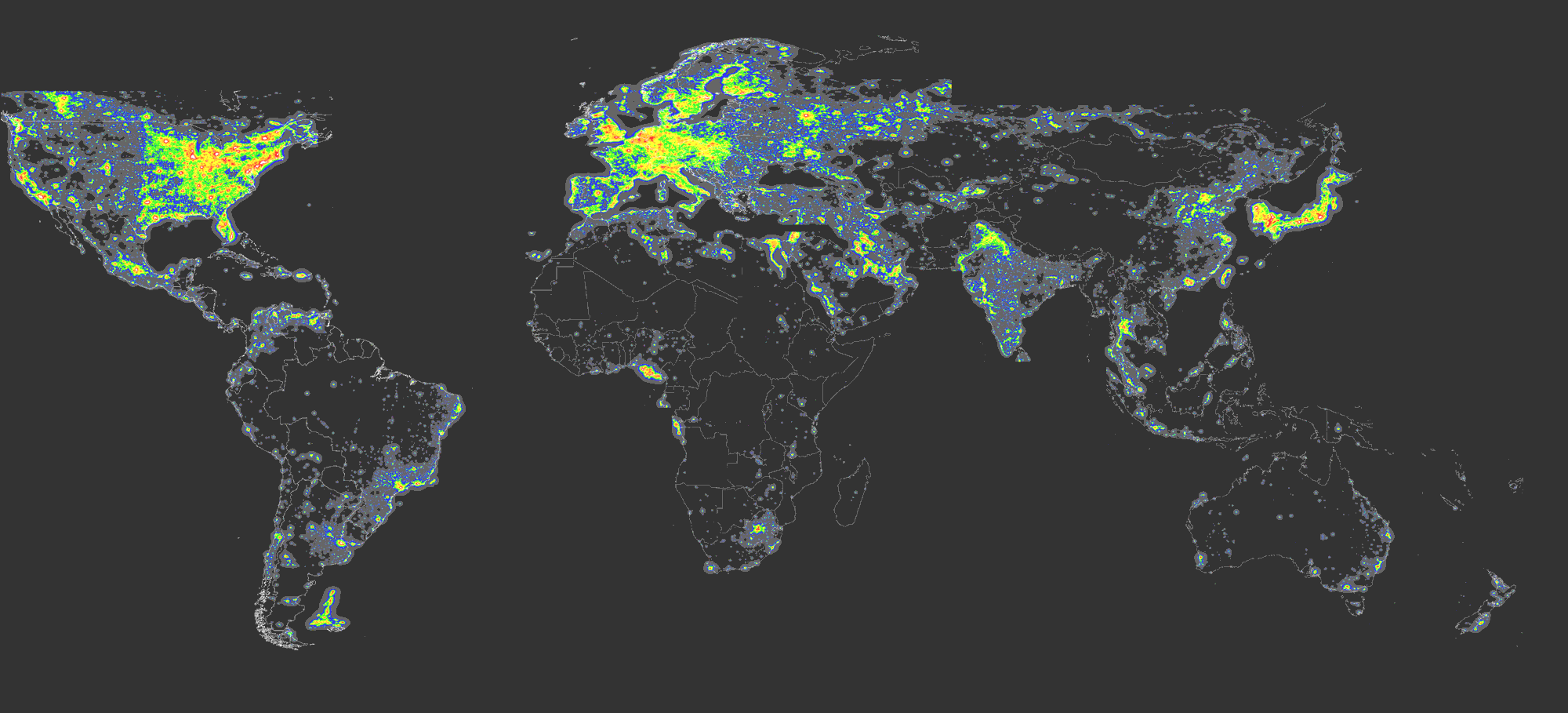
missing areasAnyone know why there's a swath missing between Israel and Lebanon from the Mediterranean eastward? See how stranglely the Africa and middle east maps both ignore it. Compare the DMSP map.
As mentioned before, the milky way is absolutely amazing when you leave the metros, especially here in the Southern hemisphere. Sad to think how few people get the chance to just stare at it in awe.
-
Re:Be prepared to pay
That damned Weather Channel site just started using the Pop up ads. Nice to know; the NOAA sites were already paid for by our tax dollars, zero ads and really useful data.
-
Supercomputer Envy
I hate it when the press makes it sound like America is the jack-ass backwards donkey of the supercomputing world. This writer implies the Japanese and Europeans have vastly superior computing power. This is clearly the notion of a chucklehead. Take a look at The Top 500. By its (Linpack) metric, 8 of the top 10 machines are in America. Three of them are DEDICATED to weather or environmental work (Naval Oceanographic Office, National Centers for Environmental Prediction). A fourth one at NERSC is relatively open, compared to defense machines, and I'd be willing to bet weather code is running on it regularly. These are all teraflops machines. Japan has the other two in the top 10. Anybody know the job mix on those two? Europe's fastest machine is the Hitachi in Muenchen. The fastest dedicated European weather machiens are the T3Es at the Deutscher Wetterdienst and at the UK Meteorological Office.
I don't buy these whiny weathermen's complaints. The difference is that the American machines are all massively parallel machines (mostly IBM SP). The Japanese manufacturers all make vector machines, some of which the Europeans use. The Cray T3E is kind of a weird in-between architecture. It takes a good programmer to use a MPP to its full capability. The vector users, on the other hand, have 30 years of old code and practice which keeps them in the game. If the Americans would suck it up and learn to use their amazingly fast IBMs we would hear whining from the other side of both ponds. If you try to run your old code for the Cray C90 on an IBM SP, you are going to get terrible performance. If you rewrite the code, you may get great performance. But these guys aren't rewriting the code. Take for example the machines at NCEP. These create the daily production weather models used all over the US. They are IBMs which replaced a Cray that self-immolated about 1.5 years ago. When they brought the new machines up, I wonder if they rewrote the code beyond making it run? If you know, enlighten us!
-
Re:lots of free geo data available (more listings)Here are a couple of other interesting geodata sources:
National Weather Service AWIPS Map Database Catalog
http://isl715.nws.noaa.gov/mapdata/newcat/
All Sorts of U.S. ditigal map data in Shapefile format.GOES Imagery On-line at NASA-GSFC
http://rsd.gsfc.nasa.gov/goes/text/0readme.html
http://rsd.gsfc.nasa.gov/goes/
http://www1.etl.noaa.gov/climsat/realtime.html
Your basic weather satellite data - get the latest imagery.Virtual Terrain Project
http://vterrain.org/index.html
Another interesting open source projectDGPS corrections over the Internet
http://www.wsrcc.com/wolfgang/gps/dgps-ip.html
Of interest to GPS users. Neat! -
Re:lots of free geo data available (more listings)Here are a couple of other interesting geodata sources:
National Weather Service AWIPS Map Database Catalog
http://isl715.nws.noaa.gov/mapdata/newcat/
All Sorts of U.S. ditigal map data in Shapefile format.GOES Imagery On-line at NASA-GSFC
http://rsd.gsfc.nasa.gov/goes/text/0readme.html
http://rsd.gsfc.nasa.gov/goes/
http://www1.etl.noaa.gov/climsat/realtime.html
Your basic weather satellite data - get the latest imagery.Virtual Terrain Project
http://vterrain.org/index.html
Another interesting open source projectDGPS corrections over the Internet
http://www.wsrcc.com/wolfgang/gps/dgps-ip.html
Of interest to GPS users. Neat! -
Re:nonsense
As long as the airflow is not turbulent, an airship can survive arbitrary large winds by just floating with them. When the airship moves with the same velocity as the wind, the relative velocity is zero. Of course you would not try to *land* in a hurricane.
Not convinced? Well, weather baloons routinely cross the jet stream which has a velocity of more than 200km/h without damage.Umm, yes. "As long as the airflow is not turbulent". I'm afraid you are kind of making my point for me - lets's see one of these behemoths lumber its way out of one of these.
And your weather balloon analogy is rather weak - the airship would operate considerably closer to the ground, and at far greater stakes than the potential loss of a cheap radiosonde. Floating along with the wind sounds fine as long as there aren't high tension lines in the way, and as long as the idea isn't currently to stay tethered. In which case this would tend to happen.
-
if you want it...
...the protocol is open, and you can write your own implementation (of at least the text data) fairly easily.
-
Re:Text of 5th Circuit Decision
"due process requires at a minimum that the codes should be available for inspection and copying at the city offices in towns where they have been adopted"
What if your city office had a webserver?
Could you donate a webserver to your city office?
Could you take a cdrom burner to the city office?
What about the Paperwork Reduction Act (read the goals)
What about RMS coming up with a couple "GPL" laws... GNU/Building code, etc...
I think there was also a similar case with westlaw owning all the law references.
-
Re:What about Whales?From a New England Aquarium naturalist on a recent whale watch.
The aforesaid naturalist also indicated "the government" is implementing plan to reduce whale boat collisions at various points on the east coast. A significant portion of the plan is posting "whale spotters" on the bows of Navy vessles to watch out for "logging" (resting/sleeping) whales at the surface. More information about such a planhere. Information about right whales killed by boats, as well as documentation of my "leading documented cause of death claim can be found here. Of course, the documented part is important -- boat strikes are probably overreported relative to other causes of right whale fatalities.
-
Give me the NOAA data!
Check this out: We paid NOAA to chart our waters. NOAA gave the data to BSB Electronic Charts, LLP for nothing. And now to get our data we have to pay juice to Maptech. This is a start to giving us our charts on the OS we choose. But the data (charts) need to be made available for free and the file spec needs to be opened.
-
Auroral ActivityAurora watchers can go here to see current auroral activity at any time, extrapolated from polar satellite imagery. Both Northern and Southern hemispheres are covered.
I've never been priviliged to see an aurora for myself. From what I understand they can't be done justice in photos. So my question is for anyone who's seen them... in photos, it seems usually there will be trees, hills, or other ground landmarks in the shot, suggesting that aurorae are usually low in the sky. But from the satellite pictures, they seem to cover the entire sky. Do they ever? Or if they only appear near the horizon, why is that?
-- -
sign up for aurora alerts, get real-time infoThe sun is currently near the maximum of its approximately 11-year cycle, so more auroral displays are likely in coming weeks. If this kind of stuff interests you, I suggest signing up for the e-mail alert from spaceweather.com so you get advance notice of events that are likely to trigger auroral displays.
Also, you can check out real-time satellite maps showing the extent of the auroral circle (in both N and S hemispheres) at www.sec.noaa.gov (note that the site has down -- or overwhelmed -- intermittently over the past day or so). Of course, if you live someplace dark you can just go outside and see for yourself, but if you're in a light-polluted area like me you can at least tell beforehand whether it's worth taking a drive to someplace with better skies. (Which I attempted to do last night, but unfortunately clouds thwarted my valiant attempt
-
NOAA has a satellite map of this
http://sec.noaa.gov/pmap/pmapN.html
If you really want to see whether you should be getting some of this good stuff in your sky tonight. -
Some places to check out...
To see how active the sun has been for the last 2+ days try the NOAA site. There was an X1 flare today, which should provide plenty of aurora material in a day or so.
To see if auroras are visible at this moment try the Auroral Activity Report page.
-
global warming blues
When the media reports on global warming, they like to talk about coastal flooding and severe weather... direct human impacts.
What particularly bums me, though, is the fact that probably every ecosystem on earth is going to be affected. There will be no pristine places left on the entire planet that are safe from the effects SUV exhaust and other excesses. Not northern Canada, not Sibera. Everywhere there will be tundra melting or species adjustment or rainfall changes in response to human activity. That makes me sorta sad.
We Americans are 5% of the world population, and we produce 25% of the world's CO2. So it is too bad that Bush has decided not to do anything.