Slashdot Mirror
Domain: nrao.edu
Stories and comments across the archive that link to nrao.edu.
Comments · 207
-
Re:Radio Telescope Effelsberg
It's also difficult to make such a dish that's suitably strong; the American one built in the 1950s collapsed in 1988. Here's a photo.
-
Re:High resolution images possible in near future?
For interferometry you need two or more observations made at the same time, from different locations. You then arrange for those signals to interfere. Basically, optical interference is a Fourier transform, so you can then read off the Fourier coefficients by examining the interference pattern. You need to move your observing stations (or have more than two) in order to measure more than one Fourier coefficient. Once you've got enough, you can inverse Fourier transform to get your image.
With radio astronomy, due to some clever techniques, you can take the information from each observing station and record it, then compare them later. That's the magic of Very Long Baseline Interferometry. As far as I know, nobody has done that with anything higher frequency than radio. For higher frequencies you have to let the two signals interfere directly, which limits how far apart you can put your telescopes. It's a moderately ambitious high school science fair project to build a visible light interferometer with a separation of a few feet though.
The problem with taking a measurement now and another with the Earth on the other side of it's orbit is that you can't get the simultaneous measurements you need. If you put a satellite at that L-point though, you could definitely do it. There are some radio telescopes in orbit already that are being used in combination with ground stations to make VLBI arrays with effective apertures larger than the planet: http://www.gb.nrao.edu/ovlbi/OVLBI.html
-
Re:Less Obvious Answer: Radio Telescopes
even bette - get a whole bunch of old antennas together to make an array a la the Very Large Array
you can call it the Very Small Array
-
Watch The Landing On The Big Screen
For anyone near Charleston, WV on Sunday, May 25th the Clay Center will be displaying streaming video from the Green Bank radio telescope that NASA is using to watch the landing. This event is free, open to the public and doors open at 6:30 pm.
-
Re:uhh, wait a sec...
I suspect smebody at SciAm crunched their numbers wrong, here are some real stats: http://www.aoc.nrao.edu/evla/
-
Re:Very, Very Large
The project name is EVLA which has at times stood for Enhanced or Expanded.
Currently it's the Expanded Very Large Array as opposed to the Very Large
Baseline Array (VLBA) which NRAO also operates. NRAO also operates the
Green Bank Telescope which could just as aptly be called the Great Big Telescope.
It's a 100 meter single dish scope.
http://www.gb.nrao.edu/
Belthize -
Re:"imprecise" - a whole new meaning
How about this: "Bright Spiral Galaxy M81 from Hubble" (http://antwrp.gsfc.nasa.gov/apod/ap070529.html) - note the asymmetric arms, the large central bulge;
Ah, I'm surprised to see you call on unquantified illustrations, but that's OK. I'm more concerned with where you got the idea that assymetry would falsify Peratt's model, nor why would so do a large central bulge. Do you in all seriousness suppose that Peratt's model relies on perfectly parallel plasma filaments with identical cross-section, plasma and current density, and their chemical composition? If you have a source that shows this in rigorous detail, perhaps you would be so kind as to provide an attribution?
As it happens, Peratt's own articles bear witness that symmetry is not essential. Indeed, many of his examples are not symmetric. Moreover, and in response to your next statement:
or this "One-Armed Spiral Galaxy NGC 4725" (http://antwrp.gsfc.nasa.gov/apod/ap050901.html)?
allow me to quote Peratt from A. L. Peratt. Evolution of the Plasma Universe II. The Formation of Systems of Galaxies. IEEE Transactions on Plasma Science, PS-14, 6 (1986); the quote stars at the bottom of page 768 and continues at the top of page 770:
Whether a normal spiral (S) or a barred spiral (BS) galaxy forms out of the plasma interaction depends primarily on the profile or cross section of the current-carrying filaments, its density distribution, and strength of the azimuthal magnetic fields. Bars form when the interacting plasma regions are sharply divided in plasma density, while normal spirals tend to form when the interacting plasma supporting the current-conducting filaments is more homogeneous overall.
If you want more detail as to why and what plasma experiments/models show it, the normal course of action would be to write Peratt and ask a question, as scientist to scientist. If you disagree and have a substantiated argument to that effect, feel free to publish it (or at least, present it here). If you can refer us to such article already published, by all means, do so.
As to the one-armed galaxy, I wonder if a bar would still form if the current density in one of the filaments is too low to trigger star formation. That would be another good question to ask Peratt, which I will do and will communicate his answer, if you're prepared to wait.
For starters, the MOND folk (Milgrom, Sanders, McGaugh, etc) would no doubt take strong exception to the "without recourse to [...] dark matter" part (http://www.astro.umd.edu/~ssm/mond/).
Oh, are you trying to shame me into not listening to another alternative model? I'm glad you pay attention to it, but I happen to disagree with that one, too. In any case, we were discussing something else.
Next, even in 1986, the observed "shape" of Double Radio Sources associated with Active Galactic Nuclei (DRAGNs) was inconsistent with the Peratt's model; today, with considerably more, much higher resolution, across many more EM wavebands observations, Peratt's model clearly fails both "shape" and "stability" criteria (an example: http://www.cv.nrao.edu/~abridle/dragnparts.htm).
How is it inconsistent? In what terms? What parameters don't match, and in which example? If in general, I'm more than interested to see a better exposition. The linked webpage would hardly qualify.
Finally, we now have independent estimates of the radial distribution of mass in galaxies, from analyses of gravitational lensing, something not available to any significant extent in 1986.
Are you saying, then, that you have data showing that galaxies don't, after all, rotate nearly as solid bodies? If so, there is no need for dark matter. Publish it; that would be a sensation.
The conclusion is clea
-
"imprecise" - a whole new meaning
Any theory that attempts to explain the inverse temperature problem must also grapple with the fact that the solar wind continues to accelerate even as it passes the planets! There is no satisfying explanation for that one to date without consideration of an electric field, and the standard solar model miserably fails in explaining it. And this is no minor matter either because the solar wind, taken as a whole, constitutes the largest structure in our solar system, the heliospheric current sheet. Contemplate the implications of that for a moment: astrophysicists do not understand what is causing the motions of the largest structure in our own immediate neighborhood!
(pln2bz; source: http://slashdot.org/comments.pl?sid=426528&cid=22144600; emphasis in the original).
"the solar wind continues to accelerate even as it passes the planets!" BUSTED http://slashdot.org/comments.pl?sid=426528&cid=22148864, http://slashdot.org/comments.pl?sid=426528&cid=22148128
(APODNereid; source: http://slashdot.org/comments.pl?sid=426528&cid=22208390).
Not quite; see http://slashdot.org/comments.pl?sid=426528&cid=22279668. Admittedly, however, the original statement, if enthusiastic, is also imprecise.
(leokor; source: http://slashdot.org/comments.pl?sid=426528&cid=22279804; emphasis added).
If you know of even one observation that doesn't square with Peratt's model of galaxies, by all means, let us know. For Peratt's model, see:
A. L. Peratt. Evolution of the Plasma Universe I. Double Radio Galaxies, Quasars, and Extragalactic Jets. IEEE Transactions in Plasma Science, PS-14, 6 (1986)
A. L. Peratt. Evolution of the Plasma Universe II. The Formation of Systems of Galaxies. IEEE Transactions on Plasma Science, PS-14, 6 (1986)(leokor; source: http://slashdot.org/comments.pl?sid=426528&cid=22284506; emphasis added).
How about this: "Bright Spiral Galaxy M81 from Hubble" (http://antwrp.gsfc.nasa.gov/apod/ap070529.html) - note the asymmetric arms, the large central bulge;
or this "One-Armed Spiral Galaxy NGC 4725" (http://antwrp.gsfc.nasa.gov/apod/ap050901.html)?To this day, Peratt's model remains the only one that explains the shape and stability of galaxies, and does it without recourse to such ad-hoc devices as dark matter.
(source as above; emphasis added).
Even in 1986, and allowing for enthusiasm, this remains
For starters, the MOND folk (Milgrom, Sanders, McGaugh, etc) would no doubt take strong exception to the "without recourse to [...] dark matter" part (http://www.astro.umd.edu/~ssm/mond/).
Next, even in 1986, the observed "shape" of Double Radio Sources associated with Active Galactic Nuclei (DRAGNs) was inconsistent with the Peratt's model; today, with considerably more, much higher resolution, across many more EM wavebands observations, Peratt's model clearly fails both "shape" and "stability" criteria (an example: http://www.cv.nrao.edu/~abridle/dragnparts.htm).
Finally, we now have independent estimates of the radial distribution of mass in galaxies, from analyses of gravitational lensing, something not available to any sign -
Robbing Arecibo to pay for ALMAThe NSF Astronomy Division convened a "Senior Review" http://www.nsf.gov/mps/ast/ast_senior_review.jsp to try and see where money could be saved to pay for the enormous operating costs of ALMA http://www.alma.nrao.edu/ which is the Atacama Large Millimeter Array. ALMA will be an array of some 64 12-meter antennas operated at an elevation of 5000 m (16,000+ ft). ALMA is a collaboration between the Europeans, Japan, Chile and the US.
Arecibo was a loser in the Senior Review; something has to give to pay for ALMA operations!
-
Re:..with a telescope _AS BIG AS the EARTH" ?
We've been doing radio-interferometry already quite a bit longer, I work at the WSRT, which became operational in 1970.
http://www.astron.nl/p/WSRT2.htm
From http://www.aoc.nrao.edu/~cwalker/talks/aaas_2001/tsld007.htm, it looks like VLBI is already 40 years old.
* 1967 First VLBI
o Jan: U. Florida - 1 kHz on Jupiter bursts
o Apr: Canadian group 448 MHz, 1 MHz bw
o May: NRAO-Cornell 610 MHz, 360 kHz bw
o June: MIT-NRAO-Cornell OH masers
* 1968 Jan. First multi-station observations
o Already global - includes Onsala, Sweden
* 1969 Oct. First US/USSR observations -
Re:Interesting, but......this thread is useless without pics =)
Here you go. From memory, it was that image that brought me to CnD in the first place...
-
Civ or Star? Hires picHope it wasn't another civilization trying out the latest theory..
-
Re:More info here
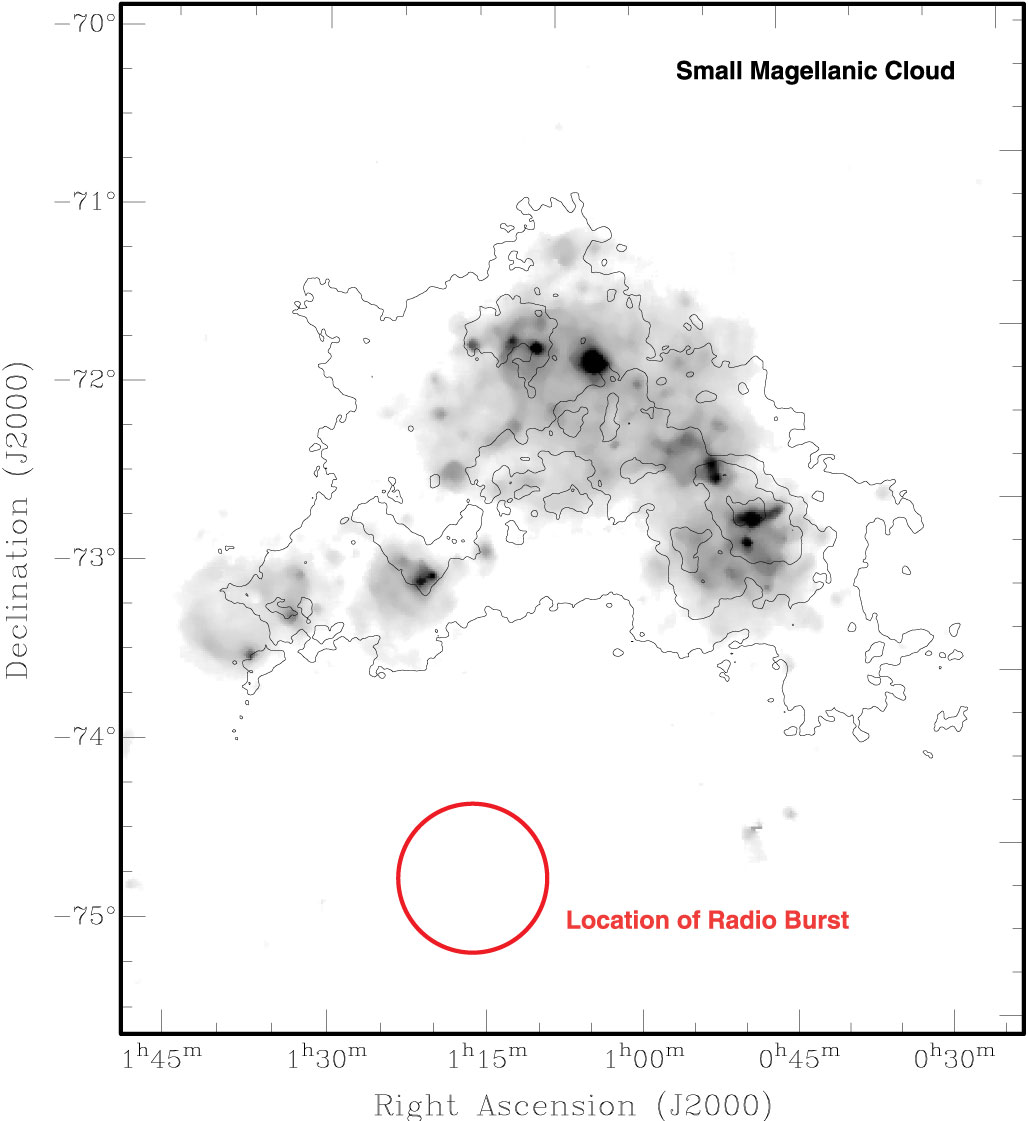
Sorry for the language. What the fuck? That is impossible. It must be some sort of equipment error or methodological mistake. Please go look at the parent's picture, it must be some sort of joke news page for the issue, seriously. It's amazing.
Here's a higher res image of exactly what I'm talking about. I can't find anything that indicates this is an artist rendition rather than an actual map, other than the fact that they used the word 'illustration' just once on the previous page. Please help me figure this out, because I know a hole like this cannot possibly be -
More info here
Now this is *big* news ! The scientific world is waiting for good explanations.
More info here (with pictures..)
http://www.nrao.edu/pr/2007/coldspot/index.shtml -
No, it's not the world's largest telescope.
It's not the world's largest telescope. There are plenty of telescopes that are larger than this. The James Clerk Maxwell Telescope is about 5 meters in diameter larger. Arecibo is about 295 meters larger.
And then you've got the array telescopes like VLA and VLBA, if you wanted to get pedantic about effective telescope size. -
No, it's not the world's largest telescope.
It's not the world's largest telescope. There are plenty of telescopes that are larger than this. The James Clerk Maxwell Telescope is about 5 meters in diameter larger. Arecibo is about 295 meters larger.
And then you've got the array telescopes like VLA and VLBA, if you wanted to get pedantic about effective telescope size. -
Re:Helium 3
And oxygen. Everyone is speculating about possible water on the moon, but if they can find ice on mercury using radar, why haven't they found any on the moon? Maybe there is a little, but unless you find concentrated ice deposits, you'll have to set up quite a mining operation.
If you can extract oxygen, I think it would make more sense to mine that than to go hunting water that very possibly isn't there. Hydrogen is much lighter, so cheaper, to haul into space. Oxygen makes the bulk of the weight.
Transporting the hydrogen in the form of e.g. liquid propane might make sense. Both hydrogen and carbon are scarse elements on the moon, and propane is much easier to handle than cryogenic hydrogen (plus, hydrogen molecules seep throuh metal walls because they are so small). -
Re:It might just take a while
or... it could be for Atacama Large Millimeter/submillimeter Array - National Radio Astronomy Observatory
http://www.alma.nrao.edu/
Google can be your friend too.. . -
Re:ridiculously expensive
I regularly work with equipment that produces signals up to 50 GHz and let me tell you... components get much higher in cost the higher in frequency they go.
Depends on how precise you want to be. Conducting and measuring signals in that region of the spectrum with low-loss gear can be tough. Generating and receiving them isn't, necessarily. Not many people realize that some of the very first wireless communications experiments were done in the 60 GHz range, two years before Marconi. -
The open eleven steps to telecommutingFrom my blog Friday, October 28, 2005 The open eleven steps to telecommuting
I have set up and supported remote sites and home based telecommuting. Listen to my advice, listen very carefully and save your sanity.
If your organization is large enough then it is likely that you will have a few older desktop PCs that have been or are due for replacement during an upgrade cycle. PCs that are inadequate for Microsoft XP and Office2003 are more than powerful enough for many current versions of Linux, especially for the role of server. Also second hand PCs with the required specifications are very cheaply acquired.
1) Find an older PC, at least a PII 300 with 256 MB memory, to set up as a headless ( no display or keyboard ) server and firewall. A simple web based interface ( or even an external hardware push button ) can be used by the local users to start/stop the server and internet connection. All other maintenance should be handled remotely via ssh, webmin and VNC.
2) Install a second NIC or connect the modem directly to the server. Connection to the Internet should be through the server and connection to the Office should be through a VPN on the server. Use a dynamic IP service for each site so you can remotely log on to the local server via ssh.
3) Install a new IDE hard drive in a 3.5" removable rack and tray. The drive should be than big enough for the operating system (Linux of course) and copies of some of the local desktop partitions. A telecommuter can shut down the server and bring in the drive during the day to resync and repair.
4) Install a DHCP demon on the local server to allocate local IP addresses, DNS and gateway settings. If the desktops are network boot capable then install TFTP to remotely boot and use Knoppix via PXE and the network. If the desktop OS is constantly crashing, or is infected by malware, the user can select PXE/network boot via the BIOS, and boot into Knoppix. The user can then be instructed over the phone to enable the ssh server to allow remote scan,repair and reimaging of the desktop partitions. The user can use the Knoppix desktop to continue working with full access to files while the the remote administrator fixes/reimages the drive in the background.( Consider hiring someone who knows how to customise Knoppix or another live Linux system for your setup )
5) Partition the desktops with as small as required C: partition ( or in the case of Linux the root partition ) for software. When software is install, use dd and netcat via live Knoppix to copy/clone a snapshot of the partition to the server. You can allocate the remaining free space as a persistent partition where documents are stored.
6) Install and enable remote VNC service on all the platforms, but only allow incoming connections from the local server ( which is redirected over a SSH tunnel ).
7) For local backup, create share directories on the desktop accessible by the server. On the local server create loopback encrypted file systems, unmount and copy the images to the desktops shares in chunks, using redundancy if enough space is available on the desktops. Checksum ( MD5 is enough ) each piece.
8) If the network load to the Office is taking up all the available internet bandwidth or the connection is just too slow then install proxy servers on the local server. You can also consider using a distributed filesystem ( OpenAFS is still the best ) wi -
Re:Cached page
You could also go to the horses mouth: http://www.alma.nrao.edu/almanews/ Chris
-
Re:Right! Russians invented everything!
And while we're on the "my country is better than yours" track, here's an interesting find:
http://www.tuc.nrao.edu/~demerson/bose/bose.html
So while Marconi and most other radio pioneers worked at LW and MW bands, Bose was working at 60 GHz in 1895. The thing that really struck me was the waveguide and horn in the pictures of his equipment, and how similar they look to today's MM-wave equipment. Also note that he used a point-contact diode detector, and even made I-V plots (see Figure 5 in the article). -
Re:Mexican scientists must be humble
While I understand the frustration at the idiot comments that have been posted so far, I think you are way off base in regards to the scientific research and education that goes on in the US. If you were too lazy to read the article before responding, the summary even states that the US has supplied funding for this project.
While it is amazing that Mexico has built a new LMT, I feel obligated to remind you of the multiple telescopes the US operates such as Gemini, KECK, NASA IRTF, CSO, SMA, NRAO. These are but a few off the top of my head. -
How does this compare to the Atacama array?
I hadn't heard of this Mexican effort before, but I've read a bit about the Atacama Large Millimeter Array being built in Chile. Is this a duplicative effort, or is ALMA supposed to be even more capable?
-
1K Hz sounds about right...
Here's a 20 mile diameter pulsar spinning at 716 Hertz. When you factor in the increase in rotational speed with the black hole contraction, 1K sounds real plausible.
-
Re:Green Bank Telescope
Not as impressive as Arecibo though. I was expecting more like an array but it really is just one giant dish.
It is *just* one big dish.. but it's also the world's largest full steerable telescope (aricebo isn't fully steerable). Also, it's one of very few off-axis paraboloid telescopes. (One of the nice things about this is the collection unit doesn't block any of the light that would be incident on the reflector.)
For impressive arrays, check out the VLA, ALMA (soon), or SKA (later). I was at the VLA last summer as part of my research (I do astronomy), it is very impressive. I was able to go into the dishes.. they're huge.
-
Re:Green Bank Telescope
Not as impressive as Arecibo though. I was expecting more like an array but it really is just one giant dish.
It is *just* one big dish.. but it's also the world's largest full steerable telescope (aricebo isn't fully steerable). Also, it's one of very few off-axis paraboloid telescopes. (One of the nice things about this is the collection unit doesn't block any of the light that would be incident on the reflector.)
For impressive arrays, check out the VLA, ALMA (soon), or SKA (later). I was at the VLA last summer as part of my research (I do astronomy), it is very impressive. I was able to go into the dishes.. they're huge.
-
Green Bank Telescope
The research involved sending a radar signal from the Arecibo telescope in Puerto Rico. The signal hit the southern lunar region and the reflection was picked up by the Green Bank Telescope in West Virginia
I live in WV and have seen the Green Bank Telescope. Impressive radio telescope. Not as impressive as Arecibo though. I was expecting more like an array but it really is just one giant dish.
Better link than in the story:
http://www.gb.nrao.edu/
B. -
Hmmm. (Thinking)Ok, you won't have much in the way of collecting power (too few dishes) but the resolving power would be amazing. Now, you don't need much in the way of collecting power to see "bright" radio sources - electrically active planets, for example, nearby stars, or globular clusters.
Your resolving power, however, should be pretty damn amazing at 20 miles diameter. Ok, so what's wanted here is something nice and noisy, where your ability to isolate a region of sky and/or track an object would be of value.
You could probably track the storms on Jupiter - you can detect those with even a trivial dipole and a receiver in the right range, so you've certainly got more collecting power than necessary. Not sure how accurate your measurements would be, but that would make a fascinating experiment.
GnuRadio will turn your computer into a suitable receiver (provided you either have a soundcard that works at the right frequency, OR you have a suitable analog-to-digital converter plugged in somewhere). You then need to process the streams into something interesting. I believe AIPS is what you'll want for this. It is "professional" Open Source software for interferometry (read: the interface is crappy, but the logic is superb).
The nearer satellites - such as those orbiting Mars - should be well within your ability to receive and track. I doubt there will be any encryption on the data being sent to Earth, so you might be able to get real-time(!) images from the probes. The only question there is whether the signal would be strong enough to correctly interpret. The same would be true of anything sent by the Cassini probe, although it is much further away and therefore would be far fainter, so you might be restricted to just knowing where it was. Which would be pretty damn good, even so.
I would certainly encourage you to give it a try and see what you can do, and also to diary what works. You may well be able to do far better than I expect - it depends on how big the dishes are and how well you are able to sort signal from noise.
You get your Real Ultimate Power badge if you can intercept a message from either Voyager probe, and an honorary lifetime membership of the Q Continuum if you can get any kind of signal at all from one of the Pioneer probes.
(Note to the humour-deprived: If NASA can barely achieve the former, and can't achieve the latter at all, on the Deep Space Network, there is no friggin' way an amateur is going to on three dishes... unless they ARE in the Q Continuum, in which case the prize is easy.) -
Black Hole????
While one should be skeptical that pressures as great as 12.50G let alone 20.00G would ever be experienced during space travel (space being weightless, this would I imagine be largely of concern only to a craft piloted foolishly close to a black hole)
Given that the nearest black hole is 1600 light years away I'd be more interested in said craft's drive system than it's centrifuge. -
Lunar Prospector Mission / Ice at moon's poles
Since the article posted on Slashdot doesn't really explain why scientists think there might be ice on the Moon, I think your questions deserve a decent answer. Some recent unmanned missions like the Lunar Prospector have made spectroscopic measurements that suggest there are higher than normal concentrations of hydrogen near the Moon's poles. This could indicate the presence of water ice, or hydrogen tied up in the molecules of the rocks on the Moon. They did try crashing the Lunar Prospector into the Moon at the end of its mission, but the experiment didn't work out as planned. The reason why they are looking in deep craters, is that parts of the deepest craters near the Moon's poles may be permanently in shadow. Sunlight never reaches the bottoms of these craters, so that water ice might be able to exist there in a sort of permafrost layer. There is some evidence for water ice in deep craters near the poles of the planet Mercury as well. If I understand the new NASA mission correctly, they are basically going to do a more sophisticated version of the Lunar Prospector experiment. Even if this new mission finds evidence for water, it doesn't mean the water is necessarily in a form that could easily be used by astronauts - it could be bound up chemically in the rocks, making it difficult to extract.
-
Re:Origins of life my foot
Can't say that I agree. In the first place, about forty of the 130 or so known interstellar molecules are as big or bigger than methanol. In the second place, methanol is readily formed in a reducing environment, such as you'd find in hydrogen-rich interstellar space. Third, while it is true that the formation reaction rate would be low, because as you point out the interstellar gas density is low, it is equally true that it's got billions of years to react. Remember how easily Stanley Miller got amino acids to form in a primordial soup with a little electrical discharge? Frankly, I'd be shocked if simple organics didn't form in a reducing, cryogenic environment with plenty of high-energy photons swimming about.
On earth we need dense solutions with a heat source to get a reaction to happen.
Not always, no. Plenty of reactions will go without heat, and in dilute solution.
if you mix oxygen and methane together in an attempt to get methanol, you'll get the lower-energy products of carbon monoxide, carbon dioxide and water.
To be sure. But that is a highly oxidizing environment, and hydrogen-rich interstellar space is a highly reducing environment. Surely most oxygen in a hydrogen-rich molecular cloud is going to be present as H2O, not O2, and then
CH3 + H2O -> CH3OH + 1/2 H2
would happens readily enough in a highly energetic environment. Interstellar space is an unusual chemical environment from the point of view of Earthlings, used as we are to living at the bottom of a pool of potent oxidizer. It's highly nonthermal and highly reducing. Our Earth-based chemistry instincts may not necessarily be a good guide. -
robotic telescopes
Ground-based telescope systems are actually important, contrary to popular
There are also cataclysmic variable surveys, transient surveys, and other uses of the robotic systems when they're not pursuing GRBs. These are far easier and cheaper to develop and deploy than space-based telescopes. Each mission has it's limitations, but there is good science to be done by each. Thinking Telescopes has more information about robotic systems and the software behind them.
So yes, the days of a professional astronomer staring through a telescope to study the stars is probably long over. But that does not mean that ground systems are obsolete or outdated. Hell with the budget cannibalization going on at NASA, astronomers are going to loose the largest means of space based missions: Explorers. So when we can't launch into space, we'll build on the ground or make balloon experiments to observe in energies that are blocked by the ozone (amazingly enough, these are still done).
And the picture they use in the bloody article is a RADIO telescope! Radio really isn't affected by contrails or climate change! The biggest concern is in the optical to infrared ranges, where the moisture and clouds do the most damage to light (diffraction, reflection, etc). Radio and microwave suffer most from cell phones, gps units, radio and television broadcasting, etc. That's why radio observatories are out in the middle of *no where*. -
Re:This would be a pretty silly weapon...
You are pretty ignorant, and clearly not any type of scientist.
50m dish is nothing and with enough motors with the correct gear train you can track any satellite
Are you joking? A 50m dish is huge. Just for perspective smaller radio telescope dishes, such as the VLA dishes (27m) or the GMRT (45m) (both of which I have operated and watched slew)can only slew at a max rate of less than 30degrees in RA, about half that in DEC per minute. Thats the SLEW rate, not the rate at which they can accurately track. The tracking rate is MUCH less (by a factor of atleast 200, even on the smaller telesopes), since tracking requires MUCH more stable motion.
Any satellite you've tracked has probably been with your tiny backyard telescope, which is much easier than a big dish. Why is that? Its a question of rigidity. A telescope needs to maintain a surface accuracy to a true parabaloid of significantly less than the wavelength. Although this is really small (500nm) for optical wavelengths that you would have in your "high tech" backyard telescope, you need to compare the strength of the mount to the torque on the optics. For your tiny backyard telescope, there is pretty much no inertia from the edges of your lens (RotationalInteria=Mass*distance^2 from rotation center), and it is supported by a relatively much larger mount. For these giant dishes, the ends of the dish sag with changing angles to the gravitational force, and buffet in the wind. They do deform much more than the allowable distance.
This is actually where adaptive optics comes in.
Adaptive focus... In a radio telescope??
Yes. You really don't know anything about RA, do you?
While you are right that the atmosphere doesn't affect radio waves as much as optical waves, it is still important at these relatively high radio frequencies. The main use of AO in radio telescopes, however, is to correct for gravitational distortions of the dish (see http://wwwlocal.gb.nrao.edu/GBT/GBT.shtml for an example... They call it Active Surface, but it is the same thing, since the surface IS the optics for radio telescopes)
At any rate, this is long enough, and I hope you've learned that it is good to try to read and be knowledgable before shooting your mouth off to someone who knows WTF they are talking about. -
GMT is UT1, not UTCUTC != GMT. GMT is either UT0 or UT1. Neither have leap seconds because their second really is an 86400th of the average day. UT1 is corrected for the difference between the geographical pole and the rotational pole.
TAI is the ticking of the atomic clocks.
UTC is TAI plus an integer offset to keep it within a second of UT1.
Leap seconds are when that integer offset is changed. They can in principle be double, or negative, or double negative. There has never been a negative leap second, but that doesn't mean they're not possible.
You can get the full details from http://en.wikipedia.org/wiki/Universal_Time or http://www.cv.nrao.edu/~rfisher/Ephemerides/times
. htmlThere was a bill in front of the UK Parliament when the Major government fell, which hasn't been re-introduced by the Blair government, to change UK `legal' time from GMT to UTC. In practice, UK legal time _is_ UTC simply because getting hold of UT1 is almost impossible. MSF and DCF77 (the UK and German equivalents of WWV)transmit UTC, and almost everyone uses either those or GPS. If, say, BT wanted to switch between peak and low rate charging at 1800 GMT, I have no idea where they'd obtain a reference from. So they use UTC (I know, because I've helped sort out NTP from MSF and GPS references for kit in the BT network).
ian
-
Using VNC & Linux to dramatically reduce downtFrom my blog "The open eleven steps to telecommuting"
4) Install a DHCP demon on the local server to allocate local IP addresses, DNS and gateway settings. If the desktops are network boot capable then install TFTP to remotely boot and use Knoppix via PXE and the network. If the desktop OS is constantly crashing, or is infected by malware, the user can select PXE/network boot via the BIOS, and boot into Knoppix. The user can then be instructed over the phone to enable the ssh server to allow remote scan,repair and reimaging of the desktop partitions. The user can use the Knoppix desktop to continue working with full access to files while the the remote administrator fixes/reimages the drive in the background.( Consider hiring someone who knows how to customise Knoppix or another live Linux system for your setup )
Lower end desktop PCs can be setup boot as thin-clients, as we used to do, and use LTSP with local ssh login and HD access to do the same job as the thick-client Knoppix.
5) Partition the desktops with as small as required C: partition ( or in the case of Linux the root partition ) for software. When software is install, use dd and netcat via live Knoppix to copy/clone a snapshot of the partition to the server. You can allocate the remaining free space as a persistent partition where documents are stored.
6) Install and enable remote VNC service on all the platforms, but only allow incoming connections from the local server ( which is redirected over a SSH tunnel ).Serously, someone whould consider hacking a copy of Knoppix or Ubuntu live to work with WINE as a bootable CD for a remote repair service business.
-
A small server can save sanity - The open ten stepI have set up and supported remote sites and home based telecommuters. Listen to my advice, listen very carefully and save your sanity and driving : Find an older PC, at least PII 300 with 256 MB memory, to set-up as a headless ( no display or keyboard ) server and firewall. A simple web based interface can be used to Start/stop the modem and server, all other maintenance should be handled remotely via ssh, webmin and vnc.
1) Install a second NIC or connect the modem directly to the server. Connection to the Internet should be though the server and connection to the Office should be though a VPN on the server.
2) Install a new IDE Hard drive in a 3.5" removable rack and tray. The drive should be than big enough for the operating system (Linux of course) and copies of some of the local desktop partitions. A telecommuter can shut down the server and bring in the HD during the day to resync and repair.
3) Install DHCP demon to allocate local IP addresses, DNS and gateway settings. If the desktops are network boot capable then install TFTP to remotely boot KNOPPIX via PXE. IF the desktop OS is constantly crashing, the user can select PXE boot, network KNOPPIX. The user can then be instructed over the phone to enable ssh server to allow remote repair and reimaging of the desktop partitions from copies on the local server.
4) Partition the desktops with as small as required C: ( or in the case of Linux the root ) partition for software. When software is install, use dd and netcat via live KNOPPIX to copy a snapshot of the partition to the server. You can allocate the remaining free space as a persistant partition where documents are stored. ( Consider hireing someone who knows how to customise Knoppix for your setup.)
5) Install/Enable VNC on all the platforms, but only allow incoming connections from the local server ( which is redirected over a SSH tunnel ).
6) For local backup, create share directories on the desktop accessable by the server. On the local server create loopback encrypted file systems, unmount and copy the images to the desktops shares in chunks, using redundantcy if enough space is available on the desktops. Checksum ( MD5 is enough ) each piece.
7) If the network load to the Office is takeing up all the available internet bandwidth or the connection is just too slow then install proxy servers on the local server and consider using a distributed filesystem ( OpenAFS is still the best )
8) If phone charges are eating into the budget, and the internet connection is good enough, then install Asterisk on the local server ( upgrade the server to a Celron 800Mhz or better ) and a card with enough FXS ports for each local user. Don't bother with software based phones/headsets. The phone will work when the desktop does not.
9) Set up a Linux server at the Office that operates as a thin client application server. Allow remote access though both FreeNX and VNC. Create login accounts and logins that operate as virtual meeting rooms, with multiple users logging in via VNC. Use VNCserver with a screen size of around 1000x600, that will operate via a VNC viewer on any 1024x768 desktop. Use phone based conference calling for voice -- it's a lot less hassle for the users
10) Add the ususal list of cross platform applications: Firefox, Thunderbird, Gaim, OpenOffice etc.Do the open ten step and save yourself and your santity from all those hours driving from site to site.
-
Re: Accurately for 10k years impossible: leap seco
I have read the article and I found no explaination at all about how the clock can calculate the local time including the leap second. Ok, the clock have a synchronization of the earth rotation using the sunlight, but this in no way synchronized to the local time. First current local time is an offset of UTC and UTC is an offet to TAI and TAI is a averge of many atomic clocks, so the basic of our local time is not astronomic, but atomic (http://cr.yp.to/proto/utctai.html). This clock can be a impressive model of the astronomic motion, but this is the wrong way to tel the local time. Second, even for the astronomic motion I have doubts, since I never see a paper telling that the earth axis motion can be know for 10'000 year. But you can find papers that tel exactly the opposite: this motion is largely unpredictable as now for a such long time. See this URL about how complexe is the earth rotation axis http://mb-soft.com/public/precess.html and this URL about why this is impossible to predict at full precision this movement http://www.cv.nrao.edu/~rfisher/Ephemerides/earth
_ rot.html. Did you know that such bulltins exists ftp://maia.usno.navy.mil/ser7/iersexp.sup ? Last, did you realiste that the local time is an human concept that have radicaly changed in less than one century ? How can someone assert that this will not change in 10'000 year ? Juste an exemple: the Asian earthquake end last year did have an observable impact on the earth roation, see http://www.nasa.gov/home/hqnews/2005/jan/HQ_05011_ earthquake.html. So keep in mind this basic facts: 1) astronomic motion is unpredictable in full precision for long time; 2) local time in based on atomic observation plus offset to keep it compatible with astronomic observation, not the opposit! -
Cool, but
While I'm all for SETI, it seems we have so many other things to learn first. Personally, I'm a big fan of the work done at the coolest of all "Arrays", the Very Large Array located in New Mexico. It's a sight to behold, and the information they gather through radio information has been extremely valuable over the years.
I'm sure it's that more impressive as it is in the middle of nowhere...there is a visitor center there (unstaffed) and the last time I went through there they sold postcards, pictures, etc., and had a box where you were kindly asked to deposit your payment. That tells me they were interested in the science first, the glitz and glamour of space.com is probably very low on their list. -
Re:Environmental loop...
Depends where they build it. If they built it in New Mexico, that'd be fine by me. It'd look in many ways small next to the Very Large Array.
-
Safari with updated webkit
If you want an easy way to check out Safari with the updated webkit that passes the Acid test, check this out:
http://www.aoc.nrao.edu/~bwaters/projects/mac/Safa riOnAcid.dmg -
Re:This is good for all the browsers
-
Re:Largest Telescope?
Arecibo Observatory is still the biggest single telescope, though there are even larger arrays.
Yep, like the Very Long Baseline Array. Nothin' like being 5,000 miles across to help you see things, I guess. It's interesting to me that at 8.4 meters each, the mirrors will be tied with the Large Binocular Telescope's mirrors which were just installed last year in Arizona. I think the next largest after that may be the 8.3 meter one on the Subaru telescope (National Astronomical Observatory of Japan) here in Hawaii. -
Re:Safari now FAILS "Acid test"
It only passes if you use a nightly. For those that aren't aware, you can build your own or download Safari on Acid
-
Re:i know about this
For anyone really interested in the math at work here, check out this page.
-
Re:From Piqy's stupid Blogvertisement
WTF is this "radio picture" he keeps talking about?
Perhaps he's talking about some of these?-1 gross incompetence
I don't think you quite deserve that. -
Re:Who needs editors anyways
kiltedtaco writes: "the Lofar images might be somewhat blurry"? Images? Since when do we get images from radio telescopes?
Ummm... Actually radio telescopes have been producing high quality images for years. In terms of sharpness (angular resolution) these images can be even better than the hubble. There are plenty of examples at www.nrao.edu.
For example:
http://www.nrao.edu/imagegallery/php/level3.php?id =5 -
Or better yet, perhaps...
...a very large array?
-
Re:Why not go private?what about a phased array of a hundred 1-meter dishes?
*whack* That's me hitting myself squarely with a clue-by-four.
Interferometers are proven to be very effective in signal reception...good call.
-
The GBT to the rescue
A lot of this work was done by the "Green Bank Telescope" aka the Great Big Telescope or GBT. You should check out the specs on this telescope. It is the world's largest fully steerable telescope and it is taller than the Statue of Liberty. I was a grad student while this was being built, and was always impressed when I saw presentations about the amount of work that went into creating this instrument. It is not nearly as famous as other telescopes like Hubble or Keck, but is very impressive nevertheless.