Slashdot Mirror
Domain: nrao.edu
Stories and comments across the archive that link to nrao.edu.
Comments · 207
-
Re:Espionage ?
They also closed the local post office. So there must have been evidence of something being shipped to the observatory.
It may have been physical evidence, or it may have been some kind of intelligence gathered.
I remember one incident when I-25 was shut down because of a shipment of radioactive rebar from Juarez.
A lot of the press coverage back then was focused on the environmental concerns. I was an undergrad at New Mexico Tech at the time. All of us science and engineering geeks immediately started thinking about the fact that the government must have had detectors for radiation installed at the borders, or along the path the truck traveled. I know that sound pretty standard to most people in the post 9/11 world, but back in the 1980's secret radiation detectors and surveillance were things that only 'evil empire' communist governments did. The good ole' US of A would never have secret detectors deployed in America! How naive we were.
Who knows what the evidence is in this case causing the shutdown, but the post office closing as well does point to something being shipped there.
BTW, many of you have probably heard of New Mexico Tech from either the VLA or, more likely, from watching Mythbusters. If you are a first responder who took a terrorist or bomb training course, it may have been at NMT. NMT was a great place to go to school. I could not imagine going to one of those universities most people go to where students are either partying or in class. We were either in class, building stuff, or blowing stuff up. Blowing it up in the name of research, of course!
-
Re:I hope not.
Places free of the pollution of the internet are getting rarer by the day. Digital quiet is a disappearing resource. What about VLA and people who prefer to live and vacation in places without connections?
Having a connection requires a connected device at both ends, so people desiring "to live and vacation in places without connections" need only turn off their devices. VLA requires visitors to turn off their mobile devices (or have them in airplane mode and turned on only while taking pictures).
-
Re:Gravitational waves?
"How does a radiotelescope detect gravitational waves?"
Green Bank did exactly that once. Remember?
http://www.nrao.edu/whatisra/h... -
Re: Yes
I spend a large fraction of my time deep in the National Radio Quiet Zone. WiFi is illegal. The assumption that you will always be able to do wireless is faulty.
-
Perytons , pulsars, ET & microwave oven RFIThe internet was buzzing about a possible ET contact. Short radio bursts were detected from radio telescopes over multiple antennas over many years that had no natural explanations that researchers claim could only be man made or from an extra-terrestrial:
http://www.newscientist.com/ar... http://www.huffingtonpost.com/...
The paper from the actual researchers is far more guarded, and suggest that it may be EMI similar to Perytons, which are radio sources that appear to look like a pulsar signature.
From Wikipedia - "In 2015, Perytons were found to be the result of premature opening of microwave oven doors at the Parkes Observatory. The microwave oven releases a frequency-swept radio pulse that mimics an FRB as the magnetron turns off.[2][10]"
http://arxiv.org/pdf/1503.0524...
Here is a paper on Perytons, and their possible sources: http://arxiv.org/pdf/1404.5080...
Here is a link on Pulsar physics, including a very basic back of the envelope derivation of the dispersion medium of pulsars. Apparently two pulses from a pulsar are detected a few milliseconds from one another, and stem from the mass difference between the electron and a proton and their interaction with interstellar space. Still trying to get a handle on this.. http://www.cv.nrao.edu/course/...
Dispersion measure variations and their effect on precision pulsar timing: http://www.parkes.atnf.csiro.a...
-
Re:Physics puts enormous limits on using 30-300GHz
Too cool! I visited the VLBA radio telescope on St. Croix when I was there and had a long, interesting chat with the tech on duty. I love how all the LNAs are liquid helium cooled in the broiling heat of the tropics. He did mention that they didn't bother with 96 GHz (I think it was) due to the extreme absorption there.
-
Re:No one is asking YOU
Heh... GP poster's clueless.
At 29,029 feet above sea level, the summit is at the altitude that jetliners cruise at. People summiting it without supplimental O2 are insane and I question their having done it to be blunt. I think it's a "full of shit" item- and they couldn't have actually done it even if it's claimed to have been done.
Hypoxia will cut in well before you summit.
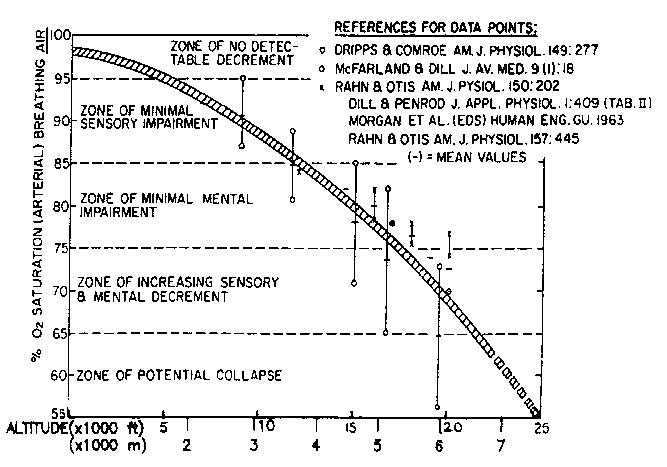
Here's a decent chart of effective O2 availability at quite a few known altitudes.
At the summit of Everest, you have only 6.9% versus 20.9% at sea level.
If you had a cabin rupture of a jetliner at the average altitude of FL300 (30000 ft...) you will have a time to unconsciousness of 1-3 minutes depending on your overall fitness. You will die shortly afterwards. There's a reason they have oxygen masks that pop out on jetliners in a cabin breach condition- that gets auto-triggered at depressure. This isn't because you suddenly lost O2 pressure- this is one of those things you honestly and really can't "build up to" like is implied there. There is just insufficient O2 in the air to function. There's a reason they call it the "Death Zone" on the mountain.
Here's a few parting links:
A Chart of the SpO2 percentages at relative Altitude
A pretty detailed aviator discussion of O2 at altitudes...Quite simply put...I can't see how **ANYONE** could actually do as claimed by the GP poster there. It's bullshit.
-
40 year old spectrometer
I work on the 12 meter radio telescope on Kitt Peak. It was built in the mid sixties, refitted with a new dish in 1982, and replaced last year with an ALMA prototype antenna. We still use the old filter bank spectrometers. They were built in 1973-4. This item.
-
NRAO shields its microwave oven
This article claims that the National Radio Astronomy Observatory in Green Bank, WV, has the "cafeteria's microwave oven is kept in a shielded cage" and "Large chambers designed to absorb radio waves - including a 5,000-square-foot conference room - have been built to make sure that, as Sizemore tells it, "radiation generated in the building stays in the building."
I visited NRAO once and got to drive a diesel '69 Checker cab (no spark plugs).
-
Re:Where will be the next quiet place?
Good point, this place http://www.vla.nrao.edu/ is in a dead zone for artificial radio waves. It makes it ideal for research. A few balloons in the area may be like shining a search light into a telescope.
-
Re:Trinity
I really hated having to kill that skink.
That was one of Infocom's greatest games.
I made the pilgramage to Trinity Site a few years ago. It is well worth the visit. If you're driving your own vehicle, I strongly encourage you to come in from the north, through the Stallion Gate opening. Be there about an hour before the gates open at 8am. Put your camera in the trunk so you're not tempted to do anything stuipd. You'll see some fascinating things along the 20-minute cruise drive to the site. No paperwork is required; although you'll be traveling several miles into a military base, on these two days per year, foreigners and civilians are as welcome as servicemen.
Take your camera out after you've found the parking lot. Visit the monument before the bus traffic arrives from the south an hour later. Visit the Ranch House (especially if you remember the Infocom game) before the bus traffic makes its way there. Revisit the monument and take a few more pictures. Then drive on out of there and make your way to the Very Large Array, which offers upgraded tours owing to the massive influx of geeks on these particular days of the year.
PROTIP: If you enjoy beer, there's also a great little brewpub/pizzeria within walking distance of the motels in Socorro, NM. Fantastic place to stop the night before you see Trinity, or after you return from VLA.
If you have even a passing interest in history or physics, this is a bucket-list level road trip. Whatever your politics, do it while there are still greyhairs around who remember seeing it. (I'm pro-nuke here, and although the most interesting conversation was with someone who was the right age to have served at the time, the memory that sticks with me is hugging a spouse of one of the downwinders. My one regret is that I lacked the courage to talk to an old Japanese man whose family I heard speaking English.) Everyone who visits Trinity Sites does so with their own reasons. Seek out at least one person whose reasons differ from yours.
Thank you, WSMR and NPS, for putting up with the logistical hassles that give all of us the opportunity to meet.
-
Re:There are 3 types of time that matter to comput
You are right. Maybe the list should be GMST, GAST, LMST, LST ? Taken from "Astronomical Times" page here: http://www.cv.nrao.edu/~rfishe...
-
Re:Academic wankery at its finest
If an intergalactic invasion looks like this, possibly with some pulsating electromagnetic propulsion we still don't know much about, it may be STL not FTL, i.e. slower than light not faster than light:
http://www.cv.nrao.edu/~akimba...
And you could have a couple million years to get your 22 stage Teller-Ulam contraptions ready for a welcome, especially if the convoy of messengers you send ahead for a treaty never signals back at the speed of light, meaning they don't respect the don't shoot the messenger to begin with the basics. The Milky Way is very hazy though, and it's hard to see which way they would be coming from, or even if they arrive, it may be a while til they arrived to get hostile in your neighborhood, if ever. Maybe, like Star Trek officers, they know how to coexist with other life forms without trying to attack everything in their path. But the Dzenghis Khan gang of Mongols taught a very good lesson to any naive douche bags who blindly expect other intelligent creatures to be peaceful. You never know, and because of that skill in defense in important. Even the Native Americans were better off with bows fighting against gunpowder, than if they only had leather strap stone/wood handle battle axes. Though Shaka did win battles against the British with spears and very quick troop movements, but even simple spears used for hunting hogs in the jungle have more action to a distance than a caveman stone/leather strap/wood handle axe. You have a good fighting chance even with inferior technology, not much, but much better than nothing. Neither the Indians nor Shaka said OK, because you have superior weapons, therefore we welcome you as our new intercontinental (as opposed to intergalactic) overlords.
-
Re:Quiet Zone
There are two kinds of zones in that Quiet Zone. There is a 10 mile radius WV Radio Astronomy Zoning Act around the telescopes which is very strict. It involves all electrical equipment sources. The other, much larger zone, is much less restrictive. In the Quiet Zone only require coordination of new or modified, permanent, fixed, licensed transmitters. "Coordination" means that plans must be submitted to NRAO and possibly modified so that emissions are directed away from the telescope. There are cellular towers in the Quiet Zone. Please note that since home WiFi is not licensed it is not coordinated.
It is a "Quiet Zone" not a "Silent Zone".
-
Re:Dark?
but how could they possible determine how much mass in each galaxy wouldn't be seen by using light within the bounds of the visible spectrum?
Such "dark matter" would show up on Xrays infrared or radio, so that's not a problem. If, however, the "dark matter" does not interact with electromagnetism, but only with gravity and the weak force, (which would be an extremely odd, and frankly, a not very believable aspect of cosmology) things would get a bit tricky.
-
Re:The difference between fantasy and reality
That's the same as saying that every person is a great writer, it's just that few of them have also decided to put things down on paper. As for me, I'm honing my craft right here on
-
Re:The difference between fantasy and reality
Used to live in a city with "free wifi". It was horrendously slow because everybody used it and most still paid a normal provider.
Given that use of the relevant ISM bands is minimally restricted, and not charged for or sold exclusively, in most of the US(sorry, suckers), every city has 'free wifi' in the sense that the FCC is actually proposing to expand... It's just that a few of them also decided to put up APs and then connect them to something.
-
This is news?
The National Radio Quiet Zone has been there since 1958. It's not like it was just discovered yesterday. People living in this zone have always had to live without radio transmitters. Not having 802.11 is just another of the services they cannot use, like wireless garage-door openers and cell phones.
-
Re:Not just the GBT
Yes, NRAO and NOAO are very different and in charge of different things.
But contrast NRAO's initial response (here) to that of NOAO (here) or even AURA (here, sorry its a PDF) to see the different approaches that are possible.
NRAO essentially criticize the portfolio review process and reject the results outright without consideration and essentially hopes that the NSF figures out a better way: "AUI and NRAO encourage the NSF to work with its other federal agency counterparts to consider a more balanced approach with additional funding scenarios for the entire U.S. federal astronomy portfolio." Compare that to NOAO's response which creates an online discussion point, lays out specific details about each relevant point, encourages all astronomers to talk to their congress people, as well as making observations about the situation between NRAO and ALMA being similar to NOAO and LSST.
This isn't a time to complain about losing one or two specific facilities, this is a time for talking about the entire picture of how bad this would really be if divestment goes through and facilities are either closed or put into private (closed) consortiums. NRAO's response honestly comes across as sour grapes defending their own stuff with little concern of the greater picture. -
A bit of history
So this unit has a bit of history -- there used to be a 300-foot diameter transit telescope on the site, which collapsed in 1988. The Byrd telescope was an upgrade, being fully steerable and covering more of the spectrum. The location is fairly special too, it's in a radio-quiet zone with some other NRAO telescopes, and close to the Navy's radio observatory site.
The thing only started working in August of 2000, it seems a shame to shut it down after such a small fraction of its expected operating lifetime.
-
Re:They don't really look like that, do they?
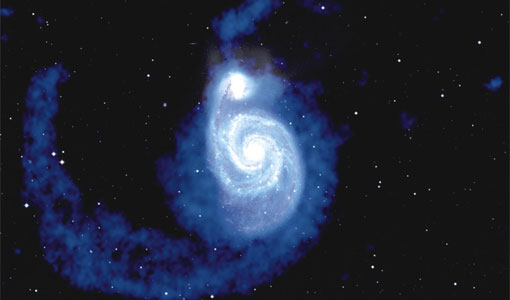
It's pictures that stunning that can tell us a hell of a lot about an object. An amazing amount of detail is in the colours, however assigned. The same can be said for radio images, where colours are assigned to relative frequencies in the image field - giving images like this shot of Messier 51 in hydrogen. Might just look like a blue blob to some but it tells a lot about the distribution of hydrogen we would otherwise miss - and assume it's uniformly spread relative to the density of stars in the cloud, which it clearly isn't. There are cool areas of hydrogen in there that don't correspond to any normal-light visible feature (ie it isn't trapped inside stars!).
-
Re:NRAO in Green Bank WV
-
Re:Not just ESO
Correct. The original two partner institutions were
- The National Radio Astronomy Observatory, which operates the North American ALMA Science Center, a regional ALMA Research Center (ARC);
- The European Southern Observatory which similarly operates the European ARC.
Later, the National Astronomical Observatory of Japan joined the consortium, to provide the ALMA Compact Array and a second correlator, among other things.
It's sometimes a bit bewildering working in this multi-site environment, but it's mostly just amazing
-
Re:Not just ESO
Correct. The original two partner institutions were
- The National Radio Astronomy Observatory, which operates the North American ALMA Science Center, a regional ALMA Research Center (ARC);
- The European Southern Observatory which similarly operates the European ARC.
Later, the National Astronomical Observatory of Japan joined the consortium, to provide the ALMA Compact Array and a second correlator, among other things.
It's sometimes a bit bewildering working in this multi-site environment, but it's mostly just amazing
-
What about the VLBA?
What definitions are being used to declare this the "largest astronomical installation in the world" as opposed to the VLBA? The VLBA claims to be the "world's largest, full-time astronomical instrument." I can't seem to find exact info on ALMA's baseline, but i doubt it exceeds 8611 km.
-
More info not linked from the article
Disclaimer: I work for the National Radio Astronomy Observatory (the US partner for ALMA).
There's lots more info on the transporters available on the ALMA web site. The two antenna transporters, named "Otto" and "Lore", have their own page at http://almaobservatory.org/en/technology/transporters. Each transporter actually has 2 500kW power plants (for redundancy) and cooling them at 5km altitude is a major challenge (actually, the datacenter has the same problem -- there's just not enough air up there to remove the heat).
There's lots more pictures of them carrying antennas there, too.
Finally, a video of the transporter taking the first ALMA antenna to the high site .
-
Re:I wonder what Jodrell Bank make of this
In limited areas, yes.
-
Great for radio astronomy
This would be perfect to deploy in the National Radio Quiet Zone. As it is right now no one can have wireless in their home within thirty miles of the GBT.
-
Great for radio astronomy
This would be perfect to deploy in the National Radio Quiet Zone. As it is right now no one can have wireless in their home within thirty miles of the GBT.
-
Re:Telescope in West Virginia
Actually, they aren't using the GBT's spectrometer. They are using an instrument that I helped to develop for pulsar research called GUPPI, which uses FPGAs and GPUs to real-time process 800MHz of radio bandwidth.
However, in this case they are using GUPPI's GPU nodes to record 800MHz of Nyquist-sampled band centered at 1.5GHz. Each sample is 2-bits, and with 2 polarizations, that is how they get 800MB/s (or almost a GB/s as it says in the article).
If you want some basic info about GUPPI, you can find it here:
-
Re:Ohhh, their planet rotates once every 24 hrs to
These data must be collected over multiple observation sessions, the Green Bank Telescope schedule is available at https://dss.gb.nrao.edu/schedule/public. Next observations are in about 15 hours - May 16 05:15 PT
-
Re:Well, that figures
The VLA is not being shut down, nor is it being replaced by some array in Chile. I work in the National Radio Astronomy Observatory (NRAO) Socorro, NM, office, so I know.
They are currently completing substantial Enhancements to the VLA, so it is becoming known as the EVLA. There has been talk of completely renaming it, though I don't know if that will actually happen. Anyway, the enhancements amount to replacing all of the 70s electronics with modern stuff. The VLA dishes, transporters, and track are remaining pretty much the same. Though they are replacing any worn out components, like the azimuth bearings. The upgrades are a *huge* improvement, much like switching your scientific calculations from an old Timex PC to your favorite modern computer. You can expect the VLA to be around for quite some time to come, and it will be producing far better data than before.
The project in Chile is the Alma Project. For the past decade an international partnership of NRAO and other observatories has been building a millimeter wave telescope in Chile. It is a lot like the VLA. But it has more dishes (28 vs 66), smaller dishes (25m vs 12m & 8m), and operates at a higher frequency. Alma does not replace the VLA; it complements the VLA.
Now, like everyone else, NRAO is feeling the budget crunch. So far this has not resulted in the closure of any of the major NRAO instruments. Hopefully that will continue to be the case, although that depends on what the next next few years bring.
For more information on the VLA, ALMA, and other cool radio telescopes please check here.
-
Re:Well, that figures
The VLA is not being shut down, nor is it being replaced by some array in Chile. I work in the National Radio Astronomy Observatory (NRAO) Socorro, NM, office, so I know.
They are currently completing substantial Enhancements to the VLA, so it is becoming known as the EVLA. There has been talk of completely renaming it, though I don't know if that will actually happen. Anyway, the enhancements amount to replacing all of the 70s electronics with modern stuff. The VLA dishes, transporters, and track are remaining pretty much the same. Though they are replacing any worn out components, like the azimuth bearings. The upgrades are a *huge* improvement, much like switching your scientific calculations from an old Timex PC to your favorite modern computer. You can expect the VLA to be around for quite some time to come, and it will be producing far better data than before.
The project in Chile is the Alma Project. For the past decade an international partnership of NRAO and other observatories has been building a millimeter wave telescope in Chile. It is a lot like the VLA. But it has more dishes (28 vs 66), smaller dishes (25m vs 12m & 8m), and operates at a higher frequency. Alma does not replace the VLA; it complements the VLA.
Now, like everyone else, NRAO is feeling the budget crunch. So far this has not resulted in the closure of any of the major NRAO instruments. Hopefully that will continue to be the case, although that depends on what the next next few years bring.
For more information on the VLA, ALMA, and other cool radio telescopes please check here.
-
Re:neat
can you give it enough mass to make it into a decent flywheel?
-
Amateur radio astronomy
Try some amateur radio astronomy, now that you have the fixin`s for your very own radio telescope There`s plenty of suitable resources on the web, e.g.: http://www.signalone.com/radioastronomy/telescope/ http://www.bambi.net/sara.html http://www.nrao.edu/epo/amateur/
-
Radio Astronomy
We did this at my school. We took a bunch of 3 meter dishes like on your property and turned them in to a astronomy farm. Now to be fair the software end of the project was intense to say the least but the pay off was huge. It was a sweet project and we accomplished it in under a year, It might be something for you to take a look at. Here are some links.
http://en.wikipedia.org/wiki/Radio_astronomy
http://www.nrao.edu/index.php/learn/radioastronomy
http://www.radio-astronomy.net/ -
WMAP cold spot?
It would be spooky if the region of space with fewer cosmic rays coincided with the WMAP cold spot.
-
We had to do this with a 7 million kg antenna
We had to go through this with a 7 million kilogram antenna at the Green Bank Telescope:
http://www.gb.nrao.edu/gbt/track.shtml
The original azimuth track wore down too quickly, apparently due to faulty materials, workmanship, etc. You can see photos of the scope rotating out of the way sections of the track could be replaced at a time.
-
Re:organic sources
Well the thought of the building blocks for life to have just "formed" on earth is too far fetched.
Why is it so hard to imagine organic molecules forming on Earth, if they for on asteroids (or wherever the meteorite came from), and, for that matter, in deep space?
I agree with your suggestion that we're probably not alone, though.
-
Re:Slashdotter?
I think since the director, Dr Rachel Rosen, is a 31 year old cutie too (linky) there might be some gender self-promotion involved. Another student already discovered the first one..., unfortunately a white male.
Oh, and if you want to see what career path will get you a job searching for pulsars, here's her application for the job (pdf). Personal details not omitted.
-
Re:Slashdotter?
I think since the director, Dr Rachel Rosen, is a 31 year old cutie too (linky) there might be some gender self-promotion involved. Another student already discovered the first one..., unfortunately a white male.
Oh, and if you want to see what career path will get you a job searching for pulsars, here's her application for the job (pdf). Personal details not omitted.
-
A good thing...
It seems like letting high schoolers have access to facilities like this is a good thing: http://www.nrao.edu/pr/2009/pulsarstudent/
-
Re:This would be wonderful
I seem to recall an experimental observation in the last few years involving Jupiter, through which they verified with about 90% certainty that the speed at which gravity propagates through space/time is equal to the speed of light.
A little googling turned this up:
http://www.nrao.edu/pr/2003/gravity/index-p.shtml -
Re:If you end up in New Mexico...
Plan your drive around the missile test schedule http://www.wsmr.army.mil/wsmr.asp?pg=y&page=202
The drive out to the VLA is worth it to see the telescopes, though there's not much in the way of a museum there. http://www.vla.nrao.edu/ [nrao.edu]
Speaking of White Sands, don't forget Trinity Site. White Sands Missile Range opens the site to the public for two days a year. Stand on the spot where humanity detonated its first atomic bomb. The base folks provide a bus that makes a few side trips from the main site to the buildings where the gadget was built, and where the engineers witnessed the test. Most of the buildings still stand and some are in the process of being restored. If you ever played Infocom's Trinity, you'll recognize a lot of landmarks. (If you haven't, play it! It's some of the best interactive fiction ever written.)
The VLA gives guided tours on those two days, owing to the large number of fellow geeks in the neighborhood.
-
If you end up in New Mexico...The New Mexico Museum of Space History http://www.nmspacemuseum.org/ is near White Sands http://www.nps.gov/whsa/ and has some interesting bits and pieces.
Plan your drive around the missile test schedule http://www.wsmr.army.mil/wsmr.asp?pg=y&page=202
The drive out to the VLA is worth it to see the telescopes, though there's not much in the way of a museum there. http://www.vla.nrao.edu/
I've also heard good things about lanl's Bradbury Museum, but I've never been there. http://www.lanl.gov/museum/
Spaceport America was originally scheduled to have a hangar and terminal in 2010, so there might be something there worth checking out. http://www.spaceportamerica.com/
-
Define "Along the way"
The submitter didn't tell us what the intended route for the road trip was, so that makes it kind of hard to suggest what might be along the way.
For example, if you are going to go through Idaho, you should see EBR-1, the first breeder reactor and the first reactor to make electrical power.
If you are passing through Oklahoma City, you'd likely want to stop off at the Omniplex.
If you are passing through Socorro, NM, you'd need to see The Very Large Array.
How about you give us a bit of an idea of the route you are taking?
-
US NM radio telescopes mixed analog/digital
The US New Mexico radio telescope facility (the scene of countless scifi movies) is upgrading its current eight-band analog system to a mixed 16K band hybrid digital/analog system. The old system transmitted the analog signal via microwave pipes from up to 26 telescopes up to 8 miles apart. Then the signals were analog cross-correlated synthesized aperture to simulate a multi-mile telescope. When I visited in 2008 they said they were going to digitize the signal at the telescope, transmit it to the central computer facility, where it was converted back into analog and cross-correlated. They could capture 16K frequency bands this way. I didnt understand why they dont do the cross-correlation digitally. The highest frequency is 50 gigahertz, within the range of the fastest specialty chips.
-
Re:Oklahoma?
"Evolution is very dependent on life being present in order to evolve"
Where is the divide between chemistry and a lifeform?
As I understand it life is generally considered to have probably started from complex chemistry. This site http://www.nrao.edu/index.php/learn/science/chemistryoflife even talks about evidence of "chemical evolution"! -
Not exactly a planet-sized radio telescope
While the resolution of a large array can be similar to one gigantic dish, this does not mean it is as sensitive. No matter how spread the array, it is (at best) only as sensitive as the sum of its individual elements. What is nice though is that as some sites rotate out of the array, others can be brought online, which allows for continuous monitoring of a single patch of space. Even a giant array in the desert like the VLA is not capable of performing this feat since it is still just one point as far as the planet is concerned.
Mal-2
-
Million-dollar idea for somebody
1. Buy a couple hundred acres in the National Radio Quiet Zone and build a resort/spa/retirement community for all the well-heeled electromagnetophobes.
2. Quietly buy up as much of the valley as you can, then support campaigns to get Blue Cross and Medicare to cover electromagnetic hypersensitivity.
3. Profit.
I'd do it, but I don't believe I could live with myself. Especially if I had to give up ubiquitous broadband.