Slashdot Mirror
Domain: popsci.com
Stories and comments across the archive that link to popsci.com.
Stories · 260
-
Making Mining the Asteroids and the Moon Legal
MarkWhittington writes: Popular Science reported on a bill called the Space Act of 2015 that has passed the House and may soon pass the Senate that will allow private companies to own the natural resources that they mine in space. The idea would seem to be a no-brainer. However, the bill is causing some heartburn among some space law experts, especially in other countries. Fabio Tronchetti, a lawyer at the Harbin Institute of Technology in China, argues that the law would violate the Outer Space Treaty. -
Lexus Unveils Its Working Hoverboard
An anonymous reader writes: Lexus has revealed its eagerly anticipated "SLIDE" hoverboard, which uses magnetic fields to carry its rider without touching the ground. The board is confined to custom-built skatepark, remaining suspended due to the board's repulsion from a specially made magnetic track. Mark Templin, Executive Vice President at Lexus International said: "Embarking on this project, we set out to push the boundaries of technology, design and innovation to make the impossible possible. With this project we call 'SLIDE', we collaborated with partners who share our passion for creating enjoyment out of motion. Even through combining our technology and expertise, we discovered making a hoverboard isn't an easy process. We've experienced the highs and lows and have overcome a few challenges, but through mutual determination we have created a demonstration of our philosophy in design and technology to create Amazing in Motion." -
A Robot That Can Walk and Jump On Water
Taco Cowboy writes: Researchers from Seoul University and Harvard have constructed tiny robots that can walk across the surface of standing water, and even jump into the air. The robots were designed to imitate the way pond-skimmer insects take advantage of surface tension to maneuver on top of still bodies of water. After studying the insects, the researchers found their legs started with a small amount of movement before gradually accelerating downward into a jump. The insects also sweep their legs inward during the jump to maximize the amount of time they stay in contact with the surface (abstract). "Using these principles, the researchers developed an ultra light robot made out of nickel titanium with a 2 centimeter long body inspired by origami. Its 5 centimeter long wire legs are curved at the tips like a real water strider's and coated with a material that repels water." Pictures of the robots are available here and here, as well as this animated gif. -
A Robot That Can Walk and Jump On Water
Taco Cowboy writes: Researchers from Seoul University and Harvard have constructed tiny robots that can walk across the surface of standing water, and even jump into the air. The robots were designed to imitate the way pond-skimmer insects take advantage of surface tension to maneuver on top of still bodies of water. After studying the insects, the researchers found their legs started with a small amount of movement before gradually accelerating downward into a jump. The insects also sweep their legs inward during the jump to maximize the amount of time they stay in contact with the surface (abstract). "Using these principles, the researchers developed an ultra light robot made out of nickel titanium with a 2 centimeter long body inspired by origami. Its 5 centimeter long wire legs are curved at the tips like a real water strider's and coated with a material that repels water." Pictures of the robots are available here and here, as well as this animated gif. -
Voyager's Golden Record For Aliens Now Available On SoundCloud
An anonymous reader writes: For years you've been able to listen to the sounds recorded on the golden records carried by the twin Voyager spacecraft online but NASA just made it a bit easier. The orginization just uploaded the recordings to SoundCloud. Now you can listen to a continuous stream of clips instead of clicking back and forth to hear the different tracks. -
Is NASA Planning To "Terraform" Part of the Moon? Not Quite
MarkWhittington writes: A story in Popular Science suggested that NASA is mulling a plan to "terraform" part of the moon. The term is more than a little misleading, as it implies making a portion of the moon livable for humans. The actual plan, being funded by the space agency as part of NASA's Innovative Advanced Concepts (NIAC) Program is exciting nevertheless. The idea is to deploy reflectors around the rim of the Shackleton Crater, a region at the moon's South Pole where ice is thought to exist in permanent shadows. The reflectors would focus light onto select areas to provide power for robotic explorers. In this manner, the robots would not have to be equipped with protection against the cold inside the crater and would not have to be powered by plutonium-fueled RTGs. Temperatures inside the shadowed regions of Shackleton plunge to minus 280 degrees Fahrenheit. -
The DARPA Robotics Challenge Was a Bust; Let's Try Again
malachiorion writes: The DARPA Robotics Challenge, the biggest and most well-funded international robotics competition in years, was a failure. After years of grueling work on the part of brilliant roboticists around the world, and millions in funding from the Pentagon, the finals came and went with little to no coverage from the mainstream media. The only takeaway, for those who aren't extremely dialed into robotics, is that a ton of robots fell down in funny ways. There were winners, but considering how downgraded the tasks were, compared to the ones initially announced in 2012, it was closer to the first DARPA Grand Challenge, where none of the robot cars finished, than the Urban Challenge, which kicked off the race to build deployable driverless cars. So just as DARPA regrouped after that first fizzle of a race, here's my argument for Popular Science: It's time to do it again, and make falling, and getting up, mandatory. -
Solar Impulse 2 Completes Record-Breaking Flight
An anonymous reader writes: Solar Impulse 2, the airplane powered only by the sun's light, has completed its flight from Japan to Hawaii. The distance sets the record for manned, solar-powered flight, both by distance (7,200 km, according to the BBC) and by time spent aloft (118 hours). This was one leg in a longer journey to fly around the world, and by far the longest they've attempted. Their next leg will send them across the rest of the Pacific Ocean, landing in Phoenix, Arizona. Then they'll stop off at New York before crossing the Atlantic Ocean on their way back to the journey's starting point, Abu Dhabi. Pilot Andre Borschberg was in good shape, despite spending almost five consecutive days in command of the aircraft. He was only allowed to sleep for up to 20 minutes at a time, so he took about a dozen naps every day. He did this at an altitude of 9,000 meters, and while taking medication to prevent thrombosis. Borschberg's partner, Bertrand Piccard, will fly the aircraft during the next leg to Phoenix. This will happen as soon as the plane is checked out and meteorologists think the weather will be placid enough for a safe crossing. -
How To Die On Mars
An anonymous reader writes: Many space-related projects are currently focusing on Mars. SpaceX wants to build a colony there, NASA is looking into base design, and Mars One is supposedly picking astronauts for a mission. Because of this, we've been reading a lot about how we could live on Mars. An article at Popular Science reminds us of all the easy ways to die there. "Barring any complications with the spacecraft's hardware or any unintended run-ins with space debris, there's still a big killer lurking out in space that can't be easily avoided: radiation. ... [And] with so little atmosphere surrounding Mars, gently landing a large amount of weight on the planet will be tough. Heavy objects will pick up too much speed during the descent, making for one deep impact. ... Mars One's plan is to grow crops indoors under artificial lighting. According to the project's website, 80 square meters of space will be dedicated to plant growth within the habitat; the vegetation will be sustained using suspected water in Mars' soil, as well as carbon dioxide produced by the initial four-member crew. However, analysis conducted by MIT researchers last year (PDF) shows that those numbers just don't add up." -
After a Year of Secret Field-Testing, Brain-Controlled Bionic Legs Are Here
An anonymous reader writes: Today, an Icelandic prosthetic-maker announced that two amputees have been testing brain-controlled bionic legs for over a year. The devices respond to impulses in the subjects' residual limbs, via sensors that were implanted in simple, 15-minute-long procedures. "When the electrical impulse from his brain reaches the base of his leg, a pair of sensors embedded in his muscle tissue connect the neural dots, and wirelessly transmit that signal to the Proprio Foot. Since the command reaches the foot before the wearer's residual muscles actually contract, there's no unnatural lag between intention and action." This is a huge step forward (sorry) for this class of bionics. It may seem like a solved problem based on reports and videos from laboratories, but it's never been exposed to real world use and everyday wear and tear like this. -
Robots4Us: DARPA's Response To Mounting Robophobia
malachiorion writes DARPA knows that people are afraid of robots. Even Steve Wozniak has joined the growing chorus of household names (Musk, Hawking, Gates) who are terrified of bots and AI. And the agency's response--a video contest for kids--is equal parts silly and insightful. It's called Robots4Us, and it asks high schoolers to describe their hopes for a robot-assisted future. Five winners will be flown to the DARPA Robotics Competition Finals this June, where they'll participate in a day-after discussion with experts in the field. But this isn't quite as useless as it sounds. As DRC program manager Gill Pratt points out, it's kids who will be impacted by the major changes to come, moreso than people his age. -
Bring On the Boring Robots
malachiorion writes: After a successful 6-month pilot, Savioke's 'butler bots' are heading to hotels around the country. These are not sexy, scary, or even technically impressive machines. But they were useful enough, over the course of their 2,000 or so deliveries, to warrant a redesign, and a larger deployment starting in April. Savioke's CEO had some interesting things to say about the pilot, including the fact that some 95 percent of guests gave the robot a 5-star review, and only the drunks seemed to take issue with it. Plus, as you might expect, everyone seemed to want to take a damn selfie with it. But as small as the stakes might appear, highly specialized bots like this one, which can only do one thing (in this case, bring up to 10 pounds of stuff from the lobby to someone's door) are a better glimpse of our future than any talk of hyper-competent humanoids or similarly versatile machines. -
Delivery Drones: More Feasible If They Come By Truck
malachiorion writes Amazon's drone delivery service was never going to work. It was too autonomous, and simply too risky to be approved by the FAA in the timeframe that Jeff Bezos specified (as early as this year). And yet, the media is still hung up on Amazon, and much of the coverage of the FAA's newly released drone rules center around Prime Air, a program that was essentially a PR stunt. Meanwhile, a Cincinnati-based company that makes electric delivery trucks has an idea that's been largely ignored, but that's much more feasible. The Horsefly launches from and returns to a delivery truck once it reaches a given neighborhood, with a mix of autonomous flight to destination, driver-specified drop-off locations, and remote-piloted landings. The company will still need to secure exemptions from the FAA, but unlike Amazon, they at least have a chance. There's more detail about Amp's technically impressive (and seemingly damn tough) drone in my story for Popular Science. -
Why ATM Bombs May Be Coming Soon To the United States
HughPickens.com writes Nick Summers has an interesting article at Bloomberg about the epidemic of 90 ATM bombings that has hit Britain since 2013. ATM machines are vulnerable because the strongbox inside an ATM has two essential holes: a small slot in front that spits out bills to customers and a big door in back through which employees load reams of cash in large cassettes. "Criminals have learned to see this simple enclosure as a physics problem," writes Summers. "Gas is pumped in, and when it's detonated, the weakest part—the large hinged door—is forced open. After an ATM blast, thieves force their way into the bank itself, where the now gaping rear of the cash machine is either exposed in the lobby or inside a trivially secured room. Set off with skill, the shock wave leaves the money neatly stacked, sometimes with a whiff of the distinctive acetylene odor of garlic." The rise in gas attacks has created a market opportunity for the companies that construct ATM components. Several manufacturers now make various anti-gas-attack modules: Some absorb shock waves, some detect gas and render it harmless, and some emit sound, fog, or dye to discourage thieves in the act.
As far as anyone knows, there has never been a gas attack on an American ATM. The leading theory points to the country's primitive ATM cards. Along with Mongolia, Papua New Guinea, and not many other countries, the U.S. doesn't require its plastic to contain an encryption chip, so stealing cards remains an effective, nonviolent way to get at the cash in an ATM. Encryption chip requirements are coming to the U.S. later this year, though. And given the gas raid's many advantages, it may be only a matter of time until the back of an American ATM comes rocketing off. -
Microbots Deliver Medical Payload In Living Creature For the First Time
Zothecula writes: Researchers working at the University of California, San Diego have claimed a world first in proving that artificial, microscopic machines can travel inside a living creature and deliver their medicinal load without any detrimental effects. Using micro-motor powered robots propelled by gas bubbles made from a reaction with the contents of the stomach in which they were deposited, these miniature machines have been successfully deployed in the body of a live mouse. -
An Open Letter To Everyone Tricked Into Fearing AI
malachiorion writes If you're into robots, AI, you've probably read about the open letter on AI safety. But do you realize how blatantly the media is misinterpreting its purpose, and its message? I spoke to the organization that released letter, and to one of the AI researchers who contributed to it. As is often the case with AI, tech reporters are getting this one wrong on purpose. Here's my analysis for Popular Science. Or, for the TL;DR crowd: "Forget about the risk that machines pose to us in the decades ahead. The more pertinent question, in 2015, is whether anyone is going to protect mankind from its willfully ignorant journalists." -
Mysterious, Phony Cell Towers Found Throughout US
Trachman writes: Popular Science magazine recently published an article about a network of cell towers owned not by telecommunication companies but by unknown third parties. Many of them are built around U.S. military bases. "Interceptors vary widely in expense and sophistication – but in a nutshell, they are radio-equipped computers with software that can use arcane cellular network protocols and defeat the onboard encryption. ... Some interceptors are limited, only able to passively listen to either outgoing or incoming calls. But full-featured devices like the VME Dominator, available only to government agencies, can not only capture calls and texts, but even actively control the phone, sending out spoof texts, for example." -
Robo Brain Project Wants To Turn the Internet Into a Robotic Hivemind
malachiorion writes Researchers are force-feeding the internet into a system called Robo Brain. The system has absorbed a billion images and 120,000 YouTube videos so far, and aims to digest 10 times that within a year, in order to create machine-readable commands for robots—how to pour coffee, for example. From the article: "The goal is as direct as the project’s name—to create a centralized, always-online brain for robots to tap into. The more Robo Brain learns from the internet, the more direct lessons it can share with connected machines. How do you turn on a toaster? Robo Brain knows, and can share 3D images of the appliance and the relevant components. It can tell a robot what a coffee mug looks like, and how to carry it by the handle without dumping the contents. It can recognize when a human is watching a television by gauging relative positions, and advise against wandering between the two. Robo Brain looks at a chair or a stool, and knows that these are things that people sit on. It’s a system that understands context, and turns complex associations into direct commands for physical robots." -
What Happens If You Have a Heart Attack In Space?
An anonymous reader sends this story about medical research in zero-gravity environments. Many earth-based treatments need to be adapted for use in space, and anatomical behaviors can change in subtle and unpredictable ways as well. This research aims to protect astronauts and future generations of space-goers from conditions that are easily treatable on the ground. The ultrasound machine the students are testing would be well suited for space missions. It is light and compact, requires very little medical training to use, and the probe can stay in the body for 72 hours at a time. But the technology has only ever been used on Earth, and no one knows whether it would function correctly in zero gravity. The most significant concern is that microgravity will cause the probe to drift out of position. The team's mentor, cardiac surgeon and space medicine specialist Peter Lee, tells me that an ultrasound probe that sits in the esophagus is an ideal diagnostic tool for extended spaceflights. "If an astronaut far from Earth were to have a cardiovascular event, or for some reason became incapacitated and had to be on a ventilator, there's no imaging currently available [in space] that provides continuous images of the heart," he says. "You can use [external] ultrasound, but the technician has to be there the whole time to hold it on the chest." -
The Profoundly Weird, Gender-Specific Roots of the Turing Test
malachiorion writes: Alan Turing never wrote about the Turing Test, that legendary measure of machine intelligence that researchers claimed to have passed last weekend. He proposed something much stranger — a contest between men and machines, to see who was better at pretending to be a woman. The details of the Imitation Game aren't secret, or even hard to find, and yet no one seems to reference it. This article explains why they should — in part because it's so odd, but also because it might be a better test for 'machines that think' than the chatbot-infested, seemingly useless Turing Test. -
The Sci-Fi Myth of Killer Machines
malachiorion writes: "Remember when, about a month ago, Stephen Hawking warned that artificial intelligence could destroy all humans? It wasn't because of some stunning breakthrough in AI or robotics research. It was because the Johnny Depp-starring Transcendence was coming out. Or, more to the point, it's because science fiction's first robots were evil, and even the most brilliant minds can't talk about modern robotics without drawing from SF creation myths. This article on the biggest sci-fi-inspired myths of robotics focuses on R.U.R, Skynet, and the ongoing impact of allowing make-believe villains to pollute our discussion of actual automated systems." -
The Singularity Is Sci-Fi's Faith-Based Initiative
malachiorion writes: "Is machine sentience not only possible, but inevitable? Of course not. But don't tell that to devotees of the Singularity, a theory that sounds like science, but is really just science fiction repackaged as secular prophecy. I'm not simply arguing that the Singularity is stupid — people much smarter than me have covered that territory. But as part of my series of stories for Popular Science about the major myths of robotics, I try to point out the Singularity's inescapable sci-fi roots. It was popularized by a SF writer, in a paper that cites SF stories as examples of its potential impact, and, ultimately, it only makes sense when you apply copious amounts of SF handwavery. The article explains why SF has trained us to believe that artificial general intelligence (and everything that follows) is our destiny, but we shouldn't confuse an end-times fantasy with anything resembling science." -
The Sci-Fi Myth of Robotic Competence
malachiorion writes: "When it comes to robots, most of us are a bunch of Jon Snow know-nothings. With the exception of roboticists, everything we assume we know is based on science fiction, which has no reason to be accurate about its iconic heroes and villains, or journalists, who are addicted to SF references, jokes and tropes. That's my conclusion, at least, after a story I wrote Popular Science got some attention—it asked whether a robotic car should kill its owner, if it means saving two strangers. The most common dismissals of the piece claimed that robo-cars should simply follow Asimov's First Law, or that robo-cars would never crash into each other. These perspectives are more than wrong-headed—they ignore the inherent complexity and fallibility of real robots, for whom failure is inevitable. Here's my follow-up story, about why most of our discussion of robots is based on make-believe, starting with the myth of robotic hyper-competence." -
Driverless Cars Could Cripple Law Enforcement Budgets
colinneagle writes "Google's driverless cars have now combined to drive more than 700,000 miles on public roads without receiving one citation, The Atlantic reported this week. While this raises a lot of questions about who is responsible to pay for a ticket issued to a speeding autonomous car – current California law would have the person in the driver's seat responsible, while Google has said the company that designed the car should pay the fine – it also hints at a future where local and state governments will have to operate without a substantial source of revenue.
Approximately 41 million people receive speeding tickets in the U.S. every year, paying out more than $6.2 billion per year, according to statistics from the U.S. Highway Patrol published at StatisticBrain.com. That translates to an estimated $300,000 in speeding ticket revenue per U.S. police officer every year. State and local governments often lean on this source of income when they hit financial trouble. A study released in 2009 examined data over a 13-year period in North Carolina, finding a 'statistically significant correlation between a drop in local government revenue one year, and more traffic tickets the next year,' Popular Science reported. So, just as drug cops in Colorado and Washington are cutting budgets after losing revenue from asset and property seizures from marijuana arrests, state and local governments will need to account for a drastic reduction in fines from traffic violations as autonomous cars stick to the speed limit." -
Why Hollywood's Best Robot Stories Are About Slavery
malachiorion writes: "On the occasion of Almost Human's cancellation (and the box office flopping of Transcendence), I tried to suss out what makes for a great, and timeless Hollywood robot story. The common thread seems to be slavery, or stories that use robots and AI as completely blatant allegories for the discrimination and dehumanization that's allowed slavery to happen, and might again. 'In the broadest sense, the value of these stories is the same as any discussion of slavery. They confront human ugliness, however obliquely. They're also a hell of a lot more interesting than movies and TV shows that present machine threats as empty vessels, or vague symbols of unchecked technological progress.' The article includes a defense (up to a point!) of HAL 9000's murder spree." -
The Brief Rise and Long Fall of Russia's Robot Tank
malachiorion writes with this report from Popular Science"Seventy-four years ago, Russia accomplished what no country had before, or has since: it sent armed ground robots into battle. These remote-controlled Teletanks took the field during one of WWII's earliest and most obscure clashes, as Soviet forces pushed into Eastern Finland for roughly three and a half months, from 1939 to 1940. The workings of those Teletanks were cool, though they were useless against Germany, and Russia proceeded to fall behind the developed world in military robotics." -
Apocalypse NAO: College Studies the Theological Ramifications of Robotics
malachiorion writes "Have you heard the one about the Christian college in North Carolina that bought a humanoid robot, to figure out whether or not bots are going to charm us into damnation (dimming or cutting our spiritual connection to God)? The robot itself is pretty boring, but the reasoning behind its purchase—a religious twist on the standard robo-phobia—is fascinating. From the article: '“When the time comes for including or incorporating humanoid robots into society, the prospect of a knee-jerk kind of reaction from the religious community is fairly likely, unless there’s some dialogue that starts happening, and we start examining the issue more closely,” says Kevin Staley, an associate professor of theology at SES. Staley pushed for the purchase of the bot, and plans to use it for courses at the college, as well as in presentations around the country. The specific reaction Staley is worried about is a more extreme version of the standard, secular creep factor associated with many robots. “From a religious perspective, it could be more along the lines of seeing human beings as made in God’s image,” says Staley. “And now that we’re relating to a humanoid robot, possibly perceiving it as evil, because of its attempt to mimic something that ought not to be mimicked.”'" -
Psychologists: Internet Trolls Are Narcissistic, Psychopathic, and Sadistic
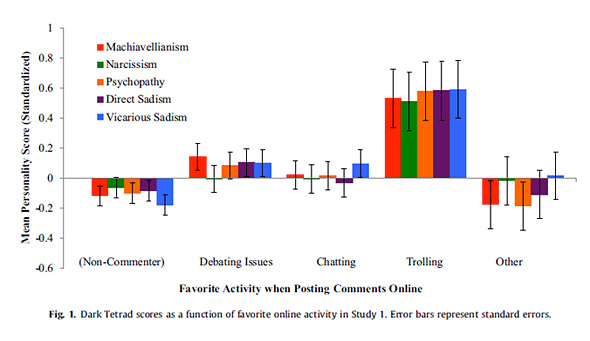
Hugh Pickens DOT Com writes "Chris Mooney reports at Slate that research conducted by Erin Buckels of the University of Manitoba confirmed that people who engage in internet trolling are characterized by personality traits that fall in the so-called Dark Tetrad: Machiavellianism (willingness to manipulate and deceive others), narcissism (egotism and self-obsession), psychopathy (the lack of remorse and empathy), and sadism (pleasure in the suffering of others). In the study, trolls were identified in a variety of ways. One was by simply asking survey participants what they 'enjoyed doing most' when on online comment sites, offering five options: 'debating issues that are important to you,' 'chatting with others,' 'making new friends,' 'trolling others,' and 'other.' The study recruited participants from Amazon's Mechanical Turk website and two measures of sadistic personality were administered (PDF): the Short Sadistic Impulse Scale and the Varieties of Sadistic Tendencies Scale. Only 5.6 percent of survey respondents actually specified that they enjoyed 'trolling.' By contrast, 41.3 percent of Internet users were 'non-commenters,' meaning they didn't like engaging online at all. So trolls are, as has often been suspected, a minority of online commenters, and an even smaller minority of overall Internet users. Overall, the authors found that the relationship between sadism and trolling was the strongest, and that indeed, sadists appear to troll because they find it pleasurable. 'Both trolls and sadists feel sadistic glee at the distress of others. Sadists just want to have fun ... and the Internet is their playground!' The study comes as websites are increasingly weighing steps to rein in trollish behavior but the study authors aren't sure that fix is a realistic one. 'Because the behaviors are intrinsically motivating for sadists, comment moderators will likely have a difficult time curbing trolling with punishments (e.g., banning users),' says Buckels. 'Ultimately, the allure of trolling may be too strong for sadists, who presumably have limited opportunities to express their sadistic interests in a socially-desirable manner.' Perhaps posting rights should only be unlocked if you pass a test." -
Why Robot Trucks Could Be Headed To Afghanistan (And Everywhere Else)
malachiorion writes "I'm surprised I haven't seen more coverage of Lockheed Martin's autonomous truck convoy demonstration — they sent a group of robotified vehicles through urban and rural environments at Fort Hood, without teleoperation or human intervention. It's an interesting milestone, and sort of a tragic one, since troops could have used robotic vehicles in Iraq and Afghanistan. What's fascinating, though, is that Lockheed is hoping to get into Afghanistan just before the U.S. withdraws, to help ferry gear. Plus, they have their sights set on what would be the defense contractor's first real commercial product—kits that turn tractor trailers into autonomous vehicles. Here's my post for Popular Science." -
Journal of Cosmology Contributor Sues NASA To Investigate Mars "Donut"
An anonymous reader writes "Rhawn Joseph, a self-described astrobiologist involved with the infamous Journal of Cosmology, is suing NASA, demanding 100 high-resolution photos and 24 micrographs be taken of the 'donut' rock that recently appeared in front of the Opportunity rover on Mars, on the basis that it is a living organism. The remarkable full text of the complaint, which cites NASA's mineralogical analysis of the rock as evidence against it being a rock, is available to read at Popular Science." Really, the lawsuit is worth a read. -
CES 2014: A Bedbug Detector that Looks Interesting but has Detractors (Video)
This is a slightly puzzling product. To begin with, Christopher Goggin, shown as the inventor of the Electronic Dog Nose (as featured in Popular Science) may not be the actual inventor, at least according to some of the comments attached to that 2011 Popular Science article. Yet other comments on the same article claim that the unit Goggin supposedly ripped off is totally different from his, and doesn't work, while his does. A report (pdf) on bed-bugs.co.uk says the device "...clearly fails to perform to the manufacturers specification and procedures." Goggin's badge at CES showed his company affiliation as Datt Solutions Group, but Datt's website did not mention him as of Jan. 21, 2013, several weeks after CES 2014 closed. A New York Real Estate blog is skeptical, as are others. Goggin also claims to have a laser device that will kill the bedbugs you find. It sounds great. But a person who prefers the tried and true to new products that may or may not work might want to use old-fashioned, all-natural Diatomaceous earth, which kills not only bedbugs but other insect pests, and costs very little compared to most other methods. If that method doesn't work, then it may be time to try dogs, lasers, and other ways to find and kill bedbugs, which have been spotted everywhere from luxury hotels to housing projects, even in taxicabs and movie theaters. -
Low-Cost Morphing Robotic Hands Could Revolutionize Blue-Collar Bionics
malachiorion writes "Cornell, MIT and iRobot have all shown off so-called jamming manipulators: rubbery blobs that grip objects by deforming around them. But with the first commercially available version shipping to industrial and manufacturing customers, Cornell spinoff Empire Robotics has a new market in mind: Prosthetics. While impossibly expensive, neuro-controlled bionic hands continue to be a fantasy for most amputees, jamming manipulators could do the job. This article is about the merits of a low-tech, self-gripping stump, that could be powered by hooking up to an air compressor." This seems like a decent solution while we close in on a method to regrow lost limbs. -
The Year In Robotics
malachiorion writes "From Google's emergence as a robotics giant to Gypsy Danger's emergence as a giant robot (we can root for), here's my attempt to round up the biggest trends in robotics in 2013. These trends are by no means comprehensive or ranked, but feel free to add your own picks for the year's biggest bot-related breakthroughs and setbacks." -
Tesla Model S Battery Drain Issue Fixed
cartechboy writes "Does the Tesla Model S suck down power even when the car is switched off? Recently, a tweet to Elon Musk with an article saying so sparked the Tesla CEO's attention. He tweeted that it wasn't right and that he'd look into the situation. Then a few hours later, he tweeted that the issue had to do with a bad 12-volt battery. Turns out Tesla had already called the owner of the affected car and sent a service tech to his house to replace that battery — and also install a newer build of the car's software. Now it appears the 'Vampire Draw' has been slain. The car went from using 4.5 kWh per day while turned off to a mere 1.1 kWh. So, it seems to be solved, but Tesla may either need to fix some software, or start sending a few new 12-volt batteries out to the folks still experiencing the issue." -
Popular Science Is Getting Rid of Comments
Daniel_Stuckey writes "From an article announcing the sites' decision to do away with comments: 'It wasn't a decision we made lightly. As the news arm of a 141-year-old science and technology magazine, we are as committed to fostering lively, intellectual debate as we are to spreading the word of science far and wide. The problem is when trolls and spambots overwhelm the former, diminishing our ability to do the latter. ... even a fractious minority wields enough power to skew a reader's perception of a story, recent research suggests. ... A politically motivated, decades-long war on expertise has eroded the popular consensus on a wide variety of scientifically validated topics. Everything, from evolution to the origins of climate change, is mistakenly up for grabs again. Scientific certainty is just another thing for two people to "debate" on television. And because comments sections tend to be a grotesque reflection of the media culture surrounding them, the cynical work of undermining bedrock scientific doctrine is now being done beneath our own stories, within a website devoted to championing science.'" This comes alongside news that Google is trying to clean up YouTube comments by adding integration with Google+. "You’ll see posts at the top of the list from the video’s creator, popular personalities, engaged discussions about the video, and people in your Google+ Circles." -
Woz & Jobs 2.0: Leap Motion's Holtz & Buckwald
theodp writes "Over at Popular Science, Tom Foste takes a look at the $79 Leap Motion controller and inventors David Holz and Michael Buckwald, best friends since they were fifth graders in Florida. Potential applications for the device are many, as proof-of-concept demos ranging from controlling Windows 8 (video) to driving JPL's Athlete Rover (video) show. 'If we're successful and build something that is a fundamentally better way to interact with a computer, there are essentially an unlimited number of use cases,' Buckwald says. 'Eventually, anything that has a computer could be controlled with it—every laptop, every desktop, every smartphone, every tablet, every TV, every surgical station, every robot, potentially even a Leap in every car.' And even if 'it's got some growing pains to experience,' writes Ars Technica's Lee Hutchinson, 'it's cool-it's extremely cool. It's not yet a game-changing interface device, but it could be.'" -
DARPA-Funded Software Could Usher In the Era of Open-Source Robotics
malachiorion writes "The best thing to come out of the DARPA Robotics Challenge, so far, isn't the lineup of nifty rescue bots being developed by teams around the world, or even Boston Dynamics' incredible Atlas humanoid. It's the pumped-up version of Gazebo, the free, open-source robotics simulation software whose expansion and further development is being funded by DARPA. This article has a look at how the software was used in the recent virtual leg of the competition, as well as how it could change the way robotics R&D is conducted (and create more roboticists, with its low-cost, cloud-based architecture)." -
Transporting a 15-Meter-Wide, 600-Ton Magnet Cross Country
necro81 writes "Although its Tevatron particle accelerator has gone dark, Fermi Laboratory outside Chicago is still doing physics. A new experiment, called muon g-2 will investigate quantum mechanical behavior of the electron's heavier sibling: the muon. Fermi needs a large ring chamber to store the muons it produces and investigates, and it just so happens that Brookhaven National Laboratory outside NYC has one to spare. But how do you transport a delicate, 15-m diameter, 600-ton superconducting magnet halfway across the country? Very carefully." -
Transporting a 15-Meter-Wide, 600-Ton Magnet Cross Country
necro81 writes "Although its Tevatron particle accelerator has gone dark, Fermi Laboratory outside Chicago is still doing physics. A new experiment, called muon g-2 will investigate quantum mechanical behavior of the electron's heavier sibling: the muon. Fermi needs a large ring chamber to store the muons it produces and investigates, and it just so happens that Brookhaven National Laboratory outside NYC has one to spare. But how do you transport a delicate, 15-m diameter, 600-ton superconducting magnet halfway across the country? Very carefully." -
Israel's Iron Dome Missile Defense Shield Actually Works
Hugh Pickens writes "Sarah Tory reports that the debut of Israel's Iron Dome missile defense shield has added a new element to the conflict between Israel and Palestinians in the Gaza strip, one that military officials are calling a 'game-changer.' Israeli officials are claiming that the shield is destroying 90 percent of missiles and rockets it aims at that have been fired into southern Israel by Hamas. This level of success is unprecedented compared with older missile defense systems such as the American-made Patriot model used during the 1991 Gulf War. The missile-defense system can detect rocket launches and then determine the projectiles' flight paths and only intercepts rocket or artillery shells if they are headed for populated areas or sensitive targets; the others it allows to land. It takes a lot of raw computing power to rapidly build a ballistic profile of a fast-incoming projectile, make a series of quick decisions concerning potential lethality, and launch a countermeasure capable of intercepting said projectile in-flight. One reason Iron Dome is showing a much more robust capability than the Patriot system did is simply that its battle control hardware and software are several generations more advanced than those early interceptor systems. 'Israeli officials point out that Iron Dome saves money despite the fact that the interceptors cost up to $100,000 each,' writes Tory. 'The cost of rebuilding a neighborhood destroyed by a rocket attack — not to mention people wounded and lives lost — would be far greater than the cost of the interceptor.' Most important, the system buys Israel time, allowing it to plan out an appropriate response without the political pressure that would be generated by hundreds of potential deaths." -
Researchers Turn Home Wi-Fi Router Into Spy Device
hypnosec writes "Researchers at University College of London have applied principles of radar used in defense and designed a detector using home based Wi-Fi routers to spy on people across walls. Using the principles behind the Doppler effect ... Karl Woodbridge and Kevin Chetty, at University College London, have built a prototype unit that uses Wi-Fi signals and recognizes frequency changes to detect moving objects. The size of the prototype unit is more or less the size of a suitcase. The unit contains a radio receiver comprising of two antennas and a signal-processing unit. The duo carried out test runs and ... they managed to determine a person's location, speed, and direction (even through a one foot thick brick wall). The device could be used to spot intruders, monitor children or the elderly, and could even be used in military applications." -
Electric Airplane Ready For Production
MrSeb writes with news about a production ready electric-hybrid airplane. From the article: "... The four-passenger carbon fiber aircraft isn't really an electric plane but more of a plug-in hybrid plane, much like the Chevrolet Volt. Whatever it is, the Volta Volare aeronautics company of Portland, Oregon says the plane can travel 300 miles on battery power, then a 1.5-liter gasoline engine engages and extends the plane's range to 1,000 miles. The company sees the plane being attractive for its low cost of operation and its environmental friendliness. Aviation gasoline is typically leaded fuel, which has been gone from motor vehicle fuel since the 1980s. On a 200-mile trip in a comparable four-passenger gas-engine private plane, you'd burn $80 worth of avgas, while the electricity to carry the GT4 200 miles would cost only $20 — nice savings, but perhaps a little inconsequential when the plane itself is expected to cost around $500,000. Testing begins this spring on the Volta Volare GT4." -
U.S. Missile Defense Against Iran Makes China/Russia Mad, Might Not Even Work
An anonymous reader writes "The United States, since the 1980s, has been trying to make missile defense work. Billions of dollars spent, tons of political capital spent, and not a lot to show. The U.S. does have two viable options: the SM-2 and SM-3, although neither are perfect. The U.S., with European allies, has been deploying missile defense in Europe to block a possible strike from Iranian nuclear tipped missiles (even though they have not made nukes or the missiles to carry them). One problem: such defenses could, in theory, also block Russian and Chinese missiles. Russia is now planning to make more missiles to counter such defenses and could pull out of the New Start Treaty. They may also stop helping U.S. forces to supply themselves in Afghanistan. Is this all worth it for something that might not even work?" -
Researchers Create First Genetically Modified Monkeys
Several readers tipped news that U.S. scientists have created 'chimeric' monkeys, made with genetic material from as many as six different genomes (abstract). This is significant because it's the first time researchers have used the technique on a primate. From the article: "Researchers took very early stem cells, called totipotent stem cells, from separate developing embryos and basically glued them together, implanting the mixed embryos into surrogate mother monkeys. The cells — from totally different sources — didn’t fuse, but worked together in harmony, forming fully fledged, normal, healthy animals. ... The key here was the scientists’ use of totipotent cells, so named for their ability to differentiate into the totality of possible cells in an animal. A totipotent cell can give rise to a whole animal. Pluripotent stem cells, the type most frequently used in stem cell research, can differentiate into any cell in the body, but can’t become a whole animal, and can’t make other embryonic tissues like a placenta. Totipotent stem cells are only derived from the very earliest stages of a zygote, mere days after fertilization. In humans, totipotent cells differentiate into pluripotent cells after four days." -
Troops In Afghanistan Supplied By Robot Helicopter
Hugh Pickens writes writes "Pakistan is still blockading NATO war supplies passing through the port of Karachi in response to last month's killing of 24 Pakistani soldiers by an alliance air strike. But inside Afghanistan, supply lines are about to get a lot safer for NATO's logisticians as an unmanned helicopter just delivered a sling-load of beans, bullets, and band-aids to Marines at an undisclosed base in Afghanistan marking the first time a drone has been used to resupply a unit at war. The 2.5-ton, GPS-guided K-MAX can heft 3.5 tons of cargo about 250 miles up and over the rugged and mountainous terrain of Afghanistan across which NATO troops are scattered and can fly around the clock. 'Most of the [K-MAX] missions will be conducted at night and at higher altitudes,' says Marine Capt. Caleb Joiner, a K-MAX operator. 'This will allow us to keep out of small-arms range.' K-MAX will soon be joined in Afghanistan by Lockheed's robo jeep that can carry a half a ton of supplies for up to 125 miles after being delivered to the field in a CH-47 or CH-53 helo." -
Undersea Neutrino Observatory To Be Second-Largest Human Structure
cylonlover writes "An audacious project to construct a vast infrastructure housing a neutrino observatory at the bottom of the Mediterranean Sea is being undertaken by a consortium of 40 institutes and universities from ten European countries. The consortium claims that KM3NeT, as it is known, will 'open a new window on the Universe,' as its 'several' cubic kilometer observatory detects high-energy neutrinos from violent sources in outer space such as gamma-ray bursts, colliding stars and supernovae. On the scale of human constructions, it will be second only to the Great Wall of China." -
Iran Tried and Failed To Launch a Monkey Into Space
Medevilae writes with a recent report from PopSci's dedicated 'space monkey' news feed that "When Iran indefinitely suspended its plans to launch a monkey into space earlier this month, it was actually because they had already tried and failed. Iranian Deputy Science Minister Mohammad Mehdinejad-Nouri told state media that the Kavoshgar-5 rocket carrying a capsule with a live monkey launched during Shahrivar, which is the Iranian month spanning August 23 to September 22, but the launch was not publicized because it did not accomplish all of its mission objectives. Assuming one of the objectives was to safely carry the monkey to space and back, things don't sound good for the monkey." -
Can the Hottest Peppers In the World Kill You?
Hugh Pickens writes "Katharine Gammon writes that last week, the Kismot Indian restaurant in Edinburgh, Scotland, held a competition to eat the extra-hot Kismot Killer curry and several ambulances were called after some of the competitive eaters were left writhing on the floor in agony, vomiting and fainting. Paul Bosland, professor of horticulture at New Mexico State University and director of the Chile Pepper Institute, says that chili peppers can indeed cause death — but most people's bodies would falter long before they reached that point. 'Theoretically, one could eat enough really hot chiles to kill you,' says Bosland adding that a research study in 1980 calculated that three pounds of the hottest peppers in the world — something like the Bhut Jolokia — eaten all at once could kill a 150-pound person. Chili peppers cause the eater's insides to rev up, activating the sympathetic nervous system — which helps control most of the body's internal organs — to expend more energy, so the body burns more calories when the same food is eaten with chili peppers. But tissue inflammation could explain why the contestants in the Killer Curry contest said they felt like chainsaws were ripping through their insides. As for the contest, restaurant owner Abdul Ali admitted the fiery dish may have been too spicy after the Scottish Ambulance Service warned him to review his event. 'I think we'll tone it down, but we'll definitely do it next year.'" -
Ex-NSA Chief Supports Separate Secure Internet
Hugh Pickens writes "Nextgove reports that Michael Hayden, former director of both the NSA and the CIA, says the United States may seriously want to consider creating a new Internet infrastructure to reduce the threat of cyberattacks and several current federal officials, including U.S. Cyber Command chief Gen. Keith Alexander, also have floated the concept of a '.secure' network for critical services such as financial institutions, sensitive infrastructure, government contractors, and the government itself that would be walled off from the public web. Unlike .com, .xxx and other new domains now proliferating the Internet, .secure would require visitors to use certified credentials for entry and would do away with users' Fourth Amendment rights to privacy. 'I think what Keith is trying to suggest is that we need a more hardened enterprise structure for some activities and we need to go build it,' says Hayden. 'All those people who want to violate their privacy on Facebook — let them continue to play.' Clay Dillow writes that on the existing internet everyone does everything online anonymously, and while that's great for liberties, it's also dangerous when cyber criminals/foreign hackers are roaming the cyber countryside. Under the proposed .secure internet 'you may not be able to go to certain neighborhoods of the Web without showing your papers at a checkpoint — and perhaps subjecting yourself to one of those humiliating electronic pat-downs as well,' writes Dillow. 'Those who want to remain anonymous on the Web can still frolic about in the world of dot-com, but in the dot-secure realm you would have to prove you are you.'" -
Crime Fighting Armored Glove
kyuubi1 writes "Just what we need: an armored glove called The BodyGuard, which inventor David Brown believes will save lives. The breathable glove weighs less than three pounds and is encased in a hard shell that extends across the forearm. A pull pin preps the stunner (generated by four electrodes on the wrist), and a button at the palm activates it. Similar buttons trigger the laser pointer, video camera and flashlight."
/cdn0.vox-cdn.com/uploads/chorus_asset/file/3920018/koh2HR.0.jpg)