Slashdot Mirror
Domain: portcommodore.com
Stories and comments across the archive that link to portcommodore.com.
Comments · 24
-
Re:Where Do I Plug In My Cassette Drive??
This was a PET, the
-
Re:Direct connect the modems
Did it all the time; going from memory...
I go for the dead simple, zip up all the files from the source
Run a phone wire between the computerers, with the terminal call one from one (IIRC you have to disable dialtone check use ATX3 then ATD555)
and on the other manual answer (ATA)
you migh have to do half duplex (local echo) on the terminals IIR this was the quickest route for no fuss local communication
once connected use the upload/download options on the terminals to start the file trnasfer
then look on it in a few hours, it will just churn away till it's finished.
It may be slow but it will complete as expected, and there is no special hardware, program or data cost.
look at the bottom of this article on my machine to machine notes -
http://www.portcommodore.com/d...I recommended Fastlynx and null modem cable elsewhere, as I think it's the best solution (especially speed over parralel cable), however I have done "phone line between the modems" before. No need for ATX3:
ATD on one machine
ATA on the other. -
Direct connect the modems
Did it all the time; going from memory...
I go for the dead simple, zip up all the files from the source
Run a phone wire between the computerers, with the terminal call one from one (IIRC you have to disable dialtone check use ATX3 then ATD555)
and on the other manual answer (ATA)
you migh have to do half duplex (local echo) on the terminals IIR this was the quickest route for no fuss local communication
once connected use the upload/download options on the terminals to start the file trnasfer
then look on it in a few hours, it will just churn away till it's finished.
It may be slow but it will complete as expected, and there is no special hardware, program or data cost.
look at the bottom of this article on my machine to machine notes -
http://www.portcommodore.com/d... -
High School in the early 80s (with examples!)
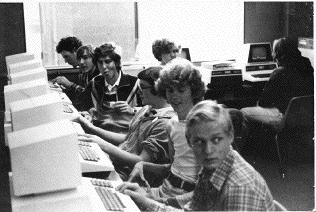
Computers were pretty new there, school got PETs, my brother and I did pretty well with them after we aced the BASIC programming classes (which just went through a BASIC introduction book) we were given independent study assignments and also did some programming for the school (my brother absence list/overdue list, and I wrote some additional graphics routines for a BASIC CAD program for the mechanical drawing class). I also got to borrow a donated TRS-80 for a few months to play with - fun times.
Picture of the circa 1982 Calaveras High Computer Club - brother and I in the back with the Disk Drive (i'm facing the computer, brother is the guy with the wild hair), the rest were running with cassettes.
We also went to a regional programming competition a couple years - these rules were from our first year (1982) - which our team got fifth place - next year we got third place.
-
Theres always the Commodore Vegas Expo in July
There's always the Commodore Vegas Expo in July as well as several regional US and other world wide gatherings of Commodore and other classic computerists.
Closer to Canada would be the Emergency Chicagoland Commodore Convention (no listed 2012 date yet, There's one I think in Lousville KY in the spring, but cant find a link. And in the fall there's the AmiWest Expo in Sacramento for the Amigans out there.
(that's all I can recall off the top of my head.)
-
Commodore Vegas Expo and many others
There are a bunch of classic shows, CommVEx is coming up in under two weeks (July 23 &24) and there are many others in various places throughout the year. Several Commodore ones, and many others including the Vintage Computer Festival. Even the Maker Faires have usually a classic computer or five in their midst. Another to look for are the Arcade/Videogaming expos that pop up, you can play on 8-bit arcade hardware.
There's always the Computer History Museum in Mountain View CA. Intel museum in San Jose, etc.
-
I walk to work
You insensitive clod.
No, really, I walk to work:
http://www.portcommodore.com/gallery/walkhome.jpg -
Re:Doesn't Anyone Miss the Commodore Pet?
I have a bunch of PETs still, certainly rugged beasties. I liked a lot of the games in that they were so simple they relied more on the user's skill (learned my angles and coordinates from many a PET game)
Also was one of the first home computers to play multi-computer games:
http://www.portcommodore.com/flashindex.php -
Idea stolen from Trail West?
A couple years ago I got an email from a person trying to get the PET game Trail West to run for his dad (who wrote Trail West) on an emulator and in part of the reply was this message:
"P.S. Glad you like the game. A little trivia about it... When my dad first made that game, just after the first PET came out, he had a meeting with some people from MECC (Minnesota Educational Computing Consortium) who were interested in buying game ideas. They thanked him and left. Never a word from them after that... EXCEPT... they magically came out with their famous nationwide best seller "Oregon Trail" the very next year, which of course was pretty much exactly "Trail West". Go figure!"
If you want to see what Trail West was like, the file is located in this disk image, and is playable on the VICE Emulator. After LOADing but before RUNing, you need to POKE 639,94 in order to circumvent the ancient copy protection. (my bad, should have fixed it)
-
Put them on display in a museum
Like this early rackmounted array of Google servers which was displayed at the Vintage Computer Festival in 2005 and now is (I believe) on display at the Computer History Museum (which is worth the effort to tour if you are near the Palo Alto/Mountain View California Area.
From my write-up about the rack: The rack in the picture holds 4 standard Pentium II Motherboards per level and has a total of 80 Linux (2.0) servers per rack. Since they were standard MBs they had to get creative with things such as wiring and insulation (which was, in this case, cork-board.) The panel shows the server room as well as talks about the fire dangers of doing such a design. (Google is a neighbor to the Computer History Museum BTW). (closeup)
-
Put them on display in a museum
Like this early rackmounted array of Google servers which was displayed at the Vintage Computer Festival in 2005 and now is (I believe) on display at the Computer History Museum (which is worth the effort to tour if you are near the Palo Alto/Mountain View California Area.
From my write-up about the rack: The rack in the picture holds 4 standard Pentium II Motherboards per level and has a total of 80 Linux (2.0) servers per rack. Since they were standard MBs they had to get creative with things such as wiring and insulation (which was, in this case, cork-board.) The panel shows the server room as well as talks about the fire dangers of doing such a design. (Google is a neighbor to the Computer History Museum BTW). (closeup)
-
What a programming competition really looks likeI and one competitor, and even had an audience.
http://www.portcommodore.com/pics/contest1.jpg
I've done a couple in high schools (with PETs back then, the first we got fifth place, the second was third) And a couple at the Vintage Computer Festival (where we had to code a game from scratch on an 8-bit system in 3 hours), this one (picture) I got second place (Jeri to the right won with Pimp Sim on the PET to my C64 game) I won the next one though with a game reminicent to kaboom called Thrift Score on the 64.
For some reason a contest to write code to correct an image just doesn't seem all that fun.
-
Re:Fantastic news, sincerely.I second that, it's an excellent place to experience computing history. Its not just old micros, there's a lot of big iron and a few past supercomputers in the museum, examples of various forms of storage, and a couple re-creations of old technology (as in getting a PDP-1 or a large IBM mainframe operational for educational and preservation purposes.
On November 5th and 6th the CHM will host the 8th West Coast Vintage Computer Festival which is a conference/expo of sorts of vintage computing enthusiasts and luminaries, definately a great time to take in two computing history experiences at the same time!
Check out my site for pictures of some previous VCFs and the CHM (in its old and new digs).
-
Re:Make C64 Open Source!It's emulated, but sounds really good!
The C64 is under one of the blobs (big one I think)...:
a tad blurry view of the 64 game's PCB
some more pics of the C-1, Jeri, and the 64-DTV at Vintage Computer Festival 7.0. -
Re:Make C64 Open Source!It's emulated, but sounds really good!
The C64 is under one of the blobs (big one I think)...:
a tad blurry view of the 64 game's PCB
some more pics of the C-1, Jeri, and the 64-DTV at Vintage Computer Festival 7.0. -
Re:Mechano Rules...
Can even lead to computer related experimentation... Like building your own Differential Analyzer! You could have seen it last weekend at VCF
-
If you're searching for prior art...
...here is it.
In an 1980 article about Bulletin Board systems (which are more or less "menu driven" by selecting from the few commands available, displayed at start-up), there was already the idea of swapping files - a way to do software updates: "We also are considering a function that would allow swapping complete programs."
Here's the full article:
http://www.portcommodore.com/commodore/bbs/cbbs.ht ml
Here's even more information on early BBS and even the invention of the XModem-Protocol:
http://www.portcommodore.com/commodore/bbs/bbshist
As even some of the earliest implementations of XModem-capable programs showed you a list of downloadable files that you could select with your cursor keys and download by pressing a key - presumable "d" - you could speak of speak of "menu driven downloads". And as this was used by developers to share patches and updated programs it was certainly "menu driven updates over a network".
Given the above facts, they can put their patent where the sun doesn't shine - if there's still space left, that is. -
If you're searching for prior art...
...here is it.
In an 1980 article about Bulletin Board systems (which are more or less "menu driven" by selecting from the few commands available, displayed at start-up), there was already the idea of swapping files - a way to do software updates: "We also are considering a function that would allow swapping complete programs."
Here's the full article:
http://www.portcommodore.com/commodore/bbs/cbbs.ht ml
Here's even more information on early BBS and even the invention of the XModem-Protocol:
http://www.portcommodore.com/commodore/bbs/bbshist
As even some of the earliest implementations of XModem-capable programs showed you a list of downloadable files that you could select with your cursor keys and download by pressing a key - presumable "d" - you could speak of speak of "menu driven downloads". And as this was used by developers to share patches and updated programs it was certainly "menu driven updates over a network".
Given the above facts, they can put their patent where the sun doesn't shine - if there's still space left, that is. -
Re:1981? Not Later?Here's my re-creation of Commodore's Spring 1980 Products Catalog.
That was before the PC, where the "big three" were Commodore, Apple and Radio Shack or Atari.
-
Re:NostolgiaDon't knock it, I got second place in the Vintage Computer Festival 5.0 Retro code programming challenge with that game...
I was beat out to a tiny version of Pimp Sim (both games for Commodore, use a C64 emulator) written by my competitor Jeri Ellsworth, (on the right) who is way better at hardware than programming....
When you have to write a complete game from scratch in three hours on a vintage 'stock' micro (i.e. Apple IIe, Commodore 64, Atari 800, etc.) BASIC is the best way to go... and last year I won.
-
Re:NostolgiaDon't knock it, I got second place in the Vintage Computer Festival 5.0 Retro code programming challenge with that game...
I was beat out to a tiny version of Pimp Sim (both games for Commodore, use a C64 emulator) written by my competitor Jeri Ellsworth, (on the right) who is way better at hardware than programming....
When you have to write a complete game from scratch in three hours on a vintage 'stock' micro (i.e. Apple IIe, Commodore 64, Atari 800, etc.) BASIC is the best way to go... and last year I won.
-
Re:NostolgiaDon't knock it, I got second place in the Vintage Computer Festival 5.0 Retro code programming challenge with that game...
I was beat out to a tiny version of Pimp Sim (both games for Commodore, use a C64 emulator) written by my competitor Jeri Ellsworth, (on the right) who is way better at hardware than programming....
When you have to write a complete game from scratch in three hours on a vintage 'stock' micro (i.e. Apple IIe, Commodore 64, Atari 800, etc.) BASIC is the best way to go... and last year I won.
-
XModem
Everybody who knows Hayes remembers Ward Christensen's Xmodem file transfer protocol.
This was Ward in 1980. I wonder where he is now? -
The C in CCBS is for Computerized, not Chicago
According the Ward himself, CBBS stands for Computerized Bulletin Board System. What Ward and Randy had in mind was replacing the cork bulletin board where members woud post buy,sell and trade notes at CACHE meetings with a computer version. It's also commnoly misnamed "Community."
Ward Christensen posted more history here on
There's some more history in an interview here.
Ward's a terrifically nice guy who also invented freeware when he gave away all of the useful utilities he wrote. Teh reason for that was more that he didn't want mess with accusations of competing with his employer than an early movement for Free Software.