Slashdot Mirror
Domain: rsc.org
Stories and comments across the archive that link to rsc.org.
Comments · 118
-
Re:Wrong
Global warming has been a major concern since the 1800s and Svante Arrhenius proved the heat trapping effect of carbon released by burning fossil fuel. Its accumulation as more fossil fuel is burned is well documented in later works by multiple other scientists.
-
Re:Odd
The 70s? That is nothing in time. Global warming has been occurring since industrialization started and its chemical mechanism was first recognized in .
-
Re:Slow news decade?
It's the International Year of the Periodic Table this year, so it's topical. http://www.rsc.org/iypt/
-
Re:If we don't stop lighting fires ...
Ok, sure.
http://www.rsc.org/images/Arrh...
Prediction: An increase in CO2 will result in net increase in global temperatures.
https://climate.nasa.gov/vital...
There's the global temperature
https://www.climate.gov/news-f...
Only the results over overlapping timeframes are relevant. As you can see, the prediction is matched with observation and has not been falsified.
Are you satisfied? Of course not! Because this was never about facts, this was about your fears that science might contradict something important to you.
-
Re:Read the souce
If you want to increase production by orders of magnitude, as this kind of project would require, you'd have to go for less economic ways of making lithium. And that means orders of magnitude higher costs.
You'd need some kind of quantitative analysis to support that point.
Many mineral resources are distributed according to a "resource pyramid", where there is vastly more resource available at each step down in ore grade. In which case, an order of magnitude increase in production may require only slightly higher monetary costs of extraction.
According to this paper, it is nearly economical at current prices to mine lithium from seawater, as a byproduct of desalination to obtain fresh water. The oceans contain nearly 10 million times as much dissolved lithium as in current terrestrial reserves, as per the paper above. In which case, the "ore grade" of dissolved salts in the ocean would not decline appreciably by our mining of them.
-
Re:NEWSFLASH: WATER IS WET
TFA is nonsense anyway. The actual paper appears to be this one: http://pubs.rsc.org/en/content...
The abstract says:
We analyze 36 years of global, hourly weather data (1980â"2015) to quantify the covariability of solar and wind resources as a function of time and location, over multi-decadal time scales and up to continental length scales. Assuming minimal excess generation, lossless transmission, and no other generation sources, the analysis indicates that wind-heavy or solar-heavy U.S.-scale power generation portfolios could in principle provide â¼80% of recent total annual U.S. electricity demand. However, to reliably meet 100% of total annual electricity demand, seasonal cycles and unpredictable weather events require several weeksâ(TM) worth of energy storage and/or the installation of much more capacity of solar and wind power than is routinely necessary to meet peak demand. To obtain â¼80% reliability, solar-heavy wind/solar generation mixes require sufficient energy storage to overcome the daily solar cycle, whereas wind-heavy wind/solar generation mixes require continental-scale transmission to exploit the geographic diversity of wind. Policy and planning aimed at providing a reliable electricity supply must therefore rigorously consider constraints associated with the geophysical variability of the solar and wind resourceâ"even over continental scales.
Which contradicts what is said in the summary and TFA. In fact it seems like the author of TFA is illiterate and can't understand clear, simple English statements.
I have watched a ton of documentaries and presentations by scientist, grid specialists and people from the energy industry and they all agree that you can replace between 70 and 80% of your energy generation with renewables. A lot of the renewable energy generation will take place in very close proximity to the consumers. This will take the form of wind generator parks, solar generation parks and a considerable amount of renewable energy generation will probably take place on the roof of the consumer's house or in their back yard with a corresponding reduction in the need for grid infrastructure. Throw in some storage, 20 to 30% always-on power generation (nuclear/gas + carbon capture), smart grid technology, maybe even super conductors, cutting edge computer model aided planning of wind/solar park location and a generally modernised grid and you have the future of energy production. The Germans aim for 80% replacement with their 'Energiewende' move to renewables but they also factor in a certain amount of always-on power-plants. This is what the experts say and it is also what that abstract is basically saying as well. Now did anybody expect a bunch of German engineers to decide you can cover the vast majority of your energy needs with renewables without first doing the math on the problem first? The idea of going for 100% renewables is not viable, it never has been, you will always need some always-on power-plants in your mix. Focusing on the 100% renewables case when the one everybody is aiming for is the 70 to 80% case is simply a cheap attempt to find material for some good old fashioned FUD that can double as clickbait.
-
Re:NEWSFLASH: WATER IS WET
TFA is nonsense anyway. The actual paper appears to be this one: http://pubs.rsc.org/en/content...
The abstract says:
We analyze 36 years of global, hourly weather data (1980â"2015) to quantify the covariability of solar and wind resources as a function of time and location, over multi-decadal time scales and up to continental length scales. Assuming minimal excess generation, lossless transmission, and no other generation sources, the analysis indicates that wind-heavy or solar-heavy U.S.-scale power generation portfolios could in principle provide â¼80% of recent total annual U.S. electricity demand. However, to reliably meet 100% of total annual electricity demand, seasonal cycles and unpredictable weather events require several weeksâ(TM) worth of energy storage and/or the installation of much more capacity of solar and wind power than is routinely necessary to meet peak demand. To obtain â¼80% reliability, solar-heavy wind/solar generation mixes require sufficient energy storage to overcome the daily solar cycle, whereas wind-heavy wind/solar generation mixes require continental-scale transmission to exploit the geographic diversity of wind. Policy and planning aimed at providing a reliable electricity supply must therefore rigorously consider constraints associated with the geophysical variability of the solar and wind resourceâ"even over continental scales.
Which contradicts what is said in the summary and TFA. In fact it seems like the author of TFA is illiterate and can't understand clear, simple English statements.
-
Re:No one ever talks about cooling
Why don't you start here and let us know where you get hung up. The total energy captured by a century of fossil fuel use is going to have some relatively wide error bars, but it's almost exactly as much as required for the climatic shift you mention. Curiously enough, the relation of CO2 levels to ice ages was exactly the topic of Arrhenius' 1896 paper which originated the Theory of AGW. The exact number has varied slightly, but that a halving or doubling of CO2 levels could cause or reverse an Ice Age is an undisputed result for something more than a century now. If you've gone thus far without reading anything scientific on this matter, Arrhenius isn't a bad place to start. After that I imagine that you will be interested in the many reasons that his work was entirely dismissed for the next five decades, as being the best hopes for actually, say, coming up with a semi-plausible reason why AGW isn't true.
I'm not sure what in particular you're claiming doesn't exist (or is it just a need to be spoon fed?) but the science is most certainly out there. The "back of the envelope" science you're asking for is found in literally the oldest paper on the topic. Consider doing us the favor of reading it.
-
Arrhenius!
Follow the money to see who is behind it.
It was Arrhenius! With the lead pipe, in the library!
The AGW deniers beg us to believe in a hundred-year-old financial conspiracy. One assumes they think this started in 2006 rather than 1896.
-
Re:Near zero emissions natural gas?
Bloody everyone in every conversation points out electrics pollute per mile depending on how the electricity is made.
Fixed that for you.
It is true some pollutants locally are less, and it may be better for a semi that travels long distances as opposed to cars, but a significant portion of CO2 and other pollutants (typically half for CO2 in cars) are generated by manufacturing it.
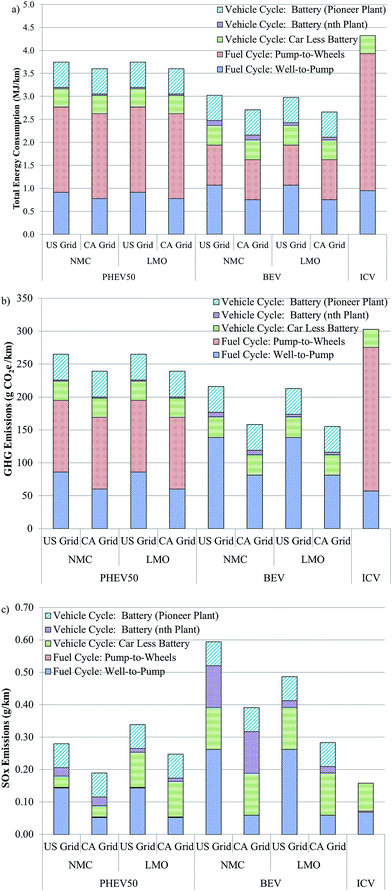
Incorrect, unless your definition of "significant" is different from mine. Said graph is from:
J. B. Dunn *a, L. Gaines a, J. C. Kelly a, C. James b and K. G. Gallagher (2015) "The significance of Li-ion batteries in electric vehicle life-cycle energy and emissions and recycling's role in its reduction" DOI: 10.1039/C4EE03029J (Analysis) Energy Environ. Sci., 2015, 8, 158-168 (The significance of Li-ion batteries in electric vehicle life-cycle energy and emissions and recycling's role in its reduction - Energy & Environmental Science (RSC Publishing) DOI:10.1039/C4EE03029J
Blue + red is energy burned in operation. Green plus purple plus light blue is energy used in manufacture, with no mass production in the EV case. Green plus purple (without light blue) is energy used in manufacture, with mass production in the EV case. To make the results of the above study even more extreme, a lot of EV manufacturers don't plan to power their production with grid power at all; Tesla, for example, plans to power the gigafactory almost exclusively with solar.
Really, it should be obvious that vehicle operation causes much more emissions than vehicle production. An average gasoline car burns its own weight in fuel every year. And beyond that, a sizeable chunk of the energy of its manufacture is recovered at the end of life via recycling.
-
Re:What about the emissions needed for constructio
800 tons would be a cube of edge length of ~23 ft, or ~7 meters. Concrete is heavy; anything actually made of concrete will get into the hundreds-of-tons range pretty quickly. Concrete is one of the most widely used materials in the world, with over 2 billion tonnes produced annually. By the time you're complaining about the concrete usage of wind turbines you're pretty far into flimsy rationalizations.
-
Re:Too little, too late
As much as I dislike the catastrophic environmental damage EV production causes
Out of curiosity, what do you mean?
Here's what production from a lithium salar looks like. Pump brine up from underneath, dry on the surface in controlled conditions to concentrate the salts of interest, send for further refining. Most of the salars flood annually and reclaim the (salt) drying ponds, meaning you have to rebuild them annually.
Do you mean energy? I'll refer you to this study, and in particular, graph 5a. Blue + red at the bottom are energy used to propel the vehicle. Green + purple + cyan is energy used to produce the vehicle, if battery packs are not in mass production (aka, no Gigafactory). Green + purple (no cyan) is the energy used to produce the vehicle with mass-produced batteries (aka, with Gigafactor(y,ies). Note the difference vs. gasoline. Is there something about this you find objectionable?
The study also focuses on recycling of li-ion batteries. Again, mass production is key. In small-scale production, batteries are manufacturing cost limited, and it's not worth the expense to recycle old batteries to recover materials vs. sourcing virgin materials. In mass production, however, costs are primarily dictated by raw material costs, and so recovery of raw materials (likewise en masse) becomes quite economical.
Is there some other aspect to EVs that concerns you? If it's copper, it's worth noting that regular vehicles contain huge amounts of copper in their overgrown wiring harnesses. The average car today has a 4km-long wiring harness. Tesla has put a huge amount of effort into reducing this. The Model S's harness is 3km; the Model 3's is 1,5km; and the Model Y is targeting a staggeringly low 100m.
It's certainly not the anodes - I presume. They're graphite/amorphous carbon and sometimes silicon. The electrolytes and membranes are basic petroleum products, and if there's anything an EV does, it's reduce petroleum consumption overall. Is it the cathodes that you object to? Tesla's are nickel cobalt aluminum oxide. Nickel and cobalt come from the same ores; cobalt is usually recovered as a side product, as nickel is more desirable. We use nickel en masse every day, in the form of stainless steel, where it makes up 1-4% of the mass (also many non-stainless steels). People who cook with stainless steel cookware usually consume about 80 micrograms of nickel per day because of this. It's found in many copper alloys in significant concentrations, it's used in high concentrations in heat-resistant alloys, such as inconel, which you can find in many gasoline-driven cars (usually higher-end ones). Cobalt is also used in high-performance alloys, although it's more commonly used in catalysts (including those used to make synfuels for cars). It's also used in car airbags. Regardless, nickel and cobalt are only a fraction of the cathode, which is in turn only a fraction of a battery. It's hard to say where Tesla's cobalt is actually from, because over the past several years it's been being stockpiled by hedge funds betting on a price rise. However, there are big producers of nickel/cobalt around the world. In North America one of the biggest is from the Canadian Sudbury deposit, which is one of the great success stories in environmental remediation - to the point that they decided to deliberately not remediate one patch of
-
Re:Too little, too late
As much as I dislike the catastrophic environmental damage EV production causes
Out of curiosity, what do you mean?
Here's what production from a lithium salar looks like. Pump brine up from underneath, dry on the surface in controlled conditions to concentrate the salts of interest, send for further refining. Most of the salars flood annually and reclaim the (salt) drying ponds, meaning you have to rebuild them annually.
Do you mean energy? I'll refer you to this study, and in particular, graph 5a. Blue + red at the bottom are energy used to propel the vehicle. Green + purple + cyan is energy used to produce the vehicle, if battery packs are not in mass production (aka, no Gigafactory). Green + purple (no cyan) is the energy used to produce the vehicle with mass-produced batteries (aka, with Gigafactor(y,ies). Note the difference vs. gasoline. Is there something about this you find objectionable?
The study also focuses on recycling of li-ion batteries. Again, mass production is key. In small-scale production, batteries are manufacturing cost limited, and it's not worth the expense to recycle old batteries to recover materials vs. sourcing virgin materials. In mass production, however, costs are primarily dictated by raw material costs, and so recovery of raw materials (likewise en masse) becomes quite economical.
Is there some other aspect to EVs that concerns you? If it's copper, it's worth noting that regular vehicles contain huge amounts of copper in their overgrown wiring harnesses. The average car today has a 4km-long wiring harness. Tesla has put a huge amount of effort into reducing this. The Model S's harness is 3km; the Model 3's is 1,5km; and the Model Y is targeting a staggeringly low 100m.
It's certainly not the anodes - I presume. They're graphite/amorphous carbon and sometimes silicon. The electrolytes and membranes are basic petroleum products, and if there's anything an EV does, it's reduce petroleum consumption overall. Is it the cathodes that you object to? Tesla's are nickel cobalt aluminum oxide. Nickel and cobalt come from the same ores; cobalt is usually recovered as a side product, as nickel is more desirable. We use nickel en masse every day, in the form of stainless steel, where it makes up 1-4% of the mass (also many non-stainless steels). People who cook with stainless steel cookware usually consume about 80 micrograms of nickel per day because of this. It's found in many copper alloys in significant concentrations, it's used in high concentrations in heat-resistant alloys, such as inconel, which you can find in many gasoline-driven cars (usually higher-end ones). Cobalt is also used in high-performance alloys, although it's more commonly used in catalysts (including those used to make synfuels for cars). It's also used in car airbags. Regardless, nickel and cobalt are only a fraction of the cathode, which is in turn only a fraction of a battery. It's hard to say where Tesla's cobalt is actually from, because over the past several years it's been being stockpiled by hedge funds betting on a price rise. However, there are big producers of nickel/cobalt around the world. In North America one of the biggest is from the Canadian Sudbury deposit, which is one of the great success stories in environmental remediation - to the point that they decided to deliberately not remediate one patch of
-
Re:An even better punishment..
Simply not true. Here's one of the most recent studies on the topic. Check out figure 5a. The blue and light purple at the bottom of the graph represent energy consumption in usage. The colours above that represent energy consumption in production. Of those colours on EVs, the light blue at the top only applies to small-volume battery production; for high volume battery production (e.g. gigafactories), only the green and dark purple apply. Note how similar they are to ICE energy consumption, and how small of a fraction of the ICE's total energy they represent.
-
Re: Weather
*facepalm* Yes, and I even noticed the error before looking up the date on Tyndall's experiments. You are correct. Full paper is here for anyone who is interested. Further context.
-
Re: This just in
Except for the whole lying through his teeth part, which makes up the bulk of both that post and the implication from yours. Look into Svante Arrhenius, the father of physical chemistry. He wrote about the exact chemical processes causing anthropogenic climate change and they are explicitly tied to burning hydrocarbon fuels. Here is a translation of the detailed paper he wrote in 1906 which is an elaboration on his original one in 1896. These mechanisms are the same ones acting now. There is zero ambiguity on the mechanism, and the direct as well as increasingly increasing role of human activity in accelerating global warming.
-
Re:Can a journalist replace you as well?
-
This harping about religion is projection
You misspelled 'Arrhenius'.
-
Re:No, they didn't tell you that.
What argument? I just provided data. The greenhouse theory is basic physics understood even back in the 1800s: http://www.rsc.org/images/Arrh....
That the world is warming is confirmed by direct measurement, and satellite measurement. We can directly observer the impacts of that warming on the cryosphere, and sea level. We don't need to use pan evaporation rate as a proxy for global temperatures when we have direct measurements. This is especially true since PER makes a very poor thermometer - it's affected by a number of factors other than temperature including humidity, rain fall, drought dispersion, solar radiation, and wind. A change in any of these other factors would render it useless as a thermometer.
-
Re:Models are inaccurate, but not wrong
America centric? Arrhenius and Tyndale? Do you think that the website is inventing the research papers being discussed? What about the scientific evidence, are the properties of H2O and CO2 also somehow "America centric"?
Arrhenius' paper was well-received, but it did contradict existing assumptions that the Earth was generally static or cyclical. Plate tectonics would not be widely accepted until the 1950s. The concept of ice ages had become mainstream only in the 1870s. In point of fact, Arrhenius was writing about CO2 in relation to his interest in the origin of ice ages. That it suggested anthropogenic warming was possible was incidental. Researchers in the early 20th Century had made measurements which suggested that additional CO2 would not have an effect on the Earth's climate. The theory was widely discredited on that basis, even though Arrhenius' equations and calculations seemed to be sound. Other lines of evidence spoke against the idea of a static Earth, and CO2's indisputably also key role in atmospheric warming spurred scientists to attempt to measure global concentrations of CO2 in the 1950s, culminating with the work of Keeling in 1960.
AGW was neither always controversial nor always accepted. Like most scientific ideas it had to gain acceptance, and as always, our theories about the universe improve with better data. The nice thing about the history of science is that it is objective: there are either published papers and observations or there are not. If AGW was as well established in the early 20th Century as you say, then you should have a plethora of evidence. So let's take a quick trip to Google scholar, and start searching for anything climate related that happens to turn up, and see what it says.
Civilization and Climate, 1922
"...there is a widespread idea that climatic uniformity is the normal condition..."
"As to the assumed uniformity of climate, meteorologists do indeed find that so far as records are yet available...there are no certain indications of progressive climatic changes."
An Introduction To Weather And Climate, 1943
"Water vapor is much the most important of the atmosphere's absorbing gases, although carbon dioxide and ozone are of minor importance."
"Very insignificant amounts of both solar energy and terrestrial energy are likewise absorbed by ozone, oxygen, and carbon dioxide."
Climate and evolution, 1915 seems to take the view that climatic changes are exclusively due to the shape and position of the continents, and that the shape and position of the continents is mostly due to erosion, not continental drift.
Ah, here's a good one. G. S. Callendar, 1949 "CAN CARBON DIOXIDE INFLUENCE CLIMATE?" You will also find Callendar's work highlighted in the AIP "Discovery of Global Warming" website I linked earlier, and I believe this article in particular is mentioned.
An interpretation of climatic change in terms of the variable carbon dioxide content of the atmosphere was first proposed some sixty years ago by the famous Swedish physicist, Sevante Arrhenius, who made some of the classic experiments on the absorption of heat radiation by gases. Since then the theory has had a chequered history; it was abandoned for many years when the preponderating influence of water vapour radiation in the lower
-
Re:Nice try
You mean all was going well until 1896 when Svante Arrhenius showed the Influence of Carbonic Acid in the Air upon the Temperature of the Ground
-
Re:Bark beetle hello!
-
Re:a maintenance nightmare
Where did you get that 15%? It is far from true.
http://pubs.rsc.org/en/Content...
"enabling large-scale electricity storage with a round-trip efficiency exceeding 70% and an estimated storage cost around 3 kW1 h1"
https://en.wikipedia.org/wiki/...And it is not necessary to burn hydrogen in inefficient gas turbines. Fuel cells have better efficiency, are advancing rapidly, and some pilot fuel cell plants using industry byproduct hydrogen already exist.
-
More cites.
Don't forget Sawyer, 1972, although I don't think he used a GCM. His prediction was right on the money. Arrhenius was pretty accurate too, on the high side of current forcing estimates, but still within the likely band.
-
Re:Puhleeze
Yes indeed, if only scientists could establish a mechanism.....
They can't explain the mechanism, nor can they explain why Earth was so much colder during times when CO2 concentration was 10 times what it is today.
You mean the Precambrian? Where every bloody factor involved in our planet's climate system was also different? Or were you under the impression that there's only one factor that determines Earth's surface temperature, carbon dioxide?
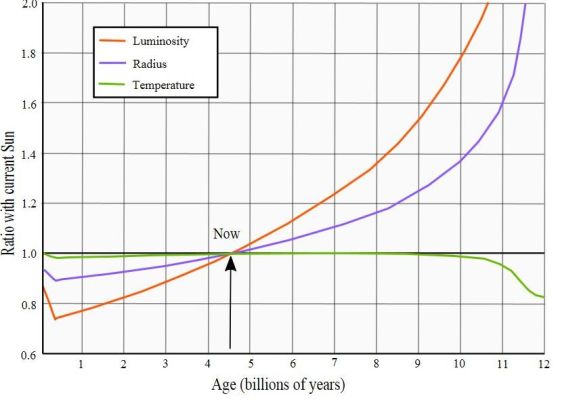
The most important factor is that the sun emitted much less light early in Earth's history. Here's a graph. Lest you think that those sorts of differences don't matter much, it should be pointed out that a 10% increase in solar radiation is predicted to be capable of boiling off Earth's oceans. Over the scale of hundreds of millions of years, the light from the sun changes by quite relevant amounts, as it slowly progresses towards its inevitable end as a red giant. Over the scale of hundreds of years? Not so much. It's also one of the most observed objects in the universe; when something changes with the sun, we know about it, and have for quite a long time.
I'm sorry, I interrupted your rant about all those idiot scientists and their pre-kindergarten education... please continue.
-
Re:Earth shifts
Your demands for citations are cute. If they're not in the right format, you won't read them. I'm sure that will make them go away.
To illustrate, that we've seen both kinds of predictions, and that the climate science has a long way to go to establish its credibility. These cooling papers came after Arrhenius, did not they?
Again, we can find contrarian research published about plate tectonics decades after it was accepted science. The existence of papers is not an argument for their credibility.
Arrhenius' first paper on the subject of warming is here. His prediction was about 4-6 degrees per doubling of CO2, with greater effects at the poles. That's on the high end of current estimates, but given the amount of hand-calculation he had to do, it's still a pretty impressive result.
Most of the early work on climate change was proving that it was possible for the climate to change at all, and as you can see in Arrhenius' paper, they mostly deal with the planet in an equilibrium state, and don't account for ever-increasing levels of CO2. One early attempt at modeling the globe in order to make these sorts of predictions was Hansen et al, 1988. He overestimated warming by about 15-25%; this article gives a post-mortem on his predictions. Essentially, using the same model with one slightly different physical constant reproduces the temperature trend far more precisely. An earlier study (Plass 1956) predicted a rise of 1.1 degrees C per century, assuming 1950s emissions levels. Warming since the 1950s has been on the order of
However, you're also reversing the burden of proof. Basic physical laws suggest that a higher partial pressure of CO2 will warm the Earth, and simple laboratory experiments show a strong positive feedback from H2O.
Great! And this was all known this for decades (if not centuries), right?
The laboratory experiments on the infrared absorption of various gases date back to Tyndall (1859), and general radiative laws derived by Boltzmann (1884). A more specific overview of radiative forcing effects can be found in Myhre et al, 1998, if you're interested. So for the general idea that CO2 affects the temperature on Earth, you can look to any of the above for confirmation, or grab an IR camera and take a photograph.
So if CO2 affects the global temperature, and CO2 is measured to be increasing (which presumably you do not dispute), then wouldn't it be obvious that temperature must also increase? Not so fast! The absorption bands of CO2 and H2O overlap, and the atmosphere is so full of water vapor that it periodically precipitates. Clearly anything CO2 could do, H2O must already be doing, right? Bzzt. The flaw in this thinking is that because H2O precipitates out before it reaches the upper atmosphere and CO2 does not, allowing the latter to build up in the upper atmosphere (Kaplan 1952). Specifically, it extends the CO2-rich layer further out into space. There are a couple more details about where emission happens at what probability for a given photon of a given energy, and how many times it can expect to hit something on its way up, but again, your IR photograph should tell you that the mean free path is pretty short. This paper gives an overview of Earth's radiative balance.
I don't have to offer my own theory — because I do not seek to convince and/or compel you to alter your way of life. You seek to do that t
-
Re:I wonder
Same here. Is there something special about apples? Would it work with pears or guavas too? TFA mentions "hard carbon" as an enabling factor, but doesn't explain why. A google search turns up a paper on the subject, which says, "Hard carbon is found to be less prone to passivation due to the high electrochemical stability of the ionic liquid." (I'm not quite sure what that means, but it sounds cool.)
In any case, I'm always happy to see more folks making more advances in battery tech. Elon is blazing a trail with the Giga-Factory, but there's a whole bunch of others lining up in the wings. I think we're going to see a 'boom' in this sector in the next few years.
-
The level of stupidity
in slashdot comment threads on climate-related posts seems to be inversely proportional to the square of the post's age, and exponential in the number of USA citizens participating in the thread. One also notes such phenomena as the denial or neglect of simple laws of nature, the denial of the 119-year old findings of a well-respected scientist, ignorance of the basic tenets of technical, even polite discussion, and a statistically not insignificant tendency to adhere to conspiration theories. Slashdot discussion threads on climate, climate change and climate policy are, to an engineer, to a scientist or even to a concerned citizen, some of the most disheartening places on the internet.
-
Efficiency
Can the electric grid handle charging that many cars every night? Not to mention that there can exist a better way, in terms of overall efficiency. If someone has better numbers than the ones I present here, let's see them!
It is known that hydrocarbon powered cars typically turn chemical energy into mechanical motion at about 35% efficiency (45% for Diesels). It is known that large power plants generate electricity from fuel at about 50% efficiency. The process of charging a battery is about 75% efficient, turning electrical energy into chemical energy. The reverse is also true, for battery discharge (75%), and the electric motors of an electric car are about 95% efficient. We multiply these numbers to get the overall efficiency of conversion of original fuel energy into mechanical motion for the car: about 27%. Even allowing for regenerative braking energy-recovery, it looks like ordinary cars win the efficiency thing here. We need better than that!
Consider replacing the electric commuter-car battery with a flywheel. We have the tech to do this for ranges of 50 miles or so. Since the flywheel is a motor-generator, it operates at about 95% efficiency, storing and producing energy. The car still has a separate electric drive motor, also 95%. The numbers are multiplied as before:
There is another factor to consider. To cruise the road at highway speed, a car only needs about 15 horsepower to fight wind resistance. All the rest of the horsepower in a car is needed for related to fast acceleration. A flywheel system can easily provide the power for fast acceleration; it could be accompanied by a small engine that generates 15-20 HP for cruising, and charging the flywheel (plus add regenerative braking). Also, a fuel tank gives the car lots of range (the flywheel doesn't have to be so big, to store energy for even a 5-mile range). Total system weight could be significantly less than today's hydrocarbon engines, and total system energy efficiency will probably be around 40% (an engine designed to run at a particular constant speed, for generating say 20 HP, is more efficient than one that revs at different rates).
And here is one more major factor: chemical reactions usually involve two things that we can call here "fuel" and "oxidizer". This is as true for a battery as it is true for a gasoline engine. The difference is that in the battery, both the fuel and the oxidizer are permanently stored; the total weight of chemicals always has to be carried around. The fuel-burning engine is associated with only carrying the fuel around; the reaction products (mostly CO2 and H2O) are dumped and their weight is never carried around. Now you know why electric-car batteries weigh so much!
We should be thinking about replacing batteries with "fuel cells", because, like hydrocarbon engines, only fuel (most agree hydrogen is best) needs to be carried around, and the waste (H2O) can be dumped. Methods of generating hydrogen are improving --can do it straight from sunlight; no need burn hydrocarbon fuel in a large power plant! That changes the efficiency situation drastically! The hydrogen fuel becomes almost free after the infrastructure is paid for (must be maintained, though); the energy efficiency of generating the hydrogen can be ignored. So we have maybe 75% efficiency for running a hydrogen fuel cell to produce 20 HP, plus three sets of 95% efficiency for the flywheel and the car's electric drive motor(s): about 64% total efficiency, increased a by by regenerative braking. -
Re:Not shared by everyone
Most people in support of drastic intervention fail to grasp that we have no real alternative to fossil fuels in the pipe.
But this guy claims we could be fossil-fuel free by 2050.
I'm not exactly sure how he plans to replace every single vehicle in the USA with a hydrogen fuel-cell powered one, or install heat pumps in every single home, but I'm certain if I pay £38 for the pdf, I'll find out how.
After all, he teaches at Stanford! And he made a computer model! He must be right!
Overall, I agree with you. Nuclear is the best short-term solution. As a side benefit, more fission development leads to technologies which would be benefit fusion research. It would also carry us over to a (potential) time when we could switch to an entirely renewable energy economy.
I just don't understand environmentalists who are also anti-nuclear.
-
Re:Unnecessary, but profitable.
Do modern solar panels need environmentally destructive production techniques?
Perhaps not:
http://www.rsc.org/chemistrywo...Whilst I'm not excusing China's pathetic environmental record, aren't these same neodymium magnets also in the motors that create electricity for hydro, coal, gas and nuclear? If so then wind turbines would still be better.
-
Nothing new
This work has none of the key features of a heart that would make the platform attractive for drug testing. Cardiomyocytes will spontaneously contract if grown on basically anything. The true value of on a chip platforms is in implementations that can recapitulate higher order function or structure like the Bhatia lab's livers or the Allbritton lab's colons.
-
Re:The research is very interesting
Printed parts are still by far inferior to more conventionally produced alternatives. For organs with 3D architecture, by far the most successful approaches have been to basically seed the relevant cell types in layers on a gel or degradable fiber based scaffold. Anthony Atala's group at Wake Forest (no association, just a fan of their work) has made replacement urethras and bladders among many others that have actually been implanted in patients. I believe the bladder work is currently in a phase II clinical trial on its way to becoming more widely available. Sangeeta Bhatia's group has done amazing work on liver tissue, although their focus has been on laboratory samples for drug testing rather than implantation for the time being. They actually do use a 3D printing approach to their work but only to build a sugar-based scaffold that can dissolve away and leave space for blood vessels to be engineered. The tissue itself is just dumped onto the scaffold in a gel slurry and organizes itself.
I think 3D printing tissues is a rather short-sighted approach to assembling structures whose function and shape is self-organized. The most successful approaches thus far (in terms of having products on the market or organs in people) have been strategies that rely on the intrinsic self-organization of tissues. Even more complex structures such as the colonic epithelium can be generated this way. -
Re:Bill Nye, the Dogma Guy!
Science is not a debate club
Yes, yes it is. Just because it deals in empirical facts, rather than philosophy, doesn't mean there's no debate. Why do you think so many journals are called (examples hyperlinked) "Transactions on/of...", "Discussions on/of" and such?
-
Better than a shot to the balls
Sounds better than the method studied in 2013- having gold nano-rods injected into the testes and only lasting a few months. http://www.rsc.org/chemistrywo...
-
Re:OMG
What, do you expect people to give you dozens of links for you for each element? Did you even check yourself at all? Why should we expect you to even read links given, since you have already been given links that show uranium metal reacts with oxygen in air and water at room temperature.
There are quite a lot of papers on the chemistry of uranium, but I'm not going to look one up for every single reactions. At least this one discusses reactions with several different halogens and involves a bunch of reactions done at room temperature and uranium metal (or even several that are done at dry ice temperatures). There will be lots of stuff around that mentions reactions at higher temperatures because industrial chemistry is about reaction yields, not just getting things to react, but that in no way negates that there are a lot of reactions at room temperature. Older production methods of uranium involved a lot of processing with alkali metal salts with reactions that happen at room temperature. Even the first search result for organouranium synthesis talks about reactions at room temperature forming various organic chemistry bonds.
Considering you don't even read or comprehend things already linked to you, there is no expectation that more links would fix anything. But for others that might be curious, this stuff is really easy to find in general considering the volumes of work on uranium chemistry compared to other heavy elements.
-
Re:The real disaster
Since you are obviously cherry-picking your sources again (which I have pointed out to you before), let me add some recent sources from highly respected journals about the risk of low-dose radiation. Ofcourse, according to Mr. D. all these journals just publish pseudo-science. Reminds me of the old joke with the wrong-way driver.
"... First, it is clear that we have now passed a watershed in our field, where it is no longer tenable to claim that CT risks are "too low to be detectable and may be non-existent" (5). A large well-designed epidemiologic study has clearly shown that the individual risks are small but real..."
Journal: Radiology
Link: http://pubs.rsna.org/doi/full/..."...We noted a positive association between radiation dose from CT scans and leukaemia (...) and brain tumours (...)."
Journal: The Lancet
Link: http://www.sciencedirect.com/s..."Conclusions The increased incidence of cancer after CT scan exposure in this cohort was mostly due to irradiation.
Journal: British Medical Journal
Link: http://www.bmj.com/content/346..."The study supports the extrapolation of high-dose rate risk models to protracted exposures at natural background exposure levels."
Journal: Leukemia
Link: http://www.nature.com/leu/jour...And with respect to Fukushima there were recent estimates from a Stanford guy:
"We estimate an additional 130 (15â"1100) cancer-related mortalities and 180 (24â"1800) cancer-related morbidities incorporating uncertainties associated with the exposureâ"dose and doseâ"response models used in the study. We also discuss the LNT model's uncertainty at low doses.
Journal: Energy & Environmental Science
Link: http://pubs.rsc.org/en/content... -
Re:Still ignoring the big issue with graphene.
http://www.rsc.org/chemistrywo...
Maher El-Kady and others at the University of California at Los Angeles have now found a way to fabricate graphene films, and graphene capacitors, without any sticking together. The researchers take a DVD and apply a layer of plastic, followed by a film of graphite oxide. They then insert the DVD into a standard DVD drive, so that the in-built laser chemically reduces the graphite oxide to graphene. Having removed the disc, the researchers peel off the plastic, which is then coated in graphene, and cut it into whatever shapes they desire.
Sounds like Riverside and LA need to team up on this. The method of using a red laser to reduce the oxide should be relatively easy to replicate at an industrial scale. Then the problem becomes sourcing large quantities of graphene oxide. However, since the US creates its own synthetic graphite, it should be relatively simple to apply the next stage of converting it to graphene oxide as part of the synthesis process.
-
Re:Graphene still has a little problem
-
Re:Of couse the other thing that would be great
-
Re:Great... Instead of CO2 we get CO
Formic acid can be stored and used in a fuel cell to have a very good solar storage fuel. No need to worry about CO if kept within this fuel cycle.
Related Abstract: http://pubs.rsc.org/en/content...
And what is the byproduct of that fuel cell? No, let me guess... a potent greenhouse gas?
I agree that this could be a useful fuel cell if the energy density is high enough, but the net CO2 change in atmosphere is 0. All the CO2 that came out, goes back in.
-
Great... Instead of CO2 we get CO
Formic acid can be stored and used in a fuel cell to have a very good solar storage fuel. No need to worry about CO if kept within this fuel cycle.
Related Abstract: http://pubs.rsc.org/en/content...
-
Tap Water
I believe "contains actual medicine" could be said of tap water.
-
Re:Not real research
I'm assuming you're being sarcastic, but the fact is that because as a species we've been systematically looking into the unknowns for a few hundred years now, there's not very much low-hanging fruit left.
(Yes, I was being sarcastic)
I strongly disagree. I've read many scientific papers which are nothing more than refinements of manufacturing technique, and I've seen lots of innovative ideas posted on blog sites by people who try things out, simply because they don't know any reason why it won't work.
I'm all about bolstering arguments with examples, so let's examine chemistry.
Chemistry has lots of underlying theory and calculations, but whenever I read chemistry papers I'm still astonished by effects and behaviours that couldn't be predicted. Theory is good, but in Chemistry you still have to try things to see what happens. Justification from theory comes later.
To take a specific example, Copper nanoparticles can be produced from Copper(II) sulfate using Ascorbic acid as a reducing agent. As near as I can tell, this reaction was first discovered in 2005, and it's something that anyone can do in their home lab. This could be the first step towards inkjet printing copper traces for circuit boards. The process happens at 60' C, so it's tough to get this to work in an inkjet. No one predicted the outcome before they tried it.
A different process using Iron(III) citrate appears to work at much lower temperatures. This was discovered in 2009.
No theory in Chemistry allows you to calculate a reaction suitable for inkjet printing of copper traces. It's all "try and see", and most of that is accessible to the home experimenter. Lots of people are looking at this right now, the field is wide open.
I really disagree with your position. It reads as "cheer up, you won't succeed but that's a good thing".
Chemistry is a concrete example where an amateur experimenter could make insightful and valuable discoveries today.
-
Re:Big problem here...
If it's concentrated enough, why can't you use sea water as "fresh", since it is powered by the difference in salinity, not the absolute value.
Research has been done on this, and I believe that a pilot plant may be built in the UAE or Oman in the next few years. It will use brine, concentrated in solar ponds, as the source of NaCl, and plain seawater as the sink.
-
Re:Oh yes, such a good idea..
Disposal at sea and open pit burning (both of which were practiced by the British and the Soviets) are now prohibited by the Chemical Weapons Convention. So they won't be dropping barrels of anything over the sides of the ship, or simply pouring the weapons into a fire. They have to be broken down carefully so that what remains is much less dangerous than what they started with.
The weapons are mostly organic compounds, so the bulk of the waste is hydrogen, oxygen, nitrogen, and carbon. Some weapons have used arsenic, chlorine, fluorine, phosphorous, and other elements. Initially they were disposed of by single stage incineration, but that produced smoke that was toxic in its own right. Modern disposal techniques use multiple stages of heat, filtration, oxidation, electrolysis, or even detonation of the weapons. Bleach is an effective oxidizer, but gives off chlorine. Hydrogen peroxide and high temperature steam will also break down many of the compounds. Sarin [2-(fluoromethyl phosphoryl)oxypropane], which the Syrians are accused of using in this war, can be broken down by a low temperature burn, followed by a scrubbing process, followed by a second high temperature burn. Any solid materials remaining after the scrubbing and filtration processes are then buried.
A UK firm was having great success using electrolysis of silver nitrate in a nitric acid solution, which was very effective at breaking up and oxidizing the compounds, but they have ceased that research. The French are building a detonation chamber, where the entire warhead is placed in a blast chamber and detonated. The high pressures and temperatures perform an initial breakdown of the agents that destroys most of the chemicals, and the remaining chemicals are treated through an incineration and filtration process. One advantage is that it destroys both the chemical weapon and the explosive, meaning they don't have to have a separate hazardous process to handle the high explosives (which might be in a less-than-safe state of stability.)
Destroying the Poisons of War, by the Royal Society of Chemistry, is an interesting read on the history of the topic.
And the U.S. Army, who is in the process of decommissioning their Utah disposal facility at Tooele, has been drilling test holes in their disposal plant and sampling the soil beneath. So far, they have found no traces of any of the weapons they had been destroying. This plant was originally commissioned in the 1970s, so the engineering, the chemistry, and the processes have proven highly successful at safely destroying the US stockpiles over the long term. They know how to do it.
-
Re:If they've alread captured the CO2,
My guess is that someone said "it doesn't matter that it works, because the energy it takes to heat that ceramic could be used more productively in many different other ways." However, it looks like the technology for making whatever you like from cobalt-ferrite is coming along all right, so it might be possible for someone to order a ceramic ring and build a setup of this sort on their own. OT: Here's a kind of interesting abstract I ran across when looking for what ever happened to this tech: Flower shaped assembly of cobalt ferrite nanoparticles: application as T2 contrast agent in MRI.
-
Re:you want to look at all details and aspects?
Some still do. IIRC Prius used to, but has switched. But this article says (2010) that Toyota uses Ni-Cd for hybrids, Li Ion for pure electrics. According to a quote in this article,
Geoffrey May, a UK based consultant to the battery industry, is more sceptical. 'More than 95 per cent of hybrid electric vehicles on the road today use nickel metal hydride batteries and that is not going to change any time soon because the main manufacturers of HEVs have invested huge amounts of money in production facilities. It is a technology that works and it is safe: there have been no reported incidents of battery fires with nickel metal hydride as have happened with lithium ion.'
Also, mining and refining lithium (or any material) has its environmental costs. Then there's this:
“The Metal Mining Effluent Regulations do not specifically regulate all of the individual substances of concern that might be released from the mining or processing of rare earth elements and lithium,” says the report.
The regulations “were not specifically designed to manage the environmental aspects of these mining processes.”
And this
Around the turn of this century, China began to separate the mixed salts of Tsaidam Basin lake beds on a large-scale. Separating naturally crystallised sodium, potassium, magnesium and lithium salts requires heavy-duty toxic solvents (such as isobutanol and chloroform), known to cause cancer. Since the Qinghai authorities were keen to industrialise their province – known for its poverty, remoteness and cold climate – land-use controls and environmental regulations were not a priority. From the provincial capital Xining, spreading out to the famous Kumbum Monastery, industrial plants took up land, pouring effluents into nearby streams. Potash and magnesium plants were built and expanded in Gormo, Xining and along the connecting railway line.
Bottom line: At this point the environmental impact of lithium mining and processing (especially at the new higher volumes to be expected) is not well understood, and apparently not yet subject to sufficient mitigation. We just don't yet know. But my point remains - over time, all these externalities will be applied to every one of these resources, to approximately the same extent, and as such their actual cost will reflect those externalities, to approximately the same extent. That is, if we go about this sanely - a dubious prospect!
-
Re:Agreed. Gas vehicles have hit physics limit
Fundamentally the ICE engine is limited by physics. It will never get more than 25-30% efficient. Whereas the electric car can achieve 70-80% easily, and is only limited right now by technology.
Perhaps you should RTFA, which points out that, in the UK, power stations are only about 36% efficient at delivering energy to end users. Add in the 80% efficiency of an electric car and now you have something similar to that of a gas (petrol)-powered car.
-
Bullshit.
http://en.wikipedia.org/wiki/Carmine#Production
The carminic acid used to produce the pigment can also be extracted from various microbes engineered for the purpose. Microbes are dissolved in a containment structure separate from their cultivation vats, and then allowed to settle out. The liquid and suspended carminic acid is then siphoned off, and metal salts are then added to give a lake pigment in a procedure that is mostly identical to the procedure for acid extracted from insects.
Aslo, it has been synthesized since the '90s.