Slashdot Mirror
Domain: salon.com
Stories and comments across the archive that link to salon.com.
Stories · 578
-
Are Silicon Valley Workers Abandoning Libertarianism For Socialism? (salon.com)
Salon writes that Silicon Valley tech workers are "defying their overlords," arguing that recent unionization attempts by Kickstarter employees may be only the beginning: The workers' Kickstarter campaign is not the first attempt, though, or even the first time rumblings of unionization, have circulated among programmers. In 2018, software engineers at the startup Lanetix announced their intent to unionize -- and were promptly fired by management (It is illegal to fire employees for trying to unionize). The National Labor Relations Board intervened, and ultimately forced Lanetix to pay the 15 fired engineers a total of $775,000. The show of worker power at Lanetix may have paved the way for Kickstarter's workers. Similarly, workers across the video game industry -- generally among the most overworked, underpaid workers within the tech industry -- have been making steps towards unionization. Game Workers Unite, profiled by Salon last year, is building a grassroots movement to organize the ranks of video game makers.
Together, this suggests that a small but visible movement for white-collar software engineers unionizing has been gaining steam in the Valley over the past few years -- suggesting that the people who make up the tech industry, once a bastion of libertarianism, are starting to understand the often subtle ways that their employers exploit them... For decades, libertarianism was part and parcel to the tech industry. Despite a grueling work culture and a high-profile collusion scandal among major tech corporations to suppress software engineers' wages, tech workers were more likely to see themselves as future founders than an exploited underclass -- a point of view encouraged by employers through high wages and generous, often absurd office perks. Recent developments suggest such endearing tactics are no longer working. -
Are Silicon Valley Workers Abandoning Libertarianism For Socialism? (salon.com)
Salon writes that Silicon Valley tech workers are "defying their overlords," arguing that recent unionization attempts by Kickstarter employees may be only the beginning: The workers' Kickstarter campaign is not the first attempt, though, or even the first time rumblings of unionization, have circulated among programmers. In 2018, software engineers at the startup Lanetix announced their intent to unionize -- and were promptly fired by management (It is illegal to fire employees for trying to unionize). The National Labor Relations Board intervened, and ultimately forced Lanetix to pay the 15 fired engineers a total of $775,000. The show of worker power at Lanetix may have paved the way for Kickstarter's workers. Similarly, workers across the video game industry -- generally among the most overworked, underpaid workers within the tech industry -- have been making steps towards unionization. Game Workers Unite, profiled by Salon last year, is building a grassroots movement to organize the ranks of video game makers.
Together, this suggests that a small but visible movement for white-collar software engineers unionizing has been gaining steam in the Valley over the past few years -- suggesting that the people who make up the tech industry, once a bastion of libertarianism, are starting to understand the often subtle ways that their employers exploit them... For decades, libertarianism was part and parcel to the tech industry. Despite a grueling work culture and a high-profile collusion scandal among major tech corporations to suppress software engineers' wages, tech workers were more likely to see themselves as future founders than an exploited underclass -- a point of view encouraged by employers through high wages and generous, often absurd office perks. Recent developments suggest such endearing tactics are no longer working. -
Are Silicon Valley Workers Abandoning Libertarianism For Socialism? (salon.com)
Salon writes that Silicon Valley tech workers are "defying their overlords," arguing that recent unionization attempts by Kickstarter employees may be only the beginning: The workers' Kickstarter campaign is not the first attempt, though, or even the first time rumblings of unionization, have circulated among programmers. In 2018, software engineers at the startup Lanetix announced their intent to unionize -- and were promptly fired by management (It is illegal to fire employees for trying to unionize). The National Labor Relations Board intervened, and ultimately forced Lanetix to pay the 15 fired engineers a total of $775,000. The show of worker power at Lanetix may have paved the way for Kickstarter's workers. Similarly, workers across the video game industry -- generally among the most overworked, underpaid workers within the tech industry -- have been making steps towards unionization. Game Workers Unite, profiled by Salon last year, is building a grassroots movement to organize the ranks of video game makers.
Together, this suggests that a small but visible movement for white-collar software engineers unionizing has been gaining steam in the Valley over the past few years -- suggesting that the people who make up the tech industry, once a bastion of libertarianism, are starting to understand the often subtle ways that their employers exploit them... For decades, libertarianism was part and parcel to the tech industry. Despite a grueling work culture and a high-profile collusion scandal among major tech corporations to suppress software engineers' wages, tech workers were more likely to see themselves as future founders than an exploited underclass -- a point of view encouraged by employers through high wages and generous, often absurd office perks. Recent developments suggest such endearing tactics are no longer working. -
Are Silicon Valley Workers Abandoning Libertarianism For Socialism? (salon.com)
Salon writes that Silicon Valley tech workers are "defying their overlords," arguing that recent unionization attempts by Kickstarter employees may be only the beginning: The workers' Kickstarter campaign is not the first attempt, though, or even the first time rumblings of unionization, have circulated among programmers. In 2018, software engineers at the startup Lanetix announced their intent to unionize -- and were promptly fired by management (It is illegal to fire employees for trying to unionize). The National Labor Relations Board intervened, and ultimately forced Lanetix to pay the 15 fired engineers a total of $775,000. The show of worker power at Lanetix may have paved the way for Kickstarter's workers. Similarly, workers across the video game industry -- generally among the most overworked, underpaid workers within the tech industry -- have been making steps towards unionization. Game Workers Unite, profiled by Salon last year, is building a grassroots movement to organize the ranks of video game makers.
Together, this suggests that a small but visible movement for white-collar software engineers unionizing has been gaining steam in the Valley over the past few years -- suggesting that the people who make up the tech industry, once a bastion of libertarianism, are starting to understand the often subtle ways that their employers exploit them... For decades, libertarianism was part and parcel to the tech industry. Despite a grueling work culture and a high-profile collusion scandal among major tech corporations to suppress software engineers' wages, tech workers were more likely to see themselves as future founders than an exploited underclass -- a point of view encouraged by employers through high wages and generous, often absurd office perks. Recent developments suggest such endearing tactics are no longer working. -
Are Silicon Valley Workers Abandoning Libertarianism For Socialism? (salon.com)
Salon writes that Silicon Valley tech workers are "defying their overlords," arguing that recent unionization attempts by Kickstarter employees may be only the beginning: The workers' Kickstarter campaign is not the first attempt, though, or even the first time rumblings of unionization, have circulated among programmers. In 2018, software engineers at the startup Lanetix announced their intent to unionize -- and were promptly fired by management (It is illegal to fire employees for trying to unionize). The National Labor Relations Board intervened, and ultimately forced Lanetix to pay the 15 fired engineers a total of $775,000. The show of worker power at Lanetix may have paved the way for Kickstarter's workers. Similarly, workers across the video game industry -- generally among the most overworked, underpaid workers within the tech industry -- have been making steps towards unionization. Game Workers Unite, profiled by Salon last year, is building a grassroots movement to organize the ranks of video game makers.
Together, this suggests that a small but visible movement for white-collar software engineers unionizing has been gaining steam in the Valley over the past few years -- suggesting that the people who make up the tech industry, once a bastion of libertarianism, are starting to understand the often subtle ways that their employers exploit them... For decades, libertarianism was part and parcel to the tech industry. Despite a grueling work culture and a high-profile collusion scandal among major tech corporations to suppress software engineers' wages, tech workers were more likely to see themselves as future founders than an exploited underclass -- a point of view encouraged by employers through high wages and generous, often absurd office perks. Recent developments suggest such endearing tactics are no longer working. -
Are America's Big Telecom Companies Suppressing Fiber? (salon.com)
Salon just published a new interview with Susan Crawford, the author of "Fiber: The Coming Tech Revolution -- And Why America Might Miss It." Crawford has spent years studying the business of these underground fiber optic cables that make fast internet possible. As it turns out, the internet infrastructure situation in the United States is almost hopelessly compromised by the oligopolistic telecom industry, which, due to lack of competition and deregulation, is hesitant to invest in their aging infrastructure... This is going to pose a huge problem for the future, Crawford warns, noting that politicians as well as the telecom industry are largely inept when it comes to prepping us for a well-connected future...
"The decay started in 2004 when -- maybe out of gullibility, maybe out of naivety, maybe out of calculation -- then-chairman of the FCC, Michael Powell, now the head of cable association -- was persuaded that the telcos would battle it out with the cable companies, that their cable modem services would battle it out with wireless, and all of that competition would do a much better job than any regulatory structure could at ensuring that every American had a cheap and fantastic connection of the internet. That's just turned out that's just not true. Since then, he deregulated the entire sector -- and as a result, we got this very stagnant status quo where in most urban areas -- usually the local cable monopoly has a lock in the market and can charge whatever it wants for whatever type of quality services they're providing, leaving a lot of people out."
"Because Americans don't travel," she adds, "you don't get the sense of what a third-world country the U.S. is becoming when it comes to communications." -
Salon: Republicans Are Launching Fake Local News Sites To Spread 'Propaganda' (salon.com)
"The Tennessee Star claims to be the 'most reliable' online local paper in the state," reports Salon. "In fact it's just a GOP front." An anonymous reader quotes their report:
An investigation by the fact-checking outlet Snopes found that several new local news websites are actually being launched by Republican consultants whose company is funded in part by the candidates the sites cover. Politico first reported last year that Tea Party-linked conservative activists Michael Patrick Leahy, Steve Gill and Christina Botteri were behind the "Tennessee Star," a website that purported to be a local news website but mostly posted content licensed from groups linked to big Republican donors. Snopes discovered that the trio has since launched similar sites in other battleground states ahead of the 2020 elections: the Ohio Star and the Minnesota Sun...
The group behind the sites does not appear content with just three outlets. According to Politico, Leahy has purchased domain names associated with Missouri, New England, the Dakotas, Michigan, North Carolina, Pennsylvania, Virginia and Wisconsin, most of which are electoral battleground states that will be vital in 2020.
Kathleen Bartzen Culver, who heads the Center of Journalism Ethics at the University of Wisconsin at Madison, told Snopes that political operatives are free to launch their own news platforms, but it's a problem if they are trying to deceive readers into believing the sites are nonpartisan local news. "I have no problem with advocacy organizations creating content that reinforces the positions they take on public policy issues on the left, right or center. The issue comes in when they're not transparent about that advocacy," Culver said... "The information sphere is so polluted right now that the average citizen has trouble telling what is real and what is not," Culver told Snopes. "I find that very troubling within a democracy." -
Lawsuit Reveals How Facebook Profited Off Confused Children: Report (salon.com)
Documents outlining how Facebook profited off children are expected to be made public soon, according to Reveal News of the Center for Investigative Reporting (CIR), who requested the documents. From a report: In a report about the trove of previously-sealed documents, Reveal News explains that Facebook has previously faced lawsuits for failing to refund charges made by children playing games on Facebook. According to Reveal, the children did not know that their parent's credit card was stored on the platform when they clicked "buy," and in some cases, hundreds or even thousands of dollars were spent. In one case, the plaintiff, who is a child, spent several hundreds of dollars in just a few weeks. According to the report, more documents show "widespread confusion by children and their parents, who didn't understand Facebook continued to charge them as they played games." -
Could Collapsing Antarctic Glaciers Raise Sea Levels Sooner Than Expected? (salon.com)
"We may be headed for an ice apocalypse which could result in the flooding of coastal cities before the end of this century," writes long-time Slashdot reader whoever57. Grist reports on two of the largest and fastest-melting glaciers in Antarctica which "hold human civilization hostage." There's no doubt this ice will melt as the world warms. The vital question is when... Together, they act as a plug holding back enough ice to pour 11 feet of sea-level rise into the world's oceans -- an amount that would submerge every coastal city on the planet... Each new iceberg that breaks away exposes taller and taller cliffs... In the past few years, scientists have identified marine ice-cliff instability as a feedback loop that could kickstart the disintegration of the entire West Antarctic ice sheet this century -- much more quickly than previously thought. Minute-by-minute, huge skyscraper-sized shards of ice cliffs would crumble into the sea, as tall as the Statue of Liberty and as deep underwater as the height of the Empire State Building. The result: a global catastrophe the likes of which we've never seen... When [land-based ice] falls into the ocean, it adds to the overall volume of liquid in the seas. Thus, sea-level rise.... All this could play out in a mere 20 to 50 years -- much too quickly for humanity to adapt...
A lot of this newfound concern is driven by the research of two climatologists: Rob DeConto at the University of Massachusetts-Amherst and David Pollard at Penn State University. A study they published last year was the first to incorporate the latest understanding of marine ice-cliff instability into a continent-scale model of Antarctica... Instead of a three-foot increase in ocean levels by the end of the century, six feet was more likely, according to DeConto and Pollard's findings. But if carbon emissions continue to track on something resembling a worst-case scenario, the full 11 feet of ice locked in West Antarctica might be freed up, their study showed.
If sea levels rise by six feet, "around 12 million people in the United States would be displaced, and the world's most vulnerable megacities, like Shanghai, Mumbai, and Ho Chi Minh City, could be wiped off the map." -
Google AMP Flaw Exploited By Russian Hackers Targeting Journalists (salon.com)
An anonymous reader writes: Russian hacktivist group Fancy Bear (also referred to as APT28, Sofacy, and Strontium) has been using a flaw in Google's caching of Accelerated Mobile Pages (AMP) to phish targets, Salon reports. To make matters worse, Google has been aware of the bug for almost a year but has refused to fix it... The vulnerability involves how Google delivers google.com URLs for AMP pages to its search users in an effort to speed up mobile browsing. This makes Google products more vulnerable to phishing attacks.
Conservative blogger Matthew Sheffield writes in the article that most of the known targets "appear to have been journalists who were investigating allegations of corruption or other wrongdoing by people affiliated with the Russian government." One such target was Aric Toler, a researcher and writer for the website Bellingcat who specializes in analyzing Russian media and the country's relationship with far-right groups within Europe and America... another journalist who writes frequently about Russia, David Satter, was taken in by a similar AMP phishing message... Shortly after Satter was tricked into visiting the fake website and entering his password, a program that was hosting the site logged into his Gmail account and downloaded its entire contents. Within three weeks, as the Canadian website Citizen Lab reported, the perpetrators of the hack began posting Satter's documents online, and even altering them to make opponents and critics of Russian President Vladimir Putin look bad.
Google told Salon they've "made a number of changes" to AMP -- without saying what they were. (After contacting Google for a comment, AMP's creator and tech lead blocked public comments on a Github bug report about Google's AMP implementation.) "More things ... will come on Google's side in the future and we are working with browser vendors to eventually get the origin right," AMP's tech lead wrote last February.
Jason Kint, CEO of a major web publishing trade association, told Salon that "This report of an ongoing security issue is troubling and exactly why consolidation of power and closed standards are problematic. The sooner AMP migrates to the open web and becomes less tied to the interests of Google, in every way the better." -
Is Apple Copying Palm's WebOS? (salon.com)
An anonymous reader quotes a report from Salon: Released in 2009 by Palm -- the same company that popularized the PDA in the 1990s -- WebOS pioneered a number of innovations, including multiple synchronized calendars, unified social media and contact management, curved displays, wireless charging, integrated text and Web messaging, and unintrusive notifications [that have all been copied by the mobile operating systems that defeated it on the marketplace]. The operating system, built on top of a Linux kernel, was also legendary for how easily it could be upgraded by users with programming skills. WebOS was also special in that it used native internet technologies like JavaScript for local applications. That was a huge part of why it was able to do so much integration with Web services, something its competitors at the time simply couldn't match.
Apple's upcoming iOS 11 once again demonstrates how far ahead of its time WebOS really was. The yet-to-be-released Apple mobile system has essentially copied the WebOS model for switching apps by having the user swipe upward from the bottom to reveal several "cards" that represent background applications. While Apple's decision to remove its massively overworked Home button is an improvement, it is still an inferior way of switching apps, compared to what you could do on WebOS eight years ago. -
Why So Many Top Hackers Come From Russia (krebsonsecurity.com)
Long-time Slashdot reader tsu doh nimh writes: Brian Krebs has an interesting piece this week on one reason that so many talented hackers (malicious and benign) seem to come from Russia and the former Soviet States: It's the education, stupid. Krebs's report doesn't look at the socioeconomic reasons, but instead compares how the U.S. and Russia educate students from K-12 in subjects which lend themselves to a mastery in coding and computers -- most notably computer science. The story shows that the Russians have for the past 30 years been teaching kids about computer science and then testing them on it starting in elementary school and through high school. The piece also looks at how kids in the U.S. vs. Russia are tested on what they are supposed to have learned.
Fossbytes also reports that Russia claimed the top spot in this year's Computer Programming Olympics -- their fourth win in six years -- adding that "the top 9 positions out of 14 were occupied by Russian or Chinese schools." The only two U.S. schools in the top 20 were the University of Central Florida (#13) and MIT (#20). -
Does Silicon Valley Need More Labor Unions? (salon.com)
Salon recently talked to Jeffrey Buchanan, who two years ago co-founded a labor rights group "that highlights the plight of security officers, food-service workers, janitors and shuttle-bus drivers in the region." An anonymous reader quotes their report: The situation among Silicon Valley's low-wage contract workers has become so perilous that in January, thousands of security guards working at immensely profitable companies like Facebook and Cisco followed the shuttle-bus drivers and voted to unionize in an effort to collectively bargain for higher wages and better benefits. The upcoming labor contract negotiations between the roughly 3,000 security guards (represented by SEIU United Service Workers West) and their employers is one of the biggest developments in Silicon Valley labor organizing to happen this year. Buchanan says there's also a broader push this year to get tech companies to be proactive in ensuring these workers can make ends meet, even if these companies have to pay more for the services they procure...
A paper published last year by University of California at Santa Cruz researchers Chris Brenner and Kyle Neering estimates between 19,000 and 39,000 contracted service workers are employed in the Valley at any given time... An additional 78,000 workers are at risk of becoming contract employees, according to the study, a number which includes administrative assistants, sales representatives and medium-wage computer programmers. This is part of a larger societal shift in which salaried workers are converted to contractors -- a transition that benefits business owners, in that they don't have to pay benefits and can hire and fire contractors at will.
Buchanan's group represents contractors typically earning "as little as $20,000 a year." But Salon's headline argues that "programmers may be next" in the drive to organize contractors. -
Can Twitter Survive By Becoming A User-Owned Co-Op? (salon.com)
What's going to happen now that Twitter's stock price has dropped from $66 a share to just $18? An anonymous reader quotes Salon: A small group of shrewd Twitter users and shareholders have come up with proposals to fundamentally restructure the way Twitter is controlled, to turn the company into a public service by removing the need to feed investors' ceaseless appetite for hitting quarterly growth benchmarks... Sonja Trauss, a Bay Area housing policy activist, and Twitter shareholder Alex Chiang proposed earlier this year a resolution for the company's recent annual shareholder vote to promote ways to get Twitter users to buy stock in the company, such as offering ways to buy shares directly through the Twitter website and mobile app. If many individual Twitter users each owned a small piece of the company, then they could participate collectively (through the annual shareholder voting process) in steering the direction of the company.
The idea makes sense from a labor standpoint. Twitter's value comes from user's tweets, which provides the backbone for digital advertising revenue. Twitter also sells this user-generated data to third parties that use it mainly for market research. This bloc of user-shareholders could theoretically overtake the control major institutional shareholders...have over the company. Because a lot of owners of a few shares of the company would have little to lose if the stock price doesn't grow or wavers, Twitter would be less beholden to meeting Wall Street's often brutal expectations. -
Can Crowdfunding Bring Back The Netbook? (salon.com)
"The mini-laptop's market niche got swamped by the iPad and the phablet," writes Salon, since the stripped-down hardware of tablets made them cheaper to produce. But now netbooks could be making a grassroots-fueled comeback, "thanks to the lower costs in electronics manufacturing and the fact that individual investors can come together to crowdfund projects." An anonymous reader quotes Salon: Michael Mrozek, the Germany-based creator of creator of the DragonBox Pyra, says "I never understood why they were gone in the first place. I have no idea why you would use a tablet. I tried one, and it's awkward to use it for anything else than browsing the Web"... He has already managed to raise several hundred thousand dollars through a private pre-order system set up on his geek's paradise online store. Once those initial orders have been filled, Mrozek said he will probably start up a mainstream crowdfunding campaign for his Linux handheld... "The niche was always there, but thanks to the Internet and crowdfunding, it's easy to reach everyone who's interested in such a device so even a niche product still gets you enough users to sell it. That wasn't possible 10 years ago."
Meanwhile, in just under two weeks Planet Computer raised $446,000 on Indiegogo, more than double the original $200,000 goal for their netbook-like Gemini computer (with a keyboard designed by the creator of the original Psion netbook). Planet's CEO Janko Mrsic-Flogel says "It's a bit like Volkswagen bringing back the Beetle," and predicts that the worldwide demand for netbooks could reach 10 million a year. -
Former Bush Official Lawrence Wilkerson Says Snowden Has Done a 'Service' (salon.com)
An anonymous reader cites an article on Salon: Lawrence "Larry" Wilkerson, former Bush official finds the revelations made by Edward Snowden a service. In 2013, Edward Snowden, a former contractor with NSA, worked with journalists to reveal a number of mass surveillance programs. In a recent interview, Wilkerson said, "I think Snowden has done a service. I wouldn't have had the courage, and maybe not even the intellectual capacity, to do it the way he did it. There's a logic to what he has done that is impressive. He really has refrained from anything that was truly dangerous, with regard to our security -- regardless of what people say. He has been circumspect about what he's released, how he's released it, who he's released it to." -
12-Year-Old Sikh Boy Arrested In Texas After Bringing a Power Bag To School (salon.com)
AaronW writes: A 12-year-old Sikh boy in Dallas, Texas was accused by another student of bringing a bomb to school. Apparently he had a powerbag; a backpack with a built-in phone charger. Rather than send him to the principal's office or ask for an explanation, the teacher instead called the police, who promptly arrested him and threw him into a juvenile detention center for three days. The school promptly suspended Armaan, and the police released him after three days but required that he wear an ankle bracelet. Verifiable details are scant, for this case — probably because the whole thing seems to revolve around some 12-year-old kids talking to each other. Armaan's story is that another student said his bag looked like it had a bomb in it, and that he would report it. Believing it to be a joke, Armaan laughed. The police say he "admitted" to joking about a bomb, and they insist their actions were justified. A school district spokesman says the family was notified, but the parents say they had to dial 911 to find somebody who could tell them where their son was being held. -
Revisiting Why Johnny Can't Code: Have We "Made the Print Too Small"?
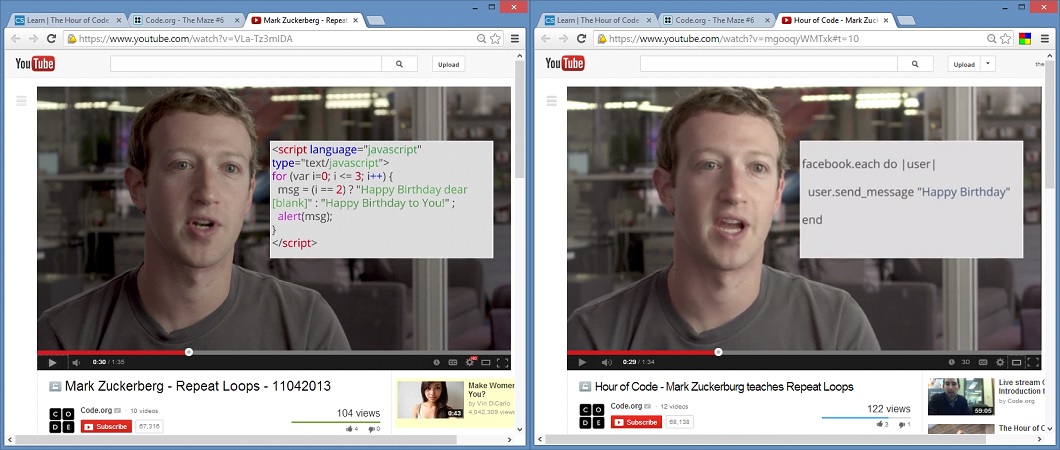
theodp writes: In What is Computer Science?, the kickoff video for Facebook's new TechPrep diversity initiative, FB product manager Adriel Frederick explains how he was hooked-on-coding after seeing the magic of a BASIC PRINT statement. His simple BASIC example is a nice contrast to the more complicated JavaScript and Ruby examples that were chosen to illustrate Mark Zuckerberg's what-is-coding video for schoolkids. In How to Teach Your Baby to Read, the authors explain, "It is safe to say that in particular very young children can read, provided that, in the beginning, you make the print very big." So, is introducing coding to schoolkids with modern programming languages instead of something like BASIC (2006) or even (gasp!) spreadsheets (2002) the coding equivalent of "making the print too small" for a child to see and understand? -
Do Not Call 911! The Life and Death of an Amazon Warehouse Temp (huffingtonpost.com)
theodp writes: Earlier this week, Amazon sicced former White House Press Secretary Jay Carney on the NY Times and the ex-Amazon employees that were interviewed for the NYT's brutal August 2015 article about Amazon's white-collar workplace culture. So, one can hardly wait to see how Amazon and Carney will respond to The Life and Death of an Amazon Warehouse Temp, Dave Jamieson's epic new HuffPo piece on what the future of low-wage work really looks like. Jamieson tells the heartbreaking tale of Jeff Lockhart Jr., who through some workforce sleight-of-hand was working-at-Amazon-but-not-entitled-to-Amazon-benefits when he met his maker after he collapsed in aisle A-215 of Amazon's Chester, VA fulfillment center and laid unconscious beneath shelves stocked with Tupperware and heating pads.
Lockhart, whose white work badge distinguished him as a member of the Integrity Staffing Solutions temp worker caste as opposed to a blue-badged Amazon employee (Google yellow-badged its benefits-less temp workers), sadly left behind a wife and three kids, the oldest of which is legally blind. Jamieson writes, "Whoever found Jeff on the third floor apparently alerted Amcare, Amazon's in-house medical team, which is staffed with EMTs and other medical personnel. In the event of a health issue, Amazon instructs workers to notify security before calling emergency services. An employee brochure from a facility in Tennessee, obtained through a public records request, reads: 'In the event of a medical emergency, contact Security. Do Not call 911! Tell Security the nature of the medical emergency and location. Security and/or Amcare will provide emergency response.'" If you're pressed for reading time, Salon's Scott Timberg has a nice TL;DR recap. -
Marvel Tweaks Their Superhero Film Formula With Ant-Man
An anonymous reader writes: Over the past decade, Marvel has been rolling out superhero film after superhero film. They've found a successful formula, and each of the last half-dozen films has brought in over a half-billion dollars in ticket revenue. Today they added to the franchise with Ant-Man, based on a superhero who can shrink himself to the size of an ant (while maintaining normal strength), and control insects. But where the spate of Avengers-related movies only occasionally interjected humor into their world-preserving plots, Ant-Man focuses more on being funny and simply entertaining. Reviews are generally positive, but not overwhelmingly so — Rotten Tomatoes has it at 79%, with a 91% audience score while Metacritic has it at 64/100, with an 8.4/10 user score. The LA Times calls it "playful." Vox has good and bad to say about Ant-Man, but notes that its failings are very common to Marvel's other films. Salon says, "...in its medium-stupid and mismanaged fashion it's not so awful." Wired posted the obligatory physics of Ant-Man article, as did FiveThirtyEight. -
USAF Cuts Drone Flights As Stress Drives Off Operators
HughPickens.com writes: The NY Times reports that the U.S. is being forced to cut back on drone flights as America's drone operators are burning out. The Air Force is losing more drone pilots than they can train. "We're at an inflection point right now," says Col. James Cluff, the commander of the Air Force's 432nd Wing. Drone missions increased tenfold in the past decade, relentlessly pushing the operators in an effort to meet the insatiable demand for streaming video of insurgent activities in Iraq, Afghanistan and other war zones, including Somalia, Libya and now Syria. The biggest problem is that a significant number of the 1,200 pilots are completing their obligation to the Air Force and are opting to leave. Colonel Cluff says many feel "undermanned and overworked," sapped by alternating day and night shifts with little chance for academic breaks or promotion.
What had seemed to be a benefit of the job, the novel way the crews could fly Predator and Reaper drones via satellite links while living safely in the United States with their families, has created new types of stresses as they constantly shift back and forth between war and family activities and become, in effect, perpetually deployed. "Having our folks make that mental shift every day, driving into the gate and thinking, 'All right, I've got my war face on, and I'm going to the fight,' and then driving out of the gate and stopping at Walmart to pick up a carton of milk or going to the soccer game on the way home — and the fact that you can't talk about most of what you do at home — all those stressors together are what is putting pressure on the family, putting pressure on the airman," says Cruff. The colonel says the stress on the operators belied a complaint by some critics that flying drones was like playing a video game or that pressing the missile fire button 7,000 miles from the battlefield made it psychologically easier for them to kill. "Everyone else thinks that the whole program or the people behind it are a joke," says Brandon Bryant, a former drone camera operator who worked at Nellis Air Force Base, "that we are video-game warriors, that we're Nintendo warriors." -
Should Disney Require Its Employees To Be Vaccinated?
HughPickens.com writes According to Joanna Rothkopf Disneyland is already a huge petri dish of disease with tired children wiping their snot faces on Goofy and then riding log flumes through mechanized rivers filled with the backwash of thousands of other sweaty, unwashed, weeping toddlers. Now John Tozzi reports at Businessweek that five workers at Disneyland have been diagnosed with measles in an outbreak that California officials trace to visitors at the theme park in mid-December. The measles outbreak is a publicity nightmare for Disney and the company is urging its 27,000 workers at the park to verify that they're inoculated against the virus, and the company is offering tests and shots on site for workers who are unvaccinated. One thing Disney won't do, however, is require workers to get routine vaccinations as a condition of employment. Almost no companies outside the health-care industry do. "To make things mandatory just raises a lot of legal concerns and legal issues," says Rob Niccolini. Disney has been working with public health officials, and they've already put some employees on paid leave until medically cleared. "They recognized that they were just a meeting place for measles," says Gilberto Chávez. "And they are quite concerned about doing what they can to help control the outbreak." -
WHO Timeline for Ebola Containment Proves Hard To Meet
The Associated Press, as carried by Salon, reports that the World Health Organization's intended timeline for limiting the spread of Ebola in the several West African countries where it has claimed thousands of lives has proved to be too optimistic. According to the article, Two months ago, the World Health Organization launched an ambitious plan to stop the deadly Ebola outbreak in West Africa, aiming to isolate 70 percent of the sick and safely Ebola 70 percent of the victims in the three hardest-hit countries — Guinea, Liberia and Sierra Leone — by December 1. Only Guinea is on track to meet the December 1 goal, according to an update from WHO. In Liberia, only 23 percent of cases are isolated and 26 percent of the needed burial teams are in place. In Sierra Leone, about 40 percent of cases are isolated while 27 percent of burial teams are operational. -
Smart Meters and New IoT Devices Cause Serious Concern
dkatana writes: The ongoing deployment of internet-of-things devices is already creating serious issues and discussions about the privacy of users, IoT security, and the potential threat of cyber criminals taking control of sensors and smart devices connected to the Internet.
Security and privacy concerns associated with smart meters are why they are currently "optional" in several countries. That's the case in the Netherlands after consumer organizations and privacy watchdog groups campaigned vigorously to stop the mandatory smart meter deployment. A report from researchers at Tilburg University claimed that "smart meters have the capacity to reveal quite privacy-sensitive information, thus affecting not only informational privacy but also privacy of the home and of family life." This now applies to televisions as well — an article in Salon discusses the author's new "smart" TV, which came with a 46-page privacy policy. Quoting: "It logs where, when, how and for how long you use the TV. It sets tracking cookies and beacons designed to detect 'when you have viewed particular content or a particular email message.' It records 'the apps you use, the websites you visit, and how you interact with content.' It ignores 'do-not-track' requests as a considered matter of policy. It also has a built-in camera — with facial recognition." -
Farmers Carry Multidrug-Resistant Staph For Weeks Into Local Communities
An anonymous reader writes: Fresh research out of the UNC Gillings and JHU Bloomberg schools of public health shows industrial farm workers are carrying livestock-associated, multidrug-resistant staph into local communities for weeks at a time. "Among the [22 people tested], 10 workers carried antibiotic-resistant strains of the bacteria in their noses for up to four days. Another six workers were intermittent carriers of the bacteria. The 10 workers found to carry the bacteria persistently had strains associated with livestock that were resistant to multiple drugs, and one also carried MRSA. Three more of the workers tested positive for strains of S. aureus that were not resistant to antibiotics. So in total, 86 percent of the workers in the study carried the S. aureus bacteria, compared with about one-third of the population at large, according to the Centers for Disease Control and Prevention." This problem has grown since its last mention on Slashdot. Unfortunately, massive industrial lobbying continues to neuter government action. -
Game of Thrones Author George R R Martin Writes with WordStar on DOS
Hugh Pickens DOT Com writes: "Ryan Reed reports that when most Game of Thrones fans imagine George R.R. Martin writing his epic fantasy novels, they probably picture the author working on a futuristic desktop (or possibly carving his words onto massive stones like the Ten Commandments). But the truth is that Martin works on an outdated DOS machine using '80s word processor WordStar 4.0, as he revealed during an interview on Conan. 'I actually like it,' says Martin. 'It does everything I want a word processing program to do, and it doesn't do anything else. I don't want any help. I hate some of these modern systems where you type a lower case letter and it becomes a capital letter. I don't want a capital. If I wanted a capital, I would have typed a capital. I know how to work the shift key.' 'I actually have two computers,' Martin continued. 'I have a computer I browse the Internet with and I get my email on, and I do my taxes on. And then I have my writing computer, which is a DOS machine, not connected to the Internet.'" -
Google and Facebook: Unelected Superpowers?
theodp (442580) writes "'The government is not the only American power whose motivations need to be rigourously examined,' writes The Telegraph's Katherine Rushton. 'Some 2,400 miles away from Washington, in Silicon Valley, Google is aggressively gaining power with little to keep it in check. It has cosied up to governments around the world so effectively that its chairman, Eric Schmidt, is a White House advisor. In Britain, its executives meet with ministers more than almost any other corporation. Google can't be blamed for this: one of its jobs is to lobby for laws that benefit its shareholders, but it is up to governments to push back. As things stand, Google — and to a lesser extent, Facebook — are in danger of becoming the architects of the law.' Schmidt, by the way, is apparently interested in influencing at least two current hot-button White House issues. Joined by execs from Apple, Oracle, and Facebook, the Google Chairman asserted in a March letter to Secretary of State John Kerry that the proposed Keystone XL pipeline is not in the economic interests of the U.S.; the Obama administration on Friday extended the review period on the pipeline, perhaps until after the Nov. 4 congressional elections. And as a 'Major Contributor' to Mark Zuckerberg's FWD.us PAC, Schmidt is also helping to shape public opinion on the White House's call for immigration reform; FWD.us just launched new attack ads (videos) and a petition aimed at immigration reform opponent Rep. Steve King. In Dave Eggers' The Circle, politicians who impede the company execs' agenda are immediately brought down. But that's fiction, right?" -
Exxon Mobile CEO Sues To Stop Fracking Near His Texas Ranch
Hugh Pickens DOT Com writes "Exxon Mobile's CEO Rex Tillerson's day job is to do all he can to protect and nurture the process of hydraulic fracturing—aka 'fracking'—so that his company can continue to rake in billions via the production and sale of natural gas. 'This type of dysfunctional regulation is holding back the American economic recovery, growth, and global competitiveness,' said Tillerson in 2012 of attempts to increase oversight of drilling operations. But now Rick Unger reports at Forbes that Tillerson has joined a lawsuit seeking to shut down a fracking project near his Texas ranch. Why? Because the 160 foot water tower being built next to Tillerson's house that will supply the water to the near-by fracking site, means the arrival of loud trucks, an ugly tower next door, and the general unpleasantness that will interfere with the quality of his life and the real estate value of his sizeable ranch. The water tower is being built by Cross Timbers Water Supply Corp., a nonprofit utility that has supplied water to the region for half a century. Cross Timbers says that it is required by state law to build enough capacity to serve growing demand. In 2011, Bartonville denied Cross Timbers a permit to build the water tower, saying the location was reserved for residences. The water company sued, arguing that it is exempt from municipal zoning because of its status as a public utility. In May 2012, a state district court judge agreed with Cross Timbers and compelled the town to issue a permit. The utility resumed construction as the town appealed the decision. Later that year, the Tillersons and their co-plaintiffs sued Cross Timbers, saying that the company had promised them it wouldn't build a tower near their properties. An Exxon spokesman said Tillerson declined to comment. The company 'has no involvement in the legal matter' and its directors weren't told of Mr. Tillerson's participation, the spokesman said." -
Celebrating Dungeons & Dragons' 40th Anniversary
disconj writes "With the 40th anniversary of the release of Dungeons & Dragons coming up this weekend, the Internet is ablaze with reflections on its legacy. Dave Ewalt gives an intro for the uninitiated. Ethan Gilsdorf explains how 'all I need to know about life I learned from Dungeons & Dragons'. Finally, Jon Peterson presents a video show-and-tell of rare artifacts from D&D's development." The real question is how many characters have you lost in Tomb of Horrors? -
How Good Are Charter Schools For the Public School System?
theodp writes "'You go to these charters,' gushed Bill Gates in 2010, 'and you sit and talk to these kids about how engaged they are with adults and how much they read and what they think about and how they do projects together.' Four years later, Gates is tapping his Foundation to bring charter schools to Washington State, doling out grants that included $4.25 million for HP CEO Meg Whitman's Summit Public Schools. So what's not to like? Plenty, according to Salon's The Truth About Charter Schools, in which Jeff Bryant delves into the dark side of the charter movement, including allegations of abuse, corruption, lousy instruction, and worse results. Also troubling Bryant is that the children of the charter world's biggest cheerleaders seem never to attend these schools ('A family like mine should not use up the inner-city capacity of these great schools,' was Bill Gates' excuse). Bryant also cites Rethinking Schools' Stan Karp, who argues that Charter Schools Are Undermining the Future of Public Education, functioning more like deregulated 'enterprise zones' than models of reform, providing subsidized spaces for a few at the expense of the many. 'Our country has already had more than enough experience with separate and unequal school systems,' Karp writes. 'The counterfeit claim that charter privatization is part of a new 'civil rights movement', addressing the deep and historic inequality that surrounds our schools, is belied by the real impact of rapid charter growth in cities across the country. At the level of state and federal education policy, charters are providing a reform cover for eroding the public school system and an investment opportunity for those who see education as a business rather than a fundamental institution of democratic civic life. It's time to put the brakes on charter expansion and refocus public policy on providing excellent public schools for all.'" -
How Chris Christie Could Use the NSA Playbook
Hugh Pickens DOT Com writes "Conor Friedersdorf has written a tongue-in-cheek article in The Atlantic advising New Jersey Governor Chris Christie how he can use the NSA playbook to successfully defend himself of the charges that a senior member of his staff was involved in shutting down George Washington Bridge traffic, a stunt meant to punish the mayor of an affected town for opposing his reelection. Christie's NSA-inspired explanation would include the following points: There are almost 9 million people in New Jersey, and only one was targeted for retribution, an impressively tiny error rate lower than .001 percent; The bridge closure was vital to national security because [redacted]; Since the George Washington Bridge is a potential terrorist target, everything that may or may not have happened near it is a state secret; Going after a political rival is wrong but it's important to put this event in context; Fort Lee Mayor Mark Sokolich was the only target of non-compliant behavior. No other Fort Lee resident was ever targeted for retribution, and any delays that any Fort Lee resident experienced were totally inadvertent and incidental; Finally a panel will be formed to figure out how to restore the public's faith in Chris Christie. "To some readers, these talking points may seem absurd or deliberately misleading," concludes Friedersdorf, "but there isn't any denying that so far they're working okay for the NSA."" -
The Internet's Network Efficiencies Are Destroying the Middle Class
Hugh Pickens DOT Com writes "Joe Nocera writes in an op-ed piece in the NYT that the same network efficiencies that have given companies their great advantages are becoming the instrument of our ruin. In the financial services industry, it led to the financial crisis. In the case of a company like Wal-Mart, the adoption of technology to manage its supply chain at first reaped great benefits, but over time it cost competitors and suppliers hundreds of thousands of jobs, thus gradually impoverishing its own customer base. Jaron Lanier says that the digital economy has done as much as any single thing to hollow out the middle class. Take Kodak and Instagram. At its height, 'Kodak employed more than 140,000 people.' Kodak made plenty of mistakes, but look at what is replacing it: 'When Instagram was sold to Facebook for a billion dollars in 2012, it employed only 13 people.' Networks need a great number of people to participate in them to generate significant value says Lanier but when they have them, only a small number of people get paid. This has the net effect of centralizing wealth and limiting overall economic growth. It is Lanier's radical idea that people should get paid whenever their information is used. He envisions a different kind of digital economy, in which creators of content — whether a blog post or a Facebook photograph — would receive micropayments whenever that content was used. 'If Google and Facebook were smart,' says Lanier, 'they would want to enrich their own customers.' So far, he adds, Silicon Valley has made 'the stupid choice' — to grow their businesses at the expense of their own customers. Lanier's message is that it can't last. And it won't." The micropayments for content idea sounds familiar. -
The Internet's Network Efficiencies Are Destroying the Middle Class
Hugh Pickens DOT Com writes "Joe Nocera writes in an op-ed piece in the NYT that the same network efficiencies that have given companies their great advantages are becoming the instrument of our ruin. In the financial services industry, it led to the financial crisis. In the case of a company like Wal-Mart, the adoption of technology to manage its supply chain at first reaped great benefits, but over time it cost competitors and suppliers hundreds of thousands of jobs, thus gradually impoverishing its own customer base. Jaron Lanier says that the digital economy has done as much as any single thing to hollow out the middle class. Take Kodak and Instagram. At its height, 'Kodak employed more than 140,000 people.' Kodak made plenty of mistakes, but look at what is replacing it: 'When Instagram was sold to Facebook for a billion dollars in 2012, it employed only 13 people.' Networks need a great number of people to participate in them to generate significant value says Lanier but when they have them, only a small number of people get paid. This has the net effect of centralizing wealth and limiting overall economic growth. It is Lanier's radical idea that people should get paid whenever their information is used. He envisions a different kind of digital economy, in which creators of content — whether a blog post or a Facebook photograph — would receive micropayments whenever that content was used. 'If Google and Facebook were smart,' says Lanier, 'they would want to enrich their own customers.' So far, he adds, Silicon Valley has made 'the stupid choice' — to grow their businesses at the expense of their own customers. Lanier's message is that it can't last. And it won't." The micropayments for content idea sounds familiar. -
US Issues 30-Year Eagle-Killing Permits To Wind Industry
Hugh Pickens DOT Com writes "Lindsay Abrams reports at Salon that the Obama administration is offering wind farms 30 years of leeway to kill and harm bald and golden eagles. The new regulations, which were requested by the wind industry, will provide companies that seek a permit with legal protection, preventing them from having to pay penalties for eagle deaths (PDF). An investigation by the Associated Press earlier this year documented the illegal killing of eagles around wind farms, the Obama administration's reluctance to prosecute such cases and its willingness to help keep the scope of the eagle deaths secret. President Obama has championed the pollution-free energy, nearly doubling America's wind power in his first term as a way to tackle global warming. Scientists say wind farms in 10 states have killed at least 85 eagles since 1997, with most deaths occurring between 2008 and 2012, as the industry was greatly expanding. Most deaths — 79 — were golden eagles that struck wind turbines. However the scientists said their figure is likely to be 'substantially' underestimated, since companies report eagle deaths voluntarily and only a fraction of those included in their total were discovered during searches for dead birds by wind-energy companies. The National Audubon Society said it would challenge the decision." -
Nebraska Scientists Refuse To Carry Out Climate Change-Denying Study
Lasrick writes "Nebraska researchers say they refuse to be used as political pawns: 'The problem, according to members of the governor-appointed Climate Assessment and Response Committee, is that the bill behind the study specifically calls for the researchers to look at 'cyclical' climate change. In so doing, it completely leaves out human contributions to global warming.'" -
Activist Admits To Bugging US Senate Minority Leader
cold fjord writes "Curtis Morrison, co-founder of the Progress Kentucky PAC, which had previous issued an apology over a racially charged tweet about Senator McConnell's wife (former Secretary of Labor, Elaine Chao), has admitted to bugging Senator McConnell. Morrison admitted he was behind the recording and said a grand jury is investigating the situation. "[Assistant] U.S. attorney, Bryan Calhoun, telephoned my attorney yesterday, asking to meet with him next Friday as charges against me are being presented to a grand jury," Morrison wrote on Salon. Morrison writes that after releasing the recording, his personal life took a negative turn. 'I've never doubted that making the recording was ethical.' He also says that he doesn't believe his actions were illegal, but admits he could be prosecuted for them."' Morrison has said that one of his inspirations was Julian Assange. Given the current direction of government activity, he may simply have been trying to build a suitable resume for future federal employment." -
Jeremy Hammond of LulzSec Pleads Guilty To Stratfor Attack
eldavojohn writes "After facing 30 years to life imprisonment and pleading not guilty to charges last year, Jeremy Hammond has pleaded guilty to his alleged involvement in Anonymous' hacking of Stratfor. The self proclaimed hacktivist member of LulzSec, who has compared his situation to that of the late Aaron Swartz, explained his reasoning in his plea: 'Today I pleaded guilty to one count of violating the Computer Fraud and Abuse Act. This was a very difficult decision. I hope this statement will explain my reasoning. I believe in the power of the truth. In keeping with that, I do not want to hide what I did or to shy away from my actions. This non-cooperating plea agreement frees me to tell the world what I did and why, without exposing any tactics or information to the government and without jeopardizing the lives and well-being of other activists on and offline. During the past 15 months I have been relatively quiet about the specifics of my case as I worked with my lawyers to review the discovery and figure out the best legal strategy. There were numerous problems with the government's case, including the credibility of FBI informant Hector Monsegur. However, because prosecutors stacked the charges with inflated damages figures, I was looking at a sentencing guideline range of over 30 years if I lost at trial. I have wonderful lawyers and an amazing community of people on the outside who support me. None of that changes the fact that I was likely to lose at trial. But, even if I was found not guilty at trial, the government claimed that there were eight other outstanding indictments against me from jurisdictions scattered throughout the country. If I had won this trial I would likely have been shipped across the country to face new but similar charges in a different district. The process might have repeated indefinitely. ... I did what I believe is right.'" -
IRS Can Read Your Email Without Warrant
kodiaktau writes "The ACLU has issued a FOIA request to determine whether the IRS gets warrants before reading taxpayers' email. The request is based on the antiquated Electronic Communication Protection Act — federal agencies can and do request and read email that is over 180 days old. The IRS response can be found at the ACLU's website. The IRS asserts that it can and will continue to make warrantless requests to ISPs to track down tax evasion. Quoting: 'The documents the ACLU obtained make clear that, before Warshak, it was the policy of the IRS to read people’s email without getting a warrant. Not only that, but the IRS believed that the Fourth Amendment did not apply to email at all. A 2009 "Search Warrant Handbook" from the IRS Criminal Tax Division’s Office of Chief Counsel baldly asserts that "the Fourth Amendment does not protect communications held in electronic storage, such as email messages stored on a server, because internet users do not have a reasonable expectation of privacy in such communications." Again in 2010, a presentation by the IRS Office of Chief Counsel asserts that the "4th Amendment Does Not Protect Emails Stored on Server" and there is "No Privacy Expectation" in those emails.'" -
Does Scientific Literacy Make People More Ethical?
New submitter alysion writes "Per research published in the online journal PLOS One, psychologists Christine Ma-Kellams of Harvard University and Jim Blascovich of the University of California, Santa Barbara report, 'Thinking about science leads individuals to endorse more stringent moral norms.' In one of the four supporting experiments, undergraduates considered an account of a date rape and were asked to judge behavior on a scale of 1 to 100. Science types, perhaps not surprisingly, proved to have a better grasp of reality, including the moral kind." -
Will Legitimacy Spoil Bitcoin?
New submitter F9rDT3ZE writes "Salon writer Andrew Leonard examines the U.S. Treasury's Financial Crimes Enforcement Network's (FinCEN) first 'guidance' regarding 'de-centralized virtual currencies,' noting that Bitcoin's supporters call it a 'currency of resistance,' while others suggest that 'the more popular Bitcoin gets, whether as a symbol of resistance or a perceived safe haven in financially troubled times, the more government attention it will inevitably draw, and the more inexorably it will be sucked into existing regulatory structures.'" -
Could Twitter Have Stopped the Media's Rush To War In Iraq Ten Years Ago?
Hugh Pickens writes "On the tenth anniversary of the U.S. invasion of Iraq, Eric Boehlert writes that if Twitter had been around during the winter of 2002-2003, it could have provided a forum for critics to badger Beltway media insiders who abdicated their role as journalists and fell in line behind the Bush White House's march to war. 'Twitter could have helped puncture the Beltway media bubble by providing news consumers with direct access to confront journalists during the run-up to the war,' writes Boehlert. 'And the pass-around nature of Twitter could have rescued forgotten or buried news stories and commentaries that ran against the let's-go-to-war narrative that engulfed so much of the mainstream press.' For example, imagine how Twitter could have been used in real time on February 5, 2003, when Secretary of State Colin Powell made his infamous attack-Iraq presentation to the United Nations. At the time, Beltway pundits positively swooned over Powell's air-tight case for war. 'But Twitter could have swarmed journalists with instant analysis about the obvious shortcoming. That kind of accurate, instant analysis of Powell's presentation was posted on blogs but ignored by a mainstream media enthralled by the White House's march to war.' Ten years ago, Twitter could have also performed the task of making sure news stories that raised doubts about the war didn't fall through the cracks, as invariably happened back then. With swarms of users touting the reports, it would have been much more difficult for reporters and pundits to dismiss important events and findings. 'Ignoring Twitter, and specifically ignoring what people are saying about your work on Twitter, isn't really an option the way turning a blind eye to anti-war bloggers may have been ten years ago,' concludes Boehlert. 'In other words, Twitter could have been the megaphone — the media equalizer — that war critics lacked ten years ago." -
Supreme Court Upholds First Sale Doctrine
langelgjm writes "In a closely-watched case, the U.S. Supreme Court today vindicated the first-sale doctrine, declaring that it "applies to copies of a copyrighted work lawfully made abroad." The case involved a Thai graduate student in the U.S. who sold cheap foreign versions of textbooks on eBay without the publisher's permission. The 6-3 decision has important implications for goods sold online and in discount stores. Justice Stephen Breyer said in his opinion (PDF) that the publisher lost any ability to control what happens to its books after their first sale abroad." -
The Accidental Betrayal of Aaron Swartz
theodp writes "The anarchist dictum when it comes to grand juries, explains Salon's Natasha Lennard, is a simple one: 'No one talks, everyone walks.' It's a lesson journalist Quinn Norton tragically learned only after federal prosecutors got her to inadvertently help incriminate Aaron Swartz, her dearest friend and then-lover. Convinced she knew nothing that could be used against Swartz, Norton at first cooperated with the prosecutors. But prosecutors are pro fishermen — they cast wide nets. And in a moment Norton describes as 'profoundly foolish,' she told the grand jury that Swartz had co-authored a blog post advocating for open data (the Guerrilla Open Access Manifesto), which prosecutors latched onto and spun into evidence that the technologist had 'malicious intent in downloading documents on a massive scale.' Norton sadly writes, 'It is important the people know that the prosecutors manipulated me and used my love against Aaron without me understanding what they were doing. This is their normal. They would do this to anyone. We should understand that any alleged crime can become life-ruining if it catches their eyes.' Consider yourself forewarned." -
Is the Concept of 'Cyberspace' Stupid?
frank_adrian314159 writes "In an article titled 'Stop Pretending Cyberspace Exists,' Salon writer Michael Lind notes that 'Some ideas make you dumber the moment you learn of them. One of those ideas is the concept of "cyberspace."' He says that analogizing cyberspace as a real place leads to an inability to think logically about laws, rules, and how and when the governments could or should intervene to regulate the Internet. He states that such a debate is essential, but that an '[invasion of] a mythical Oz-like kingdom called cyberspace is just as dopey' when talking about governments and corporations taking a larger role in online communications. Is Lind right? Does the notion of cyberspace make the debate over its governance less fruitful?" -
Are Programmers Responsible For the Actions of Their Clients?
Bobfrankly1 writes "Robert Stuart and his company Extensions Software are being charged by New York authorities, claiming he is promoting gambling in New York because of the actions of his clients. They are charging him after he rejected a plea agreement that would have him plead guilty to lesser charges, adding backdoors to his software, and using said backdoors to gather details on his clients and their customers." Another article on the case at Salon. -
The New School Nurse Is Nurse Ratched
theodp writes "In Ken Kesey's 1962 novel One Flew Over the Cuckoo's Nest, Nurse Ratched maintained order in the mental institution by dispensing antipsychotic and anticonvulsant drugs to the patients. Fifty years later, the NY Times reports that some physicians are prescribing stimulants to struggling students in schools starved of extra money, not to treat ADHD, necessarily, but to boost their academic performance. 'We as a society have been unwilling to invest in very effective nonpharmaceutical interventions for these children and their families,' said Dr. Ramesh Raghavan, an expert in prescription drug use among low-income children. 'We are effectively forcing local community psychiatrists to use the only tool at their disposal, which is psychotropic medications.'" -
Art School's Expensive Art History Textbook Contains No Actual Art
Dr Herbert West writes "Students at Ontario College of Art and Design were forced to buy a $180 textbook filled with blank squares. Instead of images of paintings and sculpture throughout history (that presumably would fall under fair-use) the textbook for 'Global Visual and Material Culture: Prehistory to 1800' features placeholders with a link to an online image. A letter from the school's dean stated that had they decided to clear all the images for copyright to print, the book would have cost a whopping $800. The screengrabs are pretty hilarious, or depressing, depending on your point of view." -
Hackers Hack Handcuffs at H.O.P.E. (Video)
Have you ever been handcuffed and wish you weren't? Even if you haven't, what if you plan to demonstrate at a political party convention in the next couple of weeks? Either way, you need to watch this video, shot by Timothy Lord and unknown_lamer at H.O.P.E. (Hackers on Planet Earth), which will teach you the rudiments of unhandcuffing yourself -- but on purpose leaves out the fine points. For those, you'll need to buy several pairs of handcuffs and practice on your own. At worst, you will probably embarrass yourself no more than Timothy does as he tries to shimmy his handcuffed hands from behind him to in front of him, starting at about 5:18. -
Icelandic MP Claims US Vendetta Against WikiLeaks
Stirling Newberry writes "Icelandic MP Birgitta Jónsdóttir details more of the evidence for what she calls a 'judicial vendetta' against WikiLeaks and its volunteers, including attempts to gain access to her Twitter account. Her efforts to block the National Defense Authorization Act were discussed here previously. The story was taken up last year by Glenn Greenwald and Wired. As a result, the International Parliamentarian Union adopted a resolution on her case. What's new? She asserts that there is a grand jury investigation into WikiLeaks and related organizations, and is calling on Sweden to provide assurances that WikiLeaks founder Julian Assange not be re-extradited to the U.S. She says, 'There is no doubt that the U.S. wants to get even with WikiLeaks.'" -
Aviation Security Debate: Bruce Schneier V. Kip Hawley (Former TSA Boss)
Fluffeh writes "A nice summary at TechDirt brings word that Bruce Schneier has been debating Kip Hawley, former boss of the TSA, over at the Economist. Bruce has been providing facts, analysis and some amazing statistics throughout the debate, and it makes for very educational reading. Because of the format, the former TSA administrator is compelled to respond. Quoting: 'He wants us to trust that a 400-ml bottle of liquid is dangerous, but transferring it to four 100-ml bottles magically makes it safe. He wants us to trust that the butter knives given to first-class passengers are nevertheless too dangerous to be taken through a security checkpoint. He wants us to trust that there's a reason to confiscate a cupcake (Las Vegas), a 3-inch plastic toy gun (London Gatwick), a purse with an embroidered gun on it (Norfolk, VA), a T-shirt with a picture of a gun on it (London Heathrow) and a plastic lightsaber that's really a flashlight with a long cone on top (Dallas/Fort Worth).""