Slashdot Mirror
Domain: scienceblogs.com
Stories and comments across the archive that link to scienceblogs.com.
Comments · 763
-
Apples and oranges
Over 35,000 people die in the US from the flu every year. Hundreds, if not thousands, of children die from the flu every year.
The 35K/year number is excess deaths due to influenza, and is derived by fancy statistics from the time series of deaths in medical categories (i.e. gunshot wounds don't get figured in.) You can read more on how difficult this process is at Effect Measure.
The "number of children" statistic, on the other hand, is confirmed 2009 H1N1 novel influenza diagnoses on the death certificate. No inference required, they are kids with confirmed infections which led directly to their deaths.
Both statements are true, in context. Please be a little less generous with the F-word.
-
Re:Turn the tables
If you were railing against divorce and philandering in defense of the sanctity of marriage, I would have a much easier time listening to your anti-gay rhetoric, but since the only time the "sanctity" of marriage comes up is with regards to homosexuality, I have a hard time respecting that argument. (Here's looking at you, Rush, the three time divorcee, for single handedly making this argument for me.)
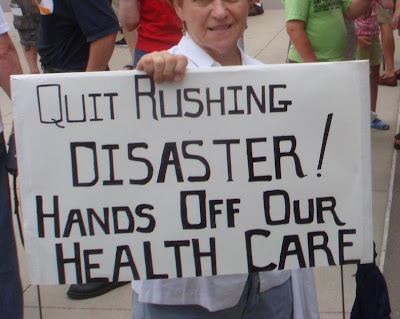
I have to point to this protester: http://scienceblogs.com/dispatches/2009/10/badass_sign_of_the_day.php
-
Yes, that Lenski
This is the same Richard Lenski whom Conservapedia (the right-wing Christian alternative to Wikipedia because Wikipedia is evil) repeatedly attacked. Apparently his work is such strong evidence of evolution, that Conservapedia's response was to more or less accuse him of faking the data. See http://scienceblogs.com/pharyngula/2008/06/lenski_gives_conservapdia_a_le.php.
-
Re:CO2 cutbacks cannot stop climate change
-
He's not a fucking troll
I say this as an American: we've become barbarians. We torture people. We incarcerate more people, both in absolute terms and on a per capita basis, than any other nation in the world, and think it's okay to gang-rape 1% of our population. Our wealth is distributed like that of a banana republic. We're stupid, vapid, and like a feral child, we snarl and bite when someone tries to help us. America really is the sick man of the world, and personally, I'm about ready to give up and pronounce the disease incurable. We can argue about causes and solutions, but you can't deny that we're in a steep decline. As George Orwell write,
We are all capable of believing things which we know to be untrue, and then, when we are finally proved wrong, impudently twisting the facts so as to show that we were right. Intellectually, it is possible to carry on this process for an indefinite time: the only check on it is that sooner or later a false belief bumps up against solid reality, usually on a battlefield.
-
Better picture
This article has a picture that shows the location of the fractal globule.
-
Re:Some journalists check their facts, others don'
I just checked http://scienceblogs.com/ and picked a story in a field that I follow. I will be forever grateful to Ed Yong for comparing wrapped DNA to dried raman noodles http://scienceblogs.com/notrocketscience/2009/10/what_is_the_difference_between_the_human_genome_and_a_pair_of.php?utm_source=sbhomepage&utm_medium=link&utm_content=channellink
However, Yong is a science writer and journalist, not a scientist. He writes for New Scientist and Nature. He got his story by interviewing the Harvard researcher (rather than from the BBC report). My point is, that's what bloggers, journalists, reporters, anybody should do if they want to produce useful science information.
There's a process in science for finding the truth (which is a good model of the process of finding the truth in other disciplines). The process is not to get a really smart guy who can tell you the truth. The process (as Feynmann described it) is to take an idea, examine it skeptically, have people from diverse viewpoints challenge it, and see how well the idea holds up. Science journalism follows and facilitates that process. It doesn't matter to me whether you do it on a blog, a daily metropolitan newspaper, or the news section of Nature.
People who don't understand and don't follow this process are not going to write useful blogs.
To return to my original point, if you want to contribute information to the Internet rather than noise, one of the important steps is to check your facts. It sounds trivial but many bloggers (like TFA for this Slashdot story) don't understand this.
-
Re:Some journalists check their facts, others don'
I just checked http://scienceblogs.com/ and picked a story in a field that I follow. I will be forever grateful to Ed Yong for comparing wrapped DNA to dried raman noodles http://scienceblogs.com/notrocketscience/2009/10/what_is_the_difference_between_the_human_genome_and_a_pair_of.php?utm_source=sbhomepage&utm_medium=link&utm_content=channellink
However, Yong is a science writer and journalist, not a scientist. He writes for New Scientist and Nature. He got his story by interviewing the Harvard researcher (rather than from the BBC report). My point is, that's what bloggers, journalists, reporters, anybody should do if they want to produce useful science information.
There's a process in science for finding the truth (which is a good model of the process of finding the truth in other disciplines). The process is not to get a really smart guy who can tell you the truth. The process (as Feynmann described it) is to take an idea, examine it skeptically, have people from diverse viewpoints challenge it, and see how well the idea holds up. Science journalism follows and facilitates that process. It doesn't matter to me whether you do it on a blog, a daily metropolitan newspaper, or the news section of Nature.
People who don't understand and don't follow this process are not going to write useful blogs.
To return to my original point, if you want to contribute information to the Internet rather than noise, one of the important steps is to check your facts. It sounds trivial but many bloggers (like TFA for this Slashdot story) don't understand this.
-
Re:Some journalists check their facts, others don'
What you fail to grasp is that bloggers aren't mere journalists, they very often are experts in a particular field - ScienceBlogs being a good example
I thought I pointed that out. I gave the examples of Juan Cole and Glen Greenwald.
Blogs by experts are fine. I'm just defining the role of a journalist -- someone who isn't necessarily an expert on the subject at hand but knows how to round up experts.
Doctor A is an expert who believes in treating a disease with surgery. Doctor B is an expert who believes in treating a disease with medication. My job as a journalist is to get Dr. A to explain why he believes in surgery, get Dr. B. to explain why he believes in medication, and get each of them to explain why they disagree with the other guy. In my story I can wind up with a broader perspective than you might get from a blog by Dr. A or Dr. B.
Take prostate cancer. Some doctors believe you should operate routinely (which leaves the patient impotent about half the time). Other doctors (especially in Europe) believe it's rational to do without surgery in a large percentage of cases. I've written a lot of stories lining up the arguments for both positions and trying to lay it out in a way that helps you figure out who's right.
If a blogger is going to give the arguments on all sides, then he's doing what a journalist does (or a good scientist), and more power to him. Conversely, the journalists in the news sections of journals like Science, Nature, etc. usually have some expertise of their own. Some of the journalists who write for the New York Times have MDs or PhDs.
-
Re:Some journalists check their facts, others don'
What you fail to grasp is that bloggers aren't mere journalists, they very often are experts in a particular field - ScienceBlogs being a good example, but just one of many - and they can tell where and how the blessed New York Times got it wrong (which is pretty much always, on any subject of even moderate complexity) without having to call anyone.
They are your fact checkers.
-
Re:Science
Vestigial != useless. A vestigial organ is an organ that has lost most of its original function. In animals with a fully developed appendix (though it's not an appendix at that point, it's sort of the main event), the organ serves as something like a fermentation chamber where cellulose and other hard to digest plant matter is broken down by bacteria, producing nutrients for the animal.
It's still vestigial in humansm, even though evolution seems to have found some use for it - which, incidentally, is not really outweighed by the fact that it might explode and kill you. After all, your gut flora will be repopulated anyway from the food you eat, unless you only eat sterilized food.
Source: this Pharyngula post, reviewing the paper you're probably referring to.
-
Re:I see what they are trying to piece together, b
My understanding is that one gets a nice nested hierarchy if one looks at SNPs for the great apes and that we share the right spots. Similar remarks apply to CNVs. (This is simply recall from ev bio and genetics classes back in college with out any specific citations) I don't know as much about either of those as I do about ERVs. The main reason I know a bit about ERVs is Abbie Smith's eponymous blog http://scienceblogs.com/erv/. The Sanger Institute http://www.sanger.ac.uk/humgen/cnv/ has done a lot of work related to Copy Number Variation and so poking around their stuff might help but I think they've mainly focused just on variation between humans. So, um, yeah, I guess the short answer is I don't know.
-
Re:Speaking of idiots...
A good rebuttal is here: http://scienceblogs.com/builtonfacts/2009/09/wifi_and_radiation.php?
-
Re:What qualifies for new sensory organ?
What would be even more awesome would be if they chose to do it to themselves with the help of some Yoga classes and a mirror. That would make for one heck of a YouTube video.
I remember reading an account of self-trepanation, back when the Internet was young (1996 or so). Here's the wikipedia article: http://en.wikipedia.org/wiki/Trepanation ; there's a link to a more recent account of self-trepanation: http://scienceblogs.com/neurophilosophy/2008/08/lunch_with_heather_perry.php
What I really liked about the original one that I read was, the author said "I got the bone drill, shaved my head, and was a little nervous so TOOK A HIT OF ACID TO CALM MY NERVES."
I can't imagine drilling a hole in my head while tripping. That's
And, reading a little into the article, I see that acid played a role in Heather's self-trepanation as well. Freaking hippies.
-
Hitchcock could have used these things
Just think: Hitchcock's 'The Birds' could have been a really scary movie, if he had used giant birds instead of normal-sized examples.
http://scienceblogs.com/tetrapodzoology/thunderbirds%20are%20go.jpg -
The researchers who work with viruses disagree
A lot of the researchers who work with viruses consider them to be alive. See for example this piece by Abbie Smith explaining why viruses should be considered to be alive and why most of the arguments against are not convincing: http://scienceblogs.com/erv/2009/03/ten_five_reasons_clumsy_excuse.php. The people who argue that viruses aren't alive are almost inevitably non-biologists or biologists who don't work with viruses.
-
Re:Good Marketing
'I just got woken up by a guy with construction boots who needed to fix the walls outside my apartment window.'
Sorry about that - there was a problem with the monitoring system. Should be fixed now
'Did you read those two linked articles?'
Yes, Dr Mercola is one of our most valued assets, though there are still a few critics we need to silence:
http://scienceblogs.com/denialism/2008/03/more_flu_woo_from_mercola.php
-
Re:Spread the FUD
Isn't it just influenza?
Yes, but it's a new strain, so few people have antibodies. It's hitting young adults harder than the usual victims (elderly and babies). See http://scienceblogs.com/effectmeasure/2009/09/when_swine_flu_kills.php for a good discussion of why we should not take this lightly.
http://crofsblogs.typepad.com/h5n1/ Great flu blog
http://scienceblogs.com/effectmeasure/ Another flu blog.
-
Re:But what is the trial studying?
Placebo is a type of experimental control--would you agree with that statement?
While you make a good point that it is not the only type of control possible, it is the only type of control used in most clinical drug trials, which are the subject of the Wired article. Such trials rarely include a "no treatment" arm, as the author acknowledges in a separate comment.
Within the context of trials in which placebo is the only control, I do not see the problem with equating the terms.
To get back to your earlier statement, it seems to me that a placebo can only be measured as "strong" or "weak" if there is an additional control (no treatment for example) to make the measurement against. But according the Wired article, the drug companies are instead measuring "strong" or "weak" placebo effect against the performance of the drugs under study, which in my mind conflates experiment and control.
-
Re:WTF
You keep saying that word, I do not think it means what you think it means.
[Disclaimer: 1.74^H^H81 beers have passed my lips.]
What *is* the placebo effect but an indirect measure of the ability of someone to heal themselves when given suitable psychological support - like a child learning to swim whilst holding their parent's hands in the pool - little realising that the adult has released their hold.
Is it so far outside the box to believe that something might be affecting our subconscious' ability to coordinate bodily processes?
-
Re:Actual evidence
Ah, the standard emotional appeal response. Never mind that it doesn't even apply to what I said.
Your article? Are you actually the author? Steve Silberman?
First, you didn't "cite" anything. You mentioned that some studies might exist. Citing them requires providing the information so that the reader might check to make sure that is actually the case. I certainly don't see any citations.
I see nowhere in your article where you make any mention whatsoever of the placebo effect size increasing in chemotherapy patients or Parkinson's disease. You mention that the placebo effect has been shown to provide relief to chemo patients, but I didn't disagree with (or even mention that). Your mention of Parkinson's is in connection with development on a drug being stopped after a phase III trial because it did not show benefit over placebo. Again, that has nothing to do with the idea that the magnitude of the observed placebo effect is significantly greater now than it was before.
Which leaves us with depression. I notice you say major depression in your post. Here is a relevant bit from your article:
Two comprehensive analyses of antidepressant trials have uncovered a dramatic increase in placebo response since the 1980s. One estimated that the so-called effect size (a measure of statistical significance) in placebo groups had nearly doubled over that time.
Again, note that at no time did I suggest either of those trials might be wrong (how could I, since you didn't provide citations so I could go check their methodology). Rather the opposite, I suggested that the results aren't really surprising. I also note the absence of any mention of "major depression." Rather, these studies seem to have looked at antidepressant trials. Now, perhaps those trials were dominated by major depressives. Again, I can't check because you've failed to cite them properly. I find it unlikely though. While depression is certainly a real, serious medical condition, it is not a novel idea that many people (most, according to some sources) who are on antidepressants probably should not be, and likely aren't really suffering from clinical depression in the first place. [1][2] You point out yourself that drug companies aren't always as careful as they should be about recruiting subjects.
Okay, so supposing that you actually are clinically depressed and you're enrolled in an antidepressant trial. In order to measure any improvement we have to have some sort of metric. We have to at least assess your level of depression before and after the treatment. How do we do that? Here are the DSM IV criteria for major depressive disorder. I chose that source because it is publicly available. You can confirm it by looking at the DSM IV itself, of course. Note that many of the criteria are subjective. Some others might be reasonably objectively assessed by following the subject (without his knowledge) for two weeks or so. How likely is it that the drug trials your "cited" studies analyzed did this? I can't tell, of course, but I find it very plausible that much of the assessment could involve the subjects reporting how they feel.
Normally I try to give science journalists the benefit of the doubt. They have a tough job and for the most part they are not trained scientists, so mistakes and misunderstandings are bound to occur. However, your posts here have demonstrated your willingness to appeal to emotional statements, misrepresentations, strawmen, and other poor tactics.
Disclaimer: I am not a physician. I am an academic researcher involved with drug trial analysis. I see you've been panned by physicians as well though.
-
Re:WTF
You keep saying that word, I do not think it means what you think it means.
No, the guy who wrote that article is wrong. He is using "placebo" where he should be saying "control". A control is what you use to measure the difference between normality and the thing you are testing. In medicine, this may or may not involve a placebo (which means a "pleaser"). For example, I can give 1000 people my new drug, and put another 1000 people in a control group, with no drug. However, I may worry that some of the improvement in my patients is due to the psychological effect of popping a pill; I therefore may give the control group a fake pill to take, called a placebo. If I have enough funding, I may even have three groups: one with the real drug, one control group with the placebo, and one true control group with absolutely nothing. This will often produce three levels of improvement.
A control cannot be described as strong or weak, but a placebo given as part of a control certainly can be. Although it is something designed to have no real effect, the fact is that every aspect of the treatment situation (the colour of the pills, frequency of treatment, the crispness of the white coats...) alters the strength of the pleasing effect, which can have major consequences for health and well-being.
-
Re:WTF
You keep saying that word, I do not think it means what you think it means.
There are plenty of other reasons for this to be occurring. Better testing procedures among them.
Perhaps the real reason efficacy of trial drugs has declined is Big Pharma is trying to treat conditions that aren't actual problems? "Over-active bladder syndrome" comes to mind immediately -- stop drinking caffeine, only drink water when you're thirsty, problem solved.
As the above URL observes:
"Failure is inevitable. It's how science works. If the CEOs don't like it, they have to either make up the data, or find a new business model."I think the CEOs have done exactly that. It's pronounced "advertise directly to the US public."
-
Re:WTF
I'm the author of the Wired article, and I would encourage people to read the article itself before taking Peter's post on Science-Based Medicine as the final word on the subject. Peter's blog runs on two sites, and if you visit the other thread here -- http://scienceblogs.com/whitecoatunderground/2009/09/placebo_is_not_what_you_think.php -- you'll see that Peter's well-informed readers offered up many citations supporting my central thesis that he seemed unaware of, many of which were contained in my article. I know that words like "crappy" and "smackdown" feel really bracing to post or read on a blog, but they're no substitute for science-based medicine. Thanks for the link, ScuttleMonkey.
-
WTF
You keep saying that word, I do not think it means what you think it means.
There are plenty of other reasons for this to be occurring. Better testing procedures among them.
-
Re:Global warming is a scam.
You believe what you want.
No, I believe the facts. My personal desires are irrelevant.
You don't need to be a scientist to realize which side is correct.
Yes, you do. AFAIK, climatology is a science.
The nasa article in the link speaks for itself.
Which essentially means you didn't even bother to verify it by going to the NASA site I mentioned. Looks like it is YOU who believe what YOU want.
I don't care who John Coleman is what he says makes sense.
He doesn't make sense. Weather is distinct from climate. He is not qualified .
The court case involving the gw swindle ended in a decision that the content was essentially true.
Ofcom, the UK media regulator has ruled that The Great Global Warming Swindle was unfair to the IPCC, David King, and Carl Wunsch and breached a requirement of impartiality about global warming policy.
http://scienceblogs.com/deltoid/2008/07/ofcom_rules_that_the_great_glo.phpExcess CO2 has nothing to do with global warming in fact rising CO2 is an effect of increased global temps not a cause. The US senate means nothing. The hundreds of scientists that disagree with the climate change fraud do. Think for yourself for a minute. CO2 is what we exhale and what plants inhale. A good case can be made for the good caused by a warming planet. The facts indicate that there has not been any warming. Studies have shown that incorrect measurements taken in hot heat island city environments can account for the change.
You're repeating the same old already disproved fallacies over. Go to the NASA site I mentioned earlier & try your best at looking at the facts.
Natural variation makes a lot more sense than the idiocy of the global warming "proof".
Natural variation has been disproved by NASA.
Go on and believe the few "experts" ignore the others and follow what Al Gore says.
I believe the facts, and that independently of what Al Gore might think. BTW, the "few experts " are the majority. That includes NASA who has the largest concentration of climate scientists, the academies of sciences of 27 countries, and all the major scientific institutions like National Oceanic & Atmospheric Administration, American Geophysical Union, American Institute of Physics, National Center for Atmospheric Research, American Meteorological Society, US Geological Survey etc...
-
Re:The goal of the chamber
Okay, I replace "expert in the literature", with "understanding the concepts discussed in the literature". Equivocate away, but my point still stands.
It's true that consensus doesn't imply a connection to reality in a strict sense - think IQ testing in the US in the era of eugenics. But the science isn't wrong simply because scientific consensus does not strickly imply a connection to reality, as you surreptitiously suggest.
If you have an argument against the scientific consensus, then make it. Perhaps you really *do* know better. Prove if to the world. Perhaps you'll win a noble prize, and save humanity from itself.
Nobody has yet made a single cogent argument against AGW, that stands up to even modest scrutiny. Most of the skeptics arguments are absolute meretricious junk. That's because they come from a small cabal of conservative think tanks, who are *not* interested in honest skeptisim, or further developing an accurate perception of climate on planet Earth.
So if my dichotomy is truly false, then where do you fit into the big picture? -
Re:You are so missing the point.
But there aren't scientists on both sides of the debate. It's science vs. a small cabal of conservative think thanks.
I am somewhat familiar with the literature. The few actually intelligent skeptics out there aren't actually scientists, but businessmen and economists.
This is simple to prove. Try to find 10 articles from the skeptic side, that meet the standards necessary to be published in a journal. (Hint, you can't). Of the paltry number of articles that you do find, look at the field of expertise of the submitters. -
Meretricious
I could point out the flaws in your claims, but doubt it's possible to get anything through an impenetrable schema.
However...
All I will ask of YOU is too do the research behind the science of climate change and draw your own conclusions, before you are sway by ANY mass public opinion.
There is something you should know. All those skeptic websites, books and movies, can be traced back to a very small cabal of conservative think-tanks.
I've done the research myself. Both the science, and the political stall tactics. You have unwittingly become the pawn of well-paid industry prostitutes. -
Re:Takesies Backsises?
On the other hand, 'No Global Warming' crowd is really a crowd - _almost_ _all_ anti-AGW publications can be traced to a few conservative "think-tanks": http://scienceblogs.com/framing-science/2008/06/ninety_percent_of_enviro_skept.php
Uh, even if true, so what? Since when does "who supports it" disprove anything? That's the so-called the "genetic fallacy." Answer the arguments of these people, with hard facts please, and then we'll talk. Sheesh.
-
Re:Why do conservatives believe in various myths?
Exactly.
Now, if people read the linked articles, they would see a number of Republican lawmakers who support this kind of bunk:
- Oklahoma Republican state Representative Mike Ritze appears to be a birther (trying to pass pro-Birth legislation), as are four Republican state Representatives--Stacey Campfield, Glen Casada, Frank S. Niceley and Eric H. Swafford--in Tennessee, as well as Fifteen Republican members of the Missouri House of Representatives
- Republican strategist Frank Luntz denied global warming, as well as Philip Cooney, who was hired by Bush to become chief of staff for the White House (Not mentioned in the Global Warning denial article but also notable is Republican senator Jim Inhofe)
- Not discussed in the relevant Wikipedia article, but Young Earth Creationism appears to be believed by Sarah Palin: ref 1 ref 2
I can't think of a prominent Democrat who espouse this kind of nonsense, but a fairly quick and simple search found a number of Republicans spouting this stuff.
For me to respect conservatives, conservatives need to stop this nonsense. There are a number of conservative causes I believe in, such as law and order and tort reform, but I can't support a party who openly supports fringe theories.
-
Re:Takesies Backsises?
What is 'Global Warming' crowd you're speaking of?
It's not like climate science consist of two scientists who decided to agree that there's a global warming.
On the other hand, 'No Global Warming' crowd is really a crowd - _almost_ _all_ anti-AGW publications can be traced to a few conservative "think-tanks": http://scienceblogs.com/framing-science/2008/06/ninety_percent_of_enviro_skept.php
So if you're betting on a global conspiracy, then which one is more plausible:
1) Thousands of scientists nearly unanimously coming to conclusion of AGW.
2) Several tens of writers (mostly NOT climate-scientists) funded by money directly linked to fossil fuels.
? -
Re:Took a PHD to figure this out?
And non-MMORPGers could have summarized this at least one year ago
old news -
Re:People definitely neglect science...
Honestly... I think people who know a lot of science are probably the biggest problem with science education.
I would never have figured Chris Mooney for a Slashdotter. You learn something new every day. (Enjoyed the first one Chris, but give it a rest would you?)
-
Re:Tripe
Consider the source:
You mean http://www.designinference.com/teaching/teaching.htm ? That's not Richard Dawkins' web site.
Why assume the students are going out there and randomly "making posts" but not contributing to the discussion?
Well, in _that_ case, Richard Dawkins' web site really _is_ an authoritative, unbiased source, since it's one of the places where the zealots in training go to do their trolling. The vast majority of them post and repost the exact same ID related claims, and if they bother posting anything else, it's usually along the lines of "You evil athiests are mean, and that's why I'm right!" - 99% of the time however, they do not ever bother posting again, and many times their posts don't actually have anything to do with the discussion they're posting it in. (Here's an example: http://scienceblogs.com/pharyngula/2009/08/marys_monday_metazoan_glow.php#comment-1827691 - discussion of glow-worms, troll posts a link to religious manifesto and never returns or responds to any of the people commenting about it.)
-
Re:Kissing = human variant of "pout face"
Kissing is not a solely human trait; many of our closest relatives also engage in kissing behavior. It's a trait we share with several other species of apes.
-
Re:from TFA
Oh no! Please don't tell me you're still carrying that old myth around.
http://quackfiles.blogspot.com/2005/11/risks-and-benefits-of-ddt-from-lancet.html
http://scienceblogs.com/deltoid/2005/11/ddt-spencer.php -
Re:Blue Eyes? Blue Vision?
I dunno, ask this guy what being blue does to his vision. He used colloidal silver (i.e. silver dissolved in water) as a folk medical treatment for so long that it tinted him blue.
The guy reports no side effects beyond an urge to hold concerts based on performance art. -
Re:It's not broken
in terms of showing that the model used to generate the graph was flawed (the model generated a similar shape graph with random inputs).
This is a red herring. See here
If you do a linear regression on random data, you'll produce a straight line. Does that mean that linear regression is invalid because it preferentially produces straight lines when there are none in the data? Of course not. What is important is whether the result of the regression is statistically significant---for random data it won't be.
-
Re:The story title is wrong ...
Losing fat comes down to a simple equation.
If calories in is less than calories burnt, you WILL lose weight. Its as simple as that.
No amount of "glandular" problem is going to make you put on weight if you are eating less calories than you use in your daily activites.
So you need to either eat less, or do more ecercise, or both. Exercise helps because as you get fitter and have more muscle, as just having more muscle makes you burn more energy - so in that respect it is easier for a fit person to stay slim, but there is no reason in the world that anyone needs to be fat, regardless of any "glandular" problem.
Getting more excercise is trivial too. It takes no more 5 minutes to do 30 pushups and 60 crunches - you can do them last thing at night before going to bed.
Likewise, you can get off the bus/train one stop earlier ( or walk to the next stop along from where you get on) and easily get a 15 to 30 min walk in a day. Losing weight doesnt have to mean hours and hours in the Gym - just a bit of self motivation to be a bit more active in your daily routine.I do think this is a bit deceptive, there is a significant genetic component and in my experience the people who claim that weight loss is simply some relatively simple triumph of will are generally the ones who are naturally skinny.
Now I'm definitely not obese but am a bit overweight (6ft & ~190lb). I've always eaten relatively healthily and tried to eat reasonable amounts. The problem is hunger. If you are hungry you will eat, as it happens some people get hungrier than others, these people tend to be larger as they have to eat to make the hunger go away.
Physical activity helps and I've always been fairly active but it's not the only factor, I was 195 and went from running ~20k/week to 45k/week, I'm not a great runner but I did a sub 4hr marathon which is respectable enough. This made absolutely no difference to my weight, I simply get hungrier and eat more.
For the last 6 months I've gone up to 60km/week (~37 miles), for the first three months this made absolutely no difference to my weight, again I simply ate more because I was hungrier. Finally I figured out that olive oil works as a decent appetite suppressant (or the Shangri-la diet is actually legit) and have been able to reduce my appetite enough to go down 5lbs in the last 3 months (probably looking at a 3:20 marathon now).
Yes diet makes a difference, as does exercise (during one period with very poor exercise and diet I hit 205) but if I can stay 30lbs over my desired weight while watching my diet and running 60k/week than I'm willing to believe that larger people might be doing a lot of work while still staying large.
One other thing - Diet drinks - stay the hell away from them. Ever see slim people in the supermarket buying diet coke? no - its always the huge people. Diet drinks have less calories, but there's an interesting littlel experiment they did, where two groups of rats were allowed to eat as much as they wanted - one group was given diet drinks, and the other normal non diet drinks. The ones on diet drinks porked up. The theory: The sweetners give your body signals to get ready to deal with a lot of sugar. When the sugar doesnt arrive, your body goes "Holy crap - we're starving! better eat more!"
So diet drinks may actually make you fatter by making you have a bigger appetite. Here's a not very authoritive link http://scienceblogs.com/cortex/2008/06/its_been_recognized_for_a.php to one article about this - Im sure with a more thorough search the actual paper would turn up somewhere.This is more useful advice (though I don't drink diet drinks), really I think weight loss needs to focus less on willpower and more on hacking the bodies appetite mechanisms.
-
Re:Passing this data back to the scientist
Illumina will sequence your genome for $48,000.
http://scienceblogs.com/geneticfuture/2009/06/illumina_launches_personal_gen.php
Details.
Helluva lots of details. After wasting some perfectly useful clicks all I could come up with was:
Illumina's technology is extremely well-established, and serves as the backbone for most large-scale genome sequencing projects currently underway (including the majority of the samples sequenced as part of the 1000 Genomes Project); that gives it an edge over the more experimental technology employed by competing sequence provider Complete Genomics.
That's so much details that I really want my clicks back. You should be ashamed of yourself, Sir.
-
Not Exactly Rocket Science
Gotta give a shout out to Ed Yong, who writes Not Exactly Rocket Science. He has a knack for summarizing research papers and show why they're cool.
Phil Plait at Bad Astronomy is also good at sharing his enthusiasm for astronomy. And the Astronomy Picture of the Day has pretty pictures.
-
Just read this on...
http://scienceblogs.com/notrocketscience/2009/07/cats_manipulate_their_owners_with_a_cry_embedded_in_a_purr.php linked by another slashdot article. I mean, within a hop I think of another article.
-
Re:Richard Dawkins
You know, there are a lot of people who don't have a problem combining religion and science... so I don't see how that part of your comment has anything to do with anything...
Yet, a lot of people DO have problems with combining religion and science. Look down at the table "Religious Belief and Affiliation". http://scienceblogs.com/gnxp/2009/07/scientists_are_godless_liberal.php
Sure, there are some religious scientists. But there's a lot fewer than you'd expect, if there were no conflict between the two. -
For biology...
Richard Dawkins is a pretty solid popularizer, if you are interested in biology.
A fair number of the bloggers at scienceblogs.com are also worth a look. Some tend more toward politics/culture; but there is plenty of science stuff, including scientists and science writers doing layman-accessible writeups of interesting peer-reviewed research(Not Exactly Rocket Science does pretty much exclusively that; but many of the others do it as well, from time to time, as do those on their blogrolls).
Beyond texts/video, of course, is equipment. Talking heads are all well and good; but microscope(should be good enough to avoid pure frustration, doesn't have to be anything fancy) will let you see the sort of crazy stuff living in your average drop of water. Even a cheap and nasty telescope will let you see more than Galileo was able to. A run through the Illustrated guide to home chemistry experiments might also be a worthy endeavor. -
Re:Passing this data back to the scientist
Illumina will sequence your genome for $48,000.
http://scienceblogs.com/geneticfuture/2009/06/illumina_launches_personal_gen.php
Details.
-
Re:The story title is wrong ...
Losing fat comes down to a simple equation.
If calories in is less than calories burnt, you WILL lose weight. Its as simple as that.
No amount of "glandular" problem is going to make you put on weight if you are eating less calories than you use in your daily activites.
So you need to either eat less, or do more ecercise, or both. Exercise helps because as you get fitter and have more muscle, as just having more muscle makes you burn more energy - so in that respect it is easier for a fit person to stay slim, but there is no reason in the world that anyone needs to be fat, regardless of any "glandular" problem.
Getting more excercise is trivial too. It takes no more 5 minutes to do 30 pushups and 60 crunches - you can do them last thing at night before going to bed.
Likewise, you can get off the bus/train one stop earlier ( or walk to the next stop along from where you get on) and easily get a 15 to 30 min walk in a day. Losing weight doesnt have to mean hours and hours in the Gym - just a bit of self motivation to be a bit more active in your daily routine.
One other thing - Diet drinks - stay the hell away from them. Ever see slim people in the supermarket buying diet coke? no - its always the huge people. Diet drinks have less calories, but there's an interesting littlel experiment they did, where two groups of rats were allowed to eat as much as they wanted - one group was given diet drinks, and the other normal non diet drinks. The ones on diet drinks porked up. The theory: The sweetners give your body signals to get ready to deal with a lot of sugar. When the sugar doesnt arrive, your body goes "Holy crap - we're starving! better eat more!"
So diet drinks may actually make you fatter by making you have a bigger appetite. Here's a not very authoritive link http://scienceblogs.com/cortex/2008/06/its_been_recognized_for_a.php to one article about this - Im sure with a more thorough search the actual paper would turn up somewhere.Hopefully this latest news about swine flu will be that final bit of motivation a lot of people need to actually do something about their weight.
-
Re:reality is librul
Forgot to add the link to the post above. Heh. My bad.
-
Re:The brain is not a computer.
See especially points
6 - No hardware/software distinction can be made with respect to the brain or mind,
Software can be expressed as hardware. For instance, decoder chips exist for video that take the load off of a processor.
7 - Synapses are far more complex than electrical logic gates,
Fine, so they are. Model them with multiple gates, or something else.
10 - Brains have bodies,
Computers have peripherals.
and the bonus - The brain is much, much bigger than any [current] computer.
and today's computers are much, much bigger (transistor count) than computers of a few decades ago, but both are still computers.
It's past time for this idea to die.
It shouldn't. Computers manipulate data, which brains do very well. It's a worthy goal to try and emulate it.
-
The brain is not a computer.
See especially points
6 - No hardware/software distinction can be made with respect to the brain or mind,
7 - Synapses are far more complex than electrical logic gates,
10 - Brains have bodies,
and the bonus - The brain is much, much bigger than any [current] computer.It's past time for this idea to die.