Slashdot Mirror
Domain: sciencenews.org
Stories and comments across the archive that link to sciencenews.org.
Comments · 439
-
Six months ago, herpes virus was a possible cause.
https://www.sciencenews.org/ar... I guess I'm glad to see that they're looking for infections as to the cause...
-
Re:I want a Cell Display like on "The Expanse"
There are some laser "hologram" technologies able to draw some simple, small linear figures in the air, but they're nowhere "mobile" sized, and it's possible that they'll never be, because physics.
-
Oh boy, so much fail in one post.
I call bullshit.
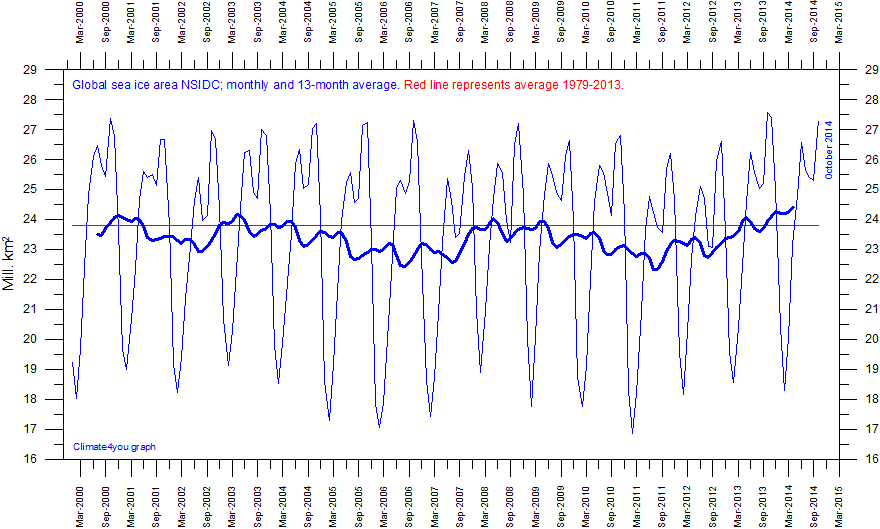
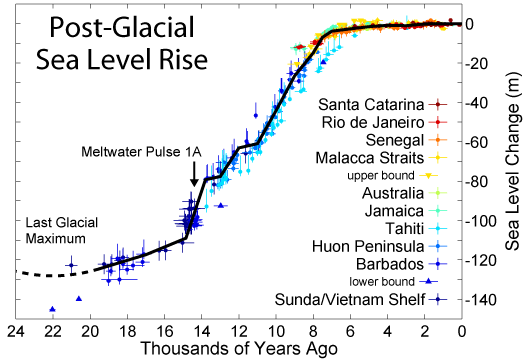
Ice is up, not down at both poles, while the Arctic goes up and down a but the Antarctic only increases much to the amazement of the the alarmists. Total sea ice has never gone down and is increasing presently to the point the seas are falling while the media claims or sometimes hints they're rising. Sea level was actually never rising abnormally, it's been 33,3cm/century for about 15,000 years. The gasses are methane and food for the microflora of the new tundra. We are coming out of an ice age and of course you can find thawing bits, it's just that there's more freezing bits than thawing bits by a large margin.
Sea ice.
Screenshot of the US National Snow and Ice Data Center graph of aggregate sea ice.
http://rs79.vrx.palo-alto.ca.u...South Sea Ice.
http://rs79.vrx.palo-alto.ca.u...So, the claims the "ice could be gone as early as 2015" (Gore 2009) are utterly specious; this really devalues the Nobel prize in my mind or his half of it anyway which is when he said this.
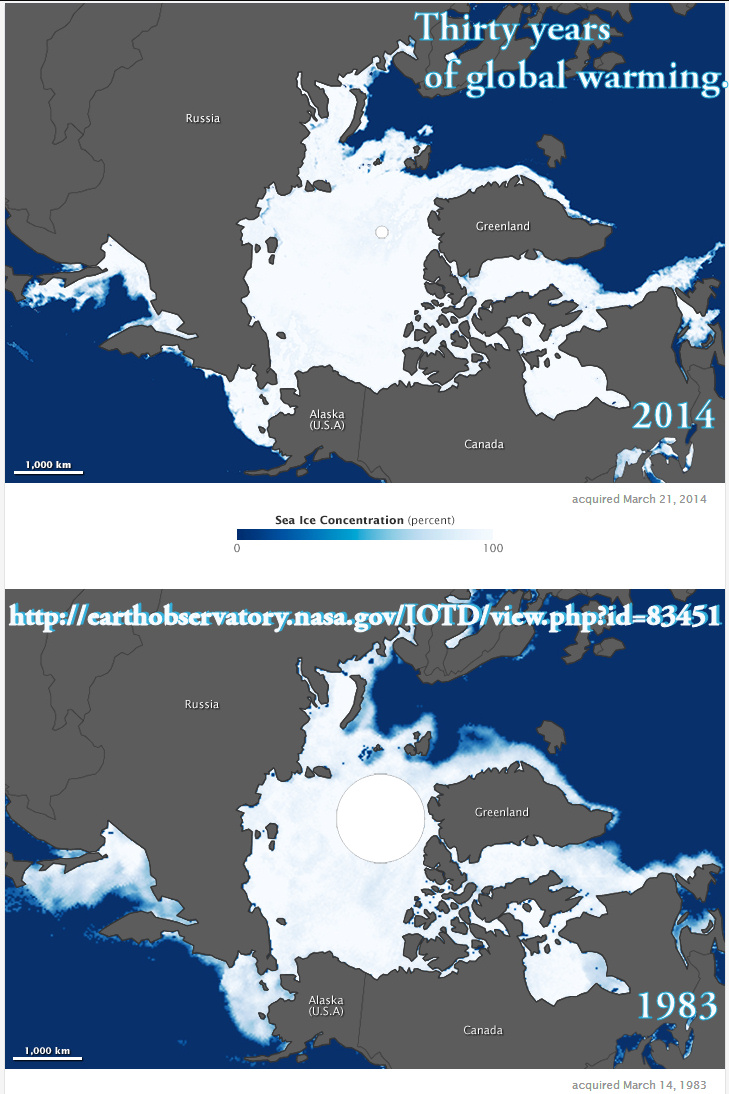
Anyway, the ice melt doesn't show up any graph. So let's look at the sat imagery NASA has at the pole.
http://rs79.vrx.palo-alto.ca.u...
Ok so it doesn't show up in NASA sat imagery either. What about maps?
Isn't it cool how you can get the story from a piece of the url? "arctic-sea-ice-gains-can-be-seen-on-new-government-map-of-canada"Anyway, Canada added ice to the marine navigation maps. The US doesn't have much arctic, Greenland has more I suspect, the rest Canada and Russia have. The Russians added ice to their maps too.
http://www.cbc.ca/news/technol...
So I dunno about this "melt" it doesn't show up maps, test instruments or sat imagery.
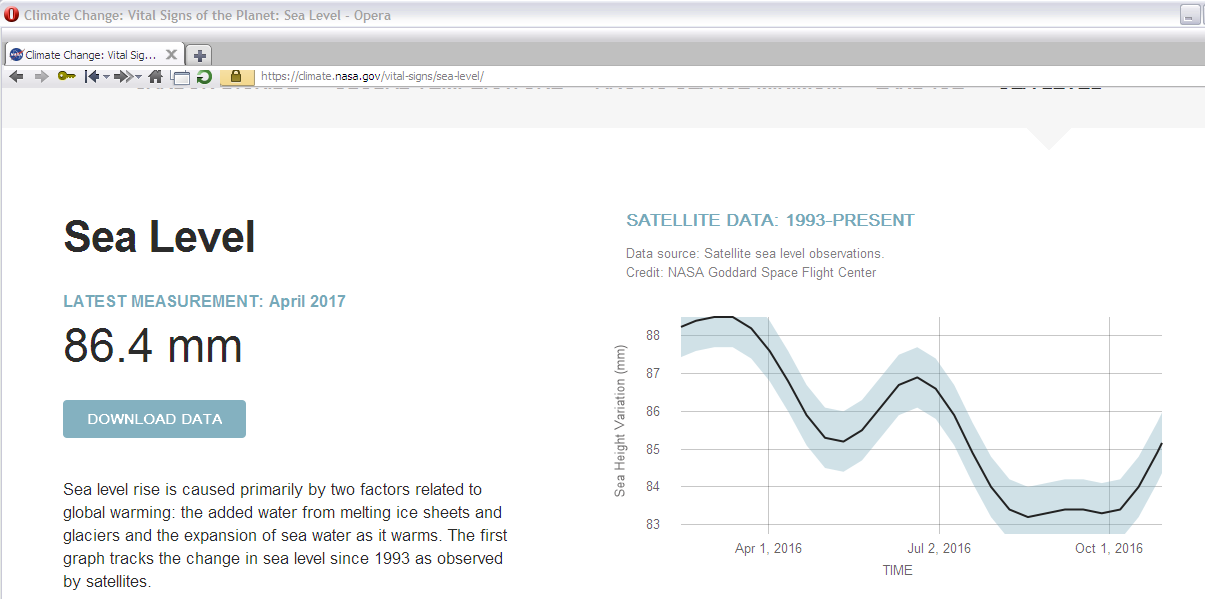
As I said, the sea levels are falling not rising if you believe NASA.
http://rs79.vrx.palo-alto.ca.u...Looks like sea level was pretty constant for th last 8000 years. Now seas have been falling for about 6 years. If they were supposed to rise abnormally I can't see where.
http://rs79.vrx.palo-alto.ca.u...
Here's the article in Nature from a few years ago. They figured if all this methane was coming up there would be an increase in carbon in the soil but there wasn't and they wrote up why they found out why: it's food for the emergent fora and fungi. Which makes sense, the plans and carbon all frozen together, why WOULD you have one wuthoutthe other. You freaky, nature.
"Fungi pull carbon into northern forest soils Organisms living on tree roots do lion’s share of sequestering carbon
"But scientists have not understood where exactly trees put their carbon. The issue becomes important when researchers build computer simulations that track carbon cycling."
https://www.sciencenews.org/ar..."Small 'hot spot' responsible for producing the largest concentration of the greenhouse gas methane seen over the United States"
"Nasa set to investigate unexplained hotspot over the 'four corners' intersection in Southwest
Small 'hot spot' responsible for producing the largest concentration of the greenhouse gas methane seen over the United States
Area near the Four Corners intersection of Arizona, Colorado, New Mexico and Utah covers 2,500 square miles
Hotspot predates widespread fracking in the area " -
Other sources
The original paper in Science: http://science.sciencemag.org/...
Space.com: https://www.space.com/41272-ma...
Science News: https://www.sciencenews.org/ar...
CNN: https://www.cnn.com/2018/07/25... -
Science News
There is also a summary here at Sciences News.
-
Re: Strange days indeed....
What are you talking about? Need a citation. The original bombs were inefficient and produced more radioactive material that was embedded into everything.
This would be an Hydrogen bomb. It would have less radioactive material to blanket everything.
You need to go live on Rongelap and make certain you live on only food grown there.
Your clean Hydrogen bomb the Castle Bravo test, was 15 megatons of pure nuclear orgasm. http://www.ctbto.org/specials/... It really didn't seem to be all that clean though After rendering Bikini and then Rongelap uninhabitable, and killing a sailor and sickening others on the ironically named Lucky Dragon when the radioactive plume drifted over them.
Bikini is going to be a long time uninhabitable. https://www.sciencenews.org/ar...
Rongelap? Perhaps if no one eats any food raised or grown there.
-
physicists stumped by second marriage
Second detectionDate: December 26, 2015
Mass of first black hole: 14.2 solar masses
Mass of second black hole: 7.5 solar masses
Merged mass: 20.8 solar massesThird detection
Date: January 4, 2017
Mass of first black hole: 31.2 solar masses
Mass of second black hole: 19.4 solar masses
Merged mass: 48.7 solar massesLIGO snags another set of gravitational waves
Astrophysicists don't fully understand how such big black holes could have formed. But now, "it seems that these are not so uncommon, so clearly there's a way to produce these massive black holes," says physicist Clifford Will of the University of Florida in Gainesville.
If it's such an insane miracle to get hitched in the first place, it couldn't conceivably happen again.
-
Re:p hacking
The paper is probably false, with a P value <
-
Gravity wave occasionally ok as Gravitational wave
While I agree it's usually best to use unambiguous terms among the public, apparently it's ok for physicists to sometimes use "gravity wave" in papers and casual conversation. See:
-
Re:Possible explanation
I recalled something on this too, so I did a little Googling. Turns out that a former Chair of the Astronomy Dept. at Boston University called Gerald S. Hawkins did indeed propose some theories based on designs found in crop circles. There's more than a little kookiness in the search results because a lot of the nature of the topic, not helped by some echos of Gödel Escher Bach with some musical connections in his findings, but there does appear to be some genuine math behind it - although it's questionable whether the perpetrators of the crop circles were just using trial and error or actually doing the math first. Basically, it all comes down to relationships between nested regular polygons that touch at each vertex or mid-point of an edge, e.g. a circle that touches all four corners of a square and so on. Euclid documented many of these, but Hawkins supposedly found a bunch of new variations that he (or anyone else) failed to find any evidence of past proofs for; it's hardly up there with Pythagoras' theorem, but they are genuine geometric theorems.
-
Re:It's the Science News Media's Fault
Science news is largely presented by reporters with journalism educations who don't have any background in the science they're coverin
The exception being, of course Science News, which I've subscribed to for over 30 years.
-
Re:What kind of pain will it work on?
Anyway, if you're not a smoker, pleeeaaase don't smoke it. Weed is a great gateway drug to the second most addictive drug there is (shared second place with crack cocaine, only topped by heroin): nicotine. Just get a vaporizer or make weed butter, space cake or marijuana milk. The big advantage of a vaporizer with a proper temperature control is that you can selectively vaporize different kinds of cannabinoids.
Please stop using the "gateway drug" crap...
http://reset.me/story/the-scie...The main reason why it could be considered a gateway drug is because the users gets exposed to other things from their dealer or the people they are smoking with.. The drug itself does not cause you to want other things more..
There are other things that should be used to deter people from smoking..
https://www.sciencenews.org/ar...Tell people the real effects it has... Not some propaganda that has been used for the last 30+ years to scare people away.
-
Re:Harm to the environment
Nuclear plants, when running normally, do not kill 28,000 birds a year
No, they kill hundreds of thousands. Which is at least a fraction of the millions killed by coal - and the hundreds of millions killed by glass windows, let alone cats.
most nuclear plants will never have an accident at all, much less one that harms the environment
True. Unfortunately, the few that do cause economic damage costing hundreds of billions.
Solar isn't perfect, but it's got a long way to go before it gets worse than our current alternatives.
-
Re:What about
"Between 365 million and 988 million birds die from crashing into windows in the United States each year, according to the latest estimate."
-
Re:Not the best plan.
Well, while I agree with you in principle, coffee is an outlier. After decades of trying to find the cloud to go with the silver lining researchers have been unable to find much evidence for serious harm from sustained heavy coffee usage. You won't get high blood pressure or ulcers; and far from causing cancer there is now solid evidence that coffee protects you from liver and pancreatic cancers.
As for the caffeine, the only serious issue still on the table is possibly higher miscarriage rates. Aside from that the negative effects of caffeine are minor: sleeplessness if taken too late, jitteriness if taken in unaccustomed amounts, withdrawal if you decide to go cold turkey. So don't go cold turkey, drink away and enjoy the benefits.
Now I've made lifestyle changes which have for the most part eliminated my craving for caffeine. Since there's diabetes in my family I've lost weight, increased exercise, and improved my diet. Consequently I don't need caffeine to power through my afternoon fog any more; I can take it or leave it. But the evidence for the health benefits of coffee are so overwhelming -- particularly for liver and pancreatic function -- that I've deliberately reintroduced heavy coffee drinking to my daily routine. I brew about 60-90 grams of grounds every day by various methods -- the equivalent of about 4-6 cups of drip coffee. If I have to skip I miss it, but because of the other changes I've made a day without coffee is not the brain-numbing torture it once would have been.
If Dr. Oz claimed that something does all the good things coffee does with so few drawbacks, I'd chalk it up to him being a lying bastard. But coffee's the real deal.
-
Re:Not the best plan.
Well, while I agree with you in principle, coffee is an outlier. After decades of trying to find the cloud to go with the silver lining researchers have been unable to find much evidence for serious harm from sustained heavy coffee usage. You won't get high blood pressure or ulcers; and far from causing cancer there is now solid evidence that coffee protects you from liver and pancreatic cancers.
As for the caffeine, the only serious issue still on the table is possibly higher miscarriage rates. Aside from that the negative effects of caffeine are minor: sleeplessness if taken too late, jitteriness if taken in unaccustomed amounts, withdrawal if you decide to go cold turkey. So don't go cold turkey, drink away and enjoy the benefits.
Now I've made lifestyle changes which have for the most part eliminated my craving for caffeine. Since there's diabetes in my family I've lost weight, increased exercise, and improved my diet. Consequently I don't need caffeine to power through my afternoon fog any more; I can take it or leave it. But the evidence for the health benefits of coffee are so overwhelming -- particularly for liver and pancreatic function -- that I've deliberately reintroduced heavy coffee drinking to my daily routine. I brew about 60-90 grams of grounds every day by various methods -- the equivalent of about 4-6 cups of drip coffee. If I have to skip I miss it, but because of the other changes I've made a day without coffee is not the brain-numbing torture it once would have been.
If Dr. Oz claimed that something does all the good things coffee does with so few drawbacks, I'd chalk it up to him being a lying bastard. But coffee's the real deal.
-
Re:even more weird
Science news seems to believe we can tell the difference of tens of milliseconds.
-
Re:Seven cent nickel?
Nice callback, but you should really link to the source.
Of course, if you want to minimize change (both the volume of coins changing hands per transaction, and the number of denominations replaced), you could just replace the dime with an 18-cent piece. As a bonus, this turns up natural selection pressure for people who are good at math.
-
Re:Same with the anti-nuke crowds
Just saw this article.
https://www.sciencenews.org/ar...
It's these types of advances that would have happened a lot sooner had the anti-nuke crowd not slowed things down so severely.
-
Re:If it works
You must go nuts at people who install windows in their houses because:
Windows may kill up to 988 million birds a year in the United States | Science NewsWell, do you? And what about cats and radio towers?
Wind turbines kill between 214,000 and 368,000 birds annually - a small fraction compared with the estimated 6.8 million fatalities from collisions with cell and radio towers and the 1.4 billion to 3.7 billion deaths from cats
Yes the world is a difficult place.
The big wind farms that I drive past are also the best location for
large soaring birds to get their lift before they fly out over the flatter
areas with good hunting So as correct as you are the big raptors suffer
from some installations out of measure.Closer to home I have noticed a hawk lurking in a tall tree to swoop down and
gobble doves. For dessert he has been observed grabbing a hummingbird on the wing. -
Re:If it works
You must go nuts at people who install windows in their houses because:
Windows may kill up to 988 million birds a year in the United States | Science NewsWell, do you? And what about cats and radio towers?
Wind turbines kill between 214,000 and 368,000 birds annually - a small fraction compared with the estimated 6.8 million fatalities from collisions with cell and radio towers and the 1.4 billion to 3.7 billion deaths from cats
-
Re:Energy use
Who cares? They are birds.
I'm not trying to troll; I really cannot understand why people are upset over a few dead birds. Nuclear kills fish. Coal kills everything. Nothing has a zero environmental impact. Is the benefit worth the cost? It seems like it is. Glass windows kill birds too. I'm not losing any sleep over it, except when they wake me up by flying into my windows.
-
Re:Enforcing pot laws is big business
Still further, Colorado is seeing the general effects of people being stoned, such as deaths,
This turns out to be hysterical misinterpretation of the evidence. If you follow that link back to the source, https://www.sciencenews.org/ar... you'll see what they really say is
The results offer just a “snapshot at the time we did the testing,” Thames says. They describe an association, not causation. “The question down the road is, what kind of implications does that have for everyday functioning?”
Scientists have largely failed to turn up compelling evidence that adult pot smokers risk permanent brain problems, Earleywine says. “Being stoned all the time is a strange way to live your life,” he says, but data just aren’t there to argue that a cannabis-fueled lifestyle is permanently harmful to the adult body and brain.
So far nobody has been able to supply any evidence (good enough to be published in a peer-reviewed journal) that marijuana is harmful.
A bigger problem than marijuana is a lack of the public understanding of science. These people don't understand what "evidence" is.
-
Jane/Lonny Eachus goes Sky Dragon Slayer
Feel free to cite the actual scientific papers predicting global cooling, as opposed to media hype about some speculation at the time. [david_thornley]
... the National Academy of Sciences itself was convinced enough of the "Global Cooling" scare to actually publish a call for immediate action (Science News, Jan. 25 1975, p. 52).
As for the mentioned announcement it is in THIS issue of Science News, in the article "NAS Warning On Climate Changes". Exactly as mentioned in the "Chilling Possibilities" article that is linked to in the page that I originally linked to, and EXACTLY as I stated it. The "NAS Warning On Climate Changes" article itself is behind a paywall. If it weren't, I would have linked to it directly. [Jane Q. Public, 2014-12-16]
Okay, so you read a blog which linked to an article which mentioned an announcement by the NAS. Then you responded to David Thornley's request for actual scientific papers predicting global cooling by saying "the NAS was convinced enough of the "Global Cooling" scare to actually publish a call for immediate action."
Did you ever think it might be educational to actually read that NAS report first-hand rather than relying on third-hand interpretations of interpretations? If you did, you'd discover that the 1975 NAS report (PDF) "Understanding Climate Change: A Program for Action" doesn't predict global cooling. Quite the opposite! Read their words:
"Of the two forms of pollution, the carbon dioxide increase is probably the more influential at the present time in changing temperatures near the earth's surface (Mitchell, 1973a)."
"The corresponding changes of mean atmospheric temperature due to CO2 [as calculated by Manabe (1971) on the assumption of constant relative humidity and fixed cloudiness] are about 0.3C per 10 percent change of CO2 and appear capable of accounting for only a fraction of the observed warming of the earth between 1880 and 1940. They could, however, conceivably aggregate to a further warming of about 0.5C between now and the end of the century."
How ironic! Instead of predicting global cooling, the NAS actually predicted "about 0.5C" of CO2-based warming between 1975 and 2000. To see how their prediction fared, let's plot HadCRUT4 over that timespan. The raw data shows warming of 0.47C from 1975 to 2000, which rounds up to 0.5C.
So that 1975 NAS report wasn't predicting global cooling! Its warming prediction was actually fairly accurate, and was certainly within the statistical uncertainties.
Again, that's probably why the National Academy of Science’s 1979 Charney report estimated climate sensitivity as 1.5C to 4.5C and said “If carbon dioxide continues to increase, [we] find no reason to doubt that climate changes will result, and no reason to believe that these changes will be negligible.”
While Jane tries to explain why that NAS report predicting about 0.5C of
-
Re:Jane/Lonny Eachus goes Sky Dragon Slayer
You linked to a blog and claimed it linked to an announcement in Science News
I did not. Try reading again.
I wrote that the article linked to on that page mentioned the announcement, references in Jan. 25 Science News. And it does; you can read it right there.
As for the mentioned announcement it is in THIS issue of Science News, in the article "NAS Warning On Climate Changes". Exactly as mentioned in the "Chilling Possibilities" article that is linked to in the page that I originally linked to, and EXACTLY as I stated it.
The "NAS Warning On Climate Changes" article itself is behind a paywall. If it weren't, I would have linked to it directly.
So I repeat: CEASE misrepresenting my words. I wrote exactly what I intended to write, and what I wrote has been demonstrated to be true.
Your distorted and inaccurate interpretation was not what I actually wrote, and I will thank you to stop doing that, once and for all. You have been warned many times. -
I agree
And, a pen and notebook cost me $2.00 - unless you splurge on those Moleskin things. The pen lasts for weeks, doesn't need recharging, if I lose it - I don't lose hundreds of dollars, no one will steal it, and I retain more information than if I used a computer.
And there's a personal tactile thing about wrting with a pen and paper - yes, I prefer printed books over electronic ones, too.
-
Re:How are microbes heritable?
Agreed, finding correlating microbes in the guts of twins does not seem to prove genetic causality, if the twins grew up in the same family and same environment. Since we know that the microbes can be passed between mammals via fecal matter ( https://www.sciencenews.org/ar... ) and identical twins are likely exposed to the same traces of fecal matter, I don't see how they have proven genetic causality. The study is behind a paywall unfortunately.
Good god. RTFS. You don't even have to bother with the Article, just read the few Summary sentences right up there at the top of the page:
The abundances of specific types of microbes were found to be more similar in identical twins, who share 100 per cent of their genes, than in non-identical twins, who share on average only half of the genes that vary between people. These findings demonstrate that genes influence the composition of gut microbes.
If identical twins and non-identical twins both share the environment with each other and identical twin's gut microbes are significantly more similar, then it certainly suggests that genetics are involved. It doesn't prove it - maybe identical twins share the environment more closely, such as being more likely to share a bed room - but it is definitely a plausible hypothesis which can be further investigated.
-
Re:How are microbes heritable?
Agreed, finding correlating microbes in the guts of twins does not seem to prove genetic causality, if the twins grew up in the same family and same environment. Since we know that the microbes can be passed between mammals via fecal matter ( https://www.sciencenews.org/ar... ) and identical twins are likely exposed to the same traces of fecal matter, I don't see how they have proven genetic causality. The study is behind a paywall unfortunately.
-
Re:as the birds go
Turbines kill an insignificant number of birds by comparison with Windows.
We need to get rid of Windows. Who knew?
https://www.sciencenews.org/ar...
How many birds does BSD or OS X kill?
-
Re:as the birds go
Turbines kill an insignificant number of birds by comparison with Windows. We need to get rid of Windows. Who knew? https://www.sciencenews.org/ar...
-
Kill the outdoor cats first
First, kill all the outdoor cats. Once the bird population recovers we can go after the power plants.
-
Re:Agreed.Sorry. The existence of Lendulus Batiatus is an historicla fact such as the existence of Marcus Linius Crassus, Rameses III and Napeoleon Bonaparte.
The existence of a guy called Jesus is an historical plausibility. There are no birth certificates, no first hand evidence (he did not write anything nor build anything) no evidence of his death, only third hand and indirect references that may even be of very different persons.
The only thing known is that there was a lot of religious violence in the Israeli region and that a sect appeared that called themselves "Christians" somewhere in Egypt, Greece or Rome between some decades and a couple of centuries after the alleged dead of their guru. That's a bit fuzzy for an "historical fact" in a time when there actually was a discipline called history.
Now to your "theory"... if something has been observed in laboratory... what else does t need to be a "fact"? Do you know that Einstein's relativity has not only been proven many times "officially" but also needs to be counted with in GPS satelli ? So, is it a fact or not?
is Avian Flu a fact or not? Are resistant infections and plagues facts or just theories? Is this fact or just theory?
Or maybe in your universe only the equation 2+2=4 is called "fact".
BTW, I do NOT believe in Darwinian evolution.
-
Re:Where does 7 feet of water come from?
The west Antarctic Ice Sheet is past the point of no return and will collapse. Antarctic glacier melt is unstoppable.
That will give you seven feet alone. In time it will give about 13.
But Greenland ice sheet is losing mass too, as are glaciers on the less icy continents. -
Re:Frequent hurricanes?
You probably should read this book.
Or this: http://fivethirtyeight.com/fea...
-
Re:Frequent hurricanes?
You probably should read this book.
-
Dupe
A year ago almost to the day a very similar question was discussed here: http://ask.slashdot.org/story/... But I'll respond the same way I did there: Science News!
-
US science literacy generally better than EU
People have actually looked at overall scientific literacy in the US, and it compares favorably to the EU (and the rest of the world):
Jon Miller of Michigan State University reported the numbers at the American Association for the Advancement of Science annual meeting, this afternoon, during a session on civic science literacy assessments around the world. The new U.S. rate, based on questionnaires administered in 2008, is seven percentage points behind Sweden, the only European nation to exceed the Americans. The U.S. figure is slightly higher than that for Denmark, Finland, Norway and the Netherlands. And it’s double the 2005 rate in the United Kingdom (and the collective rate for the European Union).
https://www.sciencenews.org/bl...
Of course, it would be nice if scientific literacy were higher everywhere, including the US.
-
Re:Gold Standard?
To be fair, the reason (credible) researchers go to great lengths to control all possible influences except the one under study is because of the binary nature of P.
Other than that nit-pick - Nice post (and your sig makes more sense now -
Re:Some fixtures need incandescent
-
hardly different in Europe
Before the gloating sets in, you have to put these numbers into perspective: a significant fraction of Europeans also do not believe in evolution; here is data from the UK:
http://www.theguardian.com/science/2009/feb/01/evolution-darwin-survey-creationism
In addition, although scientific literacy is low in both Europe and the US, American adults are generally better informed on science than European adults:
https://www.sciencenews.org/blog/science-public/science-literacy-us-college-courses-really-count
-
Re:Time for some really new physics
Although there has long been a connection between math and physics, as people dig further into the math they are finding some unexpected things, and ways to better understand, simplify, or extend the equations.
Mathematicians Link Knot Theory to Physics
A Jewel at the Heart of Quantum PhysicsThere are a number of seemingly promising developments out there that are sharpening the investigative tools as well as providing interesting new lines of investigation, as well as new data to chew on.
Spooky Connection: Wormholes and the Quantum World
Physicists Create Quantum Link Between Photons That Don't Exist at the Same Time
Schrodinger’s ‘Kitten’? Large-Scale Quantum Entanglement Achieved By Two Physics LabsString theorists squeeze nine dimensions into three
New work gives credence to theory of universe as a hologramNow we are developing a growing understanding of the interplay between biology and physics.
Quantum biology: Do weird physics effects abound in nature?
Who knows where things may lead next? Of course people should be careful in performing experiments.
-
Re:The truth is
You're still leaving out details, though. What other effects could there be? (Bleach also has anti-microbial properties, and even ignoring the effect on taste I'd still prefer to add herbs to bleach.) How does either anti-microbial agent break down in the stomach, or, if they don't, affect our gut bacteria? (Could you pass the penicillin?)
Very valid points. One could imagine that the symbiotic relation we have with our gut bacteria has evolved both us, our friendly gut bacteria strains and our friendly bacteriophages ( http://www.sciencenews.org/view/generic/id/350573/description/Viruses_and_mucus_team_up_to_ward_off_bacteria| ) to adapt to the diet we've always generally had. General antibiotics obviously kill off more than is good for us and to be honest: who knows which strains of bacteria are affected by any 'antimicrobial' additive?
Thinking about it now, it's obvious: the term 'antimicrobial' is just way too broad to base a classification of good or bad on for a herb/additive. It seems I'm half guilty of doing what started this discussion in the first placeOn the other hand, one could make the case for the antimicrobial effects of additives outside the body. F.i.: adding a lot of pepper to a dish helps kill off a plethora of bacteria before you eat the dish, but it will also kill friendly gut bacteria after having been ingested. Considering that the distribution of different bacteria strains in the food is very probably skewed towards unfriendly bacteria and the distribution of gut bacteria towards friendly bacteria, the net effect of the killing would be positive.
If this has any truth to it, the best thing to do (from an antimicrobial point of view) would be to douse food in herbs, spices etc and remove them before ingestion. Not a good idea from a phytonutrient/vitamin/mineral point of view, of course.It does look like I have to acquiesce that I'm standing on shaky ground on this general idea. However, I have found some evidence that some vitamin or mineral deficiencies can affect dietary preference for supplemented feed in rats [nih.gov], sheep [nih.gov], and hens [nih.gov]. While this behavior may not represent a "craving" as addressed by the above articles you linked to, it does support the idea that food selection can be driven by nutritional need. Now, all I need to do is ask those researchers to repeat the experiments when sugar was added to all of the tested feeds. I'll get back to you on that one...
That is pretty solid evidence, right there. Now I'm interested in the sugar experiment as well
just that there are perceptual differences that can occur due to a sufficiency or deficiency of various nutrients via their action in all systems in the body, and that if there's a signal, the brain will learn to use it.
True, though a question that rises is: how much training material does it need and how good is it at linking (back-propagating) feelings of (dis)comfort to the input signals? If a nutrient deficiency only has long-term effects such as increased risk of certain types of cancer, the only mechanism I see incorporating a response to that deficiency in our bodies is good old natural selection.
Of course, your point does hold for deficiencies with short-term effects (as the animal research showed).
Overall, the results imply that mixture suppression favors perception of sweet carbohydrates in foods at the expense of other potentially harmful ingredients, such as high levels of sodium (saltiness) and potential poisons or spoilage (bitterness and sourness).
See? I told you sugar was evil
Silly me, I focused on the effect of salt on sweetness and forgot to think about the effect of sugar on saltiness
-
Where are all the dead birds?
So if these avian flu strains are so virulent and deadly, why aren't we seeing dead birds everywhere? Maybe because the mutations that make the virus airborne also reduce its affinity for avian receptors. http://www.sciencenews.org/view/generic/id/349926/description/Mutation_makes_H5N1_flu_lose_its_grip . So now interest in H5N1 is waning we need find a new strain of avian flu to scare up some juicy research grants. Queue H7N9.
-
Other serious consequences
It isn't just the immune system that it affects. It has been shown to decrease muscle strength--including the heart. It also readily reacts with the chlorine in household tap water to form chloroform, a recognized carcinogen.
-
Re:No. Bad Conclusion. Bad.
Oh no. Not ENCODE junk again.
ENCODE detected that at some point in the life of cell about 80% of DNA was translated into RNA. That doesn't mean it's functional in any way - it's just transcribed. Also, I'd like to see your source for the 50% evolutionary conservation of junk DNA - the top estimate is about 15% of the whole genome ( http://www.sciencenews.org/view/generic/id/349505/description/Reports_of_junk_DNAs_demise_were_based_on_junky_logic_and_dubious_definitions ). -
Re:This is what happens ...You really need to educate yourself with fracking before you start with the talking points.
First, the people who claimed that their "flammable tap water" started happening ONLY when they began fracking have not necessarily been honest. In the past, these same people reported that their water was flammable, many years prior to fracking ever occuring in Pennsylvania.
Take a look at some news sources that attempt to remove the bias, such as Science NewsNewly fracked gas wells could also be intersecting with old, abandoned gas or oil wells, allowing methane from those sites to migrate. "We've punched holes in the ground in Pennsylvania for 150 years," Jackson says. Many old wells have not been shut down properly, he says. "You find ones that people plugged with a tree stump." In some places in Pennsylvania, West Virginia and elsewhere (especially those with existing coal beds), methane turned up in well water long before hydraulic fracturing became widespread.
Any place sitting on top of the Marcellus Shale has a chance for hydrocarbons to rise through layers of sediment related to the old wells that were drilled there. Remember that Pennsylvania was the "oil center of the world" in the late 1800's.
Could fracking play a part in methane increases due to the multitude of old wells that were drilled in Pennsylvania a long time ago? Possibly. Could fracking play a part in methane increases in homes in "new plays" located in North Dakota? Highly unlikely.
Second, when you frac 15k feet below the surface, you might fracture rock up to a half mile up or down (and I'm being generous). So if you're fracking horizontally, you'll induce fractures that can travel anywhere from 12.5k to 17.5k feet below the earth. You know where the LOWEST aquafer's are located? (and again, I'm being generous) Around 1000 ft below the surface.
Do you think frac operations use too much water? That's a legitimate concern.
Do you think frac operations could do better and treating and disposing waste water? That's a legitimate concern.
Do you think frac operations pump toxic chemicals below the ground? Then you should really check your fact sources.
Do you think frac operations have "secret chemicals" that they put in the water, and they won't tell us what they are? Then you should really check your fact sources. Go to any major service company's website (Halliburton, Schlumberger, etc) and search for "what's in frac water?"
Do you think frac operations cause natural gas to seep into aquifers? It's a concern, but you really need to check your fact sources, and take into account several factors before drawing conclusions. -
Science News!
As in http://www.sciencenews.org/ (but my dad and I share a print subscription). Been reading it cover-to-cover for the past 17 years at least...
-
80 not 100
"80 million years older than previously thought." http://www.sciencenews.org/view/generic/id/349098/description/Universe_is_a_teeny_bit_older_than_thought
-
Re:If by "news media" you mean mainstream media...
Interesting, list doesn't include APR, Science, Nature, or any of the science outlets.
Just the MSM, which all get their news from 1-2 sources.
Let's take a look:
APR: what's "APR"? Applied Physics Reviews? Applied Physics Research? The former African Physics Review, now the African Review of Physics?
Science: Higgs Boson Positively Identified
Nature: No story I could find specifically about the Higgs boson, just the "Seven days: 8–14 March 2013" column, which mentions it in an item ("The new particle discovered last year at CERN’s Large Hadron Collider outside Geneva continues to behave just like the Higgs boson predicted by the standard model of particle physics, according to results presented last week at a conference in La Thuile, Italy. The latest data indicate that the boson decays into leptons as predicted, and also dampen earlier hints that the boson decays into pairs of photons more often than the standard model allows. No evidence yet points to theories beyond the standard model, such as supersymmetry (see Nature 491, 505–506; 2012).")
and various science outlets:
Science News: nothing at present
LiveScience: Confirmed! Newfound Particle Is a Higgs Boson
Phys.org: Now confident: CERN physicists say new particle is Higgs boson (Update 3)
and some random organization called "CERN" or something such as that: New results indicate that new particle is a Higgs boson
So a list that does include Science, Nature, and some science outlets does have some articles and, not surprisingly, they largely don't have the "God particle" stuff in the headline.
-
Re:Functional?
It's already long known that a lot of the seeing is done in the brain. When someone draws something on your hand or other part of the body you can still "see it" even if you are blindfolded. The resolution is just isn't as good. Humans can learn to see with their tongues: http://www.sciencenews.org/view/feature/id/1946/description/The_Seeing_Tongue
They can also see with sound - either echolocation or pitch vs left-right volume. https://www.youtube.com/watch?v=qLziFMF4DHA
http://www.seeingwithsound.com/This transplant experiment isn't very useful in my opinion. Yeah it shows that if you grow an eye on a different spot on a tadpole it can sometimes kind of work. But how useful is that? The artificial eye experiments on humans are far more useful.